http://www.ijabjass.org
Design and Implementation of Network Operational
Management Systems for Integrated and Automated
Management of LANs and WANs
AHMED MATEEN,SALMAN AFSAR AND ALEXY KORBATOV†
Department of Computer Science, University of Agriculture, Faisalabad–38040, Pakistan †Ji-Soft, Kiev, Ukrine
ABSTRACT
This research includes an integrated network management architecture that can simultaneously manage both LANs (Local Area Network) and WANs (Wide Area Network) with either a standard or proprietary network management. The features of the proposed architecture are analyzed in comparison with integrated architecture and common platform architecture. The design and implementation of integrated and automated network/service management platforms that can seamlessly configure services, monitor service/network performance, and detect network faults are of great importance and interest to the service and network providers. It also includes networks supporting services and applications that require high availability and reliability as well as fast reconstitution time, in the event of failures.
Key Words: Network interoperability; Enhanced network/service management; Automated network
INTRODUCTION
Recently, there has been increasing research activities in the area of network management in an effort to produce effective maintenance of both LANs (local area networks) and WANs (wide area networks) that include a proliferation of networks and associated equipment supporting various communication services.
The IETF (Internet Engineering Task Force) has recommended SNMP (Simple Network Management Protocol) as the standard network management protocol for LANs, because SNMP is a simple management procedure and it is used frequently on the Internet. It has been recommended by the ISO as the standard network management protocol for WANs. However, until now most management systems use the proprietary network management protocol that is supplied by the associated equipment vendors to maintain existing WANs. Therefore, to maintain an existing WAN and LAN, it is necessary to either update an existing network management system and the associated equipment using a standard network management protocol or develop an integrated network management system (Terplan, 1992).
In heterogeneous networks with a variety of systems of many kinds, the activity of network maintenance and supervision is a difficult task involving a large number of operators with a diversity of skills. In such environment the time to diagnose network problems and correct faults usually is high and subject to many errors, due to the fact that traditionally most of network management activities have been performed with direct human involvement (Aidarous et al., 1990). However, the network becomes
increasingly large, these activities as they become more demanding and data intensive. When performed with extensive and direct human involvement, present some limitations: complexity, difficulty in the operation of network management systems, errors in the process of alarm filtering and identification of the affected elements and resources, etc. For these reasons the automation of network management has become of great importance and interest to the service and network providers, as it provides for improved quality of service offered to the customers, while at the same time minimizes potential human errors and reduces network operational costs. This research is aimed at studying the integrated network management architecture that can simultaneously manage both LANs (Local Area Network) and WANs (Wide Area Network).
MATERIALS AND METHODS
Generic network model. In wide-area electronic commerce communication services and applications two types of provider are usually involved in order to complete the end-to-end service offering: the Service Provider and the Network Provider (Veeraraghavan, 1993). The first is responsible for the definition of the service characteristics and the maintenance of the customer premises equipment, while the latter provides the network infrastructure (i.e. high-speed network) used by the end users and the Service Provider. The Network Provider relieves the other parties involved in that arrangement of the cost and effort of network management by reducing labor cost and capital investment. In this situation the Service Provider is essentially a Customer of the Network Provider, while the
Service Provider provides the service to its own customers or end users (usually multiple customers with small to medium size). Note that it is possible for the functions of Service Providers and Network Providers to be offered by the same provider or organization. It should be noted here that in general the providers could be either national or regional providers depending on the geographical coverage that they provide. Providers that have Point of Presence (POP) throughout a country are called national providers while providers that cover specific regions are called regional providers and connect themselves to other providers at one or more points. All service provider networks may exchange traffic only at the Network Access Points (Aidarous & Pleyak, 1994). The primary intention of the work presented here is to provide an enhanced network/service management model that deals with methods of providing a view of network events with higher granularity and analyses the impact due to those events, and not to address issues related with network interoperability. However, we present a method that is incorporated in our enhanced network model to address the impact of faults originated within network elements that are either not monitored at all (i.e. special cases of customer premises equipment) or are outside the jurisdiction of the network provider. Therefore, for the sake of simplicity and without loss of any of the paper’s objectives, throughout we do not distinguish between national and regional providers and we use the terms network and service providers with their loose definition as provided in the beginning of this section. Integrated network management architecture. Previous representative integrated network management architectures can be classified into two types: manager-of-managers or common platform. Manager-of-managers architecture is an upper and lower network management system that is layered vertically. The upper network management system collects and processes all the management information from each of the lower network management systems. These upper and lower network management systems transfer the management information using a standard protocol (Terplan, 1997). This architecture is used by NetView from IBM, and ACCUMASTER Integrator and UNMA (Unified Network Management Architecture) from AT&T etc. In common platform architecture, network management systems do not exist in each communication network. Instead, all network resources are managed using an API (Application Program Interface). All of the network equipment uses a standard network management protocol, management information, and interface. This architecture is used by EMA (Enterprise Management Architecture) from DEC, SunNet Manager from SUN, and Open View from Hewlett-Packard, etc.
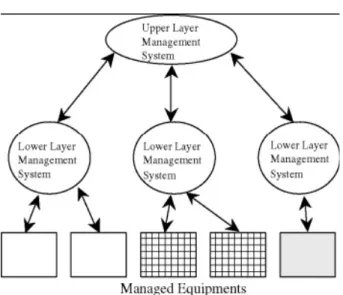
Fig. 1 represents the manager-of-managers architecture that integrates a number of network management systems. The management information is collected and processed by the lower network management system and is then concentrated in the upper network
management system. Only a standard interface is required to connect the upper and lower network management systems and it has the merit that it can integrate an entire network
Fig. 1. Manager-of-managers architecture
Fig. 2. Common platform architecture
Fig. 3. Implementation environment of the integrated network management system
management system in the short term. It should be noted, however, that since many lower network management systems depend on various kinds of networks, upper and lower network management systems need to be updated whenever a new network is inserted. Furthermore, additional hardware and communication circuits are needed for the upper network management system. If the upper network management system suffers a temporary congestion, this raises a significant problem for maintenance of the entire network.
RESULTS
Development of Integrated Network management system. So far, most network management systems employed in LANs and WANs have been separately developed. Recently, SNMP has been widely used as a standard network management protocol to manage LAN resources. The proprietary management protocol supported by the device manufacturer is used to manage WAN resources, and only a few devices support CMIP as the standard protocol. Under these circumstances, there is a need for integrated network management to efficiently construct and simultaneously maintain both LANs and WANs. Accordingly, a network management system using the proposed network management architecture has been developed to integrate the management of LANs and WANs.
Development procedure. The integrated network management system that can manage both LANs and WANs was developed on a hardware platform for stable development and efficient investment. Software engineering methods were applied to the development procedure including requirements analysis, design, and programming, test, and implementation steps. Most important, at the user’s requirements analysis step, the requirements are arranged and a possible implementation environment is proposed. All associated equipment and communication lines are also managed (Fig. 2). From among the OSI network management functions, the main support is given to the configuration management function, performance management function, fault management function, and security management function. The other requirements are integrated in order to manage both LANs and WANs, and produce a convenient user interface. A workstation is used as a hardware platform to satisfy the user’s requirements. UNIX and C language is used as the operating system and development program.
A Data Base Management System is used to store the management information and associated data. TCP/IP protocol and ETHERNET are used to collect the management information in a LAN, and a transmission line is used in a WAN (Canny, 1986). Fig. 3 shows the implementation environment of the integrated network management system. At the design step, the integrated network management system is designed to satisfy the user’s requirements and implementation environment. To satisfy the integrated management requirement of LANs and WANs, LAN and WAN managers are used as the lower layer managers of the proposed integrated network management architecture. For the convenience of users, various graphic functions and Fonts are supported based on a menu-driven method.
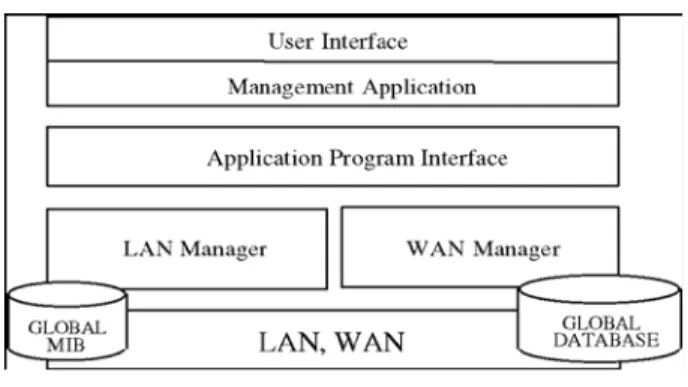
Design and implementation. The network management system managing the LAN and WAN includes LAN and WAN managers as lower layer managers. The LAN manager collects management information about the Fig. 4. Configuration of the integrated network
management system
equipment, terminals, and transmission lines in the standard SNMP protocol used by the LAN. The WAN manager collects management information about the communication devices using a proprietary network management protocol. Two lower layer managers store the management information and transfer it to the application program interface. The application program interface connects the LAN and WAN managers, and transfers the management information to the integrated management application in an integrated form. The integrated management application can then manage both LANs and WANs, and support various management functions for users (Fig. 4). Here, management application implies the management functions such as configuration management, performance management, fault management, and security management. Management information is divided into real-time and non-real-time management information. Real-time management information includes information such as heavy or light fault information and partial performance information. It is quickly supplied to the user’s display. Non-real-time management information includes component information from the networks, performance information, accumulated fault information, and log information collected over a long period of time. It is stored in the database and supplied to the user if necessary.
Network management. Fig. 5 illustrates that the network is available to its users and customers and the elements within the network components are functioning properly and according to specified requirements various operations-support tools, algorithms and methodologies are implemented to perform real-time (or close to real-time) monitoring and management functions. Network management includes trouble management, which initiates corrective actions for service and fault recovery, and proactive maintenance which may provide capabilities for self-healing. Trouble management correlates alarms to services and resources, initiates tests, performs diagnostics to isolate faults, triggers service restoral, and performs activities necessary to repair the diagnosed fault. Proactive maintenance responds to near-fault conditions that degrade system reliability and may eventually result in an impact on services. It tries to detect and/or correct network problems before service troubles are reported and well before the service or the network performance is considerably degraded.
Network management architecture. The network management architecture for supporting the model described in the previous subsection is depicted in Fig. 6. The architecture is based on a client/server model. The central management system and the clients reside in the Fig. 6. Network management architecture
NOC. The element management systems which gather data on the health of different sets of network elements are connected to the network management server via a communication server box. The communication server converts the incoming data stream to the appropriate format to be exported to the network management server (i.e. incoming ASCII information into TCP/IP). The database server provides the necessary information on the network assets, inventory assignments of network elements and circuits, network and customer provisioning data, customer profile and reference information etc.
CONCLUSIONS
This research has proposed integrated network management architecture for managing heterogeneous networks using an application program interface and lower layer manager. The proposed architecture can accept the existing networks of management systems. Also, an integrated network management system was designed and implemented that could manage both LANs and WANs using SNMP and a proprietary network management protocol according to the software development procedure. The implemented integrated network management system
can support a unified user interface on a hardware platform and manage both LANs and WANs. In future work, a complete integrated network management system that can unify management information and adapt all associated equipment to a standard network management protocol will be developed.
REFERENCES
Aidarous, S., D.A. Prooudfoot and X.N. Dam, 1990. Service management in intelligent networks. IEEE Network Mag., 4: 43–51
Aidarous, S. and T. Pleyak, 1994. Telecommunications Network Management into the 21st Century. IEEE Press, New York
Canny, J.F., 1986. A Computational Approach to Edge Detaction. IEEE Transactions on Pattern Analysis and Machine Intelligence, 8: 679– 98
Terplan, K., 1992. Communication Networks Management. 2nd Ed. Prentice
Hall, Englewood Cliffs, NJ.
Terplan, K., 1997. Global area network management. IEEE/ACM Transactions on Networking, 5: 26–33
Veeraraghavan, M., 1993. Coverage modeling for the design of new work management procedures. Network Management and Control, Plenum, 2: 53–65