Eng R. L. Nkumbwa MSc, MBA, BEng, MIET, MEIZ, REng. Copperbelt University - 2010
Why Study Engineering Management?
Eng R. L. Nkumbwa MSc, MBA, BEng, MIET, MEIZ, REng. Copperbelt University - 2010 Why Study Engineering Management?
The better you can work with people, the more successful you will be in both your personal and your professional lives.
Employers want to hire employees who can participate in managing the firm.
Even non-managers (Individual Contributors) are being trained to perform management functions.
The study of management builds the skills needed in today’s workplace to succeed in:
Becoming a partner in managing your organization through participative management Working in a team and sharing in decision making and other management tasks. The study of management also applies directly to your personal life in helping you to:
Communicate with and interact with people every day.
Make personal plans and decisions, set goals, prioritize what you will do, and get others to do things for you.
Society Needs Leaders and Team Players
Be Successful in our Community, Religious, Social, Professional, Recreational and Other Organizations.
Become Leaders for a ―Just and Humane World‖ Who is a Manager?
The individual responsible for achieving organizational objectives through efficient and effective utilization of resources.
The Manager’s Resources
Human, financial, physical, informational and knowledge Performance
Means of evaluating how effectively and efficiently managers use resources to achieve objectives.
Today often means ―How‖ as well as ―What‖ Management Qualities
Integrity, industriousness, and the ability to get along with people Management Skills
Technical
Human and communication (Teaming) Conceptual and decision-making skills
Eng R. L. Nkumbwa MSc, MBA, BEng, MIET, MEIZ, REng. Copperbelt University - 2010
Eng R. L. Nkumbwa MSc, MBA, BEng, MIET, MEIZ, REng. Copperbelt University - 2010 1.0 Management and Organizations
In today's tough and uncertain economy, a company needs strong managers to lead its staff toward accomplishing business goals. But managers are more than just leaders — they're problem solvers, cheerleaders, and planners as well. And managers don't come in one-size-fits-all shapes or forms. Managers fulfill many roles and have many different responsibilities at each level of management within an organization.
So, what is Management?
We typically think of managers as bosses – as people who supervise others by the use of force or because of organizational structure, rules, or procedure. But our perspective now is on what managers should be, which in the right situations make them also leaders. Henry Mintzberg explains on what management should be about:
“Management is not about controlling people but about facilitating human collaboration.”
Kotter says management too often is about coping with complexity: Focuses on details, order and consistency.
Focuses on short-term results. Focuses on eliminating risks.
Focuses on efficiency and bottom-line values. Focuses on things and stuff, not people. While Peter Drucker outlines that Management is,
“The skill of getting results with the cooperation of other people.”
Organizations abound in today's society. Groups of individuals constantly join forces to accomplish common goals. Sometimes the goals of these organizations are for profit, such as franchise restaurant chains or clothing retailers. Other times, the goals are more altruistic, such as nonprofit churches or public schools. But no matter what their aims, all these organizations share two things in common: They're made up of people, and certain individuals are in charge of these people.
Managers appear in every organization — at least in organizations that want to succeed. These individuals have the sometimes-unenviable task of making decisions, solving difficult problems, setting goals, planning strategies, and rallying individuals. And those are just a few of their responsibilities! To be exact, managers administer and coordinate resources effectively and efficiently to achieve the goals of an organization. In essence, managers get the job done through other people.
Eng R. L. Nkumbwa MSc, MBA, BEng, MIET, MEIZ, REng. Copperbelt University - 2010 The Intricacies of Management
No matter what type of organization they work in, managers are generally responsible for a group of individuals' performance. As leaders, managers must encourage this group to reach common business goals, such as bringing a new product to market in a timely fashion. To accomplish these goals, managers not only use their human resources, but they also take advantage of various material resources as well, such as technology. Think of a team, for example. A manager may be in charge of a certain department whose task it is to develop a new product. The manager needs to coordinate the efforts of his department's team members, as well as give them the material tools they need to accomplish the job well. If the team fails, ultimately it is the manager who shoulders the responsibility.
Levels of Management
Two leaders may serve as managers within the same company but have very different titles and purposes. Large organizations, in particular, may break down management into different levels because so many more people need to be managed. Typical management levels fall into the following categories:
Top level: Managers at this level ensure that major performance objectives are established and accomplished. Common job titles for top managers include chief executive officer (CEO), chief operating officer (COO), president, and vice president. These senior managers are considered executives, responsible for the performance of an organization as a whole or for one of its significant parts. When you think of a top-level manager, think of someone like Dave Thomas of the fast-food franchise Wendy's. Although John T. Schuessler was elected CEO in 2000, Dave Thomas was the founder
Eng R. L. Nkumbwa MSc, MBA, BEng, MIET, MEIZ, REng. Copperbelt University - 2010 and served as the chairman of the board. He was the well-known spokesperson for the chain, until his death in 2002.
Middle level: Middle managers report to top managers and are in charge of relatively large departments or divisions consisting of several smaller units. Examples of middle managers include clinic directors in hospitals; deans in universities; and division managers, plant managers, and branch sales managers in businesses. Middle managers develop and implement action plans consistent with company objectives, such as increasing market presence.
Low level: The initial management job that most people attain is typically a first-line management position, such as a team leader or supervisor — a person in charge of smaller work units composed of hands-on workers. Job titles for these first-line managers vary greatly, but include such designations as department head, group leader, and unit leader. First-line managers ensure that their work teams or units meet performance objectives, such as producing a set number of items at a given quality, that are consistent with the plans of middle and top management.
Eng R. L. Nkumbwa MSc, MBA, BEng, MIET, MEIZ, REng. Copperbelt University - 2010
Functions of Managers
Eng R. L. Nkumbwa MSc, MBA, BEng, MIET, MEIZ, REng. Copperbelt University - 2010 2.0 Functions of Managers
Managers just don't go out and haphazardly perform their responsibilities. Good managers discover how to master five basic functions: planning, organizing, staffing, leading, and controlling.
Planning: This step involves mapping out exactly how to achieve a particular goal. Say, for example, that the organization's goal is to improve company sales. The manager first needs to decide which steps are necessary to accomplish that goal. These steps may include increasing advertising, inventory, and sales staff. These necessary steps are developed into a plan. When the plan is in place, the manager can follow it to accomplish the goal of improving company sales.
Organizing: After a plan is in place, a manager needs to organize her team and materials according to her plan. Assigning work and granting authority are two important elements of organizing.
Staffing: After a manager discerns his area's needs, he may decide to beef up his staffing by recruiting, selecting, training, and developing employees. A manager in a large organization often works with the company's human resources department to accomplish this goal.
Leading: A manager needs to do more than just plan, organize, and staff her team to achieve a goal. She must also lead. Leading involves motivating, communicating, guiding, and encouraging. It requires the manager to coach, assist, and problem solve with employees.
Controlling: After the other elements are in place, a manager's job is not finished. He needs to continuously check results against goals and take any corrective actions necessary to make sure that his area's plans remain on track.
All managers at all levels of every organization perform these functions, but the amount of time a manager spends on each one depends on both the level of management and the specific organization.
Roles Performed by Managers
A manager wears many hats. Not only is a manager, a team leader, but he or she is also a planner, organizer, cheerleader, coach, problem solver, and decision maker — all rolled into one. And these are just a few of a manager's roles. In addition, managers' schedules are usually jam-packed. Whether they're busy with employee meetings, unexpected problems, or strategy sessions, managers often find little spare time on their calendars. (And that doesn't even include responding to e-mail!)
Eng R. L. Nkumbwa MSc, MBA, BEng, MIET, MEIZ, REng. Copperbelt University - 2010 In his classic book, The Nature of Managerial Work, Henry Mintzberg describes a set of ten roles that a manager fills. These roles fall into three categories:
Interpersonal: This role involves human interaction.
Informational: This role involves the sharing and analyzing of information. Decisional: This role involves decision making.
Table below contains a more in-depth look at each category of roles that help managers carry out all five functions described in the preceding ―Functions of Managers‖ section.
TABLE 1 Mintzberg's Set of Ten Roles
Category Role Activity
Informational Monitor Seek and receive information; scan periodicals and reports; maintain personal contact with stakeholders.
Disseminator Forward information to organization members via memos, reports, and phone calls.
Spokesperson Transmit information to outsiders via reports, memos, and speeches.
Interpersonal Figurehead Perform ceremonial and symbolic duties, such as greeting visitors and signing legal documents.
Leader Direct and motivate subordinates; counsel and communicate with subordinates.
Liaison Maintain information links both inside and outside organization via mail, phone calls, and meetings.
Decisional Entrepreneur Initiate improvement projects; identify new ideas and delegate idea responsibility to others.
Disturbance handler
Take corrective action during disputes or crises; resolve conflicts among subordinates; adapt to environments.
Resource allocator
Decide who gets resources; prepare budgets; set schedules and determine priorities.
Negotiator Represent department during negotiations of union contracts, sales, purchases, and budgets.
Eng R. L. Nkumbwa MSc, MBA, BEng, MIET, MEIZ, REng. Copperbelt University - 2010 Skills Needed by Managers
Not everyone can be a manager. Certain skills, or abilities to translate knowledge into action that results in desired performance, are required to help other employees become more productive. These skills fall under the following categories:
Technical Skills: This skill requires the ability to use a special proficiency or expertise to perform particular tasks. Accountants, engineers, market researchers, and computer scientists, as examples, possess technical skills. Managers acquire these skills initially through formal education and then further develop them through training and job experience. Technical skills are most important at lower levels of management.
Human Skills: This skill demonstrates the ability to work well in cooperation with others. Human skills emerge in the workplace as a spirit of trust, enthusiasm, and genuine involvement in interpersonal relationships. A manager with good human skills has a high degree of self-awareness and a capacity to understand or empathize with the feelings of others. Some managers are naturally born with great human skills, while others improve their skills through classes or experience. No matter how human skills are acquired, they're critical for all managers because of the highly interpersonal nature of managerial work.
Conceptual Skills: This skill calls for the ability to think analytically. Analytical skills enable managers to break down problems into smaller parts, to see the relations among the parts, and to recognize the implications of any one problem for others. As managers assume ever-higher responsibilities in organizations, they must deal with more ambiguous problems that have long-term consequences. Again, managers may acquire these skills initially through formal education and then further develop them by training and job experience. The higher the management level, the more important conceptual skills become.
Eng R. L. Nkumbwa MSc, MBA, BEng, MIET, MEIZ, REng. Copperbelt University - 2010 American Assembly of Collegiate Schools of Business View
Although all three categories contain skills essential for managers, their relative importance tends to vary by level of managerial responsibility. Business and management educators are increasingly interested in helping people acquire technical, human, and conceptual skills, and develop specific competencies, or specialized skills, which contribute to high performance in a management job. Following are some of the skills and personal characteristics that the American Assembly of Collegiate Schools of Business (AACSB) is urging business schools to help their students develop.
Leadership — ability to influence others to perform tasks Self-objectivity — ability to evaluate yourself realistically
Analytic thinking — ability to interpret and explain patterns in information
Behavioral flexibility — ability to modify personal behavior to react objectively rather than subjectively to accomplish organizational goals
Oral communication — ability to express ideas clearly in words Written communication — ability to express ideas clearly in writing
Personal impact — ability to create a good impression and instill confidence Resistance to stress — ability to perform under stressful conditions
Eng R. L. Nkumbwa MSc, MBA, BEng, MIET, MEIZ, REng. Copperbelt University - 2010
Insights on Organization
Eng R. L. Nkumbwa MSc, MBA, BEng, MIET, MEIZ, REng. Copperbelt University - 2010 3.0 Organization Leadership
Leading is establishing direction and influencing others to follow that direction. But this definition isn't as simple as it sounds because leadership has many variations and different areas of emphasis. Common to all definitions of leadership is the notion that
leaders are individuals who, by their actions, facilitate the movement of a group of people
toward a common or shared goal. This definition implies that leadership is an influence
process. The distinction between leader and leadership is important, but potentially confusing. The leader is an individual; leadership is the function or activity this individual performs. The word leader is often used interchangeably with the word manager to describe those individuals in an organization who have positions of formal authority, regardless of how they actually act in those jobs. But just because a manager is supposed to be a formal leader in an organization doesn't mean that he or she exercises leadership. An issue often debated among business professionals is whether leadership is a different function and activity from management.
Harvard's University John Kotter says that management is about coping with complexity, and leadership, in contrast, is about coping with change. He also states that leadership is an important part of management, but only a part; management also requires planning, organizing, staffing, and controlling. Management produces a degree of predictability and order. Leadership produces change. Kotter believes that most organizations are under-led and over-managed. He sees both strong leadership and strong management as necessary for optimal organizational effectiveness.
Kotter on Leadership argues that leadership is about coping with change and should: Focuses on change and innovation.
Focuses on the big picture.
Focuses on strategies that take calculated risks. Focuses on people’s values and dignity.
Eng R. L. Nkumbwa MSc, MBA, BEng, MIET, MEIZ, REng. Copperbelt University - 2010 Leadership Traits
Theories abound to explain what makes an effective leader. The oldest theories attempt to identify the common traits or skills that make an effective leader. Contemporary theorists and theories concentrate on actions of leaders rather than characteristics. A number of traits that appear regularly in leaders include ambition, energy, the desire to lead, self -confidence, and intelligence. Although certain traits are helpful, these attributes provide no guarantees that a person possessing them is an effective leader. Underlying the trait approach is the assumption that some people are natural leaders and are endowed with certain traits not possessed by other individuals. This research compared successful and unsuccessful leaders to see how they differed in physical characteristics, personality, and ability.
A recent published analysis of leadership traits (S.A. Kirkpatrick and E.A. Locke,
“Leadership: Do Traits Really Matter?” Academy of Management Executive 5 [1991])
identified six core characteristics that the majority of effective leaders possess: Drive. Leaders are ambitious and take initiative.
Motivation. Leaders want to lead and are willing to take charge.
Honesty and integrity. Leaders are truthful and do what they say they will do.
Self-confidence. Leaders are assertive and decisive and enjoy taking risks. They admit mistakes and foster trust and commitment to a vision. Leaders ar e emotionally stable rather than recklessly adventurous.
Cognitive ability. Leaders are intelligent, perceptive, and conceptually skilled, but are not necessarily geniuses. They show analytical ability, good judgment, and the capacity to think strategically.
Business knowledge. Leaders tend to have technical expertise in their businesses.
Traits do a better job at predicting that a manger may be an effective leader rather than actually distinguishing between an effective or ineffective leader. Because w orkplace situations vary, leadership requirements vary. As a result, researchers began to examine what effective leaders do rather than what effective leaders are.
Eng R. L. Nkumbwa MSc, MBA, BEng, MIET, MEIZ, REng. Copperbelt University - 2010 Leadership Skills
Whereas traits are the characteristics of leaders, skills are the knowledge and abilities, or
competencies, of leaders. The competency a leader needs depends upon the situation. These
competencies depend on a variety of factors: The number of people following the leader The extent of the leader's leadership skills The leader's basic nature and values
The group or organization's background, such as whether it's for profit or not -for-profit, new or long established, large or small
The particular culture (or values and associated behaviors) of whomever is being led
To help managers refine these skills, leadership-training programs typically propose guidelines for making decisions, solving problems, exercising power and influence, and building trust.
Peter Drucker, one of the best-known contemporary management theorists, offers a pragmatic approach to leadership in the workplace. He believes that consistency is the key to good leadership, and that successful leaders share the following three abilities whi ch are based on what he refers to as good old-fashioned hard work:
To define and establish a sense of mission. Good leaders set goals, priorities, and standards, making sure that these objectives not only are communicated but maintained.
To accept leadership as a responsibility rather than a rank. Good leaders aren't afraid to surround themselves with talented, capable people; they do not blame others when things go wrong.
To earn and keep the trust of others. Good leaders have personal integrity and inspire trust among their followers; their actions are consistent with what they say. In Drucker's words, ―Effective leadership is not based on being clever; it is based primarily on being consistent.‖
Eng R. L. Nkumbwa MSc, MBA, BEng, MIET, MEIZ, REng. Copperbelt University - 2010 Very simply put, leading is establishing direction and influencing others to follow that direction. Keep in mind that no list of leadership traits and skills is definitive because no two successful leaders are alike. What is important is that leaders exhibit some positive characteristics that make them effective managers at any level in an organization.
Leadership Styles
No matter what their traits or skills, leaders carry out their roles in a wide variety of styles. Some leaders are autocratic. Others are democratic. Some are participatory, and others ar e hands off. Often, the leadership style depends on the situation, including where the organization is in its life cycle.
The following are common leadership styles:
Autocratic. The manager makes all the decisions and dominates team members. This approach generally results in passive resistance from team members and requires continual pressure and direction from the leader in order to get things done. Generally, this approach is not a good way to get the best performance from a team. However, this style may be appropriate when urgent action is necessary or when subordinates actually prefer this style.
Eng R. L. Nkumbwa MSc, MBA, BEng, MIET, MEIZ, REng. Copperbelt University - 2010 Participative or Democratic The manager involves the subordinates in decision making by consulting team members (while still maintaining control), which encourages employee ownership for the decisions. A good participative leader encourages participation and delegates wisely, but never loses sight of the fact that he or she bears the crucial responsibility of leadership. The leader values group discussions and input from team members; he or she maximizes the members' strong points in order to obtain the best performance from the entire team. The participative leader motivates team members by empowering them to direct themselves; he or she guides them with a loose rein. The downside, however, is that a participative leader may be seen as unsure, and team members may feel that everything is a matter for group discussion and decision.
Laissez-faire (also called free-rein or liberal). In this hands-off approach, the leader encourages team members to function independently and work out their problems by themselves, although he or she is available for advice and assistance. The leader usually has little control over team members, leaving them to sort out their roles and tackle their work assignments without personally participating in these processes. In general, this approach leaves the team floundering with little direction or motivation. Laissez-faire is usually only appropriate when the team is highly motivated and skilled, and has a history of producing excellent work.
Situational Approach or Contingency. Contingency leadership recognizes that there is no one best way to manage. In the contingency perspective, leaders are faced with the task of determining which managerial approach is likely to be most effective in a given situation. For example, the approach used to manage a group of teenagers working in a fast-food restaurant would be very different from the approach used to manage a medical research team trying to find a cure for a disease. Contingency thinking avoids the classical ―one best way‖ arguments and recognizes the need to understand situational differences and respond appropriately to them. The theme in early approaches to understanding leadership was the desire to identify traits or behaviors that effective leaders had in common. A common set of characteristics proved to be elusive, however. Researchers were continually fr ustrated by the lack of
Eng R. L. Nkumbwa MSc, MBA, BEng, MIET, MEIZ, REng. Copperbelt University - 2010 consistent support for their findings and conclusions. As a result, research began to focus on what style of leadership was most effective in a particular situation.
Contingency or situational theories examine the fit between the leader and the situation and provide guidelines for managers to achieve this effective fit. The theorists in this section believe that managers choose leadership styles based on leadership situations. Managers adjust their decision-making, orientation, and motivational approaches based upon a unique combination of factors in their situations: characteristics of employees, types of work, organizational structures, personal preferences, and upper-level management's influences.
Many experts believe that overall leadership style depends largely on a manager's beliefs, values, and assumptions. How managers approach the following three elements — motivation, decision making, and task orientation—affect their leadership styles:
Motivation. Leaders influence others to reach goals through their approaches to motivation. They can use either positive or negative motivation. A positive style uses praise, recognition, and rewards, and increases employee security and responsibility. A negative style uses punishment, penalties, potential job loss, suspension, threats, and reprimands.
Decision making. The second element of a manager's leadership style is the degree of decision authority the manager grants employees—ranging from no involvement to group decision making.
Task and employee orientation. The final element of leadership style is the manager's perspective on the most effective way to get the work done. Managers who favor task orientation emphasize getting work done by using better method s or equipment, controlling the work environment, assigning and organizing work, and monitoring performance. Managers who favor employee orientation emphasize getting work done through meeting the human needs of subordinates. Teamwork, positive relationships, trust, and problem solving are the major focuses of the employee -oriented manager. Keep in mind that managers may exhibit both task and employee orientations to some degree.
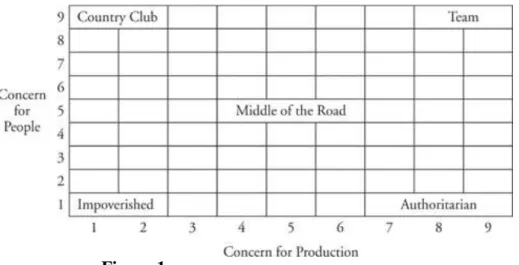
Eng R. L. Nkumbwa MSc, MBA, BEng, MIET, MEIZ, REng. Copperbelt University - 2010 The managerial grid model, shown in Figure below and developed by Robert Blake and Jane Mouton, identifies five leadership styles with varying concerns for people and production:
Figure 1 Blake-Mouton Managerial Grid.
The impoverished style, located at the lower left-hand corner of the grid, point (1, 1), is characterized by low concern for both people and production; its primary objective is for managers to stay out of trouble.
The country club style, located at the upper left-hand corner of the grid, point (1, 9), is distinguished by high concern for people and a low concern for production; its primary objective is to create a secure and comfortable atmosphere where managers trust that subordinates will respond positively.
The authoritarian style, located at the lower right-hand corner of the grid, point (9,1), is identified by high concern for production and low concern for people; its primary objective is to achieve the organization's goals, and employee needs are not relevant in this process.
The middle-of-the-road style, located at the middle of the grid, point (5, 5), maintains a balance between workers' needs and the organization's productivity goals; its primary objective is to maintain employee morale at a level sufficient to get the organization's work done.
The team style, located at the upper right-hand of the grid, point (9, 9), is characterized by high concern for people and production; its primary objective is to establish cohesion and foster a feeling of commitment among workers.
The Managerial Grid model suggests that competent leaders should use a style that reflects the highest concern for both people and production—point (9, 9), team-oriented style.
Eng R. L. Nkumbwa MSc, MBA, BEng, MIET, MEIZ, REng. Copperbelt University - 2010 3.1 Power versus Authority
Effective leaders develop and use power, or the ability to influence others. The traditional manager's power comes from his or her position within the organization. Legitimate, reward, and coercive are all forms of power used by managers to change employee behav ior and are defined as follows:
Legitimate power stems from a formal management position in an organization and the authority granted to it. Subordinates accept this as a legitimate source of power and comply with it.
Reward power stems from the authority to reward others. Managers can give formal rewards, such as pay increases or promotions, and may also use praise, attention, and recognition to influence behavior.
Coercive power is the opposite of reward power and stems from the authority to punish or to recommend punishment. Managers have coercive power when they have the right to fire or demote employees, criticize them, withhold pay increases, give reprimands, make negative entries in employee files, and so on.
Keep in mind that different types of position power receive different responses in followers. Legitimate power and reward power are most likely to generate compliance, where workers obey orders even though they may personally disagree with them. Coercive power most often generates resistance, which may lead workers to deliberately avoid carrying out instructions or to disobey orders. Unlike external sources of position power, personal power most often comes from internal sources, such as a person's special knowledge or personality characteristics. Personal power is the tool of a leader. Subordinates follow a leader because of respect, admiration, or caring they feel for this individual and his or her ideas. The following two types of personal power exist:
Expert power results from a leader's special knowledge or skills regarding the tasks performed by followers. When a leader is a true expert, subordinates tend to go along quickly with his or her recommendations.
Referent power results from leadership characteristics that command identification, respect, and admiration from subordinates who then desire to emulate the leader. When workers admire a supervisor because of the way he or she deals with them, the influence is based on referent power. Referent power depends on a leader's personal
Eng R. L. Nkumbwa MSc, MBA, BEng, MIET, MEIZ, REng. Copperbelt University - 2010 characteristics rather than on his or her formal title or position, and is most visible in the area of charismatic leadership.
The most common follower response to expert power and referent power is commitment. Commitment means that workers share the leader's point of view and enthusiastically carry out instructions. Needless to say, commitment is preferred to compliance or resistance. Commitment helps followers overcome fear of change, and it is especially important in those instances. Keep in mind that the different types of power described in this section are interrelated. Most leaders use a combination of these types of power, depending on the leadership style used. Authoritarian leaders, for example, use a mixture of legitimate, coercive, and reward powers to dictate the policies, plans, and activities of a group. In comparison, a participative leader uses mainly referent power, involving all members of the group in the decision-making process.
Eng R. L. Nkumbwa MSc, MBA, BEng, MIET, MEIZ, REng. Copperbelt University - 2010 3.2 Challenges Facing Leaders
Organizations today place multiple demands on leaders, requiring them to impart vision, initiate change, and make difficult decisions. To handle these demands, leaders must be flexible and adaptable.
Transformational Leadership
Transformational leadership blends the behavioral theories with a little dab of trait theories. Transactional leaders, such as those identified in contingency theories, guide followers in the direction of established goals by clarifying role and task requi rements. However, transformational leaders, who are charismatic and visionary, can inspire followers to transcend their own self-interest for the good of their organizations. Transformational leaders appeal to followers' ideals and moral values and inspire them to think about problems in new or different ways. These leaders influence followers through vision, framing, and impression management. Vision is the ability of the leader to bind people together with an idea. Framing is the process whereby leaders d efine the purpose of their movements in highly meaningful terms. Impression management is an attempt to control the impressions that others form of a leader by practicing behaviors that make him or her more attractive and appealing to others.
Eng R. L. Nkumbwa MSc, MBA, BEng, MIET, MEIZ, REng. Copperbelt University - 2010 A transformational leader instills feelings of confidence, admiration, and commitment in his or her followers. This type of leader is charismatic, creating a special bond with followers and articulating a vision with which his or her followers identify and for which t hese followers are willing to work. Each follower is coached, advised, and delegated some authority. The transformational leader stimulates followers intellectually, arousing them to develop new ways to think about problems. This leader uses contingent rew ards to positively reinforce performances that are consistent with his or her wishes. Management is by exception.
Transformational leaders take initiative only when problems occur and are not actively involved when things are going well. He or she commits people to actions and converts followers into leaders. Research indicates that transformational, as compared to transactional, leadership is more strongly correlated with lower turnover rates, higher productivity, and higher employee satisfaction. Transformational leaders are relevant to today's workplace because they are flexible and innovative. Although it is important to have leaders with the appropriate orientation defining tasks and managing interrelationships, it is even more important to have leaders who can bring organizations into futures they have not yet imagined. Transformational leadership is the essence of creating and sustaining competitive advantage.
Change Leadership
Today's business world is highly competitive. The way for an organization to survive is by reshaping to meet the needs of a rapidly changing world. Resistance to change is a dead -end street for employees and for the organization. Leaders need to emphasize action to make the change as quickly and smoothly as possible. Organizations go through a four-stage life cycle. For some organizations, the four periods of growth come and go very rapidly; for others, that process may take decades. Failure to follow through with the needed changes in any of the four growth periods could mean the end for an organization. Throughout these periods of change, which is just about all the time for a good organization, leaders must concentrate on having their people go from change avoidance to change acceptance. The five steps that accompany change—for individuals facing life-altering circumstances and for organizations facing fundamental shifts—are denial, anger, bargaining, depression, and finally, acceptance. Often a worker's first reaction to change is to resist it.
Eng R. L. Nkumbwa MSc, MBA, BEng, MIET, MEIZ, REng. Copperbelt University - 2010 An employee becomes comfortable performing tasks and processes a certain way. These comfort levels provide employees with the security of knowing that they are the masters of their work environment. Employees fear that change could disrupt their lives by making their jobs harder or causing them to lose their sense of control.
Leaders can help the change process by changing their employees' attitudes from avoidance into acceptance. This change is accomplished by managers as strong leaders transforming their employees' avoidance questions and statements into acceptance questions:
From “Why?” to “What new opportunities will this change provide?” When employees ask ―why,‖ a manager should focus on the benefits that the change will provide employees and the organization.
From “How will this affect me?” to “What problems will this solve?” Managers should let employees know what the problem is and how they will be part of the solution.
From “We do not do it this way” to “What will be the result if we do it this new way?” One of the first reactions is that a process never has been done this way. Managers should provide explanations and empathy.
Eng R. L. Nkumbwa MSc, MBA, BEng, MIET, MEIZ, REng. Copperbelt University - 2010 From “When will this be over so that we can get back to work?” to “What can I
do to help?” Managers should get employees involved in implementing the change.
Managers need to keep in mind that feelings are contagious. By positively promoting a change, a leader makes others want to be part of it. Managers should also give employees the necessary authority and control to help bring the change about. So that employees do not feel powerless, managers should share their responsibilities. A manager should want his or her team members to feel useful and enthusiastic. Employees should be made to feel as though the change could not have happened without them.
3.3 Leading in the Learning Organization
An organization that encourages learning among its people is referred to as a learning organization. In a learning organization, employees are engaged in identifying and solving problems, enabling the organization to continuously experiment, change, and improve. Thus, the organization can increase its capacity to grow, learn, and achieve its purpose. In the learning organization, all employees look for problems, such as understanding special customer needs. Employees also solve problems, which mean putting things together in unique ways to meet customer needs. A learning organization promotes exchanges o f information among employees, which creates a more knowledgeable workforce. Learning organizations exhibit flexibility because employees accept and adapt to new ideas and changes through a shared vision.
Today's increased pace of change is one reason the learning organization is popular. The corporation that is able to quickly shape and motivate their workers is better able to transform its work practices to keep pace with the constantly changing environment. Leadership in learning organizations requires something more than the traditional approach of setting goals, making decisions, and directing the troops. In learning organizations, managers learn to think in terms of ―control with‖ rather than ―control over‖ employees. They ―control with‖ employees by building relationships based on shared visions and shaping the cultures of their organizations so that all can help achieve the same visions. A leader in this learning environment can help facilitate teamwork, initiate change, and expand
Eng R. L. Nkumbwa MSc, MBA, BEng, MIET, MEIZ, REng. Copperbelt University - 2010 the capacity of employees to shape their organization's future. Leaders who understand how the learning organization operates can help other leaders adapt to this organizational style. Visionary leadership, a team-based structure, participative strategy, a strong, adaptive internal culture, empowered employees, and open information characterize the learning organization. Consultant Peter Senge, author of the popular book, The Fifth Discipline,
identifies the following ingredients of learning organizations: Mental models—setting aside of old ways of thinking
Personal mastery—self-awareness and ability to remain open to others Systems thinking—understanding of the plan of action
Shared vision—mutual agreement to the plan of action
Team learning—working together to accomplish the plan of action
Senge's concept of the learning organization places high value on developing the ability to learn and then make that learning continuously available to all organizational members.
Eng R. L. Nkumbwa MSc, MBA, BEng, MIET, MEIZ, REng. Copperbelt University - 2010
Management Philosophies and Motivation
Eng R. L. Nkumbwa MSc, MBA, BEng, MIET, MEIZ, REng. Copperbelt University - 2010 Management Philosophies and Motivation
Management philosophy can set the foundation for a positive work climate and influence a manager's approach to motivation. The way a manager views employees and communicates with employees affects their behavior.
4.0 Motivation Theories: Individual Needs
Motivation is a complex phenomenon. Several theories attempt to explain how motivation works. In management circles, probably the most popular explanations of motivation are based on the needs of the individual. The basic needs model, referred to as content theory of motivation, highlights the specific factors that motivate an individual. Although these factors are found within an individual, things outside the individual can affect him or her as well. In short, all people have needs that they want satisfied. Some are primary needs, such as those for food, sleep, and water—needs that deal with the physical aspects of behavior and are considered unlearned. These needs are biological in nature and relatively stable. Their influences on behavior are usually obvious and hence easy to identify. Secondary
needs, on the other hand, are psychological, which means that they are learned primarily
through experience. These needs vary significantly by culture and by individual. Secondary needs consist of internal states, such as the desire for power, achievement, and love. Identifying and interpreting these needs is more difficult because they are demonstrated in a variety of ways. Secondary needs are responsible for most of the behavior that a supervisor is concerned with and for the rewards a person seeks in an organization. Several theorists, including Abraham Maslow, Frederick Herzberg, David McClelland, and Clayton Alderfer, have provided theories to help explain needs as a source of motivation.
Abraham Maslow's Hierarchy of Needs Theory
Abraham Maslow defined need as a physiological or psychological deficiency that a person feels the compulsion to satisfy. This need can create tensions that can influence a person's work attitudes and behaviors. Maslow formed a theory based on his definition of need that proposes that humans are motivated by multiple needs and that these needs exist in a hierarchical order. His premise is that only an unsatisfied need can influence behavior; a satisfied need is not a motivator.
Eng R. L. Nkumbwa MSc, MBA, BEng, MIET, MEIZ, REng. Copperbelt University - 2010 Maslow's theory is based on the following two principles:
Deficit principle: A satisfied need no longer motivates behavior because people act to satisfy deprived needs.
Progression principle: The five needs he identified exist in a hierarchy, which means that a need at any level only comes into play after a lower-level need has been satisfied.
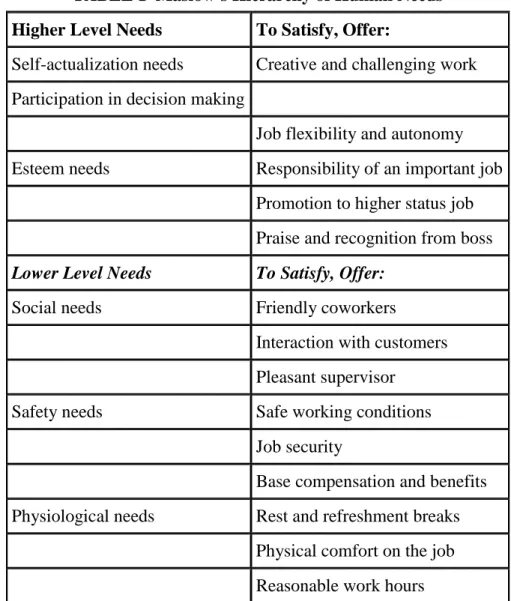
In his theory, Maslow identified five levels of human needs. Table below illustrates these five levels and provides suggestions for satisfying each need.
TABLE 1 Maslow's Hierarchy of Human Needs
Higher Level Needs To Satisfy, Offer:
Self-actualization needs Creative and challenging work
Participation in decision making
Job flexibility and autonomy
Esteem needs Responsibility of an important job Promotion to higher status job
Praise and recognition from boss
Lower Level Needs To Satisfy, Offer:
Social needs Friendly coworkers
Interaction with customers
Pleasant supervisor
Safety needs Safe working conditions
Job security
Base compensation and benefits Physiological needs Rest and refreshment breaks
Physical comfort on the job
Eng R. L. Nkumbwa MSc, MBA, BEng, MIET, MEIZ, REng. Copperbelt University - 2010 Although research has not verified the strict deficit and progression principles of Maslow's theory, his ideas can help managers understand and satisfy the needs of employees.
Herzberg's Two-factor Theory
Frederick Herzberg offers another framework for understanding the motivational implications of work environments. In his two-factor theory, Herzberg identifies two sets of factors that impact motivation in the workplace:
Hygiene Factors include salary, job security, working conditions, organizational policies, and technical quality of supervision. Although these factors do not motivate employees, they can cause dissatisfaction if they are missing. Something as simple as adding music to the office place or implementing a no-smoking policy can make people less dissatisfied with these aspects of their work. However, these improvements in hygiene factors do not necessarily increase satisfaction.
Satisfiers or Motivators include such things as responsibility, achievement, growth opportunities, and feelings of recognition, and are the key to job satisfaction and motivation. For example, managers can find out what people really do in their jobs and make improvements, thus increasing job satisfaction and performance.
Following Herzberg's two-factor theory, managers need to ensure that hygiene factors are adequate and then build satisfiers into jobs.
Alderfer's ERG Theory
Clayton Alderfer's ERG (Existence, Relatedness, and Growth) theory is built upon Maslow's hierarchy of needs theory. To begin his theory, Alderfer collapses Maslow's five levels of needs into three categories.
Existence needs are desires for physiological and material well-being. (In terms of Maslow's model, existence needs include physiological and safety needs)
Relatedness needs are desires for satisfying interpersonal relationships. (In terms of Maslow's model, relatedness correspondence to social needs)
Growth needs are desires for continued psychological growth and development. (In terms of Maslow's model, growth needs include esteem and self -realization needs)
Eng R. L. Nkumbwa MSc, MBA, BEng, MIET, MEIZ, REng. Copperbelt University - 2010 This approach proposes that unsatisfied needs motivate behavior, and that as lower level needs are satisfied, they become less important. Higher level needs, though, become more important as they are satisfied, and if these needs are not met, a person may move down the hierarchy, which Alderfer calls the frustration-regression principle. What he means by this term is that an already satisfied lower level need can become reactivated and influence behavior when a higher level need cannot be satisfied. As a result, managers should provide opportunities for workers to capitalize on the importance of higher level needs.
McClelland's Acquired Needs Theory
David McClelland's acquired needs theory recognizes that everyone prioritizes needs differently. He also believes that individuals are not born with these needs, but that they are actually learned through life experiences. McClelland identifies three specific needs:
Need for achievement is the drive to excel.
Need for power is the desire to cause others to behave in a way that they would not have behaved otherwise.
Need for affiliation is the desire for friendly, close interpersonal relationships and conflict avoidance.
McClelland associates each need with a distinct set of work preferences, and managers can help tailor the environment to meet these needs.
High achievers differentiate themselves from others by their desires to do things better. These individuals are strongly motivated by job situations with personal responsibility, feedback, and an intermediate degree of risk. In addition, high achievers often exhibit the following behaviors:
Seek personal responsibility for finding solutions to problems
Want rapid feedback on their performances so that they can tell easily whether they are improving or not
Set moderately challenging goals and perform best when they perceive their probability of success as 50-50
Eng R. L. Nkumbwa MSc, MBA, BEng, MIET, MEIZ, REng. Copperbelt University - 2010 An individual with a high need of power is likely to follow a path of continued promotion over time. Individuals with a high need of power often demonstrate the following behaviors:
Enjoy being in charge Want to influence others
Prefer to be placed into competitive and status-oriented situations
Tend to be more concerned with prestige and gaining influence over others than with effective performance
People with the need for affiliation seek companionship, social approval, and satisfying interpersonal relationships. People needing affiliation display the following behaviors:
Take a special interest in work that provides companionship and social approva l Strive for friendship
Prefer cooperative situations rather than competitive ones
Desire relationships involving a high degree of mutual understanding
May not make the best managers because their desire for social approval and friendship may complicate managerial decision making
Interestingly enough, a high need to achieve does not necessarily lead to being a good manager, especially in large organizations. People with high achievement needs are usually interested in how well they do personally and not in influencing others to do well. On the other hand, the best managers are high in their needs for power and low in their needs for affiliation.
Eng R. L. Nkumbwa MSc, MBA, BEng, MIET, MEIZ, REng. Copperbelt University - 2010 4.1 Motivation Theories: Behavior
Process theories explain how workers select behavioral actions to meet their needs and determine their choices. The following theories each offer advice and insight on how people actually make choices to work hard or not work hard based on their individual preferences, the available rewards, and the possible work outcomes.
Equity theory
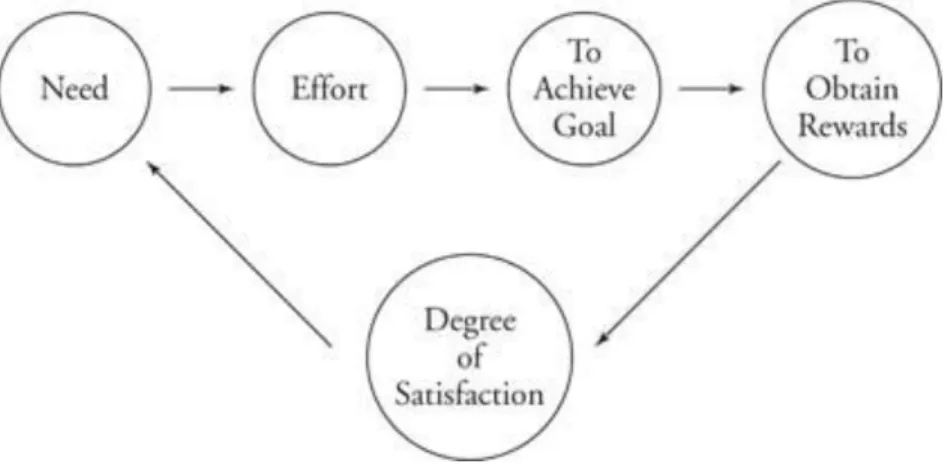
According to the equity theory, based on the work of J. Stacy Adams, workers compare the reward potential to the effort they must expend. Equity exists when workers perceive that rewards equal efforts (see Figure below).
Figure 1 The Equity Theory.
But employees just don't look at their potential rewards, they look at the rewards of others as well. Inequities occur when people feel that their rewards are inferior to the rewards offered to other persons sharing the same workloads.
Employees who feel they are being treated inequitably may exhibit the following behaviors: Put less effort into their jobs
Ask for better treatment and/or rewards
Find ways to make their work seem better by comparison Transfer or quit their jobs
Eng R. L. Nkumbwa MSc, MBA, BEng, MIET, MEIZ, REng. Copperbelt University - 2010 The equity theory makes a good point: People behave according to their perceptions. What a manager thinks is irrelevant to an employee because the real issue is the way an employee perceives his or her situation. Rewards perceived as equitable should have positive results on job satisfaction and performance; those rewards perceived as inequitable may create job dissatisfaction and cause performance problems.
Every manager needs to ensure that any negative consequences from equity comparisons are avoided, or at least minimized, when rewards are allocated. Informed managers anticipate perceived negative inequities when especially visible rewards, such as pay increases or promotions, are allocated. Instead of letting equity concerns get out of hand, these managers carefully communicate the intended values of rewards being given, clarify the performance appraisals upon which these rewards are based, and suggest appropriate comparison points.
Expectancy Theory
Victor Vroom introduced one of the most widely accepted explanations of motivation. Very simply, the expectancy theory says that an employee will be motivated to exert a high level of effort when he or she believes that:
1. Effort will lead to a good performance appraisal. 2. A good appraisal will lead to organizational rewards.
3. The organizational rewards will satisfy his or her personal goals.
The key to the expectancy theory is an understanding of an individual's goals and the relationships between effort and performance, between performance and rewards, and finally, between the rewards and individual goal satisfaction. When an employee has a high level of expectancy and the reward is attractive, motivation is usually high. Therefore, to motivate workers, managers must strengthen workers' perceptions of their efforts as both possible and worthwhile, clarify expectations of performances, tie rewards to performances, and make sure that rewards are desirable.
Eng R. L. Nkumbwa MSc, MBA, BEng, MIET, MEIZ, REng. Copperbelt University - 2010 Reinforcement Theory
The reinforcement theory, based on E. L. Thorndike's law of effect, simply looks at the relationship between behavior and its consequences. This theory focuses on modifying an employee's on-the-job behavior through the appropriate use of one of the following four techniques:
Positive reinforcement rewards desirable behavior. Positive reinforcement, such as a pay raise or promotion, is provided as a reward for positive behavior with the intention of increasing the probability that the desired behavior will be repeated. Avoidance is an attempt to show an employee what the consequences of improper
behavior will be. If an employee does not engage in improper behavior, he or she will not experience the consequence.
Extinction is basically ignoring the behavior of a subordinate and not providi ng either positive or negative reinforcement. Classroom teachers often use this technique when they ignore students who are ―acting out‖ to get attention. This technique should only be used when the supervisor perceives the behavior as temporary, not typic al, and not serious.
Punishment (threats, docking pay, suspension) is an attempt to decrease the likelihood of a behavior recurring by applying negative consequences.
The reinforcement theory has the following implications for management:
Learning what is acceptable to the organization influences motivated behavior.
Managers who are trying to motivate their employees should be sure to tell individuals what they are doing wrong and be careful not to reward all individuals at the same time.
Managers must tell individuals what they can do to receive positive reinforcement. Managers must be sure to administer the reinforcement as closely as possible to the
occurrence of the behavior.
Managers must recognize that failure to reward can also modify behavior. Em ployees who believe that they deserve a reward and do not receive it will often become disenchanted with both their manager and company.
Eng R. L. Nkumbwa MSc, MBA, BEng, MIET, MEIZ, REng. Copperbelt University - 2010 Goal-setting Theory
The goal-setting theory, introduced in the late 1960s by Edwin Locke, proposed that intentions to work toward a goal are a major source of work motivation. Goals, in essence, tell employees what needs to be done and how much effort should be expanded. In general, the more difficult the goal, the higher the level of performance expected. Managers can set the goals for their employees, or employees and managers can develop goals together. One advantage of employees participating in goal setting is that they may be more likely to work toward a goal they helped develop.
No matter who sets the goal, however, employees do better when they get feedback on their progress. In addition to feedback, four other factors influence the goals -performance relationship:
The employee must be committed to the goal.
The employee must believe that he is capable of performing the task.
Tasks involved in achieving the goal should be simple, familiar, and independent. The goal-setting theory is culture bound and is popular in North American cultures.
If the goal-setting theory is followed, managers need to work with their employees in determining goal objectives in order to provide targets for motivation. In addition, the goals that are established should be specific rather than general in nature, and managers must provide feedback on performance.
Eng R. L. Nkumbwa MSc, MBA, BEng, MIET, MEIZ, REng. Copperbelt University - 2010 4.2 Motivation Strategies
To some extent, a high level of employee motivation is derived from effective management practices. To develop motivated employees, a manager must treat people as individuals, empower workers, provide an effective reward system, redesign jobs, and create a flexible workplace.
Empowering Employees
Empowerment occurs when individuals in an organization are given autonomy, authority,
trust, and encouragement to accomplish a task. Empowerment is designed to unshackle the worker and to make a job the worker's responsibility. In an attempt to empower and to change some of the old bureaucratic ideas, managers are promoting corporate intrapreneurships. Intrapreneurship encourages employees to pursue new ideas and gives them the authority to promote those ideas. Obviously, intrapreneurship is not for the timid, because old structures and processes are turned upside down.
Providing an Effective Reward System
Managers often use rewards to reinforce employee behavior that they want to continue. A
reward is a work outcome of positive value to the individual. Organizations are rich in
rewards for people whose performance accomplishments help meet organizational objectives. People receive rewards in one of the following two ways:
Extrinsic rewards are externally administered. They are valued outcomes given to someone by another person, typically a supervisor or higher level manager. Common workplace examples are pay bonuses, promotions, time off, special assignments, office fixtures, awards, verbal praise, and so on. In all cases, the motivational stimulus of extrinsic rewards originates outside the individual.
Intrinsic rewards are self-administered. Think of the ―natural high‖ a person may experience after completing a job. That person feels good because she has a feeling of competency, personal development, and self-control over her work. In contrast to extrinsic rewards, the motivational stimulus of intrinsic rewards is internal and doesn't depend on the actions of other people.
Eng R. L. Nkumbwa MSc, MBA, BEng, MIET, MEIZ, REng. Copperbelt University - 2010 To motivate behavior, the organization needs to provide an effective reward system. An effective reward system has four elements:
Rewards need to satisfy the basic needs of all employees.
Rewards need to be included in the system and be comparable to ones offered by a competitive organization in the same area.
Rewards need to be available to people in the same positions and be distributed fairly and equitably.
The overall reward system needs to be multifaceted. Because all people are different, managers must provide a range of rewards—pay, time off, recognition, or promotion. In addition, managers should provide several different ways to earn these rewards.
This last point is worth noting. With the widely developing trend toward empowerment in American industry, many employees and employers are beginning to view traditional pay systems as inadequate. In a traditional system, people are paid according to the positions they hold, not the contributions they make. As organizations adopt approaches built upon teams, customer satisfaction, and empowerment, workers need to be paid differently. Many companies have already responded by designing numerous pay plans, designed by employee design teams, which base rewards on skill levels. Rewards demonstrate to employees that their behavior is appropriate and should be repeated. If employees don't feel that their work is valued, their motivation will decline.
Redesigning Jobs
Many people go to work every day and go through the same, unenthusiastic actions to perform their jobs. These individuals often refer to this condition as burnout. But smart managers can do something to improve this condition before an employee becomes bored and loses motivation. The concept of job redesign, which requires a knowledge of and concern for the human qualities people bring with them to the organization, applies motivational theories to the structure of work for improving productivity and satisfaction When redesigning jobs, managers look at both job scope and job depth. Redesign attempts may include the following:
Job Enlargement. Often referred to as horizontal job loading, job enlargement increases the variety of tasks a job includes. Although it doesn't increase the quality or
Eng R. L. Nkumbwa MSc, MBA, BEng, MIET, MEIZ, REng. Copperbelt University - 2010 the challenge of those tasks, job enlargement may reduce some of the monotony, and as an employee's boredom decreases, his or her work quality generally increases. Job Rotation. This practice assigns people to different jobs or tasks to different
people on a temporary basis. The idea is to add variety and to expose people to the dependence that one job has on other jobs. Job rotation can encourage hi gher levels of contributions and renew interest and enthusiasm. The organization benefits from a cross-trained workforce.
Job Enrichment. Also called vertical job loading, this application includes not only an increased variety of tasks, but also provides an employee with more responsibility and authority. If the skills required to do the job are skills that match the jobholder's abilities, job enrichment may improve morale and performance.
Creating Flexibility
Today's employees value personal time. Because of family needs, a traditional nine-to-five workday may not work for many people. Therefore, flextime, which permits employees to set and control their own work hours, is one way that organizations are accommodating their employees' needs. Here are some other options organizations are trying as well:
A compressed workweek is a form of flextime that allows a full-time job to be completed in less than the standard 40-hour, five-day workweek. Its most common form is the 4/40 schedule, which gives employees three days off each week. This schedule benefits the individual through more leisure time and lower commuting costs. The organization should benefit through lower absenteeism and improved performance. Of course, the danger in this type of scheduling is th e possibility of increased fatigue.
Job Sharing or Twinning occurs when one full-time job is split between two or more persons. Job sharing often involves each person working one-half day, but it can also be done on weekly or monthly sharing arrangements. When jobs can be split and shared, organizations can benefit by employing talented people who would otherwise be unable to work full-time. The qualified employee who is also a parent may not want to be in the office for a full day but may be willing to work a half-day. Although adjustment problems sometimes occur, the arrangement can be good for all concerned.
Eng R. L. Nkumbwa MSc, MBA, BEng, MIET, MEIZ, REng. Copperbelt University - 2010 Telecommuting, sometimes called flexiplace, is a work arrangement that allows at least a portion of scheduled work hours to be completed outside of the office, with work-at-home as one of the options. Telecommuting frees the jobholder from needing to work fixed hours, wearing special work attire, enduring the normal constraints of commuting, and having direct contact with supervisors. Home workers of ten demonstrate increased productivity, report fewer distractions, enjoy the freedom to be their own boss, and appreciate the benefit of having more time for themselves.
Of course, when there are positives, there are also negatives. Many home workers feel that they work too much and are isolated from their family and friends. In addition to the feelings of isolation, many employees feel that the lack of visibility at the office may result in the loss of promotions.
Eng R. L. Nkumbwa MSc, MBA, BEng, MIET, MEIZ, REng. Copperbelt University - 2010