DDRAFT
FHFA MORTGAGE
ANALYTICS
PLATFORM
Released by FHFA, July 10, 2014
Robert M. Dunsky
Xiaoming Zhou
Michael Kane
Ming Chow
Charles Hu
Andrew Varrieur
FHFA Mortgage Analytics Platform
1.
BACKGROUND & INTRODUCTION... 2
2.
FHFA MORTGAGE ANALYTICS PLATFORM OVERVIEW ... 3
3.
PERFORMING LOAN MODULE ... 6
3.1
C
OMMON
I
NDEPENDENT
V
ARIABLES IN THE
P
ERFORMING
L
OAN
M
ODULE
... 7
3.2
S
PECIAL
T
REATMENT OF
P
ERFORMING
M
ODIFIED
L
OANS
... 12
4.
NON-PERFORMING LOAN MODULE ... 15
4.1
I
NDEPENDENT
V
ARIABLES IN THE
N
ON
-P
ERFORMING
L
OAN
M
ODULE
... 16
5.
CREDIT LOSS MODULE
... 19
5.1
C
HARGE
-O
FF
T
IMING
... 20
5.2
C
HARGE
-O
FF
A
MOUNT
... 20
5.3
REO
O
PERATIONS
E
XPENSES
... 25
6.
INTEGRATION MODULE
... 27
6.1
S
CHEDULED AND
U
NSCHEDULED
R
ELATED
P
RINCIPAL
... 27
6.2
C
REDIT
L
OSS
R
ELATED
P
RINCIPAL
... 28
6.3
C
REDIT
L
OSS
M
EASURES
... 28
7.
STANDARDIZED REPORT ELEMENTS ... 30
8.
REFERENCES ... 32
9.
APPENDIX A: SPLINE CONSTRUCTION... 33
10.
APPENDIX B: PERFORMING LOAN MODULE MODEL COEFFICIENTS ... 34
11.
APPENDIX C: BACK-TESTING PLOTS ... 51
12.
APPENDIX D: NON-PERFORMING LOAN EQUATION PARAMETERS... 65
FHFA Mortgage Analytics Platform
1.
Background & Introduction
The Federal Housing Finance Agency (FHFA) maintains a proprietary Mortgage
Analytics Platform to support the Agency’s strategic plan. The objective of this white
paper is to provide interested stakeholders with a detailed description of the platform,
as it is one of the tools the FHFA uses in policy analysis. The distribution of this white
paper is part of a larger effort to increase transparency on mortgage performance and
the analytical tools used for policy analysis and evaluation within the FHFA.
The motivation to build the FHFA Mortgage Analytics Platform derived from the
Agency’s need for an independent empirical view on multiple policy initiatives.
Academic empirical studies may suffer from a lack of high quality data, while empirical
work from inside the industry typically represents a specific view. The FHFA
maintains several vendor platforms from which an independent view is possible, yet
these platforms tend to be inflexible and opaque. The unique role of the FHFA as
regulator and conservator necessitated platform flexibility and transparency to carry
out its responsibilities.
The FHFA Mortgage Analytics Platform is maintained on a continuous basis; as such,
the material herein represents the platform as of the publication date of this document.
As resources permit, this document will be updated to reflect enhancements to the
platform.
FHFA Mortgage Analytics Platform
2.
FHFA Mortgage Analytics Platform Overview
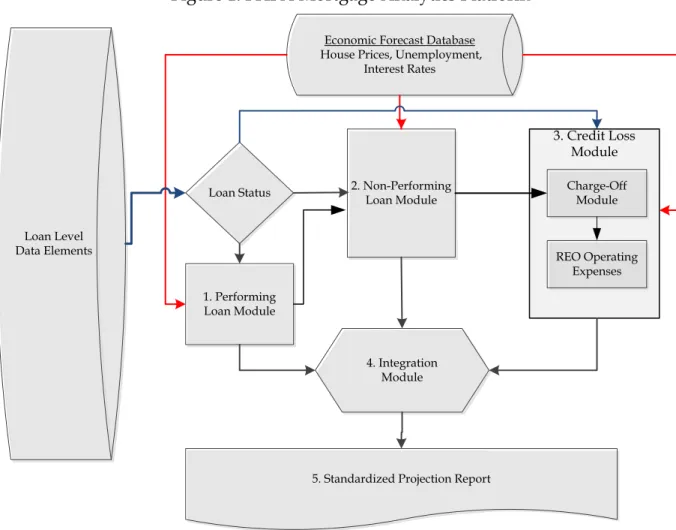
The platform integrates econometric loan performance models, loan level data and
external economic forecasts to project mortgage cash flows. This section offers an
overview of the modules and their interconnections.
Economic Forecast Database
House Prices, Unemployment,
Interest Rates
Loan Level
Data Elements
Loan Status
1. Performing
Loan Module
2. Non-Performing
Loan Module
Charge-Off
Module
4. Integration
Module
5. Standardized Projection Report
Figure 1: FHFA Mortgage Analytics Platform
REO Operating
Expenses
3. Credit Loss
Module
There are two sources of external inputs to the analytics platform: loan level data and
economic forecasts. The economic forecasts include projections of house prices, interest
rates and unemployment rates through the forecast horizon. Both vendor-supplied
economic forecasts and FHFA projections of economic variables are stored in the
FHFA Mortgage Analytics Platform
economic forecast database. These economic forecasts cover a wide range of economic
environments from baseline to highly optimistic to extremely stressful economic
conditions. The economic forecast databases are quarterly.
The loan level data elements are the second source of external inputs; these include
approximately thirty variables per loan comprising loan attributes and borrower
characteristics. The platform projects mortgage performance from the loan’s current
age to termination, including foreclosure alternatives and the resolution of real estate
owned (REO). The platform applies projected probabilities of termination to
performing loan balances such that a portion of the loan prepays, becomes delinquent
and may resolve as a default each month. To simplify the discussion within this paper,
when a loan is said to prepay (or default), only a portion of the loan is prepaying (or
defaulting), not the whole loan. The components of the platform are summarized
below and are described in greater detail in subsequent sections of this paper.
1.
Performing Loan Module – the primary function of this module is to project
monthly loan level prepayment and 90-day delinquency probabilities on performing
and modified performing loans. Loans enter into this module if they are current, less
than 90 days delinquent, or forecasted to cure from a delinquency during the
simulation. The prepayment and delinquency equations are functions of borrower
characteristics, loan characteristics, home values and other economic variables.
Multiple pairs of prepayment and delinquency equations collectively cover several loan
products and modified loans guaranteed or owned by the Enterprises.
2.
Non-Performing Loan Module – the primary function of this module is to project
lifetime outcomes for delinquent loans. Loans enter into this module if they are 90 to
180 days delinquent at the beginning of the projection, or if they are predicted to
become delinquent within the performing loan module. The module outputs four
mutually exclusive loan-specific probabilities each month: foreclosure completion
(REO), voluntary prepayment, foreclosure alternative resolutions and re-performance
(cure). The foreclosure alternative resolutions include deed-in-lieu of foreclosure,
pre-foreclosure sale (short sale), and third party sale. A loan is defined as re-performing
when all arrearages are paid and the cure is not due to a modification or restructuring.
The models are a function of borrower characteristics, house prices and state legal
structures. Unlike the performing loan module where multiple product level models
are constructed, only one set of equations is estimated for non-performing loans.
FHFA Mortgage Analytics Platform
3.
Credit Loss Module– the primary function of this module is to calculate loan
level credit losses and determine the appropriate timing of loss recognition. Loans
enter into this module if they are greater than 180 days delinquent at the start of the
projection or are projected to generate a credit loss from the non-performing module.
Credit losses are measured as charge-offs and REO operating expenses. Charge-offs
and REO operating expenses are calculated at the loan level using an accounting
approach.
4.
The Integration Module - combines the forecasted performance elements,
mortgage contractual terms, and interest rates to generate loan level cash flows. This
module outputs are aggregated across loans into the Standardized Projection Report.
5.
The Standardized Projection Report –summarizes projections of portfolio
performance measures over the forecast horizon. Key credit loss elements reported in
the report are charge-offs and REO operation expenses. Other variables in the report
include performing balances, dollars of new 90 day delinquencies, scheduled and
unscheduled principal payments, guarantee fee income, and credit enhancement claims.
The subsequent sections of the paper discuss each of the modules in detail. Sections 3
through 5 focus on the design of the econometric behavioral equations, Section 6
reviews the credit loss calculations, and Section 7 covers the calculation of the monthly
projections. The appendices include the parameter estimates and back testing results
from the modules covered in Sections 3 through 5.
FHFA Mortgage Analytics Platform
3.
Performing Loan Module
The Performing Loan Module contains a series of Multinomial Logit (MNL) equations
that predict the loan’s monthly status: current, prepaid or delinquent. Many authors
including Clapp et al (2005) and Jenkins (1995) demonstrate that the MNL provides a
convenient method for structuring prepayment and delinquency risk as a discrete-time
competing hazard. Using the estimated equation parameters, the platform calculates
the conditional probability of prepayment and 90-day delinquency as,
(
)
(
) (
)
+
+
=
90 , , , ,ˆ
'
exp
ˆ
'
exp
1
ˆ
'
exp
)
(
f t i pp t i pp t i t iv
x
x
prepay
P
β
β
β
, and
(
)
(
)
(
)
+
+
=
90 , , 90 , ,ˆ
'
exp
ˆ
'
exp
1
ˆ
'
exp
)
90
(
f t i pp t i f t i t iv
x
v
f
P
β
β
β
.
The probability of remaining current is calculated as,
)
(
)
90
(
1
)
(
current
i,tP
f
i,tP
prepay
i,tP
=
−
−
.
Where
β
ˆ
ppand
β
ˆ
f90represent the estimated prepayment and 90-day delinquency
parameter vectors, while
x
i,tand
v
i,trepresent the variables in the prepayment and
delinquency equations for the
ith
loan at time period
t
. The resulting prepayment
probability represents the likelihood that loans will prepay in the current month, given
that it has neither prepaid nor become 90 days delinquent in the prior month. The
delinquency probability is similarly defined.
Fifteen loan product specific models are estimated using historical loan-level data in
addition to a single model for all modified loans. The treatment of performing
modified loans is discussed in detail in Section 3.2. The loan product models are based
on the following eight products:
Fixed Rate Products: 40yr. FRM, 30yr. FRM, 20yr. FRM, 15yr. FRM
Adjustable Rate Products: 10/1 ARM, 7/1 ARM, 5/1 ARM, 3/1 ARM,
FHFA Mortgage Analytics Platform
Separate loan product models are estimated for each Enterprise, with the exception of
the fixed rate 40 year loan product and modified loans, which are estimated with data
combined from both Enterprises due to the low volume of fixed rate 40 year loan
product and modified loans. When possible, the entire historical population of loans is
used for estimation. In the case of the fixed rate 30 year loans, a stratified proportional
sample of three million loans is selected for each Enterprise. The stratification variables
include: geography, credit scores, origination quarter, property type, loan size, original
loan to value (LTV) and occupancy. The marginal distributions of the population and
the selected samples are compared to ensure representativeness to the loan population.
These eight loan products for each GSE represent approximately 99 percent of the
Enterprise mortgages originated since 1995. The remaining loans are comprised mostly
of single family balloon mortgages and step rate mortgages. These loans are assigned
to the product model based on their maturity term, for example, a 30 year step rate
mortgage is assigned to the 30 year fixed rate model.
3.1
Common Independent Variables in the Performing Loan Module
This section reviews the common independent variables across all of the estimated
behavioral equations for performing loans. Most of the continuous explanatory
variables are constructed as spline functions, with the locations of the spline knots
varying across models
1
. The parameter estimates, standardized errors, and the
locations of spline knots are listed in Appendix B. Back-testing plots of each model is
located in Appendix C.
3.1.1
Loan Seasoning
The loan age, or seasoning, is included in the models to capture changes in the
delinquency and prepayment tendencies over the life of the loan. The seasoning
functions in the models are constructed as a set of age spline variables; the spline knots
1
The spline specification for continuous independent variables is a common practice in prepayment and default modeling (see
Dunsky and Ho (2007), Bajari, Chu, and Park (2008), Tracey Seslen and William C. Wheaton (2010)). An important benefit of the
spline specification is that it avoids sudden jumps within a continuous variable while allows for the non-linearity relationship
between independent and dependent variable.
Page 7
FHFA Mortgage Analytics Platform
are chosen from the product specific hazard curve(s) that best represents the product
loan population
2
.
3.1.2
Vintage-Fixed Effects
In lieu of a constant term, each model is estimated with a series of vintage-specific fixed
effects. The estimated fixed effects capture unobservable changes in underwriting
standards and other non-observables that are not controlled for elsewhere in the model.
3.1.3
Seasonality
All of the models include a set of eleven monthly indicators (dummy variables) to
capture seasonality. Seasonality is a common phenomenon in mortgage performance:
prepayments during the summer months are typically borrowers moving, while late
payments frequently occur in April. The estimated seasonality parameters measure
sensitivity of prepayment and delinquency relative to January, the omitted month.
3.1.4
Down Payment at Origination
Down payment is measured in terms of the original loan-to-value (LTV) ratio; loan size
is the balance of the loan at origination and value is the appraised value at origination.
Underwriting requirements typically predetermine loan down payments. Enterprise
loans require a minimum original LTV of 80 on first lien mortgages, or, if the down
payment is less than 20 percent, then a form of credit enhancement is required, (e.g.
mortgage insurance) . The original LTV enters the model as a set of spline variables,
where the spline knots are selected at approximately the 20
th
, 40
th
and 80
th
percentiles of
original LTV in the estimation data.
3.1.5
Credit Score at Origination
The Enterprises fully adopted credit scores in their underwriting criteria in the
mid-1990s. Nearly 100 percent of loans originated since 1995 in the estimation data contain
credit scores. Credit scores are typically reported from all three of the credit
repositories. The model only uses one credit score per loan. When multiple scores are
available per borrower, the model uses the lower of the two scores if two are reported,
and the middle score if three scores are reported. The lowest score across all borrowers
is used when co-borrowers are reported in the loan data. Credit scores are specified as
2
The historical hazards are plotted from the loan populations even when sampling is required.
Page 8
FHFA Mortgage Analytics Platform
five spline variables; the spline knots are selected based on the distribution of credit
scores in the estimation data.
3.1.6
Spread at Origination (SATO)
The SATO variable captures the difference between the borrower’s mortgage rate and
the prevailing interest rate reported in the Primary Mortgage Market Survey (PMMS)
on the date of the origination. Historically, this spread measures the borrower’s price of
credit relative to the market average. To the extent that borrower credit is priced
imperfectly, the SATO measure captures other unobservable in the transaction. There
are two SATO spline variables (two spline segments, one spline knot) in each model.
The spline knot is located at the median value of the difference between the initial rate
on the mortgage and the market rate (PMMS rate) in the month of the first payment.
3.1.7
Loan Size at Origination
Loan size (in thousands) is an important factor in the prepayment equation; the value of
refinancing a loan is proportional to the size of the loan. For some mortgage products,
loan size is also inversely related to the incidence of delinquency. The loan size at
origination enters the specification as a series of four spline variables; the spline knots
are selected based on the distribution of loan size in the estimation data sets.
3.1.8
Time Varying Credit-Equity Function (Credit Score Current-LTV Interaction)
The credit equity function is the interaction between the original credit score group
indicator and spline variables of the current LTV (or mark-to-market LTV, MTM LTV)
over the observed life of the loan, similar to Lam et al [2013]
3
. The function enables
measuring the borrower’s responsiveness to changes in current LTV while controlling
for the borrower’s original credit score.
There are (k) groups of credit score indicators; each borrower’s score falls uniquely into
one of the five buckets (
k=5
). The width of each bucket is based on the distribution
observed in the estimation data. The time dependent MTM LTV ratio is expanded into
(
h
) spline variables. The length and locations of the spline segments are defined from
the estimation data. The credit equity function in compact format for the
i
th
loan in
period
t
is defined as
3
LTVs are updated in the simulation model via house price indexes from the economic forecast database. The FHFA state-level
purchase-only index is used for both model estimation and forecasting.
Page 9
FHFA Mortgage Analytics Platform
∑∑
= ==
5 1 5 1 , , , , ,,
ˆ
_
_
_
h k h t i k t i k h ti
Credit
Score
MTM
LTV
Equity
Credit
β
.
Where
Credit
_
Score
i,t,ktakes the value of zero or one, depending on the loan’s credit
score, and
MTM
_
LTV
i,t,hare a series of spline variables based on the current LTV of the
loan. For each combination of credit score groups (
k=1 to 5
) and MTM LTV range (
h=1
to 5
) a
β
ˆ
h,kparameter is estimated.
The above table displays credit equity function parameter estimates (not marginal
effects) from the delinquency equation for a 30 fixed rate product model. The table is
included here only to demonstrate that the estimated parameter values vary across the
MTM LTV spline variables for a given credit score group. A loan remains in one credit
score group throughout the simulation yet moves left and right in the table as the loan
MTM LTV changes during the simulation. The benefit of the credit equity function is
that the marginal change in the probability of delinquency is not assumed to be
constant across credit score groups or over the MTM LTV spline variables.
3.1.9
Time Varying Refinance Burnout Function
The refinance function is constructed to capture the sensitivity of borrower prepayment
behavior to changes in market interest rates, similar to Dunsky & Ho [2007]. The
refinance function is specified as the interaction between a refinance ratio and a burnout
factor. The burnout factor captures the difference in the refinancing efficiency between
two otherwise identical loans that have gone through different historical interest rate
experiences.
Credit Score
Group
0 to 60 60 to 70 70 to 85 85 to 95 95 to 120
350 to 682
2.921
1.335
1.816
3.463
0.913
682 to 720
2.154
3.384
3.989
3.078
1.444
720 to 750
1.921
4.088
4.650
4.096
1.755
750 to 780
1.485
5.424
5.109
5.571
2.011
780 to 850
1.307
5.306
5.025
6.961
2.125
MTM LTV Spline Variables
Estimated Credit Equity Parameters
FHFA Mortgage Analytics Platform
The refinance function is defined as
t i t
i t
i
refinance
ratio
burnout
function
refinance
_
,=
_
,*
,, where
=
= t i t i t iPMMS
PMMS
ratio
refinance
, 0 , ,_
The refinance ratio is constructed as the ratio of the Primary Mortgage Market Survey
(PMMS) rate for the ith loan at origination (t=0) to the current period PMMS rate. The
PMMS rate is the current mortgage rate at time t. The refinance ratio is a pure
macroeconomic measure of the value of the refinance option and devoid of borrower
specific credit information; this is in contrast to the spread at origination variable
(SATO). The burnout factor is defined in terms of the significantly positive refinance
spread cumulated over the age of the mortgage, reflecting missed refinance
opportunities. Explicitly the burnout function is defined as,
∑
= =
−
−
=
Tt it
t i t i t i
PMMS
PMMS
PMMS
MAX
burnout
0 , , 0 ,,
0
.
1
,
0
.
We assume that a refinance opportunity occurs whenever the prevailing PMMS rate
falls below the PMMS rate at origination by 10 percent.
The refinance burnout function should have the qualitative behavior of an S curve,
which typically represents the refinance incentive as a function of interest rates; when
the refinance –ratio is low, there is a constant base refinancing rate. As the refinance
ratio increases, the refinancing rate also increases. But when the refinance-ratio exceeds
a certain level, the refinancing rate should remain stable, at a high level. However, the
behavior of this
S
function varies with the burnout level. The refinance function
estimates multiple
S
functions as we categorize the loans into five buckets by the
burnout function. The burnout refinance function is only included in the prepayment
equations for the fixed rate products.
FHFA Mortgage Analytics Platform
3.1.10
State Unemployment Rate
The unemployment rate serves as a proxy for job loss of the borrower as well as to
capture local economic activity. Although prepayment is generally insensitive to the
unemployment rate, the delinquency rate increases with the unemployment rate. There
are four unemployment spline variables in each model. The selection of the spline
knots is based on the distribution of the unemployment rate of the states represented in
the input data.
3.1.11
Yield Curve Spread at Origination
The yield curve spread, measured by the difference between the 2-year and the 10-year
swap rate, captures the slope of the swap curve and serves as a proxy for the state of the
macro-economy. In the absence of large scale monetary intervention, empirical
evidence suggests an upward sloping yield curve presents a healthy macro-economic
environment. Existing borrowers would be expected to respond to a flattening of the
yield curve when long term rates decline as a refinance opportunity. Alternatively,
when the yield curve inverts, although refinance opportunities may persist,
delinquencies typically increase reflecting a weaker macro-economic environment.
Yield curve spread is only included in the prepayment equation.
Parameter estimates, spline knots and back testing results of models discussed in the
Performing Loan Module are located in Appendices B and C.
3.2
Special Treatment of Performing Modified Loans
Performing modified loans include loans that have been modified through Home
Affordable Modification Program (HAMP) or the Enterprises’ proprietary modification
programs and have not re-defaulted (90+ days delinquent). Performing modified loans
are treated differently from unmodified performing loans. Modified loans, most of
which were seriously delinquent before modification, have a higher likelihood of
delinquency than unmodified performing loans. Modification of the mortgage terms
(mortgage rate, amortization term and principal forbearance) and the delinquency
status prior to modification are important variables in projecting the prepayment and
re-default behaviors. A single prepayment and re-default model is developed and
deployed for all modified loans.
The behavioral equations for modified loans are modeled in the same multinomial logit
framework as unmodified performing loans described above. While most of the
FHFA Mortgage Analytics Platform
independent variables and all the economic variables used in the performing loan
model are retained in the modified loan model, some independent variables are
reconstructed. The reconstructed variables include loan age, seasonality, loan size and
the refinance spread. Loan age for modified loans is measured from the modification
date, and loan size is the post modification loan balance. Seasonality is captured by a
quarterly dummy variable instead of a monthly dummy due to the short performance
history of modified loans. The refinance spread is defined as the modified interest rate
of the mortgage minus the prevailing mortgage rate and is constructed as a spline
variable.
The independent variables for the performing loan behavioral equations that are not
retained in the modified loans treatment are original vintage, original down payment,
SATO and the credit equity function. Vintage is not considered for the modified loans
treatment as most modified Enterprises loans were modified after 2009, and the
underwriting environment has not changed significantly from 2009 to 2012. Down
payment and SATO are also not retained as these two variables are not meaning given
that loan has been modified. Finally, the credit equity function is excluded to maintain
a relatively simple structure for the modified loan equations.
Additional independent variables are added to the behavioral equations for modified
loans:
Percentage Change in the Monthly Mortgage Payment:
The monthly payment on most
modified loans is reduced through interest rate reductions, term extensions or principal
forbearance. The monthly payment reduction represents a financial relief to the
distressed mortgage borrower and should reduce the borrower’s tendency to default on
the loan. The percentage change in the monthly mortgage payment is constructed as a
spline variable with the knots determined by the selected percentiles of the distribution
of the monthly payment percentage change.
Delinquency Status prior to Modification:
Deeply delinquent borrowers face a greater
financial challenge than less delinquent borrowers to bring the payment status of the
loan back to current. Deeply delinquent borrowers also have less flexibility to prepay
the loan due to the large financial obligation of accrued or capitalized interest. The
Delinquency Status prior to Modification is constructed as linear spline variables with
knots at 3, 6 and 12 month delinquency.
FHFA Mortgage Analytics Platform
Home Price Appreciation since Modification:
Home Price Appreciation since
Modification is measured as a percentage change of the home price since modification
at the state level. A positive home price appreciation indicates an improved borrower’s
equity position in the property, and should reduce the borrower’s probability to
re-default on the mortgage. Home Price Appreciation is measured at the state level and is
constructed as linear spline variables with knots determined by selected percentiles of
the distribution of the percentage of the home price change.
The behavioral equations are estimated with performance history on Fannie Mae and
Freddie Mac loans from June 2009 to December 2011. The estimated coefficients and
back-testing results for the Modified Loan equations are included in Appendices B and
C.
FHFA Mortgage Analytics Platform
4.
Non-Performing Loan Module
Loans enter into the non-performing module if they are 90 to 180 days delinquent at the
beginning of the projection or if they are predicted to become 90-days or more
delinquent (F90) during the forecast horizon. The module computes four mutually
exclusive lifetime probabilities conditional on a loan being at least 90 days delinquent:
re-performance (cure), voluntary prepayment, alternative foreclosure resolution, and
foreclosure completion (REO). The lifetime probability of the loan resolving as real
estate owned (REO) is calculated as the residual of one minus the other three computed
probabilities. The alternative foreclosure resolutions include deed-in-lieu of
foreclosure, pre-foreclosure sale, and third party sale. Re-performance is defined as a
loan returning to current status without having been modified or restructured. The
loans that are projected to be re-performing are treated as performing loans and are sent
back to the Performing Loan Module.
The equations in the non-performing module are estimated simultaneously on a
population of loans that became 90 days delinquent for the first time between 1997 and
2012. The estimation data excludes loans that became 90 or more days delinquent and
were subsequently modified. Conceptually, the resolution of delinquent loans is jointly
determined by the borrower and the servicer. Information on servicers is unobservable;
therefore the equations are a function of borrower, house characteristics and state legal
structures. The lifetime probability of each of the terminal states is represented below in
a competing risks framework:
(
)
(
)
(
)
(
)
+
+
+
=
PP t i RPerf t i FCA t i FCA t i t i t iv
x
x
f
le
LifetimeSa
P
β
ω
β
β
β
ˆ
'
exp
ˆ
'
exp
ˆ
'
exp
1
ˆ
'
exp
)
90
|
(
, , , , , ,(
)
(
) (
) (
)
+
+
+
=
PP t i RPerf t i FCA t i RPerf t i t i t iv
x
v
f
RPerf
P
β
ω
β
β
β
ˆ
'
exp
ˆ
'
exp
ˆ
'
exp
1
ˆ
'
exp
)
90
|
(
, , , , , ,Page 15
FHFA Mortgage Analytics Platform
(
)
(
)
(
)
(
)
+
+
+
=
PP t i RPerf t i FCA t i PP t i t i t iv
x
f
epay
Pr
lifetime
P
β
ω
β
β
β
ω
ˆ
'
exp
ˆ
'
exp
ˆ
'
exp
1
ˆ
'
exp
)
90
|
(
, , , , ,,
, and
)
90
|
(
)
90
|
(
)
90
|
(
1
)
90
|
(
LifetimeRE
O
i,tf
i,tP
LifetimeSa
le
i,tf
i,tP
RPerf
i,tf
i,tP
Lifetime
Pr
epay
i,tf
i,tP
=
−
−
−
.
Where
β
ˆ
FCA
,
β
ˆ
RPerfand
β
ˆ
PPrepresent the equation specific parameters of exiting by a
foreclosure alternative, re-performance and voluntary prepayment of the mortgage.
The corresponding independent variable vectors are
x
i,t,
v
i,tand
ω
i,tfor the
ith
loan at
the time of the 90 day delinquency event, time
t
.
The following subsection discusses the construction of the independent variables in the
model.
4.1
Independent Variables in the Non-Performing Loan Module
There are seven groups of independent variables in the non-performing loan model,
and an intercept term. Similar to the performing modified loan model, only one model
is deployed for all non-performing loans. Consideration of explanatory variables is
restricted to variables that are observable in the month of the first 90 day delinquency
and for which economic forecasts are available.
4.1.1
Current LTV at the Delinquency Date
In order to capture the level of equity or negative equity in the property, the current
LTV (MTM LTV) of the loan in the month of the first 90 day delinquency is included as
five spline variables. The spline knots are located at 68%, 82%, 99% and 120% current
LTV. MTM LTV is calculated from the loan balance on the last paid installment, and
house values are updated using the FHFA state-level purchase-only House Price Index.
4.1.2
Original Loan Size
Similar to the performing loan module, original loan size (in thousands) is included in
the model by five spline variables with knot locations based on the distribution of loan
size in the delinquent loan data. The spline knots are located at $90k, $150k, $232k, and
$360k.
FHFA Mortgage Analytics Platform
4.1.3
Property Type
The property type is represented by three indicator variables; condominium, planned
urban development and manufactured housing. Single family detached residence
serves as the comparator.
4.1.4
Stated Occupancy at Origination
To differentiate between outcomes across owner occupants and non-owner occupants
an indicator variable is included in all of the specifications. Relative to owner
occupants, non-owner occupants are less likely to re-perform.
4.1.5
Mortgage Insurance Coverage
For loans with mortgage insurance, two spline variables based on the level of insurance
coverage are included in the specification. The spline knot is located at 25% coverage.
The spline variables for loan without mortgage insurance are set at zero.
4.1.6
Credit Score at Origination
Original credit scores enter into the model as five spline variables with spline knots
located at 623, 661, 703, and 750. Original credit scores may no longer accurately
represent the borrower’s recent payment history, yet they remain statistically significant
in the non-performing loan model.
4.1.7
State Unemployment at Delinquency Date
Four unemployment spline variables are included in each model where the selection of
the spline knots is based on the distribution of the unemployment rate of the states
represented in the input data. The spline knots are located at 5.5, 7.8, and 10.3 percent.
4.1.8
Judicial State Indicator
Lastly, a state legal structure indicator is included to control for variation in state
foreclosure laws. The judicial state indicator is set to 1 when the loans is located in the
following states: DE, FL, HI, IA, ID, IL, IN, KS, KY, LA, ND, NE, NJ, NM, NY, OH, OK,
PA, SC, and SD. In judicial foreclosure states, a lender is required to get a judgment
against the borrower and a court order authorizing the sale of the property by an office
of the court, (Hayre and Saraf, 2008). The foreclosure timelines in judicial states are
longer than non-judicial states. As such, it is necessary to control for the local legal
structures when modeling delinquent loan outcomes.
FHFA Mortgage Analytics Platform
The estimated parameters for the equations of the non-performing loan module are
provided in Appendix D.
FHFA Mortgage Analytics Platform
5. Credit Loss Module
The Credit Loss Module projects credit losses on loan balances that are 180+ days
delinquent at the beginning of the projection period, and on loan balances that are
projected to go to either foreclosure completion (i.e., REO) or to a
foreclosure-alternative sale from the Non-Performing Loan Module. The platform projects two
accounting measures of loss;
Charge-off
and
REO Operating Expenses
.
6/1/2014 - 6/8/2014
Foreclosure Expense Period
Foreclosure Time Line
Charge-off
Foreclosure expenses are accumulated
until the property title transfer date and
recognized as a off. The
charge-off amount equals the sum of expected
net REO sale proceeds, paid expenses,
3 months of paid interest, and minus
the MI Claim.
REO Time Line
REO Operating Expenses are recognized
monthly and continue until the property
is sold. REO Operating Expenses includes
paid expenses and monthly declines in
the REO property value.
An REO appreciation
adjustment is recognized at on
the REO Sale Date
6/1/2014 - 6/8/2014
REO Expense Period
REO Sale
Date
Title Transfer
Date
LPI
Date
Figure 2: Charge-offs & REO Operating Expenses
Charge-off Recognition
REO Operations Expense Recognition
Figure 2 schematically separates the differences between Charge-offs and REO
operating expenses over the delinquency and resolution lifecycle. Expense components
included in the charge-off measure are accumulated from the borrower’s last paid
installment (LPI) date to the date of the title transfer. Two forms of title transfers
generate credit losses; foreclosure completions and alternative foreclosure resolutions.
Loans that complete the foreclosure process and become real estate owned (REO) are
charged off at the title transfer date (orange arrow) and begin to generate REO
FHFA Mortgage Analytics Platform
operating expenses thereafter. Meanwhile, loans that terminate via an alternative
foreclosure resolution are charged off at the title transfer date (orange arrow); these
loans do not become REO and therefore do not generate REO operating expenses. The
calculation of charge-offs for both forms of title transfer are identical, while only
completed foreclosures generate losses captured in REO operating expense.
In contrast to charge-offs, where expenses are accumulated over the foreclosure period
and recognized on the title transfer date (orange arrow), REO Operating Expenses are
calculated and recognized monthly (blue arrows). The sections below discuss the
specifics of the recognition timing, charge-offs amounts, and REO Operations Expenses.
5.1
Charge-Off Timing
Non-performing loans are charged off when the property title is transferred at the
completion of the foreclosure process or at the culmination of an alternative foreclosure
resolution
4
. The title-transfer timelines are calculated from historical data as the
average number of months to complete the process in each state. The platform includes
both a long run timeline and a stressed foreclosure timeline. The stressed timeline
represents the average foreclosure timeline for loans that completed the foreclosure
process (or alternative foreclosure resolution) during the December 2010 to December
2011 period. The long-run average timelines are calculated from foreclosures (and
alternatives) completed from January 1995 to December 2011.
Non-performing loans with a level of delinquency greater than the historical state
average foreclosure timelines require a special treatment. These loans are assumed to
complete foreclosure (or an alternative foreclosure resolution) and be charged off
during the first 12 months of the projection. To avoid concentrating all of the
charge-offs in a particular month, each of these loans were randomly assigned a charge-off date
(based on a uniform distribution) during the first year of the projection.
5.2
Charge-Off Amount
The charge-off amount represents the expected proceeds from the property sale net of
all transaction costs, accrued expenses and credit enhancements.
𝐶ℎ𝑎𝑟𝑔𝑒𝑂𝑓𝑓
=
𝐸𝑥𝑝𝑒𝑐𝑡𝑒𝑑
𝑁𝑒𝑡
𝑅𝐸𝑂
𝑆𝑎𝑙𝑒
𝑃𝑟𝑜𝑐𝑒𝑒𝑑𝑠
4
Alternative foreclosure resolutions include deed-in-lieu of foreclosure, pre-foreclosure sale, and third party sales.
Page 20
FHFA Mortgage Analytics Platform
+
𝑃𝑎𝑖𝑑
𝐸𝑥𝑝𝑒𝑛𝑠𝑒𝑠
+
𝑃𝑎𝑖𝑑
𝐼𝑛𝑡𝑒𝑟𝑒𝑠𝑡 − 𝑀𝐼
𝐶𝑙𝑎𝑖𝑚
𝐴𝑚𝑜𝑢𝑛𝑡
More specifically, the charge-off amount is composed of four components: (1) Expected
Net REO Sale Proceeds, (2) Paid Expenses during the Foreclosure Process, (3) Three
Months of Lost Interest, and (4) the Mortgage Insurance Claim Amount. Each of these
elements is discussed below.
5.2.1
Expected Net REO Sale Proceeds
The expected net REO sale proceeds are calculated as,
𝐸𝑥𝑝𝑒𝑐𝑡𝑒𝑑
𝑁𝑒𝑡
𝑅𝐸𝑂
𝑆𝑎𝑙𝑒
𝑃𝑟𝑜𝑐𝑒𝑒𝑑𝑠
=
�𝑈𝑃𝐵 ∗
(1 +
𝐹𝐶
𝐶𝑜𝑠𝑡𝑠)
� − �𝑅𝑒𝑜𝑆𝑎𝑙𝑒𝑃𝑟𝑖𝑐𝑒
𝑡+𝑘∗
(1
− 𝑆𝑒𝑡𝑡𝑙𝑒𝑚𝑒𝑛𝑡
𝐶𝑜𝑠𝑡𝑠)
�
where
�𝑈𝑃𝐵 ∗
(1 +
𝐹𝐶
𝑐𝑜𝑠𝑡𝑠
)
�
represents the unpaid principal balance (UPB) scaled up by
the foreclosure cost factor
(1 +
𝐹𝐶
𝑐𝑜𝑠𝑡𝑠
)
. The foreclosure cost factor is adapted from the
Home Affordable Modification Program Net Present Value (HAMP NPV) model’s
state-level averages of “Foreclosure and REO costs” as a percentage of UPB
5
. The NPV
model documentation indicates that these costs are comprised of the following.
•
Attorney and trustee fees
•
Possessory and eviction fees and expenses
•
Bankruptcy expenses
•
Servicer liquidation expenses
•
MI premium
•
Flood insurance premium
•
Title insurance
•
Appraisal fees
•
Property inspection
•
Utilities
•
Property maintenance/preservation
•
Other foreclosure and holding costs
•
Total repairs (capped at $3,000 to exclude discretionary repairs)
•
Participation expenses
•
Foreclosure costs paid out at property sale (from HUD-1)
These items combine both foreclosure costs (which belong in charge-off) and REO costs
(which do not belong in charge-off). To balance out the inclusion of REO cost elements,
5
The HAMP model documentation is available at,
https://www.hmpadmin.com//portal/programs/docs/hamp_servicer/npvmodeldocumentationv502.pdf
Page 21
FHFA Mortgage Analytics Platform
the “Foreclosure and REO costs” are reduced by half when calculating the charge-off
amount. The remaining half is allocated to REO operations expense in Section 5.3.2.
The second part of expected net REO sale proceeds
�𝑅𝑒𝑜𝑆𝑎𝑙𝑒𝑃𝑟𝑖𝑐𝑒
𝑡+𝑘∗
(1
− 𝑆𝑒𝑡𝑡𝑙𝑒𝑚𝑒𝑛𝑡
𝐶𝑜𝑠𝑡𝑠)
�
captures the expected revenue from the sale of the REO property net of brokerage fees
and other settlement costs. REO sales price, denoted as
𝑅𝑒𝑜𝑆𝑎𝑙𝑒𝑃𝑟𝑖𝑐𝑒
𝑡+𝑘, represents the
expected value at time period
t
given a foreclosure timeline of
k
months. REO property
typically sells at a depressed price relative to a non-distressed transaction. The REO
sale price is calculated in two steps to account for the distressed nature of REO
property.
1.
The original value of the property is “marked forward” by the percentage change
in the FHFA state-level purchase-only house price index between loan
origination and charge-off date.
2.
The “marked forward” value of the house is haircut by a state-level REO stigma
correction.
While many REO sales are cash transactions
6
, the FHFA state-level purchase-only house
price index includes a very small percentage of REO purchase transactions. Therefore,
it is necessary to adjust the REO property value in step 1 above by a state-level REO
stigma. The REO stigma correction maps the relationship between FHFA state-level
purchase-only house price index-based home values to distressed REO sales prices.
REO stigma correction follows a modified version of the approach used in the HAMP
Net Present Value (NPV) model
7
. In contrast to the HAMP NPV model, where REO
Sale prices are regressed on home values generated by an automated valuation model
(AVM), the AVM prices are replaced by the property values in step 1 above (home
values generated from the FHFA state-level purchase-only home price). An REO
stigma equation is estimated for each of the 50 states based on Enterprise data. For all
alternative foreclosure resolutions, it is assumed that there is no REO stigma.
6
See for example,
http://www.corelogic.com/blog/authors/molly-boesel/2014/05/cash-sales-made-up-40-percent-of-total-home-sales-in-february.aspx?WT.mc_id=crlg_140519_oBvIb&elq=a1f819d883a44c33952168e917f41adc#.U3osDfldV8E
Page 22
FHFA Mortgage Analytics Platform
The REO Sales price is reduced by settlement costs
(1
− 𝑆𝑒𝑡𝑡𝑙𝑒𝑚𝑒𝑛𝑡
𝐶𝑜𝑠𝑡𝑠)
as a percentage of
the calculated REO disposition sale price, the percentage varies by state. The state-level
settlement cost percentages are from the HAMP NPV model.
Settlement Charges include:
•
Discount Points
•
Loan Origination Fees
•
Broker’s Bonus
•
Broker Commission Fees
•
Buyer’s Closing Costs (paid by seller only—not total buyer’s closing
•
costs)
•
Title Fee Cost
•
Seller’s Closing Costs
•
Assessments
•
FHA/VA Non-Allowable Costs
•
Other Costs
•
Wire Fees
•
Subtract miscellaneous revenues received at property sale:
o
Per diem amount
o
Other rent/interest amount
o
Prepaid interest amount
5.2.2
Paid Expenses during the Foreclosure Process
There are three groups of expenses that are accumulated from the last paid installment
to the foreclosure completion (or alternative foreclosure resolution) date: property
taxes, property insurance, and maintenance costs. Lookup tables containing the three
average expense rates are calculated from American Community Survey (ACS 2010) by
location and property value. Apart from homeowners’ association fees or
condominium fees, maintenance costs on single family homes are not reported in ACS.
As a proxy for monthly maintenance cost on single family homes, it is assumed that the
property maintenance costs are equal to one half homeowners’ association fees that
would have been applied if the home belonged to a homeowners’ association.
The expense rates are applied to the property value at loan origination and by
geographic state to project these monthly expenses in dollars. The monthly expenses
FHFA Mortgage Analytics Platform
are accumulated for every month between LPI date and foreclosure completion date
and recognized on the charge-off date.
5.2.3
Paid Interest
The module assumes that the loan servicer advances the borrower’s interest payment to
investors for three months, and this amount is reimbursed to the loan servicer by the
Enterprise when the loan is purchased out of the security. Three months of interest
payments are included as an expense in the charge-off amount.
5.2.4
MI Claim Amount
For loans with active MI coverage, the MI claim amount is limited to the insured UPB
plus foreclosure expenses. Foreclosure expenses are equal to the expenses in charge-off
plus lost interest for all months from the LPI date to foreclosure completion date. As
noted in 5.2.3 above, only three months of lost interest is included in the charge-off
measure.
The model assumes that the MI Company will exercise their right to buy the foreclosed
property (conveyance) in lieu of paying the MI Claim when the MI payment is greater
than the sum of the charge-off and REO operating expenses. In the case of conveyance,
the value of the property is based on the FHFA state-level purchase-only house price
index at the foreclosure completion date, not at the projected REO sale date. Both the
charge-off and REO net expenses attributed to the Enterprise are zero when the MI
Company purchases the foreclosed property.
For loans with original LTV greater than 80% and with first pay date on or later than
July 29, 1999, that coverage is projected to cancel at the earlier of: (a) the month after the
loan’s amortization LTV reaches 78 percent, and (b) the month in which the loan’s age
reaches one half its amortization term.
8
For loans originated before July 29, 1999 where
the data indicate that MI coverage is in effect at the beginning of the projection, the
coverage is never canceled.
The calculated MI claim, whether or not the property conveys, is subject to the risk that
the MI Company either fails to meet its obligations (e.g. State regulator places the
8