March 2012 1
New York City Tree Valuation Protocol
New York City’s 5.2 million trees are an integral part of the health, beauty, and vitality of the city and its residents. They are the green infrastructure of our sidewalks, streets, parks and playgrounds. They absorb gaseous air pollutants, capture particulate matter, cool summer temperatures, beautify neighborhoods, and enhance property values. Collectively, New York City’s street trees provide over $122 million each year in total benefits, with a benefit cost ratio of 5 to 11. Furthermore, a growing body of research recognizes that tree canopy is a public good with environmental and economic value. New York City’s tree canopy covers 24% of the entire land area2 and has a replacement value estimated at $5.2 billion.
Besides being an essential component of city infrastructure, trees are also biological organisms that suffer from adverse environmental and physical conditions. Human-caused damages to trees can include vandalism, improper cutting, soil removal, construction, vehicular impacts, and chemical leaching. The key to a healthy urban forest is the preservation and protection of each and every tree comprising the forest canopy. A reduction in tree canopy from tree damage or removal leads to a similar reduction in the benefits conferred by that canopy.
This tree valuation protocol reflects the unique importance of urban tree canopy to New York City and describes the appraisal method Parks uses for valuing the trees that fall under its jurisdiction.
Parks Jurisdiction
Street and park trees comprise half of all trees in New York City. Most of these trees fall under Parks’ jurisdiction, which controls all trees growing in the public right-of-way and on land mapped as City parkland. The other half of the tree canopy in New York City is growing on mostly privately-owned land parcels, which are not subject to any regulatory or administrative controls.
Tree Appraisal
Plant appraisal is a way to establish a replacement value for the loss associated with the damage or destruction of a tree, shrub, or other type of plant. There are a number of appraisal methodologies ranging from the simple (the cost to replace a tree or trees) to the complex (a comparison of real estate values with and without landscape features). These methods are recognized and documented in the Council of Tree and Landscape Appraisers’ (CTLA) Guide for Plant Appraisal, 9th edition.
The New York City Department of Parks & Recreation applies an adaptation of the Trunk Formula method, one of the valuation approaches detailed in the CTLA Guide, to assess trees under its jurisdiction that are targeted for removal3. The NYC Tree Valuation protocol
1 Specific information about NYC’s urban forest can be found on the MillionTreesNYC website:
www.milliontreesnyc.org.) 2
Calculated by Parks GIS staff using 3-foot resolution Emerge color infrared images collected in September 2001. Cover dataset developed by the USDA Forest Service, Northeastern Research Station. Statistical field sampling in New York City in 1997 by the USDA Forest Service found a citywide tree canopy cover of 20.9 % with a + or – error of 2%.
3
Please note: using the Trunk Formula described in the CTLA Guide is different from the NYC Tree Valuation protocol and values will not be the same.
March 2012 2 determines the number of trees necessary to replace the tree removed based on its SIZE (as measured by the basal area, a cross-sectional area of the trunk) and then adjusted for its
CONDITION, SPECIES, and LOCATION (see below).
1. CONDITION
The condition is established by a series of field observations made by a qualified forester. The condition is rated according to the following:
a) The structure and health of tree roots b) The structure and health of the tree trunk
c) The structure and health of the tree’s large branches d) The health of the tree’s small branches and twigs e) The health of its foliage and/or buds
2. SPECIES
According to the CTLA Trunk Formula method, species ratings vary regionally and geographically and should be based on species characteristics without regard to a plant’s condition or location factors. This method refers appraisers to scores that may be established by regional organizations, such as tree boards or arboricultural societies. Within New York State, New York State Arborists (NYSA) ISA Chapter has published a species rating list. Their most recent list divides the state into four regions:
Region 1: Long Island (Suffolk and Nassau Counties) and New York City Region 2: Westchester, Putnam, and Dutchess Counties
Regions 3 and 4: the remaining 12 northern counties of the state
New York City is a densely urbanized area that sits at the nexus of the Long Island, New Jersey, and Westchester County regions. As such, Parks considers the city to be a distinct climatic, biophysical, economic, demographic, and structural entity, a factor that is reflected in the NYC Tree Valuation protocol. The environmental and public health challenges facing New York City are not typical of the suburban or ex-urban experience. Indeed, the NYSA ISA Chapter notes in the Species Rating Guide that ―it is recognized that even within these regions there are differences and the appraisers may want to adjust their percentages‖4; therefore, we believe that for local assessments relating to NYC trees, the city must be treated as a distinct region, as it is for most other purposes by the NYSA ISA Chapter.
With this distinction in mind, we have developed a species rating system specific to New York City. This rating system reflects the value of tree species in terms of the magnitude and longevity of the services and benefits they provide in the city. The magnitude of a tree’s benefits relates to the size of its tree canopy. Magnitude and longevity are measured by
a) Tree stature (canopy size) at maturity b) Expected tree life span
Each species is assigned to a large-, medium-, and small-statured category according to the height expectations for a typical example of the species. Each species is also assigned to a short-, medium-, or long-lived category, again according to what is typical for that species. Species ratings are as follows based on the combination of categories that each species falls into [see Appendix for list of species]:
4
Tree Species Ratings for New York State. Guidebook prepared by the Shade Tree Evaluation Committee, 1995. An official publication of the New York State Arborists ISA Chapter, Inc., page 1.
March 2012 3
Stature (at maturity) Longevity Rating (%) Examples
Large Long 100% Oak, sycamore, elm, hickory, ginkgo, sweetgum Large Medium 95% Horsechestnut, ash, linden, birch, honey-locust Medium Long 95% Southern magnolia, yellowwood
Large Short 90% Ailanthus, willow, poplar, silver maple, Siberian elm Medium Medium 90% hornbeam, white mulberry, Sophora
Small Long 90% Yew, holly
Medium Short 85% Japanese snowdrop (styrax), Callery pear Small Medium 85% Dogwood, hawthorn, goldenraintree, crabapple Small Short 80% Flowering plum, cherry, hawthorn, redbud
3. LOCATION
Finally, the NYC Tree Valuation protocol accounts for location. In the CTLA Trunk Formula methodology, the Location Factor (LF) is the average of the Site Rating (SR), the Placement Rating (PR), and the Contribution Rating (CR). Parks’ adaptation does not include the CR—a measure of the benefits the tree itself provides—because the species factor already includes a measure of this very same quality. Below is the adapted Parks LF valuation formula:
𝐿𝐹 =𝑆𝑅 + 𝑃𝑅 2 where,
SR = a measure of the real-estate value and attractiveness of the neighborhood as judged by the arboricultural appraiser. The appraiser measures the qualities of the site in terms of the tree’s biological, physical, and chemical (i.e. soil and nutrients) requirements [see Table 1 below], and
PR = a measure of the functional and aesthetic efficacy of a tree as described on a 10 to 100% scale by the arboricultural appraiser.
(a) SITE RATING (%):
Sometimes a tree is the only beneficial feature in an otherwise undesirable area. In New York City, it is common to see a stately, mature pin oak or London planetree growing in the sidewalk in front of a vacant lot, along a highway shoulder, or as the single, magnificent tree on an otherwise treeless block in a very modest neighborhood. It is equally likely in New York City to see a tree and a neighborhood both struggling, but neither struggle should devalue the other, and both, given time, may ultimately be successful. The Site Rating in the Location Factor should not devalue a tree based on arbitrary judgment of how attractive, expensive, successful, functioning, or well-maintained an area seems. Instead, it will function as a measure of how well the site can support successful tree growth within the understanding that all urban locations are challenging for a tree’s biological functioning.
March 2012 1
Table 1. Site Rating Matrix. The more attractive and economically viable a neighborhood is, the higher the site rating.
Site Rating Type Scoring Range (%) Suggested Criteria
High 100% to 90%
The site is in a park or landscaped area with ample belowground and overhead growing space
The site is in the street but there is enough above and below ground space, either currently or with moderate adjustment to existing infrastructure (such as enlarging a tree pit, ramping or curving a sidewalk, or moving location of a fence or street signage, etc) to support the tree
The species is tolerant of the site’s difficult growing conditions
The site is physically limiting to the tree, but the tree’s stature is appropriate for current adjacent infrastructure (small stature under utility wires or next to a building or retaining wall, for example)
The tree has minor conflicts with existing site infrastructure that can be remedied by mild or moderate corrective pruning (such as a tree branch touching a building, house tap, etc.)
The site contains few targets and the tree is of a structurally sound species
Medium 90% to 70%
Physical space limitations at the site will challenge the success of the tree over time
The species is only moderately tolerant of the site’s difficult growing conditions
The tree has moderate conflicts with existing site infrastructure that require redesign or realignment of this infrastructure
Site has a lesser degree of the suggested criteria in the High rating type
Low 70% to 20%
The species is intolerant of the site’s difficult growing conditions
The tree’s stature is inappropriate for adjacent current site infrastructure (large tree under utility wires, or too close to a building foundation, for example)
The tree has major conflicts with existing site infrastructure that cannot be remedied without elimination of the infrastructure or drastic reduction or elimination of the tree (such as a sidewalk without the possibility of ADA clearance, a completely blocked traffic signal, a deteriorating building foundation or retaining wall, etc.)
The site contains many targets and the tree is of a structurally weak species
March 2012 1 (b) PLACEMENT RATING (%):
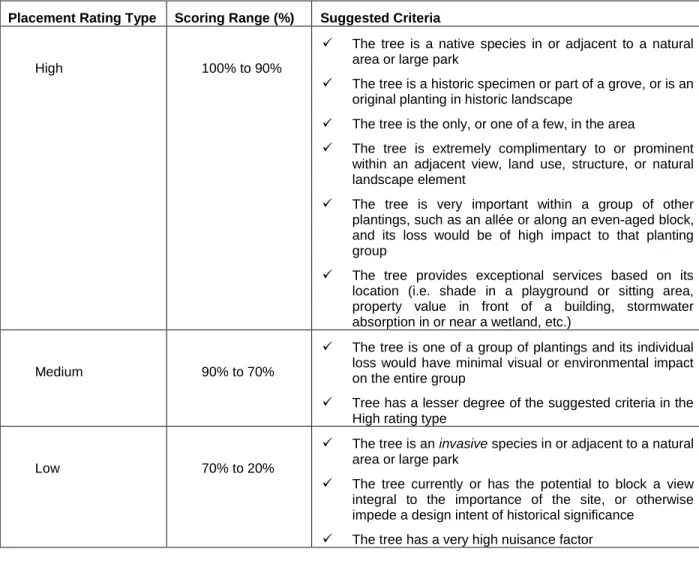
The Placement Rating is an assessment of a tree’s placement in its surrounding landscape, both in terms of its positioning and its contextual relationships. Table 2, below, describes the criteria used for determining the Placement Rating.
Table 2. Placement Rating matrix. A higher score reflects a higher aesthetic and function.
Placement Rating Type Scoring Range (%) Suggested Criteria
High 100% to 90%
The tree is a native species in or adjacent to a natural area or large park
The tree is a historic specimen or part of a grove, or is an original planting in historic landscape
The tree is the only, or one of a few, in the area
The tree is extremely complimentary to or prominent within an adjacent view, land use, structure, or natural landscape element
The tree is very important within a group of other plantings, such as an allée or along an even-aged block, and its loss would be of high impact to that planting group
The tree provides exceptional services based on its location (i.e. shade in a playground or sitting area, property value in front of a building, stormwater absorption in or near a wetland, etc.)
Medium 90% to 70%
The tree is one of a group of plantings and its individual loss would have minimal visual or environmental impact on the entire group
Tree has a lesser degree of the suggested criteria in the High rating type
Low 70% to 20%
The tree is an invasive species in or adjacent to a natural area or large park
The tree currently or has the potential to block a view integral to the importance of the site, or otherwise impede a design intent of historical significance
The tree has a very high nuisance factor
Illegal Tree Damage and Removal
Vandalism includes any action that purposefully injures or wounds a tree such as bark damage, branch damage or removal, root injury or loss, or any other physical damage done to a tree. All physical wounding will negatively impact the health of a tree in some way at some time.
If a tree is damaged beyond recovery or such that it poses an unacceptable safety risk, it has to be removed. In this case the tree is appraised as to its pre-damaged size and condition, with the remaining factors established as per the appraisal method above.
If a tree is destroyed and removed from the site leaving no further evidence, it is assumed to have been in perfect condition prior to its removal. In this case, the appraisal calculation is based on its size as measured by the cross-sectional (basal) area of the trunk. [The size is either extrapolated from the diameter of the remaining stump or from prior existing Agency records.] This basal area formula yields the number of replacement trees required to
March 2012 2 compensate for the loss of the original tree. The cost of planting the total number of replacement trees is the appraised value of the tree that was destroyed.
Conclusion
The New York City Parks Tree Valuation protocol establishes the replacement value of the tree based on its size, and then takes deductions, if required, based on the tree’s condition, species, and location. The tree’s combined score in these categories establishes the amount of the deductions. The departures from the CTLA Trunk Formula method leads to the development of a local—as opposed to regional—scoring system for the species, as well as a customization of the Location Factor. Ultimately, this appraisal methodology uses replacement trees as the valued currency rather than the monetary cost necessary to plant those trees, thus ensuring the continued maintenance and possible increase of canopy cover in New York City.
The NYC Parks Department will assist with identifying planting locations and provide a free planting permit to facilitate the planting of these replacement trees.
Please note, all replacement trees must be permitted and planting according to the specifications outlined on the Parks website…
NYC Parks Dept. is able to plant the replacement trees if requested upon payment of the current agency cost for planting
References
Nowak, DJ. 1994d. Air pollution removal by Chicago’s urban forest. In: McPherson, EG, Nowak, DJ, and RA Rowntree. Chicago’s Urban Forest Ecosystem: Results of the Chicago Urban Forest Climate Project. USDA Forest Service General Technical Report NE-186. Pp. 63-81. Nowak, DJ and Crane, DE. 2000. The Urban Forest Effects (UFORE) Model: quantifying urban
forest structure and functions. In: Hansen, M. (Ed.) Second International Symposium: Integrated Tools for Natural Resources Inventories in the 21st Century. USDA Forest Service General Technical Report.
Rosenzweig, C, Solecki, WD. (In press). Mitigating New York City’s Heat Island with Urban Forestry, Living Roofs, and Light Surfaces: New York City Regional Heat Island Initiative. Tree Species Ratings for New York State. Guidebook prepared by the Shade Tree Evaluation
Committee, 1995. An official publication of the New York State Arborists ISA Chapter, Inc. Urban, James. East River Park Bulkhead Reconstruction, Tree Preservation Recommendations.
Urban Trees + Soils, Annapolis, Maryland. June 13, 2005.
Wachter, S. 2004. The Determinants of neighborhood transformation in Philadelphia— identification and analysis: the New Kensington pilot study. The Wharton School, University of Pennsylvania, 24 pp.