Example Practice Papers for
Cambridge IGCSE® Mathematics Extended Practice Book
Example Practice Paper 2
2
Mark scheme for Paper 2
13
Example Practice Paper 4
17
1 NAME
Cambridge IGCSE Mathematics Extended Practice Book
Example Practice Paper 2 1 hour 30 minutes
PLEASE NOTE: this example practice paper contains exam-style questions only
READ THESE INSTRUCTIONS FIRST Answer all questions.
Working for a question should be written below the question.
If the answer is not exact but a degree of accuracy has not been provided, give the answer as follows: - to three significant figures for all values, except
- to one decimal place for degrees
- for π, use either your calculator value or 3.142.
The number of marks is given in brackets [ ] next to each question or part question. The total of the marks for this paper is 67.
PLEASE NOTE: this practice examination paper has been written in association with the below publication and is not an official exam paper:
2 Written specifically for the publication‘Cambridge IGCSE Mathematics Core Practice Book’. Cambridge International Examinations does not take responsibility for this content or the associated answers.
© Cambridge University Press, 2013
1
(a) For the diagram above write down (i) the order of rotational symmetry,
Answer(a)(i) ……… [1]
(ii) the number of lines of symmetry.
Answer(a)(ii) ……… [1]
(b) The prism below has 6 square faces and a regular hexagonal cross-section.
Write down the number of planes of symmetry for the prism.
Answer(b) ……… [1]
2 Calculate the value of
4 7 2 2 3 (2 3)
+ −
(a) writing down all the figures in your calculator answer,
Answer(a) ……… [1]
(b) writing you answer correct to 3 decimal places.
3 Written specifically for the publication‘Cambridge IGCSE Mathematics Core Practice Book’.
Cambridge International Examinations does not take responsibility for this content or the associated answers.
© Cambridge University Press, 2013
3 Find the midpoint of the line joining the points A(4, 3) and B(−3, 0).
Answer ( ……… , ………… ) [3]
4 Expand the brackets and simplify.
1
(9 3) 5( 3) 3 x− − x−
Answer ……… [2]
5 Zagreb changed $600 into euros at an exchange rate of $1 = €1.25.
He later changed all of the euros back into dollars at an exchange rate of $1 = €1.20. How many dollars did he receive?
Answer $ ……… [2]
6 Solve the simultaneous equations.
x + 4y = −19 3y – 5 = 2x
Answer x = ………
4 Written specifically for the publication‘Cambridge IGCSE Mathematics Core Practice Book’. Cambridge International Examinations does not take responsibility for this content or the associated answers.
© Cambridge University Press, 2013
7 The dimensions of a rectangle are 13 cm by 7 cm, correct to the nearest cm.
Find the smallest possible area of the rectangle.
Answer ……… cm2 [2]
8 The intensity of radiation from the Sun, R, is inversely proportional to the square of the distance from
the Sun, d.
When d = 2 ×10⁸, R = 20. Find d when R = 500.
Answer d = ……… [3]
9 Shade the region required in each Venn diagram.
( A ∩ B ) ∪ C A ∩ B'
[2]
10 A woman invested $300 for 5 years at 7% per year compound interest.
Calculate the final amount she had after 5 years.
Answer $ ……… [3]
A B
C
5 Written specifically for the publication‘Cambridge IGCSE Mathematics Core Practice Book’.
Cambridge International Examinations does not take responsibility for this content or the associated answers.
© Cambridge University Press, 2013
11
A = 3 4
1 2
−
⎛ ⎞
⎜ ⎟
⎝ ⎠
Work out
(a) A2
Answer(a)
⎛ ⎞
⎜ ⎟
⎜ ⎟
⎜ ⎟
⎝ ⎠
[2]
(b) A−1, the inverse of A
Answer(b)
⎛ ⎞
⎜ ⎟
⎜ ⎟
⎜ ⎟
⎝ ⎠
[2]
12
A conference table is made of two quarter circles and two identical triangles. The radius of the quarter circles is 0.7 m.
Calculate the surface area of the top of the table.
Answer ……… m2 [3]
0.7 m 0.7 m
6 Written specifically for the publication‘Cambridge IGCSE Mathematics Core Practice Book’. Cambridge International Examinations does not take responsibility for this content or the associated answers.
© Cambridge University Press, 2013
13 Make x the subject of 5
6 x y= −
Answer x = ……… [3]
14 The lengths of the sides of a parallelogram are 6 cm and 8 cm.
The length of the longer diagonal of the parallelogram is 11 cm. AB is a side of the parallelogram.
Using a straight edge and a compasses only, construct the parallelogram.
[3]
A B 8 cm
7 Written specifically for the publication‘Cambridge IGCSE Mathematics Core Practice Book’.
Cambridge International Examinations does not take responsibility for this content or the associated answers.
© Cambridge University Press, 2013
15
The graph above shows the journey of two cars, A and B.
(a) Work out the acceleration of car A during the first 10 seconds.
Answer(a) ……… m/s2 [2]
(b) Calculate how far car B travels before coming to rest.
Answer(b) ……… m [2]
(c) State which car experiences the highest deceleration.
Answer(c) ……… [1]
5 10 15 20 25 30 35 40 45 50 55 60
5 10 15 20 25 30 35 40
t Speed
(m/s)
Time (seconds) Car A
8 Written specifically for the publication‘Cambridge IGCSE Mathematics Core Practice Book’. Cambridge International Examinations does not take responsibility for this content or the associated answers.
© Cambridge University Press, 2013
16 Simplify (a)
0.6 10 32 x
⎛ ⎞
⎜ ⎟
⎝ ⎠
Answer(a) ……… [2]
(b)
( )
4x−3 −2÷2−2 5xAnswer(b) ……… [2]
17 Simplifying as much as possible, write the following as a single fraction.
2 2
6 16 1 5 14
x x
x x
+ −
−
+ −
9 Written specifically for the publication‘Cambridge IGCSE Mathematics Core Practice Book’.
Cambridge International Examinations does not take responsibility for this content or the associated answers.
© Cambridge University Press, 2013
18
(a) Draw the lines y = 12, 6x + 2y = 12 and y – 6x = 0 on the grid above. [4]
(b) Write the letter R in the region defined by the three inequalities below.
y ≤ 12 6x + 2y ≥ 12 y – 6x ≥ 0
[1]
−3 −2 −1 1 2 3
−2 2 4 6 8 10 12 14
x y
10 Written specifically for the publication‘Cambridge IGCSE Mathematics Core Practice Book’. Cambridge International Examinations does not take responsibility for this content or the associated answers.
© Cambridge University Press, 2013
19 Solve the equation.
x2 – 12x + 30 = 0
Show all your working and give your answers correct to 2 decimal places.
Answer x = ………… or x = ……… [3]
20 f(x) = x 5
x
−
g(x) = 12 x
(a) Work out f(3).
Answer(a) ……… [1]
(b) Find fg(x) in its simplest form.
Answer(b) ……… [2]
(c) Find f−1(x).
11 Written specifically for the publication‘Cambridge IGCSE Mathematics Core Practice Book’.
Cambridge International Examinations does not take responsibility for this content or the associated answers.
© Cambridge University Press, 2013
21
A, B, C and D lie on the circle, centre O. The line PCQ is a tangent to the circle at C.
Angle AOD = 62°, angle BAC = 42° and angle DCQ = 78°. Find
(a) angle ODA
Answer(a) Angle ODA = ……… [1]
(b) angle ACD
Answer(b) Angle ACD = ……… [1]
(c) Angle PCB = 42°, find BAD
Answer(c) Angle BAD = ……… [1]
O
78° 62° 42°
A
B
C
D
P
Q NOT TO
1 Written specifically for the publication‘Cambridge IGCSE Mathematics Core Practice Book’.
Cambridge International Examinations does not take responsibility for this content.
© Cambridge University Press, 2013
Cambridge IGCSE Mathematics Extended Practice Book Example Practice Paper 2 (Extended)
Mark Scheme
Key: A – Accuracy marks awarded for a correct answer seen.
M – Method marks awarded for clear attempt to apply correct method. oe – Or Equivalent.
“ ” – allow M marks for methods that include wrong answers from previous results.
1 (a)(i) 4 A1
(a)(ii) 0 A1
(b) 7 A1
2 (a) 52.64365994… (accept more figures) A1
(b) 52.644 A1
3 1
1 2
2(x +x ) or 12(y1+y2) M1
(0.5, 1.5) A1 A1
4 3x− −1 5x+15 M1
14 – 2x oe A1
5 600 × 1.25 ÷ 1.20 M1
$625 A1
6 Clear attempt at elimination or substitution method M1
x = −7, y = −3 A1 A1
7 12.5 × 6.5 (rounding down) M1
81.25 A1
8 500 ÷ 20 = 25 M1
2 × 10⁸ ÷ "25" (allow methods that involve finding a formula) M1
4 × 10⁷ oe A1
9
A1 A1 A B
C
2 Written specifically for the publication‘Cambridge IGCSE Mathematics Core Practice Book’. Cambridge International Examinations does not take responsibility for this content.
© Cambridge University Press, 2013
10 300 × 1.07n M1
300 × 1.075 M1
420.77 A1
11 (a) 5 20
1 0
−
⎛ ⎞
⎜ ⎟
⎝ ⎠ Any 2 correct M1
5 20 1 0
−
⎛ ⎞
⎜ ⎟
⎝ ⎠ All 4 correct A1
(b) 2 4
1 3
⎛ ⎞
⎜− ⎟
⎝ ⎠ seen or
1 10 M1 2 4 1 3 ⎛ ⎞ ⎜− ⎟
⎝ ⎠ seen and
1
10 ; accept
0.2 0.4 0.1 0.3
⎛ ⎞
⎜− ⎟
⎝ ⎠ A1
12 0.72 , π 0.72 2
×
M1 M1
1.26 m3 A1
13 6y= −5 x M1
5 6
x= − y M1
2 (5 6 )
x= − y A1
14 Two arcs at 6 cm from A and B M1
Arc at 11 cm from A or B M1
Arc at 8 cm from intersection of 11 cm and 6 cm arc, and fully correct answer A1
15 (a) 30 ÷ 10 M1
3 m/s2 A1
(b) 0.5 × 20 × 45 + 0.5 × 20 × 5 or 1
2× 50 × 20 (finding area under car B curve) M1
500 m A1
(c) Car A (it has the steeper downward gradient) A1
16 (a)
3 3
10 5 2
32 2 x x ⎛ ⎞ ⎛ ⎞ = ⎜ ⎟ ⎜ ⎟ ⎝ ⎠ ⎝ ⎠ M1 6 8 x A1
(b) 6
16 x ÷ 5 4 x M1 4 x A1
3 Written specifically for the publication‘Cambridge IGCSE Mathematics Core Practice Book’.
Cambridge International Examinations does not take responsibility for this content.
© Cambridge University Press, 2013
17 ( 2)( 8) 1
( 2)( 7)
x x
x x
− + −
− + M1
8 7 7 7 x x x x + + −
+ + M1
8 7 7 x x x + − − + M1 1 7
x+ A1
18 (a)
A1 A1 A1 A1
(b) R labelled in triangle formed by lines A1
19 12 144 120
2
x= ± − M1
8.45, 3.55 A1 A1
20 (a) 2
3
− A1
(b) 2
2 1 1 5 x x − M1 2
1 5x− A1
(c) x y 5
y
−
= exchange letters, rearrange to y = … M1
1 5
f ( ) 1 x
x
− =
− A1
−3 −2 −1 1 2 3
−2 2 4 6 8 10 12 14 x y
4 Written specifically for the publication‘Cambridge IGCSE Mathematics Core Practice Book’. Cambridge International Examinations does not take responsibility for this content.
© Cambridge University Press, 2013
21 (a) 59° (isosceles triangle) A1
(b) 31° (angle at centre = 2 × angle at circumference) A1 (c) 120° (opposite angles in a cyclic quadrilateral) A1
Total: 67
1 NAME
Cambridge IGCSE Mathematics Extended Practice Book
Example Practice Paper 4 2 hours 30 minutes
PLEASE NOTE: this example practice paper contains exam-style questions only
READ THESE INSTRUCTIONS FIRST Answer all questions.
Working for a question should be written below the question.
If the answer is not exact but a degree of accuracy has not been provided, give the answer as follows: - to three significant figures for all values, except
- to one decimal place for degrees
- for π, use either your calculator value or 3.142.
The number of marks is given in brackets [ ] next to each question or part question. The total of the marks for this paper is 130.
PLEASE NOTE: this practice examination paper has been written in association with the below publication and is not an official exam paper:
2 Written specifically for the publication‘Cambridge IGCSE Mathematics Core Practice Book’. Cambridge International Examinations does not take responsibility for this content or the associated answers.
© Cambridge University Press, 2013
1 One way to measure the height of a flag pole from the ground is to stand in two different positions
and measure the angle of inclination of the top of the pole, as well as the difference between the two positions. This is shown below.
In Diagram 1, angle DAC = 20° and angle DBC = 30°. The length AB = 5 m.
(a) Find
(i) angle ABD,
Answer(a)(i) ……… [1]
(ii) angle ADB,
Answer(a)(ii) ……… [1]
(iii) the length BD, using the sine rule,
Answer(a)(iii) ……… m [3]
(iv) the height of the flag pole, CD.
Answer(a)(iv) ……… m [3] 5 m
A
B
C
D
20° 30°
Diagram 1
NOT TO SCALE
3 Written specifically for the publication‘Cambridge IGCSE Mathematics Extended Practice Book’.
Cambridge International Examinations does not take responsibility for this content or the associated answers.
© Cambridge University Press, 2013
Another way to measure the height of the flag pole is to use two short poles of a known height and line them up so that their tops aim towards the flag. This is shown in Diagram 2.
In Diagram 2, BC = 2 m, DE = 3 m, BD = 4 m and DF = 120 m.
(b) (i) By considering the similar triangles ABC and ADE, find the length of AB.
Answer(b)(i) ……… m [3]
(ii) By considering the similar triangles ABC and AFG, find the height of the flagpole, FG.
Answer(b)(ii) ……… m [2] 4 m
A
D
F
G
Diagram 2
NOT TO SCALE
B
2 m 3 m
C
E
4
2
(a) D (i Answe (i Answe (i Answe
−
8
Writt Cambridge In Describe fullyi) triangle A
er(a)(i) ……
ii) triangle C
er(a)(ii) ……
iii) triangle D
er(a)(iii) ……
−
7
−
6
−
A
B
C
ten specifically fo
nternational Exam
y the single t
A onto C,
……… C onto D,
……… D onto E,
………
−
5
−
4
−
or the publication
minations does no
© Cambri transformatio
………
………
………
−
3
−
2
−
1
−
−
−
−
−
−
n‘Cambridge IGC ot take responsibi
idge University P on which ma
……… ……… ………
1
1
−
6
−
5
−
4
−
3
−
2
−
1
1
2
3
4
5
6
7
8
y
CSE Mathematics ility for this contePress, 2013 aps ……… ……… ………
2
3
Ds Core Practice B ent or the associa
……… ……… ………
4
5
E Book’. ated answers. ……… ……… ………6
7
x
[2] … [3] … [3]8
x
5 Written specifically for the publication‘Cambridge IGCSE Mathematics Extended Practice Book’.
Cambridge International Examinations does not take responsibility for this content or the associated answers.
© Cambridge University Press, 2013
(iv) triangle Bon to A.
Answer(a)(iv) ……… [3]
(b) Find the matrix representing the transformation which maps (i) triangle A onto C,
Answer(b)(i)
⎛ ⎞
⎜ ⎟
⎜ ⎟
⎜ ⎟
⎝ ⎠
[2]
(ii) triangle B onto A.
Answer(b)(ii)
⎛ ⎞
⎜ ⎟
⎜ ⎟
⎜ ⎟
⎝ ⎠
6 Written specifically for the publication‘Cambridge IGCSE Mathematics Core Practice Book’. Cambridge International Examinations does not take responsibility for this content or the associated answers.
© Cambridge University Press, 2013
3
The diagram shows a rectangle with a width of x cm and a height of y cm.
(a) (i) If the perimeter of the rectangle is 68 cm, show that y = 34 – x.
Answer(a)(i)
[2]
(ii) The diagonal of the rectangle is 26 cm.
Show, using Pythagoras’ theorem, that x satisfies the equation x2 – 34x + 240 = 0. Answer(a)(ii)
[3]
(iii) Factorise x2 – 34x + 240.
Answer(a)(iii) ……… [2]
(iv) Solve the equation x2 – 34x + 240 = 0.
Answer(a)(iv) x = ……… or x = ……… [1] A
B C
D
26 cm
x cm
y cm NOT TO
SCALE
7 Written specifically for the publication‘Cambridge IGCSE Mathematics Extended Practice Book’.
Cambridge International Examinations does not take responsibility for this content or the associated answers.
© Cambridge University Press, 2013
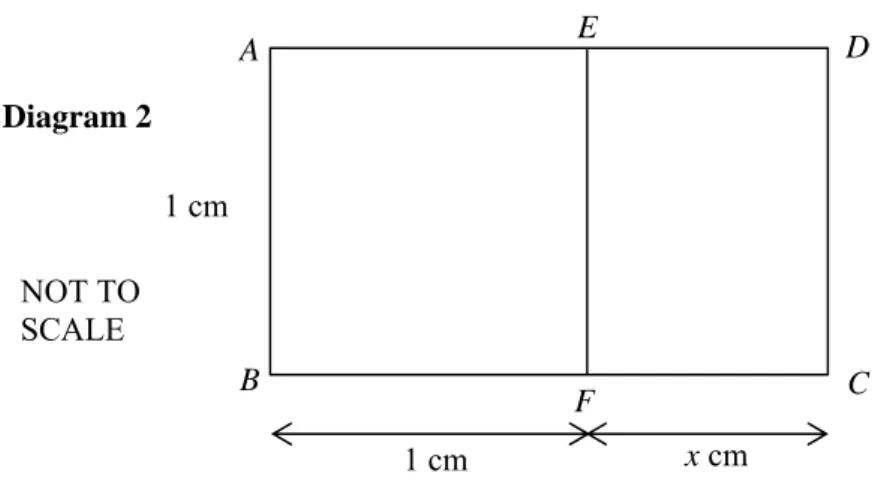
Diagram 2 shows a different rectangle. The line EF cuts ABCD into two rectangles. (b) (i) Rectangle ABCD is similar to rectangle DEFC.
Show that x2 + x – 1 = 0. Answer(b)(i)
[3]
(ii) Solve the equation x2 + x – 1 = 0, giving your answers correct to 3 decimal places.
Answer(b)(ii) x = ……… or x = ……… [3] A
B C
D
x cm NOT TO
SCALE
Diagram 2
E
F 1 cm
8 Written specifically for the publication‘Cambridge IGCSE Mathematics Core Practice Book’. Cambridge International Examinations does not take responsibility for this content or the associated answers.
© Cambridge University Press, 2013
4 (a) The table shows some values for the equation
4 3 5 x y= +x .
x −5.5 −5 −4 −3.5 −3 −2 −1 0 1 1.5 2
y 16.6 −12.8 −12.9 −10.8 −4.8 −0.8 1.2 11.2
(i) Write the missing values of y in the empty spaces. [3] (ii) On the grid, draw the graph of
4 3 5 x
y= +x for −5.5 ≤ x ≤ 2.
[5]
−6 −5 −4 −3 −2 −1 1 2
−20
−15
−10
−5 5 10 15 20
x y
9 Written specifically for the publication‘Cambridge IGCSE Mathematics Extended Practice Book’.
Cambridge International Examinations does not take responsibility for this content or the associated answers.
© Cambridge University Press, 2013
(b) Use your graph to solve the equation
4
3 5 5
x x
+ = .
Answer(b) x = ……… or x = ……… [2]
(c) (i) By drawing a tangent, work out the gradient of the graph where x = −1.5.
Answer(c)(i) ……… [3]
(ii) Write down the gradient of the graph where x = 0.
Answer(c)(ii) ……… [1]
(d) (i) On the grid, draw the line y = −2x – 10. [1]
(ii) Use your graphs to solve the equation
4
3 2 10 0 5
x
x x
+ + + = .
10 Written specifically for the publication‘Cambridge IGCSE Mathematics Core Practice Book’. Cambridge International Examinations does not take responsibility for this content or the associated answers.
© Cambridge University Press, 2013
5 Bag A contains 5 red beads and 5 green beads.
Bag B contains 2 red beads and 3 green beads.
A bead is taken at random from bag A, then a bead is taken at random from bag B.
(a) Complete the tree diagram below, showing the probabilities of each outcome. [3]
(b) Calculate the probability that (i) two red beads are picked,
Answer(b)(i) ……… [2]
(ii) exactly one red bead is picked.
Answer(b)(ii) ……… [2] Red
Green
Red
Green
Bag A Bag B
Red
11 Written specifically for the publication‘Cambridge IGCSE Mathematics Extended Practice Book’.
Cambridge International Examinations does not take responsibility for this content or the associated answers.
© Cambridge University Press, 2013
(c) All the beads are returned to the bags.
A bead is taken from bag A, its colour noted, and placed in bag B. A bead is now taken from bag B.
(i) Complete the tree diagram to show the new probabilities. [3]
Calculate the probability that
(ii) two red beads are picked,
Answer(c)(ii) ……… [2]
(iii) at least one green bead is picked.
Answer(c)(iii) ……… [2] Red
Green
Red
Green
Bag A Bag B
Red
12 Written specifically for the publication‘Cambridge IGCSE Mathematics Core Practice Book’. Cambridge International Examinations does not take responsibility for this content or the associated answers.
© Cambridge University Press, 2013
6
A small cylindrical mug has a diameter of 8 cm, and a holds 500 cm3 of water.
(a) Calculate the height of the small mug.
Answer(a) ………cm [2]
(b) (i) Work out how many cm3 there are in 1 m3.
Answer(b)(i) ……… [2]
(ii) Work out how many small mugs would be filled by 1 m3 of water.
Answer(b)(ii) ……… [1]
13 Written specifically for the publication‘Cambridge IGCSE Mathematics Extended Practice Book’.
Cambridge International Examinations does not take responsibility for this content or the associated answers.
© Cambridge University Press, 2013
(c) The large mug holds 1000 cm3 of water.
(i) Work out the scale factor for volumes between the small and large mug.
Answer(c)(i) ……… [1]
(ii) Work out the scale factor for lengths between the small and large mug.
Answer(c)(ii) ……… [2]
(iii) Work out the height of the large mug.
Answer(c)(iii) ………cm [2]
(d) Calculate the volume of the largest sphere which would fit inside the large mug.
14 Written specifically for the publication‘Cambridge IGCSE Mathematics Core Practice Book’. Cambridge International Examinations does not take responsibility for this content or the associated answers.
© Cambridge University Press, 2013
7 The heights of 120 trees in an orchard are measured.
The results are used to draw this cumulative frequency diagram.
(a) Find
(i) the median height,
Answer(a)(i) ………cm [1]
(ii) the lower quartile,
Answer(a)(ii) ………cm [1]
(iii) the interquartile range,
Answer(a)(iii) ………cm [1]
(iv) the number of trees with a height greater than 316 cm.
Answer(a)(iv) ……… [2] 140 160 180 200 220 240 260 280 300 320 340 360 380 0
10 20 30 40 50 60 70 80 90 100 110 120
Height (cm) Cumulative frequency
15 Written specifically for the publication‘Cambridge IGCSE Mathematics Extended Practice Book’.
Cambridge International Examinations does not take responsibility for this content or the associated answers.
© Cambridge University Press, 2013
(b) The frequency table shows the information about the 120 trees that were measured.
Height (h cm) 140 ≤ h ≤ 200 200 ≤ h ≤ 220 220 ≤ h ≤ 260 260 ≤ h ≤ 300 300 ≤ h ≤ 380
Frequency 10 40 30
(i) Use the cumulative frequency diagram to complete the table above. [2] (ii) Construct a histogram to represent this information.
[4]
(c) Calculate an estimate of the mean height of the 120 trees.
Answer(c) ……… [3]
140 160 180 200 220 240 260 280 300 320 340 360 380
0 Frequency density
16 Written specifically for the publication‘Cambridge IGCSE Mathematics Core Practice Book’. Cambridge International Examinations does not take responsibility for this content or the associated answers.
© Cambridge University Press, 2013
8 (a) Solve the equation 5 2 4
6 9
x− + x+ = −
Answer(a) x = ……… [4]
(b) (i) 5 4
3 4
y
x x
= −
− +
Find the value of y when x = 2.
Answer(b)(i) y = ……… [2]
(ii) Write 5 4
3 4
x− −x+ as a single fraction.
17 Written specifically for the publication‘Cambridge IGCSE Mathematics Extended Practice Book’.
Cambridge International Examinations does not take responsibility for this content or the associated answers.
© Cambridge University Press, 2013
(iii) Solve the equation 5 4 1
3 4
x− −x+ = x
Answer(b)(iii) x = ……… [3]
(c) a b c d
= +
Find c in terms of a, b and d.
18 Written specifically for the publication‘Cambridge IGCSE Mathematics Core Practice Book’. Cambridge International Examinations does not take responsibility for this content or the associated answers.
© Cambridge University Press, 2013
9
The diagram shows the triangle PQS.
T is the midpoint of PS and R divides QS in the ratio 1 : 3. PT=a
JJJG
and PQ=b
JJJG
.
(a) Express in terms of a and/or b, as simply as possible,the vectors (i) PSJJJG
Answer(a)(i) PS
JJJG
= ……… [1]
(ii) QSJJJG
Answer(a)(ii) QSJJJG= ……… [2]
(iii) PRJJJG
Answer(a)(iii) PRJJJG= ……… [2]
(b) Show that 1(2 3 )
4
RT = a− b
JJJG
Answer(b)
[3] P
Q R S
19 Written specifically for the publication‘Cambridge IGCSE Mathematics Extended Practice Book’.
Cambridge International Examinations does not take responsibility for this content or the associated answers.
© Cambridge University Press, 2013
10
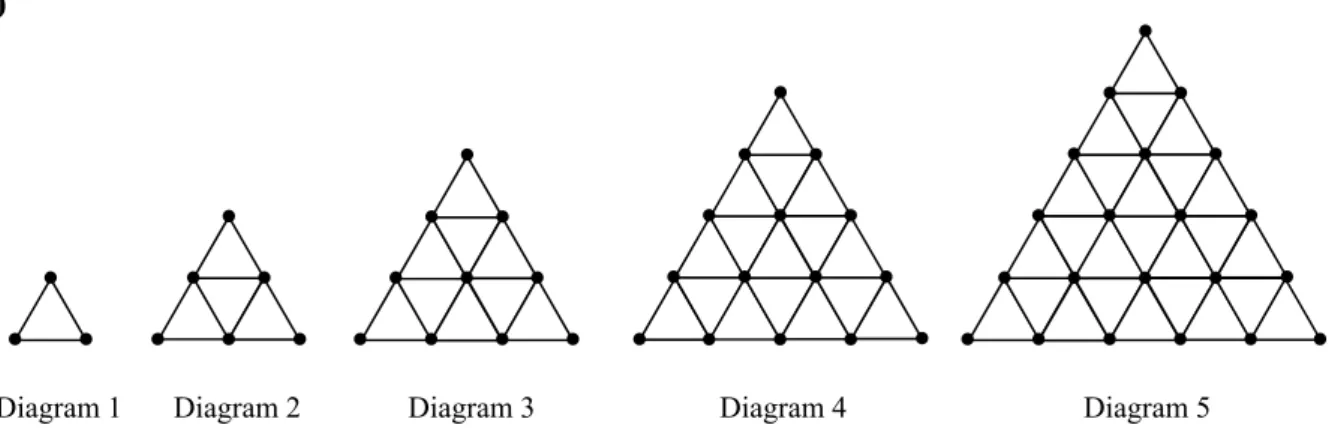
The diagram shows a pattern of triangles of dots.
(a) Complete the table below.
Diagram number 1 2 3 4 5
Number of triangles 1 4 9
Number of dots 3 6 10
[2]
(b) Work out the number of triangles and the number of dots in the 8th diagram.
Answer (b) Number of triangles = ……… , Number of dots = ……… [2]
(c) Write down an expression for the number of triangles in the nth diagram.
Answer(c) ………... [1]
(d) The number of dots in the nth diagram is k n( 2+3n+2). Find
(i) the value of k,
Answer(d)(i) k = ……… [2]
(ii) the number of dots in diagram 100.
Answer(d)(ii) ……… [1]
1 Written specifically for the publication‘Cambridge IGCSE Mathematics Core Practice Book’.
Cambridge International Examinations does not take responsibility for this content.
© Cambridge University Press, 2013
Cambridge IGCSE Mathematics Extended Practice Book Example Practice Paper 4 (Extended)
Mark Scheme
Key: A – Accuracy marks awarded for a correct answer seen.
M – Method marks awarded for clear attempt to apply correct method. oe – Or Equivalent.
“ ” – allow M marks for methods that include wrong answers from previous results.
1 (a)(i) 150° A1
(a)(ii) 10° A1
(a)(iii) 5
sin 20 sin10 BD =
° ° M1 M1
9.85 m A1
(a)(iv) sin 30 CD BD
° = M1
CD = sin 30° × “9.848…” M1
4.92 m A1
(b)(i) 3 4
2
AB AB
+
= M1
3AB= +8 2AB M1
AB = 8 m A1
(b)(ii) 132
8 2
FG
= M1
FG = 33 m A1
2 (a)(i) Reflection, in x-axis A1 A1
(a)(ii) Enlargement, factor 1
3, centre (6, 6)
A1 A1 A1
(a)(iii) Rotation, 180°, about (3, −1) A1 A1
A1 (a)(iv) Stretch in y-direction, scale factor 3, about x-axis as invariant line A1 A1
A1
(b)(i) 1 0
... ...
⎛ ⎞
⎜ ⎟
⎝ ⎠ A1
... ...
0 1
⎛ ⎞
⎜ − ⎟
⎝ ⎠ A1
(b)(ii) 1 0 ... ...
⎛ ⎞
⎜ ⎟
⎝ ⎠ A1
... ... 0 3
⎛ ⎞
⎜ ⎟
2
Written specifically for the publication‘Cambridge IGCSE Mathematics Core Practice Book’. Cambridge International Examinations does not take responsibility for this content.
© Cambridge University Press, 2013
3 (a)(i) 2x+2y=68 M1
34
x+ =y A1
(a)(ii) x2 +y2 =262 M1
2 (34 )2 262
x + −x = M1
2 2 2
2x +68x+34 −26 =0 proceeding to result M1
(a)(iii) (x−10)(x−24) A1 A1
(a)(iv) x = 10 or 24 A1
(b)(i) AD DC
AB = FC oe M1
1 1
1 x
x
+
= oe M1
(1 ) 1
x +x = leading to result A1
(b)(ii) 1 5
2
x=− ± M1
x = 0.618, −1.618 A1 A1
4 (a)(i) 0, 0, 4.4 (accept 4.39) A1 A1
A1 (a)(ii) Shape A1 Points accurate A1 A1 Smooth curve A1 Domain correct A1
(b) −5.2, 1.6 (allow ± 0.5 squares from their graph) A1 A1
(c)(i) Correct tangent drawn M1
Correct triangle used to calculate gradient M1
Gradient = approx. 4 A1
(c)(ii) 0 A1
−6 −5 −4 −3 −2 −1 1 2
−20 −15 −10 −5 5 10 15 20 x y
3 Written specifically for the publication‘Cambridge IGCSE Mathematics Core Practice Book’.
Cambridge International Examinations does not take responsibility for this content.
© Cambridge University Press, 2013
(d)(i) A1
(d)(ii) −5, −2.2 (allow ± 0.5 squares) A1 A1
5 (a)
From top to bottom of tree diagram: P(G) = 3/5,
P(R) = 2/5, P(G) = 3/5
A1 A1 A1
(b)(i) 5 2
10 5× M1
0.2 oe A1
(b)(ii) 5 3 5 2
10 5 10 5
⎛ × ⎞ ⎛+ × ⎞
⎜ ⎟ ⎜ ⎟
⎝ ⎠ ⎝ ⎠ M1
0.5 oe A1
(c)(i)
From top to bottom of tree diagram: P(G) = 3/6,
P(R) = 2/6, P(G) = 4/6
A1 A1 A1 (c)(ii) 5 3
10 6× M1
0.25 oe A1
(c)(iii) 1 0.25− oe M1
0.75 oe A1
−6 −5 −4 −3 −2 −1 1 2
−20
−15
−10
−5 5 10 15 20
x y
4
Written specifically for the publication‘Cambridge IGCSE Mathematics Core Practice Book’. Cambridge International Examinations does not take responsibility for this content.
© Cambridge University Press, 2013
6 (a) 5002
π×4 M1
9.95 cm A1
(b)(i) 1003 = 1 000 000 oe M1 A1
(b)(ii) 1 000 000
500 = 2000 A1
(c)(i) 1000
500 = 2 A1
(c)(ii) 32 M1
1.26 A1
(c)(iii) “9.95” × “1.26” M1
12.5 cm A1
(d) r = 4 × “1.26” = 5.04… M1
3 4
π(5.04...) 3
V = M1
536 cm3 A1
7 (a)(i) 270 cm A1
(a)(ii) 236 cm A1
(a)(iii) 300 – 236 = 64 cm A1
(a)(iv) Reading correctly at 316 cm M1
120 – 100 = 20 trees A1
(b)(i) 10, 30 A1 A1
(b)(ii) Widths A1 Relative heights A1 A1 Correct FDs A1
(c) 10 170 10 210 30 240 40 280 30 340 32400× + × + × + × + × = M1 "32400"
120 M1
270 cm A1
140 160 180 200 220 240 260 280 300 320 340 360 380 0 0.2 0.4 0.6 0.8 1 x f
5 Written specifically for the publication‘Cambridge IGCSE Mathematics Core Practice Book’.
Cambridge International Examinations does not take responsibility for this content.
© Cambridge University Press, 2013
8 (a) Finding LCM of 6 and 9 (18) M1
3( 5) 2( 2) 4 18
x− + x+
= − M1
3x−15 2+ x+ = −4 72 M1
61 5
x= − oe A1
(b)(i) 5 4
1 6−
− M1
2 3 5
− oe A1
(b)(ii) 5( 4) 4( 3) ( 3)( 4)
x x
x x
+ − −
− + M1
32 ( 3)( 4)
x
x x
+
− + (allow expanded denominator) A1
(b)(iii) 32 1
( 3)( 4) x
x x x
+ =
− + M1
2 32 2 12
x + x=x + −x leading to 31x= −12 M1 12
31
x= − A1
(c) a c( +d)=b M1
b c d
a
+ = M1
b
c d
a
= − oe A1
9 (a)(i) 2a A1
(a)(ii) QSJJJG JJJG JJJG=QP+PS M1
−b + 2a A1
(a)(iii) PR=PQ+QR JJJG JJJG JJJG
leading to 1
4( 2 )
+ − +
b b a M1
3 1
4b+2a A1
(b) RT =RQ+QP+PT JJJG JJJG JJJG JJJG
or PR + RT = a, so RT = a−PR M1 1
4( 2 )
− − +b a − +b a or a − (¾b + ½a) = ½a− ¾b M1
3 1
4 2
− b+ a leading to result given A1
10 (a) Triangles 16, 25 A1
Dots 15, 21 A1
(b) Triangles 64, Dots 45 A1 A1
(c) n2 A1
(d)(i) (12 3 1 2) 3
k + × + = M1
k = 0.5 A1
(d)(ii) 0.5(1002+ ×3 100 2) 5151+ = A1
Total: 130