Classroom Assessments for Improving Writing
Proficiency of English Language Learners:
Innovation, Interaction, and Impact
Dipima Buragohain Universiti Malaysia Perlis, Malaysia
Abstract—Classroom assessments are one of the most essential educational tools which can help teachers understand what their students are learning, by means of a) identifying students’ strengths and weaknesses, b) monitoring their learning and progress, and c) planning and conducting instruction. The current study aims at investigating various strategies of classroom assessments for improving writing proficiency of English language learners (ELLs) while highlighting primarily on three parameters: 1) innovation (new and innovative classroom assessment strategies), 2) interaction (student interactivity and engagement), and 3) impact (impact of the new assessment strategies on ESL writing proficiency in particular and overall learning process and proficiency in general).
Index Terms—classroom assessments, English language learners, technology-integrated assessments, English language learning, ESL writing proficiency
I. INTRODUCTION
Assessment in English language teaching and learning is a significant process to monitor and evaluate student progress, proficiency and performance on various topics. Classroom assessments are one of the most essential educational tools which can help teachers understand what their students are learning, by means of a) identifying students’ strengths and weaknesses, b) monitoring their learning and progress, and c) planning and conducting instruction. Whereas students form their knowledge of concepts taught during their learning period by submitting these assessments, and analysing and internalising their teachers’ feedback (Brown, 2004). The current study aims at investigating various strategies of classroom assessments for improving writing proficiency of English language learners (ELLs) while highlighting primarily on three parameters: i) innovation, ii) interaction, and iii) impact. Further, based on these parameters, the main objectives of the study include investigating,
• RO1: Innovative classroom assessment strategies for ELLs
• RO2: Learner interactivity and engagement in these classroom assessments
• RO3: Impact of these classroom assessments on the ESL writing proficiency in particular and the overall English language learning process and learner proficiency in general
Background:
Assessment is a process of tasks provided by the teacher of a subject along with instructions to evaluate students’ performance. Students are required to perform these instructed tasks to demonstrate their knowledge or aptitude in the subject area. In terms of classroom assessments, a clear definition is not easy since such assessments can be conducted for various purposes such as checking students’ proficiency, placement or aptitude levels (Brown, 2004). ESL classroom assessments are greatly formative in nature that can be used for achieving student performance as well as for measuring their proficiency level (Brown, 2004). In order to identify students’ strengths and weaknesses as well as understand the range of student knowledge and skills, it is better to use a variety of classroom assessments. Some of the common classroom assessment strategies are described below (Regier, 2012).
1. Student-teacher conference: Interactive discussion between students and teacher is one of the best ways to revise writing skills. Short classroom discussions can be effective to let students share and explain what they want to say through their writing.
2. Peer evaluation: Students assessing and evaluating each other based on the guidelines provided by their instructors can be effective in terms of discussing, analysing, and understanding topics.
3. Self-assessment: Students assessing their own writing proficiency by means of following stages –outlining, drafting, revising, editing, and delivering – can be effective in terms of discussing, analysing, and understanding topics.
4. Writing file: A writing file – a notebook of assignments – of a student provides a record of progress. A cumulative writing file enables the student to observe his or her progress in totality on the various aspects of the subject.
6. Tests: Classroom assessment via tests and quizzes is relevant for students in order to understand their direction and degree of effort. In education systems where formal evaluation is the norm, it is important to evaluate their progress on the concepts and ideas learned in classrooms which makes classroom assessments a great part of the formative assessment.
The present study focuses on a variety of classroom assessment strategies of ELLs on writing proficiency while addressing the parameters of innovation, interaction, and impact by means of investigating the following research questions:
• RQ1: What are the new and innovative classroom assessment strategies to be used effectively for improving writing skills of ELLs?
• RQ2: How can these assessments enable ELLs to interact and engage in English language learning?
• RQ3: What impact can these assessments have in the overall learning process and writing proficiency of ELLs?
II. LITERATURE REVIEW
Previous studies have addressed various aspects of classroom assessment of language learning (Cheng, Rogers, & Hu, 2004; Ke, 2006; Ketabi & Ketabi, 2014). While investigating English language classroom assessments in Canada, Beijing, and Hong Kong, the authors (Cheng et al., 2004) found that classroom assessments are determined by a number of factors such as total strength of students in an English language class, influence of formal testing and the role of classroom assessments in the overall learning process. The study also reported other significant indicators of complexities of classroom assessment including nature of the English language course, students’ proficiency level, and teaching experience of the instructor. Another study (Ke, 2006) proposed a skill-integrated model for formative task-based language assessment which was developed from classroom activities. Classroom assessments can not only influence improving language skills but also promote students’ motivation and performance level (Wei, 2010). This study conducted an action research on the significance of formative assessment and found that such assessments can be improved by needs analysis and assessment plan implementation.
When it comes to innovation in language learning, technology plays a crucial role (Cutter, 2015; Kennedy & Soifer, 2013; Price, Pierson, & Light, 2011). Current trends of technology-driven globalisation not only create an increased population of ELLs but also provide them with the opportunity to engage in the best learning practices and professional development. Implementing technology into language classrooms enables teachers and learners to support student growth as well as enhancement of the teaching and learning experience (Cutter, 2015; Doran, 2014). It has further positive effects of promoting learning and motivation of ELLs through their increased engagement and interactivity by means of individual and collaborative experimentation (O’Hara, Pritchard, Huang, & Pella, 2013). Moreover, use of technology in classrooms can simplify culturally responsive teaching, particularly enabling the English language teachers reach out their culturally and linguistically diverse ELLs easily (O’Hara et al., 2013).
III. RESEARCH FRAMEWORK
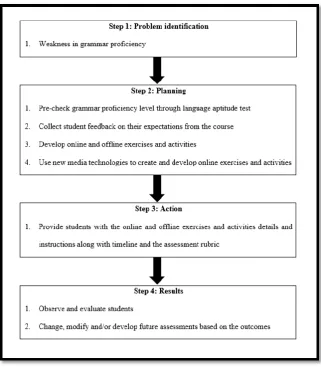
Figure 1: Research Framework
Step 1: Problem identification
The existing ETC classroom assessments for Engineering undergraduates include exercises from the ETC textbook, proposal report submission and presentation. Due to its advance-level content specific to writing skills in technical communication as well as its eligibility requirements mentioned earlier, the exercises exclude basic grammatical concepts which are equally important for English language writing proficiency. Grammatical errors such as sentence structuring, correct use of tense and parts of speech like preposition, punctuation errors, etc. are apparent in students’ assignment notebooks which require regular practice to identify, rectify and improve.
Step 2: Planning
At the beginning of the academic semester, a language aptitude test was conducted on the general learning concepts of English mainly addressing various grammatical terms and concepts to check students’ writing proficiency level. Moreover, a feedback form of student expectations from the course was also collected from students to get an understanding of what existing language skills (mainly writing) they want to improve and what new they want to learn. Further, based on the aptitude test and feedback forms, the current study has focused on the following aspects to highlight and improve students’ problems in writing skills:
• Focus on the following grammatical concepts within the periphery of the ETC curriculum: comprehension, concepts of technical communication, synonyms-antonyms, common errors, cohesion, transitional words, sentence fragments, summary writing, paraphrasing and tenses
• Develop online and offline exercises and activities for students to improve their writing proficiency • Use new media technologies to create and develop online exercises and activities
Step 3: Action
Students were provided with the online and offline exercises and activities as instructed by the author – through the author’s personal blog and web page developed specifically for it and classroom sessions, respectively. The assessments were followed through a timeline and assessment rubrics finalised at the beginning of the semester.
Step 4: Results
the end of the semester, the learning process showed remarkable outcomes in the form of students’ individual development as well as their overall improvement in ETC and English writing proficiency.
IV. DISCUSSION
The current study addresses English language classroom assessment strategies on writing skills while highlighting innovation, interaction, and impact of the assessment strategies on students’ writing proficiency and overall learning process. As a classroom action research, the study included the development of classroom assessment strategies based on the ETC course of the Engineering undergraduate students of UniMAP, Malaysia. As per the requirements of the advanced-level course, ETC students are expected to possess basic grammatical knowledge and hence their classroom assessments are mainly focused on writing technical documents. However, in the initial course of the semester, a language aptitude test (containing basic grammar concepts) and a feedback form of student expectations from the course – as shown in tables 1 and 2 below – were conducted and collected from students.
TABLE 1:
LANGUAGE APTITUDE TEST DETAILS
Concepts Instruction
Tenses Students are required to a) listen to the lyrics of a popular English song provided and b) list the words with tense (whether past, present or future) and its sub-tense types.
Irregular verbs Students are required to a) choose the irregular verbs from the options given and b) put them in the appropriate position in the sentences provided.
Synonyms and antonyms Students are required to a) fill in the blank spaces or b) answer with the appropriate words in the sentences provided.
Common errors Students are required to spot the errors in the sentences provided and rewrite them correctly. Complete sentences Students are required to identify if the sentences provided are complete or fragments.
TABLE 2:
STUDENT EXPECTATIONS FEEDBACK FORM DETAILS
Concern areas Questions
Basic language skills (listening, speaking, reading, and writing)
1. How do you learn to a) listen, b) speak, c) read, and d) write in English? 2. Which of these skills do you feel the most and least comfortable about, and why? 3. Which of these skills do you want to improve and how?
Usability of language 1. What language(s) do you use for communicating a) with family, b) with friends, c) with teachers, and d) on social media?
2. You are very good at or creative in ____. 3. How do you try to learn new words in English?
Relevance of English language 1. How do you update yourself about current affairs of the world? 2. You have chosen to take this course because ______. 3. Studying English is important to you because _____.
This further led to the identification of lack of grammar proficiency among ELLs as a serious concern. In order to address this concern, the author has developed a set of technology-integrated classroom assessment strategies including grammatical concepts based on the ETC curriculum. These strategies are discussed below along with the three parameters of the study.
A. Innovation
TABLE 3: LEARNING TOOLS DETAILS
Tool Description Learning mode Learner
engagement
Learning objective
Crosswords Puzzles with course-integrated concepts
Online Individual Self-directed and self-evaluated learning with instructions provided
MCQs Blog-based questions to understand the concepts of technical
communication
Online Individual Self-directed and self-evaluated learning with instructions provided
Puzzles Picture-based and wordsearch puzzles integrating cultural content with course-related concepts
Online Individual Self-directed and self-evaluated learning with instructions provided
Quizzes Matching columns game integrating cultural content with grammatical concepts like comprehension, paraphrasing and sentence structure
Online Individual Self-directed and self-evaluated learning with instructions provided
Poster presentations Preparing posters on topics of general knowledge and socio-cultural issues as varied as impact of globalisation, benefits of a green university campus, student engagement in university life, etc.
Offline Group Task-based, goal-oriented learning with instructions provided
Film screening and discussion sessions
Screening of short films and documentaries on topics as varied as effects of social media, attitude of millennials, social communication skills, etc.
Offline Individual Analytical learning with critical thinking and brainstorming along with instructions provided
Audio-visual presentations
Preparing and presenting videos (DVD, PPT) on topics of social awareness as varied as cross-cultural communication, social interactivity of students, languages and cultures, etc.
Offline Group Observational, task-based learning of social responsibility with instructions provided
Debates Brainstorming and discussion on topics of general knowledge and current affairs
Offline Individual and group
Analytical, goal-oriented learning along with brainstorming with instructions provided
Students were instructed with a detailed timeline for assignment submission and assessment rubrics at the beginning of the semester. The modes of submission were as varied as WhatsApp, YouTube, email, DVD, poster, and notebook submission.
B. Interaction
One of the main purposes of classroom assessments is to improve students’ engagement and interactivity in the learning process. This interactivity can be functional in two ways: interaction a) between students and teachers, and b) among students. New media technologies and tools (WhatsApp, YouTube, blogs, and emails as used in the current study) are integral part of student-teacher interaction that can happen in synchronous and/or asynchronous ways. Apart from that, peer assessment is also crucial in terms of discussing, analysing and understanding the learning concepts. The classroom assessments developed for ETC students included individual and group activities that enabled students to effectively interact with their teacher and peers, as shown in Table 4 below.
TABLE 4:
LEARNER INTERACTIVITY DETAILS
Assessment Evaluation type Interaction level Tools and technologies
Crosswords Self-evaluation Teacher-student Blog, educational webpage, WhatsApp MCQs Self-evaluation Teacher-student Blog, educational webpage, WhatsApp Puzzles Self-evaluation Teacher-student Blog, educational webpage, WhatsApp Quizzes Self-evaluation Teacher-student Blog, educational webpage, WhatsApp Poster presentations Peer evaluation Teacher-student, peers Blog, WhatsApp, PPT, notebook Film screening and
discussion sessions
Teacher evaluation Teacher-student, peers Blog, YouTube, PPT, notebook
Audio-visual presentations
Teacher evaluation Teacher-student, peers Blog, YouTube, DVD, PPT, WhatsApp
Debates Peer evaluation Teacher-student, peers Blog, PPT, WhatsApp
More particularly, group activities like poster and audio-visual presentations, film/documentary screening and discussion, and debate sessions provided more room for ELLs of various cultural and linguistic backgrounds to interact, share and exchange their knowledge and world views, and improve writing proficiency. Further, constant feedback and input exchange between student-teacher and peers created an overall interactive learning environment for ELLs.
Although the impact of these classroom assessment strategies was easily noticed at the end of the semester, the improvement was visible throughout the academic session. The assessments were provided with clear instructions, guidelines, and timeline which accommodated learning and improving steps of writing process: planning, drafting, revising, editing, and delivering. These steps have been followed and observed throughout the academic session. Apart from the writing skills, focus was also on instructing and guiding ELLs to self-manage and self-assess in an English language classroom of students from various cultural and linguistic backgrounds. The individual and group assessments were mainly developed to understand, improve, and motivate the self as well as others for English writing proficiency with grammatical accuracy and coherence.
V. RESULTS
The current study conducted a classroom action research on ESL classroom assessments focusing more particularly on improving writing skills and proficiency of Engineering undergraduate students of UniMAP under an English course entitled English for Technical Communication assigned to be taught by the author. In order to analyse and evaluate ESL classroom assessments, the study highlighted three parameters:
• Innovation: The assessments included new and innovative assessment strategies. • Interaction: The assessments focused on student interactivity and engagement.
• Impact: The study aimed at analysing and investigating the impact of the new assessment strategies on ESL writing proficiency in particular, and the overall impact on learning process and proficiency in general.
At the end of the academic session, the current study made the following observations:
• Increased student interactivity: The interactive nature of the classroom assessments helped increase student-teacher and peer interaction. This was remarkable particularly because the students as well as the teacher belong to different cultural and linguistic backgrounds. English being the common language of learning and practice provided them with the opportunity to strengthen that bond to further create an interactive learning environment.
• Increased relevance of technology-integrated assessments: Use of new media technologies and applications (WhatsApp, YouTube, email, and DVD as used in the current study) made learning more convenient in general while easing the process of understanding, analysing, and performing better on the assessed concepts in particular. Constant interaction to exchange feedback and suggestions from teacher as well as from peers was eased by the use of new technologies and tools, which also made learning both synchronous and asynchronous activity.
• Increased self-motivation: Self-directed assessments (crosswords, MCQs, puzzles, and quizzes as used in the current study) encouraged and enabled learners to become self-managing, self-monitoring, and self-modifying which eventually helped them identify their conceptual (terms and concepts related to the ETC course) and structural (grammatical concepts) doubts and errors, revise them, and improve their writing proficiency as well as overall performance.
• Increased student engagement: Active student participation was visible in terms of self-directed and self-evaluated online assessments which demanded students to follow the instructions provided, understand the questions and problems, analyse them critically, and answer and resolve them appropriately. More particularly, students were actively engaged in group activities in which the groups had to review and evaluate their peer groups in various classroom activities including poster presentations, film/documentary screening and discussion, audio-visual presentations, and topic-specific debates. This further helped students gain self-confidence, analytical skills, and communicative skill building, especially in a culturally diverse classroom.
• Increased team-building practices: Further, group activities helped students build strong teamwork and coordination. During various sessions of peer group review and evaluation (film/documentary screening and discussion, audio-visual presentations, and topic-specific debates as used in the current study), ETC students of the culturally diverse classroom shared and explained the communication issues they encountered due to different socio-cultural habits and practices, and how they worked together to resolve these issues.
• Increased cultural awareness and compassion: The audio-visual group presentations also reflected students’ awareness and compassion towards concepts of cultural knowledge and diversity. One of the selective topics was ‘Languages and Cultures’ which most of the student groups have chosen to work on. The presentations on cultural knowledge further brought to learners an enriching appreciation of the concepts of cultural diversity and cultural identity.
VI. CONCLUSION
• With the growing interest and practice of technology-driven learning across the world educational scenario, it is relevant on the part of academicians to focus on exploring new purviews of technology-integrated learning and experimenting with new technologies and applications to add them as prospective strategies for classroom assessments.
• Technology-integrated learning has further opened ways of new learning approaches. In case of ESL classrooms, it is important to include new assessment types such as storytelling, roleplaying, etc. in order to cater to learner requirements for improving basic language skills in general as well as course-specific skills demanded by the particular English language course.
• With more practice-based learning such as self-directed learning, it is crucial on the teacher’s part to provide clearer instructions and guidelines for assessments to help learners understand the concepts better, improve their learning skills, and perform appropriately.
• With the growing concept of a culturally diverse classroom, it is significant for learners to understand and value cultural, social, and linguistic differences of peers. In order to practise notions of cultural knowledge and awareness, elements of learners’ cultures can be used as learning contexts to understand technical concepts and grammatical structures. Implementation of such cultural elements into classroom assessments can further help learners understand the knowledge and importance of cultural diversity and other social issues.
REFERENCES
[1] Brown, H. D. (2004). Language assessment: Principles and classroom practices. Allyn & Bacon. White Plains, NY: Pearson Education.
[2] Cheng, L., Rogers, T., & Hu, H. (2004). ESL/EFL instructors’ classroom assessment practices: Purposes, methods, and procedures. Language Testing, 21(3), 360–389.
[3] Cutter, M. (2015). Using Technology with English Language Learners in the Classroom. Education Masters, Paper 313, 1-29. [4] Doran, P. R. (2014). Professional Development for Teachers of Culturally and Linguistically Diverse Learners: Teachers’
Experiences and Perceptions. Global Education Journal, 2014(3), 62-80.
[5] Ke, C. (2006). A model of formative task-based language assessment for Chinese as a foreign language. Language Assessment Quarterly: An International Journal, 3(2), 207–227.
[6] Kennedy, S., & Soifer, D. (2013). Technology-Driven Innovations for Teaching English Learners. Arlington, VA: Lexington Institute. Retrieved July 10, 2016, from http://lexingtoninstitute.org/wp-content/uploads/2013/11/TechnologyInnovations.pdf. [7] Ketabi, S., & Ketabi, S. (2014). Classroom and formative assessment in second/foreign language teaching and learning. Theory
and Practice in Language Studies, 4(2), 435–440.
[8] Mettetal, G. (2012). The what, why and how of classroom action research. Journal of the Scholarship of Teaching and Learning, 2(1), 6–13.
[9] O’Hara, S., Pritchard, R., Huang, C., & Pella, S. (2013). The teaching using technology studio: Innovative professional development to meet the needs of English learners. TESOL Journal, 4(2), 274–294.
[10] Price, J., Pierson, E., & Light, D. (2011). Using classroom assessment to promote 21st century learning in emerging market countries. In S. Barton, J. Hedberg, & K. Suzuki (Eds.), Proceedings of Global Learn Asia Pacific 2011 – Global Conference on Learning and Technology, 419–429.
[11] Regier, N. (2012). Book two: 60 formative assessment strategies. Regier Educational Resources. Retrieved June, 4, 2014, from www.regiereducationalresources.com.
[12] Wei, L. (2010). Formative assessment: Opportunities and challenges. Journal of Language Teaching & Research, 1(6), 838– 841.