Rhizophora mucronata
var.
alokii
– a new variety of
mangrove species from the Andaman and Nicobar
Islands, India (Rhizophoraceae)
P. Ragavan1, P. M. Mohan1, R. S. C. Jayaraj2, K. Ravichandran3, S. Saravanan4
1 Department of Ocean studies and Marine Biology, Pondicherry University, Brookshabad Campus, Port Blair, Andaman & Nicobar Islands, India 2 Department of Environment and Forests, Arunachal Pradesh, India
3 Department of Environment and Forests, Andaman and Nicobar Administration, Port Blair, A & N Islands, India 4 Institute of Forest Genetics and Tree Breeding, Coimbatore, Tamil Nadu, India
Corresponding author:P. Ragavan ([email protected])
Academic editor:Geoffrey Levin | Received 4 April 2015 | Accepted 8 June 2015 | Published 13 July 2015
Citation: Ragavan P, Mohan PM, Jayaraj RSC, Ravichandran K, Saravanan S (2015) Rhizophora mucronata var. alokii – a new variety of mangrove species from the Andaman and Nicobar Islands, India (Rhizophoraceae). PhytoKeys 52: 95–103. doi: 10.3897/phytokeys.52.5037
Abstract
Rhizophora mucronata var. alokii (Rhizophoraceae), a new variety of Rhizophora from the Andaman and Nicobar Islands, India, is described and illustrated. The new variety is remarkable in having four stamens, laterally folded leaves, a short peduncle, thick leathery petals, and a four-sided ovary with a sessile style. A key for the species of Rhizophora of the Andaman and Nicobar Islands is also provided.
Keywords
Rhizophoraceae, Rhizophora mucronata var. alokii, new variety, Andaman and Nicobar Islands, India
Introduction
The genus Rhizophora is the most common mangrove genus worldwide. Two species (R. mangle L. and R. racemosa G. Mey) and one natural hybrid (R. × harrisonii Leechm.) are restricted to the Atlantic-East Pacific Region, three species (R. apiculata Blume, R. mu-cronata Lam., and R. stylosa Griff.) and four named natural hybrids (R. × annamalayana Kathiresan, R. × lamarckii Montrouz, R. × selala (Salvoza) Toml., and R. × tomlinsonii Duke) are restricted to the Indo-West Pacific (IWP) region, and one species ( R. samoen-sis (Hochr.) Salvosal) extends into both regions (Duke and Bunt 1979, Duke 1992, Duke et al. 1998, Duke 2002, Duke 2010). In addition, Ng et al. (2013) recognized an http://phytokeys.pensoft.net
Copyright P. Ragavan et al. This is an open access article distributed under the terms of the Creative Commons Attribution License (CC BY 4.0), which permits unrestricted use, distribution, and reproduction in any medium, provided the original author and source are credited.
unnamed hybrid between R. mucronata and R. stylosa through molecular studies. All the IWP taxa except R. samoensis and R. × selala are known from India (Ragavan et al. 2011).
The mangroves of the Andaman and Nicobar Islands (ANI) are denser and more diverse compared to other mangrove habitats in India (Mandal and Naskar 2008). According to the latest estimate by the Forest Survey of India (FSI 2013), the total mangrove area is approximately 4,628 km2 in India, of which 604 km2 occurs in the
ANI. A total of 38 mangrove species has been recorded from the ANI. These include five Rhizophora taxa (R. apiculata, R. mucronata, R. stylosa, R. × lamarckii and R. × an-namalayana; Ragavan et al. 2011).
During a recent botanical excursion, an interesting population of Rhizophora was encountered in the mangrove forest of Austin Creek, North Andaman. Specimens were collected and did not match any of the known species of the genus and hence have been described and illustrated here as new.
Materials and methods
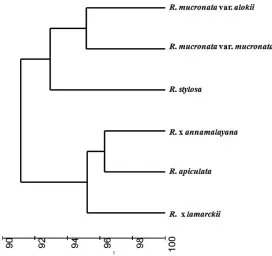
To better assess the taxonomic placement and distinguishing characteristics of the new taxon, a morphometric analysis of the Rhizophora taxa present in ANI was performed. Seventeen attributes of leaves, inflorescences and flowers (Table 1) were examined for each taxon. The dataset was used for cluster analysis with Primer-e software (Version 6). Results of the cluster analysis were then used to select the taxon morphologically most similar to the new entity. T-tests were used to determine which attributes differed significantly between the two taxa. A key for the Rhizophora species of Andaman and Nicobar Islands has also been provided to facilitate identification.
Results
The morphometric analysis shows that R. mucronata var. alokii has closest similarity with R. mucronata than to other Rhizophora taxa (Fig. 1). However, attributes such as leaf length, length-width ratio, petiole length, peduncle length, number of flowers and stamen number are significantly different (p < 0.05) between the two taxa (Table 1).
Taxonomic treatment
Rhizophora mucronata var. alokii P.Ragavan, var. nov.
urn:lsid:ipni.org:names:77148139-1
Tab
le 1.
Characters used for classification analysis of
Rhiz
ophor
a
species of the ANI; av
erage v
alue (range) in cm for each tax
on.
Wher
e no range is included, the
values for the tax
on sho
w
ed no v
ariation.
Values that differ significantly (p < 0.05) betw
een the v
arieties of R. mucr
onata ar
e mar
ked with an asterisk.
Characters R. apiculata R. mucr onata va r. mucr onata R. mucr onata va r. alokii R. stylosa R. × annamalayana R. × lamar ckii Leaf length 13 (8.5–16.2) 13.55* (8.5–18) 11.29* (7–13) 11.1 (8–13) 12.39 (10–16) 13.08 (8–16) Leaf width 5.9 (4–8.5) 8.47 (5.7–11.3) 6.71 (4–8.5) 5.68 (4–6.3) 7.4 (6–12) 6.45 (4.5–8.5)
Leaf length width ratio
2 (1.7–3.12) 1.6* (1.4–1.8) 1.69* (1.43–1.79) 2.02 (1.8–2.8) 1.67 1.4–1.7 2 (1.79–2.2) Leaf mucr o length 0.4 (0.4–0.5) 0.5 (0.4–0.6) 0.45 (0.4–0.5) 0.5 (0.4–0.6) 0.34 (0.3–0.5) 0.45 (0.4–0.5) Petiole length 1.8 (1.4–2.5) 2.61* (1.5–3) 2.22* (1.5–3) 3.35 (2–3.5) 2.17 (1.8–2.5) 2.39 (1–3) Petiole width 0.2 (0.2–0.3) 0.31 (0.3–0.5) 0.4 (0.3–0.5) 0.23 (0.3–0.4) 0.3 (0.3–0.4) 0.3 (0.3–0.4) N
umber of flo
w ers per inflor escences 2 5* (2–8) 4* (2–6) 5 (2–8) 2 (2–4) 2 (2–4) Bud length 1.2 (1–1.6) 1.47 (1.2–1.6) 1.48 (1.4–1.6) 1 (0.7–1.2) 1.5 (1.4–1.6) 1.65 (1.5–1.7) Bud width 1 (0.9–1) 0.8 (0.8–1) 0.79 (0.7–0.9) 0.43 (0.3–0.6) 1 (0.8–1.1) 0.8 (0.7–0.8)
Bud length width ratio
1.2 (0.9–14) 1.81 1.69–2.23 1.87 (1.74–2.28) 2.39 (1.81–2.51) 1.68 (1.2–1.81) 2.06 (1.79–2.32) Peduncle length 1 (0.8–1)
3.15* (1.5–6) 2.72* (2–3.5) 3.9 (2.5–5.5) 1.3 (1.2–1.5) 1.85 (1–2.5) Peduncle width 0.5 (0.4–0.6) 0.3 (0.3–0.5) 0.4 (0.3–0.5) 0.2 (0.2–0.3) 0.5 (0.4–0.5) 0.4 (0.3–0.4) Petal length 0.8 (0.7–1) 0.8 (0.8–1) 1 (0.9–1.1) 0.8 (0.7–0.9) 1.2 (1–1.2) 1 (0.9–1.1) Petal width 0.2 (0.2–0.3 0.3 (0.3–0.4) 0.4 (0.3–0.4) 0.3 (0.2–0.4) 0.4 (0.3–0.4) 0.3 (0.2–0.3) Stamen number 12 (9–14) 8* 4* 8 12 (8–16) 12
(8 – 16)
Tree: columnar to spreading, height to 20 m, evergreen (Fig. 2A). Bark: dark brown, friable, fissured horizontally (Fig. 2C). Roots: both stilt roots and aerial roots growing from lower branches, stilt roots are highly conspicuous arching above ground to 2 m (Fig. 2B). Leaves: simple, opposite, green to dark green, elliptical to broadly elliptical (Fig. 2D, E), laterally folded, underside with numerous dark spots, 7–13 × 4–8.5 cm, length to width ratio averaging 1.69 (not greater than 1.8), apex obtuse with pointed mucro, 0.4–0.5 cm long (Fig. 2F), base cuneate, margin entire; petiole green, 1.5–3 × 0.3–0.5 cm. Inflorescences: axillary, 2–6 flowered (Fig. 2G); bract and bracteoles minute (Fig. 2H); peduncle 2–3.5 × 0.3–0.5 cm; pedicel stout; Mature flower: ellipsoidal, creamy white (Fig. 2I), 1.4–1.6 × 0.7–0.9 cm, length to width ratio ca. 1.87, cross section slightly four-sided (Fig. 2J); calyx lobes 4, thicker than R. mucronata, yellowish white, apex acute; petals 4, thick, leathery, folded laterally, creamy white, velvety and hairy on the margin (Fig. 2L, N), 0.9–1.1 × 0.3–0.4 cm; stamens 4, 0.5–0.7cm long (Fig. 2M, N); style bilobed (Fig. 2O), 0.8–0.12 cm long, seated on four sided domed ovary (Fig. 2P). Mature fruits: pear-shaped, brown, 4–5 × 2.5–3.5 cm, calyx persistent with erect lobes (Fig. 2Q). Mature hypocotyls: 40–60 cm long, green, tip pointed, 1.5–1.7 cm wide at widest point (Fig. 2K); plumule green, 2–3 cm long.
Distribution. Rhizophora mucronata var. alokii is currently known only from Aus-tin Creek, North Andaman, India.
Habitat and ecology. It grows in a mangrove forest along the banks in an inter-mediate estuarine position in association with Rhizophora apiculata, R. mucronata and Ceriops tagal.
Phenology. Flowering December to March; fruiting April to July.
Etymology. Named in honour of Dr. Alok Saxena (Principal Chief Conservator of Forests) for his inspiration and his outstanding contribution to mangrove conserva-tion in the ANI.
Conservation status. Rhizophora mucronata var. alokii was collected only from Austin Creek (North Andaman Islands). At this site ca. 15 individuals were observed and hence it is assumed to be rare. At present, until further areas can be sampled the species can be accessed as “Data Deficient” (DD), using the criteria of IUCN (2001).
Discussion
Rhizophora species are very similar and can be difficult to distinguish (Lo 2003). The key distinguishing characters of Rhizophora spp. in the ANI are given in Table 2. The identification of R. apiculata is not problematic because it differs from the other species within its range in many characters, including having apiculate leaves with spinose mucronate tips, bi-flowered inflorescences borne on short peduncles below the leaves, short styles and a swollen, corky, brown bract below the calyx. However, dark spots are present on the leaf undersides of R. apiculata from India to southeast Asia and northern Papuasia; they are absent in southern Papuasia and northern Aus-tralia (Duke et al. 2002). The number of calyx lobes varies geographically; throughout most of the species range there are four lobes but in Australia there are three to six lobes (Duke et al. 2002).
Rhizophora hybrids are recognized by intermediate morphology and absence of ad-vanced reproductive stages (Tomlinson 1986). Both R. × lamarckii and R. × annama-layana are distinguished from R. apiculata by their smooth green bract and 2-4 flowered inflorescences within the leaf axils. Rhizophora × annamalayana is distinguished from R. × lamarckii by its broader leaves (length: width ratio <1.8 vs >1.8), and shorter style (<1.5 mm vs. > 1.5 mm) and stamens in two whorls vs. usually in one single whorl.
Distinguishing R. mucronata and R. stylosa is often problematic. Style length is the main feature used to differentiate these taxa; Ragavan et al. (2011) showed that in R. mucronata the style is short and the ovary elongate and tapering, similar to that in R. apiculata, whereas in R. stylosa the style is long and ovary is short, although intermedi-ates are found. The two species also differ in that R. stylosa has prominent, two-lobed bracts and bracteoles, smaller buds, obovate leaves, smaller fruits and shorter propagules.
Tab
le
2.
D
iagnostic characters of
Rhiz
ophor
a
species of the ANI. The hybrids do not pr
oduce seeds so hypocotyl characters ar
e not pr
esent in them and ther
efor
e
not included in the table. Component
A ttributes R. apiculata R. mucr onata var . mucr onata R. mucr onata var . alokii R. stylosa R. × annamalayana R. × lamar ckii Leav es Leaf shape narr owly elliptic ov ate, br oader at base elliptic narr owly obo vate br
oader at apex
br oadly elliptic narr owly elliptic Leaf apex acute acute obtuse obtuse acute acute Leaf base cuneate br
oadly acute to rounded
cuneate
cuneate
cuneate
attenuate to cuneate
Inflor
escences
Position r
elativ
e to leav
es matur es belo w matur es within matur es within matur es within matur es within matur e within Flo w er number 2 2–8 2–6 2–8 2–4 2–4 Junctur e number 1
1 to 3
1 to 3
1 to 3
1 to 2
1 to 2
Bract condition cor ky smooth, minute smooth, minute smooth, conspicuous smooth, swollen smooth swollen M atur e flo w er bud(closed) Bud length 1–1.6 cm 1.2–1.6 cm 1.4–1.6 cm 0.7–1.2 cm 1.4–1.6 cm 1.5–1.7 cm Bud width 0.9–1 cm 0.8–1 cm 0.7–0.9 cm 0.3–0.6 cm 0.8–1.1 cm 0.7–0.8 cm Shape x-section rounded rounded
slightly four- sided
rounded
four-sided
rounded
Bud length /width ratio
1.2 1.81 1.87 2.39 1.68 2.06 Petal x-section flat enclose stamens
thick folded
enclose stamens cur ved cur ved Petal margin glabr ous H air y velv ety hair y hair y slightly hair y slightly hair y Style length 0.08–0.12 cm 0.08–0.12 cm 0.08–0.1 cm 0.3–0.4 cm 0.08–0.12 cm 0.2–0.4 cm Stamen number
9 to 14
8
4
8
8–16 in two whorls
8–16 in one whorls
and four-sided ovary. It can be difficult to distinguish var. alokii from var. mucronata without the presence of flowers. Differences in flowering time is likely to make this taxon reproductively isolated. A key to the ANI species of Rhizophora is given below.
Key to Rhizophora spp. of ANI
1 Peduncle shorter than petiole ...2 – Peduncle as long as or longer than petiole ...4 2 Mature flower bud and fruits below the leaves; inflorescences two-flowered;
bract corky, brown; hypocotyl present ...R. apiculata – Mature flower buds within the leaves; inflorescences 2-4-flowered; bract
smooth and green; hypocotyls not present ...3 3 Leaves broadly elliptical; styles 0.8–1.2 mm long; stamens in two whorls, inner
shorter; mature flower bud four-sided in cross-section ...R. × annamalayana – Leaves narrowly elliptical; styles 2–3 mm long; stamens in one whorl; mature
flower bud rounded in cross-section ...R. × lamarckii 4 Stamens 4, petals thick and leathery, densely hairy R. mucronata var. alokii – Stamens 8; petals thin, hairy at margin ...5 5 Bract and bracteoles minute; style 1 mm long, seated on elongate, tapering
ovary; hypocotyls 50–80 cm long ...R. mucronata var. mucronata – Bract and bracteoles prominent, forming two-lobed, cup-like structure; style
3-4 mm, seated on short ovary; hypocotyls 20–40 cm long ...R. stylosa
Acknowledgements
We are extremely grateful to the Principal Chief Conservator of Forests, Andaman and Nicobar Islands for his guidance and ensuring we had the necessary support in the field. We also appreciate the cooperation and support provided by the CCF (Research and Working Plan), Territorial Circle and all the Divisional Forest Officers and their staff in the Department of Environment and Forests, Andaman and Nicobar Admin-istration. Thanks are due to Dr. N. Krishnakumar, IFS, Director, Institute of Forest Genetics and Tree Breeding, Coimbatore, for his support and encouragement. Special thanks are extended to Mr/Mrs/Miss/Ms DFO Mayabunder for constant support.
References
Duke NC, Ball MC, Ellison JC (1998) Factors influencing biodiversity and distributional gradients in mangroves. Global Ecol Biogeog Lett 7: 27–47. doi: 10.2307/2997695 Duke NC, Bunt JS (1979) The genus Rhizophora (Rhizophoraceae) in northeastern Australia.
Australian Journal of Botany 27: 657–678. doi: 10.1071/BT9790657
Duke NC, Lo EYY, Sun M (2002) Global distribution and genetic discontinuities of man-groves – emerging patterns in the evolution of Rhizophora. Trees 16: 65–79. doi: 10.1007/ s00468-001-0141-7
FSI (2013) State of forest report. Forest Survey of India (FSI), Dehra Dun, 33–37.
IUCN (2001) IUCN Red List categories and criteria. Version 3.1, Prepared by the IUCN Species Survival Commission. IUCN, Gland, Switzerland, and Cambridge, United Kingdom, 32 pp. Lo EYY (2003) Phylogenetic relationships and natural hybridization in the mangrove genus
Rhizophora from the Indo-West Pacific region. M.Sc. Thesis, University of Hong Kong, Hong Kong, 198 pp.
Mandal RN, Naskar KR (2008) Diversity and classification of Indian mangroves: a review. Tropical Ecology 49: 131–146.
Ng WL, Chan HT, Szmidt AE (2013) Molecular identification of natural mangrove hybrids of Rhizophora in Peninsular Malaysia. Tree Genet. Genomes 9: 1–10. doi: 10.1007/s11295-013-0619-7
Ragavan P, Saxena M, Coomar T, Saxena A (2011) Preliminary study on natural hybrids of genus Rhizophora in India. ISME/ GLOMIS Electronic Journal 9: 13–19.