PLEASE CITE AS: Tuithof, H., Logtenberg, A., Bronkhorst, L., Van Drie, J., Dorsman, L., & Van Tartwijk, J. (2019).
What do we know about the Pedagogical Content Knowledge of History teachers: A review of empirical research. Historical Encounters: A journal of historical consciousness, historical cultures, and history education, 6(1), 72-95. ISSN 2203 7543 | © Authors | This work is published under a Creative Commons Attribution 4.0 International License Publication Date: 15 August 2019 | Available Online: http://hej.hermes-history.net
What do we know about the pedagogical
content knowledge of history teachers: A
review of empirical research
Hanneke Tuithof
Utrecht UniversityAlbert Logtenberg
Leiden UniversityLarike Bronkhorst
Utrecht UniversityJannet Van Drie
University of AmsterdamLeen Dorsman
Utrecht UniversityJan Van Tartwijk
Utrecht UniversityABSTRACT: PCK is seen as the knowledge that is needed for the transformation of content knowledge to pedagogical products and teaching strategies for specific students. To explore research on history teachers’ Pedagogical Content Knowledge (PCK) in secondary education, 34 empirical studies, published between 1987 and 2015, are systematically reviewed. The conceptualization and operationalization of PCK and sources for PCK development are analysed. Results show that most studies use qualitative methods with small sample sizes. Research often lacks a systematic definition of PCK. Most of the analyzed articles discuss the PCK about disciplinary strategies and focus on knowledge of instructional strategies. PCK of novice history teachers appears to be influenced by other sources than the PCK of experienced teachers. We conclude by suggesting further research and possibilities for teacher training.
KEYWORDS: Pedagogical Content Knowledge (PCK); History Teaching; History Teachers.
Introduction
for a specific student or group of students. The transformative nature of this knowledge makes it difficult to describe, conceptualize and teach it to beginning history teachers. For example, it may seem effective to explain hyperinflation in the Weimar Republic by showing students piles of banknotes. But this ‘teaching-trick’ quickly falls apart if the teacher subsequently does not know how to react effectively to students’ questions and fails to see opportunities to trigger their historical thinking.
Many history teachers know how to teach the concepts in an existing curriculum to facilitate the understanding of their students. They choose and develop examples, representations, assignments, strategies, and tests to explain these concepts to a specific group of students. This requires certain context specific knowledge (Friedrichsen, 2015; Henze & Van Driel, 2015; Van Driel & Berry, 2010).
Shulman (1987) introduced the concept of Pedagogical Content Knowledge (PCK) for this specific knowledge and drew attention to the fact that teachers need to transform content knowledge for their teaching practice (Loughran, Berry, & Mulhall, 2006; Shulman, 1986; Shulman, 1987). There has been much debate on the definition, nature, and meaning of the concept PCK (Kind, 2009; Lee & Luft, 2008; Van Driel & Berry, 2010). PCK could be seen as a toolkit of suitable teaching tricks or as a rich repertoire based on student knowledge linked to a teaching orientation (Tuithof, 2017). Educational researchers have been inspired by this concept of PCK, resulting in much domain specific research into teaching and teacher knowledge (Achinstein & Fogo, 2015; Depaepe, Verschaffel & Kelchtermans, 2013; Evens, Elen & Depaepe, 2015). In her review on PCK and the natural sciences, Kind (2009) describes PCK as useful concept and tool for describing and understanding teaching practices. Furthermore, several studies have shown that teachers’ PCK positively impacts student learning (Depaepe et al., 2013; Evens et al., 2015; Kunter et al., 2013).
Until now, our understanding of teachers’ PCK has been mainly informed by research on science teachers’ knowledge. In comparison, research into the PCK of history teachers is limited (Cunningham, 2007; Ball, Thames, & Phelps, 2008; Depaepe et al. 2013; Evens et al., 2015; Kind, 2009). In this study, we review this research on the PCK of history teachers and the different ways in which to examine it. We also look into sources that contribute to PCK development according to empirical research on history teachers’ knowledge. Our review study could produce practical insights for teacher educators in history. Moreover, we will attempt to identify gaps in research on history teachers’ PCK.
We will first discuss research into history teaching. Subsequently, we will discuss the conceptualization and operationalization of PCK and PCK development in existing PCK research on science teachers and modern languages teachers in order to guide our empirical review study (Depaepe et al., 2013; Evens et al., 2016; Kind, 2009; Van Driel, & Verloop, 1998).
Theoretical Framework
Research on History Teaching
thinking to students. Cunningham reflected in 2007 on the importance of the concept PCK in history. She observed that research into history teachers had mainly focussed on content knowledge (first-order knowledge) and related knowledge of disciplinary strategies (second-order knowledge and strategic knowledge) (Cunningham, 2007).
Many researchers on history learning examine knowledge of disciplinary strategies such as investigating historical questions, analysing and interpreting historical sources, and comparing historical periods (Lee, 2005; Monte-Sano, 2011; Van Drie & Van Boxtel, 2008). Researchers use several concepts when examining knowledge of disciplinary strategies, such as historical thinking, historical reasoning, historical enquiry, historical interpretation, and the analysis of historical sources (Barton & Levstik, 2004;Lee, 2005; Monte-Sano, 2011; Monte-Sano & Cochran, 2009; Van Drie & Van Boxtel, 2013; Van Drie & Van Boxtel, 2008; Voet & De Wever, 2016; Wilson & Wineburg, 1991; Wineburg, 2007). The concept of historical reasoning has recently been used more often when examining knowledge of disciplinary strategies.
However, the concept is not always defined and frequently focuses on working with sources
and evidence (Van Drie & Van Boxtel, 2018). Van Drie & Van Boxtel (2013) present a broader definition of historical reasoning that is related to historical understanding, concerning one of three things: “the evaluation or construction of a description of processes of change and continuity, an explanation of a historical phenomenon or a comparison of historical phenomena or periods” (p. 44). Also, they designed a framework for historical reasoning that consists of six components: asking historical questions; using sources; contextualization; argumentation;
using substantive concepts; using meta-concepts (Van Drie & Van Boxtel, 2013; ,Van Drie &
Van Boxtel, 2008).
The underlying tenet of most research on disciplinary strategies and historical reasoning is that history teachers themselves should have knowledge of disciplinary strategies and an associated epistemological perspective on the interpretative nature of history to be able to promote students’ disciplinary strategies in the classroom. In practice that does not always seem to be the case (Baron, 2013; Burn, 2007; Fehn & Koeppen, 1998; McCrum, 2013). Moreover, teachers who have knowledge of disciplinary strategies and epistemological perspectives are not always able to teach these strategies because of the pedagogical problems they create in the classroom: students and teachers have difficulties in dealing with the uncertainty that is created by the interpretative nature of these disciplinary strategies (Barton & Levstik, 2003; Wansink, Akkerman & Wubbels, 2016). History teachers not only need to have first-order, second-order, and strategic knowledge themselves, but they also need to develop PCK about disciplinary strategies to adequately teach their students. For example, in order to teach historical sourcing skills you need to know what kind of questions and sources are needed to promote historical reasoning.
We will now discuss the conceptualization and operationalization of PCK and PCK development in existing PCK research in other domains. This discussion will guide the empirical review study that follows.
The Conceptualization of PCK
Dutch (Depaepe et al., 2013, Van Driel & Berry, 2010). In these traditions, researchers also look into subject related questions about learning and teaching without using the concept PCK (Van Driel & Berry, 2010).
Two key PCK elements in Shulman’s model are (1) instructional strategies and representations, i.e. the ways in which the teacher transforms subject matter knowledge, and (2) knowledge of students’ understanding, i.e. the learning process and the content related problems of students (Jung, Park, Jang, & Chen, 2011; Shulman, 1987). Researchers have used these two key elements as starting points, subsequently adding new PCK elements.
A much-cited model of the PCK of science teachers was developed by Magnusson, Krajcik, and Borko (1999) building on Shulman (1987), Grossman (1990), and Tamir (1988). This model contains five PCK elements. Magnusson and colleagues (1999) added three PCK elements to Shulman’s key elements. Element (3) knowledge of assessment pertains to the knowledge that teachers use to establish what students have learned. The fourth element (4) contains the knowledge about the curriculum and corresponding curricular goals prescribed by the educational authorities, and the knowledge that a teacher needs to implement and plan this curriculum. Element (5) teaching orientation represents “a general way of viewing or conceptualizing science teaching” (1999, p. 97) in the words of Magnusson and colleagues. They argue that this component is significant because “these knowledge and beliefs serve as a ‘conceptual map’ that guides instructional decisions” (Magnusson et al. 1999, p. 97). The role of teaching orientation is still under discussion: Gess-Newsome has for example questioned the straightforward impact of teaching orientation (Gess-Newsome, 2015).
Although Shulman’s key elements and Magnusson’s model mentioned above have been widely cited and used (Evens, Elen, & Depaepe, 2016, 2015; Gess-Newsome, 2015), the debate about the specific role of content or subject matter knowledge in PCK itself continues. Shulman describes content knowledge as a source but not as part of PCK (Shulman, 1987), as PCK is the transformation of content and pedagogical knowledge. In this spirit we use the definition of the leading PCK researchers in Gess-Newsome (2015) in our review. These researchers view PCK as: “the knowledge of, reasoning behind, and planning for teaching a particular topic in a particular way for a particular purpose to particular students for enhanced student outcomes” (Gess-Newsome, 2015, p. 36).
The Operationalization of PCK (Research Design and Participants)
Researchers using a cognitive perspective assume that PCK can be measured independently from the context in which it is used. In the past decade, the cognitive perspective has increasingly become more influential in the literature on science teachers’ PCK, with publications reporting correlational studies with larger samples, in which questionnaires are used as measurement instruments (Depaepe et al., 2013; Kunter et al., 2013; Park & Chen, 2012; Wongsopawiro, 2012). PCK researchers using a cognitive perspective measure and discuss relations between for instance PCK and content knowledge, PCK and general pedagogical knowledge, and PCK and student achievement (cf. Depaepe et al., 2013).
Across domains and perspectives, relatively more research has been conducted among student or novice teachers (Kind, 2009), as the reviews on PCK for mathematics teaching by Depaepe and colleagues (2013) and for science teaching by Van Driel and Verloop (1998) show. Similarly, Evens and colleagues have shown that the majority of intervention studies focus on student teachers’ and novices’ PCK (Evens et al., 2015). This might be explained by the fact that student teachers are a convenient sample, as they are often inclined to participate when their university tutors are linked to the research project (Kind, 2009). One might question the use of these groups in research on PCK, because of their limited experience with teaching while PCK is widely assumed to develop over time and through experience.
PCK Development
To develop PCK, teachers have to develop a profound understanding of their students, their subject, and teaching strategies (Calderhead, 1996; Loughran et al., 2006). Experienced teachers have more PCK than novice teachers who tend to have “vague notions of what might be interesting or relevant to students” (Harris & Girard, 2014, p. 221). In addition to PCK element (2) knowledge about students’ understanding, experienced teachers have more pedagogical flexibility and an elaborate repertoire. They are able to choose strategies that simultaneously addresses students’ needs and subject related goals as well (Gudmundsdottir & Shulman, 1987).
The importance of experience as a source for the development of PCK is undisputed (Gess-Newsome, 2015; Kind, 2009; Van Driel & Berry, 2010). Teachers need sufficient confidence and basic classroom skills to develop PCK, and teaching a subject or topic more often is an important PCK source eventually (Henze & Van Driel, 2015; Van Driel & Berry, 2010). Van Driel and Berry (2010) emphasize that teaching experience and content knowledge are important PCK sources. They also show that contextual and personal factors may lead to quite different processes of PCK development (Van Driel & Berry, 2010). In their review on intervention studies aiming at PCK development, Evens and colleagues (2015) also show that
teaching experience and content knowledge are important. They add four additional sources for PCK development that are distinguished in PCK research: PCK courses that aim at improving teachers’ PCK in a programme for teacher training or professional development;
apprenticeship of observation refers to the ways in which teachers’ past experiences as students influence their current teaching models; contact with cooperating colleagues as in collaboration with colleagues; and reflection of teachers on their educational practice (Evens et al., 2015; Henze & Van Driel, 2015; Henze, Van Driel, & Verloop, 2008; Kind, 2009; Van Driel & Berry, 2010). In this review, we use the six sources mentioned above to compare 34 empirical research articles on the PCK development of history teachers.
Our literature review aims to map the current empirical research on history teachers’ PCK. Our review addresses three research questions:
(1) How is PCK conceptualized in empirical educational research on history teachers in secondary education?;
(2) How is PCK operationalized in empirical educational research on history teachers in secondary education?;
(3) What sources are related to the PCK development of history teachers in empirical educational research?
The next paragraph details our selection and analysis of the articles, followed by our results. In the conclusion and discussion section, we will compare these results with PCK research in other disciplinary domains and discuss the implications of the results for PCK research, and for educators and researchers in the field of history.
Data collection
We searched several databases such as Web of Science and ERIC using the search terms ‘PCK’ AND ‘history’ and ‘Pedagogical content knowledge’ AND ‘History’, ‘Curriculum knowledge AND History’ and ’Teaching Orientation AND History’. Furthermore, articles were used in a “snowball procedure”; we traced references in the selected articles for potentially relevant earlier research as well as subsequent citing of the selected articles for potentially later research (see also Evens et al., 2016).The abstracts of the resulting publications were inspected using the following criteria, which were derived from our research questions (see Evens et al., 2015):
1. A publication had to report on at least one empirical study and describe a research methodology (excluding conceptual or argumentative articles);
2. A publication had to focus on history teachers;
3. Publications that only reported on the content knowledge of history teachers were excluded;
4. A publication had to report on research about history teachers in secondary education, because teachers in primary education are likely to have only limited subject specific experience and training;
5. Book chapters and conference papers were excluded because we wanted only peer-reviewed studies, as we were looking for high-quality, empirical studies;
6. Publications had to be in English.
A total of 93 articles was found and inspected by two researchers, using the criteria specified above. When disagreement ensued between the two researchers (as was the case for approximately ten percent of the articles), these cases were discussed until consensus was reached about including or excluding the articles. In total 34 articles about the subject specific pedagogical knowledge of history teachers in secondary education were selected and reviewed. These articles are listed in Tables 1 and 2..
Analysis
explored. Subsequently, to explore how PCK was operationalized, we categorized (4) the type and number of participants under discussion, and (5) the research method used. We also determined (6) which instruments were used to make the PCK (element) visible. Finally, we analysed (7) what sources were related to the development of history teachers’ PCK. For the last category, we use the six sources mentioned by Evens and colleagues (2015) as an analytical framework: (1) teaching experience; (2) PCK courses; (3) content knowledge; (4) apprenticeship of observation (influence of past experiences as a student); (5) contact with cooperating colleagues; (6) reflection on educational practice.
The first author coded all the articles on these categories, which were verified by the second author. Again, in case of doubt these codes were discussed until consensus was reached.
Results
Origin of the studies
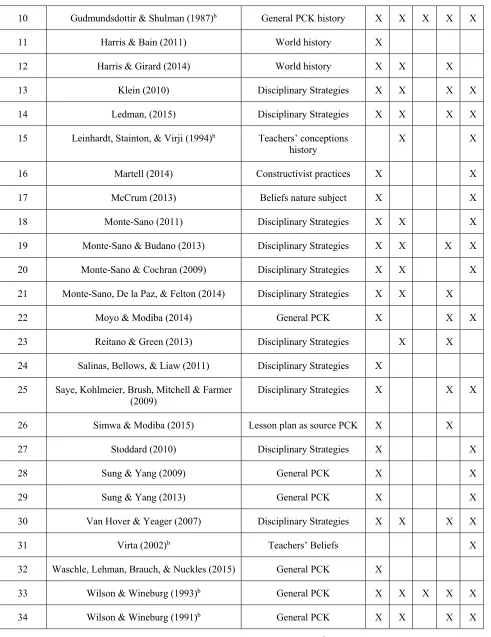
The majority of the reviewed articles (22 out of 34) were written by American authors. Most American authors examine the subject specific pedagogical knowledge of a small group of history teachers (see Table 1). Three articles are from the United Kingdom and two articles are from the same Taiwanese authors. Authors from Zimbabwe, Australia, Sweden, Germany, The Netherlands, and Finland all contributed one article. One article is about teachers from Kenya and its authors work in South Africa. These articles written outside the USA or UK are typically about history teachers in a national curriculum innovation.
Our search generated articles published between 1987 and 2015 and the majority of the articles (26) were published in 2007 or after (see Table 1). It is interesting to note that this is also the year of Cunningham’s (2007) observation that hardly any PCK research into history teachers was available. Thus, research on history teaching and PCK has grown from 2007 onwards.
Number Author(s), year Which Type of PCK (or
PCK related subject) PCK elements
1 2 3 4 5
1 Achinstein & Fogo (2014) Disciplinary Strategies X X
2 Baron (2013) Disciplinary Strategies X
3 Burn (2007) Disciplinary Strategies X X X X
4 Cunningham (2007) Historical empathya X X X X
5 De La Paz, Malkus, Monte-Sano, &
Montanaro (2011) Disciplinary Strategies X
6 Duffield, Wageman & Hodge (2013) US history X
7 Evans (1990)b Teachers’ conceptions X X X X
8 Fehn & Koeppen (1998)b Disciplinary Strategies X X
10 Gudmundsdottir & Shulman (1987)b General PCK history X X X X X
11 Harris & Bain (2011) World history X
12 Harris & Girard (2014) World history X X X
13 Klein (2010) Disciplinary Strategies X X X X
14 Ledman, (2015) Disciplinary Strategies X X X X
15 Leinhardt, Stainton, & Virji (1994)b Teachers’ conceptions
history X X
16 Martell (2014) Constructivist practices X X
17 McCrum (2013) Beliefs nature subject X X
18 Monte-Sano (2011) Disciplinary Strategies X X X
19 Monte-Sano & Budano (2013) Disciplinary Strategies X X X X
20 Monte-Sano & Cochran (2009) Disciplinary Strategies X X X
21 Monte-Sano, De la Paz, & Felton (2014) Disciplinary Strategies X X X
22 Moyo & Modiba (2014) General PCK X X X
23 Reitano & Green (2013) Disciplinary Strategies X X
24 Salinas, Bellows, & Liaw (2011) Disciplinary Strategies X
25 Saye, Kohlmeier, Brush, Mitchell & Farmer
(2009) Disciplinary Strategies X X X
26 Simwa & Modiba (2015) Lesson plan as source PCK X X
27 Stoddard (2010) Disciplinary Strategies X X
28 Sung & Yang (2009) General PCK X X
29 Sung & Yang (2013) General PCK X X
30 Van Hover & Yeager (2007) Disciplinary Strategies X X X X
31 Virta (2002)b Teachers’ Beliefs X
32 Waschle, Lehman, Brauch, & Nuckles (2015) General PCK X
33 Wilson & Wineburg (1993)b General PCK X X X X X
34 Wilson & Wineburg (1991)b General PCK X X X X
Table 1: Type of PCK and PCK elements1
Conceptualization of PCK
In terms of which PCK is studied, 16 of the 34 studies examine PCK about disciplinary strategies in all its manifestations, for example how teachers teach the use of historical sources. Two more studies touch upon a theme that is connected with disciplinary strategies (Cunningham, 2007; Fogo, 2014). Articles were all published after 2007 (Table 1) except one. In these articles, different concepts are used: historical reasoning; historical thinking; historical enquiry and interpretation; disciplinary literacy, and document-based instruction. For example, Ledman (2015) describes a curriculum innovation in Swedish vocational secondary education. The new history curriculum sets advanced standards for the development of disciplinary strategies, in this case denoted as historical thinking and presents the teachers with a new situation. These teachers consequently navigated between the curriculum standards and their knowledge of their students and tried to develop a strategy so their students could succeed in achieving these curriculum goals (Ledman, 2015). In this process, these teachers had to develop and adjust their PCK.
As can be seen in Table 1, the seven articles that were published before 2007 describe PCK of history teachers in general (e.g., Gudmunsdottir & Shulman, 1987; Wilson & Wineburg, 1991; Wilson & Wineburg, 1993), or teacher conceptions and beliefs (Evans, 1990; Leinhardt, Stainton & Virji, 1994; Virta, 2002). As mentioned before, one article before 2007 describes the PCK about disciplinary strategies (Fehn & Koeppen, 1998), namely the response of student teachers to a history intensive methods course and their subsequent use of document-based instruction. One, more recent, article describes PCK that is related to general US history courses (Duffield, Wageman, & Hodge, 2013) and two articles describe the concrete PCK about World History (Harris & Bain, 2011; Harris & Girard, 2014). These last authors make clear that content knowledge was not sufficient in thinking about a world history task and that experienced teachers improved their ability to make coherent and flexible connections based on their experience with students (Harris & Bain, 2011).
The Concept PCK
In nine articles PCK is used as a central concept and is also defined by PCK elements (such as knowledge of instructional strategies). Of these articles, two formulate new PCK elements (Cunningham, 2007; Monte-Sano & Budano, 2013). Seven articles use known PCK elements that are related to Shulman (1987), Van Driel, Verloop, and de Vos (1998) or Monte-Sano and Budano (2013). For example, Simwa and Modiba (2015) explicitly refer to Shulman and mention content knowledge, knowledge of curricular material, knowledge of learners, and knowledge of educational objectives as PCK elements. This example shows that PCK researchers have different interpretations and perspectives, as content knowledge is not a part of PCK in Shulman’s view.
Although the authors of another nine other articles use PCK as a central concept, they do not use a systematic definition including particular PCK elements. Furthermore, in nine articles PCK or Shulman are only mentioned in passing and PCK is not defined or used as a central concept. Seven articles do not use the concept PCK explicitly, but refer to subject related teacher knowledge and use more general concepts such as teacher knowledge, content knowledge, (teacher) professional development, teacher perspectives, teacher thinking, teacher conceptions, and teacher beliefs.
The PCK Elements (Table 1)
is only addressed in three articles and the PCK element teaching orientation is addressed in more than half of the articles (22) (Table 1).
In two articles, new PCK elements are distinguished (Cunningham, 2007; Monte-Sano & Budano, 2013). Monte-Sano and Budano (2013) identified PCK elements that are linked to historical reasoning. In their analysis of the literature, they refer to four subject related components of PCK: (1) representing history (the ways in which teachers communicate the nature and structure of historical knowledge to students); (2) transforming history (how teachers transform historical content in lessons and materials that target development of historical understanding and thinking); (3) attending to students’ ideas about history’ (identifying and responding to students’ thinking about history, including misconceptions and prior knowledge); (4) framing history (selecting and arranging topics into a coherent story thereby framing a history curriculum that illustrates significance, connections, and interrelationships) (Monte-Sano & Budano, 2013, p.174). They use these subject related components to analyse the PCK development of novice teachers. These components are related to Shulman (1987) and the model of Magnusson and colleagues (1999), but they are tailored to the disciplinary nature of history.
In her article on historical empathy, Cunningham (2007) refers to thirteen elements of subject related teacher knowledge which include factors concerning students (their capacities; preconceptions; eagerness; ways of reacting; general behaviour), structures (time; resources; curricular and exam specifications) and the teachers themselves (their knowledge; confidence; beliefs; energy levels; moods). The history teachers in Cunningham’s study use these types in combination as “knowledge packages” which are responsive to changing circumstances (Cunningham, 2007). The PCK elements that Cunningham defines are not specific for history teachers and some are related to Magnusson’s model, but she includes more factors than just teacher knowledge. It is interesting that only Monte-Sano and Budano (2013) formulate specific subject related PCK elements.
The Operationalization of PCK
Participants (Table 2)
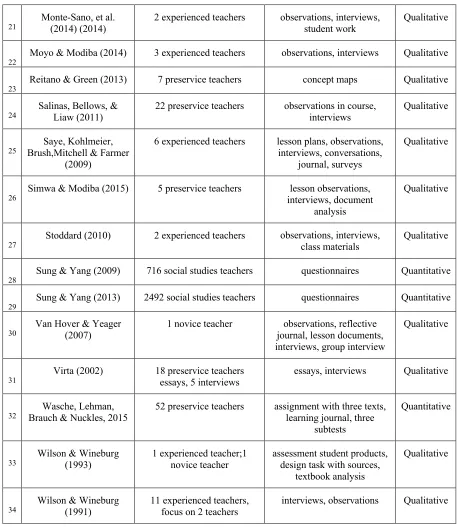
Sixteen articles examine experienced history teachers and 12 articles analyse the knowledge and development of novice or student teachers. Two articles compare a novice or student teacher with an experienced teacher (Gudsmunsdottir & Shulman, 1987; Wilson & Wineburg, 1993). Achinstein and Fogo (2015) examine the PCK of a mentor of two novice history teachers. Burn (2007) analyses the cooperation between a university and a school and examines educators, experienced teachers, and student-teachers.
Reference Participants: teachers Instruments Method
1 Achinstein & Fogo (2014) teacher/mentor;2 novices 1 experienced interviews, observations, conversations, document
analysis
Qualitative
2 Baron (2013) 15 experienced teachers discussions, lesson plans think-aloud protocols, Qualitative
3 Burn (2007) experienced mentors;5 2 teacher educators;3
preservice
conversations, assignments, interviews, observations,
questionnaires
4 Cunningham (2007) 4 experienced teachers interviews, observations, curricular documents Qualitative
5 De La Paz, Malkus, Monte Sano &
Montanaro (2011)
45 experienced teachers;525/611/948
students
logs, observations, student
work, questionnaires Mixed
6 Duffield, Wageman & Hodge (2013) 38 experienced teachers, interview with 27 interviews, observations, student work, logs,
questionnaires performance data
Mixed
7 Evans (1990) 5 experienced teachers observations, interviews with teachers + students Qualitative
8 Fehn & Koeppen (1998) 11 preservice teachers interviews, lesson plans, written reflection Qualitative
9 Fogo (2014) 11 experienced teachers;16 teacher educators Delphi study Qualitative
10 Gudmundsdottir & Shulman (1987) 1 experienced teacher;1 preservice teacher documents collected during interviews, observations,
field work
Qualitative
11 Harris & Bain (2010) 6 experienced teachers;4 preservice sorting task in part 1+log in part 2+ assignment Qualitative
12 Harris & Girard (2014) 5 experienced teachers;4 preservice interviews, card-sorting data Qualitative
13 Klein (2010) 2 experienced teachers assignments: cards with interviews + two
statements + historical case
Qualitative
14 Ledman (2015) 5 experienced teachers interviews Qualitative
15 Leinhardt & Stainton (1994) 2 experienced teachers;7 historians interviews, observations Qualitative
16 Martell (2014) 4 novice teachers interviews, observations, field notes, all classroom
artefacts
Qualitative
17 McCrum (2013) 11 novice teachers interviews Qualitative
18 Monte-Sano (2011) 3 novice teachers assessments of disciplinary assignments, observations,
knowledge
Qualitative
19 Monte-Sano & Budano (2013) 2 novice teachers observations, interviews, classroom artefacts Qualitative
21 Monte-Sano, et al. (2014) (2014) 2 experienced teachers observations, interviews, student work Qualitative
22 Moyo & Modiba (2014) 3 experienced teachers observations, interviews Qualitative
23 Reitano & Green (2013) 7 preservice teachers concept maps Qualitative
24 Salinas, Bellows, & Liaw (2011) 22 preservice teachers observations in course, interviews Qualitative
25 Brush,Mitchell & Farmer Saye, Kohlmeier,
(2009)
6 experienced teachers lesson plans, observations, interviews, conversations,
journal, surveys
Qualitative
26 Simwa & Modiba (2015) 5 preservice teachers interviews, document lesson observations,
analysis
Qualitative
27 Stoddard (2010) 2 experienced teachers observations, interviews, class materials Qualitative
28 Sung & Yang (2009) 716 social studies teachers questionnaires Quantitative
29 Sung & Yang (2013) 2492 social studies teachers questionnaires Quantitative
30 Van Hover & Yeager (2007) 1 novice teacher journal, lesson documents, observations, reflective
interviews, group interview
Qualitative
31 Virta (2002) 18 preservice teachers essays, 5 interviews essays, interviews Qualitative
32 Brauch & Nuckles, 2015 Wasche, Lehman, 52 preservice teachers assignment with three texts, learning journal, three
subtests
Quantitative
33 Wilson & Wineburg (1993) 1 experienced teacher;1 novice teacher assessment student products, design task with sources,
textbook analysis
Qualitative
34 Wilson & Wineburg (1991) 11 experienced teachers, focus on 2 teachers interviews, observations Qualitative
Table 2: Participants, instruments, method
Research Method and Instruments (Table 2)
One example of an instrument is the card sorting task of Harris and Bain (2011) which asks history teachers to structure events from world history. This instrument is interesting because it compels the teachers to make their PCK (knowledge of instructional strategies) visible and enables a comparison between experienced and inexperienced world history teachers. The experienced teachers constructed concept maps with multiple and more fluid connections between events than the inexperienced world history teachers did. Also, the experienced teachers classified events as global, cross-regional, or regional to explain connections among these events, although they were not instructed to do so (Harris & Bain, 2011).
Only three articles use quantitative methods (Sun & Yang, 2009; Sun & Yang, 2013; Wäschle, Lehman, Brauch, & Nückles, 2015), representing the cognitive perspective on PCK (assuming PCK can be measured independently from the context in which it is used). In the quantitative studies, surveys and analyses of student products are used. Two articles relate student outcomes to teacher knowledge and use qualitative as well as quantitative methods (De La Paz, Malkus, Monte-Sano& Montanaro, 2011; Duffield et al., 2013). In these two articles the cognitive and situated perspective are combined, because PCK is captured and measured in a specific context. The student outcomes are analysed and connected to the professional development of their teachers. For example, De La Paz and colleagues (2011) examined 45 experienced teachers and 2084 students through logs, observations, student work, and questionnaires. The authors draw conclusions about the relationship between teachers’ PCK (knowledge of instructional strategies) and the performance of the students. Their findings show that fifth and eleventh grade students, whose teachers were involved in ongoing networking activities on working with primary documents for at least 30 hours in one year, improved their written responses to document-based questions. A large-scale project such as this is rare in the field of PCK and history (see Table 2).
PCK development
In 20 of the 34 reviewed articles, the authors examine PCK development (see Table 3). In most cases it is the type of PCK development resulting from an intervention (e.g., a PCK course) or a context that functions as an intervention (e.g., a curriculum innovation). In terms of specific sources that are related to PCK development, our results show that teaching experience, PCK courses, and content knowledge are the main sources for PCK development of history teachers according to the authors of the reviewed articles.
Some authors draw attention to the influence of students. Teachers adjust their lessons or an entire new curriculum to the capabilities of their students and develop and adjust their PCK accordingly (Klein, 2010; Ledman, 2015; Leinhardt et al., 1994; Monte-Sano, De La Paz, & Felton, 2014). For example, Monte-Sano and colleagues (2014) show that teachers’ adaptations to a disciplinary literacy curriculum were driven by their desire to fit the curriculum to students’ needs. The two teachers in their research continuously reflected on what was working for their students; when they found that students were struggling, they made changes to help those students reach the curricular goals (Monte-Sano et al., 2014). This could be conceived as part of the PCK source experience. However, in the cases mentioned above, the interaction with the students is not part of this PCK source experience but the direct source of PCK development. Thus, in our perspective the interaction with the students can be regarded as an additional source for PCK development.
experienced teachers2 suggests that contact with cooperating colleagues is a PCK source for
experienced teachers (Saye, Kohlmeier, Brush, Mitchell & Farmer, 2009, p.6). This can be regarded an indication that PCK development works differently for experienced teachers than for novice teachers.
Experience PCK
Course CK experiences Past Contact and cooperation Reflection Students Intervention
Achinstein &
Fogo (2014) X X
Baron (2013) X X
Burn (2007) X X X Contexta
Cunningham (2007)
DeLaPaz, Malkus, MonteSano &
Montanaro (2011)
X X
Duffield, Wageman & Hodge (2013)
X X
Evans (1990)
Fehn &
Koeppen (1998) X X
Fogo (2014)
Gudmundsdottir & Shulman
(1987)
X
Harris & Bain
(2011) X
Harris & Girard
(2014) X
Klein (2010) X
Ledman (2015) X X Contexta
Leinhardt &
Stainton (1994) X X
Martell (2014) X X Contexta
Monte-Sano
(2011) X X X X
Monte-Sano &
Budano (2013) X X X X
Monte-Sano&
Cochran (2009) X X X X
Monte-Sano, De la Paz & Felton
(2014)
X X X
Moyo &
Modiba (2014) X X X
Reitano & Green (2013)
X
Salinas, Bellows, & Liaw (2011)
X X
Saye, Kohlmeier, Brush, Mitchell
& Farmer (2009)
X X X
Simwa &
Modiba (2015) X X
Stoddard (2010) X
Sung & Yang
(2009) X
Sung & Yang (2013)
X
Van Hover & Yeager, (2007)
Virta (2002) X
Waschle, Lehman, Brauch
& Nuckles (2015)
X
Wilson &Wineburg(199
3)
Wison & Wineburg
(1991)
Table 3: Sources of PCK development3
Conclusion and Discussion
Emerging PCK research in domains outside science education can inform our understanding of PCK and PCK development. We conducted a systematic literature review to document the status quo of research on PCK of history teachers in secondary education. Most research on PCK and history teachers has been conducted by American researchers after 2007. Our first research question concerned the conceptualization of PCK in empirical educational research on history teachers in secondary education.
Most research on history teachers analyzes PCK about disciplinary strategies. These researchers use different concepts such as historical reasoning; historical thinking; document-based analysis, and disciplinary literacy. The variety in disciplinary concepts makes it harder to characterize and analyze the research in this review. Currently, researchers and teachers have reached a broad consensus regarding the importance of learning disciplinary strategies for students (Wansink, 2017). However, there seems to be less consensus on the teaching of disciplinary strategies. History teaching would benefit from describing concrete examples of PCK about disciplinary strategies. It would be helpful when researchers in the domain of history use the concept of PCK and, therefore, make it possible to link to the PCK research in other domains.
Most articles mainly relate PCK to the PCK element (1) knowledge of instructional strategies (one of the two key elements in Shulman’s original concept). The other key element, (2) knowledge of students’ understanding, is less frequently addressed. That is remarkable since (1) knowledge of instructional strategies and (2) knowledge of students’ understanding are widely considered to be the core elements of PCK. Moreover, knowledge of assessment is almost non-existent in the reviewed articles, although assessment is a crucial part of the educational process. That is why Tamir (1988) and Magnusson and colleagues (1999) added this PCK element.
All PCK elements of the Magnusson model seem prerequisites for effective teaching (Kind, 2015). Unfortunately, not all PCK elements are used in the articles on PCK and history teaching. In contrast, we would like to argue that it is important to use and connect all the five PCK elements and not to exclude any (Tuithof, 2017). Using all the five PCK elements could inform teacher educators and researchers better. Instead of viewing PCK as a toolkit of good teaching tricks, it can be seen as a rich repertoire that is based on knowledge of the students and is linked to teaching orientation. Four articles cover four out of five PCK elements (except knowledge of assessment) and show the connection between these PCK elements. These four case-studies provide interesting perspectives on the influence of the goals of the teachers (related to PCK element (5) teacher orientation), the context of the school, the interaction with the students, and the insight that experienced teachers could still be learners when it comes to disciplinary strategies (Burn, 2007; Van Hover & Yeager, 2007; Ledman, 2015; Monte-Sano & Budano, 2013).
highly content related. On the other hand, the use of general models does of course enable comparisons across domains.
Our second research question asked how PCK is operationalized in empirical educational research on history teachers in secondary education. Only three articles use a quantitative method and two articles use mixed methods. All other 29 articles use qualitative methods: a case study, interviews and observations, as well as class materials or written assignments by student teachers.
PCK research on science and mathematics teachers appears to contain more variety in topics, instruments, design, and methods. The percentage of studies using a cognitive perspective and quantitative research methods, as described by Depaepe and colleagues (2013), is growing in the science domain, but studies taking this perspective are hardly present in the PCK research on history teachers (see last column of Table 2). As Depaepe and colleagues (2013) demonstrate, the cognitive perspective has provided empirical evidence for the positive connection between PCK and student learning outcomes. However, because of its contextual focus, the situated perspective is more appropriate for understanding what happens in the classroom and what really matters in teaching (Depaepe et al., 2013). Therefore, it seems worthwhile to use variation in instruments, designs, and methods, because this could provide more knowledge about PCK and its development.
Although the size of PCK research on history teachers is small in comparison to research on science and mathematics teachers, it is truly diverse in one respect: more articles examine the PCK of experienced teachers while research on science teachers focusses more on novice or student teachers.
Our third research question asked what sources are related to PCK development. Our findings support the distinction of the six sources of PCK proposed by Evens and colleagues (2015). The articles we reviewed mainly discuss teaching experience, PCK courses, and content knowledge as sources of PCK. Some authors call our attention to the influence of the students on the development of PCK (Ledman, 2015; Leinhardt et al., 1994; Monte-Sano et al., 2014). In our view, this particular source could also be seen as an additional source of PCK development; therefore, we add it as a potential source for the development of experienced history teachers’ PCK. The reviewed articles describe different sources for the PCK development of experienced teachers and beginning teachers, suggesting that PCK development might work differently for experienced teachers than for novice teachers. The articles about novice history teachers do mention the PCK sources past experiences and reflection whereas the articles about the PCK development of experienced teachers do not. Recent research by Jansen in de Wal (2016) suggests that, in general, experienced teachers tend to reflect less than novices. Researchers and teacher educators could take the differences between novices and experienced teachers into consideration when designing teacher training and future PCK studies. PCK should not only be seen as a toolkit of good teaching tricks but as a rich repertoire that is based on knowledge of the students and is linked to a specific teaching orientation. Novices do not connect the several PCK elements yet. In order to do so and to develop a rich PCK, they need to obtain knowledge on all the separate PCK elements (Tuithof, 2017).
our selection of the articles and also selected articles that did not have a clear conceptualization of PCK. Our goal was to broaden our scope on the PCK of history teachers.
Summarizing, PCK is rarely conceptualized in empirical research on history teachers and most research that does use PCK is qualitative, very specific, and often based on a small group of participants. Because this kind of research is so context specific, it is difficult to generate general conclusions regarding PCK and history. However, if we do execute large scale research, it might capture or measure PCK out of context at the risk of neglecting the strong context specific nature of PCK in that case. In order to reduce this tension, we want to recommend and advocate the use of the Content Representation-format of Loughran and colleagues (2006). It is used in professionalization programmes for teachers and in PCK research. The CoRe questionnaire has also been used by several science education teachers and researchers on relatively large samples (Bertram, 2012; Bertram & Loughran, 2012; Kind, 2009; Loughran & Nilsson, 2012; Nilsson, 2008). The CoRe questionnaire captures PCK by asking several questions about teachers’ goals, examples and instructional strategies. The CoRe questionnaire could be used for making visible the PCK of a topic or a first-order concept or a second-order concepts. In the research of the first author, the CoRe questionnaire is used to describe concrete examples of the PCK of history teachers. It is an interesting example of an instrument that integrates the situative and cognitive perspectives and, thus, values the context specific character of PCK and also provides researchers with the opportunity to generate more general knowledge about PCK (Tuithof, 2017). The CoRe questionnaire could also be used in professionalization programmes and in teacher training to make PCK visible. Finally, we would advocate the use of the concept PCK and the five PCK elements of Magnusson et al. (1999) in research and teacher training of history teachers.
References
Achinstein, B., & Fogo, B. (2015). Mentoring novices' teaching of historical
reasoning: Opportunities for pedagogical content knowledge development through mentor-facilitated practice. Teaching and Teacher Education, 45, 45-58.
doi:10.1016/j.tate.2014.09.002
Ball, D. L., Thames, M. H., & Phelps, G. (2008). Content knowledge for teaching what makes it special? Journal of teacher education, 59, 389-407. doi:10.1177/0022487108324554 Baron, C. (2013). Using inquiry-based instruction to encourage teachers' historical thinking at
historic sites. Teaching and Teacher Education, 35, 157-169. doi:10.1016/j.tate.2013.06.008
Barton, K. C., & Levstik, L. S. (2003). Why don't more history teachers engage students in interpretation? Social Education, 67, 358-358.
Barton, K. C., & Levstik, L. S. (2004). Teacher education and the purposes of history. In K.C. Barton & L.S. Levstik (Ed.), Teaching history for the common good (pp. 244-265).
Mahwah, NJ: Lawrence Erlbaum Associates.
Bertram, A. (2012). Getting in touch with your PCK: A look into discovering and revealing science teachers' hidden expert knowledge. Teaching Science, 58, 18-26.
Burn, K. (2007). Professional knowledge and identity in a contested discipline: Challenges for student teachers and teacher educators. Oxford Review of Education, 33, 445-467. doi:10.1080/03054980701450886
Calderhead, J. (1996). Teachers: Beliefs and knowledge. In D. Berliner & R. Calfee (Eds.),
Handbook of Educational Psychology (pp. 709-725). New York: Macmillan.
Cunningham, D. L. (2007). Understanding pedagogical Reasoning in history teaching through the case of cultivating historical empathy. Theory & Research in Social Education, 35, 592-630. doi:10.1080/00933104.2007.10473352
De La Paz, S., Malkus, N., Monte-Sano, C., & Montanaro, E.(2011).Evaluating American History Teachers' Professional Development: Effects on Student Learning. Theory & Research in Social Education, 39, 494-540. doi:10.1080/00933104.2011.10473465 Depaepe, F., Verschaffel, L., & Kelchtermans, G. (2013). Pedagogical content knowledge: A
systematic review of the way in which the concept has pervaded mathematics educational research. Teaching and Teacher Education, 34, 12-25. doi:10.1016/j.tate.2013.03.001 Duffield, S., Wageman, J., & Hodge, A. (2013). Examining how professional development
impacted teachers and students of U.S. history courses. The Journal of Social Studies Research, 37, 85-96. doi:10.1016/j.jssr.2013.03.002
Evans, R.W. (1990). Teacher conceptions of history revisited: Ideology, curriculum, Theory and Research in Social Education, 28, 101-138.doi:1.1080/00933104.1990.10505608 Evens, M., Elen, J., & Depaepe, F. (2015). Developing pedagogical content knowledge:
Lessons learned from intervention studies. Education Research International, 2015,1-23. http://dx.doi.org/10.1155/2015/790417
Evens, M., Elen, J., & Depaepe, F. (2016). Pedagogical content knowledge in the context of foreign and second language teaching: A review of the research literature. Porta
Linguarum, 26, 187-200.
Fehn, B., & Koeppen, K. E. (1998). Intensive document-based instruction in a social studies methods course and student teachers' attitudes and practice in subsequent field experiences.
Theory and Research in Social Education, 37, 461-481. doi:10.1080/00933104.1998.10505861
Fogo, B. (2014). Core practices for teaching history: The results of a delphi panel survey.
Theory and Research in Social Education, 42, 151-196. doi:10.1080/00933104.2014.902781
Friedrichsen, P. (2015). My PCK trajectory: A purple book prompts new questions. In A. Berry, P. Friedrichsen, & J. Loughran (Eds.). (2015). Re-examining pedagogical content knowledge in science education (pp. 147-161). New York: Routledge.
Gess-Newsome, J. (2015). A model of teacher professional knowledge and skill including PCK. In A. Berry, P. Friedrichsen, & J. Loughran (Eds.). Re-examining pedagogical content knowledge in science education (pp. 28-42). New York and London: Routledge. Grossman, P. L. (1990). The making of a teacher: Teacher knowledge and teacher education.
New York: Teachers College Press.
Gudmundsdottir, S., & Shulman, L. (1987). Pedagogical content knowledge in social studies.
Harris, L., & Bain, R. (2011). Pedagogical content knowledge for world history teachers: What is it? How might prospective teachers develop It? The Social Studies, 102, 9-17. doi:10.1080/00377996.2011.532724
Harris, L. M., & Girard, B. (2014). Instructional significance for teaching history: A preliminary framework. The Journal of Social Studies Research, 38, 215-225. doi:10.1016/j.jssr.2014.02.003
Henze, I., & Van Driel, J. (2015). Toward a more comprehensive way to capture PCK in its complexity. In A. Berry, P. Friedrichsen, & J. Loughran (Eds.). Re-examining pedagogical content knowledge in science education (pp. 28-42). New York and London: Routledge. Henze, I., Van Driel, J., & Verloop, N. (2008). Development of experienced science teachers'
pedagogical content knowledge of models of the solar system and the universe.
International Journal of Science Education, 30, 1321-1342. doi:10.1080/09500690802187017
Jansen in de Wal, J. (2016) Secondary school teachers' motivation for professional learning (proefschrift). Heerlen: Open Universiteit
Kind, V. (2009). Pedagogical content knowledge in science education: Perspectives and potential for progress. Studies in Science Education, 45, 169.
doi:10.1080/03057260903142285
Klein, S. R. E. (2010). Teaching history in the Netherlands: Teachers’ experiences of a plurality of perspectives. Curriculum Inquiry, 40, 614-634. doi:10.1111/j.1467-873X.2010.00514.x
Kunter, M., Klusmann, U., Baumert, J., Richter, D., Voss, T., & Hachfeld, A. (2013). Professional competence of teachers: Effects on instructional quality and student development. Journal of Educational Psychology, 105, 805. doi:10.1037/a0032583 Ledman, K. (2015). Navigating historical thinking in a vocational setting: teachers
interpreting a history curriculum for students in vocational secondary education. Journal of Curriculum Studies, 57, 77.93. doi:10.1080/00220272.2014.984766
Lee, P. (2005). Putting principles into practice: Understanding history. In M.S. Donovan & J.D. Bransford (Eds.), How students learn: History, mathematics, and science in the classroom (pp. 31-78). Washington, D.C.: The National Academies Press.
Lee, E., & Luft, J. A. (2008). Experienced secondary science teachers' representation of pedagogical content knowledge. International Journal of Science Education, 30, 1343-1363. doi:10.1080/09500690802187058
Leinhardt, G., & Stainton, C., & Virji, S. M. (1994). A Sense of History. Educational Psychologist,29, 79-88. doi:10.1207/s15326985ep2902_3
Loughran, J., Berry, A., & Mulhall, P. (2006). Understanding and developing science teachers pedagogical content knowledge. Rotterdam: Sense Publishers.
Loughran, J., & Nilsson, P. (2012). Exploring the development of pre-service science elementary teachers’ pedagogical content knowledge. Journal of Science Teacher Education, 23, 699-721. doi:10.1007/s10972-011-9239-y
Martell, C. C. (2014). Building a constructivist practice: A longitudinal study of beginning history teachers. The Teacher Educator, 49, 97-115.doi: 10.1080/08878730.2014.888252 McCrum, E. (2013). History teachers' thinking about the nature of their subject. Teaching and
Teacher Education, 35, 73-80. doi:10.1016/j.tate.2013.05.004
Monte-Sano, C. (2011). Learning to open up history for students: Preservice teachers’ emerging pedagogical content knowledge. Journal of Teacher Education, 62, 260-272. doi:10.1177/0022487110397842
Monte-Sano, C., & Budano, C. (2013). Developing and enacting pedagogical content
knowledge for teaching history: An exploration of two novice teachers' growth over three years. Journal of the Learning Sciences, 22, 171-211. doi:10.1080/10508406.2012.742016 Monte-Sano, C., & Cochran, M. (2009). Attention to learners, subject, or teaching: What
takes precedence as preservice candidates learn to teach historical thinking and reading?
Theory & Research in Social Education, 37, 101-135. doi:10.1080/00933104.2009.10473389.
Monte-Sano, C., De La Paz, S., & Felton, M. (2014). Implementing a disciplinary-literacy curriculum for US history: Learning from expert middle school teachers in diverse classrooms. Journal of Curriculum Studies, 46, 540-575.
doi:10.1080/00220272.2014.904444
Moyo, N., & Modiba, M. (2014). Theory and practice in in-service teacher learning: teachers’ reconceptualisation of curriculum in history lessons. Research Papers in Education, 29, pp. 438-456
Nilsson, P. (2008). Teaching for Understanding: The complex nature of pedagogical content knowledge in pre‐service education. International Journal of Science Education, 30, 1281– 1299. doi:10.1080/09500690802186993
Nilsson, P., & Loughran, J. (2012). Teaching for understanding: The complex nature of pedagogical content knowledge in pre-service education. Halmstad, Sweden: Halmstad University.
Park, S., & Chen, Y. (2012). Mapping out the integration of the components of pedagogical content knowledge (PCK): Examples from high school biology classrooms. Journal of Research in Science Teaching, 49, 922-941. doi:10.1002/tea.21022
Reitano, P., & Green, N. C. (2013). Beginning teachers' conceptual understandings of effective history teaching: examining the change from “subject knowers” to “subject teachers”. Asia-Pacific Journal of Teacher Education, 41(2), 197-217.
Salinas, C., Bellows, M. E., & Liaw, H. L. (2011). Preservice social studies teachers’
historical thinking and digitized primary sources: What they use and why. Contemporary Issues in Technology and Teacher Education,11(2), 184-204.
Saye, J. W., Kohlmeier, J., Brush, T., Mitchell, L., & Farmer, C. (2009). Using mentoring to develop professional teaching knowledge for problem-based historical inquiry. Theory & Research in Social Education, 37(1), 6-41.
Shulman, L. (1986). Those who understand: Knowledge growth in teaching. Educational Researcher, 15(2), 4-14. doi:10.3102/0013189X015002004
Simwa, K. L., & Modiba, M. (2015). Interrogating the lesson plan in a pre-service methods course: Evidence from a university in Kenya. Australian Journal of Teacher
Education,40(4), 12-34.. doi:10.14221/ajte.2015v40n4.2
Stoddard, J. D. (2010). The roles of epistemology and ideology in teachers’ pedagogy with historical ‘media’.Teachers and Teaching: theory and practice,16(1), 153-171. Stoel, G. L., van Drie, J. P., & van Boxtel, C. A. M. (2015). Teaching towards historical
expertise: developing a pedagogy for fostering causal reasoning in history. Journal of Curriculum Studies, 47(1), 49-76 DOI: 10.1080/00220272.2014.968212
Sun, P. F., & Yang, M. L. (2009). National identity and its relationship with teachers'
historical knowledge and pedagogy: the case of Taiwan. Asia Pacific Journal of Education, 29(2), 179-194. doi:10.1080/02188790902857172
Sun, P. F., & Yang, M. L. (2013). Exploring disciplinary background effect on social studies teachers’ knowledge and pedagogy. The Journal of Educational Research, 106(1), 77-88. doi:10.1080/00220671.2012.658453
Tamir, P. (1988). Subject matter and related pedagogical knowledge in teacher education.
Teaching and Teacher Education, 4(2), 99-110. doi:10.1016/0742-051X(88)90011-X Tuithof, H. (2017). The characteristics of Dutch experienced history teachers' PCK in the
context of a curriculum innovation. PhD thesis, Utrecht University.
Van Boxtel, C. & van Drie, J. (2018). Historical reasoning: Conceptualizations and educational applications. In S. A. Metzger, & L. McArthur Harris Eds.), International Handbook of History Teaching and Learning. New Jersey:Wiley-Blackwell.
Van Boxtel, C., & Van Drie, J. (2013). Historical reasoning in the classroom: What does it look like and how can we enhance it? Teaching History, 150, 44-52
Van Drie, J., & Van Riessen, M. (2010). Een vak dat zichzelf serieus neemt…: Vakdidactisch onderzoek in Nederland (eindelijk) in de lift [A school subject which takes itself seriously].
Kleio, 51, 17-21.
Van Drie, J., & Van Boxtel, C. (2008). Historical reasoning: Towards a framework for analyzing students’ reasoning about the past. Educational Psychology Review, 20, 87-110. doi:10.1007/s10648-007-9056-1
Van Driel, J., & Berry, A. (2010). The teacher education knowledge base: Pedagogical content knowledge. International Encyclopedia of Education, 7, 656-661.
Van Driel, & Verloop, (1998). Pedagogical Content Knowledge: a unifying element in the knowledge base of teachers. Pedagogische Studiën, 75, 225-237.
Van Driel, J. H., Verloop, N., & de Vos, W. (1998). Developing science teachers' pedagogical content knowledge. Journal of research in Science Teaching,35 (6), 673-695.
doi:10.1002/(SICI)1098-2736(199808)35:6<673::AID-TEA5>3.0.CO;2-J
Van Hover, S., & Yeager, E. (2007). "I Want to Use My Subject Matter to...": The Role of Purpose in One US Secondary History Teacher's Instructional Decision Making. Canadian Journal of Education/Revue canadienne de l'éducation, 30(3), 670-690.
Van Sledright, B., & Limón, M. (2006). Learning and teaching social studies: A review of cognitive research in history and geography. In P.A. Alexander & P.H. Winne (Eds.),
Virta, A. (2002). Becoming a history teacher: Observations on the beliefs and growth of student teachers. Teaching and Teacher Education, 18, 687-698. doi:10.1016/S0742-051X(02)00028-8
Verloop, N., Van Driel, J., & Meijer, P. (2001). Teacher knowledge and the knowledge base of teaching. International Journal of Educational Research, 35, 441-461.
Voet, M., & De Wever, B. (2016). History teachers' conceptions of inquiry-based learning, beliefs about the nature of history, and their relation to the classroom context. Teaching and Teacher Education, 55, 57-67. doi:10.1016/j.tate.2015.12.008
Wansink, B. G. J., Akkerman, S., & Wubbels, T. (2016). The Certainty Paradox of student history teachers: Balancing between historical facts and interpretation. Teaching and Teacher Education, 56, 94-105. doi:10.1016/j.tate.2016.02.005
Wäschle, K., Lehmann, T., Brauch, N., & Nückles, M. (2015). Prompted Journal writing Supports Preservice History Teachers in Drawing on Multiple Knowledge Domains for Designing Learning Tasks. Peabody Journal of Education,90, 546-559.
doi:10.1080/0161956X.2015.1068084
Wilson, S. M., & Wineburg, S. S. (1991). Models of wisdom in the teaching of history. The History Teacher, 24, 395. doi:10.2307/494699
Wilson, S. M., & Wineburg, S. S.(1993). Wrinkles in time and place: Using performance assessments to understand the knowledge of history teachers. American Educational Research Journal, 30(4), 729-769. doi:10.3102/00028312030004729
Wineburg, S. (2007). Unnatural and essential: The nature of historical thinking. Teaching History, 129, 06.
Wongsopawiro, D. S. (2012). Examining science teachers' pedagogical content knowledge in the context of a professional development program. Leiden: ICLON, Faculty of Science, Leiden University.
Endnotes
1 PCK elements 1= knowledge of instructional strategies; 2= knowledge of students’ understanding; 3= knowledge of assessment; 4= knowledge of curriculum; 5= teaching orientation.
aRelated to PCK about Disciplinary Strategies. bPublished before 2007
2 For the sake of clarity, we excluded those articles that address both novice and experienced teachers 3 Note. a The context of the study functions as an intervention.
About the Authors
Hanneke Tuithof is History Teacher Educator at the Graduate School of Teaching and the Department of History and Art History of Utrecht University in the Netherlands. She is also temporarily professor at the University of Applied Sciences Fontys in Tilburg. Her research focuses on the Pedagogical Content Knowledge of teachers.
Albert Logtenberg is History Teacher Educator at the Graduate School of Teaching of Leiden University in the Netherlands and Amsterdam University of Applied Sciences.
Larike Bronkhorst is Assistant Professor at the Department of Education of Utrecht University. Her research focusses on learning, development and collaboration across different contexts. Jannet van Drie is Associate Professor at the Research Institute of Child Development and Education of the University of Amsterdam. Her research focuses on the learning and teaching of history, with a particular focus on historical reasoning and writing.
Leen Dorsman is Professor of the History of Universities at the Department of History and Art History of Utrecht University in the Netherlands. His research focuses on the history of universities and the intersection of literature and history.