SYNTHESIS OF AZETIDINONE DERIVATIVES OF
2-AMINO-5-NITROTHIAZOLE AND THEIR MEDICINAL IMPORTANCE
Pushkal Samadhiya*, Ritu Sharma, Santosh K. Srivastava
Keywords: Synthesis, 2-amino-5-nitrothiazole, azetidinone, antimicrobial, antitubercular, antiinflammatory.
New series of N-[3-(2-amino-5-nitrothiazolyl)-propyl]-4-(substitutedphenyl)-3-chloro-2-oxo-1-azetidine-carboxamide, compounds 4a-4j have been synthesized and characterized by chemical and spectral analyses such as IR, 1H NMR, 13C NMR and FAB-Mass. All the
synthesized compounds 4a-4j were screened for their antibacterial and antifungal activities against some selected bacteria and fungi with their MIC values and antitubercular activity screened against M. tuberculosis. Anti-inflammatory activity was in vivo screened against albino rats. Some compounds of the series showed good activities.
* Corresponding Authors
E-Mail: [email protected]
[a] Department of Chemistry, Dr. H.S. Gour University (A Central University), Sagar, M.P. India 470003.
INTRODUCTION
Bacterial and fungal infection is most common problem of the world. Some serious and life threating diseases also caused by bacterial or fungal infection. Tuberculosis is one of the most common infectious diseases. According to World Health Organization (WHO), 196 countries reported 2.6 million new smear positive TB cases in 2008, of which 1.78 million people died from it. Another hand inflammation is also major problem of all over the world because many people die every year cause of inflammation. In case of accident and organ transplantation or surgery microbial infection is also common problem. From the last decade, researchers made a continuous effort to fight these diseases.
Several new classes of chemotherapeutic agents have been introduced in the last decade. Several azole or azetidine constitute containing drugs displayed promising results. Benzotriazole derivatives are also member of significant class of chemistry because of their wide use in organic synthesis and pharmaceutical chemistry. Thiazole is one of the most intensively investigated class of aromatic five membered heterocyclic system has been employed as a anticonvulsant1, fungicidal2. Some of the thiazole analogues
are also used as antibiological3, antibacterial4,5. All these
facts were driving force to develop novel thiazole derivatives with wide structure variations.
2-Azetidinone derivatives play a vital role owing to their wide range biological activity and industrial importance6.
Recently found application in drug development for the treatment of antimicrobial7, anticonvulsant8,
antiinflammatory9, antibacterial10,11. As part of interest in
heterocycles that have been explored for developing pharmaceutically important molecules.
The biological activities of both 2-oxo-azetidine and thiazole aroused our interest in the synthesis of 2-oxo-azetidine derivatives of 2-amino-5-nitrothiazole (scheme 1).
All synthesized compounds were screened against some selected bacteria and fungi for their antimicrobial activity and antitubercular activity screened against M. tuberculosis using H37Rv strain. Anti-inflammatory activity was in vivo screened against albino rats. The structures of all the newly synthesized compounds were confirmed by elemental analysis, IR, 1H NMR, 13C NMR, and FAB-Mass.
EXPERIMENTAL
Melting points were taken in open capillaries and are uncorrected. Progress of reaction was monitored by silica gel-G coated TLC plates using MeOH: CHCl3 system (2:8).
The spot was visualized by exposing dry plate at iodine vapours chamber. IR spectra were recorded in KBr disc on a Schimadzu 8201 PC, FTIR spectrophotometer (max in cm-1)
and 1H NMR and 13C NMR spectra were measured on a
Brucker DRX-300 spectrometer in CDCl3 at 300 and 75
MHz using TMS as an internal standard respectively. All chemical shifts were reported on scales. The FAB-Mass spectra were recorded on a Jeol SX–102 mass spectrometer. Elemental analyses were performed on a Carlo Erba–1108 analyzer. The analytical data of all the compounds were highly satisfactory. For column chromatographic purification of the products, Merck silica Gel 60 (230-400 Mesh) was used. The reagent grade chemicals were purchased from the commercial sources and further purified before use.
Biological importance
Antimicrobial activity
Antitubercular activity
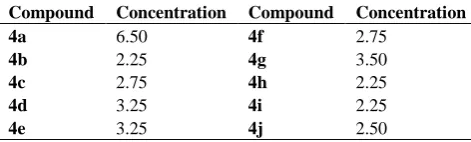
The synthesized compounds 4a-4j were screened against M. tuberculosis (H37Rv strain) using L. J. medium (Conventional) method at 50 μg/mL and lower concentrations. The standard antitubercular drugs Isoniazid and Rifampicin (MIC range 2-4 μg/mL) were taken as standards. The results were showing in Table 2.
Antiinflammatory activity
Carageenan induced rat paw oedema method was employed for evaluating the antiinflammatory activity of compounds at a dose 50 mg/ kg bw in albino rats(weighing 80-110 gm, each group contain 5 animal) using phenylbutazone as a standard drug for comparison at a dose 30 mg/ kg bw. The percentage inhibition of inflammation was calculated by applying Newbould formula. Results of some active compounds were given in Table 3.
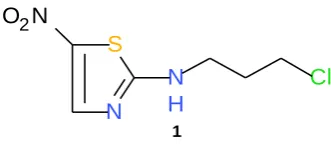
Synthesis of 1-(3-chloropropyl)-2-amino-5-nitrothiazole, (1)
2-Amino-5-nitrothiazole (0.345 mole) and 1-bromo-3-chloropropane (0.345 mole) in methanol (100 ml) were stirred on a magnetic stirrer for about 6.30 hours at room temperature. The completion of the reaction was monitored by silica gel-G coated TLC plates. After the completion of the reaction the product was filtered and purified over a silica gel packed column chromatography using CHCl3 :
CH3OH (8 : 2 v/v) system as eluant (120 ml). The purified
product was dried under vacuo and recrystallized from ethanol at room temperature to yield compound 1 (Figure 1).
Figure 1. Structure of compound 1.
1-(3-Chloropropyl)-2-amino-5-nitrothiazole (1): Yield: 62%; m.p. 173-175 ºC; IR (cm-1): 727 (C-Cl), 881 (C-S), 968 (C-NO), 1313 (N-CH2), 1362, 1532 (NO2), 1559 (C=C), 1436, 2832, 2897 (CH2), 3009 (CH-Ar), 3388 (NH);
1H NMR (300 MHz, CDCl
3, TMS) δ: 1.91-1.95 (m, 2H H-8),
3.27 (t, 2H, J = 7.35 Hz, H-9), 3.85-3.89 (m, 2H, H-7), 7.71 (s, 1H, H-4), 7.83 (br, s, 1H, H-6); 13C NMR (75 MHz,
CDCl3, TMS) δ: 34.4 (C-8), 41.7 (C-9), 45.9 (C-7), 134.2
(C-4), 137.8 (C-5), 166.5 (C-2); FAB-Mass (m/z): 221 [M+]; Anal. Calcd. for C6H8N3O2SCl: C; 32.51, H; 3.63, N;
18.95; Found: C; 32.49, H; 3.59, N; 18.87.
Synthesis of N-[3-(2-amino-5-nitrothiazolyl)-propyl]-urea, (2)
Compound 1 (0.2256 mol) and urea (0.2256 mol) in methanol (100 ml) were stirred on a magnetic stirrer for about 6.30 hours at room temperature. The completion of the reaction was monitored by silica gel-G coated TLC
plates. After the completion of the reaction the product was filtered and purified over a silica gel packed column chromatography using CHCl3 : CH3OH (8 : 2 v/v) system as
eluant (120 ml). The purified product was dried under vacuo and recrystallized from ethanol at room temperature to yield compound 2 (Figure 2).
Figure 2. Structure of compound 2.
N-[3-(2-Amino-5-nitrothiazolyl)propyl]urea (2): Yield: 70%; m.p. 153-155 ºC; IR (cm-1): 879 (C-S), 966 (C-NO),
1324 (N-CH2), 1360, 1533 (NO2), 1559 (C=C), 1662 (C=O),
1432, 2885, 2918 (CH2), 3021 (CH-Ar), 3387 (NH), 3452
(NH2); 1H NMR (300 MHz, CDCl3, TMS) δ: 2.08-2.12 (m,
2H, H-8), 3.19-3.24 (m, 2H, H-9), 3.82-3.90 (m, 2H, H-7), 5.67 (s, 1H, H-1’), 5.97 (br s, 2H, H-3’), 7.65 (s, 1H, H-4), 7.80 (br, s, 1H, H-6); 13C NMR (75 MHz, CDCl
3, TMS) δ:
33.4 (C-8), 38.6 (C-9), 44.1 (C-7), 133.8 (C-4), 138.5 (C-5), 163.4 (C-2’), 165.3 (C-2); FAB-Mass (m/z): 245 [M+]; Anal.
Calcd. for C7H11N5O3S: C; 34.28, H; 4.52, N; 28.55; Found:
C; 34.25, H; 4.48, N; 28.51.
Synthesis of N-[3-(1H-2-amino-5-nitrothiazolyl)propyl]-N’-[phenylmethylidene]urea, compound 3a:
The compound 2 (0.0330 mole) and benzaldehyde (0.0330 mole) in methanol (100 ml) in the presence of 2-4 drops of glacial acetic acid were first stirred on a magnetic stirrer for about 2.00 hours followed by reflux on a steam bath for about 3.30 hours. The completion of the reaction was monitored by silica gel-G coated TLC plates. The product was filtered and cooled at room temperature. The filtered product was purified over a silica gel packed column chromatography using CH3OH : CHCl3 (7 : 3 v/v) as eluant
(75 ml). The purified product was dried under vacuo and recrystallized from ethanol at room temperature to furnish compound 3a (Figure 3).
Compounds 3b-3j have also been synthesized by using similar method as above.
Figure 3. Structure of compound 3a-3j.
N-[3-(2-Amino-5-nitrothiazolyl)-propyl]-N’-[(phenyl)methylide- ne]urea (3a): Yield: 62%; m.p. 148-149ºC; IR (cm-1): 856
(C-S), 961 (C-NO), 1329 (N-CH2), 1356, 1531 (NO2), 1547
(C=C), 1565 (N=CH), 1661 (C=O), 1427, 2878, 2912 (CH2),
3016 (CH-Ar), 3382 (NH); 1H NMR (300 MHz, CDCl 3,
TMS) δ: 2.02-2.07 (m, 2H, H-8), 3.20-3.25 (m, 2H, H-9), 3.80-3.85 (m, 2H, H-7), 5.60 (s, 1H, H-1’), 7.24 (s, 1H, H-4),
1
N
H
Cl
S
N
O
2N
2
NH
2 O
N H NH
S
N O2N
1'
2' 3'
3(a-j)
CH
N O
N H NH
S
N
X
O2N
1' 2'
7.89 (s, 1H, H-6), 8.02 (s, 1H, H-10), 6.75-7.84 (m, 5H, Ar-H); 13C NMR (75 MHz, CDCl
3, TMS) δ: 28.2 (C-8), 36.5
(C-9), 42.4 (C-7), 126.7 (C-12 and C-16), 128.4 (C-14), 129.3 13 and C-15), 130.7 4), 136.6 5), 137.2 (C-11), 147.4 (C-10), 160.5 (C-2’), 168.8 (C-2); Anal. Calcd. for C14H15N5O3S: C; 50.44, H; 4.53, N; 21.00; Found: C;
50.35, H; 4.55, N; 20.95; FAB-Mass (m/z): 333 [M+].
N-[3-(2-Amino-5-nitrothiazolyl)propyl]-N’-[(4-chloro-phenyl)methylidene]urea (3b): Yield: 62%; m.p 178-179ºC; IR (cm-1): IR: 744 (C-Cl), 870 (C-S), 968 (C-NO), 1342
(N-CH2), 1365, 1541 (NO2), 1556 (C=C), 1568 (N=CH), 1670
(C=O), 1430, 2884, 2917 (CH2), 3022 (CH-Ar), 3390 (NH); 1H NMR (300 MHz, CDCl
3, TMS) δ: 2.11-2.15 (m, 2H,
H-8), 3.22-3.27 (m, 2H, H-9), 3.83-3.88 (m, 2H, H-7), 5.64 (s, 1H, H-1’), 7.89 (s, 1H, H-4), 7.98 (s, 1H, H-6), 8.13 (s, 1H, H-10), 6.94-7.65 (m, 4H, Ar-H); 13C NMR (75 MHz, CDCl
3,
TMS) δ: 28.6 (C-8), 40.1 (C-9), 43.2 (C-7), 126.6 (C-12 and C-16), 128.9 (C-14), 129.6 (C-13 and C-15), 130.9 (C-4), 135.2 (C-5), 141.4 (C-11), 147.7 (C-10), 160.2 (C-2’), 168.4 (C-2); FAB-Mass (m/z): 367 [M+]; Anal. Calcd. for
C14H14N5O3SCl: C; 45.71, H; 3.83, N; 19.04; Found: C;
45.60, H; 3.81, N; 19.01.
N-[3-(2-Amino-5-nitrothiazolyl)-propyl]-N’-[(3-chloro-phenyl)methylidene]urea (3c): Yield: 62%; m.p 174-175ºC; IR (cm-1): 745 (C-Cl), 866 (C-S), 977 (C-NO), 1336
(N-CH2), 1360, 1536 (NO2), 1550 (C=C), 1558 (N=CH), 1667
(C=O),1434, 2892, 2930 (CH2), 3026 (CH-Ar), 3386 (NH); 1H NMR (300 MHz, CDCl
3, TMS) δ: 2.11-2.15 (m, 2H,
H-8), 3.28-3.32 (m, 2H, H-9), 3.84-3.89 (m, 2H, H-7), 5.72 (s, 1H, H-1’), 7.30 (s, 1H, H-4), 7.95 (s, 1H, H-6), 8.14 (s, 1H, H-10), 6.82-7.93 (m, 4H, Ar-H); 13C NMR (75 MHz, CDCl
3,
TMS) δ: 30.3 (C-8), 39.6 (C-9), 43.5 (C-7), 127.7 (C-12), 128.4 (C-16), 129.4 (C-14), 130.3 (C-13), 131.7 (C-15), 133.4 (C-4), 137.1 (C-5), 141.9 (C-11), 151.2 (C-10), 161.3 (C-2’), 169.8 (C-2); FAB-Mass (m/z): 367 [M+]; Anal.
Calcd. for C14H14N5O3SCl: C; 45.71, H; 3.83, N; 19.04;
Found: C; 45.67, H; 3.77, N; 18.98.
N-[3-(2-Amino-5-nitrothiazolyl)propyl]-N’-[(2-chloro-phenyl)methylidene]urea (3d): Yield: 62%; m.p 172-173ºC; IR (cm-1): 747 (C-Cl), 860 (C-S), 962 (C-NO), 1330
(N-CH2), 1358, 1534 (NO2), 1549 (C=C), 1566 (N=CH), 1663
(C=O), 1428, 2880, 2913 (CH2), 3017 (CH-Ar), 3384 (NH); 1H NMR (300 MHz, CDCl
3, TMS) δ: 2.08-2.12 (m, 2H,
H-8), 3.30-3.35 (m, 2H, H-9), 3.82-3.86 (m, 2H, H-7), 5.70 (s, 1H, H-1’), 7.31 (s, 1H, H-4), 7.91 (s, 1H, H-6), 8.18 (s, 1H, H-10), 6.86-7.84 (m, 4H, Ar-H); 13C NMR (75 MHz, CDCl
3,
TMS) δ: 31.2 (C-8), 38.8 (C-9), 44.7 (C-7), 127.3 (C-12), 128.6 (C-16), 129.7 (C-14), 130.4 (C-13), 132.5 (C-15), 134.5 (C-4), 138.2 (C-11), 138.9 (C-5), 151.6 (C-10), 162.4 (C-2’), 169.3 (C-2), (Ar); FAB-Mass (m/z): 367 [M+]; Anal.
Calcd. for C14H14N5O3SCl: C; 45.71, H; 3.83, N; 19.04;
Found: C; 45.65, H; 3.75, N; 19.02.
N-[3-(2-Amino-5-nitrothiazolyl)-propyl]-N’-[(4-bromo-phenyl)methylidene]urea (3e): Yield: 62%; m.p 170-171ºC; IR (cm-1): 638 (C-Br), 858 (C-S), 970 (C-NO), 1335
(N-CH2), 1370, 1537 (NO2), 1551 (C=C), 1575 (N=CH), 1674
(C=O), 1440, 2886, 2921 (CH2), 3019 (CH-Ar), 3387 (NH); 1H NMR (300 MHz, CDCl
3, TMS) δ: 2.07-2.12 (m, 2H,
H-8), 3.29-3.34 (m, 2H, H-9), 3.81-3.85 (m, 2H, H-7), 5.73 (s, 1H, H-1’), 7.28 (s, 1H, H-4), 7.91 (s, 1H, H-6), 8.20 (s, 1H, H-10), 6.70-7.85 (m, 4H, Ar-H); 13C NMR (75 MHz, CDCl
3,
TMS) δ: 29.3 (C-8), 36.8 (C-9), 42.6 (C-7), 128.6 (C-12 and
C-16), 130.5 (C-14), 131.2 (C-13 and C-15), 132.2 (C-4), 136.3 (C-5), 138.8 (C-11), 150.7 (C-10), 162.1 (C-2’), 170.4 (C-2); FAB-Mass (m/z): 412 [M+]; Anal. Calcd. for
C14H14N5O3SBr: C; 40.78, H; 3.42, N; 16.98; Found: C;
45.75, H; 3.39, N; 6.92.
N-[3-(2-Amino-5-nitrothiazolyl)-propyl]-N’-[(3-bromo-phenyl)methylidene]urea (3f): Yield: 62%; m.p 169-170ºC; IR (cm-1): 643 (C-Br), 860 (C-S), 963 (C-NO), 1337
(N-CH2), 1374, 1540 (NO2), 1554 (C=C), 1571 (N=CH), 1671
(C=O), 1432, 2888, 2922 (CH2), 3025 (CH-Ar), 3388 (NH); 1H NMR (300 MHz, CDCl
3, TMS) δ: 2.10-2.17 (m, 2H,
H-8), 3.30-3.36 (m, 2H, H-9), 3.87-3.92 (m, 2H, H-7), 5.67 (s, 1H, H-1’), 7.39 (s, 1H, H-4), 7.99 (s, 1H, H-6), 8.16 (s, 1H, H-10), 6.69-7.81 (m, 4H, Ar-H); 13C NMR (75 MHz, CDCl
3,
TMS) δ: 31.8 (C-8), 37.2 (C-9), 45.4 (C-7), 128.3 (C-12), 128.7 (C-16), 130.8 (C-14), 131.6 (C-13), 132.7 (C-4), 133.8 (C-15), 136.4 (C-5), 139.4 (C-11), 148.6 (C-10), 161.9 (C-2’), 170.7 (C-2); FAB-Mass (m/z): 412 [M+]; Anal.
Calcd. for C14H14N5O3BrS: C; 40.78, H; 3.42, N; 16.98;
Found: C; 40.73, H; 3.37, N; 16.94.
N-[3-(2-Amino-5-nitrothiazolyl)-propyl]-N’-[(2-bromo-phenyl)methylidene]urea (3g): Yield: 62%; m.p 165-167ºC; IR (cm-1): 645 (C-Br), 871 (C-S), 965 (C-NO), 1332
(N-CH2), 1359, 1533 (NO2), 1552 (C=C), 1560 (N=CH), 1664
(C=O), 1437, 2883, 2914 (CH2), 3024 (CH-Ar), 3385 (NH); 1H NMR (300 MHz, CDCl
3, TMS) δ: 2.11-2.16 (m, 2H,
H-8), 3.25-3.29 (m, 2H, H-9), 3.88-3.93 (m, 2H, H-7), 5.71 (s, 1H, H-1’), 7.40 (s, 1H, H-4), 7.94 (s, 1H, H-6), 8.14 (s, 1H, H-10), 6.71-7.89 (m, 4H, Ar-H); 13C NMR (75 MHz, CDCl
3,
TMS) δ: 31.5 (C-8), 37.6 (C-9), 45.8 (C-7), 129.4 (C-12), 130.6 (C-16), 131.3 (C-14), 132.1 (C-13), 133.7 (C-15), 133.9 (C-4), 137.5 (C-5), 140.6 (C-11), 148.9 (C-10), 163.6 (C-2’), 171.4 (C-2); FAB-Mass (m/z): 412 [M+]; Anal.
Calcd. for C14H14N5O3BrS: C; 40.78, H; 3.42, N; 16.98;
Found: C; 40.70, H; 3.36, N; 16.93.
N-[3-(2-amino-5-nitrothiazolyl)-propyl]-N’-[(4-nitro-phenyl)-methylidene]urea (3h): Yield: 62%; m.p 167-168ºC; IR (cm-1): 865 (C-S), 974 (C-NO), 1340 (N-CH
2), 1367,
1532 (NO2), 1560 (C=C), 1573 (N=CH), 1673 (C=O), 1435,
2891, 2925 (CH2), 3021 (CH-Ar), 3393 (NH); 1H NMR (300
MHz, CDCl3, TMS) δ: 2.12-2.15 (m, 2H, H-8), 3.24-3.30 (m,
2H, H-9), 3.91-3.96 (m, 2H, H-7), 5.65 (s, 1H, H-1’), 7.32 (s, 1H, H-4), 7.99 (s, 1H, H-6), 8.17 (s, 1H, H-10), 6.74-7.95 (m, 4H, Ar-H); 13C NMR (75 MHz, CDCl
3, TMS) δ: 29.8
(C-8), 40.4 (C-9), 44.5 (C-7), 129.8 (C-12 and C-16), 131.2 (C-14), 132.7 (C-13 and C-15), 134.8 (C-4), 138.6 (C-5), 140.3 (C-11), 150.7 (C-10), 160.4 (C-2’), 171.3 (C-2); FAB-Mass (m/z): 378 [M+]; Anal. Calcd. for C
14H14N6O5S: C;
44.44, H; 3.72, N; 22.21; Found: C; 44.40, H; 3.69, N; 22.19.
N-[3-(2-Amino-5-nitrothiazolyl)-propyl]-N’-[(3-nitro-phenyl)methylidene]urea (3i): Yield: 62%; m.p 165-166ºC; IR (cm-1): 859 (C-S), 972 (C-NO), 1338 (N-CH
2), 1371,
1545 (NO2), 1557 (C=C), 1563 (N=CH), 1665 (C=O), 1431,
2894, 2927 (CH2), 3030 (CH-Ar), 3394 (NH); 1H NMR (300
MHz, CDCl3, TMS) δ: 2.11-2.15 (m, 2H, H-8), 3.29-3.33 (m,
2H, H-9), 3.85-3.89 (m, 2H, H-7), 5.66 (s, 1H, H-1’), 7.33 (s, 1H, H-4), 7.92 (s, 1H, H-6), 8.15 (s, 1H, H-10), 6.78-7.86 (m, 4H, Ar-H); 13C NMR (75 MHz, CDCl
3, TMS) δ: 30.7
(C-2); FAB-Mass (m/z): 378 [M+]; Anal. Calcd. for
C14H14N6O5S: C; 44.44, H; 3.72, N; 22.21; Found: C; 44.38,
H; 3.66, N; 22.17.
N-[3-(2-Amino-5-nitrothiazolyl)-propyl]-N’-[(2-nitro-phenyl)methylidene]urea (3j): Yield: 62%; m.p 162-163ºC; IR (cm-1): 864 (C-S), 976 (C-NO), 1341 (N-CH
2),
1369, 1541 (NO2), 1553 (C=C), 1561 (N=CH), 1669 (C=O),
1438, 2890, 2924 (CH2), 3028 (CH-Ar), 3397 (NH); 1H
NMR (300 MHz, CDCl3, TMS) δ: 2.15-2.19 (m, 2H, H-8),
3.20-3.26 (m, 2H, H-9), 3.87-3.93 (m, 2H, H-7), 5.68 (s, 1H, 1’), 7.36 (s, 1H, 4), 7.96 (s, 1H, 6), 8.10 (s, 1H, H-10), 6.80-7.90 (m, 4H, Ar-H); 13C NMR (75 MHz, CDCl
3,
TMS) δ: 30.7 (C-8), 39.7 (C-9), 44.5 (C-7), 131.8 (C-4), 130.5 (C-12), 131.6 (C-16), 132.4 (C-14), 133.6 (C-13), 134.5 (C-15), 137.3 (C-5), 139.7 (C-11), 149.9 (C-10), 163.2 (C-2’), 172.1 (C-2); FAB-Mass (m/z): 378 [M+]; Anal.
Calcd. for C14H14N6O5S: C; 44.44, H; 3.72, N; 22.21;
Found: C; 44.35, H; 3.70, N; 22.18.
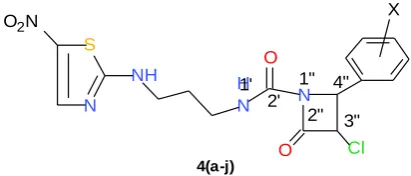
Synthesis of N-[3-(2-amino-5-nitrothiazolyl)-propyl]-4-phenyl-3-chloro-2-oxo-1-azetidine-carboxamide (4a):
The compound 3a (0.009 mole) and chloroacetyl chloride (0.009 mole) in methanol (100 ml) in the presence of Et3N
(0.009 mole) were allowed to react at room temperature. The reaction mixture was first stirred on a magnetic stirrer for about 2.00 hours followed by reflux on a steam bath for about 3.30 hours. The completion of the reaction was monitored by silica gel-G coated TLC plates. The product was filtered and cooled at room temperature. The filtered product was purified over a silica gel packed column chromatography using CH3OH : CHCl3 (7 : 3 v/v) as eluant
(90 ml). The purified product was dried under vacuo and recrystallized from acetone at room temperature to furnish compound 4a (Figure 4).
Compounds 4b-4j have also been synthesized by using similar method as above.
Figure 4. Structure of compound 4a-4j.
N-[3-(2-Amino-5-nitrothiazolyl)-propyl]-4-(phenyl)-3-chloro-2-oxo-1-azetidinecarboxamide (4a): Yield: 61%; m.p. 169-170 ºC; IR (cm-1): 860 (C-S), 964 (C-NO), 1335
(N-CH2), 1360, 1536 (NO2), 1551 (C=C), 1666 (C=O), 1736
(CO cyclic), 1432, 2884, 2917 (CH2), 2957 (CH-Cl), 3021
(CH-Ar), 3385 (NH); 1H NMR (300 MHz, CDCl
3, TMS) δ:
2.07-2.11 (m, 2H, H-8), 3.22-3.29 (m, 2H, H-9), 3.88-3.94 (m, 2H, H-7), 4.36 (d, 1H, J = 4.80 Hz, H-3”), 5.12 (d, 1H, J = 4.80Hz, H-4”), 5.65 (s, 1H, H-1’), 7.81 (s, 1H, H-4), 7.94 (s, 1H, H-6), 6.72-7.96 (m, 5H, Ar-H); 13C NMR (75
MHz, CDCl3, TMS) δ: 29.1 (C-8), 37.5 (C-9), 44.9 (C-7),
50.2 3”), 59.4 4”), 128.1 11 and C-16), 128.5 (C-15), 129.7 (C-12 and C-14), 132.7 (C-4), 136.6 (C-5), 138.5
(C-10), 161.5 (C-2’), 169.2 (C-2), 170.2 (C-2”); Mass (FAB): 409M+; Anal. Calcd. for C
16H16N5O4SCl: C; 46.88,
H; 3.93, N; 17.08%; Found: C; 46.82, H; 3.91, N; 17.02%;
N-[3-(2-Amino-5-nitrothiazolyl)-propyl]-4-(4-chloro-phenyl)-3-chloro-2-oxo-1-azetidinecarboxamide (4b): Yield: 64%; m.p 178-179 ºC; IR (cm-1): 758 Cl), 863
(C-S), 966 (C-NO), 1345 (N-CH2), 1362, 1540 (NO2), 1560
(C=C), 1667 (C=O), 1742 (CO cyclic), 1436, 2887, 2921 (CH2), 2960 (CH-Cl), 3026 (CH-Ar), 3391 (NH); 1H NMR
(300 MHz, CDCl3, TMS) δ: 2.12-2.16 (m, 2H, H-8),
3.25-3.31 (m, 2H, H-9), 3.88-3.90 (m, 2H, H-7), 4.38 (d, 1H, J = 4.80Hz, H-3”), 5.15 (d, 1H, J = 4.80Hz, H-4”), 5.66 (s, 1H, H-1’), 7.92 (s, 1H, H-4), 7.95 (s, 1H, H-6), 6.83-7.97 (m, 4H, Ar-H); 13C NMR (CDCl
3, 75 MHz) δ: 29.6 (C-8), 38.3 (C-9),
45.1 (C-7), 52.6 (C-3”), 60.2 (C-4”), 128.6 (C-11 and C-16), 129.1 15), 129.9 12 and C-14), 135.2 4), 138.8 (C-10), 139.5 (C-5), 163.5 (C-2’), 179.2 (C-2), 170.6 (C-2”); Mass (FAB): 444M+. Anal. Calcd. for C
16H15N5O4SCl2: C;
43.25, H; 3.40, N; 15.76%; Found: C; 43.23, H; 3.34, N; 15.68%.
N-[3-(2-Amino-5-nitrothiazolyl)-propyl]-4-(3-chloro-phenyl)-3-chloro-2-oxo-1-azetidinecarboxamide (4c): Yield: 65%; m.p 182-183 ºC; IR (cm-1): 763 Cl), 866
(C-S), 973 (C-NO), 1336 (N-CH2), 1363, 1541 (NO2), 1557
(C=C), 1674 (C=O), 1740 (CO cyclic), 1434, 2890, 2919 (CH2), 2968 (CH-Cl), 3025 (CH-Ar), 3395 (NH); 1H NMR
(300 MHz, CDCl3, TMS) δ: 2.15-2.18 (m, 2H, H-8),
3.31-3.36 (m, 2H, H-9), 3.89-3.92 (m, 2H, H-7), 4.40 (d, 1H, J = 4.80Hz, H-3”), 5.16 (d, 1H, J = 4.80Hz, H-4”), 5.68 (s, 1H, H-1’), 7.95 (s, 1H, H-4), 7.97 (s, 1H, H-6), 6.74-7.80 (m, 4H, Ar-H); 13C NMR (CDCl
3, 75 MHz) δ: 30.4 (C-8), 38.7 (C-9),
46.2 (C-7), 54.2 (C-3”), 61.3 (C-4”), 127.9 (C-11), 128.5 16), 129.4 15), 130.8 12), 131.3 14), 133.6 (C-4), 138.4 (C-5), 142.2 (C-10), 163.7 (C-2’), 171.4 (C-2), 172.5 (C-2”); Mass (FAB): 444M+. Anal. Calcd. for
C16H15N5O4SCl2: C; 43.25, H; 3.40, N; 15.76%; Found: C;
43.19, H; 3.35, N; 15.71%.
N-[3-(2-Amino-5-nitrothiazolyl)-propyl]-4-(2-chloro-phenyl)-3-chloro-2-oxo-1-azetidinecarboxamide (4d): Yield: 67%; m.p 188-189 ºC; IR (cm-1): 765 Cl), 867
(C-S), 974 (C-NO), 1337 (N-CH2), 1368, 1537 (NO2), 1554
(C=C), 1668 (C=O), 1743 (CO cyclic), 1441, 2893, 2927 (CH2), 2966 (CH-Cl), 3022 (CH-Ar), 3389 (NH); 1H NMR
(300 MHz, CDCl3, TMS) δ: 2.19-2.20 (m, 2H, H-8),
3.30-3.34 (m, 2H, H-9), 3.92-3.97 (m, 2H, H-7), 4.45 (d, 1H, J = 4.75Hz, H-3”), 5.19 (d, 1H, J = 4.75Hz, H-4”), 5.72 (s, 1H, H-1’), 7.86 (s, 1H, H-4), 7.98 (s, 1H, H-6), 6.65-7.98 (m, 4H, Ar-H);13C NMR (CDCl
3, 75 MHz) δ: 30.8 (C-8), 39.3 (C-9),
46.8 (C-7), 51.3 (C-3”), 61.8 (C-4”), 128.6 (C-11), 129.8 16), 130.2 15), 130.8 12), 131.7 14), 134.0 (C-4), 137.6 (C-5), 139.1 (C-10), 164.2 (C-2’), 171.9 (C-2), 172.8 (C-2”); Mass (FAB): 444M+. Anal. Calcd. for
C16H15N5O4SCl2: C; 43.25, H; 3.40, N; 15.76%; Found: C;
43.21, H; 3.38, N; 15.73%.
N-[3-(2-Amino-5-nitrothiazolyl)-propyl]-4-(4-bromo-phenyl)-3-chloro-2-oxo-1-azetidinecarboxamide (4e): Yield: 66%; m.p 186-187 ºC; IR (cm-1): 567 Br), 871
(C-S), 965 (C-NO), 1342 (N-CH2), 1364, 1546 (NO2), 1563
(C=C), 1672 (C=O), 1737 (CO cyclic), 1439, 2894, 2926 (CH2), 2963 (CH-Cl), 3024 (CH-Ar), 3396 (NH); 1H NMR
(300 MHz, CDCl3, TMS) δ: 2.15-2.20 (m, 2H, H-8),
3.32-3.38 (m, 2H, H-9), 3.94-3.98 (m, 2H, H-7), 4.42 (d, 1H, J =
4(a-j)
X
O
N H
N
Cl
O
NH
S
N O2N
1" 2" 1'
2'
4.80Hz, H-3”), 5.30 (d, 1H, J = 4.80Hz, H-4”), 5.69 (s, 1H, H-1’), 7.88 (s, 1H, H-4), 8.01 (s, 1H, H-6), 6.6-7.73 (m, 4H, Ar-H); 13C NMR (CDCl3, 75 MHz) δ: 31.5 8), 37.9
(9), 44.8 (7), 54.7 (3”), 62.1 (4”), 129.3 (11 and C-16), 130.6 (C-15), 131.2 (C-12 and C-14), 134.4 (C-4), 139.5 (C-10), 140.7 (C-5), 164.8 (C-2’), 170.5 (C-2), 171.1 (C-2”); Mass (FAB): 489M+. Anal. Calcd. for
C16H15N5O4SBrCl: C; 39.31, H; 3.09, N; 14.32%; Found:
C; 39.26, H; 3.06, N; 14.24%.
N-[3-(2-Amino-5-nitrothiazolyl)-propyl]-4-(3-bromo-phenyl)-3-chloro-2-oxo-1-azetidinecarboxamide (4f): Yield: 68%; m.p 184-185 ºC; IR (cm-1): 565 Br), 871
(C-S), 967 (C-NO), 1340 (N-CH2), 1366, 1539 (NO2), 1553
(C=C), 1650 (C=O), 1736 (CO cyclic), 1441, 2829 (CH2),
2910 (CH2), 2964 (CH-Cl), 3043 (CH-Ar), 3352 (NH); 1H
NMR (300 MHz, CDCl3, TMS) δ: 2.12-2.16 (m, 2H, H-8),
3.34-3.39 (m, 2H, H-9), 3.96-3.99 (m, 2H, H-7), 4.43 (d, 1H, J = 4.75Hz, H-3”), 5.22 (d, 1H, J = 4.75Hz, H-4”), 5.70 (s, 1H, H-1’), 7.95 (s, 1H, H-4), 8.04 (s, 1H, H-6), 6.72-7.01 (m, 4H, Ar-H); 13C NMR (CDCl
3, 75 MHz) δ: 31.7 (C-8), 41.8
(C-9), 48.2 (C-7), 52.4 (C-3”), 62.5 (C-4”), 130.7 (C-11), 131.5 (C-16), 132.1 (C-4), 132.7 (C-15), 133.4 (C-12), 134.9 (C-14), 137.5 (C-5), 142.0 (C-10), 162.6 (C-2’), 169.8 (C-2), 170.9 (C-2”) (6C, Ar); Mass (FAB): 444M+. Anal.
Calcd. for C16H15N5O4SBrCl: C; 39.31, H; 3.09, N; 14.32%;
Found: C; 39.27, H; 3.01, N; 14.29%.
N-[3-(2-Amino-5-nitrothiazolyl)-propyl]-4-(2-bromo-phenyl)-3-chloro-2-oxo-1-azetidinecarboxamide (4g): Yield: 67%; m.p 179-180 ºC; IR (cm-1): 572 Br), 864
(C-S), 980 (C-NO), 1346 (N-CH2), 1369, 1542 (NO2), 1553
(C=C), 1663 (C=O), 1741 (CO cyclic), 1438, 2892 (CH2),
2924, 2965 (CH-Cl), 3029 (CH-Ar), 3394 (NH); 1H NMR
(300 MHz, CDCl3, TMS) δ: 2.07-2.10 (m, 2H, H-8),
3.31-3.35 (m, 2H, H-9), 3.89-3.93 (m, 2H, H-7), 4.39 (d, 1H, J = 4.70Hz, H-3”), 5.23 (d, 1H, J = 4.70Hz, H-4”), 5.72 (s, 1H, H-1’), 7.89 (s, 1H, H-4), 8.05 (s, 1H, H-6), 6.75-7.76 (m, 4H, Ar-H); 13C NMR (CDCl3, 75 MHz) δ: 32.3 8), 41.4
(C-9), 45.7 (C-7), 50.6 (C-3”), 63.8 (C-4”), 129.7 (C-11), 130.5 16), 131.4 15), 131.7 4), 132.4 12), 133.7 (C-14), 138.6 (C-5), 140.2 (C-10), 162.9 (C-2’), 171.7 (C-2), 172.3 (C-2”) (6C, Ar); Mass (FAB): 444M+. Anal. Calcd.
for C16H15N5O4SBrCl: C; 39.31, H; 3.09, N; 14.32%;
Found: C; 39.28, H; 3.05, N; 14.28%.
N-[3-(2-Amino-5-nitrothiazolyl)-propyl]-4-(4-nitro-phenyl)-3-chloro-2-oxo-1-azetidinecarboxamide (4h): Yield: 65%; m.p 178-179 ºC; IR (cm-1): 870 S), 975
(C-NO), 1339 (N-CH2), 1367, 1543 (NO2), 1554 (C=C), 1665
(C=O), 1746 (CO cyclic), 1440, 2891, 2918 (CH2), 2961
(CH-Cl), 3021 (CH-Ar), 3399 (NH); 1H NMR (300 MHz,
CDCl3, TMS) δ: 2.16-2.18 (m, 2H, H-8), 3.32-3.36 (m, 2H,
H-9), 3.90-3.94 (m, 2H, H-7), 4.47 (d, 1H, J = 4.70Hz, H-3”), 5.25 (d, 1H, J = 4.70Hz, H-4”), 5.76 (s, 1H, H-1’), 7.90 (s, 1H, H-4), 8.07 (s, 1H, H-6), 6.78-7.80 (m, 4H, Ar-H); 13C
NMR (CDCl3, 75 MHz) δ: 33.4 8), 41.9 9), 46.8
(C-7), 52.3 (C-3”), 63.7 (C-4”), 126.9 (C-11 and C-16), 128.2 (C-15), 130.5 (C-12 and C-14), 137.9 (C-4), 139.6 (C-5), 143.7 (C-10), 161.8 (C-2’), 170.9 (C-2), 171.2 (C-2”); Mass (FAB): 454M+. Anal. Calcd. for C
16H15N6O6SCl: C; 42.25,
H; 3.32, N; 18.47%; Found: C; 42.14, H; 3.22, N; 18.41%.
N-[3-(2-Amino-5-nitrothiazolyl)-propyl]-4-(3-nitro-phenyl)-3-chloro-2-oxo-1-azetidinecarboxamide (4i): Yield: 69%; m.p 177-178 ºC; IR (cm-1): 865 S), 969
(C-NO), 1343 (N-CH2), 1365, 1544 (NO2), 1561 (C=C), 1670
(C=O), 1739 (CO cyclic), 1442, 2888, 2925 (CH2), 2958
(CH-Cl), 3028 (CH-Ar), 3392 (NH); 1H NMR (300 MHz,
CDCl3, TMS) δ: 2.09-2.12 (m, 2H, H-8), 3.31-3.37 (m, 2H,
H-9), 3.90-3.97 (m, 2H, H-7), 4.48 (d, 1H, J = 4.80Hz, H-3”), 5.26 (d, 1H, J = 4.80Hz, H-4”), 5.76 (s, 1H, H-1’), 7.92 (s, 1H, H-4), 8.10 (s, 1H, H-6), 6.77-7.83 (m, 4H, Ar-H); 13C
NMR (CDCl3, 75 MHz) δ: 33.2 8), 39.8 9), 47.7
(C-7), 53.4 (C-3”), 64.7 (C-4”), 130.4 (C-11), 131.7 (C-16), 132.5 (C-15), 132.9 (C-12), 133.6 (C-14), 136.8 (C-4), 139.4 (C-5), 140.8 (C-10), 162.2 (C-2’), 172.8 (C-2), 173.6 (C-2”); Mass (FAB): 454M+. Anal. Calcd. for
C16H15N6O6SCl: C; 42.25, H; 3.32, N; 18.47%; Found: C;
42.15, H; 3.26, N; 18.43%.
N-[3-(2-Amino-5-nitrothiazolyl)-propyl]-4-(2-nitrophe-nyl)-3-chloro-2-oxo-1-azetidinecarboxamide (4j): Yield: 62%; m.p 180-181 ºC; IR (cm-1): 869 (C-S), 971 (C-NO),
1350 (N-CH2), 1370, 1538 (NO2), 1556 (C=C), 1671 (C=O),
1741 (CO cyclic), 1437, 2889, 2920 (CH2), 2959 (CH-Cl),
3023 (CH-Ar), 3387 (NH); 1H NMR (300 MHz, CDCl 3,
TMS) δ: 2.11-2.15 (m, 2H, H-8), 3.30-3.34 (m, 2H, H-9), 3.94-3.98 (m, 2H, H-7), 4.49 (d, 1H, J = 4.75Hz, H-3”), 5.28 (d, 1H, J = 4.75Hz, H-4”), 5.78 (s, 1H, H-1’), 7.94 (s, 1H, H-4), 8.12 (s, 1H, H-6), 6.90-7.84 (m, 4H, Ar-H); 13C
NMR (CDCl3, 75 MHz) δ: 33.5 8), 40.7 9), 48.6
(C-7), 51.5 (C-3”), 64.1 (C-4”), 131.1 (C-11), 132.2 (C-16), 132.7 (C-15), 133.4 (C-12), 133.9 (C-4), 134.3 (C-14), 136.3 (C-5), 141.4 (C-10), 163.2 (C-2’), 170.7 (C-2), 171.5 (C-2”); Mass (FAB): 454M+. Anal. Calcd. for
C16H15N6O6SCl: C; 42.25, H; 3.32, N; 18.47%; Found: C;
42.18, H; 3.29, N; 18.44%.
RESULTS AND DISCUSSION
N-[3-(2-amino-5-nitrothiazolyl)-propyl]-4-(substituted phenyl)-3-chloro-2-oxo-1-azetidine-carboxamide, compo-unds 4a-4j were synthesized in four different steps: 2-amino-5-nitrothiazole on reaction with Cl(CH2)3Br at room
temperature to afford 1-(3-chloropropyl)-2-amino-5-nitrothiazole, compound 1. IR spectrum of compound 1
displayed absorption at 1313 and 727 cm-1 for (N-CH 2) and
(C-Cl) respectively. In the FAB-Mass spectrum of compound 1 parent ion peak found at 221 M+. The
compound 1 on reaction with urea at room temperature yielded N-[3-(2-amino-5-nitrothiazolyl)-propyl]-urea, compound 2. IR spectrum of compound 2 showed absorption for NH at 3387 and for CO at 1662 cm-1 while
absorption of (C-Cl) has been disappeared.
3(a-j) 4(a-j)
Ar= substituted phenyl ring
2 1
S N S N
S N
O Cl
N
S N N
H 2
S N
ClH2CH2CH2CHN
O2N
H2NOCHNH2CH2CH2CHN
O2N
NHCH2CH2CH2NHCO
O2N
CHAr
NHCH2CH2CH2NHCON=CHAr
O2N O2N
NH2CONH2
ArCHO
Table 1. Antibacterial and antifungal activities of compounds 4(a-j).
Compd. B. subtilis E. coli S. aureus K. pneumoniae A. niger A. flavus F. oxisporium C. albicans
4a 10.25 13.5 7.25 13.5 >25 >25 13.5 >25
4b 15.5 7.25 7.25 9.25 13.5 >25 13.5 >25
4c 5.25 6.25 4.25 7.25 7.5 7.5 10.5 13.5
4d 6.25 7.50 7.25 7.25 8.25 10.5 10.25 12.75
4e 8.25 4.25 7.25 7.25 10.5 9.5 8.5 12.5
4f 4.25 7.25 6.25 6.25 9.5 8.75 10.25 13.25
4g 7.25 13.5 7.25 7.25 13.5 12.5 13.5 13.5
4h 4.25 4.25 7.25 4.25 7.50 8.5 8.5 12.75
4i 4.25 4.25 4.25 6.25 8.25 6.75 8.75 12.5
4j 4.25 6.25 4.25 4.25 7.50 7.25 8.5 12.5
Streptomycin 1.25 2.25 3.25 2.75 - - - -
Griseofulvin - - - - 7.25 6.25 8.50 12.5
The 1H NMR spectrum of compound 2 displayed signal of
(CH2-N) appear at δ 3.19-3.24 ppm and its 13C NMR value
of CO group appeared at δ 163.4 ppm. In the FAB-MS spectrum of compound 2 parent ion peaks found at (m/z) 245. The compound 2 on further reaction with selected several substituted aromatic aldehydes produced N-[3-(1H -2-amino-5-nitrothiazolyl)-propyl]-N’-[(substituted phenyl)-methylidene]urea, compounds 3a-3j. For the compounds 3a-3j characteristic absorption for Schiff base (N=CH) in IR spectra appeared in the range of 1558-1575cm-1 and in the 1H NMR chemical shift at δ 8.02-8.20 ppm while in its 13C
NMR signal found at δ 147.4-151.6 ppm. In the 1H NMR a
broad signal of NH2 has been disappeared at δ 5.96 ppm. In
the FAB-Mass spectrum of 3a parent ion peak found at (m/z) 333.
The compounds 3a-j on treatment with ClCH2COCl in the
presence of Et3N furnished final products compounds 4a-4j.
In the spectra of compounds 4a-4j carbonyl group of β-lactam ring showed characteristic absorptions in the range of 1736-1746 cm-1 and 1H NMR spectrum two doublet
appeared for (N-CH) and (CH-Cl) in the range of δ 5.12-5.30 and 4.36-4.49 ppm respectively with coupling constant J 5.00 Hz but in the 13C NMR spectra three signals appeared
for (N-CH), (CH-Cl) and (CO cyclic) at (δ) 59.4-64.7, 50.2-54.7 and 170.2-173.6 ppm respectively. The IR absorption
1H and 13C NMR signal of (N=CH) have been disappeared.
The results of the all described activities (antibacterial, antifungal, antitubercular and antiinflammatory) were summarized in Tables 1, 2 and 3.
Table 2. Antitubercular activity of compounds 4a-j.
Compound Concentration Compound Concentration
4a 6.50 4f 2.75
4b 2.25 4g 3.50
4c 2.75 4h 2.25
4d 3.25 4i 2.25
4e 3.25 4j 2.50
The results of the antimicrobial screening data revealed that all the compounds 4a-4j showed considerable and varied activity against the selected microorganism. A new series of N -[3-(2-amino-5-nitrothiazolyl)-propyl]-4-(substituted phenyl)-3-chloro-2-oxo-1-azetidine-carboxami-de, compounds 4a-4j were prepared and screened for their antimicrobial, antitubercular and anti-inflammatory activities data (as shown in Table 1 and 2) revealed that all the
synthesized compounds 4a-4j have a structure activity relationship (SAR) because activities of compounds varies with substitution. Nitro group containing compounds (4h, 4i
and 4j) showed higher activity than chloro (4c, 4d), or bromo group containing compounds (4e, 4f).
Table 3. Anti-inflammatory activity of compounds 4(a-j).
Compo-und
Paw volume (cm3)a
Paw volume (cm3)b
Inhibi-tion,% 4a 0.66 ± 0.02 0.15 ± 0.02 50.00 4b 0.68 ± 0.02 0.14 ± 0.02 53.33 4c 0.65 ± 0.02 0.13 ± 0.01 56.67 4d 0.66 ± 0.02 0.13 ± 0.02 56.67 4e 0.68 ± 0.02 0.12 ± 0.01 60.00 4f 0.69 ± 0.03 0.13 ± 0.02 56.67 4g 0.65 ± 0.02 0.13 ± 0.01 56.67 4h 0.67 ± 0.03 0.12 ± 0.02 60.00 4i 0.68 ± 0.02 0.11 ± 0.03 63.33 4j 0.6 ± 0.03 0.11 ± 0.01 63.33 Control 0.69 ± 0.02 0.30 ± 0.01 - Standardc 0.70 ± 0.03 0.10 ± 0.02 66.67
a) Before carageenan administration; (mean SEM) b) Total increase in paw volume after 5 hours (mean SEM); c) phenylbutazone standard
Chloro and bromo derivatives also have higher activity than other rested compounds. On the basis of SAR, concluded that the activity of compounds depends on electron withdrawing nature of the substituted groups. The sequence of the activity is following
NO2 > Cl > Br > OH > OCH3 > CH3
The investigation of antimicrobial (antibacterial, antifungal and antitubercular) data revealed that the compounds 4c, 4d, 4e, 4f, 4h, 4i and 4j displayed high activity in the series, the compounds 4b and 4g showed moderate activity and rest compounds showed less activity against all the strains compared with standard drugs. In the anti-inflammatory activity (Table 3) compounds 4c, 4d, 4e, 4f, 4h, 4i and 4j
CONCLUSION
Concluded that all compounds have been synthesized successfully and screened for antimicrobial, antitubercular and anti-inflammatory activities data of compounds (shown in Table 1, 2 and 3) revealed that the compounds shows moderate to good activities against all the strains compared with standard drugs.
ACKNOWLEDGEMENT
The authors are thankful to SAIF, Central Drugs Research Institute Lucknow (India) for providing spectral and analytical data of the compounds. We are also thankful to Head, Department of Chemistry Dr. H. S. Gour, University, Sagar (India) for giving the facilities to carryout the work.
REFERENCES
1Soliman, R., Gabr, M., Abouzeit-Har, M. S., Sharabi, F. M. J.
Pharm. Sci. 1981, 70, 94.
2Pattan, S. R., Dighe, N. S., Nirmal, S. A., Merekar, A. N., Laware,
R. B., Shinde, H. V., Musmade, D. S. Asian J. Res. Chem., 2009, 2, 196.
3Popov-Pergal, K., Rancic, M., Pergal, M., Bogdanovic, G., Kojic,
V., Djokovic, D. J. Serb. Chem. Soc., 2006, 71, 861.
4Kaplancikli, Z., Turan-Zitouni, A., Gulhan, R., Gven K. G., Arch.
Pharm. Res., 2004, 27, 1081.
5Sonwane, S. K., Srivastava, S. D. Proc. Natl. Acad. Sci. India,
2008, 78, 129.
6Desai, K. G., Desai, K. R. Indian J. Chem., 2005, 44, 2093.
7Sharma, M. C., Kohli, D. V., Sahu, N. K., Sharma, S., Chaturvedi,
S. C. Digest J. Nanomater. Biostruct., 2009, 4, 339.
8Srivastava, S. K., Srivastava, S., Srivastava, S. D. Indian J. Chem.,
1999, 38, 183.
9Srivastava, S. K., Srivastava, S. L., Srivastava, S. D. Indian J.
Chem., 2000, 39, 464.
10Raval, J. P., Patel, H. V., Patel, P. S., Patel, N. H., Desai, K. R.
Asian J. Res. Chem., 2009, 2, 171.
11Patel, K. H., Mehta, A. G. E-J. Chem., 2006, 3, 103.