©Science and Education Publishing DOI:10.12691/plant-5-2-1
Asexual Morphological Differences in Male and Female
Plants of Commiphora wightii (Arn.) Bhandari - An
Endangered Medicinal Plant
Arti Gaur, Hema Singhal, U.K. Tomar*
Forest Genetics and Tree Breeding Division, AFRI, Jodhpur *Corresponding author: [email protected]
Abstract
Studies were carried out on growth characteristics, stem branching pattern and leaf morphology to reveal the significant differences in male and female plants and development of reliable morphological markers to identify gender even in non-flowering phase. Female plants have spreading growth and weeping canopy whereas male plants have erected growth and divergent canopy. Female plants have significantly higher height (p = 0.06) and collar diameter (p = 0.03) than males. Similarly, female plants also have higher number of secondary and tertiary branches with wider branch angles leading to the differences in canopy shape and size between two genders. Other morphological differences observed in female and male plants are in leaf characters viz. leaf area, leaf margin and number. Male plants were only having higher stomatal density (p = 0.03) on both the sides of leaves as compared to females. Guggulsterone-Z was detected only in aerial branches of female plants (0.014-0.029%) and in males it was below detectable limits.Keywords
: apomixis, branch angle, Burseraceae, endangered, guggul, sexual dimorphism, stomatal densityCite This Article:
Arti Gaur, Hema Singhal, and U.K. Tomar, “Asexual Morphological Differences in Male and Female Plants of Commiphora wightii (Arn.) Bhandari - An Endangered Medicinal Plant.” Research in Plant Sciences, vol. 5, no. 2 (2017): 51-59. doi: 10.12691/plant-5-2-1.1. Introduction
Commiphora wightii (Arnott) is one of the important traditional and endangered medicinal plants of semi arid region of India [1]. It belongs to family Burseraceae. C. wightii is also known as ‘guggal’ or ‘guggulu’ in hindi and Indian bdellium tree in English ([2,3]). It is much-branched perennial shrub/small medium-sized tree, reaching to a height of 3-4 m [4]. It is distributed mainly in the arid regions of Rajasthan, Gujarat, Madhya Pradesh, Karnataka and Orissa states of India and also in the adjoining areas of Pakistan [5].
It is basically used for its oleo-gum resin commonly known as guggul gum which has been a key component in ancient Indian ayurvedic system of medicine [6]. This is a mixture of many important secondary metabolites mainly E and Z-guggulsterones, which are of potent medicinal uses mainly in arthritis, cold, bronchitis, laryngitis, obesity, heart disease, lipid disorders etc. [7,8]. Encroachment, unawareness of rural people, destructive harvesting methods, unsustainable overexploitation and lack of management cultivation practices led to decrease in its population [9,10,11], as a result it has become threatened species [12,13]. Thus the gap between supply and demand of guggul gum is increasing rapidly. According to the assessment reported by Ayurvedic Drug Manufacturing Association (ADMA), less than 10% of requirement of guggul gum is currently being met from indigenous
sources and remaining 90% of this material being obtained through imports [14].
It is a polymorphic flowering plant having male, female and andromonoecious type of plants [15]. Flowering occurs twice in a year i.e. in April/May and October/November, rest of the year the plant remains in vegetative phase. Male and andromonoecious plants are extremely rare in natural population and plantations
[16,17]. In absence or scarcity of male plants, it evades the process of fertilization and adopted apomixis for its survival [16]. This situation may be leading the production of genetically identical plants and loss of genetic variation which may lead to genetic erosion of the species. Further the breeding programmes and production of pure line and homozygous plants would also get hampered in absence of male plants. Thus, there is a need to identify extremely rare male plants in natural habitats and conserve them for future breeding programmes. Male and female plants can be easily identified on the basis of flowers but difficult to identify them during non flowering season.
2. Materials and Methods
Germplasm bank of C. wightii was established from 25 different districts of Rajasthan in 2007. In this germplasm, two male plants were identified during flowering time. Some distinct morphological differences in male and female plants were also noticed in their form. Present studies were carried out on 6-year-old two male (M1 and M2) and three female (F1, F2 and F3) genotypes of
Commiphora wightii growing in this germplasm. Initially these plants were irrigated for 1st & 2nd year and later these plants were kept under natural conditions at the site. Observations were taken in the mid of June 2013. Minimum average temperature was 29.8°C, maximum average temperature was 41.5°C, relative humidity I was 61% and relative humidity II was 32%. The annual rainfall for that year was 575 mm.
2.1. Morphological Parameters
Thirteen qualitative and quantitative morphological parameters under three categories i.e. growth characteristics, leaf morphology and branching pattern of the plant were studied. Growth habit, canopy, plant shape, stem bark color, leaf shape and margin were qualitative and height, crown, number of branches, branch angles, number of leaves, leaf length and leaf area were quantitative parameters.
(A) Growth characteristics: Plant shape, height, canopy, growth habit, and crown size were observed as growth characteristics. The overall shape, growth and canopy of the plant were evaluated visually on the basis of standard terminology used in taxonomy. Plant height was measured in cm from ground adjacent to the stem to the tip of leading branch of plant using graduated pole. Average crown spread was measured in cm using cross method of two longest spread at right angle and average of these two readings was considered as crown diameter
[19].
(B) Branching pattern: Number of branches and branching angles were measured to study branching pattern. The numbers of branches of each genotype were counted at three different levels viz. primary, secondary and tertiary. The branching angles were evaluated using divider and compass at all the three different orders. First order (I) is the branching angle between primary and secondary branches, II order is the branching angle between secondary and tertiary branches and III order is the branching angle between tertiary and quaternary branches. Stem bark color was assessed visually of the same diameter stem, from almost similar location of every plant for the comparison.
(C) Leaf morphology- Data were recorded on shape, margin, size, number and area of leaf. To evaluate leaf shape and margins. ten fully expanded matured leaves from each genotype were taken and assessed visually to evaluate leaf shape. Leaf length of ten fully mature leaves from each genotype was measured using measurement scale. To count the number of leaves three apical twigs (15 cm long) were collected from each plant and leaves on each twig were counted excluding the small leaves at the top of the twig. Leaf area was also calculated using graph paper method [20].
2.2. Stomatal Studies
Microscopic studies were also conducted on stomatal density, stomatal index and stomata types. Fresh mature leaves of all the genotypes were collected, washed and dried before removing epidermal layers. To peel the epidermal layer method was adopted from TIEE [21]. Counting of stomata was performed on both adaxial and abaxial epidermal layer of each genotype in 3 different microscopic fields. An average no. of stomata and epidermal cells per microscopic field (400X magnification) were calculated and stomatal index was calculated using the equation of Salisbury [22].
no. of stomata X 100 Stomatal index
no. of stomata no. of epidermal cell
=
+
Stomatal density was also determined by calculating number of stomata per mm2. The number of stomata present in a particular area of a grid was counted using motic image analyser and then it was divided by the grid area [23].
no. of stomata in a grid area Stomatal density
grid area
=
2.3. Estimation of Z- Guggulsterone
Z- guggulsterone from aerial branches of two male and three female plant samples was estimated using a non- destructive procedure described by Agarwal et al. [24]. 50 gm powder of aerial branches from each sample were taken to perform High performance liquid chromatography using standard reference (M/s Natural Remedies, Bangalore, India) at 242 nm wavelength. The mobile phase used was 0.1% acetonitrile and formic acid/H2O (60:40) and flow rate was adjusted at 1.0 ml/min.
The column was used of RP-18 (250mmX4.6mm.5µm, Merck). The peak of standard Z- guggulsterone was observed and then readings of the samples were compared to estimate the Z guggulsterone concentration of samples. Z-guggulsterone was estimated in the laboratory of DMAPR, Anand.
3. Results
Significant differences were observed in different morphological parameters assessed in male and female plants, which are described category wise in following paragraphs.
3.1. Morphological Differences
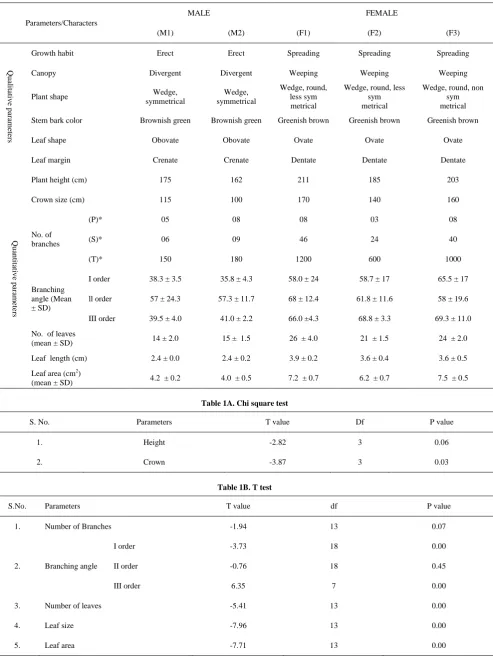
plants as compared to females (Table 1). Statistical test performed on various quantitative parameters indicate that crown size of the plant was significantly different between male and female plants whereas height of the plants was
found to be non significant at 5% level of chi square test (Table 1A). Quantitative measurements on height and crown diameter clearly indicate superiority of female plants over male plants.
Figure 1. Canopy of female and male C. wightii plants. A; Weeping type of canopy in female plant, B; Divergent type of canopy in male plant
(B) Branching pattern: The number of branches (3-8) at primary level was almost same in both type of plants but secondary and tertiary branches were significantly higher in females (unpaired student t-test
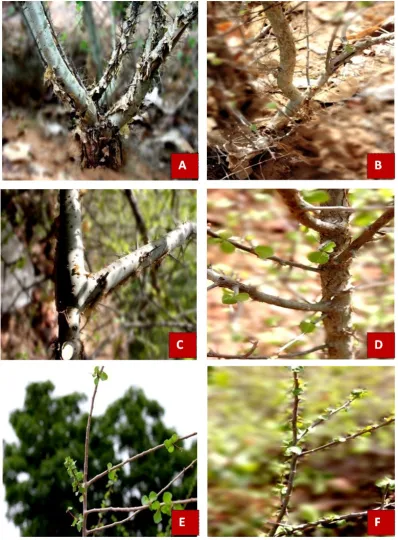
p = 0.041 and p = 0.043, respectively) as compared to males. The branching angle between primary and secondary branches (Iorder; Figure 3A and Figure 3B) and between tertiary and quaternary branches (III order;
Figure 3E and Figure 3F) was also more in females as compared to males (Table 1). However, there was insignificant difference in male and female plants for
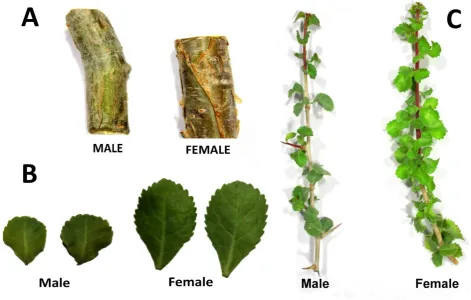
branch angle between secondary and tertiary branches (II order; Figure 3C and Figure 3D) both type of plants were having knotty and crooked branches. Paired T test on branch angles in male and female plants revealed that the angle of branching at I order and III order varies significantly (P = 0.00, 0.01) whereas differences in II order branching angle was found to be insignificant (Table 1B). The stem bark of female was brown tinged with green colour and peels more frequently than that of male which is green tinged with brown colour (Figure 4A).
(C) Leaf morphology: The leaf shape was obovate in males and ovate in female plants (Figure 4B). The margins of male leaf were of crenate type i.e. the edge of leaf had blunt, rounded teeth and dentate type in females i.e. the
edge of leaf had pointed teeth (Figure 4B). Both numbers and size of leaves were significantly greater (p = 0.0; Table 1B) in female than in male plants (Figure 4B and
Figure 4C).
Table 1. Morphological parameters of male and female plants of Commiphora wightii
Parameters/Characters
MALE FEMALE
(M1) (M2) (F1) (F2) (F3)
Q
u
al
itat
iv
e p
ar
am
et
er
s
Growth habit Erect Erect Spreading Spreading Spreading
Canopy Divergent Divergent Weeping Weeping Weeping
Plant shape Wedge,
symmetrical
Wedge, symmetrical
Wedge, round, less sym metrical
Wedge, round, less sym metrical
Wedge, round, non sym metrical
Stem bark color Brownish green Brownish green Greenish brown Greenish brown Greenish brown
Leaf shape Obovate Obovate Ovate Ovate Ovate
Leaf margin Crenate Crenate Dentate Dentate Dentate
Q
u
an
tit
at
iv
e p
ar
am
et
er
s
Plant height (cm) 175 162 211 185 203
Crown size (cm) 115 100 170 140 160
No. of branches
(P)* 05 08 08 03 08
(S)* 06 09 46 24 40
(T)* 150 180 1200 600 1000
Branching angle (Mean ± SD)
I order 38.3 ± 3.5 35.8 ± 4.3 58.0 ± 24 58.7 ± 17 65.5 ± 17
ll order 57 ± 24.3 57.3 ± 11.7 68 ± 12.4 61.8 ± 11.6 58 ± 19.6
III order 39.5 ± 4.0 41.0 ± 2.2 66.0 ±4.3 68.8 ± 3.3 69.3 ± 11.0
No. of leaves
(mean ± SD) 14 ± 2.0 15 ± 1.5 26 ± 4.0 21 ± 1.5 24 ± 2.0
Leaf length (cm) 2.4 ± 0.0 2.4 ± 0.2 3.9 ± 0.2 3.6 ± 0.4 3.6 ± 0.5
Leaf area (cm2)
(mean ± SD) 4.2 ± 0.2 4.0 ± 0.5 7.2 ± 0.7 6.2 ± 0.7 7.5 ± 0.5
Table 1A. Chi square test
S. No. Parameters T value Df P value
1. Height -2.82 3 0.06
2. Crown -3.87 3 0.03
Table 1B. T test
S.No. Parameters T value df P value
1. Number of Branches -1.94 13 0.07
2. Branching angle
I order -3.73 18 0.00
II order -0.76 18 0.45
III order 6.35 7 0.00
3. Number of leaves -5.41 13 0.00
4. Leaf size -7.96 13 0.00
Figure 4. Morphological differences in male and female C. wightii plant. A: Stem bark colour; B: Leaf margin, shape and size; C: Number of leaves
3.2. Stomatal Studies
On the contrary of all quantitative characters studied stomatal density was significantly higher (p = 0.03; Table 1A) on both the sides of leaves in males (Figure 5A) as compared to female plants (Figure 5B). Whereas, there
was no significant difference (p = 0.27) in stomatal index between male and female plants (Table 2A). Stomata were of anomocytic type (irregularly arranged) and were hypoamphistomatic types (having more stomata on lower epidermis as compared to upper; Figure 5A and
Figure 5B).
Table 2. Leaf stomatal index and stomatal density of male and female plants of C. wightii
S.
No. Parameters/ Characters
MALE FEMALE
(M1) (M2) (F1) (F2) (F3)
1. Stomatal density (/mm)
(Ad)* 310 ± 11.6 308 ± 15.0 282 ± 15.0 275 ± 19.1 280 ± 24.2
(Ab)* 338 ± 27.3 350 ± 19.3 300 ± 15 305 ± 36.8 288 ± 37.7
2. Stomatal index
(Ad)* 12.4 11.7 11.3 12.0 11.1
(Ab)* 13.0 12.6 11.8 12.5 10.0
*Ad= Adaxial, Ab= Abaxial
Table 2A. T test
S. No. Parameters T value df P value
1. Stomatal density
Ad* 3.59 13 0.03
Ab* 3.34 13 0.05
2. Stomatal index
Ad* 1.35 3 0.27
Ab* 1.42 3 0.25
Figure 5. Stomatal density of male (A) and female C. wightii plant (B).
3.3. Z- guggulsterone
Z- guggulsterone was also estimated in male and female plants from aerial branches using non destructive method which revealed a difference among three female plants (140.96, 139.93 and 289.17
µg/g)
whereas it was below detectable limits in male plants.4. Discussion
Differences in morphology and growth characteristics have been documented between male and female plants of some species by many researchers [25,26,27]. In some plants like Juniperus virginiana, Acer negundo and
Lindera benzoin females were smaller and slow growing
than male plants [28,29,30,31]. Commiphora wightii
resembles later case of Ailanthus excelsa and Mercurialis annua where female plants have higher biomass and better growth characteristics as compared to males [32,33].
reproduction requires less energy for seed production resulting in transfer of the supplements to increase the growth of the plants. Whereas male plants investing proportionately more in root growth, presumably to provide nitrogen for pollen production. Thus, they are not having superiority in above ground portion of plants. This hypothesis appears true in cases where male plants have poor growth like C. wightii.
Higher numbers of branches and leaves in female plants as compared to male can be interpreted as a sign of higher adaptability to the extreme arid condition of India [35]. The variations in leaf morphology, which may be due to differences in reproductive function of female plants for which they allocate more nutrients and carbohydrates for a longer period than males. Therefore, the optimal leaf size and longevity may be greater in females than males [36]. These variations in leaf size of male and female genotypes of C. wightii may be used for sex identification, as in litchi
[37].
Stomatal density plays a key role in determining water use efficiency, Since, it controls leaf conductance, which is crucial for both photosynthesis and transpiration [38]. The present results are of great importance as the stomatal density of male plants is significantly greater than that of female plants which may lead to more evapo-transpiration in water deficiency which may be a possible reason for depletion of its male population. The stomatal index is fairly constant for leaves of a particular species [39]
However, some researchers also reported that stomatal density was positively correlated with the stomatal index
[40].
Previously Sinha et al. [35] also studied growth performance and morphological parameters in five female provenances of guggul. They revealed a significant amount of variation between provenances but not within provenances which is a clear identification of ecological adaptation of provenances. The present results include female plants from only one provenance so we did not observe much difference among female genotypes. Since, they observed a significant amount of differences among female genotypes for parameters like plant height, shape, growth habit and stem bark colour, these parameters were not considered as strong morphological parameters to differentiate male and female genotypes.
Z-guggulsterone screening also showed variation and it was very less (below detectable limit) in male plants as compared to females. The previous work done for the estimation of Z-guggulsterone from stem bark based on sex of C. wightii plant [41] also observed similar results. Secondary metabolites play a major role in the adaptation of plants to their environment in stress conditions [42,43]. In C. wightii male plants were less in number [16] and poor growth also indicated that probably the males were less adapted to stressful environment as compared to female plants.
Over all male plants were weaker in their growth as compared to females. Out of thirteen different qualitative and quantitative morphological characters, branch angles and tree form were the stronger markers for field level workers to identify extremely rare male plants even during vegetative phase also. If the rare male plants in the natural population of C. wightii can be identified using some simple descriptors provides, it can provide great
opportunities for in situ and ex situ conservation and integration in future breeding programmes. On the basis of these morphological characters we have identified ten new male plants at Deesa trials.
These types of studies will also help in understanding phenomenon of sex differentiation which is largely considered as an adaptation for out-breeding and also prove useful in judicious bio-resource utilization [44]. Thus, the gender-related bio-chemo diversity within a species is of considerable importance depending upon its uses.
Compting Interests (If Any)
The author(s) declare(s) that there is no conflict of interest
Authors' Contributions
This work was carried out in collaboration between all authors. Author UKT designed the study, performed the statistical analysis, wrote the protocol, and author AG wrote the first draft of the manuscript. Authors HS and AG managed the field study. All authors read and approved the final manuscript.
Acknowledgements
The authors are thankful to Shri N.K. Vasu, Director AFRI and Dr. D. K. Mishra, Sci. F Silviculture Division, AFRI Jodhpur for supporting present studies. Financial support of UGC and NMPB, New Delhi are also gratefully acknowledged.
References
[1] UNDP. (2008). Rajasthan Red Listed Medicinal Plants, pp. 22-23. http://envis.frlht.org/documents/rajasthan-medicinal-plants-conservation.pdf
[2] Murray MT. (1995). The Healing Power of Herbs (2nd edition), Prima Publishing.
[3] Lal H and Kasera PK. (2010). Status and distribution range of Guggal: a critically endangered medicinal plant from the Indian Thar desert. Sci Cult 76: 531-533.
[4] Singhal H, Gaur A, Tomar UK. (2014). Observations on flowering and fruiting in Commiphora wightii (Arnott) Bhandari. Eur.J. Med. Plnts. 4(9): 1087-1097.
[5] Dixit AM, Subba Rao SV. (2000). Distribution and habitat characterization of Commiphora wightii in arid region, Kachchh Gujarat. Trop Ecol 41(1): 81-88.
[6] Chakravarty HL. (1975). Herbal heritage of India. Bull Bot Soc Bengal 29: 97-103.
[7] Jain SK. (1991). Dictionary of Indian folk medicine and ethnobotany. Deep publications, New Delhi, India.
[8] Satyavati GV. (1991). Guggalipid: A promising hypolipidaemic agent from gum guggal (Commiphora wightii) In: Wagner H, Farnsworth NR (Eds.), Economic and Medicinal Plant Research. New York Academic Press Harcourt Brace Javanovich, London 4: 47-80.
[9] Atal CK, Gupta OP, Afaq SH. (1975). Commiphora mukul: Source of Guggal in Indian System of Medicine. Econ Bot 29: 208-218. [10] Kumar A, Bhandari MM. (1994). Commiphora wightii - A
[11] S Kumar R. (2013). Distribution and abundance of Commiphora wightii (Arn) Bhandari, in the forest of north Gujarat region (NGR), Gujarat, India. Ind J Plant Sci 2(1): 43-51.
[12] GEC. (1994). Current ecological status of Kachchh. Gujarat Ecology Commision, Vadodara.
[13] WCMC. (1994). Biodiversity Data Sourcebook. World Conservation Press. Cambridge.
[14] Ved DK and Goraya GS. (2007). Demand and Supply of Medicinal Plants in India. NMPB, New Delhi & FRLHT, Bangalore, India.
[15] Yadav BBL, Billore KV, Joseph JG, Chaturvedy DD. (1999). Cultivation of GUGGULU. Central Council for Research in Ayurveda and Siddha, New Delhi.
[16] Gupta P, Shivanna KR, Mohan Ram HY. (1996). Apomixis and polyembryony in the guggal plant, Commiphora wightii. Ann Bot 78: 67-72.
[17] Tomar UK. (2013). Assessment of Guggul germplasm for studying population density, diversity, female-male plant's ratio for in situ and ex situ conservation in Rajasthan. SFD Rajasthan. ICFRE Report.
[18] Samantaray S, Geetha KA, Hidayath KP, Maiti S. (2010). Identification of RAPD markers linked to sex determination in guggal Commiphora wightii (Arnott.) Bhandari. Plant Biotechnol Rep 4: 95-99.
[19] Blozan W. (2008). The tree measuring guidelines of the Eastern native tree society.
http://www.nativetreesociety.org/measure/tree_measuring_guideli nes-revised 1. pdf accessed May 12, 2017.
[20] Green-armytage S. (2008). Extraordinary leaves. buffalo, ny: firefly books.
[21] Grant BW and Vatnick I. (2004). Environmental Correlates of Leaf Stomata Density. TIEE 1: 1-24.
[22] Salisbury EJ. (1927). On the causes and ecological significance of stomatal frequency, with special reference to the woodland flora. Philosophical Transactions of the Royal Society of London B 216: 1-65.
[23] Grant OM, Chaves MM, Jones HG. (2006). Optimizing thermal imaging as a technique for detecting stomatal closure induced by drought stress under green house conditions. Physiol Plantarum 127: 507-518.
[24] Agarwal SK, Siddique TMS, Kumar S, Khanna AK, Chander R. (2000). Process for the isolation of Z and E Guggalsterone from aerial branches of Commiphora wightii (Guggal). United State Patent No 6,086,889.
[25] Laporte MM, Delph LF. (1996). Sex-specific physiology and source-sink relations in the dioecious plant Silenelatifolia. Oecologia 106: 63-72.
[26] Dawson TE, Geber MA. (1999). Sexual dimorphism in physiology and morphology In: Geber MA, Dawson TE, Delph LF (Eds.), Gender and sexual dimorphism in flowering plants. Springer Berlin Heidelberg New York: 176-215.
[27] Espirito-Santo MM, Madeira BG, Nevees FS, Faria ML, Fagundes M, Fernandes GW. (2003). Sexual differences in reproductive phenology and their consequences for the demography of Baccharis dracunculifolia (Asteraceae), a dioecious tropical shrub. Ann Bot 91: 13-19.
[28] Hoffmann AJ and Alliende MC. (1984). Interactions in the patterns of vegetative growth and reproduction in woody dioecious plants. Oecologia 61:109-114.
[29] Vasiliauskas SA and Aarssen LW. (1992). Sex ratio and neighbour effects in monospecific stands of Juniperus virginiana. Ecology 73:622-632.
[30] Jing SW and Coley PD. (1990). Dioecy and herbivory: the effect of growth rate on plant defense in Acer negundo. Oikos 58: 369-377.
[31] Cipollini ML, Whigham DF. (1994). Sexual dimorphism and cost of reproduction in the dioecious shrub Lindera benzoin (Lauraceae). Am J Bot 81: 65-75.
[32] Chandak VS, Jaimini SN. (2004). Variability in Ardu (Ailanthus excelsa). International conference on multipurpose trees in the tropics: Assessment, growth and management: 257.
[33] Harris MS, Pannell JR. (2008). Roots, shoots and reproduction: sexual dimorphism in size and costs of reproductive allocation in an annual herb. Proceedings of the Royal Society B: Biological Sciences 275: 2595-2602.
[34] Bayer RJ, Ritland K, Purdy BG. (1990). Evidence of partial apomixis in Antennaria media (Asteraceae Inuleoe) detected by segregation of genetic markers. Amer J Bot 77: 1078-83.
[35] Sinha NK, Mertia RS, Kandpal BK, Kumawat RN, Santra P, Singh D. (2012). Morphological characterization of guggal (Commiphora wightii) provenances from extremely arid parts of India. Forests, Trees and Livelihoods 21(1): 63-69.
[36] Rhoades DF and Cates RG. (1976). Toward a general theory of plant anti herbivore chemistry In: Wallace JW, Mansell RL (Eds.), Recent Advances in phytochemistry. Plenum New York: 168-213. [37] Singh K, Choudhary BM, Shankar R, Jain BP. (1999). Studies on
the physiological changes in litchi fruits during growth and development under Ranchi condition. Prog Hort. 31: 151-155. [38] Wang H, Ngwenyama N, Liu Y, Walker JC, Zhang S. (2007).
Stomatal development and patterning are regulated by environmentally responsive mitogen-activated protein kinases in Arabidopsis. Plant Cell 19: 63-73.
[39] Meidner H. (1987). Tree hundred years of research into stomata. In: Zieger E, Farquhar ZE, Cowan IR (Eds.), Stomatal Function. Stanford University Press, Stanford (CA): 7-27.
[40] Sack FD. (1987). The development and structure of stomata. In: Zieger E, Farquhar GD Cowan IR (Eds.), Stomatal Function. Stanford University Press, Stanford (CA): 59-89.
[41] Gajbhiye NA, Makasana JS, Geetha KA. (2010). Chemical screening of guggul (Commiphora wightii) accessions collected from different natural habitats of Gujarat. J Med Arom plant 1 (2). [42] Oyama K, Dirzo R. (1991). Ecological aspects of the interaction
between Chamaedorea tepejilote, a dioecious palm and Calyptocephala marginipennis, a herbivorous beetle, in a Mexican rain forest. Principes 35: 86-93.
[43] Cowan MM. (1999). Plant products as antimicrobial agents. Clin Microbial Rev 12: 564-582.