Volume 2016, Article ID ama0284, 23 pages ISSN 2307-7743
http://scienceasia.asia
_______________
Key words and phrases: Hydromagnetics, variable thermal conductivity, slip velocity, chemical reaction, diffusion-thermo, thermal-diffusion, stress work, permeable sheet.
© 2016 Science Asia 1 / 23 SORET- DUFOUR AND STRESS WORK EFFECTS ON HYDROMAGNETIC FREE CONVECTION OF A CHEMICALLY REACTIVE STAGNATION SLIP-FLOW AND HEAT
TRANSFER TOWARDS A STRETCHING VERTICAL SURFACE WITH HEAT GENERATION AND VARIABLE THERMAL CONDUCTIVITY
ADETUNJI ADENIYAN
Abstract: Investigation was carried out on steady two-dimensional free convective flow and heat transfer of a boundary layer hydromagnetic flow over a stretching porous vertical sheet embedded in an expanse of an incompressible, and electrically conducting fluid awash of uniform transverse magnetic field in the presence of combined influences of stress work, exponentially decaying heat generation, Soret and Dufour alongside the suction/ injection. It was assumed that the thermal conductivity of the fluid was a linear function of temperature. Using appropriate similarity variables, the governing non-linear PDEs are transformed into a set of ODEs together with the considered BCs, which were solved numerically by shooting iteration method coupled with the fourth order classical Runge-Kutta integration scheme through a reliable computation software package. A comparison with previously published results on the similar special cases was accessed, and the results were found to be in perfect agreement. The effects of Prandtl number, Eckert number, buoyancy force, Lorentz force, the thermal heat generation, thermal-diffusion, diffusion-thermo, velocity ratio and mass blowing/fluid suction on the fluid behavior were delineated in physical terms. Finally, numerical values of pertinent physical quantities, such as the skin-friction coefficient, the local Nusselt and Sherwood numbers were sorted out and presented in tabular form while those of the dimensionless fluid velocity, temperature and concentration were addressed and discussed by graphs. Our findings reveal that all the basic emerging flow parameters significantly influence the heat and mass characteristics of the flow.
1. Introduction
desired characteristics. Most often it is necessary to introduce magnetic field into the flow regime of boundary layer flow of an electrically conducting, viscous fluid as this may serve as a means of reducing the speed which consequently impedes the influence of separation or postpone transition. Prandtl, after his proposed boundary layer theory in 1904 (see Anderson, 2005), demonstrated that the boundary layer approximation facilitated a means for flow separation control. His slotted cylinder experiment clearly indicates that suction stems down the boundary layer thickness and reduces the wall drag force. The classical boundary layer approximation was pioneered by Hiemenz (1911) to solve exactly steady two-dimensional momentum equation for a stagnation point flow and obtained similarity results. Crane (1970), studied steady two-dimensional boundary-layer flow induced by linear stretching of the sheet using similarity analysis. Since then, several studies on heat and mass transfer incorporating some other thermophysical effects into the boundary layer flow for a stagnation point flow have appeared in the literature (Makinde and Charles, 2010; Yian et al., 2011; Mahapatra and Nandi, 2013; Olanrewaju and Adesanya, 2011; Wong et al., 2013; Adeniyan and Adigun, 2013; Oahimire and Olajuwon, 2013; Chen, 2014; Arthur and Seini, 2014), among others. The behavior of Magnetohydrodynamics (MHD) boundary layer flow over a stretching rigid surface abounds in an electrically conducting fluid, exposed to a transverse magnetic field is being utilized in many modern technological processes such as in the field of metallurgy exemplified by MHD stirring of molten metal and magnetic levitation casting, and also petrochemical and geothermal applications for enhanced crude oil and geothermal energy extractions, and several others. Heat and mass transfer problems over a permeable stretching surface in an electrically conducting fluid, permeated by a transverse magnetic field have been presented by Ibrahim and Makinde (2010, 2011), Makinde and Charles (2010), Usman and Uwanta (2013), Makinde et al. (2013), Akbar et al. (2014), a few among others. Thermal conductivity in a fluid is that property in virtue of which it is able to offer penetration of thermal convection. The coefficient of thermal conductivity is not a constant, but in general depends on fluid temperature. For example, the thermal conductivity of liquid metals varies with temperature in an approximately linear manner in the range from 00 F to 4000 F ( Rangi
SORET- DUFOUR AND STRESS WORK EFFECTS
SORET- DUFOUR AND STRESS WORK EFFECTS
the effects of Soret, Dufour, chemical reaction, thermal radiation and heat generation/absorption on mixed convection stagnation point flow over an isothermal plate encompassed in a saturated porous medium, Makinde and Olanrewaju (2011) studied the effects of unsteadiness, chemical reaction, Dufour and Soret for a mixed convection boundary layer flow over a porous vertical plate moving through a binary mixture, which may be deemed of as an extension of Makinde et al. (2011) save the exclusion of thermal radiation characteristics, Olanrewaju and Gbadeyan (2011) analyzed a two-dimensional case with Soret, Dufour, chemical reaction effects in a porous medium. Olanrewaju and Adeniyan (2013) presented numerically, using similarity analysis, the effects of thermal-diffusion, diffusion-thermo and thermal radiation on a two-dimensional steady flow, heat and mass transfer due to a moving vertical plate placed in a saturated porous medium. They pointed out that mass transfer originating from the effect of temperature gradient finds utilization in isotope separation and in mixture between gases with medium molecular weight such as hydrogen-air (𝐻2, 𝑎𝑖𝑟) and with very light molecular weight as in
hydrogen-helium (𝐻2, He). Awad et al. (2011) investigated the heat and mass transfer
characteristics in mixed convection along a semi-infinite stationary vertical plate in a porous medium with radiative heat transfer, diffusion-thermo and thermo-diffusion effects using successive linearization/Keller-box method. Makinde and Olanrewaju (2011) investigated the unsteady mixed convection flow past a vertical porous flat plate moving through a binary mixture in the presence of radiative heat transfer and n-th order Arrhenius type of irreversible chemical reaction by taking into account the diffusion thermal and thermo-diffusion effects. Later on, Olanrewaju et al. (2013) extended their work by incorporating the combined effects of an applied magnetic field and viscous dissipation.
2. Mathematical Formulation
Fig. 1: Physical model and coordinate system
Let us consider a two-dimensional steady free convection stagnation flow, heat and mass transfer of a chemically reactive incompressible viscous fluid over a vertical permeable sheet stretching linearly in a saturated porous medium with velocity 𝑢𝑤(x) = 𝑏x where 𝑏 >
0 and x is a distance from a fixed (stagnation) point on the plate along the upward direction and 𝑦 ≥ 0 is the transverse distance directed into the entirety of the fluid as shown in Fig. 1. It is assumed that the ambient fluid is streaming with a velocity 𝑢𝑒(x) = 𝑎x , 𝑎 ≥ 0 such
that the two velocities have the same direction. The velocity components of the fluid in the flow regime are 𝑢(x, y) and v(x, y) respectively along the x − and y − axes , while v𝑤 represents the local wall mass flux velocity perpendicular to the plate such that vw<
0 is suction velocity and vw > 0 𝑖𝑠 injection velocity whereas v𝑤 = 0 is the condition for impermeability of the plate. In addition, the thermal conductivity of the fluid is temperature dependent and the property variations due to temperature and solute concentration are limited to the fluid density only. Ignoring Hall effects, and the magnetic Reynolds number. Taking into account the boundary-layer and Boussinesq approximations, the appropriate governing equations for mass , momentum, heat energy and species concentration balance in the presence of applied transverse magnetic field, and absence of an applied electric field are as stated herein:
𝜕𝑢
𝜕𝑥 + 𝜕v
𝜕𝑦= 0 (1)
𝑢𝜕𝑢
𝜕𝑥+ v 𝜕𝑢 𝜕𝑦= 𝑢𝑒
𝑑𝑈𝑒
𝑑𝑥 + 𝜈 𝜕2𝑢
𝜕𝑦2+ 𝑔𝛽𝑇(𝑇 − 𝑇∞ ) + 𝑔𝛽𝐶(𝐶 − 𝐶∞) −
𝜎𝑒𝐵02
𝜌 (𝑢 − 𝑢𝑒) (2)
𝑢𝜕𝑇
𝜕𝑥+ v 𝜕𝑇 𝜕𝑦=
1 𝐶𝑃𝑢𝑒
𝑑𝑢𝑒
𝑑𝑥 (𝑢𝑒 − 𝑢) + 1 𝜌𝐶𝑝
𝜕
𝜕𝑦(𝑘(𝑇) 𝜕𝑇 𝜕𝑦) +
𝑄̇∗
𝜌𝐶𝑝+
𝐷𝑚𝐾𝑇𝜕2𝐶
𝐶𝑠𝐶𝑝𝜕𝑦2 (3)
𝑢𝜕𝐶
𝜕𝑥+ v 𝜕𝐶 𝜕𝑦 = 𝐷𝑚
𝜕2𝐶 𝜕𝑦2 +
𝐷𝑚𝐾𝑇
𝑇𝑚
𝜕2𝑇
SORET- DUFOUR AND STRESS WORK EFFECTS
subject to the boundary conditions:
v = v𝑤, 𝑢 = 𝑢𝑤(x) + 𝑢𝑠, 𝑇 = 𝑇𝑤(x) , 𝐶 = 𝐶𝑤(x) 𝑎𝑡 𝑦 = 𝑜 𝑢 → 𝑢𝑒(x), 𝑇 → 𝑇∞, 𝐶 → 𝐶∞ (x) 𝑎𝑠 𝑦 → ∞
} (5)
The temperature and the species concentration at the plate surface assume the following form:
𝑇𝑤(x) = 𝑇∞+ 𝑐𝑥𝑛, 𝐶𝑤(x) = 𝐶∞+ 𝑑𝑥𝑛 (6)
c and d are constants and “n” is the exponent or power index of the wall temperature and concentration. (c has unit of temperature per n-th power distance, d has unit of concentration per n-th power distance) along the plate such that 𝑇𝑊> 𝑇∞ , 𝐶𝑤 > 𝐶∞ respectively corresponding to heated plate and much loaded plate species concentration. In eq. (6) allowance has been made in the equal power-law indices for both wall temperature and concentration som that their ratio remains constant.
In the above equations (1) − (5), T, 𝑇∞ are fluid and free stream (ambient) temperatures, 𝐶, 𝐶∞ are species concentrations in the boundary layer and boundary edge, 𝑇𝑤, 𝐶𝑤 are the uniform wall temperature and species concentration. The acceleration due to gravity is 𝑔, where 𝛽𝑇 𝑎𝑛𝑑 𝛽𝐶 are respective thermal and solutal expansivities, k(T) is the temperature
dependent thermal conductivity of the fluid while 𝜈, 𝐶𝑃 and 𝜌 kinematic viscosity, specific heat at constant pressure and density of the fluid respectively. Also 𝜎𝑒, is the electrical conductivity coefficient, 𝐾𝑅 is the chemical reaction rate constant, 𝐾𝑇 is the thermal diffusion ratio, 𝑇𝑚 is the mean fluid temperature, 𝐶𝑠 is the concentration susceptibility, 𝐷𝑚 is the coefficient of diffusivity due to mass (species concentration) transfer. The middle two terms of equation (1) involving 𝑔 represent the thermal and species concentration buoyancy forces respectively while the last stands for the Lorentz force. It is also assumed that the fluid contains a heat source 𝑄̇ which exhibits the property ∗
of exponential decay with the transverse dimensionless distance 𝜂 from the plate according to the laws given in equations (7), where the surface slip velocity is 𝑢𝑠 .
𝑄∗ = 𝑄0(𝑇𝑊− 𝑇∞)𝑒−𝜂, 𝑢𝑠 = 𝐿 𝜕𝑈
𝜕𝑦(𝑥, 0) (7)
In (7), L designates the slip length, 𝑄0 is the internal heat energy generation or absorption depending on whether 𝑄0 > 0 or 𝑄0 < 0.
𝜂 = 𝑦√𝑏
𝜈, 𝑓(𝜂) = 𝜓
𝑥√𝑏𝜈, 𝜃(𝜂) =
𝑇−𝑇∞
𝑇𝑤−𝑇∞, 𝜀 =
𝑎 𝑏
𝐹𝑤 = − v𝑤
√𝑏𝜈, 𝜆𝑇 = 𝐺𝑐
𝑅𝑒𝑥2, 𝜙(𝜂) =
𝐶−𝐶∞
𝐶𝑤−𝐶∞, 𝑃𝑟 =
𝜈 𝛼 ,
𝐾𝑟 = 𝐾𝑅𝑥2
𝜈𝑅𝑒𝑥, 𝑄 = 𝑄0
𝑏𝜌𝐶𝑝,
𝐻𝑎 =𝜎𝑒𝐵02𝑥2
𝜇𝑅𝑒𝑥 , 𝜆𝑇 =
𝐺𝑟 𝑅𝑒𝑥2, 𝑅𝑒𝑥=
𝑥𝑢𝑤(x)
𝜈 ,
𝑆𝑟 =𝐷𝑚𝐾𝑇
𝜈𝑇𝑚
𝑇𝑤−𝑇∞
𝐶𝑤−𝐶∞,
𝐷𝑢 =𝐷𝑚𝐾𝑇(𝐶𝑤−𝐶∞)
𝐶𝑠𝐶𝑝(𝑇𝑤−𝑇∞) , 𝐺𝑟 =𝑔𝛽𝑇𝑥3(𝑇𝑤−𝑇∞)
𝜈2
𝛿 = 𝐿√𝑏
𝜈,
𝐸𝑐 = 𝑢𝑤2
𝑐𝑝(𝑇𝑤−𝑇∞), 𝐺𝑐 =𝑔𝛽𝑇𝑥3(𝐶𝑤−𝐶∞)
𝜈2
}
(8)
In equations (8) above 𝜇 is the dynamic viscosity, Pr is the Prandtl number, 𝜀 is the ratio of the velocity at wall to the velocity far off from the wall, Gr is the thermal Grashof number, Gc is the solutal Grashof number, 𝜆𝑇 is the thermal buoyancy parameter while 𝜆𝐶 is the solutal buoyancy parameter, Q is the internal heat energy generation parameter, 𝑅𝑒𝑥 is the local Reynolds number, Sc is the Schmidt number, 𝐹𝑤 is the suction/injection (Fw > 0 signifies suction and Fw < 0 signifies injection, while Fw =0 is the case of impermeable sheet), 𝜂 is dimensionless transverse distance, 𝜓 is the dimensional stream function, 𝑓(𝜂) is dimensionless stream function, 𝜃 𝑎𝑛𝑑 𝜙 are dimensionless temperature an species concentration respectively, Ha is the Hartman number or magnetic parameter, 𝐷𝑢 is the Dufour number, 𝑆𝑟 is the Soret number, Ec is the Eckert number, 𝐾𝑟 is the reaction rate parameter and 𝛿 is the velocity slip parameter. Following Hayat et al. (2014), the variation of thermal conductivity is discerningly taken as
𝑘 = 𝑘∞(1 + 𝛽 𝑇−𝑇∞
𝑇𝑤−𝑇∞) (9)
where 𝛽 is the parameter which depends on the nature of the fluid, called thermal conductivity variation parameter and 𝑘∞ is the value of the thermal conductivity at the free stream.
The velocity components in virtue of the stream function are
𝑢 =𝜕𝜓
𝜕𝑦 , 𝑣 = − 𝜕𝜓
𝜕𝑥 (10)
which automatically accedes to the satisfaction of the equation (1) identically.
Using (7) and (9), and invoking (8) into the set of eqs. (2) − (4) alongside the boundary conditions (5), one gets the following set of non-similar equations, where “ prime” designates ordinary differentiation with respect to 𝜂.
𝑓′′′ + 𝑓𝑓′′– (𝑓′)2− 𝐻𝑎(𝑓′ − 𝜀) + 𝜆
SORET- DUFOUR AND STRESS WORK EFFECTS 𝐼
𝑃𝑟[(1 + 𝛽𝜃)θ′′ + 𝛽(𝜃′)
2] + 𝑓𝜃′ − 𝑛𝑓′𝜃 + 𝑄𝑒−𝜂 + 𝐸𝑐(𝜀 − 𝑓′) + 𝐷𝑢𝜙′′ = 0 (12)
𝐼
𝑆𝐶𝜙′′ + 𝑓𝜙′ − 𝑛𝑓′𝜙 + 𝑆𝑟𝜃
′′− 𝐾𝑟𝜙 = 0 (13)
subject to the boundary conditions:
𝑓(0) = 𝐹𝑤 , 𝑓′(0) = 1 + 𝛿𝑓′′(0), 𝜃(𝑂) = 1, 𝜙(0) = 1
𝑎𝑛𝑑 𝑓′(∞) = 𝜀, 𝜃(∞) = 0, 𝜙(∞) = 0 } (14) In the absence of species concentration eq. (13), setting 𝜎 = 𝑛 = 1, 𝐹𝑤 = 𝛽 = 𝜆𝑇 = 𝜆𝐶 = 𝑄 = 𝛿 = 𝐷𝑢 = 𝐸𝑐 = 0 in our present equations (11)−(12) and (14), the result gives the set of equations due to Ishak et al. (2007). Further, setting 𝐹𝑤 = 𝛿 = 𝐾 = 𝜆𝐶 = 𝐷𝑢 = 𝐸𝑐 = 𝑆 =
0 in the same set of the resent work equations, one recovers another special case Bazid et al. (2012).
The local skin-friction coefficient 𝐶𝐹, the local Nusselt number 𝑁𝑢𝑥 and the local Sherwood
number 𝑆ℎ𝑥, as important as the physical quantities of engineering interest, are defined in terms of wall shear stress 𝜏𝑤, heat exchange flux 𝑞𝑤, and mass flux at the wall 𝑞𝑚 as:
𝐶𝐹 = 𝜏𝑤
𝜌𝑢𝑤2, 𝑁𝑢𝑥 =
xqw
𝑘∞(Tw−T∞), 𝑆ℎ𝑥 =
𝑥𝑞𝑚
𝐷𝑚(𝐶𝑤−𝐶∞) (15) where
𝜏𝑤 = 𝜇𝜕𝑢
𝜕𝑦(x,o), 𝑞𝑤 = −𝑘 𝜕𝑇
𝜕𝑦(𝑥, 𝑦), 𝑞𝑚= −𝐷𝑚 𝜕𝐶
𝜕𝑦(𝑥, 0) (16)
and 𝜇 = 𝜌𝜈 is the dynamic viscosity.
Invoke (15) into (14), and then use (8)−(9) to obtain the dimensionless quantities
𝐶𝐹𝑟= 𝐶𝐹𝑅𝑒𝑥
1
2 = 𝑓′′(0), 𝑁𝑢𝑟 = 𝑁𝑢 𝑥𝑅𝑒𝑥
− 12
= −(1+β)𝜃′(0), Shr=ShxRex - 12
=-ϕ'(0) (17) respectively called the reduced local skin-friction, reduced local Nulsselt number and reduced local Sherwood number which are measurable by 𝑓′′(0), −(1+β)𝜃′(0), −𝜙′(0).
3. Numerical procedure
The preceding set of equations (11) − (13) with the specified boundary conditions (14), after duly converted to systems of first order differential equations has been solved numerically using classical Runge-Kutta (R-K) integration algorithm alongside the Newton-Raphson (N-R) shooting quadrature (Abel et al., 2007; Ibrahim and Makinde, 2010, 2011; Akbar et al. 2014). Specifically, the selection of an appropriate value of the terminal point of the integration interval [0, 𝜂∞] in place of [0, ∞) is the crucial aspect in this method. To this end, we begin with the initial guesses of 𝑓′′(0), 𝜃′(0) 𝑎𝑛𝑑 𝜙′(0) and
This iteration selection is achieved by means of N-R shooting method with difference error of 10−7, guaranteeing the convergence of the process and acceding its termination for accurate selection. In this work, a step size of Δ𝜂 = 0.001 has been used for the numerical integration and 𝜂∞= 9 replaces 𝜂 → ∞ in nearly all cases and has been found satisfactory for a convergence criterion with accuracy to seven places of decimal. The implementation has been carried out on a computer programming language written in Maple-17. As these computations are default based there is need to attest the credibility of the computed results sorted out from the numerical process for values of the local skin friction coefficient CF or f′′(0), the reduced local Nusselt number Nur or − θ′(0), the reduced local Sherwood
number Shr or − ϕ′(0) for selected numerical data obtained as special cases of previous published articles and thereafter we present our results in tables and figures for parametric variations.
4. Results and Discussion 4.1 Tabular Results
SORET- DUFOUR AND STRESS WORK EFFECTS
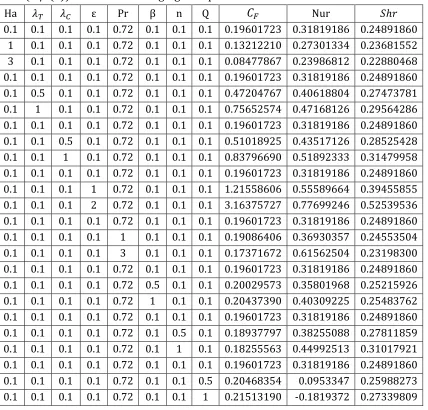
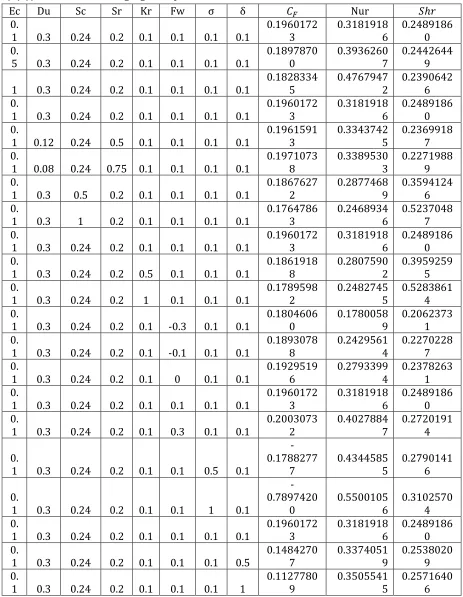
the magnetic parameter (𝐻𝑎) or injection parameter (𝐹𝑤 < 0). More importantly, it is worthy to note that the local skin-friction generally increases with an increase in magnetic field and injection parameters. Also one notices that both the local wall shear stress and the local species mass flux at the plate surface increase in values as the thermal conductivity variation parameter (𝛽) increases, but opposite trend is recorded as the Prandtl number (Pr) increases in values. However, the reduced local Nusselt number can be increased in values consequential to increase in Pr, and be decreased in values as 𝛽 improves in values. It is quite interesting as observed in the Tables 4-5, that increase in exponent parameter (n) in its effect decreases the values of the local skin friction coefficient but causes increment in the magnitudes of the reduced local Nusselt snd the Sherwood numbers respectively. As revealed from these tables, again both the local skin-friction coefficient and the reduced local Sherwood number increase in magnitudes as the internal heat energy parameter (Q) intensifies whereas the reverse is the case for the reduced local Nusselt number. Further, the local skin-friction coefficient and the reduced local Sherwood number decrease in values as Eckert number advances in magnitudes while the opposite is seen in the case of the reduced local Nusselt number. It is, however noteworthy that the concurrence of variation of the Dufour number (while decreasing) and Soret number (while increasing) consequentially influences the magnitude variation of not only the reduced local skin-friction coefficient and local Nusselt number but also the reduced local Sherwood number. The combined variation as it increases, causes increment in both (𝐶𝐹 𝑜𝑟 𝑓′′(0) 𝑎𝑛𝑑 𝑁𝑢𝑟 𝑜𝑟 – (1 + 𝛽)𝜃′(0)) but a decrease in (𝑆ℎ𝑟 𝑜𝑟 − 𝜙′(0)). Tables 4-5
unveil that both the local skin-friction coefficient and the reduced local Nusselt number diminish in values as each of the Schmidt number (Sc) and chemical reaction (Kr) parameters intensify in magnitude. But of course, the reverse trend is signposted by the Sherwood number. Specifically, increasing the values of the velocity slip parameter (𝛿) results into a reduction in the values of the local skin-friction coefficient and a magnification in the values of both the reduced local Nusselt and Sherwood numbers anyway. As important as it, is the influence of the stretching parameter on the local wall velocity gradient 𝐶𝐹, heat transfer rate 𝑁𝑢𝑟 and species concentration transfer rate 𝑆ℎ𝑟 at the wall. One notices from the tables that the flow, heat and mass transfer characteristics at the wall all increase as the stretching parameter (𝜎) increases, besides the reduced local skin-friction coefficient which increases absolutely. However, it is observed that the values of the local skin friction are negative for this special case. Of course, the negative value of the skin-friction physically means that the dragging force is being exerted on the fluid as opposed to the usual case of dragging force being exerted on the wall by the fluid.
4.2 Graphical Results
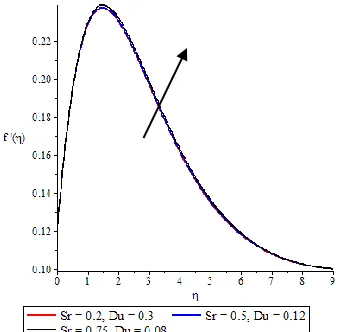
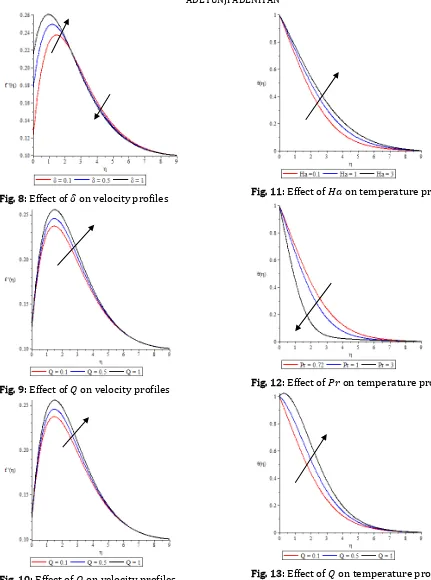
Figs. 2 − 10 depict the velocity profiles 𝑓(𝜂) against the transverse distance 𝜂 for a range of values of the governing flow parameters. The velocity distribution assumes its wall value and varies continuously to attain the boundary edge value asymptotically, in general. Specifically, as illustrated in these figures, the variation indicates an overshot near the wall for some cases, thereafter it nosedives to the far field value. It may be worthy to mention that due to lack of space some of our figures with almost similar variations have been omitted and retained their representatives. Fig. 2 serves as a representative velocity plot for Pr, Sc, Ec, Kr and n variations while Fig. 3 is an approximate representative revealing similar velocity plot for the variations in 𝜆𝑐 and 𝛽 . Particular attention is paid to the dual velocity distributions as
demonstrated for value variation of the stretching parameter (𝜎) in Fig. 7 together with velocity slip parameter (𝛿) Fig. 8 wherein the velocity increases at first before a cross point in the boundary layer and opposite trend emanates thereafter. Interestingly, it can be reported that the dimensionless velocity increases with an increase in parameter values of 𝜆𝑇, 𝜆𝐶 , ℰ, 𝛽, 𝑄, 𝐸𝑐, 𝑆𝑐, 𝐾𝑟, injection (𝐹𝑤 < 0), 𝛿 and σ (before the cross point), Du (decreasing) and Sr (increasing) concurrently, but decreases with an increase in 𝐻𝑎, 𝑃𝑟, 𝑛, suction (𝐹𝑤 > 0), 𝛿 and σ (after the cross point). Thusly, not only the Lorentz forces exhibited by magnetic parameter (Ha), inhibit the fluid velocity but also the Prandtl number (Pr) and the exponent parameter (n). These parameters may be recommended for velocity boundary layer speed control. Further, the buoyancy forces due to temperature and concentration differences as well as the Prandtl and Schmidt numbers (Pr, Sc), thermal conduction variation and chemical reaction parameters (𝛽, 𝐾𝑟) can accelerate the fluid velocity in a boundary layer flow which in consequence may promote boundary layer separation.
4.2.2 Effect of parameter variation on temperature field
SORET- DUFOUR AND STRESS WORK EFFECTS
conduction variation (𝛽) and chemical reaction (Kr) parameters. The respond of the thermal distribution with the dimensionless transverse distance 𝜂 as presented in Figure 12 unveils a monotonic decrease in the fluid temperature everywhere in the thermal boundary layer as the Prandtl number (Pr) strengthens in magnitude. Again, almost similar response, though omitted for obvious reasons stated earlier, has been recorded for each of the cases for which the parameters 𝜆𝑇, 𝜆𝐶 , ℰ, n, 𝜎, 𝛿 intensify in magnitudes. The
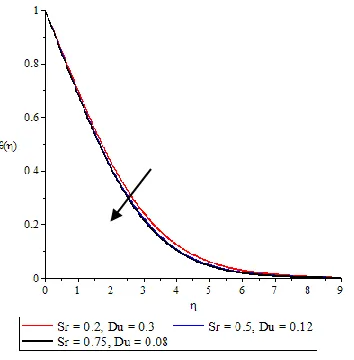
variation of the temperature profiles with respect to suction/injection parameter is signposted by Fig. 15. Clearly, the dimensionless fluid temperature increases in values as the injection parameter (Fw<0) increases but reverse is the response recoded for increasing suction parameter (Fw>0). Thusly, this study also reaffirms that suction mechanism can be used as a means of temperature control within the thermal boundary layer. The revelation as presented in Fig. 14 is quite astonishing in the sense that the fluid temperature is reduced by combined Du (decreasing) and Sr (increasing) concurrently and oncemore, a confirmation of earlier report of Bazid et al. (2012). Particular attention is focused on the influence of the stress work which is characterized by the Eckert number (Ec) whose increment causes fluid temperature reduction, see Fig. 16. It therefore follows that the energy due to fluid interaction at the surface without the interaction of the fluid friction enhances temperature reduction.
4.2.3 Effect of parameter variation on concentration field
5. Table and Figure Legends
Table 1: Computations showing comparison of the local skin-friction coefficient
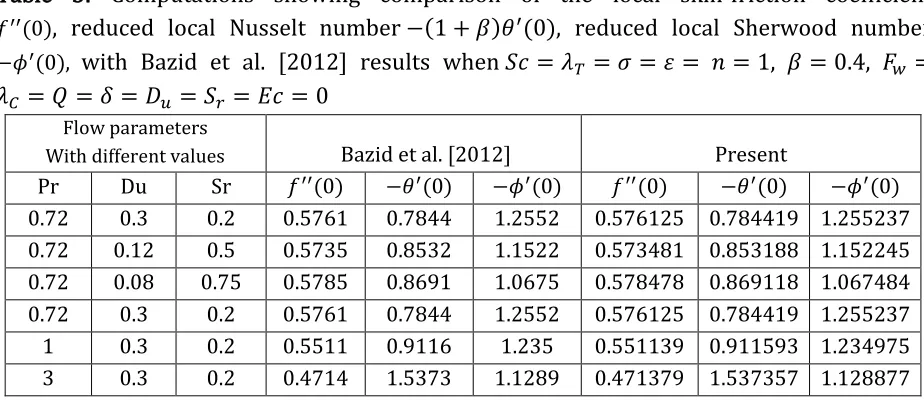
𝑓′′(0) , with Ishak et al. [2007] and Bazid et al. [2012] results when 𝑃𝑟 = 𝜎 = 𝑛 = 1, 𝐹𝑤 =
𝛽 = 𝜆𝑇 = 𝜆𝐶 = 𝑄 = 𝑆𝑐 = 𝛿 = 𝐷𝑢 = 𝑆𝑟 = 𝐸𝑐 = 0
ε
Ishak et al. [2007] Bazid et al. [2012] Present 𝑓′′(0)
0.1 -0.9694 -0.9694 -0.969386157
0.2 -0.9181 -0.9181 -0.918107137
0.5 -0.6673 -0.6673 -0.667263671
2 2.0175 2.0175 2.017502802
3 4.7294 4.7292 4.729282356
Table 2: Computations showing comparison of the local skin-friction coefficient
𝑓′′(0) and reduced local Nusselt number −(1 + 𝛽)𝜃′(0), Bazid et al. [2012] results when
𝑃𝑟 = 𝜆𝑇 = 𝜎 = 𝑛 = 1, 𝐹𝑤 = 𝛽 = 𝜆𝐶 = 𝑄 = 𝑆𝑐 = 𝛿 = 𝐷𝑢 = 𝑆𝑟 = 𝐸𝑐 = 0
Pr
Bazid et al. [2012] Present
𝑓′′(0) −𝜃′(0) 𝑓′′(0) −𝜃′(0)
0.72 0.3645 1.0931 0.364492792 1.093108 6.8 0.1804 3.2894 0.180415289 3.289574 20 0.1173 5.6182 0.117500107 5.620131 40 0.0845 7.9383 0.087242479 7.938306 60 0.0682 9.7141 0.07284223 9.718013 80 0.0572 11.2205 0.063942409 11.21874 100 0.0491 12.5829 0.057727598 12.5411
Table 3: Computations showing comparison of the local skin-friction coefficient
𝑓′′(0), reduced local Nusselt number −(1 + 𝛽)𝜃′(0), reduced local Sherwood number
−𝜙′(0), with Bazid et al. [2012] results when 𝑆𝑐 = 𝜆𝑇 = 𝜎 = 𝜀 = 𝑛 = 1, 𝛽 = 0.4, 𝐹𝑤 =
𝜆𝐶 = 𝑄 = 𝛿 = 𝐷𝑢 = 𝑆𝑟 = 𝐸𝑐 = 0
Flow parameters
With different values Bazid et al. [2012] Present
SORET- DUFOUR AND STRESS WORK EFFECTS
Table 4: Computations showing the local skin friction coefficient 𝐶𝐹 𝑜𝑟 (𝑓′′(0)), reduced
local Nusselt number Nur or (– (1 + 𝛽)𝜃′(0)) and reduced local Sherwood number 𝑆ℎ𝑟 𝑜𝑟 (– 𝜙′(0)) for various emerging flow parameter values
Ha 𝜆𝑇 𝜆𝐶 ε Pr β n Q 𝐶𝐹 Nur 𝑆ℎ𝑟
Table 5: Computations showing the local skin-friction coefficient 𝐶𝐹 𝑜𝑟 (𝑓′′(0)), reduced local Nusselt number Nur or (– (1 + 𝛽)𝜃′(0)) and reduced local Sherwood number Shr or
(– 𝜙(0)) for various emerging flow parameter values
Ec Du Sc Sr Kr Fw σ δ 𝐶𝐹 Nur 𝑆ℎ𝑟
0.
1 0.3 0.24 0.2 0.1 0.1 0.1 0.1
0.1960172 3 0.3181918 6 0.2489186 0 0.
5 0.3 0.24 0.2 0.1 0.1 0.1 0.1
0.1897870 0 0.3936260 7 0.2442644 9
1 0.3 0.24 0.2 0.1 0.1 0.1 0.1
0.1828334 5 0.4767947 2 0.2390642 6 0.
1 0.3 0.24 0.2 0.1 0.1 0.1 0.1
0.1960172 3 0.3181918 6 0.2489186 0 0.
1 0.12 0.24 0.5 0.1 0.1 0.1 0.1
0.1961591 3 0.3343742 5 0.2369918 7 0.
1 0.08 0.24 0.75 0.1 0.1 0.1 0.1
0.1971073 8 0.3389530 3 0.2271988 9 0.
1 0.3 0.5 0.2 0.1 0.1 0.1 0.1
0.1867627 2 0.2877468 9 0.3594124 6 0.
1 0.3 1 0.2 0.1 0.1 0.1 0.1
0.1764786 3 0.2468934 6 0.5237048 7 0.
1 0.3 0.24 0.2 0.1 0.1 0.1 0.1
0.1960172 3 0.3181918 6 0.2489186 0 0.
1 0.3 0.24 0.2 0.5 0.1 0.1 0.1
0.1861918 8 0.2807590 2 0.3959259 5 0.
1 0.3 0.24 0.2 1 0.1 0.1 0.1
0.1789598 2 0.2482745 5 0.5283861 4 0.
1 0.3 0.24 0.2 0.1 -0.3 0.1 0.1
0.1804606 0 0.1780058 9 0.2062373 1 0.
1 0.3 0.24 0.2 0.1 -0.1 0.1 0.1
0.1893078 8 0.2429561 4 0.2270228 7 0.
1 0.3 0.24 0.2 0.1 0 0.1 0.1
0.1929519 6 0.2793399 4 0.2378263 1 0.
1 0.3 0.24 0.2 0.1 0.1 0.1 0.1
0.1960172 3 0.3181918 6 0.2489186 0 0.
1 0.3 0.24 0.2 0.1 0.3 0.1 0.1
0.2003073 2 0.4027884 7 0.2720191 4 0.
1 0.3 0.24 0.2 0.1 0.1 0.5 0.1
-0.1788277 7 0.4344585 5 0.2790141 6 0.
1 0.3 0.24 0.2 0.1 0.1 1 0.1
-0.7897420 0 0.5500105 6 0.3102570 4 0.
1 0.3 0.24 0.2 0.1 0.1 0.1 0.1
0.1960172 3 0.3181918 6 0.2489186 0 0.
1 0.3 0.24 0.2 0.1 0.1 0.1 0.5
0.1484270 7 0.3374051 9 0.2538020 9 0.
1 0.3 0.24 0.2 0.1 0.1 0.1 1
SORET- DUFOUR AND STRESS WORK EFFECTS
Fig. 2: Effect of Ha on velocity profiles
Fig. 3: Effect of 𝜆𝑇 on velocity profiles
Fig. 4: Effect of ℰ on velocity profiles
Fig. 5: Effects of Sr and Du on the velocity profiles
Fig. 6: Effect of 𝐹𝑤 on velocity profiles
Fig. 8: Effect of 𝛿 on velocity profiles
Fig. 9: Effect of 𝑄 on velocity profiles
Fig. 10: Effect of 𝑄 on velocity profiles
Fig. 11: Effect of 𝐻𝑎 on temperature profiles
Fig. 12: Effect of 𝑃𝑟 on temperature profiles
SORET- DUFOUR AND STRESS WORK EFFECTS
Fig. 14: Effects of Sr and Du on temperature profiles
Fig. 15: Effect of 𝐹𝑤 on temperature profiles
Fig. 16: Effect of 𝐸𝑐 on temperature profiles
Fig. 17: Effect of 𝜆𝑇 on concentration profiles
Fig. 18: Effect of 𝐹𝑤 on concentration profiles
6. Conclusions
Investigation has been carried out numerically to study the heat and mass transfer characteristics of a chemically reacting hydromagnetic flow towards a permeable stretching vertical plate awash of a transverse magnetic field in the presence of buoyancy forces, stress work, heat generation, suction/injection, thermal conductivity variation, Dufour and Soret effects. The results of our findings are as follows:
1. The local velocity gradient, the local heat and mass transfer rates at plate surface increase as buoyancy parameters (𝜆𝑇, 𝜆𝐶) and velocity ratio (ℰ) increase.
2. The fluid velocity increases everywhere in the momentum boundary layer as buoyancy parameters (𝜆𝑇, 𝜆𝐶), Eckert and Schmidt numbers (𝐸𝑐, 𝑆𝑐), velocity ratio
(ℰ), thermal conductivity variation (𝛽), heat generation (𝑄) and chemical reaction (𝐾𝑟) parameters increase.
3. The local skin friction coefficient and the reduced local Nusselt number increase due to increase in suction (𝐹𝑤 > 0) as well as concurrent variation in 𝐷𝑢 (decreasing) and Soret (increasing).
4. The local velocity gradient, the heat and mass transfer local rates at plate surface decrease as the injection (𝐹𝑤 < 0) and magnetic (Ha) parameters increase, but increase with increase in the stretching parameter (𝜎).
5. The local skin friction coefficient and the fluid velocity are reduced by increase in the magnetic field parameter (𝐻𝑎) whereas fluid temperature and concentration of species are increased by increase in Ha.
6. The reduced local Nusselt and local Sherwood numbers can be increased by increasing the values of temperature/concentration exponent (𝑛) and stretching (𝜎) parameters while the dimensionless thermal and solutal distributions are reducible by increasing the stretching parameter (𝜎).
7. The heat transfer local rate at the wall can be increased by increase in Pr whereas the mass transfer local rate at the wall demonstrates opposite trend.
8. The heat transfer local rate can be decreased by increase in Sc as well as Q and Kr, whereas the mass transfer local rate at the wall demonstrates opposite trend.
9. The temperature field increases as Sc and Kr intensify in values while the reverse is unveiled as Sc and Kr intensify.
SORET- DUFOUR AND STRESS WORK EFFECTS
Acknowledgments
The author wishes to thank the University of Lagos for provision of books, referred articles and computer facilities.
REFERENCES
[1] Abel, M. S. and Mahesha, N. (2008). Heat transfer in MHD viscoelastic fluid flow over a stretching sheet with variable thermal conductivity, non-uniform heat source and radiation, Appl. Math. Modelling. 32, pp. 1965-1983.
[2] Adeniyan, A. and Adigun, J. A. (2014). Transient MHD boundary-layer slip-flow of heat and mass transfer over a stretching surface embedded in porous medium with waste discharge concentration and convective boundary conditions. Applied and Computational Mathematics. 3, (5), pp. 247-255. doi: 8/j.acm.20140305.19.
[3] Adeniyan, A. and Adigun, J. A. (2013). Studies of effects of convective plane stagnation point Mhd flow with convective boundary condition in the presence of a uniform magnetic field. Int. J. Eng. Sci., 2, (1), pp. 310-313.
[4] Adeniyan, A. and Ogwuegbu, C. S. (2014). Effects of chemical reaction and heat generation on a mixed convection stagnation point flow, heat and mass transfer towards a stretching vertical porous flat plate. Asian Research Publishing Network [ARPN] J. Engng. & Appl. Sci. 9, (12), pp. 2676-2686.
[5] Adrian, P. (2010). Heat and mass transfer by natural convection at a stagnation point in a porous medium considering Soret and Dufour effects. Heat Mass Transfer. 46, pp 831 – 840.
[6] Akbar, N. S., Khan, Z. H., Haq, R. U., Nadeem, S. (2014). Dual solutions in MHD stagnation point flow of Prandtl fluid impinging on shrinking sheet, Appl. Math. & Mech. (Engl. Ed.), pp. 1-7.
[7] Aman, F., Ishak, A. and Pop, I. (2011). Mixed convention boundary layer flow near stagnation-point on vertical surface with slip. Appl. Math. Mech. Engl. Ed. 32, (12), pp. 1599-1606.
[8] Anderson, J. D. (2005). Ludwig Prandtl’s boundary layer. American Institute of Physics, Physics Today-S-0031-9228-0512-020-1.
[9] Arthur, E. M. and Seini, Y. I. (2014). MHD thermal stagnation point flow towards a stretching porous surface. Mathematical Theory & Modeling. 4, (5), pp. 163-179.
[10] Awad, F. G., Sibanda, P., Narayana, M., Motsa, S. S. (2011). Convection from a semi-infinite plate in a fluid saturated porous medium with cross-diffusion and radiative heat transfer, Int. Journ. Phys. Sciences. 6 (21), pp. 4910-4923.
[11] Bazid, M. A. A., Gharsseldieu, Z. M., Seddeek, M. A., Alharbi, M. (2012). Soret and Dufour number effect on heat and mass transfer in stagnation point flow towards a stretching surface in the presence of buoyancy force and variable thermal conductivity, Journ. of Computations & Modelling. 2, (4), pp. 25-50. [12] Bhattacharyya, K and Mukhopadhyay, S. (2013). Similarity solution of mixed convective boundary
layer slip flow over a vertical plate. Ain Shams Engng. J. 4, 299-305.
[13] Chen, H. (2014). Mixed convection unsteady stagnation-point flow towards a stretching sheet with slip effects. Mat. Prob. Eng. Article ID 435697, pp. 1-7.
[14] Crane, L. J. (1970). Flow past a stretching plate, Z. Angew. Math. Phys. 21, 645-647
[15] Eegunjobi, A. S. and Makinde, O. D. (2012). Combined effect of buoyancy force and Navier slip on entropy generation in a vertical channel. Entropy. 14, pp. 1028-1044.
[17] Hayat, T., Shehzad, S. A., Qasim, M., Alsaedi, A. (2014). Mixed convection flow by a porous sheet with variable thermal conductivity and a convective boundary condition. Brazilian J. of Chem. Eng. 31, (1), pp. 109-117.
[18] Hiemenz, K. (1911). Die Grenzschicht an eimen in den gleichformigen Flussignkeitsstrom eingetauchten geraden Kreiszylinder Dingl. Polytech. J. 32, 321-410.
[19] Ibrahim, S. M. and Reddy, N. (2013). Similarity solution of heat and mass transfer for natural convection over a moving vertical plate with internal heat generation and a convective boundary condition in the presence of thermal radiation, viscous dissipation, and chemical reaction. Thermodynamics, Article ID 790604, pp. 1-10.
[20] Ibrahim, S. Y. and Makinde, O. D. (2010). Chemically reacting MHD boundary layer flow of heat and mass transfer over a moving vertical plate with suction. Scientific Research and Essays, 5 (19), pp. 2875-2882.
[21] Ibrahim, S. Y and Makinde, O. D (2011), Chemically reacting Magnetohydrodynamics (MHD) boundary layer flow of heat and mass transfer past a low-heat-resistant sheet moving vertically downwards, Scientific Research and Essays, vol. 6(22), pp. 4762-4775
[22] Ishak, A., Nazar, R., Arifin, N. M., Pop, I. (2007). Mixed convection of a stagnation point flow towards a stretching permeable sheet. Malaysian Journal of Mathematical sciences . 1 (2), pp. 217-226.
[23] Joshi, Y. and Gebhart, B. (1981). Effect of pressure stress work and viscous dissipation in some natural convection flow. Int. J. of Heat and Mass Transfer. 24, pp. 1577-1588.
[24] Khan, S. K., Abel, M. S., Sonth, R. M. (2003). Viscoelastic MHD flow, heat and mass transfer over a porous stretching sheet with dissipation energy and stress work. Heat and Mass Ttransfer. 40, pp. 47-53. [25] Mahapatra, T. R., Nandy, S. K. (2013). Momentum and heat transfer in MHD axisymmetric stagnation
point flow over a shrinking sheet. J. of Appl. Fluid Mech. 6, (1), pp. 121-129.
[26] Makinde, O. D. (2012). Computational modeling of MHD unsteady flow and heat transfer toward a flat plate with Navier slip and Newtonian heating. Brazilian Journ. of Chem. Eng. 29, (2), pp. 159-166. [27] Makinde, O. D., Charles, W. M. (2010). Computational dynamics of hydromagnetic stagnation flow
towards a stretching sheet. Appl. Comput. Math. 9 (2), pp 243 – 251.
[28] Makinde, O. D., Mahabaleswar, U. S., Maheshkumar, N. (2013). Non-perturbative solution for hydromagnetic flow over a linearly stretching sheet. Int. J. of Appl. Mech. & Eng. 18, (3), pp. 935-943. [29] Makinde, O. D. and Olanrewaju, P. O (2011). Unsteady mixed convection with Soret and Dufour effects
past a porous plate moving through a Binary Mixture of Chemically reaction fluid, Chemical Eng. Communications. 198 (7), 920-938.
[30] Makinde, O. D. and Olanrewaju, P. O. (2012). Combined effects of internal heat generation and buoyancy force on boundary layer flow over a vertical plate with convective boundary condition. Canadian J. of Chemical Eng. 90, pp. 1289-1294.
[31] Makinde, O. D., Olanrewaju, P. O., Charles, W. M. (2011). Unsteady convection with Chemical reaction and radiative heat transfer past a flat porous plate moving through a binary mixture. Afri. Mat. 22 (1), pp. 65-78.
[32] Makinde, O. D. and Osalusi, E. (2006). MHD steady flow in a channel with slip at the permeable boundary. Rom. Journ. Phys. 51 (3-4), pp. 319-328.
[33] Manhata, P. K. (2013). Effects of variable viscosity and thermal conductivity on heat transfer over a stretching surface in the presence of uniform magnetic field. World Academy of Science, Engineering and Technology, 77, pp. 1059-1064.
SORET- DUFOUR AND STRESS WORK EFFECTS
[35] Oahimire, J. I. and Olajuwon, B. I. (2013). Hydromagnetic flow near a stagnation point on a stretching sheet with variable thermal conductivity and heat source/sink. Int. J. of Appl. Sc. Eng. 11 (3), pp. 331-341.
[36] Olanrewaju, P. O. (2012). Effects of internal heat generation on hydromagnetic non-Darcy flow and heat transfer over a stretching sheet in the presence of thermal radiation and Ohmic dissipation. World Applied Sciences Journ. (Special Issue of Appl. Math.), 16, pp. 37-45.
[37] Olanrewaju, P. O. and Gbadeyan, J. A. (2011). Effects of Soret, Dufour, chemical reaction, thermal radiation and volumetric heat generation/absorption and a mixed convention stagnation point flow on an isothermal vertical plate in porous media. The Pacific Journ. Sci.Tech. [PJST]. 12 (2),pp. 234-245. [38] Olanrewaju, P. O. and Adeniyan, A. (2013). Dufour and Soret effects on MHD free convection with
thermal radiation and mass transfer past a vertical plate embedded in a porous medium, Nonlinear Sci. Lett. A. 4 (1), pp. 21-34.
[39] Olanrewaju, P. O. and Adesanya, A. O. (2011). Effects of radiation and viscous dissipation on stagnation flow of a micropolar fluid towards a vertical permeable surface, Australian J. of Basic Appl. Sciences, 5 (9), 2279-2289.
[40] Olanrewaju, P. O., Alao, F. I. and Adeniyan, A. (2013). Effects of thermal-diffusion, diffusion-thermo, magnetic field and viscous dissipation on unsteady mixed convection flow past a porous plate moving through a binary mixture of chemically reacting fluid, Thermal Energy and Power (TEPE). 2 (3), pp. 118-131.
[41] Rangi, R. R.and Ahmad, N. (2012). Boundary layer flow past a stretching cylinder and heat transfer with variable thermal conductivity. Appl. Math. 3, pp. 205-209.
[42] Seddeek, M. A. (2004). Thermal-diffusion and diffusion-thermo effects flow and heat transfer over an accelerating surface with heat source in the presence of suction and blowing in the case of variable viscosity. Acta Mechanica, 177 (1-2), pp. 83-94.
[43] Shrama, P. R and Singh, G. (2010). Steady MHD natural convection flow with variable electrical conductivity and heat generation along an isothermal vertical plate. Tamkang Journ. of Sci. and Eng. 13 (3), pp. 235-242.
[44] Singh, G. and Makinde, O. D. (2013). MHD slip flow of viscous fluid over an isothermal reactive stretching sheet. Annals Faculty Eng. Hunedoara-Int. Journ. of Engineering. 11 (2), pp. 41-46.
[45] Wong, S. W., Awang, M. A. O., Ishak, A. (2013). Stagnation point flow towards a vertical, nonlinearly stretching sheet with heat flux, J. of . Appl. Mat. Article ID:528717, pp. 1-7.
[46] Yian, L. Y., Ishak, A. and Pop, I. (2011). MHD stagnation point flow with suction towards a shrinking sheet. Sains Malasiana. 40 (10), pp. 1179-1186.