International Journal of Advances in Management and Economics
Available online at:
www.managementjournal.info
RESEARCH ARTICLE
Mengling Li | Jan.- Feb. 2019 | Vol.8| Issue 1 |36-45 36
Research on Cultural Identity and Cultural Adaptability of
Overseas Students in Jinan University
Mengling Li
Jinan University, China.
*Corresponding Author: E-mail: [email protected]
Executive Summary
Jinan University is China's first
state-founded overseas Chinese university. Students attending Jinan University include a variety of cultural backgrounds. However, under the huge cultural background differences, oversea students generally face the issue of cultural adaptability. Through interviews and questionnaires, this paper found that the cultural adaptability of overseas students in Jinan University is not high enough, which is not a good signal, because for students themselves, it is not conducive to their own learning and living in schools.
For schools, The low cultural adaptability of overseas students can lead to many problems, such as improper behavior or dropping out of school, which in turn has a negative impact on the reputation of the school. The questionnaire investigation and Smart plus software path analysis showed that the low cultural adaptability of overseas students resulted from the cultural differences between mainland China and Hong Kong, Macao and Taiwan, and the low degree of cultural identity. To improve the cultural adaptability, we need to enhance the cultural identity of overseas students.
On this basis, this paper proposes three solutions, including developing the history
and culture courses, organizing campus
cultural activities and the cultural
propaganda in We Chat and micro blog
platform. Taking into account the
implementation time, cost and feasibility of the three projects, this paper argued that conducting cultural activities in the campus can promote cultural communication and help them better understand, accept and agree with the campus culture as well as the regional culture so as to achieve the goal of improving cultural adaptability of overseas students.
Cultural Adaptability of Overseas
Students
With the return of Hong Kong and Macao and the easing of cross-Strait relations in Taiwan, the educational exchanges and cooperation between the four places have been increasing. Taking the International Business School of Jinan University as an example, the International Business School recruits students from all over the world every year, including Hong Kong, Macao and Taiwan students.
Although overseas students and mainland students learn together, it is clear that overseas students are in a special group. They
enter the university through joint
But the education that overseas students receive in university is almost the same as mainland students.
Can they adapt to the teaching contents and education methods under the Chinese cultural background? In order to fully understand the adaptability of overseas students in school, I invited three teaching assistants from International Business School. The interview mainly focused on the study adaptability of overseas students. One of them showed that the performance of overseas student was not positive, while the other said that they did not well in the final exams. The reason may be that their learning foundation is different, or they may not be adapted to the mainland teaching methods. The interview results also showed that it is difficult for overseas students to integrate into the class and communicate with the teachers.
The lack of such communication resulted from cultural differences to a great extent. Adaption is used in psychology to represent changes in the environment, which includes three levels, the biological sense of adaptation; the psychological adaptation and the adaptation to the social living environment. “Social adaptation” also includes several sub-dimensions like cultural adaptation, career adaptation, interpersonal adaptation, etc.
This paper only analyzes the cultural adaptability of overseas students. According to Ward's cultural adaptation theory model,
cultural adaptation is divided into
psychological adaptation and social and cultural adaptation. Social and cultural adaptation also contains learning adaptation,
living adaptation and psychological
adaptation.
In order to further study the cultural adaptation of overseas students, I conducted a survey using a questionnaire, and 120 questionnaires were distributed while 100 valid questionnaires were collected. There are six items in the learning adaptability scale.
The answer are all set according to the
five-point Likert scale, 1="Completely
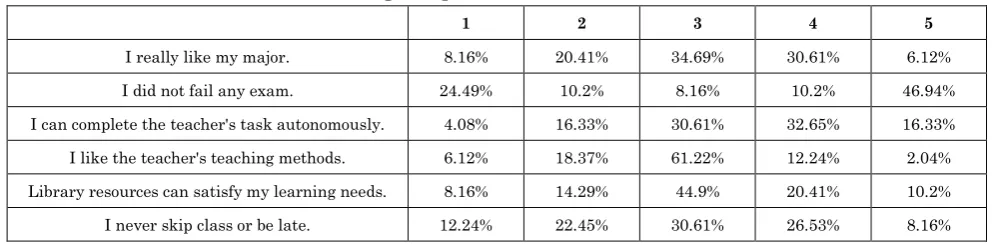
Disagree"; 2 = "Disagree" ; 3= "General"; 4= "Basic Agree"; 5= "Fully Agree". The results can be seen in Table 1-1, the data in the table manifests that only 36.73% of overseas students prefer or like their own major, and more than 50% students had failed the exam. Only 16.33% of the students can complete the task of teacher's autonomously.
More than half of the students think the teaching methods are just so-so. As for attendance, only 8.16% said they never absent or were late. From the overall
situation, overseas students' learning
adaptation is not high.
Table 1: Overseas Students' Learning Adaptation Scale
1 2 3 4 5
I really like my major. 8.16% 20.41% 34.69% 30.61% 6.12% I did not fail any exam. 24.49% 10.2% 8.16% 10.2% 46.94% I can complete the teacher's task autonomously. 4.08% 16.33% 30.61% 32.65% 16.33% I like the teacher's teaching methods. 6.12% 18.37% 61.22% 12.24% 2.04% Library resources can satisfy my learning needs. 8.16% 14.29% 44.9% 20.41% 10.2% I never skip class or be late. 12.24% 22.45% 30.61% 26.53% 8.16%
Living Adaptation Scale contains the information about the food, housing, physical exercise, entertainment. The scale has 8
Mengling Li | Jan.- Feb. 2019 | Vol.8| Issue 1 |36-45 38
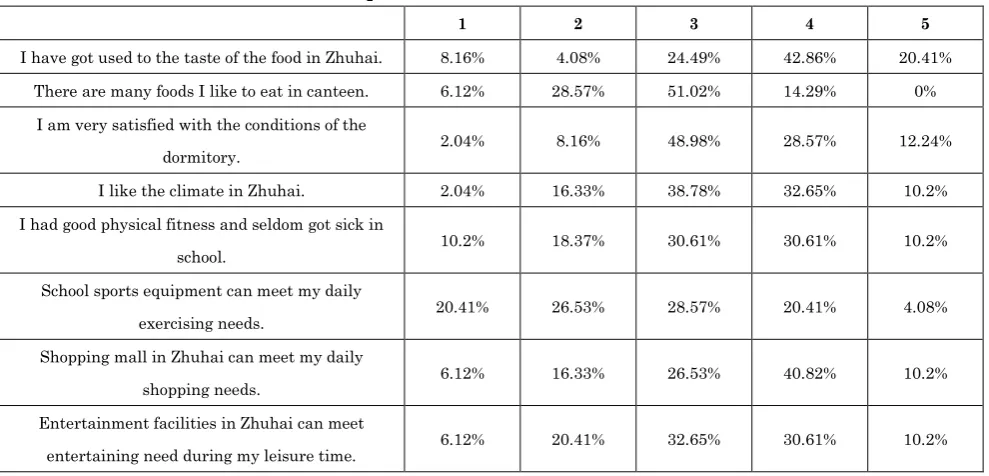
However, 34.69% of students think school canteens do not have their favorite dishes. As for Accommodation, only 12% of students are not satisfied with the school dormitory and many students think it is just so-so. In terms
of climate, students who enjoy climate in Zhuhai account for a relatively high proportion. And 18% of students think they are physically poor at school. Overall, the living adaptation of overseas students is general.
Table 2: Overseas Student Life Adaptation Scale
1 2 3 4 5
I have got used to the taste of the food in Zhuhai. 8.16% 4.08% 24.49% 42.86% 20.41% There are many foods I like to eat in canteen. 6.12% 28.57% 51.02% 14.29% 0%
I am very satisfied with the conditions of the
dormitory. 2.04% 8.16% 48.98% 28.57% 12.24%
I like the climate in Zhuhai. 2.04% 16.33% 38.78% 32.65% 10.2% I had good physical fitness and seldom got sick in
school. 10.2% 18.37% 30.61% 30.61% 10.2%
School sports equipment can meet my daily
exercising needs. 20.41% 26.53% 28.57% 20.41% 4.08% Shopping mall in Zhuhai can meet my daily
shopping needs. 6.12% 16.33% 26.53% 40.82% 10.2%
Entertainment facilities in Zhuhai can meet
entertaining need during my leisure time. 6.12% 20.41% 32.65% 30.61% 10.2%
Psychological adaptation scale consists of five items. The table 1-3 shows that 47% of students basically agree or completely agree that they feel happy in school, and only 16% of students show a negative attitude. 35% of students are satisfied with their study and
life and 28% of students are not satisfied with the current status. In facing difficulties, only 8% of students said it is hard to solve, most students are willing to actively cope. From these data, overseas students have a higher level of psychological adaptability to some extent.
Table 3: Overseas Students Psychological Adaptation Scale
1 2 3 4 5
Most of the time I study in school is happy 2.04% 14.29% 36.73% 40.82% 6.12% I am very satisfied with my present state of study and
living 2.10% 26.53% 36.23% 31.11% 4.02%
I have confidence and ability to do better in all aspects 2.04% 10.2% 36.70% 40.85% 10.2% There are many friends around me 6.12% 20.41% 38.78% 28.57% 6.12% I can take the initiative to deal with difficulties and
setbacks 4.08% 4.08% 42.86% 42.86% 6.12%
The Reasons for the Low Cultural Adaptability
Through interviews and questionnaires, we concluded that although overseas students of Jinan University had a high level of psychological adaptability, their learning and living adaptability were not high, which led to
backgrounds bring about changes in cultural patterns through mutual contact. In Oberg's "cultural shocks" model, it describes the cultural impact they experience as a process in accordance with the physical and
psychological sensibilities of cultural
adapters, including the following four phases: honeymoon, crisis, recovery and adjustment. Lysgaard's U-curve hypothesis argues that cultural adaptation generally goes through three phases, the initial adjustment, the crisis and the regained adjustment. The process of cultural adaptation appears as a U-shaped curve based on changes in the level of satisfaction of cultural adapter (from high to low than to high).
Berry summarized and analyzed the impact of cultural adaptation on cultural adapter and proposed a theoretical framework for
analyzing the pressures of cultural
adaptation. The "acculturative stress" refers to the phenomenon that cultural adapters have experienced a decline in their mental health during the process of cultural
adaptation, specifically manifested as
confusion, anxiety, depression, alienation, marginalization, etc.
Berry believes that cultural adaptation was affected by two factors: acculturation experience and stressors. Berry pointed out that the relationship between "cultural adaptation experience", "stressor" and
"cultural adaptation stress" ultimately depends on a series of regulatory factors including: (1) characteristics of the guest country's society (2) characteristics of cultural adaptation groups (3) types of cultural adaptation (4) individual demographics characteristics (5) individual psychological characteristics. The characteristics of the guest country's society are external objective environment which is difficult to change, such as the cultural differences between mainland China and Hong Kong, Macao and Taiwan. Because of the culturally relevant content discussed in this paper, the psychological characteristics of individuals--the degree of cultural identity, also influence the level of cultural adaptation.
In terms of cultural differences, Dutch social
psychologists and anthropologists G.
Hofstadter and other researchers carried out extensive and long-term survey and analysis in more than 70 countries and regions from the late 60s of last century, than they put forward and perfecting the five cultural
dimensions used to examine ethnic
differences, namely individualism, power distance, uncertainty avoidance, masculinity, Long-term orientation. Unfortunately, the survey led by Hofstadter has never included our region of Macau. According to Hofstadter’s research, scores of the five areas in mainland China, Hong Kong and Taiwan are as follows (with a total score of 120):
Table 4: scores of cultural differences between Mainland, Hong Kong and Taiwan
Mainland Hong Kong Taiwan
individualism 20 25 17
power distance 80 68 58
uncertainty avoidance 30 27 69
masculinity 66 57 45
long-term orientation 118 96 87
The figures above explain that Hong Kong is strongest in the individualist dimension between Mainland, Hong Kong and Taiwan
Mengling Li | Jan.- Feb. 2019 | Vol.8| Issue 1 |36-45 40
masculinity, Long-term orientation got the most scores (80, 66, 118). In short, according to the findings of Hofstadter’s investigation and research, there are some differences between the mainland culture and Hong Kong and Taiwan culture in all five cultural dimensions, and some differences are still considerable. Therefore, overseas students cannot adapt quickly to the learning and living of colleges and universities in mainland China. As for the perspective of cultural identity, it is also mentioned in Ward's "cultural adaptation process model", which reveal the factors that affect cultural adaptability like cultural identity, cultural differences and social support and so on.
Of course, it is also influenced by political and economic factors at the social level, but this paper mainly focused on the cultural aspects. Cultural identity contains two levels of meaning, one refers to the recognition of local culture, the other refers to the recognition of their nation culture.
With reference to Ward and Kennedy's theory, the study focused only on the analysis of local cultural identity. In examining overseas students' identity of local culture, there are mainly two dimensions: campus cultural identity and regional cultural identity. Among them, the identity of campus culture includes five items and the regional cultural identity contains three items. Cultural identity is the sum of all the questions in these two dimensions.
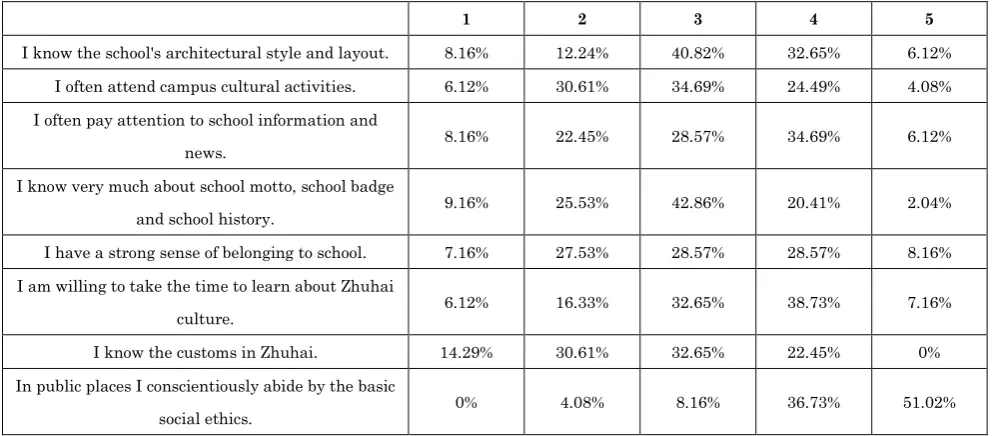
The specific results can be seen in Table 2-2, which showed that 38% of students are more familiar with the school's architectural style, but there is low participation of cultural activities in the campus. 36% of the students are less involved in campus cultural activities and 42% of overseas students do not understand the campus history. As for regional culture identity, a large proportion of students are willing to take time to comprehend the culture of Zhuhai.
Table 5: overseas Students Cultural Identity Scale
1 2 3 4 5
I know the school's architectural style and layout. 8.16% 12.24% 40.82% 32.65% 6.12% I often attend campus cultural activities. 6.12% 30.61% 34.69% 24.49% 4.08% I often pay attention to school information and
news. 8.16% 22.45% 28.57% 34.69% 6.12%
I know very much about school motto, school badge
and school history. 9.16% 25.53% 42.86% 20.41% 2.04% I have a strong sense of belonging to school. 7.16% 27.53% 28.57% 28.57% 8.16% I am willing to take the time to learn about Zhuhai
culture. 6.12% 16.33% 32.65% 38.73% 7.16%
I know the customs in Zhuhai. 14.29% 30.61% 32.65% 22.45% 0% In public places I conscientiously abide by the basic
social ethics. 0% 4.08% 8.16% 36.73% 51.02%
In order to verify the impact of students' cultural identity on the level of cultural adaptation, this paper analyzes the path by using Smart plus software. In the table, CI means cultural identity, PA is psychological adaptation, SA means learning adaptation,
the results of path analysis of cultural
identity and psychological adaptation,
learning adaptation and living adaptation, with path coefficients of 0.681, 0.536 and 0.648, respectively. It can be concluded that
cultural identity has a positive impact on all three dimensions of cultural adaptation, of which cultural identity has the greatest impact on psychological adaptation, secondly on living adaptation, and finally on adaptation.
Table 6: reliability analysis of the scale
Composite Reliability Cronbachs Alpha
CI 0.869150 0.824636
LA 0.842327 0.785869
PA 0.925465 0.899205
SA 0.822055 0.750159
Figure 1: Cultural Identity and Cultural Adaptations Path Analysis Results
Solutions to the Low Cultural
Adaptability
Through the preceding analysis, we can conclude that overseas students of Jinan University are in low learning, living and psychological adaptability.
The reasons for this phenomenon are the cultural differences between Hong Kong, Macao, Taiwan and mainland China, and the low level of cultural identity among the overseas students. Cultural differences are hard to change in a short period of time, but students' cultural identity can be improved in some ways. So, to enhance the cultural adaptability of overseas students, we need to
improve students' cultural identity. There are many ways to achieve our goal. But, it is necessary to evaluate which scheme can maximize the benefits. The standard of evaluation mainly focuses on the time required to implement the Scheme, the tangible cost and the feasibility of the scheme.
Mengling Li | Jan.- Feb. 2019 | Vol.8| Issue 1 |36-45 42
History teaching undertakes the special task of accepting and promoting the excellent cultural traditions. Most colleges and universities have some public compulsory courses on Chinese history, such as the Outline of Modern Chinese History, Chinese Traditional Culture, Modern China, the Introduction to Contemporary China. In particular, Jinan University, which has a large proportion of overseas students, will also offer more relevant elective courses in Chinese history such as Chinese Culture, Religion and Culture in China, Islam and Chinese culture, Famous Historical and Cultural Cities in China, Precious Chinese Cultural Relics, Folklore and Chinese culture, the History of Ming and Qing Social Life History and so on. In the overseas matriculation education for college students from Hong Kong, Macao and Taiwan, historical subjects make up a large proportion.
These historical courses are conducive to giving play to the advantages of history teaching in cultural identity education. Jinan University has great advantages over the number of history courses offered. If you want to open a new historical elective course, take the implementation time into consideration, the implementation time from the application to the formal start of the course is not long.
But if there are no related professional teachers, the implementation time will be expanded due to the searching work. Considering the monetary cost of setting up a course, the course cost of the university is difficult to estimate, and even the definition of the course cost has no final conclusion. For the feasibility of setting up a course, this
paper conducted a questionnaire to
understand the overseas students’ history and culture course attitude.
The results indicated that although many
historical and cultural courses are offered in Jinan University, 44.9% of the overseas students never take the courses. Some think the courses are too boring and some students take the courses just for credit.
Combining these factors, it can be found that setting up culture courses is less feasible, especially in the cases that the school already has a large number of history and culture courses. Secondly, we can promote cultural exchanges by organizing a number of campus cultural activities to help them better understand, accept and agree with the campus and the regional culture. Campus cultural activities can provide a stage for Hong Kong, Macao and Taiwan ideological exchange and self-expression. Its richness and diversity of features offer them communication opportunities from different sides So as to exercise their interpersonal skills, understand and agree with the campus culture and regional culture.
This paper can take the annual "Chinese Culture Festival" held by Jinan University as an example to analyze the advantages and disadvantages of campus cultural activities in enhancing the cultural identity of overseas students. For the time of implementation, from the planning of the activity to the promotion, the execution of the event, it lasts for at least a month. Considering the cost of the program, the average cost for organizing such a large-scale event is about 1,000RMB per booth. The budget includes prizes, supplies and publicity expenses.
about 39% of students participated in the activities of Chinese Culture Festival, 63% of students who did not participate expressed their wish to take part in.
When asked about whether the activities of
Chinese Culture Festival can help
understand and integrate Chinese culture, 90% of students considered it helpful while 27% of students thought it would be more beneficial. From all three aspects, campus cultural activities have great advantages in terms of time, cost and feasibility. Thirdly, we can use new media by adding more cultural content to We Chat and Weibo platforms, helping overseas students enhance their understanding of local culture and make them more aware of and agree with the campus and regional culture so as to improve their cultural adaptability.
New media subverts the traditional mode of communication and dissemination of thinking, it is more three-dimensional and panoramic, and the information audiences are also undergoing major changes quietly, which makes the access to information and communication behavior, thinking patterns, psychological concepts, behavior habits of the social groups in the public undergone tremendous change a lot. "Self-media" "All media" "Micro-communication" is favored by the general public with a geometric increase in the number involved.
Therefore, by making full use of the advantages of new media widely popularized among those young people especially college
students, the popularization and
dissemination of excellent Chinese traditional culture among college students become more feasible to ideological and political education. It is also an important issue for university workers to continuously explore and practice in the actual teaching process. Plan 3 has
certain advantages in terms of
implementation time.
It is very simple to set up a We Chat official account or official Weibo, but it takes a lot of time and effort in the follow-up platform operation. From the perspective of monetary cost, the cost of manpower and other operating expenses to be paid for promoting cultural contents can be saved if it is handed over to students.
In terms of feasibility, the survey results show that while students spent much time on new media platforms like We Chat and Weibo and more than 70% spend more than two hours per day on new media platforms, 78% of students rarely pay attention to the contents of the cultural sector when they visit the new media. This may not be attractive because of the form of content. That is to say, operating a new cultural media platform is risky.
Recommended Solution
This paper found that the cultural adaptability of overseas students in Jinan University is not high by using interviews and questionnaires, which is manifested in the aspects of living adaptability, learning adaptability and psychological adaptability. The reasons for this phenomenon are objective Environmental cultural differences and the low degree of cultural identity of students. So we need to start from the cultural identity to improve the cultural adaptability of overseas students.
Mengling Li | Jan.- Feb. 2019 | Vol.8| Issue 1 |36-45 44
is a typical activity to promote the cultural identity, Jinan University can organize more similar activities, which requires students to brainstorm and collect meaningful topics. For example, an "Ancient Chinese Cultural Exhibition" can be held each year, which can inherit and learn Chinese culture making the Chinese traditional culture no longer confined to the absorption from the classroom but independently learning in entertainment.
A series of things need to be arranged during the preparation of the event, such as the preparation of exhibition panels for the ancient cultural gallery which covers the development history of each dynasty in China from the historical process of xia-shang-zhou dynasties to the final Qing Dynasty. The ancient Chinese cuisine and the ancient
traditions Clothing Ancient clothing
exhibition and the ancient food stalls can be
applied by student union, students'
association union, student groups and individual groups.
The student troupe is responsible for Drama stage performance to arrange various programs. All the groups submit various types of activities plan and budget in the preparation of activities. Besides, the public relations department is also responsible for searching sponsors for clothing and other materials and contact guests and the media .After the official start of the final activity, all departments should also play their respective roles and actively respond to emergencies that occur during the event,
making the best of the activities.
Holding the "Ancient Chinese Cultural Exhibition" is just one of the ideas of campus cultural activities. The campus cultural activity is a very wide stage that everyone can put forward his own ideas. Only in the collision of thoughts, can we get the best and most meaningful event arrangement
References
1. Barry DT (2001) Development of a New
Scale for Measuring Acculturation: The East Asian Acculturation Measure (EAAM) [J]. Journal of Immigrant Health, 3(4):193-197
2. C Ward, A. Kennedy (1999) the
measurement of socio-cultural [J].
International Journal of Intercultural Relations, 23:659-667.
3. Gordon M (1978) Human Nature, Class,
and Ethnicity [M]. New York: Oxford University Press.
4. Gudykunst WB Ed (2003) Cross-cultural
and intercultural communication.
Thousand Oaks, CA: Sage Publications, Inc
5. John W (19992) Berry Immigration,
Acculturation and Adaption Applied
Psychology. An International Review,
46(1):5-68.
6. Kim YY (2001) Becoming Intercultural: An
Integrative Theory of Communication and Cross-Cultural Adaptation .Thousand Oaks: Sage Publications
7. Kim YY, Gudy kunst WB (1996) Theories in
intercultural communication. Newbury Park, CA: Sage Publications.
8. Neto F'elix (2002) Acculturation Strategies
among Adolescents from Immigrant
Families in Portugal [J]. International. Journal of intercultural Relations, 26:17-38.
9. Oberg K (1960) Cultural Shock: Adjustment
to new cultural environments. Practical Anthropology, 7(3):177-182.
10.Paige RM Ed (1993) Education for the
11.Rudmin Floyd W (2003) Critical History of
the Acculturation Psychology of
Assimilation, Separation, Integration, and Marginalization [J]. Review of General Psychology, 7 (1): 3-37.
12.Swing Wood (1997) The Myth of Mass
Culture [M].London, Mammalian.