International Journal of Advances in Management and Economics
Available online at:
www.managementjournal.info
RESEARCH ARTICLE
Measuring the Factors Affecting Employees Job Satisfaction in
Readymade Garments Industry: Bangladesh Perspective
Md Alauddin
1, Syed Hasib Ahsan
1, Md Musharof Hossain
1,
Mohammad
Masrurul Mowla
1*,
Mohammad Shahab Uddin
21Department of Business Administration International Islamic University Chittagong.
2Department of Management, University of Chittagong.
*Corresponding Author: Email: [email protected], Email: [email protected]
Abstract: This paper attempts to identify the factors influencing employee’s job satisfaction of readymade garment sector (RMG) in Bangladesh. To lookout this point, hundred workers employed in RMG sector in Chittagong were selected by random sampling technique. The study is based on primary data which has been collected through structured questionnaire. The gathered data were assessed by using statistical software (SPSS). Findings of the study indicate that job satisfaction in RMG sector is mostly influenced by salary, promotion, housing facility, behavior of supervisor and job security. However workers job satisfactions are less influenced by transport facility and training and development. This study will help the policy makers to make comprehensive planning and strategy to satisfy their employees and thus, it will help for the overall development of this industry.
Keywords: Job Satisfaction, Readymade Garments (RMG), Bangladesh.
Introduction
Job satisfaction can be perceived as how an individual is comfortable with his or her job. It represents one of the most critical areas where managers are facing challenges while managing their employees. If workers do not feel better with their jobs, there performances are overblown and their behavior may also affect other workers. For increasing the productivity level of any industry, employees job satisfaction play a key role. Developed countries are more advanced in this sector compared to developing countries.
They emphasized more on workers job satisfaction and they are getting better output by applying this. A set of factors are responsible for the worker’s job satisfaction. Some of them highlight the compensation system, the upgradation system, the working environment, transport facilities, training and development facilities, job security, behavior of managers, housing facilities, medical allowances and, the job. This sector has not only grown as a prime export industry but also became a remarkable source of earning currency overseas. This industry holds number one position in our
economy. As this industry plays an important role in generating employment opportunity, a regular monitoring of employee’s' job satisfaction is essential for the smooth conduct of operation.
Literature Review
Job satisfaction deals with the perception of workers towards their activities. “Job satisfaction represents the extent to which expectations are and match the real awards and it is closely linked to that individuals’ behavior in the work place” [1]. A set of factors have impact on a person's job satisfaction including compensation, promotion, job security, workplace, transport facilities, training and development, behavior of managers. “In developing countries, people think, not from their brains but stomach because of unemployment and destabilization of economy the only sure source of job satisfaction is pay and promotion” [2].
resources management approach to productivity improvement in the organization and it deals with the design, implementation and maintenance of compensation system that are geared to the improvement of organizational, team and individual performance which is also considered as an important tool for retention and turnover”. Salary is a form of periodic payment, which is mentioned in a service agreement [5].
“Salary is found to be the main factor of motivation and job satisfaction of employees and it is also identified as a motivator for an employee and commitment with the organization which this will enhances attraction and retention of employees”. [3-6-7]. “Employees are more satisfied with their current job if they see a path available to move up to the top-most ranks in the company and they will be given more responsibility and along with it higher compensation and Part of the interest in job satisfaction is due to the correlation between satisfaction and employee behavior” [8].
Another factor influencing job satisfaction is medical allowance. Another important variable determining job satisfaction is employee promotion. It is something that gives a drive to cherish a better career. From the study of Shields and Ward in 2001, it is very much clear that “dissatisfaction with promotion and training opportunities has a stronger effect on intentions to quit than dissatisfaction with workload or pay”. Many research studies are conducted to appreciate the nexus between workplace environment and worker’s satisfaction in all over the world within diverse contexts over time.
“Many businesses leaders fail to understand the importance of working environment for employee job satisfaction and thus face a lot of difficulties during their work and Such organizations are internally weak therefore unable to introduce innovative products into the market to outpace their competitors”[9] . Herzberg et al. (1959) found that “the job related factors can be divided into two categories like Hygiene factors and motivation factors, hygiene factors can not cause satisfaction but they can change dissatisfaction into no dissatisfaction or short term motivation, whereas motivational factors have long lasting effect as they raise positive feelings towards job and convert no dissatisfaction into satisfaction.
In the absence of hygiene factors (that are working conditions, supervision quality and level, the company policy and administration, interpersonal relations, job security, and salary) the employees chances of getting dissatisfied increase”. As employees spend a great deal of time in their working location, it is essential for companies to optimize the working circumstances. Sell and Cleal [10] stated that “different psychosocial and work environment variables like work place, social support etc have direct impact on job satisfaction and that increase in rewards
does not necessarily improve the
dissatisfaction level of the employees”.
Bakotic & Babic [11] found that workplace condition is a vital issue for job gratification and workers under a hostile working situation are not that much satisfied. “Job insecurity, defined as an employee’s perception of a potential threat to continuity in his or her current job, should be differentiated from actual job loss and unemployment whereas the stressful aspects of job loss include financial concerns and interruptions in one’s usual role tasks and obligations, the stressful aspects of job insecurity stem from anticipating the problems of job loss, ambiguity about what the future holds and, thus, lack of clarity as to which responses might be most adaptive”[12].
Many researchers claim that training facilities for employees are prerequisites of employees’ positive behavior [14]. Landy [15] clarified, “Training is a set of planned activities on the part of an organization to increase the job knowledge and skills of its members in a manner consistent with the goals of organization”. In a study Martensen and Gronholdt [16] quoted, “the development of individual competencies through various training programs has a positive impact on employee satisfaction and when employees attended to training programs, they achieve self-confidence of making their jobs, they observe career development opportunities and they think that their companies make investment in them”.
Conceptual Framework of the Study
Figure1: Conceptual Framework
Objectives of the Study
The Objectives Are
To examine the factors that affects the level of job satisfaction in readymade garment industry in Bangladesh.
To identify the individual factors that affect employee’s job satisfaction of RMG in Bangladesh.
To propose policy and strategy for the overall employees job satisfaction of RMG in Bangladesh.
Hypotheses of the Study
Consistent with the literature review, following hypotheses those are to be tested in this study in order to confirm the research objectives.
Methodology of the Study
H1: There exists a significant relationship between salary and job satisfaction (JS). H2: There exist a significant relationship between promotion and JS.
H3: There exist a significant relationship between job security and JS.
H4: There exist a significant between working environment and JS.
H5: There exist a significant between transport facility and JS.
H6: There exist a significant between training facility and JS.
H7: There exist a significant between behavior of supervisor and JS.
H8: There exist a significant between housing facility and JS.
Sample and Data Collection
Population of this study has been taken from different categories of garments. The study included 100 questionnaires with full information distributed to respondents. SPSS version 22 program has been used to analyze the statistical data. There are almost 4 million people involved in RMG sector directly and indirectly [18-19].
Due to time constraints 100 respondents have been chosen for collecting data through simple random sampling technique where eight variables are independent and one variable is dependent variable thus the minimum appropriate number of sample according to the Roscoe’s [20] rule of thumb would be at least 70. Out of 100 respondents, 65 are male and 35 are female respondents.
Among them it is found that there is 20 Manager, 25 Junior Officer, 20 Officer, 20 Senior Officer, 15 Operator, and 5 Inspectors. Data has been collected only from the different Garment sector in Chittagong. Chittagong is a commercial capital city of Bangladesh where most of the renowned garments companies are doing their business including CEPZ & KEPZ. The survey was carried out during December 2017 to April 2018.
Data Analysis Methods
Data was analyzed using SPSS-22 version program. First of all reliability of variables was checked then correlation was used to check the interrelationship between the variables and job satisfaction.
Reliability
The most commonly measure of reliability is Cronbach's alpha that reflects items’ internal consistency how items are closely related. “The satisfactory value in Cronbach's alpha is required to be more than 0.60 to be reliable”. In this study, the value of Cronbach's alpha is .857 that is absolutely unquestionable.
Analysis & Findings Correlation Analysis
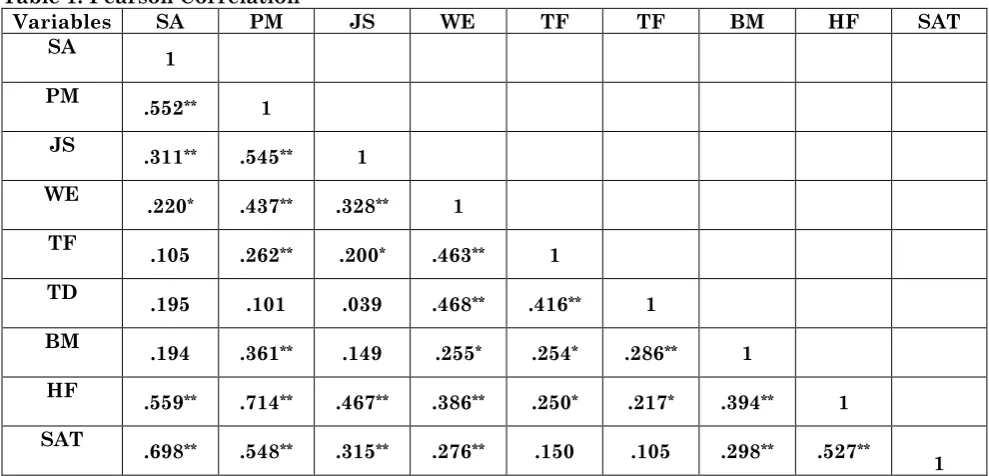
Correlation analysis was conducted to evaluate the pair-wise relationship between the constructs studied, such as Salary,
promotion, job security, working
environment, Transport facility, Training and development, Behavior of Supervisor, Housing facility and Job satisfaction. Table 1 clearly indicates that the factors are correlated with job satisfaction of the employees in the organization. From Table 1, it can be understood that “maximum correlation existed between Satisfaction and Salary (r = 0.70) and Better promotion (r = .55) and all these factors were correlated with each other and with overall satisfaction which statistically significant at p = 0.000 at the 5% level of significance.
Table 1: Pearson Correlation
Variables SA PM JS WE TF TF BM HF SAT
SA 1
PM .552** 1
JS .311** .545** 1
WE .220* .437** .328** 1
TF .105 .262** .200* .463** 1
TD .195 .101 .039 .468** .416** 1
BM .194 .361** .149 .255* .254* .286** 1
HF .559** .714** .467** .386** .250* .217* .394** 1
SAT .698** .548** .315** .276** .150 .105 .298** .527**
1 **. Correlation is significant at the 0.01 level (2-tailed)
Legends
(SA=Salary, PM=Promotion, JS=Job
Security, WE=Working Environment,
TF=Transport facility, TD=Training and development, BM=Behavior of Manager, HF= Housing facility, SAT= Job Satisfaction) Source: Calculated by authors
Regression Analysis Model Summary
The value of “R Square are (0.609) and R (0.780) which show that there is strong
association between the set of independent variables and the dependent variable with the standard error of 0.660” (Table-2) .In additions, the Table- implies that the “job satisfaction of the readymade garment workers is 60% depended on Salary,
promotion, job security, working
environment, Transport facility, Training and development, Behavior of Supervisor & Housing facility”. The rest only 40% is depended on some others factors that is not considered by the researcher in this study.
Table 2: Model Summary
Model R R Square Adjusted R Square Std. Error of the
Estimate Durbin-Watson
Predictors: (Constant), Salary, promotion, job security, working environment, Transport facility, Training and development, Behavior of manager, Housing facility.Dependent Variable: Satisfaction
Table 3: ANOVA Test
Model Sum of
Squares Df Square Mean F Sig.
1 Regression 61.225 9 6.803 15.585 .000
b
Residual 39.285 90 .437
Total 100.510 99
Dependent Variable: Satisfaction
Predictors: (Constant), Salary, promotion, job security, working environment, Transport facility, Training and development, Behavior of manager, Housing facility, Medical allowance.
Interpretation
From the above result it was found that the F value of the test for the data is 15.585. The p-value associated with this F p-value which is
.000 which is lower than the alpha value 0.05 (Table 3). The result of the analysis is indicated that there is a relation between dependent variable and the predictors.
Table 4: Regression Co-efficient
Model Unstandardized
Coefficients Standardized Coefficients t Sig.
B Std. Error Beta
1
(Constant) 1.066 .305 3.493 .001
Satisfied with Salary .646 .067 .698 9.661 .000
Promotion .563 .110 .648 5.104 .000
Job security .256 .078 .315 3.287 .001
Working environment .265 .093 .276 2.847 .005
Transport facility .038 .088 .036 .426 .671
Training & Development .069 .080 .077 .858 .393
Behavior of Supervisor .274 .089 .298 3.089 .003
Housing facility .484 .124 .614 4.936 .000
Source: Calculated by authors
Interpretations
The coefficient table (Table-4) shows that the values of unstandardized coefficient (B) of variable
“Satisfied with salary is .646 that means hundred percent changes in salary leads to 65 percent change in employees’ job satisfaction”.
“Satisfied with promotion is .563 that means hundred percent changes in promotion leads up to 57 percent change in employees’ job satisfaction”
“Satisfied with Job Security is .256 that means hundred percent changes in job security leads to 26 percent change in employees’ job satisfaction”
“Satisfied with working environment is .265 that means hundred percent changes in working environment to 27 percent change in employees’ job satisfaction”.
“Satisfied with transport facility is .038 that meanshundred percent change in
transport facility leads to 3 percent change in employees’ job satisfaction”.
“Satisfied with training and development is .069 that means hundred percent changes in training and development leads to 7 percent change in employees’ job satisfaction”.
“Behavior of manager is .274 that means hundred percent changes in behavior of manager leads to 28 percent change in employees’ job satisfaction”.
“Satisfied with housing facility is .484 that meanshundred percent changes in housing facility leads to 49 percent change in employees’ job satisfaction”.
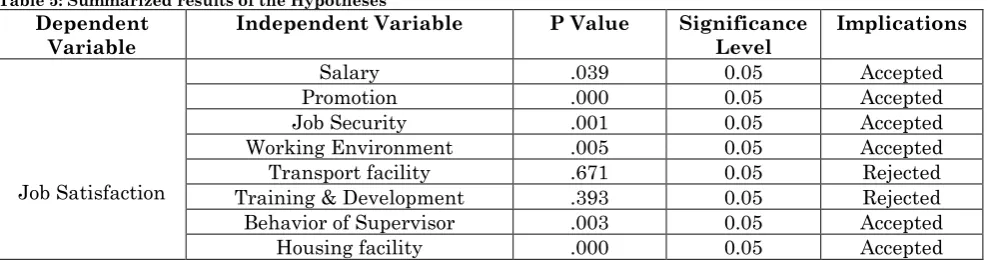
Test of Hypothesis
Table 5: Summarized results of the Hypotheses Dependent
Variable Independent Variable P Value Significance Level Implications
Job Satisfaction
Salary .039 0.05 Accepted
Promotion .000 0.05 Accepted
Job Security .001 0.05 Accepted
Working Environment .005 0.05 Accepted
Transport facility .671 0.05 Rejected
Training & Development .393 0.05 Rejected
Behavior of Supervisor .003 0.05 Accepted
Housing facility .000 0.05 Accepted
Source: Calculated by authors
Interpretations
The result of the hypothesis (Table-5) showed that, in most case the “P values are less than the significance level i.e. 0.05”. As a result, all the hypotheses are accepted except transport facility and training and development facilities which can be said that job satisfaction of the workers of readymade garments is mostly influenced mostly by salary, promotion, housing facility, behavior of Supervisor and Job security. However, workers job satisfactions are less influenced by transport facility and training and development facility. The table of Coefficient (Table-5) reflects that job satisfaction of RMG workers depends more on salary (70%) and comparatively less on transport facilities (4%).
Conclusion and Policy Implication
Among all variables there are five constructs i.e. salary, promotion, housing facility, Behavior of supervisor and job security highly impact on the employees’ satisfaction of RMG and remaining constructs have the minimum influence. The contribution of RMG sector for the growth of our economy is immense. In some cases, this sector is neglected which can bring negative effect on this country.
All the factors related to this industry should be evaluated properly. From the above analysis, it can be said that training facilities and transport facilities should be improved. However working environment, behavior of supervisor are considered as important factors in our country. Government also can play a vital
role to develop this industry. It should be kept in remind that if employees are satisfied, productivity of the factory will be increased. If all the above factors are fulfilled fairly, this sector will flourish in all over the world which will make the country developed.
Limitations of the Study
Like any other research this study is also limited to sample size. Employees of this sector were unwilling to provide necessary information and their internal policy due to confidentiality and heavy work load. This study basically focuses on few Independent variables. We have chosen only Chittagong city for this study which is not sufficient to get the overall scenario of employee’s job satisfaction in Bangladesh.
Scope for Further Research
Future research can be initiated with an objective to enhance the understanding of
customer perception and customer
satisfaction. Moreover, the study can be conducted with a larger sample size so that results could be comprehensive to a large people to measure the levels of employee’s job satisfaction.
This research has been carried out only in Chittagong so further study could be conducted in many other cities in Bangladesh which may find out a better result for developing this industry. The research result may help the managers, practitioners and policy makers regarding this sector to formulate new business policy and strategy for the overall development of ready-made garments sector in Bangladesh [21-27].
References
1. Davis K, Nestrom JW (1985) Human Behavior
at work: Organizational Behavior, 7 edition, McGraw Hill, New York, 109.
2. Ehsan Malik, Muhammad, Danish, Rizwan,
Higher Education Institutes of Pakistan. American Journal of Economics. 2. 6-9. 10.5923/j.economics.20120001.02.
3. Zobal C (1998) the ideal team compensation system – an overview: Part I. Team Perform. Manage, 4(5): 235-249.
4. Armstrong M (2005) A Handbook of Human Resources management practices. UK: Kogan 986.
5. Sharma JP, Bajpai N (2011) Salary
Satisfaction as an Antecedent of Job Satisfaction: Development of a Regression Model to Determine the Linearity between.
6. Moncarz E, Zhao J, Kay C (2009) An
exploratory study of US lodging properties’ organizational practices on employee turnover and retention, Int. J. Contemp. Hosp. Manage, 21(4):437-458.
7. Chiu KR, Luk VW, Tang TL (2002) Retaining and motivating employees, Compensation preferences in Hong Kong and China. Personnel Rev, 31(4): 402-431.
8. Clark AE (2001) “What really matters in a job? Hedonic measurement using quit data.”Labour Economics, 8:223-242.
9. Aiken L, Clarke S, Sloane D (2002) Hospital staffing, organizational support and quality of care: cross-national findings. International Journal for Quality in Health Care, 50(5):87-94.
10. Sell L, Cleal B (2011) Job satisfaction, work environment, and rewards: Motivational theory revisited. LABOUR, 2(1):123.
11. Bakotic D, Babic TB (2013) Relationship between Working Conditions and Job
Satisfaction: The Case of Croatian
Shipbuilding Company International.
12. Joelson L, Wahlouist L (1987) the
psychological meaning of job insecurity and-job loss: resuits of a longitudinal studv. Sot. Sci. Med, 25:179-182.
13. Shields M, Ward M (2001) “Improving nurse retention in the National Health Service in Enland: the impact of job satisfaction on intentions to quit.” Journal of Health Economics, 20:677-701.
14. Shields MA, Wheatley S (2002) “Racial
harassment, job satisfaction and intentions to quit: evidence from the British nursing
profession”, Economical, 69 (274):295-326. Social Sciences, 8 (1):121-31.
15. Landy FJ (1985) Psychology of work behavior. Homewood, IL: Dorsey Press.
16. Martensen A, Gronholdt L (2001) “Using employee satisfaction measurement to improve people management: an adaptation of Kano‟s quality types”, Total Quality Management, 2(7/8)949-57.
17. Blum R, Kaplan JM (2000) "Network
professionals’ job satisfaction.’ Lucent
Technologies network care’.
18. BGMEA (2015) BGMEA at a glance.
19. Ferdous SR et al (2015) The RMG Sector: Prospects and Challenges and Role of Different Stakeholders. A study report submitted to
National Human Rights Commission,
Bangladesh.
20. Roscoe JT (1975) Fundamental research
statistics for the behavioral sciences [by] John T. Roscoe.
21. BGMEA (2014) the Apparel Story Desk.
CEBAI: A Centre to Improve RMG
Productivity.
22. Cooper DR, Schindler PS (2001) Business research methods, 11.
23. Herzberg F, Mausne B, Snyderman B (1959) the Motivation to Work. Jhon Wiley https://exceldatapro.com/medical-allowance/ 24. Malhotra NK (2002) Basic marketing research:
applications to contemporary issues. Recording for the Blind & Dyslexic.
25. Pergamit MR, Veum JR (1999) “What is a promotion?” Industrial and Labor Relations Review, 52 (4):581-601.
26. Rodgers WL, Converse PE (1975) Measures of the perceived overall quality of life. Social Indicators Research, 2:127-152.