European Journal of Physical Education and Sport Science
ISSN: 2501 - 1235 ISSN-L: 2501 - 1235 Available on-line at: www.oapub.org/edu
doi: 10.5281/zenodo.1400752 Volume 4 │ Issue 9 │ 2018
HEALTH RELATED QUALITY OF LIFE: AN ANALYSIS OF
COLLEGIATE SPORTSMEN AND NON-SPORTSMEN
Vivek Solanki1i,
Jyoti Solanki2
1Assistant Professor, Physical Education, Maharaja Surajmal Institute, GGSIPU, New Delhi, India
2Assistant Professor, Physical Education, Government of Haryana, India
Abstract:
The present study was conducted to assess and compare the health related quality of life in collegiate sportsmen and non-sportsmen. For the purpose of the study a total of fifty (n=50) male subjects i.e., 25 male sportspersons from Delhi University and 25 male non-sportspersons from Indraprastha University as subjects were selected. These subjects were given a standardized questionnaire of health related quality of life (SF-36) developed by Stewart Hayes and Ware (1988). The data was obtained from these subjects and analyzed statistically on the sub scale of Physical Functioning scale (PF), Role-Physical scale (RP), Bodily Pain scale (BP), General Health scale (GH), Vitality scale(VT), Social Functioning scale (SF), Role-Emotional scale (RE), Mental Health scale (MH). The statistical technique employed for analyzing the data were mean, standard deviation and ‘t’ test. The level of significance chosen was 0.05. The result of the study indicates that there were significant difference obtained among male sports person and non-sports person on the sub-scale of general health (GH). However there were no significant difference among male sports person and non-sports person on the sub-scales of Physical Functioning scale (PF), Role-Physical scale (RP), Bodily Pain scale (BP), Vitality scale (VT), Social Functioning scale (SF), Role-emotional scale (RE), Mental Health scale (MH).
Keywords: physical functioning scale, role-physical scale, bodily pain scale, general health scale, vitality scale, social functioning scale, role- emotional scale, mental health scale.
1. Introduction
With heightening expectations to foster life skills for health action, sport activities have brought attention, Especially in Western nations, as a promoting factor to advance life skills. Sport activities are easy to understand as challenge or management experience (Chalip, et al, 1984), and are considered to be desirable experience for fostering life skills. For example, through the process of experiencing sport activities, players are required to have various skills. These skills include such psychological skills as stress management, time perspective, communicative skills with others, and self-control. If these skills acquired through exercises and athletic situations can be transferred to daily life, good management in the present life or any future event in life is feasible (Danish, et al., 1992;Ueno and Nakagomi, 1998). Danish (1998), based on a hypothesis that psychological and social skills acquired in exercises and participation in sports are applicable to different situations, developed educational programs, including the GOAL (Going for the Goal) program, to foster life skills by participating in sport activities. GOAL is targeted for primary school students, and is implemented to prevent smoking, drinking and drug abuse by heightening self-efficacy experienced in acquiring life skills and their processes. Meanwhile, in Japan, research focusing on skills in the field of sport activities includes social skills (Sugiyama, 1999), coping skills (Aoki and Matsumoto, 1997; Sasaki, 1999), psychological competitive ability (Tokunaga and Hashimoto, 1988), and competitive situation skills and life skills (Ueno and Nakagomi, 1998). There are, however, only a few studies on how skills acquired through sport experiences are applied in daily life. One such study was made by Ueno and Nakagomi (1998), who, by creating a scale of life skills, found that students who participate in sport club activities acquire higher interpersonal and personal skills in daily life than general students. The scale prepared in their study, however, had such problems that it did not aim at a diagnosis of personal skills but was developed based on students’ in-school experiences, and its sub-scale was only categorized to personal skills and interpersonal relationship skills. Therefore, they have tried to create a new scale to understand health-enhancing skills in daily life in a versatile and comprehensive manner.
2. Methodology
The data was collected from 25 sportsmen and 25 non-sportsmen of Delhi. The Health status questionnaire (SF-36) developed by Stewart Hayes and Ware (1988) was employed to collect the data from the subjects. All the necessary instructions were given to the subjects before the subjects were requested to respond to the statements in the questionnaire.
(RE),Mental Health scale (MH).The SF-36 health survey items and scales were constructed using the Likert method of summated question that are scored. These scores are then summed to produce raw scale scores for each health concept which are then transformed to a 0-100 scale. Scale is set up so that a higher score indicates better health.
3. Analysis and Discussion
To find out the difference in the Health Related Quality of Life between sportsmen and non-sportsmen the mean, standard deviation and the‘t’ values were calculated which are presented in the table-1.
Table 1: Significance of Differences among Sportsmen and Non-Sportsmen
on the Sub-Scale Of Sf-36
Sub-Scales Groups Mean Sd Df ‘T’ Sig.
General Health Scale Sportsmen 79.4400 13.51567 48 2.553* .014 Non Sportsmen 63.7760 27.54550
Physical Functioning Scale Sportsmen 70.0000 28.72281 48 .323 .748 Non Sportsmen 67.4000 28.17801
Role-Physical Scale Sportsmen 53.0000 36.31460 48 .802 .427 Non Sportsmen 61.3200 37.04470
Bodily Pain Scale Sportsmen 74.3200 19.57618 48 .035 .973 Non Sportsmen 74.1200 21.31181
Role- Emotional Scale Sportsmen 51.9840 42.03253 48 .665 .509 Non Sportsmen 59.9840 43.03273
Mental Health Scale Sportsmen 70.7200 15.60854 48 .302 .764 Non Sportsmen 72.3200 21.41401
Vitality Scale Sportsmen 69.4000 3.40049 48 .039 .969 Non Sportsmen 69.2000 3.82623
Social Functioning Scale Sportsmen 73.0000 19.98697 48 1.433 .158 Non Sportsmen 81.0000 19.47220
*Significant at0.05 level t 0.05 (48)=2.00
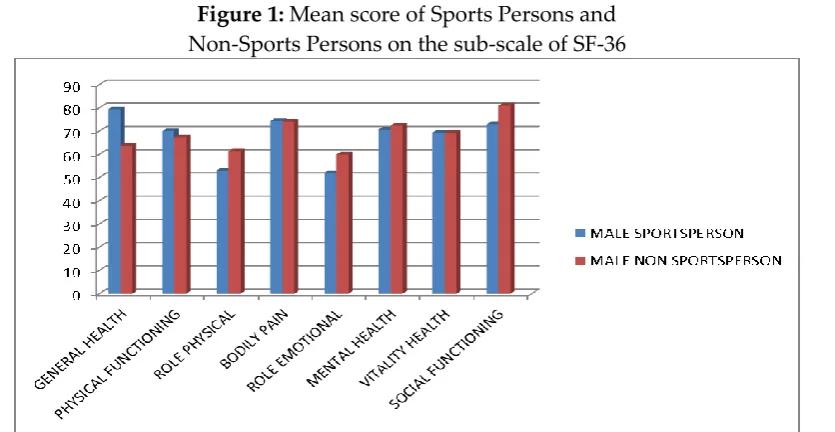
Figure 1: Mean score of Sports Persons and Non-Sports Persons on the sub-scale of SF-36
Mean score of male sportsperson and non-sportsperson on the variable of General Health scale (GH) Physical Functioning (PF), Role-Physical scale (RP),Bodily Pain scale (BP), Role- Emotional scale (RE), Mental Health scale (MH),Vitality scale (VT), Social Functioning scale (SF).
4. Discussion and Findings
Analysis of the data revealed a significant difference in the ‘t’ values between the sports person and non-sportsperson on general health scale. However there were no significant differences in other subscale namely: Physical Functioning scale ( PF), Role-Physical scale (RP),Bodily Pain scale (BP), General Health scale (GH),Vitality scale (VT), Social Functioning scale (SF), Role- Emotional scale (RE), Mental Health scale (MH) between the sports person and non-sportsperson. The probable reason for the significant differences in the general health perception between the sports person and non-sportsperson owes to the active lifestyle inclusive of competitive sports participation that in itself bring about a wholesome development in the sportsperson. The probable reason for the insignificant differences in other subscales namely: Physical Functioning scale ( PF), Role-Physical scale (RP),Bodily Pain scale (BP), General Health scale (GH), Vitality scale (VT), Social Functioning scale (SF), Role- Emotional scale (RE), Mental Health scale (MH) shows a normal based line values and the subjects selected (sports person and non-sportsperson) for the study were leading a healthy life style and with higher education values perceived better health, subjects belonged to good academic background, they were well psyched up and they had good knowledge and were well aware about their health.
5. Conclusion
(BP), Vitality scale (VT), Social Functioning scale (SF), Role- Emotional scale (RE), Mental Health scale (MH).Our findings support the notion that athletic involvement is a benefit to the overall general health status of adults and highlight the need to promote physical activities of maintaining or improving Health related quality of life.
References
1. Akoi, T., Ohashi, T., Mastumoto, T., Sato, M. (1997). The pipette aspiration applied to the local stiffness measurement of soft tissues. Annals of biomedical engineering, vol 25,issue 3, pp581-587
2. Chalip, L., Csikszentmihalyi, M., Kleiber, D. and Larson, R., (1984). Variation of experience in formal and informal sport. Research Quarterly for Exercise and Sport 55 (2), 109-116.
3. Danish, S.J., Petipas, A.J. and Hale B.D. (1992) A developmental-educational intervention model of sport psychology. The Sport Psychologist 6:403-415.
4. Danish, S. J. (1998). Teaching life skills through sport: Community based programs for adolescents. In: Van Raatle, J.L. and Brewer B.W. (Eds.) Exploring Sport and Exercise Psychology. American Psychological Association: Washington D.C., pp.205-225. 7)
5. Tokunaga, M. and Hashimoto, K. (1988). A study on the training of psychological competitive ability for athletes (4): On making the diagnostic inventory. Journal of Health Science, 10: 73-84
6. Ueno, K., & Nakagomi, S. (1998). A Study on the Acquisition of Life Skills through the Participation in Athletic Club. Japan Journal of Physical Education, 43, 33-42.
7. http://www.jstor.org/pss/3350401
8. http://fampra.oxfordjournals.org/content/6/2/153.extract 9. http://www.ncbi.nlm.nih.gov/pubmed/8201132
10. http://www.ncbi.nlm.nih.gov/pmc/articles/PMC1060184/
11. http://www.nationalmssociety.org/for-professionals/researchers/clinical-study-measures/sf- 36/index.aspx
Creative Commons licensing terms