© 2020 by the Serbian Biological Society How to cite this article: Sahoo DD, Patnaik P. Oxidative stress markers and 23 antioxidant defense in hibernating common Asian toads, Dutta-phrynus
melanostictus. Arch Biol Sci. 2020;72(1):23-30.
Oxidative stress markers and antioxidant defense in hibernating common Asian toads,
Duttaphrynus melanostictus
Deba Das Sahoo1,*and Prabhati Patnaik2
1Post-graduateDepartment of Life Sciences, S.K.C.G. Autonomous College, Paralakhemundi, Odisha-761200, India 2Assistant Scientific Officer, Regional Forensic Science Laboratory, Berhampur, Odisha, India
*Corresponding author: [email protected]
Received: June 5, 2019; Revised: August 24, 2019; Accepted: September 9, 2019; Published online: September 25, 2019
Abstract: To assess the oxidative assaults and antioxidant defense, oxidative stress markers, including lipid peroxidation level, protein carbonylation level, GSSG/GSH ratio and nonenzymatic antioxidants such as total glutathione, ascorbic acid and uric acid, in liver and brain tissues of hibernating common Asian toads, Duttaphrynus melanostictus, were compared with toads during active periods. Oxidative stress was found in both liver and brain tissues of hibernating common Asian toads in spite of depressed metabolism and low oxygen consumption. Significantly higher lipid peroxidation, protein car-bonylation and an increased GSSG/GSH ratio were found in liver and brain tissues of hibernating toads, indicating oxida-tive stress. To counteract the stress, ascorbic acid was increased significantly in the liver and brain tissues of hibernating individuals in comparison to individuals during active periods. The uric acid level decreased in both the liver and brain tissues of hibernating toads, which may be due to its decreased rate of synthesis because of low xanthine oxidase activity at low body temperature and hypometabolism. The common Asian toad faced oxidative stress during hibernation, which was counteracted by augmented nonenzymatic antioxidant defense.
Keywords: hibernation; oxidative stress markers; nonenzymatic antioxidant defense; glutathione redox ratio
INTRODUCTION
In all aerobic organisms, reactive oxygen species(ROS) such as superoxide radicals (O2˙-), hydroxyl radicals
(OHˉ) and hydrogen peroxide (H2O2) that are produced during cellular metabolism promote the oxidation of biomolecules, and their damaging effects are minimized by antioxidant defenses comprising antioxidant enzymes and nonenzymatic antioxidants. When the rate of ROS production overcomes the natural capacity of cellular antioxidant defenses a situation called oxidative stress results [1]. ROS-mediated oxidation of amino acid resi-dues, inparticular proline, arginine and lysine of protein in animal cells to their carbonyl derivatives, increases exponentially with exposure to stressed conditions [2,3]. Similarly, oxidative damage of lipids, resulting in a wide variety of lipid peroxidation products such as malondialdehyde, hexanol, and 4-hydroxyalkenals, has been reported to increase during stressed condi-tions in insects, rotifers, fishes, amphibians, reptiles and
mammals [4-6]. Thus, lipid peroxidation and protein carbonylation are considered to be oxidative stress mark-ers in a variety of living organisms [7-8].
for its neutralization in the presence of GPx, followed by regeneration from GSSG by GR. Accordingly, the GSSG/GSH ratio has been considered as a marker of oxidative stress [13]. Nonenzymatic antioxidants such as ascorbic acid and uric acid, are water-soluble ROS scavengers that have been reported to increase in physiologically stressed conditions [14]; however, reports regarding their status during hibernation are limited to some endothermic mammals and are almost nonexistent in ectothermic animals.
The common Asian toad, Duttaphrynus
melanost-ictus, hibernates as an adaptation to cold during the
winter season, characterized by metabolic depression, low body temperature, slow breathing and decreased heartbeat rate. They usually hibernate inside their bur-rows in moist and loose soil and under leaves and debris. Although cycles of torpor and arousal, depending on changes in body temperature, have been reported during hibernation in endothermic mammals, studies related to hibernation in ectothermic animals are limited. A reduction in oxygen consumption to nearly 20%of normal resting rate and depressed metabolism during hibernation were reported [15], most likely resulting in a decrease in ROS production and lower oxidative stress. However, increased oxidative stress during hi-bernation has been reported mainly in endothermic mammals [16-18]. Reports on oxidative stress and antioxidant defenses during the hibernation of ecto-thermic vertebrates are limited [2,19-21], and investi-gations into oxidative stress markers and antioxidant defense in the hibernating common Asian toad have not been undertaken in detail. In the present work we examined whether oxidative stress markers increase during hibernation in spite of low oxygen consump-tion and depressed metabolism, and what happens to the antioxidant defense status, specifically to selected nonenzymatic antioxidants, during hibernation.
MATERIALS AND METHODS
Ethics statement
Animal treatment followed the directives of the In-stitutional Animal Ethics Committee, Berhampur University, India, Registration No. 2020/GO/Re/S/18/ CPCSEA, and Resolution No. 01.
Chemicals
GR, 5,5'dithio-bis (2-nitro benzoic acid)(DTNB) and thiobarbituric acid(TBA) were purchased from Sigma Chemical Co (USA); NADPH, GSH, GSSG,2-vinyl pyridine, guanidine hydrochloride ,EDTA and ascorbic acid were obtained from HiMedia Laboratories Pvt. Ltd., India. All other chemicals and reagents were of analytical grade.
Sample collection
Middle-aged (2-to 4-year-old) male toads (
Duttaphry-nus melanostictus) found along with toads of
differ-ent age in a well-protected area with broken houses, bushes and swampy areas located in Paralakhemundi (10˚ 45' N, 84˚ 6'E), India, were selected after determin-ing their age by skeletochronology[22]. Males were identified by observing a brick red or orange colored hue on the throat region, the subgular vocal sac and black nuptial pads on the inner sides of the first two fingers of the forelimb. In this study, 14 male toads with a snout-vent length of 7.5-8 cm and body weight of 35-47 g,collected fromtheir natural habitat, were used. Oxida-tive stress markers and the nonenzymatic antioxidant defense status were assessed in brain and liver tissues of 7 hibernating toads collected during the winter season (December and January) and compared to 7 active toads collected during the early rainy season(July to August).
Tissue preparation
Toads were collected from their natural habitat and im-mediately decapitated to dissect out the whole liver and brain. Adherent tissues were removed in ice-cold (2°C) amphibian Ringer’s solutions, and they were weighed and processed immediately for different estimations of oxidative stress markers and nonenzymatic antioxidants.
Lipid peroxidation assay
The level of lipid peroxidation (LPO) in terms of thio-barbituricacid reactive substances (TBARS) formed was estimated by the thiobarbituric acid (TBA) test as described[23]; 0.5 mL 2.5% (w/v) ice-cold aqueous tissue homogenate, 1.5 mL of 1% orthophosphoric acid and 0.5 mL of 0.6% TBA were heated in a hard glass test tube for 45 min at 95oC. After cooling to room temperature,
added to the mixture. Extinction of the upper phase of the supernatant containing TBARS after centrifugation at 1000×g for 10 min was measured at 535nm against the control containing 0.5 mLof distilled water instead of the tissue homogenate. The formed TBARS was expressed as µmol/g tissue wet weight using a molar extinction coefficient of 1.56 × 10⁵M-1cm-1.
Protein carbonylation assay
The carbonyl content of proteins as a marker of oxida-tive stress [24] in a sucrose soluble tissue homogenate was estimated following the methods of Uchida and Stadtman [25]. In the experimental tube, 0.8 mL of 0.25 M sucrose soluble tissue supernatant (2.5% w/v) and 0.8 mL of 0.1% (w/v) 2,4 dinitrophenyl hydrazine (DNPH) in 2 N HCl was incubated at room tempera-ture (25±2oC) for 1 h in the dark. A control tube was
also run simultaneously along with the experimental tube with 0.8 mL of 2 N HCl instead of DNPH. After the incubation period, protein fractions were obtained by centrifugation (1000 × g for 10 min) with 0.8mL of 20% trichloroacetic acid (TCA). Protein fractions were washed with an ethanol/ethyl acetate mixture (1:1V/V) and then dissolved in 2 mL of 8Mguani-dine hydrochloride prepared in 133 mMTrisbuffer (pH 7.2) containing 13 mM EDTA. Extinction of the experimental sample was measured at 365 nm against the control, and the carbonyl content was expressed as nanomoles of DNPH incorporated per mg protein, based on the molar extinction coefficient of 22×103
M-1cm-1. The protein content of the tissue homogenate
was estimated following the method of Lowry et al. [26] using bovine serum albumin as standard.
Total and oxidized glutathione
Total glutathione equivalents (GSHeq) consisting of both GSH and GSSG were measured following the method of Griffith [27]. A protein-free supernatant obtained by centrifugation (10000×g for 15 min) of the tissue homogenate (1:5w/v) in ice-cold (2oC)
sul-fosalicylic acid, was divided into two parts. One part was used to measure GSHeq by observing the rate of reduction of DTNB at 412 nm containing 0.2 mM NADPH, 0.6 mM DTNB, 5 mM EDTA, 125 mM so-dium phosphate buffer (pH 7.5) and tissue extract in a final volume of 1mL.To ensure the rate of
reac-tion as zero, the reacreac-tion was started by adding GR (0.5U). The rate of reaction is proportional to the concentration of GSHeq and was compared with the standard curve of GSH (0-6 µM). Another part of the protein-free supernatant was treated with 170mM2-vinyl pyridine for 1h to derivatize GSH. The rest of the GSSG was measured, and the total GSH was calculated from the equation GSHeq=GSH+2GSSG, and the result was expressed as µmol/g tissue wet weight. The levels of GSH (GSH=GSHeq-2GSSG) and percent oxidized GSH (GSSG/GSH) were also calculated.
Ascorbic acid
A deproteinized supernatant obtained from centrifu-gation (1000×g for 10 min) of 2.5%(w/v) of tissue ho-mogenate prepared from 6% ice-cold TCA was used to estimatethe ascorbic acid content following the method by Roe [28]. Ascorbic acid present in deproteinized tissue extract was oxidized to dehydroascorbic acid (DHAA) using bromine water, which transformed ir-reversibly to 2,3-diketogulonic acid (DKA). The DKA coupled with 2, 4-dinitrophenyl hydrazine (DNPH) to form a colored product with H2SO4. Extinction of the colored product was measured at 530nm and the result was obtained from the standard curve of ascorbic acid and expressed as µg ascorbic acid/g wet tissue.
Uric acid
The uric acid content in the deproteinized superna-tant obtained by centrifugation (1000×g for 10 min) of 0.5 mLof 2.5%(w/v) tissue homogenate prepared in ice-cold 50 mM phosphate buffer (pH 7.0), 4 mL of N/23 H2SO4 and 0.5 mL of 5.6% sodium tungstate was estimated as described [29]. Extinction of the light blue-colored product formed by adding 0.2 mL of phosphotungstic acid reagent and 1mL of 0.6 N NaOH to 3 mL of deproteinized supernatant was measured at 720 nm, and the result was obtained from the standard curve of uric acid. The uric acid content was expressed as µg uric acid/g wet tissue.
Statistical analysis
RESULTS Oxidative stress
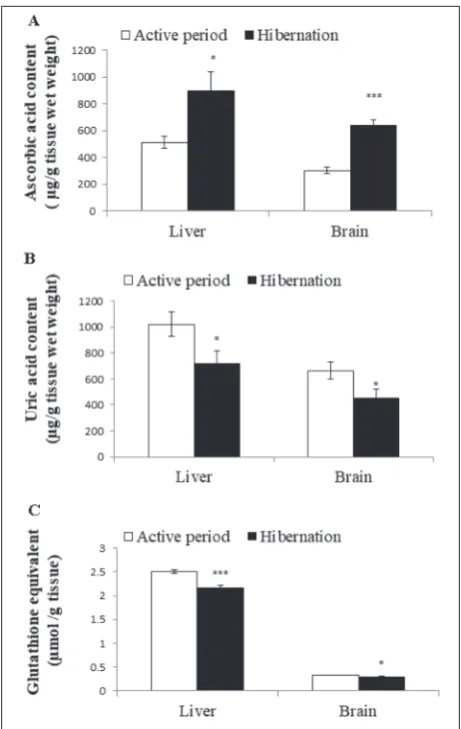
Table1 shows the glutathione status of different organs during hibernation vs the active period. GSH was signifi-cantly low in both liver (P<0.001) and brain (P<0.001) tissues in comparison to toads during the active period. A significantly higher GSSG level was observed in both liver (P<0.001) and brain (P<0.01) tissues of hiber-nating toads in comparison to toads during the active periods. However, there was a significantly (P<0.001 and P<0.05) lower level of total glutathione equivalent (GSHeq=2GSSG+GSH) in both liver and brain tissues of hibernating toads (Fig. 2C) in spite of significant (P<0.001 and P<0.01) increases in GSSG. The decrease in the GSHeq was due to a decrease in GSH, which led to a significant increase (P<0.001) in the GSSG/GSH ratio in both liver and brain tissues, indicating oxidative stress.
Oxidative damage
Compared with the active period, the level of lipid per-oxidation measured in terms of TBARS was significantly higher in both liver (P<0.001) and brain (P<0.001) tissues during hibernation (Fig. 1A).Similarly, a significantly higher level of protein carbonylation was also found in both liver (P<0.01) and brain (P<0.01) tissues of hiber-nating toads in comparison to active toads (Fig. 1B).
Antioxidant defense
Ascorbic acid, a potent prooxidant scavenger, was significantly higher in both liver (P<0.05) and brain (P<0.001) tissues in comparison to toads during the
active period (Fig. 2A). Uric acid, a nonenzymatic an-tioxidant, significantly deceased in both liver (P<0.05) and brain (P<0.05) tissues of hibernating toads in comparison to toads during the active period (Fig. 2B).
DISCUSSION
The status of oxidative stress markers and the nonenzy-matic antioxidant defense was investigated in the liver and brain tissues of hibernating common Asian toads.
Hibernation, which is accompanied by hypometabolism and low body temperature, has a potent effect on ROS
Table 1. Glutathione status in liver and brain tissues of the common Asian toad, Duttaphrynus melanostictus.
Tissue Condition GSH (µmol/g Tissue) GSSG (µmol/g Tissue) GSHeq(2GSSG+GSH)
(µmol/g Tissue) GSSG/GSH Ratio
Liver
Active period
Hibernation
1.93±0.03
1.50±0.04*** (22% decrease)
0.28±0.006
0.33±0.004*** (17% increase)
2.50±0.04
2.18±0.04*** (12% decrease)
0.147±0.003
0.225±0.006*** (53% increase)
Brain
Active period
Hibernation
0.28±0.006
0.22±0.005*** (21% decrease)
0.026±0.001
0.041±0.004** (57% increase)
0.332±0.006
0.304±0.008* (8% decrease)
0.093±0.003
0.186±0.004*** (100% increase)
GSH – reduced glutathione, GSSG – oxidized glutathione, GSHeq– glutathione equivalent.
Data are expressed as the means±SEM, (n=7). Significant differences calculated using Student’s t-test from animals during active period are designated as *(P<0.05), ** (P<0.01), *** (P<0.001).
generation and oxidative stress [16,30-33].Data from our investigation supports the assumption that the level of oxidative stress increases during hibernation. Significantly lower levels of GSH and GSHeq were found in both liver and brain tissues of hibernating toads. In addition, a significantly higher GSSG level was found in both tissues during hibernation. This increase in GSSG and the reduction in GSH lead to a significant increase in the GSSG/GSH ratio, an indicator of oxidative stress [34, 35] and overall susceptibility towards oxidative damage [2]. The reduction in GSH could be due to its decreased biosynthesis [30] and decreased regen-eration from GSSG [2]. As biosynthesis of GSH is an energy-consuming process [24], its synthesis probably
diminished in the hypometabolic state during hiberna-tion. Similarly, regeneration of GSH from GSSG by GR activity was probably decreased due to low GR activity and decreased NADPH supply in the hypometabolic condition and low body temperature during hiberna-tion [2,36]. GSH-linked enzymes (GPx and GR) have also been reported to possess decreased activities in tissues of aestivating toad Scaphiopus couchii[2]. Our findings regarding oxidative stress in liver and brain tissue, as indicated by an increased GSSG/GSH ratio, also support the observed significantly higher levels of lipid peroxidation and protein carbonylation dur-ing hibernation. The difference in GSH content found between liver and brain tissues of the hibernating toad was probably because of the role played by the liver in its biosynthesis and inter-organ homeostasis [37]. A higher GSSG/GSH ratio indicating oxidative stress has also been reported in the intestinal mucosa of endo-thermic animals such as ground squirrels (Spermophilus
tridecem lineatus) during hibernation [30]. Similarly,
oxidative stresses during hibernation and activation of the redox-sensitive transcription factor NF-κB have also been reported in intestinal tissue of ground squirrels [16]. The GSH status of the common Asian toad during hibernation is in good agreement with findings obtained in different ectothermic animals, such as Scaphiopus
couchii [2] and Nanorana parkeri [33].
Our investigation showed a significantly higher level of lipid peroxidation in terms of TBARS and pro-tein carbonyl content in both tissues studied in toads during hibernation in comparison to toads during the active period. Hypometabolism and reduced oxygen consumption during hibernation are supposed to pro-duce low levels of ROS that causes low level of oxidative damage [38]. The augmented lipid peroxidation level in the studied tissues points to oxidative damage due to reduced lipid peroxide scavenging mechanisms and continuous accumulation of damaged products in lipid reserves that are not replenished by dietary intake and biosynthesis during hibernation. The increased carbonyl protein content in the liver and brain during hiberna-tion, indicating oxidative damage to proteins, may be due to elevated lipid peroxide products [25] and low protease activities removing oxidized proteins [39]. Reduced oxygen consumption maintains the redox state of the mitochondrial electron transport system towards a reduced state, favoring the production of superoxide radicals [40] and thus increased cellular oxidant
produc-Fig. 2. Effect of hibernation on the ascorbic acid (A), uric acid (B) concentrations and the glutathione equivalent (C) of liver
and brain tissues of male common Asian toad, Duttaphrynus
melanostictus. The data are expressed as the means±SEM, (n=7).
tion [41]. Hibernating toads with hypometabolism and low oxygen consumption probably produced consider-able oxidants that caused increased lipid peroxidation and protein carbonylation in the examined tissues. Also, the increase in polyunsaturated fats (PUFA) in membranes during cold exposure maintains membrane fluidity [42]. Accordingly, the increase in PUFA content in the body fat of heterothermic mammals has also been reported before their entry into torpor [43]. Low body temperature during hibernation could have increased the PUFA content in the cell membrane, making them more susceptible to lipid peroxidation. Our findings regarding oxidative stress and oxidative damage conform with results obtained in different ectothermic [2,33] and endothermic animals [16,30,31].
During hibernation, the toads were dormant in-side their burrows, without food intake until arousal, with increased oxygen intake and rewarming. With increased oxygen consumption for rewarming during arousal, it is tempting to speculate that the animals would be exposed to oxidative stress in the absence of an augmented antioxidant defense system [44]. Our investigation showed a significantly higher ascorbic acid content in both liver and brain tissues of hiber-nating toads in comparison to toads during the active period. In amphibians, including the common Asian toad, ascorbic acid is usually synthesized in the kidney [45,46] and distributed to other tissues where it is trans-ported into cells through sodium-dependent uptake [47]. Ascorbic acid is a well-established antioxidant [48,49] and has been reported to act as a free radical trap [50]. It has also been reported that ascorbic acid acts as a protective antioxidant during hibernation and rewarming from hibernation by scavenging free radicals produced during hibernation and the oxidative burst associated with rewarming [51,52]. Our results showing an increased ascorbic acid content in liver and brain tissues corroborate this. This augmented ascorbic acid content in liver and brain tissues could be a preparatory mechanism to minimize the potential injury of ROS during hibernation and rewarming after hibernation [17,24,53,54]. The rise in ascorbic acid indicates the ability of the common Asian toad to adapt to oxida-tive stress. A comparaoxida-tively higher increase in ascorbic acid content in brain tissue as compared to liver tissue observed in this study may be an adaptive response to counteract lipid peroxides that are produced due to its high PUFA content and to act as a neuroprotectant [55].
Like ascorbic acid, uric acid is a water-soluble an-tioxidant due to its ability to scavenge. ·O
2ˉ, H2O2 and
peroxy radicals [56]. It also maintains ascorbic acid in its reduced state [57]. Unlike ascorbic acid, uric acid is produced locally in tissues as a product of purine metabolism catalyzed by xanthine oxidase in response to oxidative stress [58]. We found significantly lower uric acid contents in both liver and brain tissues of hibernating toad in comparison to active toads. The low uric acid content in the examined tissues during hibernation may be due to its decreased synthesis because of low xanthine oxidase activity at low body temperature and hypometabolism. A low uric acid content has also been reported during hibernation in the liver of the ground squirrel because of low AMP deaminase 2 activity [59].
GSH is a water-soluble, endogenous antioxidant tripeptide that is also capable of neutralizing free radi-cals and maintaining exogenous antioxidants such as ascorbic acid and tocopherol in their reduced state [60]. We observed its decrease in both liver and brain tissues of hibernating toads. This may have been due to its decreased biosynthesis and regeneration from GSSG during the hypometabolic state. Moreover, the biosynthesis of GSH is an energy-consuming process [24] and probably decreased in several organs during hibernation [18]. The increased GSSG observed in the present study might be due to its increased production because of the higher neutralization of ROS by reduced GSH and its decreased turnover into GSH due to low GR activity during the hypometabolic state of hibernation.
CONCLUSION
Hibernation in the common Asian toad, Duttaphrynus
melanostictus is an adaptive response to low
of synthesis in the hypometabolic condition. The com-paratively higher level of ascorbic acid in brain tissue points to its neuroprotective role during oxidative stress.
Funding: This work was partly supported by a research project grant from the UGC (University Grant Commission), ERO, Kolkata, India, with Letter No-F.PSO-004/15-16 sanctioned to D. D. Sahoo.
Acknowledgments: The authors are grateful to Prof. T.C. Kara for his guidance and proofreading of the manuscript and to Manoj Gouda for the technical assistant.
Author contributions: Deba Das Sahoo conceptualized and defined the research idea and developed the research design. Prabhati Patnaik searched the literature, performed the experiments and the statistical analysis of the data. The first draft of the manuscript was written by Deba Das Sahoo, Prabhati Patnaik wrote the second draft of the manuscript and Deba Das Sahoo edited the manuscript.
Conflict of interest disclosure: The authors declare that there is no conflict of interest.
REFERENCES
1. Sies H, Brigelius R, Akerboom TPM. Intrahepatic glutathi-one status In: Larsson A, Orrenius S, Holmgren A, Man-nervik B, editors. Functions of glutathione: biochemical, physiological, toxicological and clinical aspects. Raven: New York; 1983. p. 51-64.
2. Grundy JE, Storey KB. Antioxidant defense and lipid per-oxidation damage in estivating toads, Scaphiopus couchii. J Comp Physiol B. 1998;168(2):132-42.
3. Kania N, Thalib I, Suhartiro E. Oxidative stress and protein carbonylation as a new tool to access redox status in liver toxicity induced by Iron. IJCPR. 2016;7(5):300-5.
4. Majhi S, Jena BS, Patnaik BK. Effect of age on lipid Perox-ides, lipofuscin and ascorbic acid contents of lungs of male garden lizard. Comp Biochem Physiol. 2000;126(3):293-8. 5. Kasapoglu M, Ozben T. Alterations of antioxidant enzymes
and oxidative stress markers in aging. Exp Gerontol. 2001;36(2):209-20.
6. Sahoo DD, Kara TC. Cold stress-induced lipid peroxida-tion and non-enzymatic antioxidant defense in tissues of the common Indian toad, Bufo melanostictus. Arch Biol Sci. 2014;66(4):1303-10.
7. Edwin H, Keyvan-Karimi G, Chia-Chi L, Ravi B, Gemma AF. Biological markers of oxidative stress. Redox Biol. 2013;1(1):483-91.
8. Marta C, Karolina M, Marek Z, Jolanta G, Wojciech W. Occupational and environmental determinants of the health status of the population. Med Pr. 2015; 66(3):393-405. 9. Halliwell B, Gutteridge JMC. Free radicals in biology and
medicine. Oxford: Oxford University Press; 2006.388 p. 10. Chainy GBN, Paital B, Dandapat J. An overview of seasonal
changes in oxidative stress and antioxidant defense param-eters in some invertebrate and vertebrate species. Scientifica. 2016;2016:e6126570.
11. Gerard-Monnier D, Chaudiere J. Metabolism and anti-oxidant function of glutathione. Pathol Biol (Paris). 1996;44(1):77-85.
12. Gaullier JM, Lafontant P, Valla A, Bazin M, Giraud M, San-tus R. Glutathione peroxidase and glutathione reductase activities towards glutathione derived antioxidants. Biochem Biophys Res Commun. 1994;203(3):1668-74.
13. Pandey KB, Rizvi SI. Markers of oxidative stress in erythro-cytes and plasma during aging in humans. Oxid Med Cell Longev. 2010;3(1):2-12.
14. Zhang W, Chen B, Niu C, Yuan L, Jia H, Storey KB. Response of the Chinese soft-shelled turtle to acute heat stress: insights from the systematic antioxidant defense. Front Physiol. 2019;10:710.
15. Seymour RS. Energy metabolism of dormant spadefoot toad
(Scaphiopus). Copeia. 1973(3);435-45.
16. Carey HV, Frank CL, Seifert JP. Hibernation induces oxida-tive stress and activation of NF-κB in ground squirrel intes-tine. J Comp Physiol B. 2000;170(7):551-9.
17. Hermes-Lima M, Storey JM, Storey KB. Antioxidant defenses and animal adaptation to oxygen availability dur-ing environmental stress. In: Storey KB, Storey JM, editors. Cell and Molecular Response to Stress. Vol 2. Elsevier B.V; 2001. p. 263-87.
18. Orr AL, Lohse LA, Drew KL, Hermes-Lima M. Physiologi-cal Oxidative Stress after arousal from Hibernation in arc-tic ground squirrel. Comp Biochem Physiol A Mol Integr Physiol. 2009;153(2):213-21.
19. Joanisse DR, Storey KB. Oxidative damage and antioxi-dant in Rana sylvatica, the freeze-tolerant wood frog. Am J Physiol. 1996;271(3 Pt 2):R545-53.
20. Hermes-Lima M, Storey KB. Relations between anoxia expo-sure and antioxidant status in the frog Rana pipiens. Am J Physiol. 1996;271(4 pt 2):R918-25.
21. Holenweg A, Reyer H. Hibernation behavior of Rana
lessonae and R. esculenta in their natural habitat. Oecologia.
2000;123(1):41-7.
22. Sahoo DD, Kara TC. Determination of age, longevity and
age at sexual maturity in common Asian toad (
Duttaphry-nus melanostictus) by skeletochronology. Octa J Biosci.
2017;5(1):5-8.
23. Sestini EA, Carlson JC, Allsopp R. The effect of ambient temperature on life span, lipid peroxidation, superoxide dis-mutase and phospholipase A2 activity in Drosophila
mela-nogaster. Exp Gerontol. 1991;26(4):385-95.
24. Hermes-Lima M. Oxygen in biology and biochemistry: Role of free radicals. In: Storey KB, editors. Functional Metabo-lism: Regulation and Adaptation. Hoboken: John Wiley & Sons, Inc.; 2004. p 319-68.
25. Uchida K, Stadtman ER. Covalent attachment of 4- to glyceraldehydes-3-phosphate-dehydrogenase. J Biol Chem. 1993;268(9):6388-93.
26. Lowry OH, Resebrough NJ, Farr AL, Randall RJ. Protein measurement with the Folin Phenol reagent. J Biol Chem. 1951; 193:265-75.
28. Roe JH. Chemical determination of ascorbic, dehydroascor-bic, and diketogulonic acids. In: Glick D, editor. Methods of Biochemical Analysis. Vol 1. New York: Inter-Science Publ; 1954. p. 115-39.
29. Buchanan MJ, Isdale IC, Rose BS. Serum uric acid estima-tion: chemical and enzymatic methods compared. Ann Rheum Dis. 1965;25:285-8.
30. Carey H, Rhoads C, Aw T . Hibernation induces glutathi-one redox imbalance in ground squirrel intestine. J Comp Physiol B. 2003;173(4):269-76.
31. Emre A, Safak B, Filiz SB, Aydin O, Sale CC. Effect of hiber-nation on oxidative and antioxidant events under laboratory conditions in Anatolian ground squirrel, Spermophilus
xan-thoprymnus from Central Anatolia. Pakistan J Zool. 2014;
46(1):177-83.
32. Halliwell B, Gutteridge JM. Free Radicals in Biology and Medicine. 5th ed. Oxford: Oxford University Press; 2015. 354 p.
33. Yonggang N, Wangjie C, Yaofeng Z, Haotian Z, Yao Z, Xiaolong T, Qiang C. The levels of oxidative stress and
anti-oxidant capacity in hibernating Nanorana parkeri. Comp
Biochem Physiol A Mol Integr Physiol. 2018;(219-220):19-27. 34. Shelly CL. Glutathione synthesis. Biochim Biophys Acta.
2013;1830(5):3143-53.
35. Sentellas S, Morales-Ibanez O, Zanuy M, Alberti JJ. GSSG/ GSH ratio in cryopreserved rat and human hepatocytes as a biomarker during induced oxidative stress. Toxicol In Vitro. 2014;28(5):1006-15.
36. Ferreira-Cravo M, Welker AF, Hermes-Lima M. The con-nection between oxidative stress and estivation in gastro-pods and anurans. In: Arturo Navas C., Carvalho J, editors. Aestivation: Progress in Molecular and Subcellular Biology, vol 49. Springer; 2010. p. 47-61.
37. Ookhetens M, Kaplowitz N. Role of the liver in inter-organ homeostasis of glutathione and cysteine. Semin Liv Dis. 1998;18(4):313-29.
38. Adelman R, Saul RL, Ames BN. Oxidative damage to DNA: Relation to species metabolic rate and life span. Proc Natl Acad Sci USA. 1988;85(8):2706-8.
39. Wolff SP, Dean RT. Fragmentation of proteins by free radi-cals and its effect on their susceptibility to enzymatic hydro-lysis. Biochem J. 1986;234(2):399-403.
40. Hernansanz-Agustin P, Izquierdo-Alvarez A, Sanchez-Gomez FJ, Ramos E, Villa-Pina T, Lamas S. Acute hypoxia produces a superoxide burst in cells. Free Radic Biol Med. 2014;71:146-56.
41. Smith KA, Waypa GB, and Schumacker PT. Redox sig-naling during hypoxia in mammalian cells. Redox Biol. 2017;13:228-34.
42. He J, Yang Z, Hu B, Ji X, Wei Y, Lin L, Zhang Q. Correlation of polyunsaturated fatty acids with the adaptation of
Rhodo-torula glutinis. Yeast. 2015;32:683-90.
43. Munro D, Thomas DW. The role of polyunsaturated fatty acids in the expressions of torpor by mammals, a review. Zoology (Jena). 2004;107(1):29-48.
44. Gavric J, Andelkovic M, Tomovic L, Prokic M, Despotovic S, Gavrilovic B, Radovanovic T, Borkovic-Mitic S, Pavlovic S, Saicic Z. Oxidative stress biomarkers, cholinesterase activity and biotransformation enzymes in the liver of dice snake
(Natrix tessellata Laurenti) during pre-hibernation and
post-hibernation: A possible correlation with heavy metals in the environment. Ecotoxicol Environ Saf. 2017;138:154-62. 45. Grollman AP, Lehninger AL. Enzymatic synthesis of
L-ascorbic acid in different animal species. Arch Biochem Biophys. 1957;69:458-67.
46. Chatterjee IB. Evolution and Biosynthesis of ascorbic acid. Science. 1973;182(4118):1271-2.
47. Drew KL, Toien O, Rivera PM, Smith MA, Perry G, Rice ME. Role of the antioxidant ascorbate in hibernation and warming from hibernation. Comp Biochem Physiol C Toxi-col PharmaToxi-col. 2002;133(4):483-92.
48. Chakrabarty S, Nandi A, Mukhopadhyay CK, Chatterjee IB. Protective role of ascorbic acid against lipid peroxidation and myocardial injury. Mol Cell Biochem. 1992;111(1-2):41-7. 49. Ames BN, Shigenaga MK, Hagen TM. Oxidants,
antioxi-dants, and the degenerative diseases of aging. Proc Natl Acad Sci USA. 1993;90(17):7915-22.
50. Sandness K. Vitamin C in fish nutrition – a review. Fisk Dir Skr Ser Ernaering. 1991;4:3-32.
51. Drew KL, Osborn PG, Frerichs KU, Hu Y,Koren RE, Hal-lenbeck JM, Rice ME. Ascorbate and glutathione regulation in hibernating ground squirrel. Brain Res. 1999;851(1-2):1-8. 52. Toien O, Drew KL, Chao ML, Rice ME. Ascorbate dynamics
and oxygen consumption during arousal from hibernation in Arctic ground squirrel. Am J Physiol Regul Integr Comp Physiol. 2001;281(2):R572-83.
53. Moreira DC, Oliveira MF, Liz-Guimaraes L, Diniz-Rojas N, Campos EG, Hermes-Lima M. Current trends and research challenges regarding “preparation for oxidative stress”. Front Physiol. 2017;8:702.
54. Giraud-Billoud M, Rivera-Ingraham GA, Moreira DC, Bur-mester T, Castro-Vazquez A, Carvazalino-Fernandez J M, Dafre A, Niu C, Tremblay N, Paital B, Rosa R, Storey JM, Vega IA, Zhang W, Yepiz-Plascencia G, Zenteno-Savin T, Storey KB, Hermes-Lima M. Twenty years of the ‘Prepa-ration of Oxidative Stress (POS) theory: Ecophysiological advantages and molecular strategies. Comp Biochem and Physiol A: Mol Integr Physiol. 2019;234:36-49.
55. Fiona EH, James MM. Vitamin C function in the Brain:Vital role of the ascorbate transporters (SVCT2). Free Radic Biol Med. 2009;46(6):719-30.
56. Davies KJ, Sevanian A, Muakkassah-Kelly SF, Hochstein P. Uric acid-iron ion complexes: a new aspect of the antioxi-dant function of uric acid. Biochem J. 1986; 235(3):747-54. 57. Sevanian A, Davies KJ, Hochstein P. Conservation of vita-min C by uric acid in the blood. J Free Radic Biol Med. 1985;1(2):117-24.
58. Halliwell B, Gutteridge JM. Free radicals and antioxidant protection mechanism and significance in toxicology and diseases. Hum Toxicol. 1988;7(1):7-13.
59. Miguel AL, Elane E, Nanxing L, Christina C, Gabrieta EG, Richard JJ. Opposing activities changes in AMP damage and AMP-activated protein kinases in the hibernating Ground squirrel. PLoS ONE. 2015;10(4):e0123509.