Research Article
a
July
2018
Computer Science and Software Engineering
ISSN: 2277-128X (Volume-8, Issue-7)
A Noval Approach for Document Categorization Based on
Latent Semantic Indexing Using ANN
Mamta Rani, Gagan Dhawan
Department of CSE, MIET, Kurukshetra University, Kurukshetra, Haryana, India
Email- [email protected], [email protected]
Abstract— In modern era, document categorization is most prominent and challenging problem in various domains of data mining. It helps greatly on defining interoperability in information processing systems. Document categorization institutes interoperability by deriving semantic similarity and correspondences between the information. In this paper Document Categorization Based on Latent Semantic Indexing or LSA has been discussed. For Document Categorization we follows the Various types of Techniques ,Tools and Technology such as KNN Classifier, Artificial Neural Network classifier and Tools is Newsgroup20 and Rueter21578 .In Document Categorization on LSI by using Various Techniques, Provides the Best Results In which we compare the results of various techniques. At last, we compare the result of TFIDF with LSI always LSI provides the best results as compare to TFIDF. By the way, if we find the results of all techniques after that the finally best will produce the ANN Classifier.
Keywords— LSI or LSA, SVM, Proposed, VSM, Clustering, Self Organizing Map, Document and Terms, TFIDF
I. RELATEDWORK
The isolated "latent semantic indexing" (LSI) scrutiny that we have tried uses singular-value decomposition. We take a big size matrix of Term and Document syndicate data and construct a "semantic" space wherein terms and documents that are closely syndicate are placed near one another. Singular-value decomposition allows the arrangement of the space to reflect the major associative patterns in the data, and ignore the smaller, less important dominations. As a result, terms that did not actually appear in a document may still end up adjacent to the document, if that is consistent with the major patterns of confederacy in the data. Location in the space then serves as the new type of semantic indexing, and retrieval proceeds by using the terms in a query to identify a point in the space, and documents in its neighbourhood are returned to the user.Document Categorization Based On latent Semantic indexing the main purpose of this topic to reduce the no of rows while saving the similarity formatting betweenculumns.in which most important work done using matrix .Those type of matrix is containing word count per paragraph in which the rows shows the unique words and in same way columns shows the each paragraph .
II. PROPOSEDALGORITHM
In this section, flow chart of proposed algorithm has been explained. The proposed system can be summarized in to three main steps: document representation, classifier construction and performance evaluation.
Data set
Prepare File List
ISSN(E): 2277-128X, ISSN(P): 2277-6451, pp. 1-5 A. Prepare File List
Trying to find old files is like trying to read your own mind. Based on old files try to maintain useful files. These files arrange in sequence. Eliminate these exasperating and time-consuming mental exercises.
B. Tokenizing
Given a character sequence and a defined document unit, tokenization is the task of chopping it up into pieces, called tokens , perhaps at the same time throwing away certain characters, such as punctuation.
C. Pre-processing
The first step in our processing consisted of creating an LSI representation space from the training documents of the Reuters 21578 collection. In preprocessing trying to clean the data text that contains various steps.
Lowercase Conversion
Special Symbol Removal
Stopword Removal
Stemming/Root words Conversions
And for Root Word Conversion the Porter Algorithm will be used.
D. Term Selection
In term selection select the useful terms. E.TF-IDF
TF-IDF which stands for Term Frequency-Inverse Document Frequency is a technique for word weighting usually used in information retrieval and text mining. This technique measures statistically the strength of word appearance in a document. TF calculates probability of a term by dividing it by total words in whole documents, while IDF measures a term (word) divide by invers of a document frequency. Document frequency is total documents which the specified term lies there.
tf = f/M...(1) idf = log(M/df)...(2) tfidf = (f/M) * log(M/df)...(3) From equation (1), (2), and (3) above,
tf is term frequency (the number of word occurrence in adocument),
df is document frequency, the number of documents containing the word, N is number of documents. In this research TFIDF is used to measure the strength of word pairs that occurs in whole documents. For example, the word „what‟ will be paired one by one to other words, then the paired word which has highest value will be added after the word „what‟ will be extended by the predicted word. In the case of extending two words, the 2-highest probability of paired words will be added after the given word.
III. RESULTS
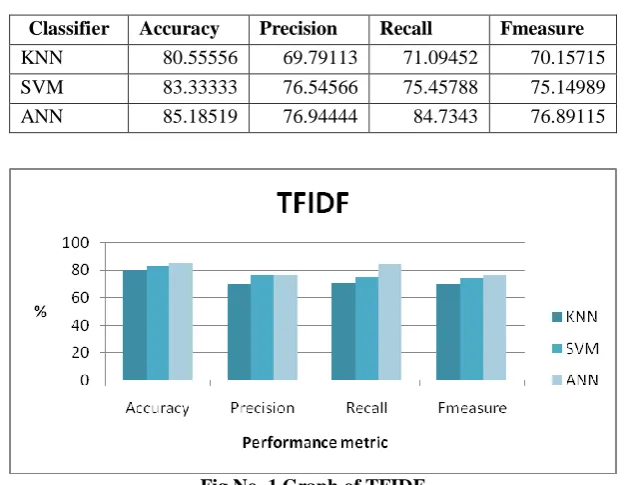
Results on TFIDF
Fig No. 1 Graph of TFIDF
Classifier Accuracy Precision Recall Fmeasure
KNN 80.55556 69.79113 71.09452 70.15715
SVM 83.33333 76.54566 75.45788 75.14989
ISSN(E): 2277-128X, ISSN(P): 2277-6451, pp. 1-5
Results of LSI
Classifier Accuracy Precision Recall Fmeasure
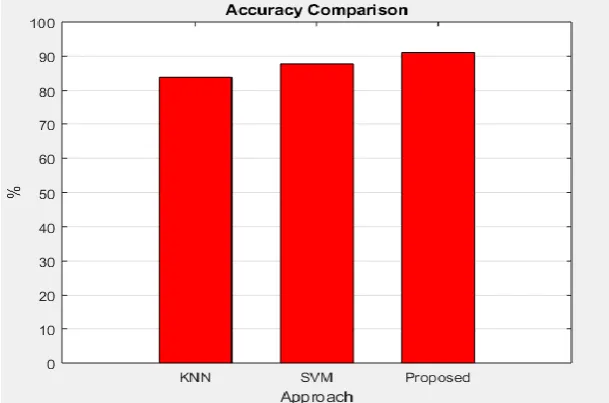
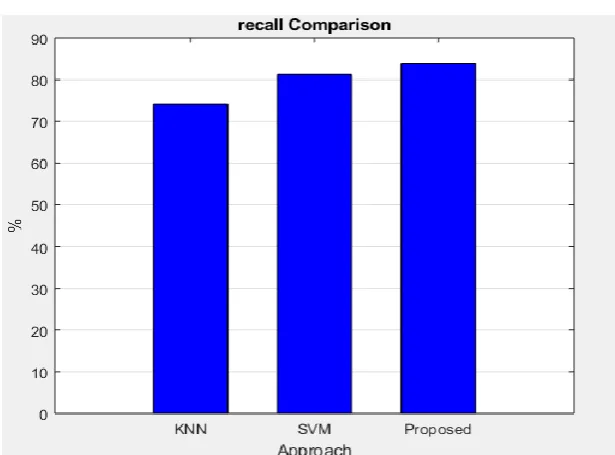
KNN 83.88889 74.27609 74.23934 74.15884
SVM 87.77778 82.63305 81.2825 81.6781
ANN 91.11111 83.21678 83.83838 83.46723
Fig No. 2 Graph of LSI
Classifiers Results:- KNN,SVM,PROPOSED
Fig.No. 3 Graph comparison of various approch KNN,SVM,PROPOSED
ISSN(E): 2277-128X, ISSN(P): 2277-6451, pp. 1-5
Fig. No. 5 Precision Comparison on KNN, SVM, PROPOSED
Fig. No. 6 FmeasureComparision on KNN, SVM, PROPOSED
ISSN(E): 2277-128X, ISSN(P): 2277-6451, pp. 1-5
IV. CONCLUSIONANDFUTUREWORK
In this paper we have presented a framework for document categorization based on better categorization by using ANN and Latent Semantic Indexing. The main motivation for this proposed work is to improve the existing algorithm. Results produced are more efficient and more accurate than existing algorithm. The main factor of time complexity of ANN using LSI is reduced with the help of improved algorithm or work. Future work can be proposed for highly accurate results with the help of topic modelling and we can use hybrid models with more effective framework so that results can improve further.
REFERENCES
[1] Gonzalo Navarro, “Text Document”, Encyclopedia of Database Technologies and Applications, Idea Group Inc.,
Pennsylvania, USA.
[2] Richard T. Freeman, Hujun Yin, “Web Content Management by SelfOrganization ,” IEEE transactions on Neural Network, vol. 16, No. 5, pp. 1256-1268, Sept. 2005.
[3] BoYu, Zong-ben Xu, and Cheng-hua Li, ”Latent semantic analysis for text categorization using neural network,
” Knowledge-Based Systems 21 pp. 900–904, 2008.
[4] A. McCallum and K.Nigam, “A comparison of event models for naïve bayes text classification,” in Proc. AAAI/ICML-98 workshop on Learning for Text Categorization , 1998
[5] D. Cutting, D. Karger, J. Pederson and J. Tukey, “Scatter/gather: A cluster-based approach to browsing large
document collections,” in Proc. 15th Int. ACM/SIGIR Conf. Research and Development in Information Retrieval., Copenhagen, Denmark, 1992, pp. 318–329.
[6] K. Lagus, S. Kaski, and T. Kohonen, “Mining massive document collections by the websom method,” Inf.
[7] Sukhjinder Singh, KamaljitKaur. A Review on Diagnosis of Diabetes in Data Mining. International Journal of
Science and Research (IJSR). 2013.
[8] VeenaVijayan V, AswathyRavikumar. Study of Data Mining Algorithms for Prediction and Diagnosis of
Diabetes Mellitus. International Journal of Computer Applications (0975 – 8887) Volume 95– No.17, June 2014.
[9] P.Yasodha, N.R. Ananthanarayanan.Comparative Study of Diabetic Patient Data‟s Using Classification
Algorithm in WEKA Tool . International Journal of Computer Applications Technology and Research Volume 3– Issue 9, 554 - 558, 2014 .
[10] AiswaryaIyer, S. JeyalathaandRonakSumbaly. DIAGNOSIS OF DIABETES USING CLASSIFICATION
MINING TECHNIQUES. International Journal of Data Mining & Knowledge Management Process (IJDKP) Vol.5, No.1, January 2015. Sci.., vol. 163, no. 1–3, pp. 135–156, 2004.
[11] Nicholas Evangelopoulos, Xiaoni Zhang, Victor R. Prybutok, “Latent Semantic Analysis: five methodological
recommendations”, European Journal of Information Systems (2012) 21, 70–86.
[12] G. Navarro, R. Baeza-Yates, E. Sutinen, and J. Tarhio.“Indexing methods for approximate string matching”. IEEE Data Engineering Bulletin, 24(4):19–27, 2001.