ISSN: 2347-7474
International Journal Advances in Social Science and Humanities
Available Online at: www.ijassh.com
RESEARCH ARTICLE
A Study of Reverse Logistics in the Brazilian Solid Waste Policy
Priscila Eise Alves Vasconcelos
1*, Paulo Sérgio Vasconcelos
Universidade Federal da Grande Dourados UFGD, Brazil.
*Corresponding Author: Priscila Eise Alves Vasconcelos
Abstract
This article brings a summary analysis of the Brazilian solid waste policy in the aspects of reverse logistics and shared responsibility, with the main premise to protect the environment. The analysis of reverse logistics techniques provided for in Brazilian Solid Waste Policy, Law no. 12.305/2010, should be seen as a way to make the industry more sustainable (environmental, economic and social pillars), as well as address the inherent public policy. A brief analysis with other countries will be done in order to demonstrate how the technique of reverse logistics has been developed in the world. The comparison performed between Brazil and the world is indispensable to achieve the effectiveness of the procedure. The environmental liability of companies will be analyzed as the reverse process occurred during the lifetime of the product, with the aim of promoting better environmental preservation through appropriate legal measures. The decisions of the Higher Courts are also analyzed in this work to demonstrate the practical applicability of the legislation in force.
Keywords: Reverse logistics, Environmental responsibility, Legislation.
Introduction
This paper deals with two subjects of great importance to the study of environmental law in Brazil: the reverse logistics and corporate accountability. The reverse logistics, provided for in the federal law about national solid waste Policy, Law n°. 12.305/2010 [1], is addressed in order to correlate your applicability in Brazil and abroad with its main aspects, in addition to the study on the accountability of companiesThe second theme is environmental responsibility, where is shown the historical evolution in Brazil and in the world, the first legislation that the predicted, as well as an analysis on your triple aspect, encompassing the civil, criminal and administrative areas. Analysis of the literature and the case-law of the higher courts are also discussed with respect to the subject. Finally, there is the correlation between the two topics, addressing mainly the shared responsibility News brought by legislation in 2010, with the presentation of relevant issues, problems of everyday life, in addition to a discussion in the search for solutions of outstanding issues.
This is a very discussed nowadays. By growing concern with being environmental preservation, will be shown the current stage of application of recycling technique in Brazilian municipalities. The techniques of reverse logistics applied properly can bring gains national industries, exceeding the environmental sphere. In addition, the technical verification of reuse and reuse, recycling, proper disposal, among others, can bring significant economic benefits, resulting in a positive impact not only the environment but also the economy, being the main object of this work.
Body Text
Reverse Logistics
Reverse Logistics is directly related to the protection of the environment and sustainable development. However, before the advent of Law no. 12.305/2010, many Brazilian companies applied the technique, influenced by international environmental protection policies. For Fiorillo [3], the reverse logistics is brought as a form of solid waste management, based on the principles, objectives, instruments, guidelines, goals and actions of the National Environmental Policy [04].
The National Solid Waste Policy [1] brings the reverse logistics within a political context for urban development of the Brazilian municipalities, based on the Constitution of the Republic [5]. For Fiorillo [3], the Constitution of Brazil comes ordering the development of social functions along with the economic order of capitalism [5]. Three pillars underlying the process of reverse logistics: consumer, the logistics operator and the merchant or manufacturer (Figure 01):
Reverse Logistics
INDUSTRY DISTRIBUTOR RETAIL CONSUMER COLLECT
AND SELETION RECICLE NDUSTRY Font: Canal [06]
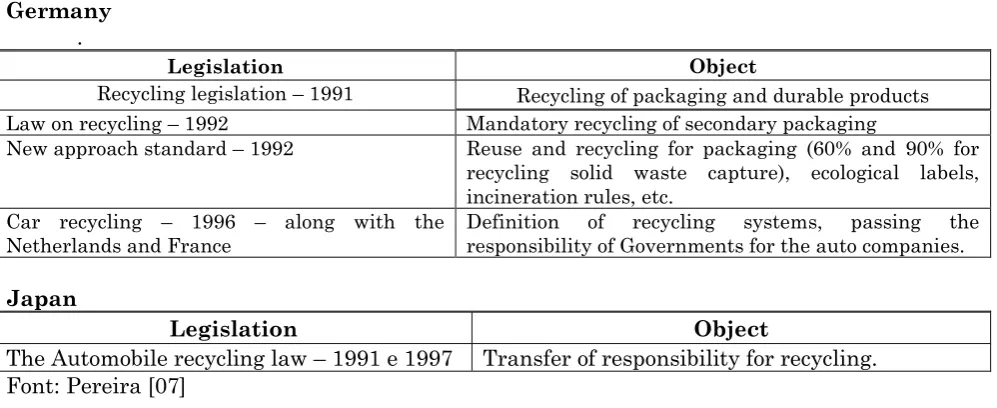
In countries like Germany and Japan there is specific legislation on the subject since 90´s. The prediction procedures for recycling, reuse of packaging, prohibition of use of plastic bags, are already used by these countries for almost three decades, as can be seen in table 01:
Table 1: Legislation in other countries
Germany .
Legislation
Recycling legislation – 1991
Object
Recycling of packaging and durable products
Law on recycling – 1992 Mandatory recycling of secondary packaging
New approach standard – 1992 Reuse and recycling for packaging (60% and 90% for
recycling solid waste capture), ecological labels, incineration rules, etc.
Car recycling – 1996 – along with the
Netherlands and France Definition of recycling systems, passing the responsibility of Governments for the auto companies.
Japan
Legislation
The Automobile recycling law – 1991 e 1997
Object
Transfer of responsibility for recycling. Font: Pereira [07]
In Brazil, with the growing concern on environmental supervision since 80´s and the significant increase in the production of solid waste (garbage) in large urban centers, there was also an incentive for the use of packaging and disposable products. There was early a phase of awareness of society with respect to environmental preservation. Important to highlight the existence of reverse logistics practices at that time with the returnable packaging such as glass bottles of soda, beer and milk, but not yet with this nomenclature.
The Brazil, despite growing concern about the environment and existing policies, is still far away compared to other countries, especially the more developed that have protective practices since 70´s. FARIDI and Hatakeyama [8] argue that the earliest conceptualization about reverse logistics date the early 70, with focus on the reverse process, the main objective being to meet the needs of recoil from the post-consumer materials and post-sales. FARIDI and Hatakeyama [8] noted the reverse logistics emphasizing aspects of recycling techniques and their advantages for the environment existing at the end of the years 70, in addition to the economic aspects and the importance of reverse channels to return and effluent treatment.
With the Brazilian Solid Waste Policy [1], there was the regulation and adjustment of practices involving reverse logistics, as a way to reduce the production of waste to be disposed of, turning them into new inputs to be used in the market, influencing directly the economic, environmental and social spheres. About environmental responsibility, demonstrating your historical evolution in Brazil and in the world, the first legislation that the predicted, as well as an analysis on your triple aspect, encompassing the civil, criminal and administrative areas have great relevance in this theme. The shared responsibility can only be analysed, being an Institute brought to our legal system in 2010, by express legal provision (Law no. 12.305/2010) [1].
Great importance for the analysis involving the existing public policies in Brazil today. Environmental legislation has a major role in the Brazilian planning, especially with regard to the accountability of enterprises on the entire life cycle of the product. It's not more satisfying just the delivery of the final product to the consumer. The current concern is also in the form of completion of disposal in the waste produced, which exert great influence on the generation of environmental impacts. With the advent of public policies, whether in tax, social aspect and others, there will be a greater formal accession on the part of the industries that will see significant opportunities to develop activities on a regular basis. We see, therefore, that it is highly interconnected and that need to be analyzed to generate not only pertinent information as needed to make a positive contribution in the development of the industrial sector.
Despite the gap of approximately 20 years, the theme of reverse logistics, regulated only in 2010 in Brazil, is addressed in order to correlate your applicability in Brazil compared with other countries, as well as their main aspects [09]. According to the MMA [10], through the lifting of the National System of information about 2014 sanitation, only 23.7% of Brazilian municipalities have separate collection system, being the percentage of whimsy 2% which effectively is destined for recycling. Is set out in 32.4% of municipalities that still haven't declared information about procedure.
Environmental legal doctrine used to conceptualize reverse logistics with the goal of recapturing value or perform a proper disposal, as a process of planning, implementation and control of raw materials, in-process inventory, and finished goods (and your flow of information) of the consumer endpoint to the point of origin [11]. When the analysis of application of reverse logistics in countries like Germany and Japan, make up demonstrated through scientific studies conducted and published, how the technique is beneficial for the accounting and economic balance of the industries involved [07][09].
As LEITE [12], in the United States, the flow of products that return through the reverse channel is growing. About values, about 35 billion dollars per year, which makes a percentage of 0.5% of the gross production from the American return to the productive cycle of post-consumer products. Highlights the percentage of return of these products by industry segment (table 02):
Table 2: Branches of activity
Enterprises editing magazines-50% Companies who edit books-20-30%
Companies that make distribution of books-10-20% Companies that make electronic distribution-10-12% Companies that manufacture computers-10-20% Companies that manufacture CD-Rooms-18-25% for computer Printers-4-8%
auto parts industry Products-4-6%
Font: Leite [12]
Recently, in may 2016, in São Paulo, started to be implemented a project of reverse logistics of waste electronics [13]. Called on disposal, is the result of a partnership between Brazil and Japan, being a pilot program within the project for improvement of reverse logistics of WEEE (waste electrical and electronic) in Brazil.
Environmental Responsibility
About environmental responsibility, your study is done by comparing the historical evolution in Brazil and in the world, in addition to an analysis of your triple aspect, involving the civil, criminal and administrative areas. The main focus is on the case-law of the Superior Court of Justice [09]. In Brazil, since the 1980, there was the beginning of a phase of awareness of society with respect to environmental preservation, much influenced by the regulation of the National Environmental Policy, through the Law number 6.938/81.
In 1998, with the beginning of the Brazilian program retraining by the Ministry of industry and trade, a new milestone in Brazilian environmental legislation arises through a policy on solid wastes, beginning to encourage separate collection at home, the obligation for manufacturers and distributors of farmings and pneumatic products for packaging and post-consumer products collection, in addition to the incentive with a differentiated taxation material recycling activities [09]. Points out that, currently, most medium and large companies, are only performed the techniques of reverse logistics for products listed in the law, such as, for example, pesticides, fluorescent lights, tires, batteries (article 33 of the Law 12.305/2010).
Although there are several techniques of sustainable use, the number of companies that have developed, in Brazil, is still small compared to other countries. In many cases, companies whose headquarters are abroad and bring such policies to the internal framework, influenced by the internal culture of the company. Among the companies of high repute in Brazil, which uses techniques of reverse logistics for sustainable enterprise status, is the beverage Company AMBEV- the Americas. Located in the State of Rio de Janeiro, the company uses the reuse of water as a means of cooling the tanks, has effluent treatment plants (ETE ´ s), uses biomass and biogas as a way to reduce the emission of CO2, among other techniques [14].
Regarding the accountability of companies, will be shown through judged from the higher courts, how relevant is the matter for the law and how it is essential to respect the law.
Results and Discussion
A universal vision, Razzolini Filho and Berté [15] and Campos [16] brings the most recurrent concepts of reverse logistics Reverse Logistics Executive Council (RLEC) and Council of Logistic Management (CLM), which define:
"The activity of planning, execution and control of the flow of raw materials, goods in process and finished products (as well as related information flows), the consumer endpoint to the point of origin, efficiently and effectively, in order to recapture the value or intended proper disposal, handling the impact of costs related to this process." (REVERSE LOGISTICS EXECUTIVE COUNCIL – RLEC, 2007)
The reverse logistics is concern the handling and management of equipment, products, components and materials to be retrieved. For your implementation, there is, for example, the recycling process for the recovery of certain products. Great importance has been received in the corporate world from the moment you found how profitable it could be such a procedure, adding environmental values, better competition in the market and a positive corporate image. The reverse logistics works at the end of the string, when the products are already on the end user and there's a new consumption or reuse. Is there a reverse flow of materials.
Despite the reverse logistics classification be booked, your real goal is being sought both in Brazil as in the world for many years. The doctrine used to conceptualizing it as a "process of planning, implementation and control of raw materials, in-process inventory, and finished goods (and your flow of information) of the consumer endpoint to the point of origin, with the aim of recapturing value or perform a proper disposition" [11].
We highlight the importance of reverse logistics is not limited to the economic aspect. On the contrary, this is a matter involving public health, environment, economics, among others, being a real productive cycle inside out.
The great advantage of reverse logistics is related to the company itself, in addition, of course, the environment. Among its advantages, one can cite the possibility of return of solid waste for businesses (which prevents the contamination of soil, seas and rivers), allowing the economy in the productive processes of the enterprises (there is a reduction in the consumption of raw materials), creating a shared responsibility for the fate of solid waste (including public authorities), in addition to the industries to use cleaner technology , and, therefore, in order to reuse, creating packages that are more easily recyclable.
One of the factors for the application of reverse logistics, there are economic factors (cost of production), Government (legislation and environmental policy), corporate responsibility (commitment of manufacturers with the collection of their products to the end-of-life), technology (technological advances of recycles.
The law 12,305/2010 brought some innovations to our legal system. Among them, we highlight the ban on landfills (which resulted in end of the landfill of Jardim Gramacho, in Duque de Caxias/RJ), the assignment of responsibility to the disposal of solid waste produced by them, social inclusion of organizations of collectors, the reverse logistics, shared responsibility, prediction of solid waste plans, and responsibility regarding the correct conditioning of the garbage in the case of separate collection. The national solid waste policy (PNRS) brought also some general principles of environmental law. We can highlight the principles of prevention, precaution, polluter-pays principle, the protective principle, sustainable development, of the reasonableness and proportionality, all these much discussed when the realization of Agenda 21-set of resolutions taken at the International Conference Eco-92-held in the year 1992 by ONU Janeiro, with the participation of approximately 180 countries.
Essential to highlight that in 2014, the Minister of environment Izabella Teixeira, pointed out five reverse logistics chains that were being deployed in Brazil: plastic packaging of lubricating oils (sectoral agreement was signed 12/19/2012 day); sodium vapor lamps and mercury and mixed light (the draft sectoral agreement, concluded after negotiations between the Government and the sector, was approved at a meeting of the CORI and the public consultation); electrical and electronic products and their waste (presented ten proposals already examined by the Ministry of Environment in negotiations with proponents); packaging (draft sectoral agreement was approved at a meeting of the CORI, awaiting the realization of public consultation); dispose of medicines (the proposals are still under negotiation) [17].
independently of the public service urban cleaning and solid waste management, as can be seen in Figure 3.
Transfer of responsibility for recycling.
Dealer and Distributor
Consumer
Fig. 3: Shared responsibility on reverse logistics (FIERGS)
The legislature, through the Institute of shared responsibility, sought the effectiveness in the rollback process involving materials such as batteries, tires, lights, electronics, among others. To become effective, it is necessary to the existence of terms of regulation sector agreements and terms of commitment to agreements signed by companies close to the Government, and may extend them to other companies that manufacture products in plastic packaging, glass or metal plus other products and packaging, as their impact to health and the environment, being valued by environmental agencies and related to public health (article 33 , paragraph 1 of the law 12,305/2010). With respect to the jurisprudence of the Egregious Superior Court of Justice, one can highlight judgments about environmental responsibility, where admits the application of reverse the burden of proof (common practice in consumeirista probative issues involving law, article 6 of the code of Consumer protection and defense, Law 8,078/90) [18], on the actions of remedying of environmental damage.
The Foundation of this permission is in the public interest of the repair and the precautionary principle, being a trial where there is doubt, as this may be probative attributed to the alleged polluter the onus to show that environmental damage is being repaired, or, if any, that this was not your own. In this sense: special features 972.902 and 1.060.753-SP, both judged in 2009 [19].
Stands still judged of the Superior Court of Justice [19] dismissed the existence of causality when the determination of environmental responsibility. This occurred in the special feature of 650.728/2007, where the Superior Court [19] claimed that for the purpose of calculating the environmental damage causation, action who does, who does not when you should be doing, who don't mind to do, who finances to do, and who benefits when others do.
In the Superior Court of Justice there are judged based on Risk Theory, being the objective liability in its strongest mode, where you don't just break the link caused by the fact that third, unforeseeable circumstances or force majeure. In the special feature 442.586, trial in 2002, the SUPREME COURT [20] is sure to provide that the responsibility for the adoption of the theory of integral risk and that discussions inter parties should discuss guilt and the right of return.
Conclusion
The reverse logistics is related to the disposal of products and materials already discarded by the final consumer, thus avoiding the creation of new waste and encouraging a greater concern for the environment. There's the return of post consumer goods to the productive cycle, reducing the accumulation of industrial waste to be thrown. You can, therefore, relate the reverse logistics as an important tool for environmental preservation [21]. Therefore, there was a considerable increase of ecological consciousness of the consumer, which shall enhance products from companies with greater environmental concern.
Through a positive management economically and environmentally sustainable waste reduction is possible, along with initiatives of companies and the general public, stimulated by preventive and educational.
Brazilian environmental legislation presents a highlight in relations with the other with respect to the liability of the companies over the entire life cycle of the product, not limited to the mere delivery of the final product to the consumer. Currently, there is also concern regarding the disposal of the waste produced in order to avoid further environmental impacts. With the advent of public policies, whether in the tax aspect, social or other, there will be a greater formal accession on the part of the industries that will see a significant opportunity to develop this activity on a regular basis. Shared responsibility is an effective joint participation for the fulfilment of the obligations inherent in the management of solid waste. This effective participation is the set of actions on the part of responsible agents, aiming to achieve an optimal level for the shared management of solid waste.
Furthermore, although expressly provided in federal law, to become effective the shared responsibility it is necessary to institute an effective system of supervision by the public authorities with the industries and commerce, in addition to the structural feasibility to carry out the procedure, being properly incorporated into the production process. Some gaps are present in national politics. With respect to limitation of liability of agents involved in the production chain, there is a blurring and it raises concern in business and retail sectors. A better way to determine the dosage of responsibility of the operatives is still awaited, delimiting the main responsible.
The legislation stipulates that certain sectors are required to perform the procedure of reverse logistics. Among them are those using packaging waste pesticides, batteries and tires. However, issues such as the dispersal of waste in urban centers in the post-consumer (the issue of); the geographical distance of industries in relation to the distribution centers of its products; In addition to the amount of waste required to generate volume in the collection and processing in order to optimize costs are some of the problems encountered. In large urban centers such as the cities of Rio de Janeiro and São Paulo, where there are third party companies for garbage collection, there is a never-ending discussion: the common garbage collection companies refuse to perform the selective collection and the consumer goods producing industries have no structure for the realization of this collection.
What is in the major urban centres are casual collectors, many in a State of vulnerability, as those who live in streets or even near landfills. Selective formal programs are rarities and the participation of the waste recovered and taken to recycling is still little. We see, therefore, that Brazil still has based a post-consumer recycling post-consumer collection and informal, even in lesser extent when compared to other countries. The effectiveness of recycling technique could be best viewed if there were greater formalization of those involved and waste recovery, as in the case of cooperatives exist in major centers. Programs such as deployed in São Paulo, with the goal of deploying a reverse logistics process efficient, throughout the collection process, transportation to recycling and proper waste disposal, must be valued and magnified in Brazil [10].
The effectiveness of the standards comes at the time of the regulation and guidance of public policies, with accountability standards forecast of manufacturers, traders, public authorities and consumers themselves. From an effective implementation is that we will have a significant positive result, in order to really reflect on the economic and social aspects. While there are no predefined accountability policies much lack to become effective deployment of reverse logistics.
Acknowledgments
References
[1] POLÍTICA NACIONAL DE RESÍDUOS SÓLIDOS. Lei 12.305/2010. Disponível em < http://www.planalto.gov.br/ccivil_03/_ato2007-2010/2010/lei/l12305.htm> Acesso em 10/11/2016.
[2] ALMEIDA, K. M. V. Logística reversa para gestão de resíduos e coprodutos da cadeia de biodiesel estudo de caso em usinas do nordeste brasileiro. 2012. 197p. Dissertação (Doutorado em Engenharia Civil) – Universidade Federal de Pernambuco - UFP, Recife, 2012.
[3] FIORILLO, Celso Antônio Pacheco. Curso de Direito Ambiental Brasileiro. Ed. Saraiva. 16 ed. São Paulo. 2015.
[4] POLÍTICA NACIONAL DO MEIO AMBIENTE. Lei 6.938/81. Disponível em < http://www.planalto.gov.br/ccivil_03/LEIS/L6938.htm> Acesso em 10/11/2016.
[5] CONSTITUIÇÃO DA REPÚBLICA FEDERATIVA DO BRASIL. 1988. Disponível em <
http://www.planalto.gov.br/ccivil_03/constituicao/constituicaocompilado.htm>. Acesso em
10/11/2016.
[6] CANAL, EDUARDO. Logística Reversa: desafios e oportunidades para os operadores logísticos. 2015. Disponível em < http://www.administradores.com.br/noticias/negocios/logistica-reversa-desafios-e-oportunidades-para-os-operadores-logisticos/98733/> Acesso em 10/11/2016.
[7] PEREIRA, André Luiz. Logística Reversa e Sustentabilidade. Ed. Cengage Learning. 2012.
[8] FELIZARDO, Jean Mari; HATAKEYAMA, Kazuo. A logística reversa nas operações industriais no setor de material plástico: um estudo de caso na cidade de Curitiba. In: XXIX Encontro da ANPAD (ENANPAD), set. 2005, Brasília. Anais... Brasília, 2005, p. 1-17.
[9] VASCONCELOS, Priscila E. A. Logística reversa e responsabilidade ambiental: aspectos gerais. Trabalho de conclusão de Curso. MBE – Pós Graduação Executiva em Meio Ambiente. COPPE-UFRJ. 2014.
[10] MINISTÉRIO DE MEIO AMBIENTE (MMA). BRASIL. Resíduos Sólidos. Disponível em < http://www.mma.gov.br/mma-em-numeros/residuos-solidos>. Acesso em 10/11/2016.
[11] LACERDA, Leonardo. Logística Reversa – Uma visão sobre os conceitos básicos e as
práticas operacionais. 2000. Disponível em:
http://www.ecodesenvolvimento.org/biblioteca/artigos/logistica-reversa-uma-visao-sobre-os-conceitos. Acesso em 14/12/2015.
[12] LEITE, Paulo Roberto. Logística reversa: meio ambiente e competitividade. São Paulo: Prentice Hall, 2003.
[13] MAXPRESS. Projeto inédito de logística reversa de resíduos eletroeletrônicos, "descarte
ON" começa a funcionar em São Paulo. Disponível em <
http://www.maxpressnet.com.br/Conteudo/1,833640,Projeto_inedito_de_logistica_reversa_de_re siduos_eletroeletronicos_descarte_ON_comeca_a_funcionar_em_Sao_Paulo,833640,8.htm> Acesso em 10/11/2016.
[14] AMBEV. Disponível em http://www.ambev.com.br/relatorio-anual-2012/valores-ambientais. Acesso em 02/03/2016.
[15] RAZZOLINI FILHO, Edelvino; BERTÉ, Rodrigo. O reverso da logística e as questões ambientais no Brasil. Curitiba: Ibpex, 2009.
[17] MINISTÉRIO DE MEIO AMBIENTE (MMA). BRASIL. Entrevista com a Ministra Izabella
Teixeira. 2014. Disponível em <
http://www.mma.gov.br/informma/item/10272-pol%C3%ADtica-de-res%C3%ADduos-s%C3%B3lidos-apresenta-resultados-em-4-anos>. Acesso em 10/11/2016.
[18] CÓDIGO DE PROTEÇÃO E DEFESA DO CONSUMIDOR. Lei no. 8.078/90. Disponível em < http://www.planalto.gov.br/ccivil_03/leis/L8078.htm>. Acesso em 10/11/2016.
[19] SUPERIOR TRIBUNAL DE JUSTIÇA. Disponível em <
http://www.stj.jus.br/portal/site/STJ>. Acesso em 09/10/2016.
[20] SUPREMO TRIBUNAL FEDERAL. Disponível em <
http://www.stf.jus.br/portal/principal/principal.asp> Acesso em 09/10/2016.