International Journal Advances in Social Science and Humanities
Available online at: www.ijassh.comCASE STUDY
Factors Influencing Ordinary Level Students’ Academic
Performance in Integrated Science, A Case Study of Three
Secondary Schools in the Victoria Falls Town of Zimbabwe
Emily Mangwaya
1, Mangwaya Ezron
2*, Tsumele Johnson
31Educational Foundations Lupane State University PO Box AC 255 Ascot Bulawayo Zimbabwe.
2Educational Foundations Midlands State University PB 9055 Senga Road Gweru Zimbabwe.
3Mosiatunya High School Victoria Falls Zimbabwe.
Abstract
Students’ academic performance at secondary school level in developing countries tends to be affected by various factors. In rural school settings lack of resources is one such key factor. Observations over the last five years indicate that high school students in Victoria Falls have not been performing well in Integrated Science. This qualitative study sought to explore through questionnaires, interviews and observations, factors influencing academic performance in Integrated Science in urban secondary schools in the Victoria Falls town of Zimbabwe. Findings from the study indicate that lack of qualified teachers, inadequate science equipment and lack of motivation, among others, negatively influence students’ academic performance in Integrated Science. Intervention strategies are proposed which should enhance students’ performance in Integrated Science.
Keywords: Integrated science, Academic performance, Ordinary level.
Introduction
Hues and cries among the stakeholders in education have arisen in recent times over the growing rate of failure in Zimbabwean secondary schools [1]. While parents find joy in the success of their children despite lack of the necessary support from them, stakeholders have blamed the pupils for their unpreparedness to study as one of the major causes of failure. Stakeholders also blame teachers for their lack of dedication to their jobs which inadvertently affects pupils’ performance [2]. High quality teachers are education’s best resources and assets as further coined by Ayodele [3]. The ability of the teacher to teach effectively depends therefore on the teacher’s knowledge of the subject and the teacher’s effectiveness is impeded if the teacher is unfamiliar with subject matter. The way the pupils perceive the teachers in terms of their knowledge of the subject significantly affects pupils in their learning [1]. Ncube [1] further points out that the quality of education in Zimbabwe is compromised by lazy teachers, increased absenteeism among teachers and
teachers’ strikes over salaries and poor working conditions. Most teachers in the public schools do not check on the pupils’ progress and go to work without being clear on what to teach and how to teach thus lacking planning [1]. Effective teaching is a balanced blend of pedagogical knowledge and content knowledge.
Zimbabwe Schools Examinations Council (ZIMSEC) inherited the Ordinary level Integrated science syllabus from the University of Cambridge in 1998, when the Zimbabwe government finally struck a deal to localize all its high school certificate examinations [3]. The major motive behind was to reduce costs pertaining to foreign currency payments to overseas markers and to make use of local professional teachers in Zimbabwe.
that regarding a subject as difficult repels learners from continuing with studies in the subject, hence many countries have developed new syllabi for secondary schools to make subjects more learner-friendly. Despite the change of syllabus in Ordinary level Integrated Science, the quality of the results is a big worry in most schools. There is need to identify the gaps between students’ wishes and teachers’ teaching as observed by Rannikmae [6] and help teachers map out more effective strategies to tackle the subject and promote meaningful science learning [7] as well as uproot many variables that affect student learning [8].
A study was carried out at three high schools in Makoni District, Manical and Province of Zimbabwe by Kazembe and Musarandega in 2011. The study involved form six Chemistry students and their teachers, from January to May 2011. Data
were collected using questionnaires,
interviews, observations and securitization of records and other documents. The data
revealed factors affecting student
performance and how performance could be enhanced. Teachers and students voiced concern about the extensive nature of the Chemistry syllabus and the nature of examination questions and they felt that the abstract nature of Chemistry was a major source of learning problems. Some students had misgivings about the way the subject was taught, lack of suitable text books and the very limited access to practical work, attitude of some teachers who failed to motivate students toward liking the subject, and the quality of teachers.
Tshabalala and Ncube [9] also carried out a study on investigating learners’ attributions
on high failure in Mathematics
examinations in rural secondary schools in Nkayi district in Matabeleland North Province of Zimbabwe. The research instrument used was the questionnaire which had both close ended and open ended questions. The study revealed that pupils attributed their failure mainly to lack of material resources, poor teaching methods, bad teacher behaviour, poor grounding in the subject at lower levels as well as their fear of the subject. The study recommended that the Ministry of Education should embark on serious in-service training for
Mathematics teachers and also that Mathematics teachers should embark on team teaching to assist each other on the subject. Pupils should be motivated to view Mathematics like the rest of the subjects in the school curriculum.
According to Medinat [10], lack of qualified teachers, lack of well-equipped libraries, parental or guardian influence, attitude of students, instructional materials and time allocation were important factors affecting pupils' performance in Agricultural Science in secondary schools.
Another research that was carried out sought to investigate the causes of low pass grades in advanced level accounting in the Bindura urban schools for the period 2006 to 2008. This was a survey of three high schools offering advanced level Accounting which were studied to determine the trend of results since 2006. Different sets of questionnaires were used to collect data from the respondents. An interview guide was used to gather information from headmasters, departmental heads, and teachers of accounting. Student performance was low because the pupils were not well motivated and there was lack of resources. The pupils felt that the causes of low pass grades were lack of motivation, not following instructions, blaming the teacher, not attending lessons, not taking notes, relying too much on other pupils and not managing
time well.
Pedzisaiet. al. [11] did a study on investigating factors contributing to poor performance in the Zimbabwe advanced level Agriculture syllabus (9159) in two selected high schools in the Midlands province of Zimbabwe. The study used questionnaires for students and interviews for Agriculture teachers to collect the required data. The research found out poor
Science background, poor subject
combination at advanced level, lack of
Science equipment, unavailability of
textbooks for the syllabus and lack of funding for field trips and seminars as the major challenges schools faced when
teaching the syllabus. The study
There are two secondary schools and five private colleges in Victoria Falls urban. These learning institutions offer a wide range of subjects at Ordinary level including Integrated Science. Victoria Falls urban has in the past produced an approximate output of 500 candidates per annum. Several researches have been carried out locally and abroad but no published research has been done in the Victoria Falls’ high schools to
ascertain factors affecting academic
performance of Integrated Science students. It is on account of this information that this study sets out to explore factors influencing Ordinary level Integrated Science pupils’ academic performance in three secondary schools.
Statement of the Problem
Pupils who study sciences at Advanced level would have passed Integrated Science at Ordinary level. A results analysis of Ordinary level Integrated Science for the past five years in Victoria Falls reveals that only 13% of pupils pass Integrated Science. As a result of this low pass rate very few pupils consider Advanced level Sciences. This study explores factors that influence
Ordinary level students’ academic
performance in Integrated Science in the Victoria Falls urban secondary schools.
Research Questions
What are the factors that have contributed
to low academic performance of Ordinary level pupils in Integrated Science?
What are the learning conditions that
compromise the proper learning of pupils in ordinary level integrated science?
What strategies can be utilized to enhance
performance of
Ordinary level Integrated Science pupils?
Research Design
The qualitative research was used to explore factors that influence performance of Ordinary Level Integrated Science pupils in three secondary schools. Bell [12] classifies such a research as a case study research design where an issue that needs exploration in a section of the country was encountered. This design falls within the
interpretivist paradigm where the
researcher constructs data socially.
According to Pedzisaiet al, [11], the sampling strategy used is purposive sampling since participants are information rich about performance of pupils at ordinary level. Wahyuni [13] explains that an interpretivist paradigm is one that has data with subjective meanings and focuses upon the details of the situation and the reality behind the situations. Assumptions, varied backgrounds and experiences of humans contribute to the construction of reality. Interpretivist research favours a dialogue
with the participants under study.
Qualitative data provides a rich description of social constructs [13]. Three school heads,
three Integrated Science heads of
departments, three Integrated Science teachers and three students from each secondary school were purposively selected for this study. Questionnaires, interviews and observation were the key instruments that were used to generate data in this study.
Findings
Findings are discussed in the context of the research questions that guided this study.
Question 1: What are the Factors that Contribute to Low Academic Performance of the Pupils in Ordinary Level Integrated Science?
Experience in the Teaching Profession
The nine (9) questionnaires that were administered required respondents to indicate their experience in the teaching profession. All nine (9) respondents indicated their experience giving a one hundred percent (100 %) response on the question.
Table 1: Respondents’ experience in the teaching profession Experience in teaching Frequency for school
heads
Frequency for heads of departments
Frequency fir Integrated Science teachers
1 to 5 years Nil 2 2
6 to 10 years Nil nil Nil
11 to 15 years 1 1 1
16 to 20 years 1 nil Nil
Over 20 years 1 Nil Nil
Total 3 3 3
science teacher had between eleven (11) and fifteen (15) years working experience.
Teacher related factors such as the teacher’s academic preparedness, teaching experience, attitude and teaching styles contribute to pupils’ level of academic achievement in school subjects. The longer the working experience of a teacher the more are the chances that pupils will benefit. This is so because a teacher’s experience shapes the manner in which he/she approaches the subject. Experienced teachers will thus use
previous experience to address learners’ challenges hence have a high possibility of raising pass rate in Integrated Science.
Educational Qualifications of School Heads, Heads of Departments and Teachers
School heads, heads of science departments, and ordinary level Integrated Science teachers were asked to indicate their levels of education. A response rate of one hundred percent (100 %) was achieved.
Table 2: Educational qualifications of school heads, heads of science departments and ordinary level Integrated Science teachers
Levels of education Frequency for school
heads Frequency for heads of departments Frequency for integrated science teachers
Masters degree Nil Nil Nil
Honours degree 2 1 1
General degree 1
Diploma holder 1 1 2
Certificate holder nil nil Nil
Other/ A level Nil nil Nil
Total 3 3 3
Two (2) heads of schools had honours degrees and only one (1) of the school heads had a diploma. Only one (1) of the heads of department had an honours degree while the other head of department had a general degree. The last head of department had a diploma. Only one (1) ordinary level science teacher had an honours degree while the other two (2) science teachers had diplomas. One observation made by the researchers is that degree holders did not have teaching qualifications like post graduate diploma in education. Ncube [1] postulated that teacher effectiveness is impeded if the teacher is unfamiliar with the body of knowledge taught and the teachers’ effectiveness is subject specific. The results show that all teachers are degree holders. The qualifications of a teacher are important in ensuring that the teacher has content on the subject that the teacher is teaching. Content mastery assists the teacher to clearly explain concepts to the pupils. Such
explanations could have been enhanced had Integrated Science teachers been exposed to pedagogical content through a teaching qualification.
Area of Specialisation
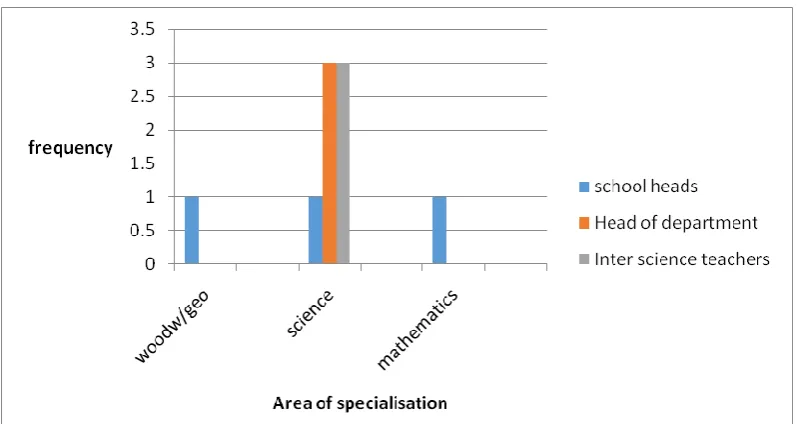
Respondents were also asked to indicate their area of specialisation on the questionnaires. The nine (9) participants responded to this question thus giving a one hundred percent response (100 %). The responses identified Mathematics, Science and Woodwork/Geography as areas of specialisation.
One (1) school head specialised in Woodwork and Geography while the other school head specialised in Sciences. The third school head specialised in Mathematics. All heads of departments and science teachers at the three schools specialised in Sciences. This gives a one hundred percent (100 %) level of
specialisation in all three science
Figure 1: Areas of specialisation for school heads, heads of science departments, Integrated Science teachers and their frequencies
A difference in areas of specialization (teaching out of field) makes teachers less
competent in discharging their
responsibilities. In this study heads of departments and teachers specialized in their respective subjects. One would thus expect them to produce glowing pass rates. As pointed out earlier on competence in teaching not only requires subject content but also the necessary pedagogical skills, which these teachers did not have hence the high failure rate in Integrated Science.
Homework Assistance
The interview question on homework was, “Who assists you with Integrated Science homework?” One pupil answered “I get assistance from my sister who was in form four last year'’ and the other pupil said “ My neighbours assist me in doing my homework” Some pupils who did not have either text books or internet access got help from friends and relatives to do homework.
Figure 2: Reference material used by pupils when given homework in integrated science
Most pupils were found to be assisted by their relatives and friends (44 %), while three (3) (17%) had access to the internet. Those who could access textbooks to use on a daily basis were 7. According to Ramala [14], the learner’s background that includes
however important that the pupils get proper assistance in homework because homework assists pupils in studying when they are not at school.
Parental Attitude and Motivation
Pupils during the interviews responded to the question, “Who motivates you to do and sit for ordinary level Integrated Science final examinations at the end of the year?” Six (6) pupils responded that both their parents and teachers motivated them to do Integrated Science. Parents with a negative attitude towards a subject do not motivate their children to work hard in those subjects. Tucker et al. [15] expressed that academic preparation, praise and encouragement by both teachers and parents and positive peer influences enhance academic success of pupils. Desimone [16] affirmed that a large portion of the variance in science achievement can be explained by a linear
relation with parental involvement.
According to Ho and Williams and Teachman cited in Liew and Pong [17], certain types of parental involvement such as discussing school related topics benefit children. Hartog and Brosnaa in Chagwizaet al, [18] emphasize that parents can assist their children develop a love for a subject by doing the subject with them. The research findings show that most parents do not take their time to talk about their children’s schoolwork. Pupils follow the needs and attitudes of their parents therefore it is important that parents have a positive attitude towards Integrated Science.
Shortage of Qualified Teachers to Teach Ordinary Level Integrated Science
School heads and heads of departments were asked to give reasons as to the causes of poor performance in ordinary level Integrated Science. All three (3) school heads and heads of departments responded to this question with different comments. Two (2) school heads and their heads of departments indicated that the poor performance was a result of lack of qualified personnel and equipment in the science department while the other school head pointed out bad attitude towards the subject on the part of pupils. Johnstone [19] pointed out that there was a positive relationship between the teachers’ quality and pupils’ interest and success in the science subjects. The findings show that although the science teachers are degree holders, they do not have teaching qualifications.
Curriculum Challenges
The ordinary level Integrated Science syllabus has five (5) distinct topics that have different levels of difficulty. These are science in industry, energy uses, agriculture, structures and mechanical systems and science in the community. Eighteen (18) pupils were interviewed and asked to comment on the level of difficulty of the topics. During an interview, one pupil responded, “If there was no science in industry, then science was going to be a simple subject” and another pupil said “My most difficult time at school in Integrated Science was when the teacher was teaching science in industry because it was difficult to
understand anything”. According to
Johnstone and Kellett [20], the difficulty of a topic as perceived by pupils is a main contributor towards their ability and willingness to learn it.
Table 3: Level of difficulty of topics in Integrated Science
Topic Very difficult Difficult Average
Science in agriculture 0 0 18
Science in structures and mechanical systems
0 8 10
Science in industry 16 2 0
Science in energy uses 3 11 4
Science in the community 0 0 18
The most difficult topic was observed to be science in industry with 16 pupils pointing out that it is the most difficult. The topic was followed by science in energy uses which had 11 pupils and 3 pupils pointing out that it was either difficult or very difficult.
was an overloaded chemistry curriculum that was time consuming. Tshabalala and Ncube [9] found out in the research study that seventy-three percent (73%) of the
pupils respondents confirmed that
mathematics was a naturally difficult subject while only twenty-seven percent (27%) strongly disagreed to this notion. The findings on this research question show that most of the pupils face difficulties in learning science in industry.
Question 2: What are the Learning
Conditions that Compromise the
Proper Learning of Pupils in Ordinary level Integrated Science?
Availability of Equipment and
Laboratory
The interviewed pupils were asked the following question “Do you have a room and enough learning equipment for ordinary level Integrated Science?”. One pupil responded “There is no laboratory and all practical work takes place here in class when the teacher brings a few apparatus for us to use in groups of at least seven pupils per each group”. A pupil from the other school said “All practical work takes place in the laboratory but the teacher puts pupils in groups of at least four per each group and monitors as pupils do practical work”. A pupil from the third school said “Every time there is a practical to be done, pupils are called into the lab where the whole class gather around the teacher’s desk as the teacher does the practical or instructs one pupil from the class to perform the practical”. Awang [21] postulated that educational aids and resources increase pupils’ achievement as they found out that more than ninety four percent (over 94%) of Singapore students own computers and seventy-eight percent (78 %) of them use computers both at home and at school. The findings of thisstudy show that there is a shortage of equipment for pupils to use during practicals.
Classroom Climate
The observations made by the researcher showed that in one school, there is a spacious laboratory with enough stools and working space for all the pupils and the teacher. The laboratory has no running water but has enough gas taps. The laboratory is well ventilated but has very
few charts on only one of the walls. The other school has a laboratory that is half the size of an ordinary classroom and is poorly ventilated with no charts on the walls. Pupils in this school are subjected to a crowded environment that is hot and uncomfortable. The third school has no laboratory therefore pupils do practical work in the classroom that they use for all other subjects. The room has no charts at all. Mullins [22] expressed that the climate which surrounds learners determines their readiness and motivation to learn, which directly affects their performance. According to Kiadese [23] school based problems such as poor infrastructure, poorly equipped workshops and laboratories contributed towards poor performance of pupils. Ketchum [24] expressed that up to date textbooks and other materials for use by the teacher during lesson delivery were important in ensuring effective learning. Some schools have laboratories that are poorly equipped while other schools have no laboratories at all.
Pupil Motivation by Teachers
The interviewed pupils were asked the following question “Who motivates you and encourages you to do and sit for ordinary level Integrated Science final examinations at the end of the year?”. Six pupils from one school responded “The integrated science teacher always encourages us to attend all lessons and do all work given by the teacher, that way we will pass Integrated Science at the end of the year”. The other pupil from the second school said “The teacher is very active and always says science is very easy, which motivates us to work hard”, while another pupil from the third school said, “I am motivated to learn because the teacher responds to my questions every time I ask”. Gilman and Anderson [25] explained that motivation influences psychological and social functioning which facilitates both positive school perceptions and academic performance. The study revealed that Integrated Science teachers motivate their pupils during lessons.
Methods of Teaching Used by Teacher
and teaching aids during lessons?”. One pupil responded “We only do practical group work once a week and that is when the teacher brings apparatus and charts”. Another pupil said, “The teacher talks and writes on the board until we are tired of listening and writing notes, such that we feel like sleeping”. Research findings from observations done showed that the teachers were using the traditional lecture method most of the time and only involved pupils during practical sessions. The pupils were made passive recipients during lessons. The researchers observed two theory lessons per each school. In school A, seven (7) out of forty-two pupils (17%) participated while on the second day, only 4 participated (10%). In school B, on the first day, only three (3) out of thirty-eight pupils (8%) participated while five (13%) participated on the second day. In school C, two (2) pupils out of thirty-five (35) pupils (6 %) participated during the first lesson and five (5) pupils (14%) participated on the second day. The lecture method was used in two of the schools throughout the two lessons while the third school used a combination of both the lecture method and group work. Teachers came late for all schools sampled but came within five (5) minutes of starting time. The teachers were not good at motivating pupils though they showed good mastery of the topics. Pupils in the two schools where the lecture method was used were seen to be “slaves of knowledge” as the teacher dished out knowledge to them while they were passive recipients. In the third school, pupils became very active when group work was given during part of the lesson. Polya [26] postulated that one of the most important factors for improving performance is students’ involvement. Anthony [27] further emphasises that active learning and seeking pupils’ efforts were some factors leading to pupils’ failure. Skemp in Chirume and Chikasha [28] postulated that teachers should carry the major part of the blame when they become more authoritarian and less humane in their teaching approaches and promote rote learning. Chirume and Chikasha [28] further explain that most teachers rarely make use of the affective domain of Bloom’s taxonomy of objectives
during preparation of instructional
programmes. Ballone-Duran et al, [29]
coined that the art and science of teaching has been found to be the most important factor in improving student achievement in schools. The research revealed that the teachers use the traditional lecture method most of the time.
Question 3: What Strategies can utilize to Enhance Ordinary Level Students’ Performance in Integrated Science? Strategies to Improve Learning of Ordinary Level Integrated Science
Questionnaires for school heads, heads of
departments and Integrated Science
teachers had questions on how to improve the teaching and learning of Integrated Science. There was a one hundred percent (100 %) response to this question with two (2) school heads pointing out that there is need to acquire more qualified teachers and staff develop those that are present. The other school head pointed out the need to vary teaching methods by the teachers who teach ordinary level Integrated Science. Two (2) heads of departments indicated that there is need to do workshops in order to staff develop teachers and to do frequent supervision of these Integrated Science teachers. The other head of department for the third school indicated the need to be learner-centred in teaching the subject. All three (3) Integrated Science teachers pointed out the need to use modern technology in the teaching of science which motivates pupils. One teacher from one school wrote, “Pupils need to be motivated by telling them that if they work hard they will pass Integrated Science at the end of the year and that they are as capable as any other pupil who passed Integrated Science”. Zikovelis and Tsapalis [30] wrote that research established that pupils trained in problem solving skills demonstrate greater understanding of concepts than their counterparts. Sirhan [4] expressed that
learner participation gives learners
opportunities to verbalise and discuss ideas as they are presented thus giving an opportunity for exposing and correcting confusions and misunderstandings. Learner participation and varying teaching methods were found to be strategies that could be
used to improve pupils’ academic
Preparation of Ordinary Level
Integrated Science Teachers for
Teaching the Subject
All the ordinary level Integrated Science teachers in the three schools hold a diploma, general degree or honours degree. However, none of the teachers had a teaching qualification. The United Nations Education Scientific and Cultural Organisation (2000) pointed out that there was need to staff develop teachers before they teach science so as to equip them with some skills required to teach some of the topics. Professional
development can help overcome
shortcomings that may have been part of teachers' pre-service education and keep teachers abreast of new knowledge and practices in the field [31]. This ongoing training for teachers can have a direct impact on student achievement. Dialogue and reflections with colleagues, peer and
supervisor observations and keeping
journals are all effective ways for teachers to advance their knowledge [31]. A programme in Kenya, the Mombasa School Improvement Project, built on this approach to professional development showed that teachers supported with in-service as well as
external workshop training improved
significantly in their abilities to use child-centered teaching and learning behaviors [32].
Strategies to Improve Performance in Ordinary Level Integrated Science for All Secondary Schools in Zimbabwe
School heads were asked to give a view of what they thought would assist in the efficient teaching and learning of Integrated Science. One (1) school head pointed out the need for qualified teachers and teacher incentives so as to motivate teachers. The other school head pointed out the need for individual performance prices for pupils at cluster, district and national levels while the third school head mentioned the need for secondary schools to invite resource persons
from Zimbabwe School Examinations
Council. One school head wrote, “The resource persons from Zimbabwe School Examinations Council (ZIMSEC) should be invited to workshop teachers and pupils on
the answering techniques that the
examiners require. Heads of departments and teachers agreed that the availability of resources such as textbooks, chemicals and
teaching aids would improve performance. Pupils pointed out positive attitude towards subject. One pupil said, “Nomatter how difficult the subject is, positive attitude and encouragement by both teachers and parents causes one to pass the subject”. Yucel [8] emphasised that the effects of attitude towards science on pupil achievement in science lessons is greater than the effect of pupils’ abilities. The importance of attitudes by the learners in determining success was expressed by Mwamwenda [33] who argued that performance of pupils in schools was determined by their attitudes rather than their inability to study. Pupils’ negative attitudes towards a subject were a stumbling block towards increasing the performance of pupils in the subject. The study pointed out that schools can concentrate on gaining a positive attitude of pupils, giving incentives to teachers, as well as inviting resource persons from ZIMSEC to improve the
academic performance of pupils in
Integrated Science [34].
Conclusions
The research explored the factors that influence the academic performance of pupils in ordinary level integrated science. Poor academic performance of pupils is a shared blame. The research identified that teacher factors, parental factors, conditions of the learning environment, nature of the subject and pupil characteristics have an influence on the academic performance of a pupil in Integrated Science. Among the most influential factors were teacher factors such as lack of qualified teachers and the teaching methods used by teachers. Availability of equipment in the laboratories and pupils’ attitudes towards the subject were equally important.
Recommendations
Teachers and parents should work
together to motivate pupils to work hard in schools.
The government should assist schools in
setting up science laboratories and equipping them.
School based staff development
Qualified Integrated Science teachers should get incentives so that they remain dedicated to the job.
ZIMSEC should provide feedback after
marking examinations so as to assist Integrated Science teachers to teach their
students about the requirements of the examinations when answering questions.
Replica studies should be carried out in
other schools in Zimbabwe so as to verify findings from this research.
References
1. Ncube A (2013) Students’ Failure, a Shared Blame in ZimbabweanSecondary Schools-The Way Forward. International Journal of Science and Research (IJSR).
2. Ayodele S (2004) Social capital and dropping out of high school: benefits to at risk students' support and guidance. Teacher College Record, 103(4):548-581.
3. Hove N, Muropa BC, Taruwona M, Maseko N, Denga J, Mudzura M, Zivanai O, Chipfere E (2011) An investigation into the causes of low pass grades in advanced level accounting: A survey of Bindura Urban schools. Journal of Business Management and Economics 2(1):028-039.
4. Sirhan G (2007) Learning difficulties in chemistry: An overview. Journal of Turkish Science Education, 4(2):2-20.
5. Kazembe TC, Musarandega A (2011) Student performance in A-level chemistry examinations in Makoni district, Zimbabwe Eurasian J. Phys. and Chem. Educ. 4(1):2-29’ 6. Rannikmae M (2005) Promoting science
teaching ownership through STL teaching, Asia Pacific Forum on Science Learning and Teaching, 6(1).
7. Holbrook J (2005) Making chemistry teaching relevant, Chemical Education International, 6(1).
8. Yucel S (2007). An analysis of the factors affecting achievement in chemistry lessons, World Applied Sciences Journal, 2(S):712-722. 9. Tshabalala T, Ncube AC (2013) Causes Of
Poor Performance Of Ordinary Level Pupils In Mathematics In Rural Secondary Schools In Nkayi District: Learner’s Attributions. Nova Journal of Medical and Biological Sciences, 1(1):4-14.
10. Medinant MO (2007) Factors influencing achievement in School Certificate Exam in Nigeria, (online) http://www.met.ubc.ca 11. Pedzisai C, Chiwara A, Dondo A (2014) The
involvement of parents in the education of their children in Zimbabwe’s rural schools: The case of matabelel and north province, Journal of Research Methods in Education [online] http://www.ijsr journals.org
12. Bell J (2003) Doing Your Research Project. A Guide for First-Time Researchers in Education and Social Sciences. Open University Press, Buckingham. Philadelphia. 13. Wairimu KL (2012) Career aspirations and
expectations of secondaryschool students of the 8-4-4 system of education in Kiambu,Kajiado, and Machakos districts, Kenya. Retrieved March 24,2011 from
http://ir-library.ku.ac.ke/etd/handle/123456789/4548.
14. Ramala V (2009) Factors Associated with Non-Performing Filipino Students in Mathematics: AVision of Student’s Cognitive and Behavior Management. In Proceedings of the 2nd IMT-GT Regional Conference onMathematics, Statistics and Applications, UniversitiSains Malaysia,Penang, June 13-15, 2006.
15. Tucker C, Herman K, Pedersen T, Vogel D, Reinke W (2000) Student-generated solutions to enhance the academic success of African-American youth. Child Study Journal, 30(3):205-221.
16. Desimone L (1999) Linking parent involvement with student achievement. Do race and income matter? Journal of Education Research 93(1):11-30.
17. Liew HP, Pong SL (2004) Mathematics and Science Achievement in Malaysia. Retrived on
28 Dec 2003 from
http://paa2005,.princeton.edu/download.aspx? submissionld=50599.
18. Chagwiza CJ,
Mutambara LHN, Tatira B (2013) An analysis of attitudes and mathematics achievement of ‘O’ level pupils: Insight from some Bindura urban secondary schools. International Journal of Academic Research in Progressive Education and Development, 2(2):2226-6348
19. Johnstone AH (1984) New stars for the teacher to steer By? Journal of Chemical Education, 61(10): 847-849.
working hypothesis, European Journal of Science Education, 2(2):175-181.
21. Awang T (2009) Teacher development: making an impact. Washington, D.C.: Academy for Educational Development, ABEL Clearinghouse for Basic Education.
22. Mullens J (2005) The Contribution of training and subject matter knowledge to teaching effectiveness in Belize. Comparative Education Review, 40(2):139-157.
23. Kiadese AL (2011) An assessment of the teaching effectiveness of prevocational subject teachers in Oguni State Nigeria, Journal of Vocational and Technical Education. [Online] http://www.journals.org
24. Ketchum D (2008) Factors Affecting Effective Teaching [online] http://www.ehow.com 25. Gillman A, Anderman EM (2006) The
relationship between intrapersonal and interpersonal motivation and academic functioning among older adolescents, Journal of School of Psychology 44(3):9-10.
26. Polya G (2011) How to solve it. New Jersey: Princeton University Press.
27. Anthony G (2000) Factors influencing first-year students success in mathematics. International Journal ofMathematical Education in Science and Technology, 31(1):3-15.
28. Chirume S, Chikasha A.S (2014) A critical analysis of the factors affecting achievement in secondary school mathematics in Zimbabwe: A case study of Gweru district. Merit Research Journal of Education and Review 2(9):194-202.
29. Ballone-Duran L, Czerniak CM, Haney JJ (2005) A study of the effects of LSC projects on scientist teaching practices and beliefs. Journal of Science teacher education 16 (2):159-184.
30. Zikovelis V, Tsapalis G (2006) Explicit teaching of problem categorisation and a preliminary study of its effect on student performance in the case of problems in solutions, Chemistry Education Research and Practice, 7(2):114-130.
31. UNICEF (2000) Defining Quality in Education. (Online)http://www.unicef.org 32. Anderson SE (2000) A Coordinated District
Consultant/Teacher Centre Approach to School-Based Teacher Development: The Mombasa School Improvement Project. Paper Presented at the Annual Meeting of the Comparative and International Education Society, San Antonio. Texas, March, 2000. 33. Mwamwenda TS (2008) Educational
Psychology: An African Perspective, Heinemann Butterworth Publishers Ltd, London.