Australian Journal of Basic and Applied Sciences
2020 April; 14(4): pages 15-20 DOI:10.22587/ajbas.2020.14.4.2 Original paper AENSI Publications
Australian Journal of Basic and Applied Sciences ISSN: 1991-8178, EISSN: 2309-8414
Journal home page: www.ajbasweb.com
Application
of
Nanoparticle
Technology
with
Biological
Treatment Method on greywater for re-use in irrigation
Tahani Youssef 1,Mohamed N. Ali 2, Shokri M. Abdel Aziz 3, Mohamed Seiam 4
1 Professor of Water Resources, Faculty of Engineering, Mataria, Helwan University 2
Assistance Professor of environmental and Sanitary Engineering Department, Faculty of Engineering, Beni-Suef University, Egypt.
3
Assistance Professor, Faculty of Engineering, Mataria, Helwan University
4 Civil Engineering Department, Faculty of Engineering, Mataria, Helwan University
Correspondence Author: Dr. Mohamed N. Ali, Environmental and Sanitary Engineering Department, Faculty of Engineering- Beni-Suef University, Egypt. E-mail: [email protected]
Received date: 20 January 2020, Accepted date: 20 April 2020, Online date: 28 April 2020
Copyright: © 2020 Mohamed N. Ali, Mohamed Syam, This is an open-access article distributed under the terms of the Creative Commons Attribution License, which permits unrestricted use, distribution, and reproduction in any medium, provided the original author and source are credited.
Keywords: Greywater, biodegradation, nanoparticles, SBR.
INTRODUCTION
Greywater was defined as wastewater not containing any output from toilets, which suggests that it corresponds to wastewater produced in showers, bathtubs, hand basins, and laundry machines in schools, households, office buildings, etc., (Al-Jayyousi, 2003; Nolde, 2000). The greywater fraction overall has been estimated to account for about 75% of all wastewater of the combined residential sewage (Christova-Boal et al., 1996). Greywater's properties differ geographically and over time. Many factors have a significant effect on greywater compositions, such as the structure of the system that carries both grey and potable, as well as in-house operations, the consistency of the water supply (Eriksson et al., 2002). A strong emphasis has been on the possibility of re-use for this fraction of wastewater. Treated greywater was also used for other things such as garden watering, indoor irrigation, and flushing of the toilets. Usually, a simplified treatment system for the aim of irrigating landscape, like sand/gravel filtration or settlement and flotation, is operated to stop clogging of the distributing system (Lamine et al., 2007).
The composition of greywater is getting different, and it largely reflects the life-style and so the type and selection of chemicals used for cleaning, bathing, and laundry. Generally, it contains high concentrations of quickly biodegradable organic materials and some essential constituents which are generated mostly from households. These include phosphorus and its derivatives, nutrients such as nitrates and nitrates, and their derivatives, but others include xenobiotic organic compounds (XOCs) and biological microbes such as fecal coliforms, salmonella, and general hydrochemical constituents. The presence of these contaminants in greywater may be a sign of the gradual increase within the amount of complexity within the composition of greywater (Fatta-Kassinos et al., 2011). Many biological methods were globally applied to greywater treatment like sequencing batch reactor (SBR), activated sludge process(ASP), and up-flow anaerobic sludge blanket (UASB). Treating greywater with SBR goes one step further. On a minimal footprint, hygienically acceptable water is produced. Nanoparticles
Abstract
are used for wastewater treatment by applying it beside the biological treatment method because of its small size, crystal form, high area, structure, high catalytic ability, unique network order, and its high reactivity(Pavithra & Shanthakumar, 2017).
This study aims to investigate the application of SBR technology for the treatment of greywater obtained at outlets of several buildings. Use multiple techniques with or without additives.
2. MATERIAL AND METHODS
2.1. Sample Collection
Greywater was collected from residential sewage. For the collection of greywater sewerage systems of three different houses (3, 4, and 6 persons each) were modified through the separation of the toilet flush (blackwater) away from other wastewater sources (greywater). The average daily volume of collected raw greywater was 120 L. And after filling the containers through the plastic vessel, the containers are prepared to be transferred to the workplace to process the greywater. Samples were collected in plastic containers with 20 liters for each one. Samples were collected and transferred to the faculty of engineering, Mataria, for the experiments. Greywater from each house was collected in a 200-liter plastic container and continuously mixed.
2.2 Pilot Description
A pilot was made by a 30 * 30 * 60 cm aeration tank with a total volume of 54 liters with a working capacity of 45 liters, with a freeboard capacity of five cm. A diffuse air system that uses three air tubes mounted at the bottom of the reactor to pump air into the tank to add ventilation cycles. The design for the pilot and the real pilot components is shown in Figure no. (1).
a) Shows components of the system b) The SBR system including
the aerators Fig No (1) Components of the SBR model.
2.3 Experimental Run Description
The aeration tank was filled with gray water. The ventilation time of the aeration tank has been checked by adjusting the ventilation period in three cycles, as described below.
The first run was 8 hours without any additives for the aeration cycle. There are aeration stages (7 hours). A settling stage (50 min) and a decanting stage (10 min) were used following the aeration stage. After the application of any stage next to the raw sample, samples were taken. Two days have been requested. The second run was increasing the aeration duration to 12 hours without any additives. It consists of aeration stages (11 hours). After the aeration stage, a settling stage (50 min) followed by a decant stage (10 min) was applied. Samples were taken after applying each stage beside the raw sample. This run was applied for two days. While The third run was selecting the aeration duration of 12 hours by applying nanoparticle additives, it consists of aeration stages (11 hours). After the aeration stage, a settling stage (50 min) followed by a decant stage (10 min) was applied. Samples were taken after applying each stage beside the raw sample. The optimum dose of nanoparticles was obtained by conducting the jar test on the raw greywater sample. This run was applied for two days.
It was suggested to use a chemical additive to enhance the greywater treatment. The nanoparticles (INNPT) were used to treat wastewater at different wastewater in Egypt. Nanoparticles are used for wastewater treatment due to their properties such as small size, crystal form, high surface area, structure, high catalytic ability, unique network order, and its high reactivity. Nanoparticles (INNPT nanomaterial) were produced from Elwatanya Company for development, investment, and trade, Egypt. The composition of INNPT nanomaterial (weight %) is CaO (35-40%), Al2O3 (40-45%), Fe2O3 (5-15%) and SiO2 (2-3%).(Mahmoud et al., 2018).The optimum dosage of nanoparticles was found to be 4mg/l, which predetermined by jar test apparatuses. It is determined by measuring the turbidity values for the samples used in the jar test at different nanoparticles
concentration (1, 2, 3, and 4 mg L-1).
2.5 Chemical and Physical Analysis
Characterization of raw and treated greywater was carried out through measuring some physicochemical and bacteriological parameters. These parameters were biochemical oxygen demand (BOD5), chemical oxygen demand (COD), total suspended solids (TSS), pH, NH3-N, and TP. All these parameters were analyzed and measured according to the standard technics for the examination of water and wastewater APHA2010 at the national research center(Association et al., 2010)
3. RESULTS AND DISCUSSION
3.1 Characterization of Raw greywater Sample
Three samples had been taken from the greywater, which is raw water (untreated), and tested at the National Research Center to know the rate of pollutants and pathogens in it. The characteristics of raw greywater are given in Table (1).
Table 1: Raw greywater samples
Parameters Raw sample1 Raw water 2 Raw water 3
pH 8.5 8.3 7.9
TSS (mg/L) 265 325 283
COD (mg/L) 1020 1140 1090
BOD (mg/L) 510 600 582
NH3-N (mg/L) 4.5 5.1 4.8
TP (mg/L) 4.5 4.8 4.9
Table (1) shows the values for measured physicochemical parameters of raw greywater to evaluate and determine the efficiency of the greywater treatment process. The raw greywater was highly polluted due to the high values of physicochemical parameters. In this study, the pH of raw greywater ranged alkaline side (7.9–8.5) (do Couto et al., 2015). Washing machines are usually the main source of alkaline pH in greywater due to the presence of soaps and detergents (Boyjoo et al., 2013).
It was clear that raw greywater contains high concentrations of suspended matters measured by TSS. However, TSS average concentrations were in the same range as reported by some researchers, 260-490 mg/L (Abubakar et al., 2016). Laundry greywater is the main source of high values of TSS, which arise from washing clothes using detergents.
Also, raw greywater showed high concentrations of organic matter fraction expressed as COD and BOD5, which derives primarily from laundry and dishwashing detergents. The high value of COD concentrations might indicate the presence of anions (chloride) used in disinfectants and cations, such as sodium used in soaps (Eriksson et al., 2009). High concentrations of BOD5 are attributed to the presence of kitchen greywater, which contains food residues (Ajit, 2016).
3.2 Effect of Different Aeration Cycle and the Nanoparticles addition
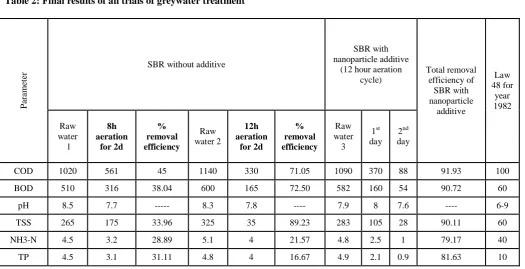
Table 2: Final results of all trials of greywater treatment
Paramet
er
SBR without additive
SBR with nanoparticle additive
(12 hour aeration cycle) Total removal efficiency of SBR with nanoparticle additive Law 48 for year 1982 Raw water 1 8h aeration for 2d % removal efficiency Raw water 2 12h aeration for 2d % removal efficiency Raw water 3 1st day 2nd day
COD 1020 561 45 1140 330 71.05 1090 370 88 91.93 100
BOD 510 316 38.04 600 165 72.50 582 160 54 90.72 60
pH 8.5 7.7 --- 8.3 7.8 ---- 7.9 8 7.6 ---- 6-9
TSS 265 175 33.96 325 35 89.23 283 105 28 90.11 60
NH3-N 4.5 3.2 28.89 5.1 4 21.57 4.8 2.5 1 79.17 40
TP 4.5 3.1 31.11 4.8 4 16.67 4.9 2.1 0.9 81.63 10
Generally, raw greywater showed higher average values of physicochemical and bacterial parameters than the permissible limits of treated wastewater re-use in irrigation purposes according to the Egyptian guidelines.
3.2.1 Chemical oxygen demand
The experiment result with SBR system indicates that the removal efficiency of chemical oxygen demand (COD) was
increased significantly from the first run to the second run to the third run. Raw greywater showed high concentrations of organic matter fraction expressed as COD and BOD, which derives primarily from home processes. The obtained results in Table (2) showed that industrial wastewater had a relatively high average concentration of COD (1020-1140 mg/l). During the total operational period, high COD removal was achieved in the system by applying the third trial of adding the nanoparticles additives with 4 mg/l concentration to the greywater and using a 12-hour aeration cycle and the removal efficiency approaches to 91.93%. In other studies, a less removal efficiency for COD by applying only SBR treatment method (Abubakar et al., 2016). The increase in COD concentrations might indicate the presence of anions (chloride) used in disinfectants and cations such as sodium used in soaps.
3.2.2 Biological oxygen demand
Wastewater consists of a mix of organic and inorganic matters. Organic maters sit down with molecules that are based on carbon and include excretion. These large organic molecules are breaking down by bacteria aerobic or anaerobic types. However, oxygen is required for this process of breaking large molecules into smaller molecules and eventually into carbon dioxide and water. The amount of oxygen needed for this procedure named the biochemical oxygen demand. Biological oxygen demand (BOD)removal efficiency approach to 90.72% while applying the third trial of adding the nanoparticle additives with 4 mg/l concentration to the greywater and using a 12-hour aeration cycle. Treatment of greywater through the use of SBR process has been reported by many research workers (Lamine et al., 2007). In this study, the BOD5 concentration of effluent is less than achieved in this study.
3.2.3 Total suspended solids
solids in an overwater body is also correlated with higher levels of bacteria, nutrients, chemicals and metals in water. The major problem with the use of recycled water is that standards for microbial content are usually supported by the potential risk to human health. Several researcher staff have documented treatment of greywater by using an SBR method (Lamine et al., 2007) in this area, the TSS effluent concentration is lower than that obtained in this study.
3.2.4 Ammonia-nitrogen (NH3-N)
The data were obtained by taking samples of the effluent and analyzed for the efficiency of removal. The transformation of ammonia into nitrite and nitrate was found to have occurred successfully in the course of treatment with SBR. The removal efficiency of 79.17 percent is achieved. The entire nitrification process necessitates oxygen. Nitrification is accounted for by aerobic autotrophic bacteria, where Nitrification is the biological oxidation of ammonia or ammonium to nitrite followed by nitrite oxidation to nitrate. The transformation of ammonia into nitrite is sometimes the nitrification step that limits its rate. Nitrification in the soil is a critical step in the organic cycle. In other research, removal efficiency is achieved by using the same type of treatment with SBR (Lamine et al., 2007).
3.2.5 Total phosphorus
Phosphorus found in the wastewater is neither a hazard nor a toxic substance. Phosphorus, on the other hand, can be a component of many living cell structures as well as the metabolism of plants and animals. Phosphorus has been found in the most highly oxidized forms of sewage. Phosphorus may be a significant problem, however, because it is generally a limiting factor for the evolution of organisms in the aquatic environment. Total phosphorous removal is an average of 81.63 percent. Where the total phosphorus (TP) value varied from 4.9-0.9 mg / l after the 12-hour aeration cycle with the addition of nanoparticles to the treatment cycle, however, it has been noted that the value of raw industrial wastewater TP varies from 4.5-4.9 mg / l, which is lower than the law limiting the re-use of treated water for irrigation purposes. In other studies, 52% of the removal efficiency is achieved by applying the SBR treatment method (Abubakar et al . , 2016).
4. CONCLUSION
Sequencing Batch Reactor (SBR) is an available treatment technology for greywater, mainly where limited space restricts the use of other biological methods. According to the results achieved by the experimental program, it is concluded that:
The raw Greywater sample has high polluted properties due to the laundry and dishwashing machine wastewater.
Using biological treatment by SBR without additive and using air blower for 8 hours reduces the water properties by
an overall percentage of 35.4%.
Using biological treatment by SBR without additive and using air blower for 12 hours reduces the water properties by
an overall percentage of 54.2%.
Using biological treatment by SBR without additive and using air blower for 12 hours reduces the water properties
more than 8 hours cycle.
Using biological treatment by SBR with nanoparticles additive with a dose of 4 mg/l and using air blower for 12
hours reduces the water properties by an overall percentage of 86.71%.
A comparison was made between the results of the different stages used in greywater treatment and the Egyptian
standards for irrigation or disposal in drains.
The final results of the treated greywater by using INNPT with 12-hour aeration were less than the Egyptian standards
of treated water for irrigation purposes.
From the obtained results, it is concluded that it is necessary to use INNPT additive to greywater because the final
properties of treated greywater were matching with the Egyptian specification of treated water for irrigation purposes.
REFERENCES
Abubakar, S., Latiff, A. A., Lawal, I. M., & Jagaba, A. H. (2016). Aerobic treatment of kitchen wastewater using sequence
batch reactor (SBR) and re-use for irrigation landscape purposes. Am J Eng Res, 5(5), 23–31.
Ajit, K. (2016). A review on grey water treatment and re-use. International Research Journal of Engineering and Technology
Al-Jayyousi, O. R. (2003). Greywater re-use: towards sustainable water management. Desalination, 156(1–3), 181–192.
Association, A. P. H., Association, A. W. W., Federation, W. P. C., & Federation, W. E. (2010). Standard methods for the
examination of water and wastewater. American Public Health Association.
Boyjoo, Y., Pareek, V. K., & Ang, M. (2013). A review of greywater characteristics and treatment processes. Water Science
and Technology, 67(7), 1403–1424.
Christova-Boal, D., Eden, R. E., & McFarlane, S. (1996). An investigation into greywater re-use for urban residential
properties. Desalination, 106(1–3), 391–397.
do Couto, E. de A., Calijuri, M. L., Assemany, P. P., da Fonseca Santiago, A., & Lopes, L. S. (2015). Greywater treatment in
airports using anaerobic filter followed by UV disinfection: an efficient and low cost alternative. Journal of Cleaner
Production, 106, 372–379.
Eriksson, E., Andersen, H. R., Madsen, T. S., & Ledin, A. (2009). Greywater pollution variability and loadings. Ecological
Engineering, 35(5), 661–669.
Eriksson, E., Auffarth, K., Henze, M., & Ledin, A. (2002). Characteristics of grey wastewater. Urban Water, 4(1), 85–104.
Fatta-Kassinos, D., Kalavrouziotis, I. K., Koukoulakis, P. H., & Vasquez, M. I. (2011). The risks associated with wastewater
re-use and xenobiotics in the agroecological environment. Science of the Total Environment, 409(19), 3555–3563.
Lamine, M., Bousselmi, L., & Ghrabi, A. (2007). Biological treatment of grey water using sequencing batch reactor.
Desalination, 215(1–3), 127–132.
Mahmoud, U. F., Mostafa, S. A., Ali, M. N., & Mostafa, A. H. (2018). Application of Nanoparticles with Sequencing Batch
Reactor for the Treatment of Landfill Leachate. AJBAS) Australian Journal of Basic and Applied Sciences, 12(2), 24–
30.
Nolde, E. (2000). Greywater re-use systems for toilet flushing in multi-storey buildings--over ten years experience in Berlin.
Urban Water, 1(4), 275–284.
Pavithra, S., & Shanthakumar, S. (2017). Removal of COD, BOD and color from municipal solid waste leachate using silica