Volume 58 (2013)
Proceedings of the
12th International Workshop on Graph Transformation
and Visual Modeling Techniques
(GTVMT 2013)
Analysis of Hypergraph Transformation Systems in A
GGbased on
M
-Functors
Maria Maximova, Hartmut Ehrig and Claudia Ermel
13 pages
Guest Editors: Matthias Tichy, Leila Ribeiro
Managing Editors: Tiziana Margaria, Julia Padberg, Gabriele Taentzer
Analysis of Hypergraph Transformation Systems in A
GGbased on
M
-Functors
Maria Maximova, Hartmut Ehrig and Claudia Ermel
Institut f¨ur Softwaretechnik und Theoretische Informatik Technische Universit¨at Berlin, Germany
[email protected], [email protected], [email protected]
Abstract: Hypergraph transformation systems are examples ofM-adhesive trans-formation systems based on M-adhesive categories. For typed attributed graph transformation systems, the tool environment AGGallows the modelling, the simu-lation and the analysis of graph transformations. A corresponding tool for analysis of hypergraph transformation systems does not exist up to now. The purpose of this paper is to establish a formal relationship between the correspondingM-adhesive transformation systems, which allows us the translation of hypergraph transforma-tions into typed attributed graph transformatransforma-tions with equivalent behavior, and, vice versa, the creation of hypergraph transformations from typed attributed graph trans-formations. This formal relationship is based on the general theory ofM-functors between differentM-adhesive transformation systems. We construct a functor be-tween theM-adhesive categories of hypergraphs and of typed attributed graphs, and show that our construction yields anM-functor with suitable properties. We then use existing results for M-functors to show that analysis results for hypergraph transformation systems can be obtained using AGG by analysis of the translated
typed attributed graph transformation system. This is shown in general and for a concrete example.
Keywords: M-adhesive transformation system, graph transformation, hypergraph transformation,M-adhesive category,M-functor, critical pair analysis, AGG
1
Introduction
In the theory of graph transformation, various related approaches exist.Hypergraphshave shown to be appropriate e.g. for evaluation of functional expressions since they allow a function with narguments to be modelled by an hyperedge with one source node andntarget nodes [Plu93]. Other applications are distributed systems [BCK02] and diagram representation [Min00].
In our previous paper [MEE11], we have proposed formal criteria ensuring a semantical cor-respondence of reconfigurable Petri nets and their corresponding representations as graph trans-formation systems. The aim of our previous work was to establish a formal basis allowing us to translate Petri net transformations into graph transformations and, vice versa, to create Petri net transformations from graph transformations such that the behavior of Petri net transformations can be simulated by simulating their translation using the graph transformation tool AGG.
In [MEE11], we established the new framework ofM-functorsF:(C1,M1)→(C2,M2)
be-tweenM-adhesive categories. This framework allows to translate transformations in(C1,M1)
into corresponding transformations in (C2,M2) and, vice versa, to create transformations in (C1,M1)from those in(C2,M2).
Building on this previous work, we have extended this framework in [MEE12] to allow the analysis of interesting properties like termination, local confluence and functional behavior, in addition to parallel and sequential independence, using the corresponding results and analysis tools like AGGfor graph transformation systems.
Hence, in this paper we define anM-functorFHG:(C1,M1)→(C2,M2), where(C1,M1)
are hypergraphs and (C2,M2) typed attributed graphs. In our main results, we show that the
functorFHGsatisfies all the properties required by the general framework to guarantee the
trans-fer, i.e., translation and creation of transformations and local confluence. This allows us in par-ticular to apply the well-known critical pair analysis for typed attributed graph transformations supported by the AGG-tool [AGG12] to analyse these properties for hypergraph transformations. In contrast to previous instantiations ofM-functors in [MEE11], we do not have to restrict our functor to injective morphisms.
The paper is structured as follows: Section 2 introduces the basic notions of M-adhesive transformation systems andM-functors to define a formal relationship between two different M-adhesive categories. In Section 3, we construct the functorFHG between hypergraph and
typed attributed graph transformation systems, and show that this functor satisfies the proper-ties of M-functors and some additional properties that are required in the general theory. In Section 4, we study theF-transfer of local confluence by analysingF-reachable critical pairs and show that theM-functorFHG fromSection 3satisfies the required properties. The result
is used inSection 5to analyse a hypergraph transformation system using AGGon the functorial
translation of the system. InSection 6, we compare our approach to related work, conclude the paper and give an outlook to future research directions. Detailed proofs are given in [MEE13].
2
M
-Adhesive Categories, Transformation Systems,
M
-Functors
M. The VK-property means that the top face is a PO iff the front faces are PBs.
A B
C D
A0 B0 C0
D0 m a
b
c
d
Figure 1:M-VK-square The concept of M-adhesive categories generalises that of
ad-hesive [LS04], adhesive HLR, and weak adhesive HLR categories [EEPT06]. The categories of typed attributed graphs, hypergraphs and several categories of Petri nets are weak adhesive HLR (see [EEPT06]) and hence alsoM-adhesive. A set of transformation rules in anM-adhesive category constitutes anM-adhesive trans-formation system [EGH10].
Definition 1(M-Adhesive Transformation System)
Given anM-adhesive category(C,M), anM-adhesive
transfor-mation system AS= (C,M,P)has a setPof productions of the formρ= (L←−l K−→r R)with
l,r∈M. A direct transformationG=ρ⇒,m Hviaρand matchmconsists of two pushouts according
to the DPO approach [EEPT06].
We use the notion of an M-functor [MEE11] to define a formal relationship between two differentM-adhesive transformation systems.
Definition 2(M-Functor)
A functor F :(C1,M1)→(C2,M2) between M-adhesive categories is calledM-functor if
F(M1)⊆M2andF preserves pushouts alongM-morphisms.
Given anM-adhesive transformation systemAS1= (C1,M1,P1), we want to translate
trans-formations fromAS1 toAS2 = (C2,M2,P2) with translated productionsP2 =F(P1) and, vice
versa, we want to create transformations inAS1from the corresponding transformations inAS2.
This can be handled byTheorem 1below, shown in [MEE11].
By definition, each M-functor F :(C1,M1)→(C2,M2) translates each production ρ = (L←l K→r R)inP1withl,r∈M1into F(ρ) = (F(L)
F(l)
← F(K)F→(r)F(R))inP2=F(P1)
withF(l),F(r)∈M2and each direct transformationG=ρ⇒,m HinAS1given by DPO(1) + (2)
into a direct transformationF(G)F(ρ=)⇒,F(m)F(H)inAS2given by DPO(3) + (4).
L K R
G D H
(1)
= (=2)
l r
m
⇒
F(L) F(K) F(R)
F(G) F(D) F(H)
(3)
= (=4)
F(l) F(r)
F(m)
Vice versa, we sayF creates direct transformations, if for each direct transformationF(G)
F(ρ),m0
=⇒ H0inAS2there is a direct transformationG
ρ,m
=⇒HinAS1withF(m) =m0andF(H)∼=
H0 leading toF(G)F(ρ=)⇒,F(m)F(H) inAS2. In the following, we provide two conditions in
order to show creation of direct transformations and transformations, i.e., sequences of direct transformations writtenG⇒∗ H.
Theorem 1(Translation and Creation of Transformations)
EachM-functorF :(C1,M1)→(C2,M2)translates (direct) transformations.
• (F creates morphisms): For all m0 :F(L)→F(G) in(C2,M2), there is exactly one
morphism m:L→G withF(m) =m0.
• (F preserves initial pushouts):(C1,M1)has initial pushouts and for each initial pushout (1)over m:L→G, also(2)is initial pushout overF(m)in(C2,M2).
B
(1)
L
C G
b
m
⇒
F(B) (2)
F(L)
F(C) F(G)
F(b)
F(m)
The proof for Theorem 1 is given in [MEE11]. Moreover, it is shown under the same as-sumptions thatFtranslates and creates parallel and sequential independence of transformations. Concerning the definition and the role of initial pushouts for the applicability of productions we refer to [EEPT06,MEE11].
3
M
-Functor from Hypergraphs to Typed Attributed Graphs
Our aim is to construct a functor from hypergraphs to typed attributed graphs to be able to analyse hypergraphs by anlysing typed attributed graphs according to the general theory from [MEE11] and [MEE12]. For this purpose, we review on the one hand the category(HyperGraphs,M1)
of hypergraphs with the classM1of all injective hypergraph morphisms, which is shown to be
M-adhesive in [EEPT06]. On the other hand, we review the category of typed attributed graphs
(AGraphsATG,M2)with the classM2of all injective typed attributed graph morphisms, which
is also shown to beM-adhesive in [EEPT06], and we define a suitable attributed hypergraph type graphAT G=HGT G. Moreover, we construct a functorFHGbetween both categories and
show that the general result fromTheorem 1is applicable to this functor.
Definition 3(CategoryHyperGraphs[EEPT06])
A hypergraphGis defined asG= (VG,EG,sG,tG), whereVGis a set of hypergraph nodes,EGis
a set of hyperedges andsG,tG:EG→VG∗are functions assigning the stringsG(e)of source nodes
resp.tG(e)of target nodes to each hyperedgee.
Consider two hypergraphs G1 = (VG1,EG1,sG1,tG1) and G2 =
(VG2,EG2,sG2,tG2). A hypergraph morphism f :G1→G2 is given by a tuple of functions f = (fV :VG1 →VG2,fE:EG1 →EG2)such that the diagram to the right commutes with source and target functions, i.e., sG2◦ fE= f
∗
V◦sG1 and tG2◦ fE = f
∗
V◦tG1, where f
∗
V :VG∗1 →V
∗ G2 with
λ 7→λ andx1. . .xn7→ fV(x1). . .fV(xn).
EG1
=
VG∗ 1
EG2 V
∗ G2
sG1
tG1
fE fV∗
sG2
tG2
According to [EEPT06], the category(HyperGraphs,M1) of hypergraphs with a classM1
of all injective morphisms isM-adhesive, where pushouts are constructed componentwise. Attributed graphs and morphisms between them form the category
AGraphs, where each object is a pair(G,D)of an E-graphGwith sig-natureE(shown to the right) andΣ-natalgebraD, where in the
follow-ing we only useD=TΣ-nat∼=NAT(with the term algebraTΣ-nat and the
ordinary natural numbers algebraNAT). This means,Gis given by
EG VG
ENA
VD
EEA
sG
tG sNA
tNA sEA
tEA
G= (VGG,VDG,EGG,ENAG ,EEAG ,(sGj,tGj)j∈{G
,NA,EA}), where V G
nodes ofG,EGG,ENAG resp.EEAG are the graph edges resp. node attribute and edge attribute edges ofGandsGj,tGj are corresponding source and target functions for the edges.
The notion of attributed graphs combined with the typing concept leads to the well-known category of typed attributed graphs AGraphsATG, where attributed graphs are typed over an
attributed type graphATG[EEPT06]. Here, we consider a specific type graphHGTGto express hypergraphs as typed attributed graphs, which is shown inFigure 2.1
Node
Edge in:nat out:nat
n2e num:nat e2n
num:nat
Figure 2: Attributed type graphHGTG
The meaning of every depicted element of HGTG is as follows: Nodes of typeNodeandEdgerepresent hypergraph nodes and hyper-edges. Edges of typesn2e,e2nrepresent hyperedge tentacles and are attributed by a numbernumwhich contains the position of a node in the source (resp. target) string of the considered hyperedge. Nodes of typeEdgehave two attributesinandoutgiving the number of nodes in the pre- and postdomain of a hyperedge (to ensure the preserva-tion of anEdgenode’s environment using typed attributed graph mor-phisms). All node and edge attributes are typed over natural numbers. We consider the categoryAGraphsHGTGwith fixed data typeNAT
and identical algebra homomorphism, which implies that the VD
-component of morphisms is the identity.
According to [EEPT06], the category(AGraphsATG,M)isM-adhesive for each type graph
AT G, whereM-morphisms are injective with isomorphic data type part. Hence also the special case of(AGraphsATG,M)withAT G=HGT GisM-adhesive. The subcategory
(AGraphsHGTG,M2) with identical algebra homomorphism as considered above is also M
-adhesive for the subclassM =M2of all injective typed attributed graph morphisms.
We are using the M-functorFHG :(HyperGraphs,M1) →(AGraphsHGTG,M2) defined
below for the translation ofHyperGraphsobjects and morphisms into the corresponding AGraphsHGTGobjects and morphisms.
Definition 4(M-FunctorFHG:(HyperGraphs,M1)→(AGraphsHGTG,M2))
Consider a hypergraphG= (VG,EG,sG,tG). We define the objectFHG(G) = ((G0,NAT),type)2
inAGraphsHGTGwith morphismtype:(G0,NAT)→(HGTG,Df in)and E-graphG0= (VG 0 G ,VG
0
D =
N,EG 0
G,E G0 NA,E
G0 EA,(s
G0 j ,tG
0
j )j∈{G,NA,EA})as follows:
VGG0=VG]EG(graph nodes)
EGG0=EnG20e]EeG20n(graph edges) with
EnG20e={(v,e,n)∈VG×EG×N|snG(e) =v},
EeG20n={(e,v,n)∈EG×VG×N|tGn(e) =v},
wheresnG(e)is then-th node in the stringsG(e)and similar fortGn(e),
ENAG0 =EinG0]EoutG0 (node attribute edges) with
EinG0={(e,n,in)|(e,n)∈EG×N∧ |sG(e)|=n},
1Node and edge attributes are depicted in compact notation as node/edge inscriptions together with their data type. 2In the following, we also use the short notationF
EoutG0 ={(e,n,out)|(e,n)∈EG×N∧ |tG(e)|=n},where|w|is the length ofw,
EEAG0 =EsG0]EtG0 (edge attribute edges) with
EsG0={(n,v,e)∈N×VG×EG|snG(e) =v}3,
EtG0={(n,e,v)∈N×EG×VG|tGn(e) =v}3,
(and the corresponding source and target functions:)
sGG0,tGG0:EGG0 →VGG0 defined by sGG0(x,y,n) =x,tGG0(x,y,n) =y,
sGNA0 :ENAG0 →VGG0,tNAG0 :ENAG0 →N defined by sGNA0 (e,n,x) =e,tNAG0(e,n,x) =n,
sEAG0 :EEAG0 →EGG0,tEAG0 :EEAG0 →N defined by sEAG0(n,x,y) = (x,y,n),tEAG0(n,x,y) =n.
TheAGraphsHGTG-morphismtype:(G0,NAT)→(HGTG,Df in)is given by the final morphism
of data types fromNAT to the final algebraDf in andtypeG 0
:G0→HGTGis given by E-graph morphismtypeG0 = (typeVG,typeVD,typeEG,typeENA,typeEEA), where each component is mapped to the obvious type in the type graphHGT G, e.g.,typeVG:V
G0
G →V
HGTG
G with x7→Node(ifx∈
VG),x7→Edge(ifx∈EG).
For each hypergraph morphism f:G1→G2withf= (fV :VG1→VG2,fE:EG1→EG2), we de-fineFHG(f):FHG(G1)→FHG(G2), where in short notationFHG(Gi) = (VGGi,N,E
Gi
G,E Gi
NA,E Gi
EA, (sGi
j ,t Gi
j )j∈{G,NA,EA})withi∈ {1,2} by FHG(f) = f0= (fV0G,f
0
VD =idN,f
0 EG,f
0 ENA,f
0
EEA)with
fV0 G:V
G1
G →V
G2
G with V
Gi
G =VGi]EGi for i∈ {1,2} by f
0
VG= fV]fE fE0
G:E
G1
G →E
G2
G with E
Gi
G =E
Gi
n2e]E Gi
e2n for i∈ {1,2} by
fE0
G(v,e,n) = (fV(v),fE(e),n) for (v,e,n)∈E
G1
n2e
fE0
G(e,v,n) = (fE(e),fV(v),n) for (e,v,n)∈E
G1
e2n
fE0 NA:E
G1
NA→E
G2
NA with E
Gi
NA=E
Gi
in ]E Gi
out for i∈ {1,2} by
fE0
NA(e,n,x) = (fE(e),n,x) for (e,n,x)∈E
G1
in ]E G1
out ∧ x∈ {in,out}
fE0 EA:E
G1
EA→E
G2
EA with E
Gi
EA=E
Gi
s ]E
Gi
t for i∈ {1,2} similar3to fE0G :E
G1
G →E
G2
G
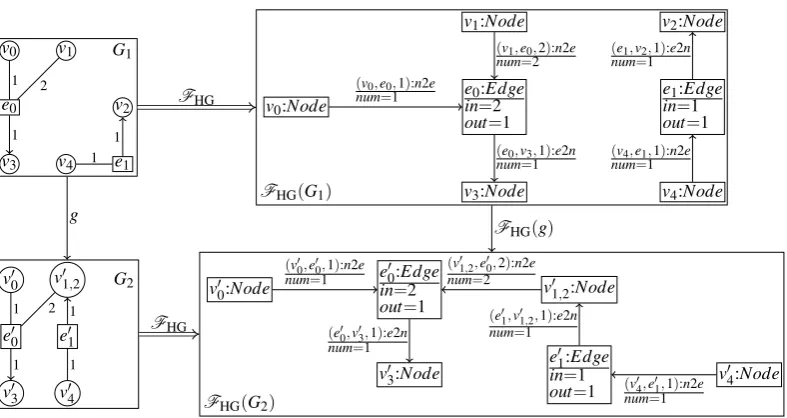
An example for using the functorFHGon objects and morphisms is shown inFigure 3, where
the typed attributed graphs on the right together with the morphism between them are the transla-tion of the corresponding hypergraphs and the morphism on the left. As usual in the hypergraph notation, only the target nodes of a hyperedge are marked by arrows.
Note thatFHGdefined above is a well-definedM-functor in the sense ofDefinition 4. This
includes that the components of FHG(f) are well-defined w.r.t. their codomain and that they
are compatible with source and target functions as well as typing morphisms. FHGis a functor,
becauseFHG preserves identities and composition. Moreover, FHG is anM-functor, because
we have FHG(M1)⊆M2, i.e., FHG preserves injectivity of morphisms, and FHG preserves
pushouts alongM-morphisms (see [MEE13]).
Now we apply the translation and creation of (direct) transformations (see Theorem 1) to theM-functorFHG:(HyperGraphs,M1)→(AGraphsHGTG,M2) leading to our new main
technical result.
3whereEG0
s ∼=EG
0
n2eandEG
0
t ∼=EG
0
v0:Node
v1:Node
FHG(G1)
e0:Edge in=2 out=1
v3:Node v4:Node
e1:Edge in=1 out=1 v2:Node
(v0,e0,1):n2e num=1
(v1,e0,2):n2e num=2
(e0,v3,1):e2n num=1
(v4,e1,1):n2e num=1
(e1,v2,1):e2n num=1
v00:Node v01,2:Node
FHG(G2)
e00:Edge in=2 out=1
v03:Node v04:Node
e01:Edge in=1 out=1
(v00,e00,1):n2e num=1
(v01,2,e00,2):n2e num=2
(e00,v03,1):e2n num=1
(v04,e01,1):n2e num=1
(e01,v01,2,1):e2n num=1 v00 v01,2
e00
v03 e01
v04 G2
1 2
1 1
1 v0 v1
e0
v3 v4 e1 v2 G1 1 2 1 1 1 FHG
FHG(g) g
FHG
Figure 3: Applying functorFHGto two hypergraphs and morphism between them
Theorem 2(Translation and Creation of Transformations between Hypergraphs and Typed At-tributed Graphs)
TheM-functorFHG:(HyperGraphs,M1)→(AGraphsHGTG,M2)translates and creates
di-rect transformations and transformations.
Proof Idea. According toTheorem 1 we have to show that FHG creates morphisms and
pre-serves initial pushouts.
1. (FHG creates morphisms): Given a typed attributed graph morphism f0:FHG(G1)→
FHG(G2), there is a unique hypergraph morphism f :G1→G2 with FHG(f) = f0
de-fined by f = (fV,fE) with fV(v) = fV0G(v) for v∈VG1 ⊆V
G1
G and fE(e) = f 0
VG(e) for e∈EG1 ⊆V
G1
G , whereV G1
G =VG1]EG1 is theVG-component ofFHG(G1). From the mor-phism property of f0we can show that fis a hypergraph morphism withFHG(f) = f0and
FHG(f) =FHG(g)implies f =gand hence uniqueness. The proof is based on the lemma
given in [MEE13] showing that each typed attributed graph morphism f0:FHG(G1)→
FHG(G2)is uniquely determined by itsVG-component fV0G :V
G1
G →V
G2
G .
2. (FHG preserves initial pushouts): Preservation of initial pushouts means that(
Hyper-Graphs,M1)has initial pushouts, which become also initial pushouts in(AGraphsHGTG,
M2)as defined in [EEPT06] after application ofFHG. The construction of initial pushouts
in(HyperGraphs,M1)and their preservation is shown in [MEE13].
4
F
-Transfer of Local Confluence
oneAS2= (C2,M2,F(P))with translated productionsF(P)and, vice versa, under which
con-ditions local confluence ofAS1can be created byFfrom local confluence ofAS2(see [MEE12]). In this case, we speak ofF-transfer of local confluence.
According to [EEPT06], anM-adhesive transformation system(C,M,P) is locally conflu-ent, if for all direct transformations G⇒H1 and G⇒H2 there is an object X together with transformationsH1
∗
⇒X andH2
∗
⇒X. In the case of confluence this property is required for transformationsG⇒∗ H1andG
∗ ⇒H2.
In [MEE12] it is shown under the assumptions of Theorem 1 that AS1 is locally confluent for all transformation spans H1ρ⇐1,m=1 Gρ=2⇒,m2 H2 iff AS2 is locally confluent for all translated transformation spansF(H1)F
(ρ1),F(m1)
⇐= F(G)F(ρ=2),⇒F(m2)F(H2).
A well-known approach for the verification of local confluence is the analysis of critical pairs. A critical pairP1ρ⇐1,=o1 Kρ=2⇒,o2P2 is a pair of parallel dependent transformations with a minimal overlappingKof the left-hand sides of the rules.
Definition 5(F-Reachable Critical Pair)
Given anM-functorF :(C1,M1)→(C2,M2). AnF-reachable critical pair of productions
F(ρ1)andF(ρ2)is a critical pair inAS2of the form
F(R1) F(K1) F(L1) F(L2) F(K2) F(R2)
F(P1) F(N1) F(K) F(N2) F(P2)
F(o1) F(o2) F(l1)
F(r1)
F(v1) F(w1)
F(l2) F(r2)
F(w2) F(v2)
where all morphisms of typeF(A)→F(B) are of the formF(f) for some morphism f : A→B.
Note that for determiningF-reachability of a critical pair, it is sufficient to ensure that the overlapping ofF(L1)andF(L2)is anF-image [MEE12].
ForTheorem 3below we require thatF :(C1,M1)→(C2,M2)iscompatible with pair
fac-torisation. This means, on the one hand, that(Ci,Mi)has pair factorisation based onEi−Mi
-factorisation fori∈ {1,2}. For(C1,M1)this means that each morphism pair(f1:L1→G,f2:
L2→ G) with common codomain can be decomposed uniquely up to isomorphism as (f1 =
m◦e1,f2 =m◦e2) with a pair (e1,e2) of jointly epimorphic morphisms and m∈M1. On
the other hand, it means that F preserves pair factorisation, i.e., for each pair factorisation
(f1=m◦e1,f2=m◦e2)in(C1,M1)also(F(f1) =F(m)◦F(e1),F(f2) =F(m)◦F(e2))
is a pair factorisation in(C2,M2).
Furthermore, we use the Local Confluence Theorem [EEPT06] to analyse whether a givenM-adhesive transformation system is lo-cally confluent. This is the case, if all critical pairsP1
ρ1,o1
⇐=Kρ=2⇒,o2P2
of the given transformation system are strictly confluent. Strictness means intuitively that the largest substructure ofKthat is preserved by the critical pair is also preserved by the merging transformation stepsP1
∗
⇒K0andP2 ∗
⇒K0(see the diagram to the right).
K
P1 P2
K0
ρ1,o1 ρ2,o2
The followingTheorem 3, with the proof in [MEE12], shows thatAS1 is locally confluent if
all F-reachable critical pairs inAS2 are strictly confluent. This is important if in AS2 critical pairs of typed attributed graph transformation systems have to be considered, because they can be detected automatically using the tool AGG.
Theorem 3(Creation of Local Confluence Based onF-Reachable Critical Pairs)
GivenM-adhesive transformation systems AS1= (C1,M1,P), AS2= (C2,M2,F(P))and an
M-functorF:(C1,M1)→(C2,M2)that creates (direct) transformations and morphisms (see Theorem 1 in Section 2) and is compatible with pair factorisation in the sense as discussed before. Then, AS1 is locally confluent for all transformation spans H1
ρ1,m1
⇐= Gρ=2,⇒m2 H2 if all
F-reachable critical pairs ofF(ρ1)andF(ρ2)in AS2are strictly confluent.
Now we apply the results concerning the creation of local confluence based onF-reachable critical pairs to the concreteM-functorFHG :(HyperGraphs,M1)→(AGraphsHGTG,M2).
This is our main conceptual result, allowing us to use AGGfor the analysis of hypergraph
trans-formation systems.
Theorem 4(Local Confluence of Hypergraph Transformation Systems )
Consider theM-functorFHG:(HyperGraphs,M1)→(AGraphsHGTG,M2)fromDefinition 4
in Section 3. A hypergraph transformation system is locally confluent for all transformation spans H1
ρ1,m1
⇐=Gρ=2,⇒m2H2if allFHG-reachable critical pairs ofFHG(ρ1)andFHG(ρ2)are strictly
confluent.
Proof Idea. InTheorem 2(seeSection 3), we have shown thatFHG:(HyperGraphs,M1)→ (AGraphsHGTG,M2) is anM-functor, which creates (direct) transformations and morphisms.
Moreover,FHGis compatible with pair factorisation using theE-M-factorisations(E1,M1)in (HyperGraphs,M1)and(E2,M2)in(AGraphsHGTG,M2), whereE1andE2are the classes of
surjective morphisms. In fact,FHGpreserves coproducts and we haveFHG(E1)⊆E2 such that
we obtain compatibility ofFHG with pair factorisation according to [MEE13]. Altogether, this
allows us to applyTheorem 3withF=FHG.
SinceAGraphsHGTGis the category of typed attributed graph transformation systems, we can
use the tool AGG for critical pair analysis, while it is sufficient for our result to consider only FHG-reachable critical pairs (seeDefinition 5in this section).
5
Analysis of Hypergraph Transformation Systems based on A
GGWe consider a simple distributed system with mobility, inspired by [BCK02], with servers con-nected by channels, and processes moving through the network and running on the servers.
Note that for this example, we use hypergraphs extended by a labelling function for hyper-edges. Objects in this slightly extended category have the form:G= (VG,EG,sG,tG,lG)with the
labelling functionlG:EG→A, whereAis some alphabet. The correspondingM-functor
category of labelled hypergraphs and the extendedM-functorFHG.4
In our distributed system model with mobility, servers, connections and processes are repre-sented as labelled hyperedges. The meaning of the hyperedge labels is as follows: Pdenotes a process before it is executed,Sstands for server, andCfor connection. A running process is rep-resented by labelR. Note that, on the one hand, we simplify the network model in [BCK02] by disregarding firewalls and secure servers; on the other hand, we allow for connections between three servers modelled by hyperedges with three tentacles, and we distinguish between travelling processesPand running processesR.
The hypergraph inFigure 4models a network with four servers, different kinds of connections between them, and two processes. Nodes are depicted as black bullets, while hyperedges are represented by labelled rectangles.
Figure 4: Hypergraph defining a network with distributed processes
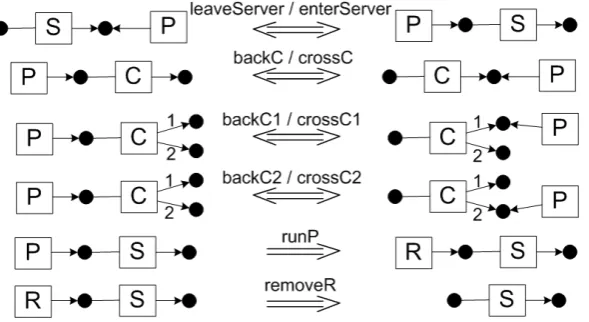
The behaviour of the system is modelled by the hypergraph transformation rules inFigure 5. RulesenterServer [leaveServer]allow a process to enter [leave] a server location. Both rules are inverse to each other (indicated by the double arrow). RulescrossC [backC]model the travelling of a process via a connection. We have different rules for process travelling, depending on the kind of connection hyperedge that is crossed. When a process finally has found a suitable server, it switches into the staterunningby applying the rulerunP. A process that has finished its execution is removed from the system by the ruleremoveR.
Figure 5: Hypergraph transformation rules modelling the behaviour of mobile processes
Applying the M-functor FHG from Definition 4 to this hypergraph transformation system
results in a typed attributed graph transformation system that can be statically analysed using AGG. Figure 6shows anFHG-reachable critical pair for the application of rulesleaveServerand
crossC(depicted in the left part) when their left-hand sides overlap as indicated in the overlapping graph in the right part. The conflict (a delete-use conflict) is obviously caused when a process can “choose” either to leave a server location or to cross a connection channel in the network.
Figure 6: A critical pair detected by AGGfor the rule pair (leaveServer,crossC)
This critical pair is strictly confluent: after applying either rule, we can reverse the effect by applying the corresponding inverse rule and hence have at least one graph which can be derived to join the different results. We can even conclude that the whole transformation system is locally confluent by applyingTheorem 4, showing strict confluence of allFHG-reachable critical pairs.5
Obviously, rules for process travelling can be executed in any order; a step modelling forward travelling and a step modelling the execution of a process can be joined again by performing backward travelling and then executing the process.
6
Related Work and Conclusion
In our previous paper [MEE11] we have developed a general framework to establish a formal relationship between differentM-adhesive transformation systems, showing under which condi-tions transformacondi-tions can be translated and created between differentM-adhesive transformation systems. This result is based on suitable properties ofM-functors between the corresponding M-adhesive categories. In this paper, we construct anM-functor from hypergraphs to typed attributed graphs. We show in our main technical result inTheorem 2(with non-trivial proof in [MEE13]) that the functor satisfies the required properties guaranteeing translation and creation of rule applications, as well as the transfer of local confluence. Moreover, also termination and functional behavior can be transferred according to [MEE12]. This provides us with a general framework to analyse hypergraph transformation systems and allows us by Theorem 4to use
5Note that there are several non-F
HG-reachable critical pairs that do not have to be considered according to
the critical pair analysis of the AGG-tool [AGG12] for typed attributed graphs to analyse con-fluence of hypergraph transformation systems. We demonstrate this by analysing a hypergraph transformation system modelling a distributed system with mobile processes.
A related approach to hypergraph analysis considers causal dependencies modelled by approx-imated unfolding [BCK02,BK02]. The thesis of D. Plump [Plu93] contains already theoretical results about confluence of hypergraph transformation systems, comprising a sufficient condition for local confluence based on critical pairs. But to the best of our knowledge, a tool supporting directly critical pair analysis of hypergraph transformation systems does not yet exist.
A suitable automated detection ofF-reachable critical pairs would be helpful to reduce the analysis effort, and is subject to future work. Furthermore, we will investigate how (nested) ap-plication conditions [HP05] can be handled in this framework in order to consider critical pairs and local confluence of M-adhesive transformation systems with (nested) application condi-tions.
References
[AGG12] TFS-Group, TU Berlin. AGG. 2012.http://www.tfs.tu-berlin.de/agg.
[BCK02] P. Baldan, A. Corradini, B. K¨onig. Static Analysis of Distributed Systems with Mo-bility Specified by Graph Grammars—A Case Study. In Ehrig et al. (eds.), Proc. of Int. Conf. on Integrated Design & Process Technology. SDPS, 2002.
[BK02] P. Baldan, B. K¨onig. Approximating the behaviour of graph transformation systems. InInt. Conf. on Graph Transformation. Pp. 14–29. Springer, 2002. LNCS 2505.
[EEPT06] H. Ehrig, K. Ehrig, U. Prange, G. Taentzer.Fundamentals of Algebraic Graph Trans-formation. EATCS Monographs in Theor. Comp. Science. Springer, 2006.
[EGH10] H. Ehrig, U. Golas, F. Hermann. Categorical Frameworks for Graph Transformation and HLR Systems based on the DPO Approach.EATCS Bulletin102:111–121, 2010.
[HP05] A. Habel, K.-H. Pennemann. Nested constraints and application conditions for high-level structures. In Kreowski et al. (eds.), Formal Methods in Software and Systems Modeling. LNCS 3393, pp. 294–308. Springer, 2005.
[LS04] S. Lack, P. Soboci´nski. Adhesive Categories. InProc. FOSSACS’ 04. LNCS 2987, pp. 273–288. Springer, 2004.
[MEE11] M. Maximova, H. Ehrig, C. Ermel. Formal Relationship between Petri Net and Graph Transformation Systems based on Functors between M-adhesive Categories. In Proc. of 4th Workshop on Petri Nets and Graph Transformation Systems. Volume 40. ECEASST, 2011.http://journal.ub.tu-berlin.de/index.php/eceasst/issue/archive. [MEE12] M. Maximova, H. Ehrig, C. Ermel. Transfer of Local Confluence and Termination
[MEE13] M. Maximova, H. Ehrig, C. Ermel. Analysis of Hypergraph Transformation Sys-tems in AGG based on M-Functors: Extended Version. Technical report 2013/02, TU Berlin, 2013. http://www.eecs.tu-berlin.de/menue/forschung/forschungsberichte/ 2013.
[Min00] M. Minas. Hypergraphs as a Uniform Diagram Representation Model. InProc. 6th Int. Workshop on Theory and Application of Graph Transformations (TAGT’98). LNCS 1764, pp. 281–295. Springer, 2000.