Long-Term Survival Following Aortic
Valve Replacement: The Influence of Age,
Prosthesis-Patient Mismatch and Indexed
Effective Orifice Area
Alexander Manché
1, Aaron A Casha
1,2, Liberato Camilleri
31. Cardiothoracic Surgery Department, Mater Dei Hospital, Malta 2. Faculty of Medicine, University of Malta
3. Department of Statistics and Operations Research, Faculty of Science, University of Malta
Corresponding author: Alexander Manché
Cardiothoracic Surgery Department Mater Dei Hospital, Malta
E mail: [email protected]
Introduction
The concept of prosthesis-patient mismatch was introduced in 1978.[1] PPM occurs when the effective orifice area (EOA) of a prosthesis is too small for the patient’s body size, resulting in excessively high postoperative valve gradients.[2] Independent researchers evaluating valve performance in vivo by echocardiography have underlined the overestimation of EOA
in tables[3,4] issued by valve manufacturers (based on in-vitro testing)[5,6] and this has resulted in revised valve specifications.[7]
Valve design has evolved from intra-annular implantation where the internal orifice diameter is smaller than the tissue annular diameter (TAD) to the introduction of supra-annular implantation where these diameters are equivalent.[8] This feature allows for
Highlights
Background
Prosthesis-patient mismatch (PPM) has been linked to reduced long-term survival after aortic valve replacement. We studied the influence of age, PPM and indexed effective orifice area (iEOA) in this setting.
Methods
Patients (n=586) subjected to aortic valve replacement were followed up for a mean of 7.8 (maximum 20) years. The study population was divided into four equivalent groups by age. Mortality data was extracted from the National Statistics database. Data pertaining to patient body surface area and valve effective orifice area was collected prospectively and mismatch (moderate or severe) was defined according to established values. The Cox proportional hazard model was used to study the effect of age, mismatch and iEOA on survival. The Log Rank test was used to compare survival curves by age groups and date of surgery.
Results
The incidence of moderate PPM was 24.6%, and of severe PPM 3.9%. Mismatch increased the hazard of death by 31.2% for moderate PPM and 70.3% for severe PPM but did not reach statistical significance. Mean age of patients with mismatch (n=167) was 2.52 years less than in those without (63.35±10.61 versus 65.87±11.69, p=0.016). Age significantly affected survival, increasing the risk of death by 7.3% for every incremental year. Mean iEOA was 0.94±0.15cm2/m2; for every 0.1unit increase in iEOA the risk of death decreased by 8.8%.
Conclusions
Long-term survival was significantly affected by age at operation. Although mismatch increased hazard of death the effect did not reach statistical significance. A larger iEOA had a significant beneficial effect on survival.
Keywords: long-term survival; aortic valve replacement; age; prosthesis-patient mismatch; indexed effective orifice area Citation: Manché A, Casha AA , Camilleri L. Long-Term Survival Following Aortic Valve Replacement: The Influence of Age,
Prosthesis-Patient Mismatch and Indexed Effective Orifice Area. International Cardiovascular Forum Journal. 2017; 11: 31-36. DOI: 10.17987/icfj.v11i0.432
* Corresponding author. E-mail: [email protected] ISSN: 2410-2636 ©
supra-annular implantation of a larger valve for a fixed TAD, often of the magnitude of one valve size. Various additional design features such as the TopHat design,[4] a lower-profile sewing ring and external mounting of pericardial tissue contribute to a larger EOA.[9]
The improvements in EOA are based on the premise that inferior haemodynamics result in suboptimal clinical outcomes. Studies have linked PPM with persistent left ventricular hypertrophy, diastolic dysfunction and curtailed functional improvement.[10] Late cardiac complications [11] and accelerated degeneration of bioprostheses have also been reported.[12] However, in the setting of advancing age, the combined effects of these factors on survival remains unclear.[13,14]
Although age undoubtedly increases early and late mortality after aortic valve replacement, the direct effect of mismatch remains debatable.[15-17] We studied the effect of the interaction of age and mismatch as well as the influence of iEOA on long-term survival both as a continuous variable, and as a categorical determinant of moderate or severe PPM.
Methods
586 consecutive patients (61.6% male, mean age 63.6±12.0) undergoing AVR ±CABG between January 1995 and December 2016 in a single-surgeon’s practice were enrolled in the study and grouped according to age: 15-59 (n=148), 60-67 (n=145), 68-74 (n=149), 74 or more (n=144). Patients were excluded if they underwent transcatheter valve implantation or other procedures. Baseline patient characteristics as well as postoperative complications were recorded in the presence or absence of PPM (table 1). Mortality data was obtained from the National Statistics database. Patients were followed up for a mean of 7.8 years (median 7.3) up to a maximum of 20 years. The Hospital Scientific Ethical Committee waived the necessity for consent as the study was retrospective and patient data was anonymized. The study protocol conformed to the ethical guidelines of the 1975 Declaration of Helsinki.
Surgery was performed in a standard fashion under normothermic bypass with antegrade cold cardioplegia. We used the internal thoracic artery supplemented by saphenous vein grafts when additional coronary bypass was necessary. No patient included in this series underwent root enlargement. Ninety three percent of patients below 70 received a mechanical valve whereas 96% of patients over 70 received a bioprosthesis. The choice of valves implanted evolved with the introduction of models with a larger EOA, potentially providing superior haemodynamics (table 2).
No PPM was defined as an indexed effective orifice area (iEOA) of >0.85cm2/m2, moderate PPM as 0.65-0.85cm2/m2 and severe as <0.65cm2/m2, and was calculated according to published data on valve EOA derived from independent researchers’ post-operative echocardiographic studies (table 3).
Statistical Methods
The student’s t-test was used to compare age groups with or without PPM. The Cox proportional hazard model was used to study the impact of age, iEOA and PPM category on long-term survival. Survival analysis was performed using the facilities of the Statistical Package for Social Sciences (SPSS, Inc, Chicago,
IL) by using both a non-parametric approach (Kaplan-Meier estimates) and semi-parametric approach (Cox regression analysis). The Log-Rank (Mantel-Cox) test was used to determine whether the Kaplan Meier survival curves for different age-groups differed significantly at the 0.05 level.
Results
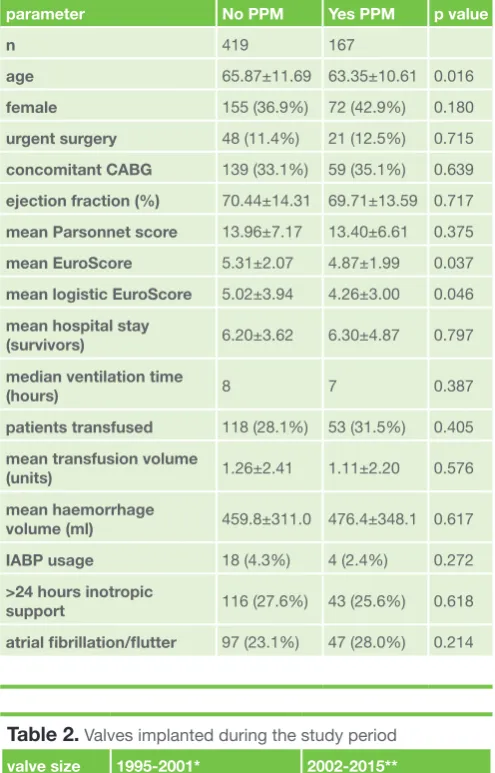
Baseline characteristics and postoperative complications in patients without or with PPM did not differ, except for logistic/ EuroSCORE risk, which was affected by age (table 1).
Table 1.
Baseline patient characteristics and postoperative complicationsparameter No PPM Yes PPM p value
n 419 167
age 65.87±11.69 63.35±10.61 0.016
female 155 (36.9%) 72 (42.9%) 0.180
urgent surgery 48 (11.4%) 21 (12.5%) 0.715
concomitant CABG 139 (33.1%) 59 (35.1%) 0.639
ejection fraction (%) 70.44±14.31 69.71±13.59 0.717 mean Parsonnet score 13.96±7.17 13.40±6.61 0.375
mean EuroScore 5.31±2.07 4.87±1.99 0.037
mean logistic EuroScore 5.02±3.94 4.26±3.00 0.046 mean hospital stay
(survivors) 6.20±3.62 6.30±4.87 0.797
median ventilation time
(hours) 8 7 0.387
patients transfused 118 (28.1%) 53 (31.5%) 0.405 mean transfusion volume
(units) 1.26±2.41 1.11±2.20 0.576
mean haemorrhage
volume (ml) 459.8±311.0 476.4±348.1 0.617
IABP usage 18 (4.3%) 4 (2.4%) 0.272
>24 hours inotropic
support 116 (27.6%) 43 (25.6%) 0.618
atrial fibrillation/flutter 97 (23.1%) 47 (28.0%) 0.214
Table 2.
Valves implanted during the study period valve size 1995-2001* 2002-2015** mechanical19, 21 CarboMedics Reduced CarboMedics TopHat 23 CarboMedics Standard CarboMedics TopHat 25 CarboMedics Standard CarboMedics Standard bioprosthetic
19, 21, 23 Carpentier Edwards Perimount Sorin Mitroflow
25 Carpentier Edwards Perimount Carpentier Edwards Perimount/Magna
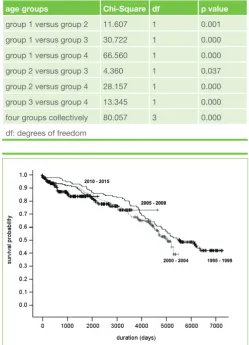
412 of 586 patients were alive at the completion of the study. The survival curves display the Kaplan-Meier survival probabilities for each age group against survival duration (figure 1). The log-rank test show that the Kaplan Meier survival curves of the four age-groups differ significantly when compared pairwise (table 4).
Survival was also plotted and analysed in relation to operative date, in five-year quartiles (figure 2). There was no influence on survival and the incidence of PPM within these quartiles was similar (p = 0.965) (table 5).
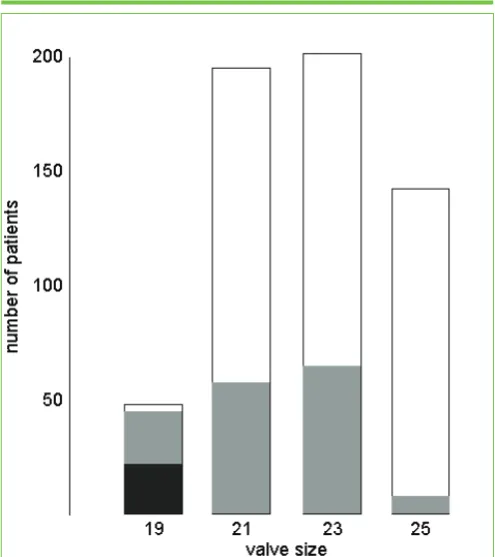
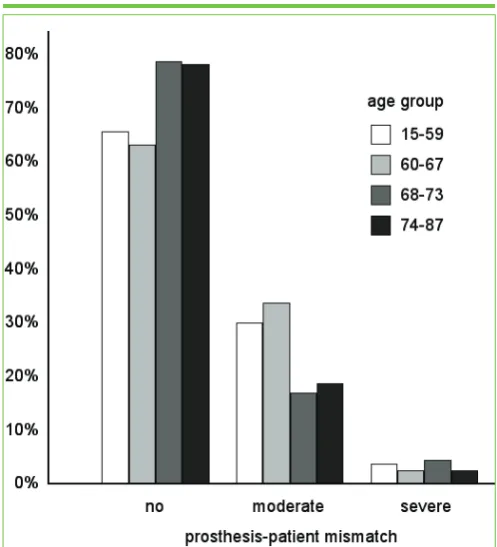
140 patients received a size 25 valve, 202 patients received a size 23, 195 patients received a size 21, and 49 patients received a size 19 valve. The incidence of moderate PPM was 24.6% and severe PPM was 3.9% (figure 3). Mismatch was present in 167 patients and was more prevalent in younger patients. In fact, the mean age of patients with mismatch (63.35±10.61) was 2.52 years lower than their counterparts with no mismatch (65.87±11.69) and this difference is significant (p=0.016) (figure 4).
There was no correlation between PPM and perioperative mortality. There were 11 early deaths (1.9%), and of these, 10 patients had no PPM and one had moderate PPM. Seven patients who died underwent concomitant coronary grafting and 8 were over 70 years old, both recognized risk factors for increased perioperative mortality.
Survival probability was significantly affected by patient’s age with the hazard of dying increasing by around 7.3% for every incremental year. In patients with severe and moderate mismatch the hazards of dying were respectively 70.3% and 31.2% higher compared to patients with no PPM, but the increase was not statistically significant. In patients with mismatch the hazards of dying were 86.5% higher for 19mm valves, 68.7% for 21mm valves and 13.7% for 23mm valves compared to 25mm valves. These hazard ratios are not significant mainly because the incidence of mismatch was low, particularly for the larger valves. (table 6).
Table 3.
EOA valuesvalve model size19EOA size 21EOA size 23EOA size 25EOA reference source*
CarboMedics 1.0 1.54 1.63 1.98 [18,19] Carpentier
Edwards 1.1 1.5 1.8 1.8 [13,20,21]
Sorin Mitroflow 1.2 1.5 1.8 2.3 [13,22,23,24] St Jude Medical
Toronto SPV 1.3 1.5 1.7 [25]
*reference source refers to the publications quoting the EOA values used in this study
Table 4.
Log-Rank (Mantel-Cox) test relating survival time to ageage groups Chi-Square df p value group 1 versus group 2 11.607 1 0.001 group 1 versus group 3 30.722 1 0.000 group 1 versus group 4 66.560 1 0.000 group 2 versus group 3 4.360 1 0.037 group 2 versus group 4 28.157 1 0.000 group 3 versus group 4 13.345 1 0.000 four groups collectively 80.057 3 0.000 df: degrees of freedom
Table 5.
PPM incidence in five-year quartilesperiod No PPM Yes PPM
1995-1999 89 37
70.6% 29.4%
2000-2004 117 49
70.5% 29.5%
2005-2009 93 36
72.1% 27.9%
2010-2015 120 45
72.7% 27.3%
total 419 167
71.5% 28.5%
X2(3) = 0.275, p = 0.965
Figure 1. Kaplan-Meier survival curves for the four age groups
Mean iEOA was 0.94±0.15cm2/m2. When iEOA was analysed as a continuous parameter rather than a categorical parameter, a higher iEOA was associated with a significantly reduced hazard ratio of dying. The chance of survival increased by 8.8% for every 0.1 unit increment in iEOA (table 7).
In conclusion, age was a significant predictor of long-term survival whereas prosthesis-patient mismatch failed to exert a statistically significant effect. This situation applied for both moderate and severe mismatch and for all valve sizes used. In contrast long-term survival was affected by iEOA when this was analyzed as a continuous variable.
Discussion
Cardiac-related mortality was shown to be increased by prosthesis-patient mismatch in a meta-analysis of 34 observational studies published in 2012.[26] This analysis included a number of studies that failed to demonstrate a significant effect of PPM, amongst which were one study [27] with a longer mean follow-up (9.1 vs. 7.8 years) and a second [28] with a comparable follow-up (median of 7.3 vs. 7.3 years) to our study. Both these studies failed to show a significant effect on survival, raising the possibility that a longer follow-up may be salient. The authors stressed the value of preventing PPM, particularly in younger patients in whom long-term survival may be impacted to a greater extent.
The incidence of common postoperative complications was similar in patients with or without PPM. Certain complications have been shown, by multivariate analysis, to affect long-term outcome. [29] In this study risk stratification was higher by logistic (p=0.046) and additive EuroSCORE (p=0.037) in patients without PPM because this group was older by 2.52 years, age being a contributor to the score. The incidence of mismatch is higher in younger patients and this may attenuate its effect on survival. Follow-up duration is inversely proportional to advancing age at operation. Studies with a longer follow-up have failed to demonstrate a deleterious effect of mismatch. The combined effect of a younger age and a longer follow-up may overshadow the importance of mismatch in determining long-term survival. Although mismatch leads to adverse cardiac events its effect on survival is reduced by advancing age.[29] Our results suggest that age, and its direct effect on follow-up duration, significantly affects survival whereas mismatch does not.
A long follow-up necessarily entails evolving practices including the implantation of novel valves that may significantly affect survival. Analysis of survival by operative date, in four five-year quartiles, showed no significant difference in survival in these groups.
When valve haemodynamics are translated into a continuum of iEOA a significant effect on long-term survival becomes evident. This relationship failed to reach statistical significance with mismatch because of the low incidence of moderate PPM, and the very low incidence of severe PPM. All data pertaining to valve EOA was obtained from published studies and not from our own post-operative measurements. These values should be readily available in theatre and act as a guide to the surgeon implanting an aortic prosthesis with the goal of avoiding mismatch. Our study suggests that the largest size valve with the best possible EOA should always be implanted. In extreme circumstances of a small aortic root, enlargement may be performed. However, the increased operative risk of this procedure has not been shown to benefit long-term survival.[30]
Table 7.
Cox regression relating survival time to age and iEOA: parameterestimate SE Wald test df p value Hazard Ratio 95% lower CI higher age 0.0683 0.0082 69.38 1 0.000 1.071 1.054 1.088 iEOA -0.0921 0.0312 8.714 1 0.003 0.912 0.858 0.970 Wald test: used to test the true value of the parameter, based on the sample estimate df: degrees of freedom associated with each parameter estimate
Table 6.
Cox regression relating survival time to age and PPM parameterestimate SE Wald test p value Hazard Ratio 95% lower CI higher age 0.0701 0.0092 58.06 0.000 1.073 1.053 1.092 severe
PPM 0.5324 0.3251 2.682 0.101 1.703 0.901 3.221 moderate
PPM 0.2715 0.2073 1.715 0.190 1.312 0.874 1.969
no PPM 0 1
size 19
PPM 0.6234 0.3584 3.026 0.082 1.865 0.924 3.765 size 21
PPM 0.5232 0.3143 2.771 0.096 1.687 0.911 3.124 size 23
PPM 0.1287 0.2927 0.193 0.660 1.137 0.641 2.019 size 25
PPM 0 1
SE: standard error, CI confidence interval
Limitations
The data was derived from a single surgeon’s practice and may not be representative of a wider population. A change in the use of certain valve models during the study period may have influenced the outcome. The low incidence of mismatch may have been a factor limiting statistical significance.
Conclusion
PPM, whether moderate or severe, did not significantly curtail long-term survival. A larger iEOA increased survival by 8.8% per 0.1 unit increase. Age exerted a significant effect on survival, reducing it by 7.3% for each incremental year.
Declarations of interests
The authors declare no conflict of interest.
Acknowledgements
The authors agree to abide by the requirements of the “Statement of publishing ethics of the International Cardiovascular Forum Journal.[31]
References
1. Rahimtoola SH. The problem of valve prosthesis-patient mismatch. Circulation 1978;58:20-24. https://doi.org/10.1161/01.CIR.58.1.20 2. Zoghbi WA, Chambers JB, Dumesnil JG, Foster E, Gottdiener JS, Grayburn
PA et al. Recommendations for evaluation of prosthetic valves with echocardiography and Doppler ultrasound. J Am Soc Echocardiograph 2009;9:975-1014. http://dx.doi.org/10.1016/j.echo.2009.07.013
3. https://www.sjm.com/en/professionals/featured-products/structural-heart/ mechanical-heart-valves/aortic-and-mitral-valves
4. http://www.livanova.sorin.com/products/cardiac-surgery/aortic/ carbomedics-standard-aortic-valve
5. Pibarot P, Dumesnil JG, Lemieux M, Cartier P, Metras J, Durand LG. Impact of prosthesis-patient mismatch on hemodynamic and symptomatic status, morbidity and mortality after aortic valve replacement with a bioprosthetic heart valve. J Heart Valve Dis 1998;7:211-218.
6. Cohen RG, Bourne ET. Industry-generated charts for the selection of stented aortic valve prostheses: clinical tool or marketing ploy? Ann Thorac Surg 2011;91:1001-1002. http://dx.doi.org/10.1016/j.athoracsur. 2011.01.051
7. Dumesnil JG, Honos GN, Lemieux M, Beauchemin J. Validation and applications of indexed aortic prosthetic valve areas calculated by Doppler echocardiography. J Am Coll Cardiol 1990;16:637-643. http://dx.doi. org/10.1016/0735-1097(90)90355-S
8. Gillinov AM, Blackstone EH, Alster JM, Craver JM, Baumgartner WA, Brewster SA, Kleinman LH, Smedira NG. The CarboMedics Top Hat supra-annular aortic valve: a multicenter study. Ann Thorac Surg 2003;75:1175-1180.
9. Jamieson WR, Koerfer R, Yankah CA, Zittermann A, Hayden RI, Ling H, Hetzer R, Dolman WB. Mitroflow aortic pericardial bioprosthesis – clinical performance. Eur J Cardiothorac Surg 2009;36:818-824. http://dx.doi. org/10.1016/j.ejcts.2009.05.020
10. Pibarot O, Dumesnil JG. Prosthesis-patient mismatch: definition, clinical impact, and prevention. Heart 2006;92:1022-1029. http://dx.doi. org/10.1136/hrt.2005.067363
11. Tasca G, Mhagna Z, Perotti S, Centurini PB, Sabatini T, Amaducci A, Brunelli F, Cirillo M, Dalla Tomba M, Quaini E, Troise G, Pibarot P. Impact of prosthesis-patient mismatch on cardiac events and midterm mortality after aortic valve replacement in patients with pure aortic stenosis. Circulation 2006;113:570-576. http://dx.doi.org/10.1161/ CIRCULATIONAHA.105.587022
12. Flameng W, Herregods MC, Vercalsteren M, Herijgers P, Bogaerts K, Meuris B. Prosthesis-patient mismatch predicts structural valve degeneration in bioprosthetic heart valves. Circulation 2010;121:2123-2129. http://dx.doi. org/10.1161/CIRCULATIONAHA.109.901272
13. Pibarot P, Dumesnil JG. Hemodynamic and clinical impact of prosthesis-patient mismatch in the aortic valve position and its prevention. J Am Coll Cardiol 2000;36:1131-1141. http://dx.doi.org/10.1016/S0735-1097(00)00859-7
14. Blackstone EH, Cosgrove DM, Jamieson WR, Birkmeyer NJ, Lemmer JH jr, Miller DC, Butchart EG, Rizzoli G, Yacoub M, Chai A. Prosthesis size and long-term survival after aortic valve replacement. J Thorac Cardiovasc Surg 2003;126:783-796. http://dx.doi.org/10.1016/S0022-5223(03)00591-9 15. Asimakopoulos G, Edwards MB, Taylor KM. Aortic valve replacement in
patients 80 years of age and older. Survival and cause of death based on 1100 cases: Collective results from the UK Heart Valve Registry. Circulation 1997;96:3403-3408. http://dx.doi.org/10.1161/01. CIR.96.10.3403 16. Brennan JM, Edwards FH, Zhao Y, O’Brien SM, Douglas PS, Peterson
ED on behalf of the Developing Evidence to Inform About Effectiveness – Aortic Valve Replacement (DEcIDE AVR) research team. Long-term survival after aortic valve replcement among high-risk elderly patients in the United States. Insights from the Society of Thoracic Surgeons Adult Cardiac Surgery Database, 1991 to 2007. Circulation 2012;126:1621-1629. http:// dx.doi.org/10.1161/CIRCULATIONAHA.112.091371
17. Mrowczynski W, Lutter G, Attmann T, Hoffmann G, Quaden R, Cremer J, Boning A. Does patient-prosthesis mismatch influence the results of combined aortic valve replacement and coronary bypass grafting? Kardiol Pol 2009;67:865-873.
18. Chambers J, Cross J, Deverall P, Sowton E. Echocardiographic description of the CarboMedics bileaflet prosthetic heart valve. J Am Coll Cardiol 1993;21:398-405. http://dx.doi.org/10.1016/0735-1097(93)90681-P 19. Mosquera VX, Bouzas-Mosquera A, Bautista-Hernandez V,
Estévez-Cid F, Herrera-Noreña JM, Alvarez-García N, Cuenca-Castillo JJ. The CarboMedics supra-annular Top Hat valve improves long-term left ventricular mass regression. J Thorac Cardiovasc Surg 2014;148:2845-2853. http://dx.doi.org/10.1016/j.jtcvs.2014.06.082
20. Wiseth R, Levang DW, Sande E, Tangen G, Skjaerpe T, Hatle L. Hemodynamic evaluation by Doppler echocardiography of small (≤21mm) prostheses and bioprostheses in the aortic valve position. Am J Cardiol 1992;70:240-246.
21. Botzenhardt F, Eichinger WB, Guenzinger R, Bleiziffer S, Wagner I, Bauernschmitt R, Lange R. Hemodynamic performance and incidence of patient-prosthesis mismatch of the complete supraannular perimount magna bioprosthesis in the aortic position. The Thoracic and Cardiovascular Surgeon 2005;53:226-230. http://dx.doi.org/10.1055/s-2005-837678 22. Bleiziffer S, Eichinger WB, Hettich IM, Ruzicka D, Badiu CC, Guenzinger
R, Bauernschmitt R, Lange R. Hemodynamic characterization of the Sorin Mitroflow pericardial bioposthesis at rest and exercise. J Heart Valve Dis 2009;18:95-100.
23. Jamieson WR, Koerfer R, Yankah CA, Zittermann A, Hayden RI, Ling H, et al. Mitroflow aortic pericardial bioprosthesis – clinical performance. Eur J Cardiothorac Surg 2009;36:818-824. http://dx.doi.org/10.1016/j. ejcts.2009.05.020
24. Yankah CA, Pasic M, Musci M, Stein J, Detschades C, Siniawski H, Hetzer R. Aortic valve replacement with the Mitroflow pericardial bioprosthesis: durability results up to 21 years. J Thorac Cardiovasc Surg 2008;136:688-696. http://dx.doi.org/10.1016/j.ejcts.2008.05.022
25. Del Rizzo DF, Goldman BS, Christakis GT, David TE. Hemodynamic benefits of the Toronto stentless valve. J Thorac Cardiovasc Surg 1996;112:1431-1445. http://dx.doi.org/10.1016/S0022-5223(96)70001-6
26. Head SJ, Mokhles MM, Osnabrugge RL, Pibarot P, Mack MJ, Takkenberg JJ, Bogers AJ. The impact of prosthesis-patient mismatch on long-term survival after aortic valve replacement: a systematic review and meta-analysis of 34 observational studies comprising 27186 patients with 133141
patient-years. Eur Heart J 2012;33:1518-1529. http://dx.doi.org/10.1093/ eurheartj/ehs003
27. Tsutsumi K, Nagumo M, Nishikawa K, Takahashi R. Effect of prosthesis-patient mismatch on survival after aortic valve replacement using mechanical prostheses in patients with aortic stenosis. Gen Thorac Cardiovasc Surg 2008;56:577-583. http://dx.doi.org/10.1007/s11748-008-0317-9
28. Frapier JM, Rouviere P, Razcka F, Aymard T, Albat B, Chaptal PA. Influence of patient-prosthesis mismatch on long-term results after aortic valve replacement with a stented bioprosthesis. J Heart Valve Dis 2002;11:543-551.
29. Manché A, Camilleri L, Gauci D. Dies aortic valve replacement restore normal life expectancy: a twenty-year relative survival study. International Cardiovascular Forum Journal 2016;6:46-53. http://dx.doi.org/10.17987/ icfj.v6i0.138
30. Kulik A, Al-Saigh M, Chan V, Masters RG, Bedard P, Lam BK, et al. Enlargement of the small aortic root during aortic valve replacement: is there a benefit? Ann Thorac Surg 2008;85:94-100. http://dx.doi.org/10.1016/j. athoracsur.2007.07.058