URIDINE AS PHOTOCHEMICAL ACTINOMETER:
APPLICATION TO LED-UV FLOW REACTORS
Franco Cataldo
[a]*Keywords: actinometry; uridine; UV-LED; flow reactors; photochemistry.
Two LED-UV based photochemical flow reactors have been compared. One was a commercially available LED-UV flow reactor designed for water disinfection or sterilization and the other one was a home-made LED-UV flow reactor designed for analogous purposes. The photochemical performances of two mentioned flow reactors working both at about 275 nm were evaluated using uridine actinometry through the determination of the pseudo-first order kinetics rate constant of uridine photolysis and through the measurement of the incident light I absorbed by the actinometer solution. From these data, the energy released to the solution by the LED-UV sources was determined. Furthermore, a third LED-UV reactor working at 360 nm was evaluated with uridine actinometer. As expected in the latter case uridine was not photolyzed and the reactor was found unsuitable for water disinfection.
* Corresponding Authors
E-Mail: [email protected]
[a] Actinium Chemical Research Institute, Via Casilina 1626A, 00133 Rome, Italy
Introduction
The consolidated technology of laboratory photochemical reactors is based on the application of low-pressure mercury lamps submerged in a batch reactor where the reaction mixture to be irradiated is kept in the gap between the quartz lamp walls and the glass walls of the reactor.1,2 This scheme was also adapted to the batch-wise production of chemicals on an industrial scale or the batch-wise wastewater treatment.3 For continuous processes, photochemical flow reactors are designed around submerged mercury lamps.2 Other types of advanced design is already applied in the case of photochemical flow reactors.4 Low-pressure mercury lamps are characterized by relatively low cost and long duty and an almost monochromatic emission at 253.7 nm.1,2 Drawbacks in the mercury lamps regard their fragility, the release of mercury into the environment in case of accidental breaking or in case of uncontrolled disposal of exhausted lamps. Furthermore, the silica walls of the mercury lamps show a tendency to darken with the continuous use.1,2 Medium and high-pressure mercury lamps are instead characterized by a polychromatic emission and large part of the input energy is lost in the visible where most of the photochemical reactions do not occur.1,2 Therefore, the application of these lamps is limited. Alternatives to mercury-based lamps involve xenon-arc lamps and excimer lamps.2 However, the former has little emission in the UV while the excimer lamps are interesting with monochromatic radiation in the UV-C or also the vacuum-UV (i.e. λ< 190 nm). The excimer lamp technology, although promising, remains a complex, expensive and not fully reliable technology and is relegated to niche applications, although the improvements are coming fast in this field also.2,5,6
A solid alternative to the mercury lamp is represented by the LED-UV (Light Emitting Diodes in the UV). These devices are essentially solid-state semiconductor-based systems which, when appropriately designed and electrically powered, are able to transform electric current in photons.7
Commercially-diffused LEDs are able to emit light in the visible and are characterized by a very long life of the order of 25000-100000 h, against only 1500-8000 h of mercury vapor lamps.2,7,8-10 In addition, LEDs are very low energy-consuming systems. For example, a common 4000 Lumen visible light source requires 300 W from a classic incandescent bulb with tungsten filament, about 100-200 W with modern compact fluorescence lamps and only 40 W from a LED source.9,10 In addition, the LEDs are compact, resistant to shock and vibrations and therefore far superior to mercury vapor lamps even because their emission intensity can be modulated within certain limits by the current intensity, a possibility which is not applicable to the traditional mercury vapor lamps. Despite the wide diffusion of LED light sources for visible lighting, the LED sources which are able to emit in the UV have become available in the market only very recently. These LED-UV sources are based on semiconductor materials made of gallium-aluminum nitrides or gallium-indium-gallium-aluminum nitrides, through which it is possible to approach or reach the wavelengths normally emitted by low-pressure mercury vapor sources, the UV-C, which is the wavelength range commonly used for photochemical reactions and water disinfection.7-10
similar conclusions on the bactericidal action of UV light on
E. coli, indicating the range between 265 and 275 nm as the most effective in sterilization or disinfection of water.11 Furthermore, the LED-UV technology allows even the choice of most suitable LED-UV for irradiating any organic substance to convert it photochemically. Therefore, to work up to 240 nm, it is suggested to select UV-LEDs of the AlGaInN type available in various versions.8-10 For irradiation to 235 nm, there are available LED-UV based on a suitably doped diamond. 8-10 To irradiate up to 215 nm are available LED-UV based on boron nitride. 8-10 Finally, to reach 210 nm, LED- UV based on aluminum nitride can be used. 8-10
As explained in the experimental section, in this study two different LED-UV based reactors were used. The first one was a commercially available flow reactor from Aquisense Technologies with diodes emitting in the range comprised between 265 and 285 nm, a range suitable for water disinfection and sterilization. Furthermore, a home-made reactor was designed and built using three LED-UV emitting at 275 nm with 10 mW power each. To test the photochemical efficiency of these two photochemical reactors, use was made of uridine actinometer.12,13 The UV irradiation of a dilute solution of uridine affords practically a single photoproduct, the photohydrate of uridine as shown in scheme 1. The uridine photoproduct does not absorb light at 260 nm (in contrast to the parent molecule) and is stable for very long time in aqueous solution at pH = 7 and 20 °C.14
Scheme 1. Formation of uridine photohydrate on irradiation of uridine with UV light.
Flow photochemistry was thoroughly reviewed in recent times.16-18 The increasing availability of LED-UV has propelled their application in flow photochemistry of small and even micro-reactors.16-18 Furthermore, the LED-UV technology has also found application in water disinfection.19-20 What is lacking or is remained behind in this flourishing field is the simple evaluation of the photochemical efficiency of these LED-UV based photochemical reactors. A need that was highlighted in a recent paper.21 Consequently, in the present paper, the uridine actinometer was employed in the evaluation of the photochemical efficiency of two LED-UV reactors, one of them was commercially available and purchased fully assembled while the other was assembled in a simple building scheme in our laboratory.
Experimental
Materials and equipment
Uridine was purchased from Sigma-Aldrich. A commercial photochemical reactor for water disinfection was purchased from Aquisense Technologies, model
PearlAqua 6D with the emission of the LED-UV in the UV-C range (265-285 nm). This lamp is working with water flow rate of 1.8 L min-1. The input power is 12 V (DC) and the power consumption 8 W. Lamp life is granted for >10000 h. Another commercial photochemical reactor was purchased from Novaquashop.com. The reactor was made of PMMA and it was equipped with an LED-UVA lamp powered at 3W and emitting at 360 nm.22
To construct the home-made LED-UV photochemical reactor, working in the UV-C range, commercial LED-UV were purchased from LG-Innotek. The selected LED-UV are of type 8686 emitting at 275 nm with 10 mW power each. The typical electric current used for these diodes was 111 mA with a radiant flux of 1.1 a.u. each. We used 3 LED-UV diodes 10mW each, mounted on three adjacent faces inside a polished aluminum cube. Polite aluminum has been chosen as the ultimate reflection material for ultraviolet radiation.2 On the fourth face of the cubic reactor a UV photodiode was mounted to detect the amount of light emitted by the diodes to check and confirm their service. Under normal operating conditions at 111 mA, the photodiode gave an indicative signal of about 200 Lux. Initially, inside the cubic reactor along with three LED-UV and a photodiode, a spherical quartz reactor having a volume of 1.26 ml equipped with inlet and outlet piping was inserted. It was fed with distilled water at a rate of 23 mL min-1.
Later, the quartz reactor was replaced by perfluoropolymer piping (Teflon-FEP) which is transparent to UV radiation and which overcomes the fragility of the quartz reactor. Thus, the Teflon-FEP piping was installed in order to be irradiated by the three adjacent LED-UV diodes. UV-LEDs are not in contact with the substances or water to be irradiated because they are made to flow into perfluoropolymer pipes which are known to be highly inert from the chemical and health point of view, eliminating corrosion and dirt problems This facilitates the maintenance of the reactor for the rapid replacement of perfluoropolymer pipes or the external UV-LEDs.
Uridine irradiation in the Aquisense Technologies reactor (UV-C at about 275 nm)
A uridine solution in distilled water (50.0 mg L-1) was loaded in the photochemical reactor and in the pipes connecting to the peristaltic pump and an expansion vessel. A total volume of 122 ml of the uridine solution was used. At the beginning of the irradiation 62 ml of the uridine solution was loaded into the expansion vessel and other 60 ml into the pipes and in the reactor. The uridine solution was circulated from the expansion vessel to the reactor and back to the expansion vessel using a peristaltic pump working at 30 mL min-1. Periodically a sample of the uridine solution was collected and checked spectrophotometrically for its absorbance at about 262 nm. In this run, the LED-UV irradiation was prolonged for 90 min. A decay of the uridine absorbance at 262 nm was treated according to pseudo-first chemical kinetics law, so that a photolysis rate constant could be determined (see the Results and Discussion section). The irradiation was repeated thrice with freshly prepared uridine solution and similar photolysis rate constant values were obtained.
O
OH HO
OH N NH
O
O
N NH
O O
HO O OH
HO OH H2O
Uridine irradiation in the home-made photochemical reactor (UV-C at 275 nm)
The home-made reactor was used directly in the configuration with Teflon-FEP pipes also in the UV-irradiation chamber. A total volume of about 100 ml of uridine solution in distilled water (48.8 mg L-1) was loaded into the pipes, the reactor, and the expansion vessel. The uridine solution was circulated in the system through the use of a peristaltic pump working at 30 mL min-1. Also, in this case, the irradiated uridine solution was periodically sampled and checked spectrophotometrically for its absorbance at 262 nm. The absorbance decay as the function of the irradiation time was treated according to the pseudo-first order kinetics law, determining the photolysis rate constant.
Uridine irradiation in the Aquashop reactor (UV-A at about 360 nm)
The photochemical reactor, the circuit, and the expansion vessel were loaded with 150 ml of uridine solution in distilled water (1.9 mg L-1). The solution was pumped in the circuit through the reactor at 30 mL min-1 using a peristaltic pump. Periodically the uridine solution was sampled and checked spectrophotometrically. However, even after 4 h irradiation, no change in the uridine concentration was detected. This result was expected since the uridine is not absorbing at 360 nm and therefore the uridine photolysis was not achieved.
Results and Discussion
Uridine photolysis with the Aquisense Technologies LED-UV reactor (UV-C at about 275 nm)
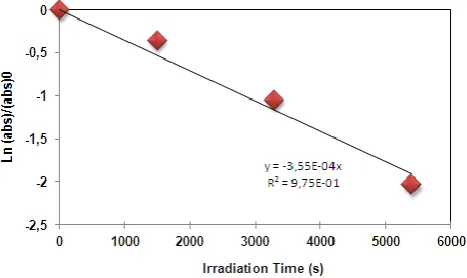
Uridine is characterized by an absorption maximum at about 262 nm in neutral water as shown in figure 1. To photolyze uridine, it is necessary that the UV light source used emits in the wavelengths corresponding to its absorption maximum. The commercial Aquisense Technologies LED-UV reactor employed in the present work is reported by specification to emit in the range comprised between 265 and 285 nm. As shown in figure 1, the LED-UV irradiation of the uridine solution causes a reduction in the intensity of the absorption band at 262 nm as a function of the irradiation time at the flow rate of 30 mL min-1. In these conditions, the reaction, shown in scheme 1, occurs with the disappearance of the uridine and the formation of the photolysis reaction product uridine photohydrate which does not absorb a at 262 nm.12-14 The uridine absorbance data taken from figure 1 followed the pseudo-first order kinetics law (Figure 2), with a rate constant of 3.55 10-4 s-1.
The change of uridine optical density during the UV irradiation allows the calculation of the incident light I, in photons cm-2 s-1, absorbed by the actinometer solution using the following equation.14
I = 6.02 1020 (ξψt)-1 log[(10A0-1)(10At-1)-1] (1)
where
ξ is the molar extinction coefficient of uridine ≈8000 M-1 cm-1 and
ψ the quantum yield of uridine photohydration is 2.16x10⁻², with
t the irradiation time in s.12,14
A0 and At are the absorbances measured at 262 nm of the uridine solution at the beginning and the end of the UV irradiation.
In a series of different irradiation experiments with the Aquisense Technologies LED-UV reactor, I = 1.1-3.2 1015 photons cm-2 s-1 was determined.
Figure 1. Electronic absorption spectra of uridine solution in distilled water irradiated with the LED-UV.
Figure 2. Pseudo-first order plot of photolysis of uridine.
Since the energy of a single photon at 275 nm is given by eqn. (2), eqn. (3) gives the amount of energy transported by the incident light beam emitted by the LED-UV lamp and delivered on the uridine solution in mJ cm-2 s-1. The β value was found in the range of 1.0 and 2.3 mJ cm-2 s-1.
E = hν = hcλ-1 = 7.23x10⁻¹⁹ J (2)
Uridine photolysis in the home-made photochemical LED-UV reactor (UV-C at 275 nm)
Uridine solution irradiated in the home-made LED-UV photochemical reactor working at 275 nm at the flow rate of 30 mL min-1 gives a response similar to that already observed in figure 1, with the gradual disappearance of the absorption band at 262 nm. Treating the absorbance data according to the pseudo first order chemical kinetics law leads to the linear graph of figure 3.
From the slope of the mentioned graph, the kinetic rate constant k = 2.17 10-5 s-1 was determined for the uridine photolysis in the home-made LED-UV reactor. The k value for uridine photolysis measured on the home-made reactor is just one order of magnitude lower than that measured on the commercial LED-UV reactor (2.17 10-5 s-1 vs. 3.55 10-4 s-1 respectively).
Figure 3. Pseudo-first order kinetics plot of uridine photolysis in the home-made LED-UV reactor.
Substituting in Eqn. (1) the appropriate values for the home-made LED-UV reactor, the incident light absorbed by uridine is: I ≈ 1.18 1014 photons cm-2 s-1 which is again one order of magnitude lower than the I value found in similar conditions on the commercial LED-UV reactor from Aquisense Technologies. Using to the I value measured on the home-made reactor the eqns. (2) and (3) yield β = 8.55 10-2 mJ cm-2 which should be compared to the range of 1.0 and 2.3 mJ cm-2 s-1 measured on the commercial LED-UV reactor. Thus, the latter reactor is able to transfer to the actinometer from about 12 to 27 times more energy than the home-made reactor build with only 3 LED-UV diodes each having 10 mW power.
Comparative aspects between the two LED-UV reactors (UV-C at 275 nm)
Apart the number of UV-LED installed and the individual power from each LED which is unknown in the case of the commercial Aquisense Technologies LED-UV reactor and which is limited to 30 mW in the case of the LED-UV home-made reactor, another crucial aspect regards the materials through which the actinometer solution was irradiated. The chemical nature of the pipes used in the commercial reactor remains unknown although it is reasonable to assume that a perfluoroelastomer-based material was used.
Figure 4. UV-light transmittance of a series of commercially available perfluoroelastomers employed in pipes of photochemical flow reactors at the same thickness.
As already discussed, in the home-made reactor also the pipes in the irradiation chamber were made by Teflon-FEP (a terpolymer made by tetrafluoroethylene, ethylene, and propylene. From figure 4, it is evident that the Teflon-FEP is not the best material for photochemical reactors since at 262 nm it ensures only 13% transmittance of the UV-C light. All the other materials considered in figure 4 show a much better transmittance with the best material being the ETFE, a copolymer of ethylene and perfluoroethyelene. Thus, one of the reasons of the best performance of the commercial reactor from Aquisense Technologies may be due not only to the number of individual LED-UV installed but also by the most judicious selection of the most appropriate material for the irradiation segment of the reactor.
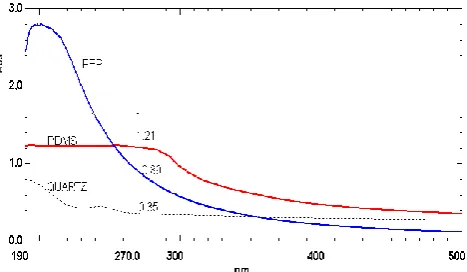
Turning back to the home-made LED-UV reactor, figure 5 shows the selection criteria of the available materials for the irradiation chamber. As reported in the experimental section, initially use was made of quartz which however is fragile but the most transparent to the UV light at about 270 nm. Afterward, quartz was replaced by Teflon-FEP because it is more transparent than PDMS at 270 nm, although less transparent than quartz, as shown in figure 5. However, Teflon-FEP is characterized by an outstanding chemical resistance as well as resistance to UV irradiation. Even after prolonged UV irradiation at 254 nm in air and for a week, the Teflon-FEP did not show any sign of oxidation in its FT-IR spectrum.23
Uridine photolysis in the Aquashop reactor (UV-A at about 360 nm)
The absorption spectrum of uridine is completely free from any significant absorption in the UV-A range and specifically at 360 nm. Consequently, the LED-UV-A reactor is not able to cause the photolysis of uridine as expected and found experimentally. This part of the study represents a “blank” or a reference to the actinometric work with the LED-UV reactors working at about 275 nm. Furthermore, the light emitted by the LED-UV-A diode is a very narrow line at 360 nm.22. Therefore, the commercial reactor from Aquashop is not emitting photons in the spectral range suitable for water disinfection and sterilization, i.e. in the 265-280 nm spectral range.2, 10,11
Conclusions
Uridine as a chemical actinometer is useful for the determination of the number of photons or the energy released by a UV light source provided that the emission is comprised between 250 to 285 nm.12 Despite its simple use in the neutral aqueous solution, it is seldom used.13 When uridine is irradiated with the UV-C light source, it is transformed into a photohydrate as shown in scheme 1, which does not absorb anymore in the spectral range comprised between 250 and 285 nm. In the present work uridine, actinometry was successfully employed in the evaluation of the irradiation efficiency of two LED-UV photochemical reactors both working at about 275 nm. One of them was a commercially available LED-UV reactor from Aquisense Technologies while the other one was a home-made photochemical reactor designed to work with only three 10 mW diodes. It was found that the pseudo-first order kinetics rate constant for the uridine photolysis was one order of magnitude larger for the commercially available LED-UV reactor from Aquisense Technologies concerning the home-made LED-UV reactor. Accordingly, also the energy delivered to the uridine solution by the light sources in the two reactors was found from 12 to 27 times larger for the commercially available LED-UV reactor from Aquisense Technologies. It can be concluded that both the photochemical flow reactors equipped with UV-LED are effective tools in water disinfection and sterilization, with their light emission at 275 nm, although the commercially available reactor from Aquisense Technologies outperforms the home-made reactor. Uridine actinometer does not work with another LED-UV reactor which instead emits light in the UV-A spectral region i.e. at 360 nm. In this latter case, uridine is not photolyzed by the monochromatic light at 360 nm since it does not absorb at this wavelength.
Since also bacteria and viruses do not absorb at 360 nm, it appears obvious that the LED-UV reactor working at 360 nm is not suitable for water disinfection or sterilization.
References
1Weissberger, A. (Ed.) “Techniques of Organic Chemistry” Vol. 2, 2nd Ed., Wiley-Interscience, New York, 1956, p.257-381. 2Oppenlander, T. “Photochemical Purification of Water and Air,"
Wiley-VCH, Weinheim, 2003.
DOI: 10.1002/9783527610884
3Cataldo, F. "Process for the purification of landfill leachate wastewater by active charcoal and photo-ozonolysis." U.S. Patent Application No. 14/356,881, 2014.
4Schiavello, M. “Photoelectrochemistry, Photocatalysis and Photoreactors”, Springer, Berlin, 1985, p. 527-547.
DOI: 10.1007/9789401577250
5Lomaev, M. I., Sosnin, E. A., Tarasenko, V. F. Chem. Eng. Technol.2016, 39, 39. DOI: 10.1002/ceat.201500229 6Lomaev, M. I., Sosnin, E. A., Tarasenko, V. F. Progr. Quantum
Electron.2012, 36, 51.
DOI: https://doi.org/10.1016/j.pquantelec.2012.03.003
7Tamulaitis, G. Lithuanian J. Phys.2011, 51, 177. 8Wikipedia, “Light Emitting Diode”
https://en.wikipedia.org/wiki/Light-emitting_diode
9Wikipedia, “Lumen” https://en.wikipedia.org/wiki/Lumen_(unit),
10Cataldo, F. “Photochemical reactors for photochemical wastewater treatments” Italian Patent Demand No
UB2015A005719, filed June 30th, 2015.
11Vermeulen, N., et al., Biotechnol. Bioeng. 2008, 99, 550-556. DOI: 10.1002/bit.21611
12Kuhn, H. J., Braslavsky, S. E., Schmidt, R. Pure Appl. Chem.
2004, 76, 2105.
DOI:https://doi.org/10.1351/pac200476122105
13Zhang, J. Y., Boyd, I. W., Esrom, H. Appl. Surf. Sci.1997, 109, 482. DOI:https://doi.org/10.1016/S0169-4332(96)00789-1
14Cohn, W.E., Moldave, K. (Eds) “Progress in Nucleic Acids Research and Molecular Biology” Vol. 37, Academic Press,
San Diego, 1989, Chapter 1.
15Oelgemöller, M., Shvydkiv, O. Molecules, 2011, 16, 7522-7550. DOI:10.3390/molecules16097522
16Knowles, J. P., Elliott, L. D., Booker-Milburn, K. I. Beilstein J. Org. Chem..2012, 8, 2025. DOI: 10.3762/bjoc.8.229 17Gilmore, K., Seeberger, P. H. Chem. Record, 2014, 14, 410-418.
DOI: 10.1002/tcr.201402035