Developing Critical Reading of Argumentative
Text: Effects of a Comprehension Strategy
Intervention
Michael Tengberg Karlstad University, Sweden
Christina Olin-Scheller Karlstad University, Sweden
Abstract—This article reports a single-group intervention study designed to improve critical reading proficiency among adolescents. Critical reading in the study is defined as 1) being able to identify written argumentative structure; 2) being able to analyze arguments in terms of relevance and sustainability; and 3) being able to evaluate argumentation through written, critical response. A multiple strategy approach for critical reading instruction was implemented over the course of six weeks (15 lessons) in four classes in Swedish 9th grade (N=74). Classroom activities included reading of argumentative texts, teacher modeling of three strategies (identifying, analyzing, and evaluating), frequent discussions, and response writing to argumentative texts. Results indicated that low and middle achievers made significant and large improvements from pretest to posttest, while for high achievers the intervention seemed to have no effect at all. Closer analysis also revealed that the ability to analyze arguments accounted for the largest proportion of improvement.
Index Terms—argumentative text, critical reading, comprehensions strategies, dialogue, intervention study
I. INTRODUCTION
The development of critical reading practices reflects a key component in an education for democratic citizenship. Recent curriculum reforms in many countries emphasize that a major challenge for future schooling of adolescents’ literacy is to improve their ability to cope with argumentative texts. Research demonstrates that critical reading of argumentative text is important for a rich involvement in modern social and cultural life and for many concrete real-life decisions, but also immediately important for students in the large variety of text-based assignments awaiting them across the curriculum (Larson, Britt,& Larson, 2004; Knudsen, 1992). However, empirical research on the reading of argumentative texts indicates that explicit classroom instruction is rare, that students at both secondary and tertiary level are generally not very skilled at identifying key components of argumentative structures in texts, and that students often conflate provided arguments with cases they build themselves while reading, especially when reading arguments of controversial content (Chambliss, 1994, 1995; Haria, MacArthur,& Edwards Santoro, 2010; Larson et al., 2004; Newell, Beach, Smith,& VanDerHeide, 2011). Newell, Beach, Smith, and VanDerHeide (2011) also argue that although research programs emphasize argumentative reasoning and modeling of argumentative reading, future research should pay more attention to the instructional activities that facilitate a development of critical reading behaviors. A particular focus in that line of research, they argue, would be to investigate in what way instructional discourses influence students’ reasoning about written argumentation.
This paper reports an intervention study designed to improve critical reading proficiency among adolescents. The working definition of critical reading in the study includes 1) being able to identify written argumentative structure (author’s claim, supporting arguments1
, evidence, and counter arguments); 2) being able to analyze arguments in terms of relevance and sustainability; and 3) being able to evaluate argumentation through written, critical response.
Comprehension strategies instruction
For a couple of decades, empirical research has confirmed that comprehension strategies instruction may contribute strong and lasting improvements of students’reading comprehension (Block & Duffy, 2008; Duke & Pearson, 2002; Graesser, 2007; National Reading Panel [NRP], 2000). These effects of teaching strategies,such as summarizing, monitoring, generating questions and making predictions,have extended to both narrative (Janssen, Braaksma, & Couzijn, 2009) and expository (Elbro & Buch-Iversen, 2013; Spörer, Brunstein, & Kieschke, 2009) texts. However,whilethe term ‘strategies instruction’ seems to emphasize the strategies themselves, many researchers have also suggested that the context (e.g., the type of classroom interaction or motivational factors such as engagement)of the instruction is also a criticalaspect (Almasi& Hart, 2011; Wilkinson & Son, 2011). Drawing on theories about the
1
cultural aspects of learning (Vygotsky, 1978) and dialogism (Bakhtin, 1981), a strand of research have accentuated the need for reading instruction thatcombinesexplication and critical examination of textual features with open-ended discussions about different reader positions or stances (Hobbs & Frost, 2003; Nystrand, Gamoran, Kachur,& Prendergast,1997; Soter, Wilkinson, Murphy, Rudge, Reninger, & Edwards, 2008). The dialogic approach aims, for instance, to givestudents control of their own learning process and to make learning an active and collaborative enterprise (Pressley, Beard El-Dinary, Gaskins, Schuder, Bergman, Almasi, & Brown, 1992).More specifically, the dialogic component of instruction also entails that different ideas and interpretations of text are contrasted and examined collaboratively in the classroom (Almasi, 1995; Nystrand, 2006).In this sense,dialogue refers both to oral and written circulation of ideas and interpretations, especially sinceintegratingreading and writing, by training students how to produce proficient written responses to texts,has also proven effective for fostering comprehension (Graham & Hebert, 2010; Headley, 2011).
In the following study, these pedagogical principles are united within an instructional framework referred to asdialogic strategy instruction (DSI). DSI draws on theories of metacognition (Israel & Block, 2005) and dialogism (Nystrand et al., 1997; Wilkinson & Son, 2011) in stressing the necessity of making content learnable by visibility and by public sharing of learners’ perceptions.Itis characterized by a combination of three different features:1) structured text discussions based on open-ended questions and a high degree of student engagement; 2)explicit introduction of carefully selected comprehension strategies by way of a five-step gradual release model (cf. Duke & Pearson, 2002); and3) continuous and challenging response writing, which is in turn responded to by peers and teachers (cf. Tengberg, Olin-Scheller, & Lindholm, 2015). Thus, DSI share a number of traits with other multiple strategies programs like Reciprocal Teaching (RT) (Palincsar & Brown, 1984) and Transactional Strategies Instruction (TSI) (Pressley et al., 1992). Distinctive from these instructional models, however, is the integration ofshared response-writing in order to help students deepen their analysis of texts and of their own understanding of texts. By getting time and opportunity to formulate their own interpretations carefully, it is also expected that students may contribute more substantially and more confidently to classroom dicussions about the texts they read (Wong, Kuperis, Jamieson, Keller, & Cull-Hewitt, 2002).In this way, the study incorporates and explores an additional dimension of the effectiveness of multiple strategies instruction.
In line with the pedagogical aims of the intervention, i.e., to improve critical reading proficiency, the comprehension strategies employed in the interventionalso differ from the ones used in RT and TSI. Strategies were defined as
identifying, analyzing, and evaluating. The motivation for the choice of strategies is outlined in next section.Strategies were introduced in the first phase of intervention and trained continuously while reading, discussing and responding to a mixture of argumentative texts appropriate for the participants, who were Swedish students in 9th grade (15 yrs old).
Previous research has also indicated that explicit instruction of comprehension strategies may be of particular benefit for low-achieving readers (Tengberg, Olin-Scheller, & Lindholm, 2015; Brown, Pressley, Van Meter, & Schuder, 1996; Gersten, Fuchs, Williams, & Baker, 2001). This may be consistent with theoretical propositions that reading strategies are usedprimarily fordecoding or used when comprehension provesdifficult (Afflerbach, Pearson, & Paris, 2008) and thatdifferent sorts of strategiesare appropriate at different levels of reader competence (Alexander, 2006; Skaftun, 2011). For this reason, we will examine not only the intervention effect on group level, but also its possible relation to students’ initial levels of reading proficiency. As previous research demonstrates strong correlations between amount of reading and reading achievement (Baker & Wigfield, 1999; Cunningham & Stanovich, 1998; Gottfried, Schlackman, Gottfried, & Martinez, 2015; OECD, 2010), we are similarly interested in the relationship between reading habits and intervention effect.
Thus, the main purpose of the study is to investigate whether dialogic strategy instruction can serve to improve adolescents’ critical reading of argumentative texts by training their capacity for identifying, analyzing and evaluating argumentative structure in text.A second purpose is to examine whether students’ initial level of reading proficiency as well as their reading habits are factors that relate to the intervention effect.
Critical reading
Historical and social perspectives
2011; Shor, 1992). From the social perspective, critical reading also contains a component of personal growth in terms of developing ethical, moral, and ideological awareness.
Textual practices and knowledge of argumentative structure
While habits of mind to encourage awareness, deconstruction, and potential resistance to textual ideologies constitute the core of a critical literacy, none of these traits are possible without essential knowledge of textual and rhetorical structures.Freebody and Freiberg (2011)argue, for instance, that critical reading should be understood as “a body of curricular knowledge […] on the matter of knowledge about textual practices to do with reading, constructing, analyzing, and evaluating texts and interpretations of texts.” (p. 447)Similarly, Chambliss (1995) argues that competent reading of argumentative textincludes identifyingspecific text cues and applyingthe appropriate strategies for comprehension of written argumentation. According to Chambliss, reading instruction should,thus,focus on both argumentative structure and comprehension strategies. Following Toulmin’s (1958) claim-evidence-warrant model, she investigated advanced high-school readers’ response to lengthy written arguments. In the Toulmin model,theclaimis the assertion or case put forward, e.g.,a plea of guilt or of innocence; theevidenceis facts or examples supporting the claim; and thewarrant(called argument in the present study)is the link between the two by defining the conclusion drawn from the evidence (cf. Chambliss, 1995, p. 781). Chambliss also draws on Meyer’s (1985) notion about successful strategies for competent reading. According to Meyer, competent reading involves the ability to identify rhetorical structures usedby authors and link them into a summary of the argument structure, helping readers to recall the gist of the text. While the 12th-grade advanced readers (N=80) in Chambliss’study were influenced by textual structure (e.g., placement and explicitness of claims), they were able to identify both claims and evidence and to construct gist representations of the argumentative texts.
Influenced by Chambliss, Haria et al. (2010) designed a comprehension strategy intervention in order to enhance fifth-graders (N=7) ability to identify and critically analyze written arguments. The instruction focused on identifying structural elements, summarizing, and critically evaluate the overall argument. Thus, in addition to Chambliss’ model, Haria et al. (2010) focused on helping students to summarize the author’s arguments and develop their own views in response to the text. After 21 training sessions, participants showed substantial progress on measures for all three aspects (identifying, analyzing, summarizing). Although not having been taught explicitly to write persuasive responses, their capability to do so also improved significantly.
The instructional objective in the present study and the assembly of strategies for developing critical reading builds on the studies mentioned above, although the participating students are older and the classroom instruction is performed by ordinary teachers and not by the researchers. We also include a larger sample of students than Haria et al. (2010) in order to be able to verify results by statistical analysis. In the study, we relate to the interactive perspectiveon argument promoted by Newell et al. (2011), viewing argumentation and analysis of arguments from both a cognitive and a social perspective. Argumentation is, thus, not only dependent on task-specific knowledge and familiarity with a model for argument analysis (cognitive perspective), but also on the awareness of the social practices, the literacy events (Prior, 2005), in which arguments are provided and responded to (social perspective).
We hypothesize that by combining strategy instruction (emphasizing the cognitive aspects) with structured classroom discussion using the implications from dialogic theory (emphasizing the social perspective),teachers may scaffold students’ comprehension of and capability to respond to written argumentation. The design is based on the anticipation that students will be able to integrate knowledge drawn from reading, responding in writing, and from discussing the argumentative texts. Some previous studies have indicated significant correlations between comprehension and writing of arguments (cf. Parodi, 2007), and there are theoretical motivations for a transfer to occur between both writing and reading and discussion and reading (cf. Newell et al., 2011). Some studies indicate, however, that integrated reading and writing instruction of persuasive text have a significant effect on writing quality, but not on reading recall (Crowhurst, 1991). Similar results have been reported for transfer from discussion to writing and reading, i.e., effects were observed for persuasive writing but not for recall of text (Reznitskaya, Anderson, & Kuo, 2007). In the present study, however, the integrated writing mode is closely connected to the reading analysis and takes the form of analytical response writing. Similarly, the discussions aim at a mutual and deepened understanding of the argumentative structure in the texts that the students read. Thus, our anticipation is that writing and discussion in this setting may contribute to levels of comprehension rather than recall. In sum, the following research questions are pursued in the study:
1. To what extent may DSI serve to improve adolescents’ critical reading of argumentative texts by training explicitly their capacity for identifying, analyzing and evaluating argumentative structure in text?
2. Is the effect of the intervention dependent on students’ initial level of reading proficiency? 3. Is the effect of the intervention dependent on students’ reported reading habits?
II. METHOD
Participants
study, 63 students reported Swedish as L1 and 11 students (15%) reported another(all non-Scandinavian)L1. 4 of these 11 students reported to be enrolled for Swedish as a second language instead of L1 Swedish. The sample of students was not selected by randomization. Rather, students were nested in classes and chosen because their teachers had previous experience of participating in intervention studies and of working with DSI.
All participants were informed of the purpose of the study and written consent was collected. For students who were under 15 years of age (N=2), written consent was also collected from their parents. Participants were informed that they had the right to withdraw from the study at any point, and that the data collected would be treated confidentially and used for research purpose only.
Design
The study uses a single-group pre-test/post-test design to determine the impact of DSI on 9th graders capacity for critical reading of argumentative texts.Unfortunately, we were unable to include a control groupin the study, which means thatwe cannot establish whether DSI provides a more efficient learning environment than any other instructional approach would. Results from the study should therefore be treatedcautiously and subsequent corroboration is necessary. However, to use control groups as a way of comparing educational efficiency has its own problems. If the study had been targeting narrative reading, a control group might have included classrooms of naturally occurring instruction in narrative reading to represent a business-as-usual condition (common in intervention designs). Instruction in critical reading of argumentative text, on the other hand, is less frequently occurring in second grade classroom and was not available at the time of data collection. A business-as-usual condition would, thus, have meant that the studentshad received reading instruction but no specific training in critical reading. The comparison would, therefore, be a comparison of more and less instruction on the given topic,as much asit would be a comparison of two different instructional approaches. Alternatively, the control condition might have constituted another intervention. In our case, we would then have had to design a second intervention for the particular purpose of demonstrating an effect of DSI. Both these alternatives raise questions about the scientific appropriateness and the validity of the comparative data.Nonetheless, the present design still clearly suffers from the lack of a control condition.
Analytical procedure
Statistical analyses related to pre-test/post-test results in the study are based on paired sample t-testing and effect sizes are calculated using Cohen’s d (Cohen, 1988).In order to examine whether students’ initial levels of critical reading ability was associated with the effect of the intervention, the sample was split three ways based on rank orders from pre-test results (low achievers, middle achievers, and high achievers) and a repeated measures ANOVA was used to determine interaction between time and group. Similarly, in order to control whether students’ reading habits was associated with the intervention effect, data from a questionnaire, administered by the researchers two weeks before the intervention started, was used to compare improvement rates for those who reported frequent, medium and non-frequent leisure time reading.The samplewas consequently split three ways by rank orders on a reading habits index2and repeated measures ANOVA was used to analyze interaction between time and group.
Strategies
The strategies selected for the particular aims of the intervention were defined as identifying;analyzing; and
evaluating. Identifying means identifying structure and structural components such as claim, argument, evidence and (sometimes) counter argument within argumentative texts. Analyzing means recognizing the types of arguments such as argument by authority, by emotional connection or by logic. It also includes assessing arguments by relevance (is the argument related to the claim?) and sustainability (does the argument justify the claim?).Evaluating, finally, means to arrive at an evaluative judgment and to provide an independent response to the claim by taking departurein both prior knowledge of the topic and in an analysis of the argumentative structure in the text.
Teacherpreparation and implementation of instruction
Intervention teachers were provided with training of the teaching model, including theoretical baselines and plans for classroom procedures, in three 3-hr seminars before the intervention started and in an additional two 3-hr seminars during the intervention. In these sessions, plans for classroom procedures, including detailed written instructions, were presented by the research team and discussed in the group of teachers and researchers. Teachers were allowed to provide suggestions for revisions in order to match instructional procedures to the participating students. The final version of the instructions then served as script for lesson plans for all four teachers.
DSI was implemented in four 9th grade classrooms (87 students in all) and taught over a period of six weeks (November–December), 15 lessons in all. Classroom activities included reading of argumentative texts, teachers’ modeling of the three strategies, discussions in pairs, groups and whole class, at times arranged as classroom debates, and response writing to argumentative texts followed by peer response and whole-class evaluation. The intervention at large was divided into four phases: 1) introduction including definition of argumentative text and argumentative structure; 2) the construction of arguments and evidence, analytical perspectives; 3) analysis and response to argumentative texts; and 4) argumentation in various formats. A brief description of the text material selected for the intervention and the activities included in each phase is provided in Table 1.
2
TABLE 1.
THE STRUCTURE OF THE INTERVENTION
Phase Text types in use Activities
1) Introduction Lessons 1–3
Debate articles Classroom debates to warm up. Introduction of the argumentation unit and of learning objectives. Introducing classical rhetorical analysis. Identifying theses.
2) Arguments and evidence Lessons 4–7
Debate articles and columns Introducing Identifying as strategy. Practicing argumentation and identifying author claims and arguments. Introducing
Analyzing as strategy. Practicing analysis of arguments. 3) Analysis and response
Lessons 8–12
Debate articles, columns Responding to argumentation, peer-evaluation of responses. Introducing Evaluating as strategy. Practicing written responses based on argumentation analysis. Classroom debate. 4) Argumentation in various
formats Lessons 12–15
Public service video campaign, columns, commercial ads and reviews
Discussing multimodal argumentation. Ideological markers in the frame. Practicing analyzing arguments. Writing a debate article.
The materials selected for the 15 lessonsconsisted of nine argumentative texts (including columns, debate articles, reviews, and commercial ads) and a short section of a public service video campaign. Topics were wide-ranging and included, for instance, the roleof private, independent schools in Sweden, wolf hunt, furnishing minors with alcohol etc., but they also included texts with purely commercial interests, a category of text that the teachers found particularly useful for the purpose of the intervention. A corner stone of the implementation was that the teaching would focus both on comprehension strategies themselves and on the issues dealt with in the texts. Teachers were also instructed to be especially observant to students’ levels of emotional engagement as they read and discussed texts on various topics and to use these observations as grounds for meta-discussions with students. Previous studies (cf. Chambliss, 1994) show that when students are emotionally engaged in the content of the text, they often show signs of biased processing in that they fail to remember arguments correctly or are less able to accurately identify claims that contradict their own opinions. In this study, we tried to make this aspect an object of analysis in the classroom and to have teachers discuss their own levels of engagement in order to raise students’ awareness of their processing of emotionally engaging content.
In phase 1, after having been warmed-up with a series of short classroom debates, and introduced to the theme and objectives of the six-week teaching unit, students were given an introduction to classical rhetorical analysis by the teacher. Identifying arguments in a text requires a particular type of search-reading (Khalifa & Weir, 2009) based on the reader’s formal knowledge of the text type structure. For this reason, an initial step in the intervention was to make students familiar with the classical rhetorical structure, which is often reproduced in debate articles and columns. These experiences were then operationalized, at first in whole-class analyses, then in smaller groups, of debate articles.
In phase 2, students were introduced to the first two strategies (identifying and analyzing). They also practiced argumentation by writing various claims on the black board and discussing the relevance and sustainability of arguments in support of or opposed to the claims. These exercises were mixed with continued shared reading of debate articles, now including topics (e.g., wolf hunt) chosen particularly to stir some emotional engagement in some of the readers.
Phase 3 included repetition of previously used themes, including for instance meta-discussions about the relationship between emotional engagement and the ability to be attentive to argumentative structures. Students were also introduced to the third strategy (evaluating), which was then practiced in response to debate articlesand columns. Students also read each other’s texts and engaged in a whole class debate.
In phase 4, elements of multimodal argumentation was discussed and examined in groups and in whole class. Students read, analyzed, and produced critical responses to an online public service video campaign, to commercial ads, and a film review.To round off the unit, students were assigned to individually compose a debate article on a topic of their own choice. These texts were then circulated and critically examined by a classmate.
Critical reading measures
(including short-answer and open-ended questions only) was re-coded by one of the researchers. The agreement between coders according to Cohen’s kappa statistics was .82 on pre-tests and .87 on post-tests, which was considered to be sufficient for the purpose of the study.
Since the study is based on repeated measures, we used an ABBA design in order to avoid order or practice effects, i.e., two test versions (A and B) were composed and half of the students (each class was split randomly) received the A-test for pre-A-test and the B-A-test for posA-test, while the other half took the A-tests in the reversed order. An independent t-test, conducted to ensure that the two tests were equally, or almost equally, difficult, indicated no significant difference between pre-test means in the two groups (MA=8.95, SDA=4.59; MB=9.03, SDB=5.48; t (74)=.069, p=.95). Using a two
sample Kolmogorov-Smirnov test, it was also verified that the two distributions were equal (p = .98).3 Fidelity of implementation
All classes were observed at three different occasions (beginning, middle and end of intervention period)in order to verify the quality and pace of implementation of the intervention.From these observations, we were able to conclude that the intervention teaching was implemented in a similar pace and manner and in accordance with the lesson guide in all four classes. Obviously, the discussions about texts took different directions and initiated opportunities for different types of reflection about text and argumentation. Yet, the same texts and assignments were read and responded to in the course of the six weeks. The observations also revealed a large degree of positive student engagement and several signs of a dynamic learning environment. At the same time, we observed that both students and teachers often found it difficult to correctly identify the claim and the arguments in the texts. Arguments were, for instance, conflated with evidence or with background references, which sometimes lead to confusion in the students’ written responses.
III. RESULTS
Measurement of intervention effects
In order to determine the impact of DSI on 9th graders capacity for critical reading of argumentative texts, pre-test and post-test scores were analyzed using paired samples t-test. Descriptive statistics are reported in Table 2 along with results for significance tests and effect sizes. All scores were approximately normally distributed with all values for skewness and kurtosis non-significant, i.e., z-values within the range of -1.96 to 1.96 at both pre-test and post-test, thus making the distributions appropriate for parametric analysis.
TABLE 2.
TEST SCORES FOR ALL STUDENTS AND BY ACHIEVEMENT LEVELS AND READING HABITS FREQUENCY
Student group Pre-test Post-test Effect size
(d)
p
N Meana SD Mean SD
All students 74 8.99 5.02 13.00 5.89 0.60 0.001
Proficiency groups
low achievers 25 3.76 1.72 1.74 2.67
11.48 12.84 14.75
6.26 5.53 5.64
1.41 0.85 Ns
0.001 0.001 middle achievers 25 8.52
high achievers 24 14.92
Reading habits non-freq. readers 24 7.17 8.50 10.96
3.75 5.38 5.24
11.21 13.25 14.96
6.58 5.35 5.29
0.63 0.65 0.76
0.008 0.007 0.001 med-freq. readers 24
freq. readers 24 a
Max. 30 points
Paired samples t-testing of pre-/post-test scores was conducted to evaluate the impact of the intervention on sample level. The increase from pre-test (Mpre = 8.99, SD = 5.02) to post-test (Mpost = 13.00, SD = 5.89) wasstatistically
significant [t (73) = 5.14, p<.001 (two-tailed)]. In addition, an estimate of effect size(Cohen’s d = .60) tells us that the impact was medium sized according to Cohen’s (1988) guidelines.In order to assess intervention impact for different achievement levels, a repeated measures ANOVA was run indicating a significant and large between-subject effect for the interaction between time and group [F(2, 71) = 34.68, p< .001, partial η2 = .47].Pairwise comparison showed that all groups were significantly different from each other in this respect. We then conducted paired samples t-tests for each achievement group in order to analyze the effects for each group individually. As shown in Table 2, the improvements made by both low achievers and middle achievers was statistically significant with large effect sizes [tlow (24) = 6.01, p< .001 (two-tailed), Cohen’s d = .1.41] [tmed (24) = 3.71, p = .001 (two-tailed), Cohen’s d = .85]. For high achievers, on
the other hand, mean post-test score was slightly lower than the pre-test mean score, although the difference was not statistically significant [thigh (23) = .14, p = .89 (two-tailed)]. A graphic illustration of differences in improvement
between the three achievement groups is provided in Figure 1.
Figure 1.Improvement from pre-test to post-test for low, middle, and high achievers.
In order to control whether the effects of the intervention was related to students’ reading habits, a repeated measures ANOVA was run,indicating a significant difference in training effectsbetween frequent and non-frequent readers (p
= .002). The differences in effect between non-frequent and frequent readers on the one hand, and medium-frequent and medium-frequent readers on the other, were both non-significant. As shown in Table 2, the intervention effect is larger for the frequent readers (d = .76) than for medium- (d = .65) and non-frequent (d = .63) readers. This result suggests, contrary to what we might expect based on previous research,that the low achievers on the test are not necessarily the same students as those who report low frequency of reading. Similarly, the high achievers on the test are not necessarily the frequent readers. A Chi-squared test for independence verified this assumption, suggesting that there was no significant association between the two variables achievement level and reading habits [ 2 (4, N = 72) = 5.69, p
= .22, phi = .20].This result is unexpected since previous research demonstrates a strong correlation between amount of reading and reading achievement (Baker & Wigfield, 1999; Cunningham & Stanovich, 1998; Gottfried, Schlackman, Gottfried, & Martinez, 2015; OECD, 2010). It should be notedthat the sample size in the present study might be too small for this type of analysis,and that the findings, therefore, do not exclude the possibility of detecting an association between reading habits and intervention effect by using a larger sample.
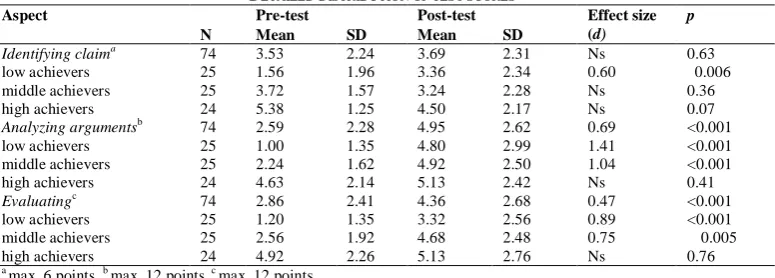
At this point it is also interesting to analyze more specifically on which aspect of the critical reading the students made the largest improvement. The reading test was designed to measure the ability to 1) identify author’s claim and supporting arguments;2) to analyze arguments in terms of relevance and sustainability; and 3) to evaluate by responding critically to the author’s claim and arguments. Descriptive statistics for the threeaspectsmeasured are reported in Table 3. By conducting paired samples t-tests for each aspect separately, we found that no significant improvement was made in terms of identifying author’s claim, whereas significant and large improvement was made both in terms of analyzing arguments [tana (73) = 5.79, p< .001 (two-tailed), Cohen’s d = .69] and in terms of evaluating [teva (73) = 4.014, p< .001
(two-tailed), Cohen’s d = .47].
TABLE 3.
DETAILED DISTRIBUTION OF TEST SCORES
Aspect Pre-test Post-test Effect size
(d)
p
N Mean SD Mean SD
Identifying claima
low achievers middle achievers high achievers
Analyzing argumentsb low achievers middle achievers high achievers Evaluatingc low achievers middle achievers high achievers 74 25 25 24 74 25 25 24 74 25 25 24 3.53 1.56 3.72 5.38 2.59 1.00 2.24 4.63 2.86 1.20 2.56 4.92 2.24 1.96 1.57 1.25 2.28 1.35 1.62 2.14 2.41 1.35 1.92 2.26 3.69 3.36 3.24 4.50 4.95 4.80 4.92 5.13 4.36 3.32 4.68 5.13 2.31 2.34 2.28 2.17 2.62 2.99 2.50 2.42 2.68 2.56 2.48 2.76 Ns 0.60 Ns Ns 0.69 1.41 1.04 Ns 0.47 0.89 0.75 Ns 0.63 0.006 0.36 0.07 <0.001 <0.001 <0.001 0.41 <0.001 <0.001 0.005 0.76 a
max. 6 points, b max. 12 points, c max. 12 points
in the groups of middle and high achievers. As can be expected, judging from the general results reported in Table 2 above, the high achievers make no significant improvement on any of the three aspects of the test.
IV. DISCUSSION AND CONCLUSIONS
The study was designed to investigate whether dialogic strategy instruction can serve to improve adolescents’ critical reading of argumentative text. Critical reading, in the study, was defined as the capacity for identifying, analyzing and evaluating argumentative structure in text. We also set out to investigate whether the intervention effect would be related to students’ initial levels of critical reading proficiency and/orto the reading habits they reported.
Summary of the results
The results indicate first of all that the six-week intervention of DSI indeed helped to improve students’ critical reading ability. The size of the effect for the whole group was large according to standard mean statistics, yet, for high achieving students, the intervention seemed to have no effect at all. Conversely, low and middle achievers seemed to benefit extensively from the intervention. By analyzingthe subsets of the test, we foundthat low achievers were the only ones to demonstrate significant improvement in identifying arguments in a text. For analyzing and evaluating arguments, however, middle achievers also demonstrated large improvement. Finally, the results indicate that students’ reading habits were associated to their response to the intervention, in the sense that frequent readers made significantly larger improvements than non-frequent readers.
Comparative measures
Although these results are interesting and valuable to both researchers and practitioners, the study design suffers from the lack of a control condition, by which the intervention effects could be compared. An alternative way to assess the impact of the intervention is to relate the effect size to some previously known measureof progress in reading comprehension for the similar age group.In Sweden, no data of this sort is available, but in Norway an example is offered by the national reading tests taken each year by students in 8th and 9th grade, and thereby providing a measure of progress in reading comprehension over the period of one school year. From the average mean differences over the last five years, the effect size of a school year can be estimated to equal d = .364, compared to d = .60 in six weeks for the whole group in our study. It should be noted that this is a quite rough measure, and although there is an overlap between the national reading test and the researcher-designed test that we used in the study, one should be careful when drawing conclusions based on this comparison. It has been confirmed, for instance, that intervention effects are generally larger when using researcher-designed comprehension tests than when using standardized reading comprehension tests (Rosenshine & Meister, 1994).The researcher-designed test obviously focuses on a much more narrow area of skills, which makes it reasonable to expect larger effects from intense instruction, as was provided in the study.
Bearing these limitations in mind, the comparison still offers a relevant reference to the effects reached in the present study. It may not support conclusions about the pedagogical potential of the instruction as compared to other possible approaches to critical reading instruction.But it provides at least a small indication that the size of the learning effect in the present study is quite large compared to what is normally expected over a school year in the similar educational topic.
Relation to previous research
In concurrence with earlier studies designed to analyze and improve students’ ability to read and comprehend written argumentation (e.g., Chambliss, 1995; Haria et al., 2010; Reznitskaya, Anderson, & Kuo, 2007), our findings suggest that explicit teaching of argumentative structure in text, including identifying key elements such as claim, argument, and evidence, plays a crucial role in enhancing students’ comprehension and their ability to respond critically to argumentative text. The results of the study also support suggestions made in previous research (e.g., Crowhurst, 1991; Parodi, 2007) that the writing and reading of persuasive discourse are highly integrated capabilities and that the synergy effects from the mutual dependency of productive and responsive facets of comprehending argumentative structure should be utilized in instruction. The fact that the intervention seems to contribute especially well to the improvement for low achieving students is interesting and aligns with previous research on strategy instruction (Tengberg, Olin-Scheller, & Lindholm, 2015; Brown et al., 1996; Gersten, et al., 2001).
In this way, the studyoffers some crucial implications for classroom practice. If students are provided with the opportunity both to engage in dialogues about argumentative text and to learn models for identifying and analyzing these texts, their capacity for critical reading may be strongly supported. In addition, DSI, like some other comprehension strategy approaches,seems to have the potential of contributing to an increase of equity between students, by offering the most to those who are initially the weakest readers.To some extent, the instruction thereby serves the progressive purpose of a deliberative literacy as discussed above. Finally, a distinctive contribution of the present study is the suggestion that these effects are not exclusive to some specially designed experimental condition, but available in ordinary classrooms after only a modest amount of teacher preparation.
Limitations
4
The study also has a number of limitations that need to be considered. First of all, since the intervention was composed of several different instructional features, it is not possible to pin down which of them were more or less important for the end result. It is often suggested, for example, that the complexity of classroom teaching cannot be analyzed into the sum of the different parts. Rather, it should be expected that there is an interaction going on between, for instance, close analysis of structural elements in written arguments and open-ended discussion on engaging topics. Although this interaction may contribute, for instance, to an integration of cognitive and social perspectives on critical reading, known to be important for high-quality teaching (cf. Newell, 2011), and to general robustness in relation to classroom diversity, it may also cause problems when there is a lack of effect in some aspect of the instructional target.
Second, as noted above, the improvement with regard to identifying author’s claim was confined to low achievers only, which was unexpected given that identification of author’s claim was a recurrent topic of discussion during the whole intervention. If this problem was related to some deficiency of the intervention (it could for example also have been related to the level of difficulty in the test), there are many possible adjustments that can be made and we have little evidence to decide on which one of them to choose. We know from observations that identification of author’s claim in the text was sometimes experienced as difficult even for the teachers. Therefore, we need to consider both the instructional design and the level of complexity in the text sample used during instruction. Distracting information in the text may conceal nodal elements such as claim and argument, and the argument structure encountered in a text may not match the expectancies that students bring from instruction. So, while complexity, just like emotionally engaging content, contributes a challenge necessary for creating a meaningful literacy learning environment, it may also hamper students’ comprehension in a way that compromise transfer effects from learning. A suggestion for future research, therefore, would be to trace the discursive patterns from classroom dialogue in speech and writing to the discourses of analysis brought to use in the students’ post-test responses. That may help to explain why some features of instruction are less useful to students than others.
Third, in the study, both students and teachers were quite aware of the fact that they were part of an educational intervention, i.e., that they were trying out something different from their ordinary teaching andalso being monitored by researchers. This awareness may contribute a Hawthorne-effect, which might be difficult to evade in educational interventions unless the design involves several different intervention conditions, in which case the effect can be considered neutralized.
Fourth, in the present study, neither alternative interventions nor a regular control group was used. The findings reported need, therefore, to be corroborated by subsequent studies. As we argued in the methods section, using a control condition in order to estimate instructional effects of an uncommon educational content, such as explicit teaching of critical reading ability, carries its own limitations. On the other hand, one might argue that any comparison is better than no comparison. A suggestion for a follow-up study would, thus, be to include both a business-as-usual condition as controls and an alternative intervention condition. In order for the latter to make an appropriate comparison, it should preferably constitute some other ‘best practice’ strategy design,such asReciprocal Teaching (Rosenshine & Meister, 1994), but using only argumentative texts as reading material.
Conclusion
In conclusion, the results of the study suggests that it is possible to scaffold the improvement of adolescents’ critical reading of argumentative texts by using dialogic strategy instruction, focusing on the capacity for identifying, analyzing and evaluating argumentative structure. Even in a short intervention period like 15 lessons, the learning effects may be relatively strong compared to baseline measurement. However, the effects observed in the study are limited to low-achieving and middle-low-achieving students only. For high-low-achieving students, thus, instruction in critical reading must be accompanied by supplementary pedagogical measures.
REFERENCES
[1] Afflerbach, P. P., Pearson, P. D., & Paris, S. G. (2008). Clarifying differences between reading skills and reading strategies.The
Reading Teacher, 61(5), 364–373.
[2] Alexander, P. A. (2006). The path to competence: A lifespan developmental perspective on reading. Journal of Literacy
Research, 37(4), 413–436.
[3] Almasi, J. F. (1995). The nature of fourth graders’ sociocognitive conflicts in peer-led and teacher-led discussions of literature.
Reading Research Quarterly, 30(3), 314–351.
[4] Almasi, J. F. & Hart, S. J. (2011). Best practices in comprehension instruction. In L. M. Morrow & L. B. Gambrell (Eds.), Best
practices in literacy instruction, 4th ed. (pp. 250–275). New York, NY: The Guilford Press.
[5] Tengberg, M., Olin-Scheller, C., & Lindholm, A. (2015).Improving students’ narrative comprehension through a multiple
strategy approach.Effects of dialogic strategy instruction in secondary school.L1–Educational Studies in Language and
Literature, 15, 1–25.
[6] Baker, L., & Wigfield, A. (1999).Dimensions of children’s motivation for reading and their relations to reading activity and
reading achievement.Reading Research Quarterly, 34, 452–477.
[7] Bakhtin, M. M. (1981). The dialogic imagination.Four essays by M. M. Bakhtin. (M. Holquist Ed.). Austin, TX: University of
Texas Press.
[8] Block, C. C., & Duffy, G. G. (2008). Research on teaching comprehension. In C. C. Block & S. R. Parris (Eds.),
[9] Brown, R., Pressley, M., Van Meter, P., & Schuder, T. (1996). A quasi-experimental validation of transactional strategy
instruction with low-achieving second-grade readers.Journal of Educational Psychology, 88(1), 18–37.
[10] Chambliss, M.(1994). Why do readers fail to change their beliefs after reading persuasive text? In R. Garner & P.A. Alexander
(Eds.), Beliefs about text and instruction with text (pp. 75–89). Hillsdale, NJ: Erlbaum.
[11] Chambliss, M. (1995).Text cues and strategies successful readers use to construct the gist of lengthy written arguments.
Reading Research Quarterly, 30(4), 778–807.
[12] Cohen, J.W. (1988). Statistical power analysis for the behavioral sciences (2nd ed.). Hillsdale, NJ: Lawrence Erlbaum Ass.
[13] Cunningham, A. E., & Stanovich, K. E. (1998). What reading does for the mind.American Educator, 22(1–2), 8–15.
[14] Crowhurst, M. (1991).Interrelationships between reading and writng persuasive discourse.Research in the Teaching of
English,25(3), 314–338
[15] Duke, N. K., & Pearson, P. D. (2002).Effective practices for developing reading comprehension. In A. E. Farstrup & S. J.
Samuels (Eds.), What research has to say about reading instruction (3rd ed.) (pp. 205–242). Newark, DE: International
Reading Association, Inc.
[16] Elbro, C., & Buch-Iversen, I. (2013). Activation of background knowledge forinference making: Effects on reading
comprehension. Scientific Studies of Reading, 17(6), 435–452.
[17] Eriksen, A., & Roe, A. (2011). Den nasjonale prøven i lesing på 8. og 9. trinn, 2011. Rapport basert på populasjonsdata. Oslo:
Institutt for lærerutdanning og skoleforskning. Universitetet i Oslo.
[18] Eriksen, A., & Roe, A. (2012). Den nasjonale prøven i lesing på 8. og 9. trinn, 2012. Rapport basert på populasjonsdata. Oslo:
Institutt for lærerutdanning og skoleforskning. Universitetet i Oslo.
[19] Eriksen, A., & Roe, A. (2013). Den nasjonale prøven i lesing på 8. og 9. trinn, 2013. Rapport basert på populasjonsdata. Oslo:
Institutt for lærerutdanning og skoleforskning. Universitetet i Oslo.
[20] Freebody, P.,& Freiberg, J.(2011). The teaching and learning of critical literacy: Beyond the “Show of wisdom”. In M.L. Kamil,
P.D. Pearson, E.B. Moje, & P. Afflerbach (Eds.), Handbook of Reading Research, Vol. IV (pp. 432–452). London: Routledge.
[21] Freire, P. (1972). Pedagogy of the oppressed. Harmondsworth, UK: Penguin Books.
[22] Gersten, R., Fuchs, L.S., Williams, J. P., & Baker, S. (2001). Teaching reading comprehension strategies to students with
learning disabilities.A review of research.Review of Educational Research, 71(2), 279–320.
[23] Gottfried, A. W., Schlackman, J., Gottfried, A. E., & Martinez, A. S. (2015). Parental provision of early literacy environment as
related to reading and educational outcomes across the academic life-span. Parenting: Science and Practice, 15, 24–38.
[24] Graesser, A. C. (2007). An introduction to strategic reading comprehension. In D. S. McNamara (Ed.), Reading comprehension
strategies: Theories, interventions, and technologies (pp. 3–26). Mahwah, NJ: Lawrence Erlbaum Ass.
[25] Graham, S., & Hebert, M. (2010). Writing to read: Evidence for how writing can improve reading. Washington, DC: Alliance
for Excellent Education.
[26] Haria, P., MacArthur, C., & Edwards Santoro, L. (2010). The Effects of Teaching a Text-Structure Based Reading
Comprehension Strategy on Struggling Fifth Grade Students’ Ability to Summarize and Analyze Written Arguments. Paper
presented at the SREE Conference, Research into Practice, Washington, D.C., March 4–6, 2010.
[27] Headley, K. (2008). Improving reading comprehension through writing. In C. C. Block & S. R. Parris (Eds.), Comprehension
instruction: Research-based best practices, Vol. 2 (pp. 214–225). New York: Guilford Press.
[28] Hobbs, R.,& Frost, R. (2003).Measuring the acquisition of media-literacy skills.Reading Research Quarterly, 38, 330–355.
[29] Israel, S.E., Block, C.B., Bauserman, K.L. & Kinnucan-Welsch, K. (Eds.) (2005). Metacognition in Literacy Learning.Theory,
Assessment, Instruction, and Professional Development. Mahwah, NJ: Lawrence Erlbaum Ass.
[30] Janks, H (2010). Literacy and power.New York and London: Routledge.
[31] Janssen, T., Braaksma,, M., & Couzijn, M. (2009). Self-questioning in the literature classroom.effects on students’
interpretation and appreciation of short stories. L1 – Educational Studies in Language and Literature, 9(1), 91–116.
[32] Khalifa, H., & Weir, C. (2009). Examining reading: Research and practice in assessing second language learning. New York:
Cambridge University Press.
[33] Knudsen, R.E. (1992). Analysis of argumentative writing at two grade levels.Journal of Educational Research, 85, 169-179.
[34] Larson, M., Britt, M.A., & Larson, A.A. (2004).Disfluencies in comprehending argumentative texts.Reading Psychology, 25,
205-224.
[35] Luke, A. (1988). Literacy, textbooks and ideology: Postwar literacy instruction and the mythology of Dick and Jane. London:
Falmer Press.
[36] Meyer, B. J. F. (1985). Prose analysis: Purposes, procedures, and problems, Parts 1 and 2. In B.K. Britton &J. Black (Eds.),
Understandingexpository text (pp.11–64, 269–304). Hillsdale, NJ: Erlbaum.
[37] National Reading Panel (2000). Teaching children to read.An evidence-based assessment of the scientific research literature on
reading and its implications for reading instruction [online].Retrived March 29, 2016,
fromhttp://www.nichd.nih.gov/publications/pubs/nrp/documents/report.pdf.
[38] Newell, G.E., Beach, R., Smith, J. & VanDerHeide, J. (2011). Teaching and Learning Argumentative Reading and Writing: A
Review of Research. Reading Research Quarterly46(3), 273–304.
[39] Nussbaum, M. (1997). Cultivating Humanity.A classical defense of reform in liberal education. Cambridge, MA: Harvard
University Press.
[40] Nystrand, M. (2006). Research on the role of classroom discourse as it affects readingcomprehension. Research in the Teaching
of English, 40(4), 392–412.
[41] Nystrand, M., Gamoran, A., Kachur, R. & Prendergast, C. (1997). Opening Dialogue: Understanding the Dynamics of
Language and Learning in the English Classroom. New York: Teachers College Press.
[42] OECD (2009). PISA 2009 Assessment framework.Key competencies in reading, mathematics and science.Retrived March 29,
2016, fromhttp://www.oecd.org/pisa/pisaproducts/44455820.pdf.
[43] OECD (2010). PISA 2009 results: Learning to learn – student engagement, strategies and practices (Volume III). Retrived
[44] Palincsar, A. S., & Brown, A. L. (1984). Reciprocal teaching of comprehension-fostering and comprehension-monitoring
activities.Cognition and Instruction, 1(2), 117–175.
[45] Parodi, G. (2007). Reading–writing connections: Discourse-oriented research. Reading and Writing, 20(3), 225–250.
[46] Pressley, M., Beard El-Dinary, P., Gaskins, I., Schuder, T., Bergman, J. L., Almasi, J., & Brown, R. (1992). Beyond direct
explanation: Transactional instruction of reading comprehension strategies. The Elementary School Journal, 92(5), 513–555.
[47] Prior, P. (2005). Toward the ethnography of argumentation: A response to Richard Andrews’ ‘Models of argumentationin
educational discourse.’ Text, 25(1), 129–144.
[48] Reznitskaya, A., Anderson, R.C., & Kuo, L. (2007). Teaching and learning argumentation.The Elementary School Journal,
107(5), 449–472.
[49] Roe, A. (2014). Den nasjonale prøven i lesing på 8. og 9. trinn, 2014. Rapport basert på populasjonsdata. Oslo: Institutt for
lærerutdanning og skoleforskning. Universitetet i Oslo.
[50] Rosenshine, B., & Meister, C. (1994). Reciprocal teaching: A review of the research. Review of Educational Research,64(4),
479–530.
[51] Saunders, T. J. (1987). Introduction to Socrates.In Plato, Early Socratic Dialogues (pp. 13-36). London: Penguin Books.
[52] Shor, I. (1992). Empowering education: Critical teaching for social change.Chicago: University of Chicago Press.
[53] Skaftun, A. (2011). Understanding reading development: A phenomenological perspective. L1-Educational Studies in
Language and Literature, 11, 127–148.
[54] Soter A. O., Wilkinson, I. A. G., Murphy, P. K., Rudge, L., Reninger, K. B., & Edwards, M. (2008). What the Discourse Tells
Us: Talk and Indicators of High-Level Comprehension. International Journal of Educational Research, 47(6), 372−391.
[55] Spörer, N., Brunstein, J. C., & Kieschke, U. (2009). Improving students’ reading comprehension skills: Effects of strategy
instruction and reciprocal teaching. Learning and Instruction19(3), 272–286.
[56] Toulmin, S. E. (1958). The uses of argument.Cambridge, UK: Cambridge University Press.
[57] Vagle, W., & Roe, A. (2010). Den nasjonale prøven i lesing på 8. og 9. trinn, 2010. Rapport basert på populasjonsdata. Oslo:
Institutt for lærerutdanning og skoleforskning. Universitetet i Oslo.
[58] Vygotsky, L. S. (1978). Mind in Society: The development of higher psychological processes. Cambridge, MA: Harvard
University Press.
[59] Wilkinson, I.A.G. & Son, E.H. (2012). A dialogic turn in research on learning and teaching to comprehend. In M.L. Kamil, P.D.
Pearson, E.B. Moje, & P. Afflerbach (Eds.), Handbook of Reading Research, Vol. IV (pp. 359–387). London: Routledge.
[60] Wong, B. Y. L., Kuperis, S., Jamieson, D., Keller, L. & Cull-Hewitt, R. (2002). Effects of guided journal writing on students'
story understanding. The Journal of Educational Research, 95(3), 179–191.
Michael Tengberg, Karlstad, holds a PhD in Humanities in education from the Department of Literature, History of Ideas and Religion, University of Gothenburg, Sweden, 2011. The thesis is an empirical investigation of literature discussions in the classroom and the learning potential of such discussions.
He has extensive experience of teaching at all educational levels and has been a Secondary school teacher of mathematics, science and Swedish, Senior lecturer of comparative literature, Senior lecturer of educational work and is currently holding a position as Associate professor of educational work at Karlstad University, Sweden. He is the author of several scientific articles, including “National reading tests in Denmark, Norway,
and Sweden. A comparison of construct definitions, cognitive targets, and response formats” in Language
Testing and “Improving students’ narrative comprehension through a multiple strategy approach: Effects of
dialogic strategy instruction in secondary school” inL1–Educational Studies in Language and Literature, and also co-editor of
several anthologies, such as Bedömning i svenskämnet (Stockholm: Natur & Kultur, 2015). Tengberg’s research has centered on
reading instruction from a dialogical perspective and the learning effects of various instructional approaches. He is currently doing research into the asessement of reading comprehension, primarily within high-stakes testing.
Dr. Tengberg Scheller is a member and coordinator of the National network for research on Swedish in education. He is also a member of the Association for Educational Assessment – Europe.
Christina Olin-Scheller, Karlstad, holds a PhD in comparative literature from the department of Aesthetics and Social Sciences, Karlstad University, Sweden, 2006.The thesis dealt with upper secondary school student’s fictional text worlds in and out of school.
She has broad experience from teaching at all educational levels and was Lecturer in comparative literature for two years. Since 2008 she has been Senior lecturer at the Institution for Pedagogical Studies, Karlstad University, Sweden, where she currently holds a position as full Professor in Educational Work. She has published articles, f.e. ”Literary Prosumers. Young people’s reading and writing in a new media landscape”,
Olin-Scheller, C. & Wikström, P. Education Inquiry 1:1, 2010 and “’Let´s Party.’ Fan fiction sites as arenas
for young girls’ gender construction”, Karlsson, M. & Olin-Scheller, C., Gender and Language, 9 (2)
2015.She has also contributed with book chapters which turn to researchers, as well as teacher educators and teachers, f.e. together
with Michael Tengberg, Läsa mellan raderna [Reading between the lines], (Malmö: Gleerups, Olin-Scheller; C & Tengberg, M.,
2016). In her present research Olin-Scheller has a focus on questions dealing with literary and education at different levels and her research interests are about young people’s reading and writing in a new media landscape as well as questions dealing with reading instruction and reading development.