Sharif University of Technology
Scientia IranicaTransactions A: Civil Engineering www.scientiairanica.com
Comparison of the drift spectra generated using
continuous and lumped-mass beam models
F.R. Rofooei
and A.H. Shodja
Department of Civil Engineering, Sharif University of Technology, Tehran, P.O. Box 11155-9313, Iran. Received 16 April 2012; received in revised form 9 March 2013; accepted 14 May 2013
KEYWORDS Time history analysis; Near-eld records; Drift spectrum; Approximation methods.
Abstract. The drift spectrum, as a new measure of earthquake-induced demands in structures, was developed using a uniform-stiness continuous beam model. Practical limitations in the procedures based on such models have caused structural engineers to pay little attention to drift spectra. In this paper, a method is proposed to estimate the seismic-induced inter-story drift demands, using the modal analysis technique of lumped mass, non-uniform beam models. The proposed approach is simple and can overcome many deciencies of the previous methods. It can take into account the very important eect of height-wise stiness reduction on drift demands, without the numerical diculties usually encountered in computing the drift spectra. The drift spectra for high-rise shear buildings are computed using both continuous and lumped mass beam models. The comparisons indicate that the results of the continuous uniform-stiness beam models in some cases are not acceptable. The eects of various parameters such as the structural system, the height-wise variation of structural stiness, the number of stories, higher modes and damping ratios on inter-story drift demands are investigated. Also, the inuences of the structural system and height-wise variation of structural stiness on the height-wise distribution of maximum inter-story drift demands are evaluated using a number of building models.
c
2013 Sharif University of Technology. All rights reserved.
1. Introduction
The response spectrum [1,2] is an important tool in seismic design of structures. Using modal analysis procedures, the peak elastic response of a Multi-Degree Of Freedom (MDOF) system during an earthquake excitation can be approximately determined from the earthquake response spectrum, without performing a dynamic time history analysis. The response spectrum analysis can also provide an estimate of the overall dis-placement demands of the building models. However, extensive research has shown that the inter-story drift ratio has the best correlation with the inicted damages
*. Corresponding author. Tel: 98-21-66164233; Fax: 98-21-66164233
E-mail addresses: [email protected] (F.R. Rofooei), [email protected] (A.H. Shodja)
to buildings under earthquake excitations [3-5]. The distribution of the inter-story drift demands along the height of the buildings is not uniform, and therefore cannot be obtained directly from the displacement response spectrum.
The responses of the structures during near-eld excitations cannot be characterized by a resonance buildup, so the underlying assumptions of the modal analysis method are not satised for structures sub-jected to these ground motions [6]. Iwan [6] introduced the so-called \drift spectrum" as a new measure of the induced seismic demands on structures for such situations. Iwan's drift spectrum was based on the solution of the problem for non-dispersive damped waves in a one-dimensional continuous medium, as treated by Courant and Hilbert [7]. He used the shear strain in a continuous shear beam as an analogy to the inter-story drift ratio in a building structure.
Using modal analysis of a continuous shear beam, Chopra and Chintanapakdee [8] showed that the dif-ferences between drift and response spectra are not unique for near-eld strong ground motions. These dierences simply reect the eects of higher modes on the response that are larger due to the characteristics of near-eld ground motions [8]. Also, the existing modal combination rules are equally accurate for near-eld and far-eld ground motions, although their main as-sumptions are not satised by near-eld excitations [8]. Miranda and Akkar [9] extended Iwan's drift spectrum for buildings with exural or exural-shear type of behavior. They proposed the so-called \gen-eralized inter-story drift spectrum" that was based on shear-exural continuous uniform stiness beam. A modication factor was employed by Miranda and Akkar to consider any arbitrary combination of exural and shear types of behavior for the structural system. The proposed generalized inter-story drift spectrum was based on modal analysis techniques. To compute the inter-story drift ratio, Miranda and Akkar used a code-based relationship to estimate the height of the structures from their fundamental periods.
As it was already mentioned, Iwan's drift spec-trum was based on the propagation of non-dispersive damped waves, a concept not known by many struc-tural engineers. Also, Kim and Collins [10] showed that the formulation used in the Iwan's drift spectrum could result in residual drifts for certain ground motions that are not consistent with the assumed linear elastic model. On the other hand, for shear beams or beams with predominant shear deformation, the computation of exact formulations of Miranda and Akkar [9] in most computers may include considerable amount of round o error. So, they provided some approximate relations for the problem in such beams. In this work, the importance of the error caused by the application of these approximate relations and their eects on the accuracy of the method will be discussed.
Since the introduction of the concept of drift spec-tra by Iwan [6] in 1997, not many engineers have paid attention to these new spectra due to the diculties existed in treating the continuous beam models. In this paper, a new method is proposed to determine the drift spectra, using the well-established modal analysis technique for lumped mass, non-uniform beam models. This method, unlike the previous ones, can consider the eect of height-wise stiness reduction on drift demands, which is shown to be very important. Application of Code-based approximate formulas, to relate the height of the structural models to their fun-damental periods, which was among the shortcomings of previous methods, does not exist in the proposed approach.
The mean drift spectra for high-rise building models are computed for both continuous and lumped
mass beam models, using ten near-eld strong ground motions. The eects of various parameters such as the type of structural system, the ratio of the lateral stiness at the top of the building model to the lateral stiness at its base, number of stories, higher modes and damping ratio on the inter-story drift demands are investigated. Moreover, the eects of structural system and height-wise variation of structural stiness on the distribution of maximum inter-story drift demands are evaluated using a number of building models.
2. Miranda and Akkar's \generalized drift spectrum"
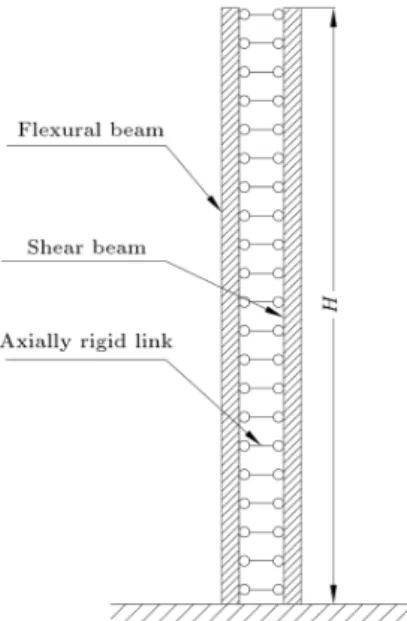
Miranda and Akkar [9] used the Csonka's [11] exural-shear beam model, shown in Figure 1, to obtain estimates of drift demands in linearly elastic buildings. It assumes that these beams are connected by an innite number of axially rigid members that only transmit horizontal forces. They used the derivatives of the mode shapes of the continuous shear-exural beam to approximate the drift ratios. When the undamped uniform model is subjected to a horizontal acceleration ug(t), the Inter-story Drift Ratio (IDR) at the jth story
is estimated by [9]:
IDR(j; t) H1 Xm
i=1
i0i(x)Di(t); (1)
where H is the total height of the building, i is the
modal participation factor of the ith mode of vibration of the continuous beam model, and 0
i(x) is the rst
derivative of the ith mode at a non-dimensional height x of the beam model which is the average height of the j + 1 and j oors. Also, Di(t) is the relative
Figure 1. Flexural-shear beam used in Miranda and Akkar's generalized drift spectrum.
displacement response of a SDOF (Single-Degree of Freedom) system with period Ti and modal damping
ratio i corresponding to those of the ith mode of
vibration, subjected to a ground acceleration ug(t), and
m is the number of modes considered in the analysis. The details of computing values of 0
i(x) and i
can be found in Miranda and Taghavi [12]. The mode shapes of vibration and their derivatives of continuous beams depend only on the lateral stiness ratio , dened as:
= H r
GA
EI; (2)
where GA and EI are the shear and exural rigidities of the shear beam model, respectively.
Miranda and Akkar [9], assuming a T1 =
0:0853H0:75 relationship between fundamental period
and height of steel moment-resisting frames, obtained the ordinates of the generalized inter-story drift spec-trum. In a previous study, Miranda and Reyes [13] concluded that the maximum inter-story drift demands were not signicantly inuenced by reduction of sti-ness along the height of the structural system. Based on this study, Miranda and Akkar [9] computed the drift spectra for uniform (stiness) beams, and sug-gested the following equation describing the maximum inter-story drift ratio:
IDRmax max 8t;x
H1 Xm
i=1
i0i(x)Di(t): (3a)
Since application of any assumption for determining the height of the building models could reduce the accuracy of their proposed method, this assumption is not considered in this paper. Instead, a drift spectrum is generated using the value of the \inter-story drift ratio total height", as its ordinates. Therefore, Eq. (3a) can be re-arranged as:
IDRmax H max8t;x
m X i=1
i0i(x)Di(t): (3b)
3. Problem formulation
The response of an MDOF system with N degrees of freedom subjected to horizontal ground acceleration is governed by the following dierential equation:
[M]f Ug + [C]f _Ug + [K]fUg = [M]f1gug(t); (4)
where [M], [C], and [K] are mass, damping, and stiness matrices, respectively, fUg is the relative displacement vector of the dynamic system, and ug(t) is
the input ground acceleration. The response of elastic structures with classical damping can be obtained using
the expansion theorem. The relative displacement vector of MDOF systems can be computed as:
fU(t)g =XN
i=1
fUi(t)g; (5)
in which fUi(t)g is the contribution of the ith mode
to the displacement vector of the system fU(t)g, determined as:
fUi(t)g = ifigDi(t); i = 1; 2; ; N; (6)
in which:
i= fig
T[M]f1g
figT[M]fig; i = 1; 2; ; N; (7)
where i and fig are the modal participation factor
and the ith mode shape, respectively. The relative displacement history of the ith mode shape of the system, Di(t), can be determined from:
Di(t) + 2i!i _Di(t) + !2iDi(t) = ug(t);
i = 1; 2; ; N; (8) in which !iand iare the ith mode un-damped natural
frequency and damping ratios, respectively. The inter-story drift hiinter-story of the jth inter-story can be obtained as:
Driftj= N
X
i=1
fUi(j)g fUi(j 1)g
=XN
i=1
i[i(j) i(j 1)]Di(t);
i = 1; 2; ; N; (9) in which a smaller number of modes can be used for inter-story drift estimation.
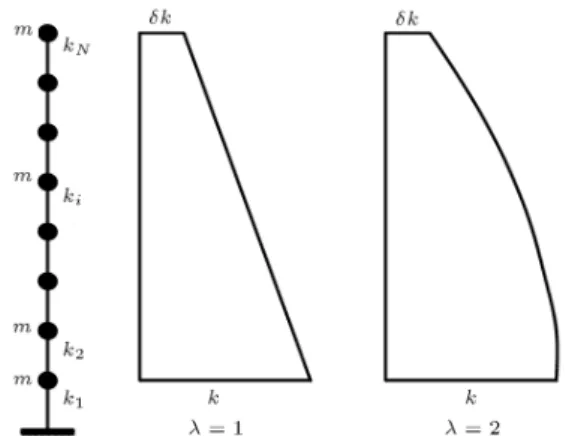
Now, consider the lumped mass shear beam rep-resenting an N-story building shown in Figure 2. The masses of dierent oors that are considered to be equal, are lumped at each oor level. The mass matrix [M] can therefore be written as:
[M] = m[I]; (10)
where m is the mass of each story and [I] is the identity matrix. For a building with uniform mass, the modal participation factor given by Eq. (7) reduces to:
i= N
P
j=1i(j) N
P
j=1 2 i(j)
Figure 2. The lumped mass, non-uniform beam model and variation of stiness along its height.
The non-uniform distribution of stinesses along the height of beam model is assumed to be estimated from:
ki = 1 (1 )
i 1 N 1
!
k; (12)
where kiand k are the stiness of the ith and the rst
stories, respectively. The parameter is the ratio of the lateral stiness at the top story to that of the rst story of the beam model, and is a non-dimensional parameter that controls variation of the lateral stiness along the beam. This relationship is similar to the one used by Miranda and Reyes [13] for continuous beams. As they noted, values of equal to 1 or 2 correspond respectively to linear or parabolic variation of lateral stinesses along the height of the beam model, as shown in Figure 2. All elements of the stiness matrix of the system can be determined in terms of the rst story stiness k, so this matrix can be written as:
[K] = k[S]; (13)
where non-dimensional matrix [S] is a function of N, and .
Substituting Eqs. (10) and (13) into the charac-teristic equation of the system yields:
det( !2
i[M] + [K]) = 0; i = 1; 2; ; N; (14)
or:
det !2
imk[I] + [S]
= 0; i = 1; 2; ; N: (15) The mode shapes (eigenvectors) can then be deter-mined from:
!2
imk[I] + [S]
fig = 0; i = 1; 2; ; N:
(16) Dening the non-dimensional parameter `i' by:
2
i = !2imk: (17)
Eqs. (15) and (16) can be written as: det( 2
i[I] + [S]) = 0; (18)
and: ( 2
i[I] + [S])fig = 0: (19)
Eq. (19) shows that all N-story buildings with uniform mass and a similar variation pattern for stiness, with no dependency on the value of stiness, mass and height, would have identical mode shapes. Using Eq. (17) for the 1st and the ith modes of vibration produces: 2 i 2 1 = !2 i !2
1: (20)
Therefore, the ith mode circular frequency or period can be obtained from the frequency or the period of the rst mode as follows:
!i= i
1!1; Ti=
1
iT1: (21)
This means that if the fundamental period of vibra-tion of a building with particular stiness variavibra-tion is known, its higher mode natural periods can be calculated using Eq. (21).
For a given ground motion time history, the maxi-mum inter-drift distribution for an N-story shear build-ing with the height-wise stiness variation described by Eq. (12) can be obtained from its fundamental period of vibration. The procedure is simple: rst the matrix [S] for the specied values of and is generated, and then Eqs. (18) and (19) can be used to nd the non-dimensional parameters i and mode
shapes fig. The periods of the higher modes and the
modal participation factors are calculated by Eqs. (21) and (11), respectively. If the period Ti of any mode
is known, the response history of the equivalent SDOF systems, Di(t), for the selected modal damping ratios
i, under any earthquake record can be determined by
solving Eq. (8). The drift history of all stories can then be calculated from:
Driftj= N
X
i=1
fUi(j)g fUi(j 1)g
=
N
X
i=1
i[i(j) i(j 1)]Di(t);
j = 1; 2; ; N: (22) Considering two buildings with n1 and n2 number of
stories, and the same fundamental period T , one could write:
n1h1= H1; (23)
in which h1 and h2 are the story heights and H1
and H2 are the building heights, respectively. Thus,
the maximum inter-story drift ratios (MIDR) of these buildings will be equal to:
MIDR1= 1;maxh 1 =
1;maxn1
H1 ; (25)
MIDR2= 2;maxh 2 =
2;maxn2
H2 ; (26)
where i;maxis the maximum inter-story drift demand
of the ith building.
Tall buildings can be approximated by continuous beams. In a continuous beam model, the MIDR can be obtained using Eq. (3a). It is also shown in Eq. (19) that all N-story buildings with uniform mass and a similar variation pattern for stiness, with no dependency on the value of stiness, mass and height, would have identical mode shapes. It is therefore reasonable to assume that tall uniform-mass buildings with identical natural periods and similar variation pattern for stiness have nearly the same mode shapes. Hence, from Eq. (3b) it can be concluded that:
MIDR1 H1 MIDR2 H2; (27)
or \maximum inter-story drift ratio total height" for tall buildings with uniform mass and similar variation pattern for stiness would be nearly the same if their fundamental periods of vibration be identical. Increasing the height of the buildings will improve this
approximation. The maximum inter-story drift ratio total height is an upper bound for the roof displacement of the building models. So, two tall buildings with uniform distribution of mass, same fundamental period and similar height-wise variation of stiness, would have the same upper bound for roof displacement, which is consistent with the concept of displacement spectrum. This result will be numerically veried in this work, and then will be used in presentation of the drift spectra.
4. Near-eld ground motions
As mentioned in Section 1, the drift spectrum was originally developed to provide a new measure of induced seismic demands in building models for situa-tions in which the ground motion cannot be appropri-ately specied by the maximum spectral displacement. The fault-normal component of a near-eld ground motion that is characterized by a forward directivity eect is such a case [14]. The forward directivity-related velocity pulse could impart a large amount of energy to the buildings at the onset of an earth-quake episode [15]. Table 1 shows the 10 near-eld records used in this study. The earthquake records with forward directivity have signicant PGV, and exhibit long period velocity pulses due to directivity eects. To provide a rational basis for comparison, the ground motion records listed in Table 1 are scaled to 0.5 g. All these records were obtained from the PEER website [16].
Table 1. Details of the near-eld ground motions.
No. Earthquake MWa Station Date Vs(30) b
(m/s)
NEHRP site class
Tpc
(sec)
PGAd
(g)
Source Dist. Rrupte
(km)
Comp.
1 Cape Mendocino 7.01 Petrolia 92/04/25 712.8 C 3 0.662 8.2 090
2 Erzincan 6.69 Erzincan 92/03/13 274.5 D 2.7 0.496 4.4 EW
3 Imperial valley 6.53 EC Meloland
Overpass 79/10/15 186.2 D 3.3 0.296 0.1 270
4 Kobe 6.90 JMA 95/01/17 312.0 D 1.0 0.821 1.0 000
5 Kobe 6.90 Takatori 95/01/17 256.0 D 1.6 0.611 1.5 000
6 Landers 7.28 Lucerne 92/06/28 684.9 C 5.1 0.721 2.2 275
7 Loma Prieta 6.93 LGPC 89/10/18 477.7 C 3.0 0.563 3.9 000
8 Northridge 6.69 Sylmar-Olive
View 94/01/17 440.5 C 3.1 0.843 5.3 360
9 Northridge 6.69 Rinaldi 94/01/17 282.2 D 1.2 0.838 6.5 228
10 Tabas 7.35 Tabas 78/09/16 766.8 B Backward 0.836 2.0 LN
a Mw: moment magnitude;bV
s(30): 30 m divided by the travel time of an S-wave to 30 m depth; cTp: period of pulse;dPGA: peak ground acceleration.;eRrupt: closest distance to rupture plane.
5. Drift spectrum based on lumped mass non-uniform beam model
5.1. Computation of drift spectrum
It was shown in Section 3 that if the stiness variation along the height of a building model is represented by Eq. (12), it is possible to estimate its maximum inter-story drift under earthquake excitation, using its fundamental period of vibration. Using the described lumped mass beam model for a given earthquake record, the drift spectrum for N-story building models with specic values of , and stiness variation given by Eq. (12), can be computed by simply repeating the procedure for the desired range of fundamental periods. Although a large number of drift spectra could be generated using the above approach, it will be shown that just a few spectra would be sucient to address most practical cases. The drift spectra for building models with shear and exural behavior can also be produced by the proposed method. However, only the results for shear beam models are presented here. 5.2. The inuence of the number of stories on
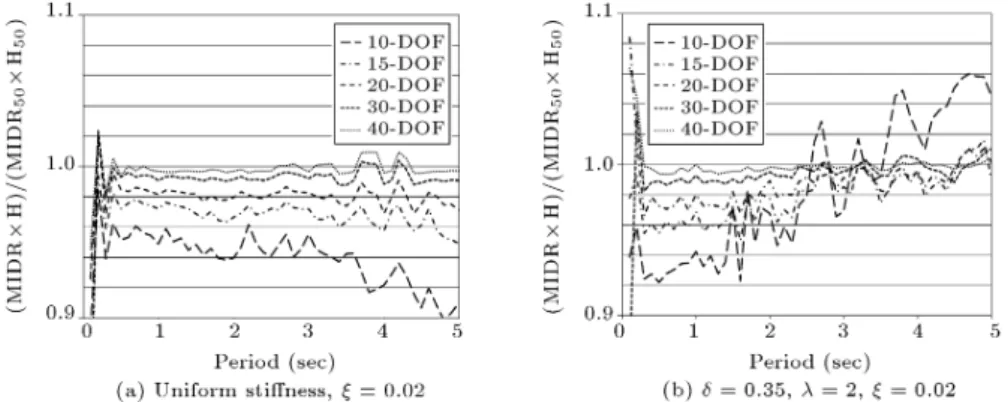
maximum inter-story drift demands Figure 3(a) and (b) represent the eect of a building's number of stories on its maximum inter-story drift demands for a 0.02 damping ratio for a uniform stiness
beam and a beam with = 0:35 and = 2, respectively. Clearly, the number of stories has an important eect on inter-story drift demands. For any given period, the inter-story drift demands are decreased by increasing the number of stories. This trend suggests that dierent presentations of the drift spectra, i.e. the product of maximum inter-story drift and number of stories, or product of Maximum Inter-story Drift Ratio (MIDR) and total height of building (H) (see Eqs. (25) and (26)) versus the fundamental period, as shown in Figure 4(a) and (b), may be more useful. These gures show that for the shear buildings with more than 20 Degrees Of Freedom (DOFs), the value of inter-story drift ratio multiplied by the total height is not very sensitive to the number of stories. To better quantify the dierence between these spectra, Figure 5(a) and (b) show the same spectra normalized by the spectrum of 50-DOFs. These gures show that except for periods less than 0.5 sec (which are not common for high-rise buildings), the dierences between drift spectra for shear buildings with more than 20 degrees of freedom are less than 4 percent. Therefore, for tall buildings with specic values of and , a single \maximum inter-story drift ratio total height" spectrum can be used to approximately describe their behavior. This result is supported by Eq. (27). One can conclude that it is acceptable to
Figure 3. The eect of number of stories on the maximum inter-story drifts demands.
Figure 5. Quantifying the eect of number of stories on the maximum inter-story drifts demands.
Figure 6. The eect of on the maximum inter-story drifts demands with the assumed H-T relationship.
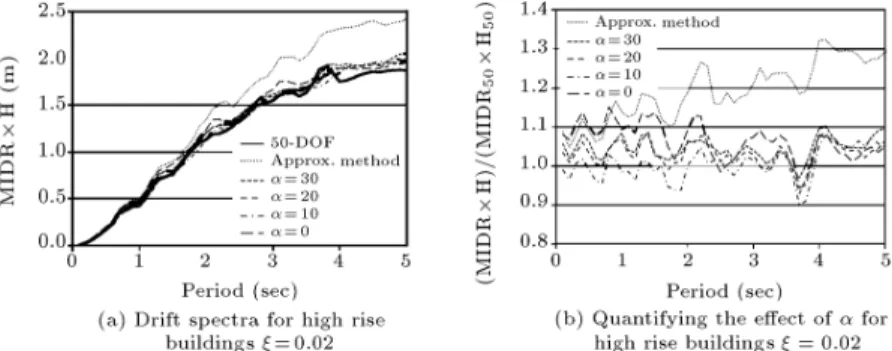
consider a 50-DOFs lumped mass shear beam as an approximation for a continuous shear beam. This result will be veried in Figure 6(a) by comparing the drift spectra of continuous model and 50-DOF stick model for the Rinaldi NS component of 1994 Northridge earthquake.
It should be noted that the proposed method has no assumption on the value of structural or story height. It is not possible to represent the inter-story drift ratio spectra without doing such assumptions. Therefore, from now on in this manuscript, the term \drift spectrum" means \maximum inter-story drift ratio total height of building" spectrum.
5.3. Comparison of drift spectra obtained using continuous and lumped mass beam models
The drift spectra obtained using the continuous and lumped mass beam models are compared to investigate their dierences. For comparison purposes, the drift spectra obtained by the method of Miranda and Akkar (by using the code based relationship between the height and the fundamental period of structural mod-els) for the Rinaldi NS component of 1994 Northridge earthquake is shown in Figure 6(a). This gure shows that the lumped mass beam with 50-DOFs very closely approximates values obtained by the exact continuous-beam method by Miranda and Akkar [9]. This gure
also shows that the approximate method may lead to errors up to 33%.
Figure 6(b) shows the drift spectra obtained using the LGPC component of 1989 Loma Prieta earthquake. As this gure indicates, the spectra for small values of are not necessarily very dierent from that of a shear beam model. Furthermore, the maximum inter-story drift demands are not necessarily very sensitive to the value of . The next section discusses on this subject in more detail.
5.4. Inuence of the structural system on the value and height-wise location of
maximum inter-story drift demands In Section 5.3, it is shown that the amount of maximum inter-story drift ratio is not necessarily dependent on the structural system, but the drift spectra do not provide any information about the height-wise location of the maximum inter-story drift ratio. Thus, the eect of structural system on the position of maximum inter-story drift demands needs to be investigated. The drift spectra of continuous shear-exural beams for various values of and drift spectrum of 50-DOFs lumped mass uniform beams are presented in Figure 7(a). The drift spectra for values of less than 30 are calculated using the exact relations derived by Miranda and Akkar [9]. However, as mentioned in Section 1, for large values of , the computation of these exact
Figure 7. The eect of on the maximum inter-story drifts demands.
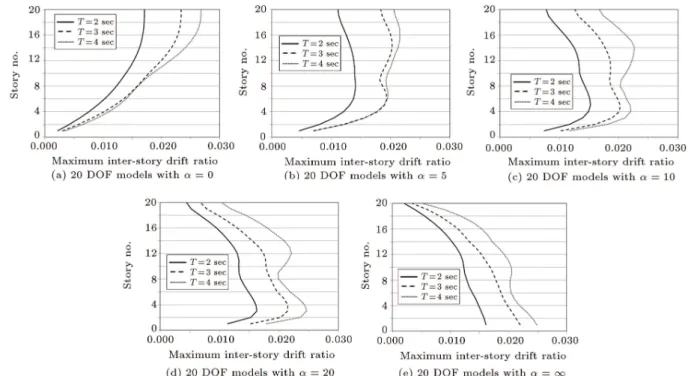
Figure 8. The eect of on the height-wise variation of the maximum inter-story drifts demands for 20-DOF uniform-stiness beam models with = 0:02.
relations in most computers may include considerable amount of round o error. Thus, a lumped mass shear beam with 50-DOFs is considered as an approximation for a continuous beam. Also, Figure 7(a) represents the results of the approximate relations of Miranda and Akkar for large values of that corresponds to a shear beam model. Figure 7(b) shows the same drift spectra normalized by the spectrum of a 50-DOFs beam mod-els. This gure shows that the average drift spectra obtained, using the 10 earthquake records of Table 1, are not very sensitive to the value of . Moreover, Figure 7(b) shows that the error caused by using the approximate relations is not negligible. These results are not consistent with the results obtained by Miranda and Akkar, as they examined only two ground motion records. It is observed that by increasing the number of records, the sensitivity of the inter-story drift ratios
to the value of is reduced and the error, due to using approximate relations, becomes important. The presented results are obtained using the strong ground motions of Table 1, and more earthquake records should be studied before generalizing this nding.
To investigate the eect of structural system on the location of maximum inter-story drift demands, 15 uniform-stiness structural models that are representa-tives of 5 dierent structural systems are investigated. The 70 meters tall structural models have 20 DOFs with fundamental periods of vibration of 2, 3 and 4 seconds. They exhibit pure exural behavior with = 0, pure shear behavior with = 1 and shear-exural behaviors with = 5, = 10 and = 20. The damping ratio is assumed to be = 0:02. The distributions of inter-story drift ratio demands over the height of these structural models are shown in
Figure 8. From this gure it is concluded that the location of maximum inter-story drift ratio is very sensitive to the structural system, while its value is not strongly dependent on the structural system, for the considered ground motions. Figure 8 shows that the location of maximum inter-story drift ratio for uniform-stiness structures with exural behavior is at roof level, while for structures with shear behavior is at rst story, and for systems with combined shear-exural behavior is somewhere in the mid-height of the structural models.
5.5. Inuence of the structural fundamental period on maximum inter-story drift demands
Figure 9 shows the eect of the fundamental period of vibration of the structural models on maximum inter-story drift demands for uniform-stiness 20-DOF models with damping ratio = 0:02. This gure demonstrates the distribution of inter-story drift de-mands over the height of structural models for ve values of . As this gure indicates, by increasing the period of vibration, the inter-story drift demands usually increase, but as Figure 7(a) shows, small decreases are also possible. Figure 9 also shows that the height-wise distribution of maximum inter-story drift demands is mostly dependent on the structural system. For certain values of , uniform height-wise changes in the stiness do not signicantly aect the distribution pattern of maximum inter-story drift demands. These obtained results are due to the earthquake records listed in Table 1.
5.6. Inuence of the stiness reduction pattern on maximum inter-story drift demands
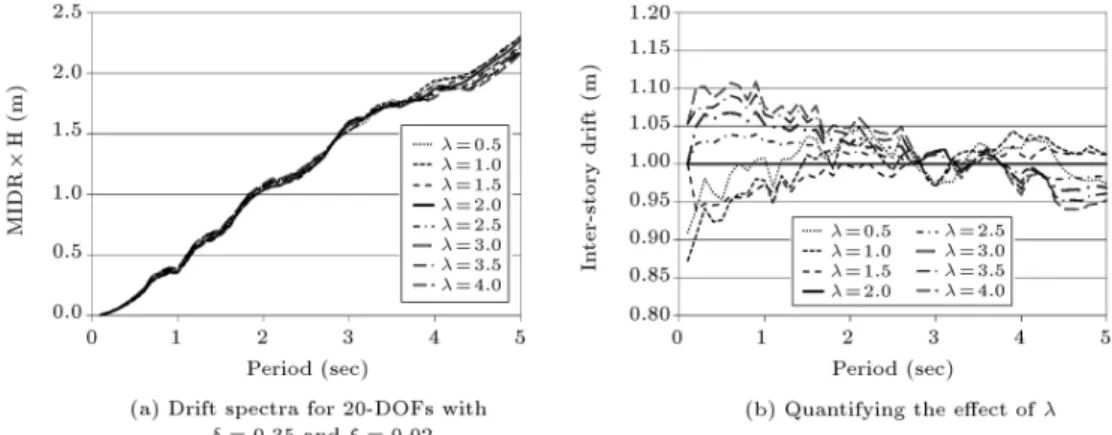
Figure 10(a) shows the eect of the stiness reduction pattern on maximum inter-story drift demands for 20-DOFs beam models with = 0:35 and damping ratio = 0:02. The sensitivity of maximum inter-story drift demands to changes in is negligible, thus making it possible to assign it a xed value. Since, for most of the building models, lies between 1 and 3, for the remainder of this work, this parameter is assumed to be equal to 2. Figure 10(b) presents the same spectra normalized by the spectrum for = 2. It is seen that the error due to ignoring is in general less than 10%, while for a wide range of periods, it is less than 5%. 5.7. The eect of top to bottom story stiness
ratio on the maximum inter-story drift demands
Figure 11(a) shows the eect of the lateral stiness ratio of the top story to that of the rst story, , on maximum inter-story drift demands for 20-DOFs models with = 2 and = 0:02, while Figure 11(b) shows the same spectra normalized by the spectrum for = 1. These gures demonstrate that the eect of on maximum inter-story drift demands for values of < 0:5 is not small. Reducing the lateral stiness ratio causes inter-story drifts to increase signicantly. This eect for values of greater than 0.5 is insignicant. A value of = 0:5 can be used for values of 0:5 with an error below 10%, while for values of < 0:5, dierent spectra should be computed. These gures show that
Figure 9. The eect of structural fundamental period on the height-wise variation of the maximum inter-story drifts demands for 20-DOF uniform-stiness beam models with = 0:02.
Figure 10. The sensitivity of the maximum inter-story drift demands to the stiness reduction pattern.
Figure 11. The sensitivity of the maximum inter-story drift demands to the parameter, .
the eect of lateral stiness ratio of the top stories, with respect to the rst ones, is considerable. For further investigation, the distribution of inter-story drift ratio demands over height of two shear building models with 30 stories and fundamental periods of vibration of 3 sec and 4 sec, is illustrated in Figure 12(a) and (b), respectively. In these gures, drift demands are computed for various values of for = 2 and = 0:02. These gures show that lateral stiness ratio of the top story to that of the rst story not only aects the value of maximum inter-story drift demand,
but also inuences its location along the height of the building.
5.8. The eects of damping ratio and higher modes on the maximum inter-story drift demands
Figure 13 shows the maximum inter-story drift spec-trum obtained using dierent numbers of modes for the 20-story building models with = 0:35, = 2, and = 0:02. As this gure shows, for the near-eld ground motions of Table 1, the spectral values obtained, using
Figure 13. The eect of higher modes on the maximum inter-story drift demands.
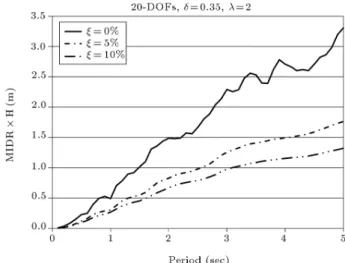
Figure 14. The eect of damping ratio on the maximum inter-story drift demands.
only one or two modes, are highly under-estimated, while those using the rst 6 modes of vibration for 20-story buildings can produce acceptable estimates. Also, Figure 14 shows the eect of damping on maximum inter-story drift demands for 20-story buildings with = 0:35 and = 2. As expected, an increase in the damping ratio leads to a decrease in the maximum inter-story drift demand.
6. Conclusions
A new method based on a lumped mass beam model for estimating the inter-story drift demands of buildings is proposed. It is shown that for the considered near eld earthquake records, the average of the maximum inter-story drift ratios for high-rise buildings is mostly depen-dent on their fundamental periods, and its sensitivity to the structural system is not considerable, although the location of its occurrence is strongly dependent on the structural system. The drift spectra for shear
buildings with dierent numbers of stories and non-uniform distribution of stiness along the height are presented. It is observed that the maximum inter-story drift is not strongly dependent on the stiness variation pattern. However, its dependency on the ratio of lateral stiness of the top story to that of the rst story of the building models, that was not referred to in previous methods, is very important. For shear buildings in which the lateral, top to bottom story stiness ratio is greater than 0.5, a single drift spectrum can be used, while for ratios less than 0.5, dierent spectra would be needed. Moreover, it is deduced that the product of maximum inter-story drift ratio and total height for tall buildings with similar variation pattern for stiness are mostly dependent on their natural fundamental periods. Based on this nding, for each value of lateral stiness ratio of top to base story, for buildings taller than 20 stories, a single spectrum is presented. In contrast to other available methods, no code-based relationship is used in this approach to estimate the height of the structural models from their fundamental periods. The proposed method is simple because it uses well-established lumped mass beam concept rather than complicated continuous shear-exural beam representation with due computational diculties. The proposed drift spectra are powerful tools for structures with regular height-wise stiness distribution. They can be used to study the eect of various parameters on inter-story drift demands and preliminary assessment of drift demands, providing guidelines to optimum design of structures.
References
1. Biot, M.A. \A mechanical analyzer for the predic-tion of earthquake stresses", Bull. Seismol. Soc. Am., 31(2), pp. 151-171 (1941).
2. Housner, G.W. \Characteristics of strong motion earthquakes", Bull. Seismol. Soc. Am., 37(1), pp. 19-31 (1947).
3. Moehle, J.P. \Strong monitor drift estimates for R/C structures", ASCE J. Struct. Eng., 110(9), pp. 1988-2001 (1984).
4. Naeim, F. \Performance Extensively Instrumented Buildings during the 1994 Northridge Earthquake", Report No. 97-7530.68, Los Angeles CA, John A. Martin & Associates Inc. (1997).
5. Gulkan, P. and Sozen, M.A. \Procedure for determin-ing seismic vulnerability of builddetermin-ing structures", ACI Struct. J., 96(3), pp. 336-342 (1999).
6. Iwan, W.D. \Drift spectrum: Measure of demand for earthquake ground motions", J. Struct. Eng., 123(4), pp. 397-404 (1997).
7. Courant, R. and Hilbert, D., Methods of Mathematical Physics, II, New York, NY John Wiley & Sons Inc., pp. 191-193 (1962).
8. Chopra, A.K. and Chintanapakdee, C. \Drift spectrum versus. Modal analysis of structural response to near-fault ground motions", Earthquake Spectra, 17(2), pp. 221-234 (2001).
9. Miranda, E. and Akkar, D. \Generalized inter-story drift spectrum", ASCE J. Struct. Eng., 132(6), pp. 840-852 (2006).
10. Kim, J. and Collins, K.R. \Closer look at the drift demand spectrum", J. Struct. Eng., 128(7), pp. 942-945 (2002).
11. Csonka, P. \Simplied analysis for the calculation of multistory frames subjected to wind load", (Muszaki Tudomanyok Osztalyanak Kozlemenyei), 35(1-3), pp. 209-229 (in Hungarian) (1965).
12. Miranda, E. and Taghavi, S. \Approximate oor acceleration demands in multistory buildings. I: For-mulation", J. Struct. Eng., 131(2), pp. 203-211 (2005). 13. Miranda, E. and Reyes, C.J. \Approximate lateral drift demands in multi-story buildings with nonuni-form stiness", ASCE J. Struct. Eng., 128(7), pp. 840-849 (2002).
14. Somerville, P.G. \Development of an improved repre-sentation of near fault ground motions", Proc. SMIP98 Seminar on Utilization of Strong Motion Data, Oak-land, CA, pp. 1-20 (1998).
15. Alavi, B. and Krawinkler, H. \Eects of near-fault ground motions on frame structures", Blume Center
Rept. No. 138, Dept. of Civil Eng., Stanford University, Stanford, CA (2001).
16. Pacic Earthquake Engineering Research (PEER) Center website (http://peer.berkeley. edu/smcat) (2011).
Biographies
Fayaz Rahimzadeh Rofooei is a professor in the Civil Engineering Department of Sharif University of Technology, Tehran, Iran. Currently, he is the head of the Earthquake Engineering Research Center of Sharif University of Technology. He received his PhD from the Rensselaer Polytechnic Institute, Troy, N.Y., USA. His research interests include structural control, nonlinear structural analysis, base isolation, seismic vulnerability analysis and retrotting of structures and lifelines.
Amir Hossein Shodja is a PhD student in the Department of Civil Engineering at Sharif University of Technology, Tehran, Iran. He received his MSc and BSc degrees from Sharif University of Technology. His research interests include earthquake engineering, non-linear structural analysis, seismic vulnerability analysis and retrotting of structures.