Published online: 11.06.2016 --- © jbm 2016
--- L. Straus1
e-mail: [email protected] T. Robbert2
e-mail: [email protected] S. Roth3
e-mail: [email protected]
1,2,3 University of Kaiserslautern, Kaiserslautern, Germany
Customer Participation in the Customization of Services –
Effects on Satisfaction and Behavioral Intentions
Lennart Straus · Thomas Robbert · Stefan Roth
Abstract: Customers´ evaluation of the service process has important implications for service providers. However, research on customer participation at the specification stage of a customization process and its effects on the evaluation of the process and service outcome is still scarce. This paper analyzes the effect of customer participation in a scenario experiment with two measurement points in which customers and salespeople collectively customize a service offering according to customers´ needs. We find that customer participation has a positive impact on satisfaction and behavioral intentions irrespective of the actual service outcome. Even for negative service experiences, participating customers are significantly more satisfied than customers who played a rather passive role at the specification stage of the service process.
499
Introduction
Customers increasingly have the opportunity to adapt products and services to their needs (Schmitz and Dietz, 2010) and hence, customization is discussed in various literature streams and with differing focus (Leischnig and Messer, 2014). Literature on mass customization, for instance, focuses on customers´ perception and evaluation of online-based tool kits which allow customers to design t-shirts, shoes, or even skis according to their individual needs and taste (Franke and Schreier, 2010; Merle et al., 2010). Literature on service customization, in contrast, differentiates between customer-controlled and provider-controlled customization (Schmitz and Imgrund, 2013). Customer-controlled service customization is based on the premises of mass customization whereby customers control the customization process and service providers only provide the prerequisites. In contrast, customers consult salespeople of stationary service providers in provider-controlled service customization. Thereby, customers receive information on the general service process, customization possibilities (Haas and Kenning, 2014), and eventually start to adapt the service offering to their needs (Simonson, 2005). These customer-salesperson interactions take place at the specification stage of the service process (Raaij and Pruyn, 1998; Fließ, 2007), prior to the actual purchase decision, and are characterized by a more or less intense customer participation (Büttgen et al., 2012): some customers only listen to the information provided by the salesperson, others get more involved in the interaction by asking questions, providing information, making suggestions, or giving feedback (Chan et al., 2010).
Especially for services where specification and delivery are separated in time, customers´ purchase decisions are affected by their assessment of the service process so far and the specification process serves as relevant cue. This is especially true for services like the planning of a round trip vacation, a new kitchen, or customized furniture. Consequently, for these services customers´ perception and evaluation of their participation at the specification stage has important implications on their decision to buy the offer, to search for other offers elsewhere or even to postpone the purchase decision (Straus et al., 2015). It is therefore central for service providers do design the specification process in a way that customers perceive as supportive and informative (e.g. Haas, 2006), but which does not overextend customers (Dellaert/Stremersch, 2005) or lead to self-attributions (Bendapudi/Leone, 2003). As the service provider already has invested a large amount of resources in the specification process, losing customers to a competitor or a do-it-yourself alternative is costly.
Therefore, we build on existing research on customer participation to empirically elaborate on its effect in the special context of service specification. Specifically, we empirically analyze how the degree of customer participation at the specification stage effects the evaluation of the participation process and of the delivered service.
Thereby, our research is guided by the following questions:
(1) What is the impact of customer participation at the specification stage on customers´ satisfaction and behavioral intentions like purchase intention and the intention to recommend the provider to others?
500 (2) What are the implications of customer participation at the specification stage on satisfaction with the finally delivered service? Does customer participation even play a role when the participation process itself is temporally separated from service delivery?
To tackle these research questions, we conduct a scenario-experiment, which allows us to specifically analyze the effect of customer participation at the specification stage on customers´ purchase decisions and satisfaction as well as on customers´ satisfaction and behavioral intentions with the delivered service.
We find that customer participation in the specification of services has a positive effect on satisfaction and behavioral intentions without being influenced by the actual outcome. Surprisingly, participating customer having experienced a negative service are even more satisfied than low-participating customers. These findings lead to the conclusion that customer participation in the specification of services is universally beneficial for service providers.
Our paper is structured as follows: In the next chapter, we will discuss the existing literature on customer participation. Then, we will derive our research hypotheses based on the confirmation-disconfirmation paradigm and the theory of cognitive dissonance. In the following section, we will present the design and implementation of the empirical study before we simultaneously evaluate our hypotheses. We will conclude by discussing the results and by briefly outlining future research avenues.
Literature Review
The concept of customer participation is discussed in various literature streams, yet with different approaches. From a resource perspective, literature on customer integration focuses on the integration of customers´ external resources (e.g. rights, objects, or information) in the process of service production and delivery (Kleinaltenkamp and Jacob, 2002; Moeller et al., 2013). Similarly, research on customer co-production regards customers as partial employees who actively engage in the organizations work (Mills and Morris, 1986; Kelley et al., 1990; Lengnick-Hall et al., 2000), thereby supplying labor and knowledge to the firm (Hsieh et al., 2004). In general, firms benefit from customer co-production through cost reductions, where-as customers can expect lower prices and higher control over the service offering (Auh et al., 2007).
In contrast, research on customer participation mainly refers to activities performed by customers during the service process and their implications for both customers and providers (Cermak et al., 1994; Rodie and Kleine, 2000; Bendapudi and Leone, 2003). Silpakit and Fisk (1985, p. 117) define customer participation as “[…] the degree of consumers´ effort and involvement, both mental and physical, necessary to participate in production and delivery of services”. Consequently, customer participation refers to behavioral, informational, and emotional participation (Ennew and Binks, 1999; Harris et al., 2001; Uzkurt, 2010).
In general, customers can participate in every stage of the service process with varying degrees of participation (Raaij and Pruyn, 1998). For instance, customer can participate in the specification stage by modifying aspects of “their” service, in the
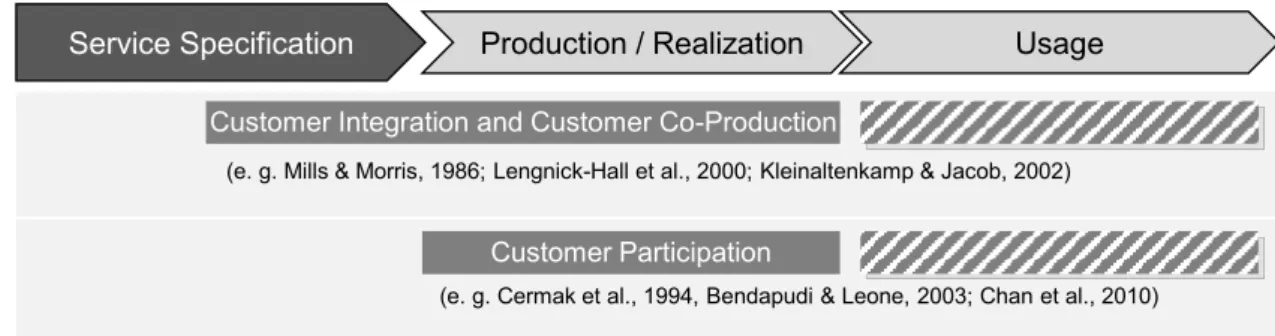
501 production stage by physically assembling parts of the service, or in the usage stage by using and evaluating the service (Fließ, 2009; Atakan et al., 2014a). Figure 1 shows the research focus of the discussed literature so far.
Fig. 1: Literature streams and stages of customer participation
Customers mainly participate to receive economic (Bitner et al., 1997; Meuter et al., 2000) and psychological benefits (Arnould and Price, 1993; Raaij and Pruyn, 1998). Economic benefits relate to enhanced service quality, reduced costs, or potential time savings (Kellogg et al., 1997; Meuter et al., 2000). In contrast, psychological benefits may refer to increased control over the service process, but also to the anticipated enjoyment of participation (Rodie and Kleine, 2000; Etgar, 2008). Literature further identifies customers´ ability, role clarity and motivation as key determinants of participation (Lengnick-Hall, 1996; Dellande et al., 2004; Chen et al., 2015). In addition, the physical and social surroundings as well as the service characteristics are regarded as influential factors on the degree of customer participation (Silpkait and Fisk, 1985; Chen et al., 2015).
Literature distinguishes mandatory and voluntary customer participation behavior (Bettencourt, 1997; Youngdahl et al., 2003; Büttgen, 2009; Revilla-Camacho et al., 2015). Other approaches focus on the stages of the service process in which the participation takes place (Raaij and Pruyn, 1998; Uzkurt, 2010). Atakan et al. (2014a), for instance, analyze customer participation in the design or input specification stage and the realization or physical production stage. Similarly, Dong (2015) identifies two types of customer participation. First, customers can contribute physical labor to the service process, thereby acting as producers. However, customers can also adopt the role of a “designer” and share information to design or specify a service or service offering.
The effect of customer participation has mainly been analyzed with regard to service quality (Cermak et al., 1994; Ennew and Binks, 1996; Dong et al., 2015), customer loyalty (Ennew and Binnks, 1999; Eisingerich and Bell, 2006; Auh et al., 2007), and customer satisfaction (Driscoll, 1978; Chan et al., 2010; Dabholkar and Sheng, 2012). In addition, recent research examines the effect of customer participation on the evaluation of the outcome (Norton et al., 2012; Mochon et al., 2012; Atakan et al., 2014a, 2014b; Xia/Suri, 2014; Dong, 2015). Most of the studies find positive effects of customer participation on the dependent variables. For instance, Dong et al. (2015) state that increased customer participation leads to enhanced perceived quality. Similarly, Auh et al. (2007) report a positive effect of participation on
Service Specification Production / Realization Usage
Customer Integration and Customer Co-Production
Customer Participation
(e. g. Mills & Morris, 1986; Lengnick-Hall et al., 2000; Kleinaltenkamp & Jacob, 2002)
502 customers´ attitudinal loyalty. Hsieh and Chang (2004) discover that participating customers indicate lower price sensitivity, whereas Franke et al. (2010) find a positive effect on customers´ willingness to pay for a customized offer. Literature argues that the customization process and the psychological reaction elicited by the process have to be considered to explain why customers value products that are adapted to their needs (Franke and Schreier, 2010).
However, when it comes to the effect on customer satisfaction, results are mixed. As one of the first, Driscoll (1978) finds in an organizational context that participating in decision making has a positive effect on satisfaction with the decision making process as well as with the decision itself. Dellande et al. (2004) conceptualize customer participation as the degree to which customers comply with a weight loss program´s requirement and show a positive effect of compliance on satisfaction. Dabholkar and Sheng (2012) report a positive effect of customers´ participation in using an online recommendation agent on customer satisfaction with the agent. Chan et al. (2010) and Yim et al. (2012) argue that the effect of customer participation on satisfaction is fully mediated by the creation of economic and relational value as well as participation enjoyment. Dong et al. (2008) even report a positive effect of customer participation in service recovery on satisfaction with service recovery.
In contrast to the reported findings, Bendapudi and Leone (2003) find that customers are more satisfied with a better-than-expected service when they have not participated in production. The authors argue that due to the self-serving bias, which refers to an individual´s tendency to attribute success to their own disposition and failure to external forces (Miller and Ross, 1975), customers claim responsibility for the successful outcome and are therefore less satisfied with the service provider than non-participating customers. Bendapudi and Leone (2003) also show that customers´ focus on the service process strongly increases when they participate, which in turn has a large effect on customers´ satisfaction. They suggest that service providers need to ensure a benefit providing process for customers.
However, we do not focus on customer participation at the production or realization stage of the service process but rather on customer participation at the specification stage (see figure 1). We further consider the fact that for many services, customers rather purchase a promise that the provider will deliver the service according to the specified conditions and characteristics and not the final service. Consequently, our aim is to report the effect of customer participation on satisfaction and behavioral intentions subsequent to the specification stage, but in addition also on satisfaction after the service was delivered and experienced by the customers.
Hypotheses Development
Literature offers several explanations for the effect of customer participation on satisfaction with the service process at the specification stage and the subsequent behavioral intentions. Since customer participation in the specification process enables a direct and active information exchange between customer and salesperson, customers may receive economic benefits such as better quality, a service customized to their needs, and increased control over the specification and the final outcome (Chan et al., 2010). Therefore, and in line with agency theory, customers can closely
503 monitor the provider´s behavior. In addition, customers may experience fun or enjoyment while participating in service specification (Yim et al., 2012). As Raaij and Pruyn (1998, p. 813) point out: “For some services, the specification and planning process may itself be enjoyable”. Furthermore, literature suggests satisfaction as a result of several customer participation behaviors such as preparation, relationship building, information exchange, and intervention (Kellogg et al., 1997). Consequently, receiving these bene-fits by actively participating in the service process may lead to an increased satisfaction with the service process (Patterson and Spreng, 1997). We therefore propose the following hypothesis:
H1,a: Customer participation at the specification stage of services increases customer satisfaction with the service process.
We further elaborate on the effect of participation on customers´ purchase intentions as variable which directly impacts the economic situation of the service provider. Especially for services where specification and delivery are separated by time, consumers might also behave in an opportunistic manner (e. g. Weiser, 2011). Since customers are not bound to a specific retailer, they also might use the received service know-how to purchase the service elsewhere or do it on their own, for instance booking the vacation trip online or planning the kitchen at a competitors´ outlet. However, we reason that customer find themselves psychologically tied to the service as result of their participation at the specification stage (Pierce et al., 2001, 2003). The authors reason that by controlling a target, getting to know the target intimately, or by investing themselves into the target, a state of mind that they call psychological ownership might develop. Pierce et al. (2001) further outline that investing the self includes investing one´s time, idea, skills, or intellectual and psychological energies. Literature further proposes customers´ purchase intention as consequence of such subjective ownership feelings (Fuchs et al., 2010). Therefore, we hypothesize that:
H1,b: Customer participation at the specification stage of services increases customers´ purchase intentions for the specified service.
Furthermore, word-of-mouth is of high relevance for service providers. This is especially true for services which are high of experience and credence qualities (Darby/Karni, 1973). In these cases, word-of-mouth helps to reduce the perceived risk or uncertainty of prospective customers. File et al. (1992) propose that customer participation is key to produce word-of-mouth. Similarly, Pozsnanski (2007) argues that customer participation positively affects word-of-mouth through its three antecedents perceived service quality, relationship quality, and customer retention. We therefore propose:
H1,c: Customer participation at the specification stage of services increases customers´ intentions to engage in positive word-of-mouth.
We further argue that satisfaction is a cognitive and affective evaluation of the service experience (Oliver, 1993). When the specified service is delivered, customers
504 evaluate what they receive. Following the conformation-disconfirmation paradigm (Oliver, 1980; Wirtz/Anderson, 1999), customers compare the outcome of the service with their expectations that they developed in the specification of the service. In case of a high satisfaction in the specification phase and a high satisfaction in the service delivery, customers feel a confirmation of their expectations. Thus, participation will have no additional positive effect on satisfaction with the delivered service. All customers are satisfied irrespective of their degree of participation.
However, when customers have a negative service experience, participation in the service specification may well have an impact on customers´ satisfaction. In the following, we discuss two different approaches.
First of all, we argue that participation subsumes relevant aspects of behavioral involvement (Silpakit/Fisk, 1985; Cermak et al., 1994). Hence, high participating customers are also highly involved in service specification. Literature has identified involvement as important driver of post-purchase attitude formation, repurchase intentions, and referrals (Cermak et al., 1997). It is generally assumed that consumers with high involvement are motivated to experience higher satisfaction (Bennett/Kennedy, 2007). Hence, if high participating customers experience a positive service, they are satisfied. However, if these customers are confronted with a negative experience, they most likely are even more dissatisfied as they experience a strong dis-confirmation of their needs.
Second, we build on Festinger´s (1957) theory of cognitive dissonance and argue that customers who actively participate in the specification of the service experience have two strongly unbalanced cognitions. One is the very positive experience in the service specification and the other is the negative experience in service delivery. Customers generally strive for an enduring balance of their cognitions. They try to reduce and finally eliminate their dissonance by selectively interpreting dissonance-inducing information, or by improving their attitude to the experience. Literature on escalation of commitment argues that decision makers which are personally responsible for a negative outcome and consequently have no others to blame also show this behavior and enhance their attitude towards their course of action in order to protect their self-esteem. (Staw, 1976; Brockner, 1992; Roth et al., 2014).
Although both approaches seem to lead to different conclusions, we reason that the underlying arguments align. We argue that high participating and highly involved customers who are confronted with a negative service experience also perceive a higher level of cognitive dissonance than those customers who play a rather passive role in service specification. These customers therefore feel a greater need to reduce this dissonance by the means proposed above.
Consequently, we expect customers who actively participated in the specification process to report higher satisfaction than those customers who did not participate. Therefore, we propose the following hypothesis:
H2,a: The service experience moderates the relationship between customer participation in the specification of services and customers´ satisfaction such that the effect of customer participation is stronger for a negative service experience than for a positive service experience.
505 Similarly, we expect customer participation to have no effect on repurchase intentions and word-of-mouth referrals when customers had a positive service experience. However, we argue that actively participating customers have higher intentions to repurchase or recommend since they improved their attitude towards the service. We therefore propose the following hypotheses:
H2,b: The service experience moderates the relationship between customer participation in the specification of services and customers´ purchase intentions such that the effect of customer participation is stronger for a negative service experience than for a positive service experience.
H2,c: The service experience moderates the relationship between customer participation in the specification of services and customers´ word-of-mouth such that the effect of customer participation is stronger for a negative service experience than for a positive service experience.
Methodology
Experiment
To test our hypotheses, we developed a scenario experiment and employed a mixed factorial design with two between and one repeated measures factor. First customer participation was manipulated (low vs. high). In the second step, we manipulated the experience of the delivered service (positive vs. negative). Thus we had subjects with a high or low customer participation who then experienced a positive or negative service outcome. Third, we measured our dependent variables twice: The first measure is taken at T1 which is just after the service specification. The second measure is taken at T2 which is after subjects have experienced the service.
Design and stimuli: Subjects read a scenario in which they should imagine to plan a customized holiday trip to a favorite country of their choice. They were further told that it was their first journey to this country which was the reason why they decided to consult a travel agency. The travel agent was described as friendly, polite and professional.
Subjects in the low-participation condition read that the travel agent planed the flights, destinations, accommodations, and daily activities according to their wishes. Hence, subjects´ participation in the specification process was low and rather passive. In contrast, subjects in the high-participation condition read that they planed their trip in close interaction with the travel agent, actively discussing destinations, sharing information, providing feedback on the agent´s suggestions, and making own suggestions in addition. Consequently, subjects´ participation was high and therefore time and energy consuming.
Afterwards, subjects of both groups were told that they received the printed details of the customized round trip and that the proposed trip matched their ideas, but the price slightly exceeded their initial budget. Subsequently, both groups had to indicate
506 how satisfied they were with the specification process and whether they intended to purchase the trip. Furthermore, they were asked to state their intention to recommend the travel agency to their friends and relatives (WOM).
In the next step, subjects were further divided into the two conditions to manipulate experience. In the positive experience condition subjects were told that they just came back from their journey and that everything was planned fine. In the negative experience condition they should imagine that they encountered some organizational problems. It is important to note that the manipulated positive vs. negative experiences were all in the travel agent´s scope of responsibility. It included organizational issues such as insufficient transfer times at the stop-over airport or the amount of visited sights each day.
After the scenario, we controlled for successful manipulation and measured customer satisfaction with the journey, repurchase intention and positive word-of-mouth behavior. At the end of the survey, participants answered questions on several control and demographic variables, such as age, gender, education, and income.
Subjects: The experiment was conducted at a computer lab of a German university. We recruited 149 participants for the experiment, whereby the participants have been randomly assigned to one of the conditions. Subjects were 36 % female with an average age of 22.30 (SD=2.45) years. The data collection was in conjuncture with an unrelated study on pricing. Subjects received 10 € compensation for their participation.
Measures: To measure our dependent variables, we adapted established scales from the marketing literature to the characteristics of the present research. All constructs were assessed using seven-point Likert scales (strongly disagree to strongly agree). The satisfaction construct was measured using a two-item scale from Ruyter, Bloemer, and Peeters (1997). We focus on a transactional rather than an attitudinal satisfaction. The two items of purchase intention were based on the research of Grewal, Monroe, and Krishnan (1998). The manipulation check was conducted using the five items of the customer participation scale proposed by Chan et al. (2010). Word-of-mouth (WOM) has been measured with indicators of Walsh and Beatty (2007). All items were separately translated and adapted by members of the research team, before they were agreed upon. All used scales fulfill the common quality criteria (Table 1). The discriminant validity is sufficiently high since the Fornell-Larcker-Criterion is satisfied for all constructs (Appendix 1).
507
Tab.1: Quality of Measurement
Manipulation Checks: First, we compare the means of the two experimental conditions for customer participation in T1. As expected, the mean values are significantly higher in the group with high customer participation (MCP_low=3.97, SD=1.51, n=83; MCP_high=6.19, SD=0.82, n=66) indicating that the manipulation was successful (F (1, 147)=113.58, p < 0.001). The manipulation of the travel experience in T2 was also successful (MExp_Neg=4.21, SD=0.65, n=77; MExp_Pos=6.50, SD=1.31, n=72; F(1, 147)=178.30; p < 0.001).
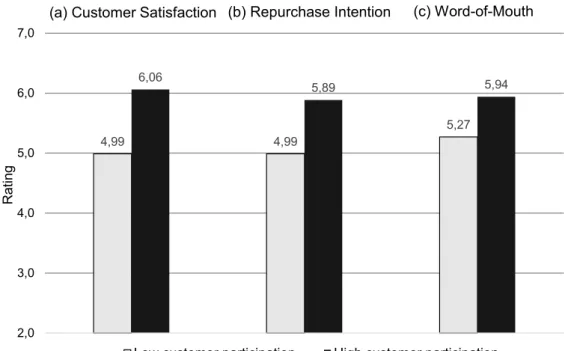
Results: In the first step of our analysis, we focus on subjects’ evaluations of the specification process in measurement point T1. First, we look at the differences in customer satisfaction with the specification process in the travel agency. In line with our hypothesis H1a, we find that a higher customer participation leads to a higher customer satisfaction (MCP_low=4.99, SD=1.51; MCP_high=6.06, SD=0.86, F(1, 147)= 26.55; p < 0.001) (Figure 2).
The very same pattern can be found with regard to purchase intention. Subjects who actively participated in the customization of the service show significantly higher ratings compared to subjects in the low participation condition and thereby support our hypothesis H1b (MCP_low=4.98, SD=1.53; MCP_high=5.88, SD=1.09, F(1, 147)= 16.13; p < 0.001).
Finally, the intended positive word-of-mouth behavior is also significantly increased in the group with a higher participation (MCP_low=5.27, SD=1.81; MCP_high=5.94, SD=0.92, F(1, 135)= 10.82; p < 0.01). H1c is also supported.
Construct Means Factor
Loadings
Composite Reliability
AVE Cronbachs Alpha
Cutoff-Criterion > 0.4 > 0.6 > 0.5 > 0.7
Satisfaction T1- 1 5.41
0.963 0.964 0.930 0.919
Satisfaction T1- 2 5.60 Purchase Intention T1- 1 5.61
0.944 0.939 0.885 0.871
Purchase Intention T1- 2 5.18
WOM T1- 1 5.68
0.949 0.964 0.900 0.945
WOM T1- 2 5.39
Satisfaction T2- 1 5.19
0.963 0.937 0.882 0.921
Satisfaction T2- 2 5.44 Repurchase Intention T2 - 1 5.17
0.988 0.990 0.981 0.976
Repurchase Intention T2 - 2 4.87
WOM T2- 1 5.28
0.963 0.977 0.934 0.977
508
Fig. 2: Customer Participation Low vs. High
In the second step, we shift our focus on subjects’ evaluations after they have experienced a positive or negative journey in measurement point T2. To account this second measurement we apply a mixed methods ANOVA and control for within-subject effects.
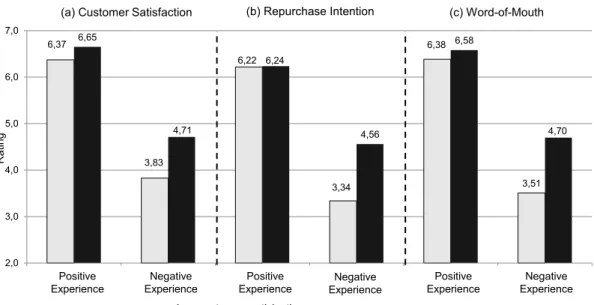
Customers who had a positive travel experience are highly satisfied with the journey regardless whether they were previously in the low or high participation condition. The satisfaction is only slightly different on a very high level (Figure 2). In contrast and as expected, subjects in the negative experience group were less satisfied with the journey (MExp_Neg=4.20, SD=1.31; MExp_Pos=6.50, SD=0.65). The total between-subjects effect is significant (F (1, 145)=50.874, p < 0.001). The within-subject effect of satisfaction is not significant (F (1, 145)=2.30, p = n.s.).
However, we find remarkable differences between subjects who have previously been exposed to low vs. high customer participation in the specification phase. Subjects in the low participation group also indicated a fairly low satisfaction with the journey whereas customers with high participation were more satisfied (MCP_low=3.83, SD=1.39; MCP_high=4.71, SD=1.00). The interaction effect of customer participation and experience is significant (F (1, 145)=3.33, p < 0.1).
4,99 4,99
5,27 6,06
5,89 5,94
2,0 3,0 4,0 5,0 6,0 7,0
SatisfactionLow customer participationPurchase IntentionHigh customer participationWOM (a) Customer Satisfaction (b) Repurchase Intention (c) Word-of-Mouth
R
atin
509
Fig. 3: Experience x Customer Participation
As for satisfaction, the very same results can also be found for intention to purchase the journey again. Whereas repurchase intentions are equally high for subjects who experienced a positive journey, intentions are lower when the experience has been negative (MExp_Neg=3.95, SD=1.45; MExp_Pos=6.23, SD=0.94). Again, we find a significant between subjects effect (F (1, 144)=9.465; p < 0.01), a non-significant within-subjects effect (F (1, 144)=0.249; p = n.s.) and a significant interaction (F (1, 144)=4.47; p < 0.05).
Our findings are further supported by the results for WOM intention for the positive and negative journey experience (MExp_Neg=4.02, SD=1.55; MExp_Pos=6.42, SD=0.71) with significant between-subjects (F (1, 144)=153.95; p < 0.001) and non-significant within-subject effects (F (1, 144)=1.527; p = n.s.). The interaction is again significant (F (1,144)=6.406; p < 0.05). Our data on all three constructs provide evidence to support H2a, H2b and H2c. As a final point, we controlled for several confounding factors such as age, gender and income without any significant results.
General Discussion
In our study, both the low vs. high participation group were confronted with a service specification process in which the specified offer fits their needs. Therefore, the level of satisfaction, purchase intentions and word-of-mouth intention is fairly high across all customers.
Despite this overall high satisfaction level, customers are even more satisfied with this specification process when they have a high level of participation. They are also more likely to actually purchase the service and to recommend the service provider to their friends and relatives.
Our data reveals that it is beneficial for the service provider who specifies the service to actively integrate the customer into the specification process. This is an
6,37 3,83 6,22 3,34 6,38 3,51 6,65 4,71 6,24 4,56 6,58 4,70 2,0 3,0 4,0 5,0 6,0 7,0
Positive Reise Negative Reise Positive Reise Negative Reise Positive Reise Negative Reise
Geringe KM Hohe KM
Negative Experience
(a) Customer Satisfaction (b) Repurchase Intention (c) Word-of-Mouth
Negative Experience Negative Experience Positive Experience Positive Experience Positive Experience
Low customer participation High customer participation
R
atin
510 important implication since service providers often suffer from the fact that customers engage in a time and cost consuming service specification process without actually closing the deal.
However, this research goes one step further: We find that customer participation also unfolds a positive impact on the evaluation of the delivered service. We are aware of the fact that this finding is contentious. Bendapudi and Leone (2003) argue that customers attribute a positive service experience to themselves and a negative experience to the provider. However, when the service is a positive experience for the customer, our results suggest that participation in its previous specification does not play an important role. Regardless of the degree of participation all customers are highly satisfied. The high expectations that customers have are simply fulfilled. The positive experience is not able to delight customers. We therefore believe that a positive disconfirmation does not take place. We do not find the negative effect of customer participation as a result of a self-serving bias.
As a possible explanation we build on research on service expectations. It argues that an interactive specification process gives customers the chance to articulate and to build their preferences when they are still vague (Simonson, 2005; Franke et al., 2009). Through this clarification the probability of an “above expected” service experience can be lowered. In this light, our results even match findings of Bendapudi and Leone (2003) who also exhibit no effect of customer participation on satisfaction in case of an “as expected” service experience.
The most remarkable result of our study is that customer participation has a positive impact on satisfaction and behavioral intentions when customers have a negative service experience.
In case of a “lower as expected” service experience, Bendapudi and Leone (2003) argue that customers attribute the service failure to the service provider rather than to themselves. Following this idea we would expect that customers with a high participation are even less satisfied when they experience an inferior service.
However, our data does not support this notion. Our reasoning for this is that in contrast to Bendapudi and Leone (2003) customers in our example pass through two different stages: service specification and service experience. We believe that self-enhancing attribution as proposed in the self-serving-bias is only one way to reduce cognitive dissonance in case of a negative experience. We argue that customers avoid cognitive dissonance by feeling a higher satisfaction with the service that they planned themselves.
After the service specification, customers are already satisfied with the specification process. When customers experience the service they stick to the evaluation that they developed in the specification stage. They exchange dissonant cognitions with more positives that match their positive opinion of the full transaction. Even if they have a negative subsequent service experience they strive for an enduring balance of their cognitions. They try to reduce and finally eliminate their dissonance by selectively interpreting dissonance-inducing information, in this case their service experience, or by improving their attitude to the experience (Festinger, 1957).
In addition, the investment of time and effort as well as the responsibility for the decisions increases the commitment and evaluation of the service even if is not
511 satisfying (Roth et al, 2014; Brockner, 1992). This is in line with findings of Swan and Oliver (1991) who also find that customers actively monitor their inputs in the specification process which in turn have a positive impact on satisfaction.
Limitation and Outlook
Although the experiments reveal important results, our research is subject to some limitations. Our study is based on a limited student sample and hypothetical choices. Further empirical support is needed to support the results that we find in this scenario experiment. It is tempting to find out if our results can be found in a setting were the time delay between the evaluation of the specification and the delivery is much longer. Also our study could be extended with a condition in which customers experience a positive disconfirmation. In addition, our study only manipulates customer participation in the specification phase of the service. To this point, we do not address the question on how an additional manipulation of the participation in service production or delivery would influence our results.
In line with this, we see a lot of potential for further research: An interesting question concerns the role of customer participation in the specification process for the development, adaptation, or concretion of customers´ expectation towards the specified service (Straus et al., 2015). Furthermore, a more detailed analysis of customers´ perception of the specification process may provide researchers as well as practitioners with more insights on the potential benefits and drawbacks of customer participation (Schmitz/Imgrund, 2013). Here, adapting the cost-benefit based research approach of mass customization research might be a promising avenue (see Merle et al., 2010; Franke/Schreier, 2010). Thereby, factors such as economic value, participation enjoyment or perceived process costs can be included as mediators on the relationship between customer participation and satisfaction or purchase intention. Finally, the moderating impact of personality traits as well as service characteristics should further add to our understanding of customer participation at the specification stage of the service process (e.g. Dong et al., 2015).
References
Arnould, E. J., & Price, L. L. (1993). River magic: Extraordinary experience and the extended service encounter. Journal of consumer research, 20(1), 24-45.
Atakan, S. S., Bagozzi, R. P., & Yoon, C. (2014a). Consumer participation in the design and realization stages of production: How self-production shapes consumer evaluations and relastionships to products. International journal of research in marketing, 31(4), 395-408.
Atakan, S. S., Bagozzi, R. P., & Yoon, C. (2014b). Make it your own: How process valence and self‐construal affect evaluation of self‐made products. Psychology & marketing, 31(6), 451-468.
512 Auh, S., Bell, S. J., McLeod, C. S., & Shih, E. (2007). Co-production and customer
loyalty in financial services. Journal of retailing, 83(3), 359-370.
Bendapudi, N., & Leone, R. P. (2003). Psychological implications of customer participation in co-production. Journal of marketing, 67(1), 14-28.
Bennett; R., J. R. McColl-Kennedy, &. Coote, E. V. (2007). Involvement, satisfaction, and brand loyalty in a small business services setting. Journal of business research, 60(12), 1253-1260.
Bettencourt, L. A., & Gwinner, K. (1996). Customization of the service experience: The role of the frontline employee. International journal of service industry management, 7(2), 3-20.
Bitner, M. J., Faranda, W. T., Hubbert, A. R., & Zeithaml, V. A. (1997). Customer contributions and roles in service delivery. International journal of service industry management, 8(3), 193-205.
Brockner, J. (1992). The escalation of commitment to a failing course of action: Toward a theoretical progress, Academy of the management review, 17(1), 39-61. Büttgen, M., Schumann, J. H., & Ates, Z. (2012). Service locus of control and
customer coproduction: The role of prior service experience and organizational socialization. Journal of service research, 15(2), 166-181.
Büttgen, M. (2009). Beteiligung von Konsumenten an der Dienstleistungserstellung: Last oder Lust? – Eine motivations- und dissonanztheoretische Analyse. In: Bruhn, M., & Stauss, B. (Eds.): Kundenintegration – Forum Dienstleistungsmanagement, Wiesbaden, 63-89.
Cermak, D. S. P., File, K. M., & Prince, R. A. (1994). Customer participation in service specification and delivery. Journal of applied business research, 10(2), 90-97. Chan, K. W., Yim, C. K. B., & Lam, S. S. K. (2010). Is customer participation in value
creation a double-edged sword? Evidence from professional financial services across cultures. Journal of marketing, 74(3), 48-64.
Chen, S. C., Raab, C., & Tanford, S. (2015). Antecedents of mandatory customer participation in service encounters: An empirical study. International journal of hospitality management, 46, 65-75.
Dabholkar, P. A., & Sheng, X. (2012). Consumer participation in using online recommendation agents: effects on satisfaction, trust, and purchase intentions. Service industries journal, 32(9), 1433-1449
Darby, M. R., & Karni, E. (1973). Free competition and the optimal amount of fraud. Journal of law and economics, 16(1), 67-88.
Dellande, S., Gilly, M. C., & Graham, J. L. (2004). Gaining compliance and losing weight: The role of the service provider in health care services. Journal of marketing, 68(3), 78-91
Dellaert, B./Stremersch, S. (2005): Marketing Mass-Customized Products: Striking a Balance between Utility and Complexity. Journal of marketing research, 42(2), 219-227.
Dong, B. (2015). How a customer participates matters: “I am producing” versus “I am designing”. Journal of services marketing, 29(6/7), 498-510.
Dong, B., Evans, K. R., & Zou, S. (2008). The effects of customer participation in co-created service recovery. Journal of the academy of marketing science, 36(1), 123-137.
513 Dong, B., Sivakumar, K., Evans, K. R., & Zou, S. (2015). Effect of customer participation on service outcomes: The moderating role of participation readiness. Journal of service research, 18(2), 160-176.
Driscoll, J. W. (1978). Trust and participation in organizational decision making as predictors of satisfaction. Academy of management journal, 21(1), 44-56.
Eisingerich, A. B., & Bell, S. J. (2006). Relationship marketing in the financial services industry: The importance of customer education, participation and problem management for customer loyalty. Journal of financial services marketing, 10(4), 86-97.
Ennew, C. T., & Binks, M. R. (1996). Good and bad customers: The benefits of participating in the banking relationship. International journal of bank marketing, 14(2), 5-13.
Ennew, C. T., & Binks, M. R. (1999). Impact of participative service relationships on quality, satisfaction and retention: an exploratory study. Journal of business research, 46(2), 121-132.
Etgar, M. (2008). A descriptive model of the consumer co-production process. Journal of the academy of marketing science, 36(1), 97-108.
Festinger, L. (1957). A theory of cognitive dissonance. Stanford: Stanford University Press.
File, K., Judd, B. B., & Prince, R. A. (1992). Interactive marketing: The influence of participation on positive word-of-mouth and referrals. Journal of services marketing, 6(4), 5-14.
Fließ, S. (2009). Dienstleistungsmanagement – Kundenintegration gestalten und steuern, Wiesbaden.
Franke, N., Schreier, M., & Kaiser, U. (2010). The “I designed it myself” effect in mass customization. Management science, 56(1), 125-140.
Franke, N., & Schreier, M. (2010). Why customers value self‐designed products: The importance of process effort and enjoyment. Journal of product innovation management, 27(7), 1020-1031.
Franke, N., Keinz, P., & Steger, C. J. (2009). Testing the value of customization: When do customers really prefer products tailored to their preferences? Journal of marketing, 73(5), 103-121.
Fuchs, C., Prandell, E., & Schreier, M. (2010). The psychological effects of empowerment strategies on consumers´ product demand. Journal of marketing, 74(1), 65-79.
Goff, B. G., Boles, J. S., Bellenger, D. N., & Stojack, C. (1997). The influence of salesperson selling behaviors on customer satisfaction with products. Journal of retailing, 73(2), 171-183.
Grewal, D., Monroe, K. B., & Krishnan, R. (1998). The effects of price-comparison advertising on buyers' perceptions of acquisition value, transaction value, and behavioral intentions. Journal of marketing, 62(2), 46-59.
Haas, A. (2006): Bestimmungsfaktoren des Beratungserfolgs - Eine informationsökonomische Betrachtung und empirische Analyse im Handel. Schmalenbachs Zeitschrift für betriebswirt-schaftliche Forschung, 58(5), 510-536. Haas, A., & Kenning, P. (2014). Utilitarian and hedonic motivators of shoppers’
514 Harris, K., Harris, R., & Baron, S. (2001). Customer participation in retail service: Lessons from Brecht. International journal of retail & distribution management, 29(8), 359-369.
Hsieh, A. T., & Chang, E. T. (2004). The effect of consumer participation on price sensitivity. Journal of consumer affairs, 38(2), 282-296.
Hsieh, A. T., Yen, C. H., & Chin, K. C. (2004). Participative customers as partial employees and service provider workload. International journal of service industry management, 15(2), 187-199.
Kelley, S. W., Donnelly Jr, J. H., & Skinner, S. J. (1990). Customer participation in service production and delivery. Journal of retailing, 66(3), 315-356.
Kellogg, D. L., Youngdahl, W. E., & Bowen, D. E. (1997). On the relationship between customer participation and satisfaction: Two frameworks. International journal of service industry management, 8(3), 206-219.
Kleinaltenkamp, M., & Jacob, F. (2002). German approaches to business-to-business marketing theory: Origins and structure. Journal of business research, 55(2), 149-155.
Leischnig, A., & Messer, U. (2014). Service Value durch Customization – Implikationen für die Gestaltung des Dienstleistungsmanagements. In: Bruhn, M., & Hadwich, K. (Eds.). Ser-vice Value als Werttreiber – Konzepte, Messung und Steuerung, Wiesbaden, S. 245-264.
Lengnick-Hall, C. A. (1996). Customer contributions to quality: A different view of the customer-oriented firm. Academy of management review, 21(3), 791-824.
Lengnick-Hall, C. A., Claycomb, V. C., & Inks, L. W. (2000). From recipient to contributor: Examining customer roles and experienced outcomes. European journal of marketing, 34(3/4), 359-383.
Menon, K., & Dubé, L. (2000). Ensuring greater satisfaction by engineering salesperson response to customer emotions. Journal of retailing, 76(3), 285-307. Merle, A., Chandon, J. L., Roux, E., & Alizon, F. (2010). Perceived value of the mass‐
customized product and mass customization experience for individual consumers. Production and operations management, 19(5), 503-514.
Meuter, M. L., Ostrom, A. L., Roundtree, R. I., & Bitner, M. J. (2000). Self-service technologies: Understanding customer satisfaction with technology-based service encounters. Journal of marketing, 64(3), 50-64.
Miller, D. T., & Ross, M. (1975). Self-serving biases in the attribution of causality: Fact or fiction? Psychological bulletin, 82(2), 213-225
Mills, P. K., & Morris, J. H. (1986). Clients as “partial” employees of service organizations: Role development in client participation. Academy of management review, 11(4), 726-735.
Mochon, D., Norton, M. I., & Ariely, D. (2012). Bolstering and restoring feelings of competence via the IKEA effect. International journal of research in marketing, 29(4), 363-369.
Moeller, S., Ciuchita, R., Mahr, D., Odekerken-Schröder, G., & Fassnacht, M. (2013): Un-covering collaborative value creation patterns and establishing corresponding customer roles. Journal of service research, 16(4), S. 471-487.
Norton, M. I., Mochon, D., & Ariely, D. (2012). The IKEA effect: When labor leads to love. Journal of consumer psychology, 22(3), 453–460.
515 Oliver, R. (1980): A cognitive model of the antecedents and consequences of
satisfaction decisions. Journal of marketing research, 17(4), S. 460-470.
Oliver, R. L. (1993). Cognitive, affective, and attribute bases of the satisfaction response. Journal of consumer research, 20(3), 418-430.
Patterson, P. G., & Spreng, R. A. (1997). Modelling the relationship between perceived value, satisfaction and repurchase intentions in a business-to-business, services context: An empirical examination. International journal of service industry management, 8(5), 414-434.
Pierce, J., Kostova, T., & Dirks, K. (2001). Toward a theory of psychological ownership in organizations. Academy of management review, 26(2), 298-310.
Pierce, J.L., Kostova, T., & Dirks, K.T. (2003). The state of psychological ownership: Inte-grating and extending a century of research. Review of general psychology, 7(1), 84-107.
Poznanski, S. (2007). Wertschöpfung durch Kundenintegration: eine empirische Untersuchung am Beispiel von strukturierten Finanzierungen. Springer-Verlag. Raaij, W. F. Van, & Pruyn, A. T. (1998). Customer control and evaluation of service
validity and reliability. Psychology & marketing, 15(8), 811-832.
Revilla-Camacho, M. Á., Vega-Vázquez, M., & Cossío-Silva, F. J. (2015). Customer participation and citizenship behavior effects on turnover intention. Journal of business research, 68(7), 1607-1611.
Roth, S., Robbert, T. & Straus, L. (2014): On the sunk-cost effect in economic decision making - A meta-analytic review. Business research, 8(1), 1-40.
Rodie, A. R., & Kleine, S. S. (2000): Customer participation in services production and delivery. In: Swartz, T.A./Iacobucci, D. (Eds.): Handbook of services marketing and Management, Thousand Oaks, S. 111-125.
De Ruyter, K., Bloemer, J., & Peeters, P. (1997). Merging service quality and service satisfaction: An empirical test of an integrative model. Journal of economic psychology, 18(4), 387-406.
Schmitz, G., & Dietz, M. (2010). Individualisierung im stationären Einzelhandel: Möglichkeiten, kundenseitige Bewertung und Ansatzpunkte technologischer Unterstützung. In: Becker, J., Knackstedt, R., Müller, & Winkelmann, A. (Eds.): Vertriebsinformationssysteme: Standardisierung, Individualisierung, Hybridisierung und Internetisierung, Heidelberg, 51-69.
Schmitz, G., & Imgrund, F. (2013). Dienstleistungsindividualisierung – Umsetzung und kundenseitige Wirkung. In: Roth, S. (Eds.). Aktuelle Beiträge zur Dienstleistungsforschung, Wiesbaden , 123-150.
Silkapit, P., & Fisk, G. D. (1985). Participatizing’ the service process: A theoretical frame-work. In T. M. Bloch, G. D. Upah, & V. A. Zeithaml (Eds.), Services marketing in a changing environment (pp. 117-121). American Marketing Chicago. Simonson, I. (2005). Determinants of customers’ responses to customized offers:
Conceptual framework and research propositions. Journal of marketing, 69(1), 32-45.
Staw, B. M. (1976). Knee-deep in the big muddy: A study of escalation of commitment to a chosen course of action, Organizational behavior and human performance, 16(1), 27-44.
516 Straus, L., Robbert, T., & Roth, S. (2015). Kunden-Anbieter-Interaktionen in der Spezifizierungsphase bei Dienstleistungen. In: Bruhn, M., & Hadwich, K. (Eds.): Interaktive Wertschöpfung durch Dienstleistungen - Strategische Ausrichtung von Kundeninteraktionen, Geschäftsmodellen und sozialen Netzwerken, Forum Dienstleistungsmanagement 2015, Wiesbaden, 261-286.
Swan, J. E., & Oliver R. L. (1991). An applied analysis of buyer equity perceptions and satisfaction with automobile salespeople. Journal of personal selling and sales management, 11(2), 15-26.
Troye, S. V., & Supphellen, M. (2012). Consumer participation in coproduction: “I made it myself” effects on consumers' sensory perceptions and evaluations of outcome and input product. Journal of marketing, 76(2), 33-46.
Uzkurt, C. (2010). Customer participation in the service process: a model and research propositions. International journal of services and operations management, 6(1), 17-37.
Walsh, G., & Beatty, S. E. (2007). Customer-based corporate reputation of a service firm: Scale development and validation. Journal of the academy of marketing science, 35(1), 127-143.
Weisser, J. (2011): Pfand und Anreizsysteme - Wirkung auf
Kaufentscheidungsprozesse im Tourismus, Wiesbaden.
Xia, L., & Suri, R. (2014). Trading effort for money: Consumers’ cocreation motivation and the pricing of service options. Journal of service research, 17(2), 229-242.
Yim, C. K. B., Chan, K. W., & Lam, S. S. K. (2012). Do customers and employees enjoy service participation? Synergistic effects of self-and other-efficacy. Journal of marketing, 76(6), 121-140.
Youngdahl, W. E., Kellogg, D. L., Nie, W., & Bowen, D. E. (2003). Revisiting customer participation in service encounters: does culture matter? Journal of operations management, 21(1), 109-120.
517
Appendix
App. 1: Squared-Multiple-Correlations of Latent Constructs
T1 T2
Satisfaction Purchase Intention
WOM Satisfaction Purchase
Intention
WOM
Satisfaction 1 0.635 0.587 Satisfaction 1 0.815 0.874
Purchase
Intention 1 0.475
Purchase
Intention 1 0.870