Evaluation of Seismic Performance of Concrete Gravity Dams Under
Soil-structure-reservoir Interaction Exposed to Vertical Component
of Near-field Earthquakes During Impounding (Case study: Pine Flat
Dam)
Farzad Naseri1, Ahad Bagherzadeh Khalkhali2*
1 Department of Civil engineering, Islamic Azad University-Electronic Branch, Tehran, Iran
2 Department of Civil Engineering, Science and Research Branch, Islamic Azad University, Tehran, Iran
*Correspondence should be addressed to Ahad Bagherzadeh Khalkhali, Department of Civil Engineering, Science and Research Branch, Is-lamic Azad University, Tehran, Iran; Tell: +989121023519; Fax: +9888944857; Email: [email protected].
ABSTRACT
Given the current water crisis in the world and the fact that dams are superstructures for water conservation in agricultural and domestic uses, the seismic performance of Pine Flat Dam is evaluated under the soil-structure-reservoir interaction ex-posed to vertical component of near-field earthquakes in this study. Hence the dam is modeled in the plane strain space un-der the foundation-structure-fluid interaction using Abaqus finite element software in orun-der to consiun-der the effects of founda-tion flexibility and hydrodynamic forces. The reservoir is modeled in 3 full, half-full and empty condifounda-tions and the results are assessed and presented for each condition. The results of analysis show that when the dam is in use and the entire volume of reservoir is filled with water and the conditions of near-field earthquakes are predominated, more displacement is applied to the dam, which may make it enter the nonlinear region.
Key words:Water crisis, Concrete dam, Effect of vertical component, Soil-structure-reservoir interaction, Near-field fault.
Copyright © 2018 Farzad Naseri et al. This is an open access paper distributed under the Creative Commons Attribution License.
Journal of Civil Engineering and Materials Applicationis published byRaika Pajuhesh Pars; Journal p-ISSN xxxx-xxxx; Journal e-ISSN 2588-2880.
1. INTRODUCTION
ater supply has been always in the forefront of human’s mind as the most crucial need for liv-ing (1). Today this need has also appeared in the policies of different nations around the world, so that geopolitical experts predict many wars to achieve water supplies (2). Meanwhile, the Middle East is one of the main centers of the crisis, facing a severe water scarcity (3). Moreover, dams are among the most important structures in today’s industrial life, which are constructed for a varie-ty of purposes, e.g. hydroelectric power generation, water storage for agricultural and industrial uses, flood control and drinking water supply. According to the reports of Iranian Bulletin of Water Research, the average annual rainfall is about 252 mm in Iran, which equals about one-fourth of the average rainfall in the world and one-third of the average rainfall in Asia. Therefore, Iran is known as a dry region in the world. On the other hand, Iran is one of
the countries exposed to numerous severe earthquakes. Since most dams are constructed in high seismic risk areas in Iran, it is of particular importance to achieve adequate safety of dams against earthquakes (4). Numerous studies were carried out for seismic assessment of the dams under a variety of accelerograms. The occurrence, type and direc-tion of seismic waves and frequency content are all factors which play an essential role in the dynamic response of dams (5-9). In the studies, different mechanisms were con-sidered for support conditions and its impact on seismic performance of concrete dams; the main incompetence of these models was due to the dramatic difference between the motions in lower soil layers and the reality (10). In a modeling in China, the allowable stress under seismic stimulation and elastic modulus were increased by 30% for a damping ratio of 0.05 and it was concluded that the foundation flexibility changes the motion frequencies and dam-foundation movement modes (11). The dynamic
effects of energy absorption at the end boundary of the reservoir and it was found that a great part of energy is absorbed by water and the construction cost is reduced significantly if water is supposed incompressible (12). An-other study was carried out about the Morrow Point Dam and the effect of reservoir-foundation rock-dam interaction on the linear and nonlinear response of the arch dam was examined. The results showed that when the reservoir is empty and the foundation is considered rigid, the maxi-mum frequency response is received from the model (13). It is so useful to investigate the nonlinear analyses of be-havior response of dam structure. The most absolute meth-od for the seismic analysis of dams in accordance with dam-reservoir-foundation interaction was done considering the nonlinear behavior of materials (14-17). In 2013, an-other research was conducted on Pine Flat Dam through the NSAG-DRI program. In this research, six near-field earthquake records were used for both mass and massless foundation states. The results demonstrated that the proba-bility of surface crack limitation is almost the same for both models with and without foundation (13). In this study, the effects of vertical component of near-field accel-erograms is assessed for three empty, half-full and full reservoir conditions under the soil-structure-reservoir in-teraction.
2. MATERIALS AND METHODS
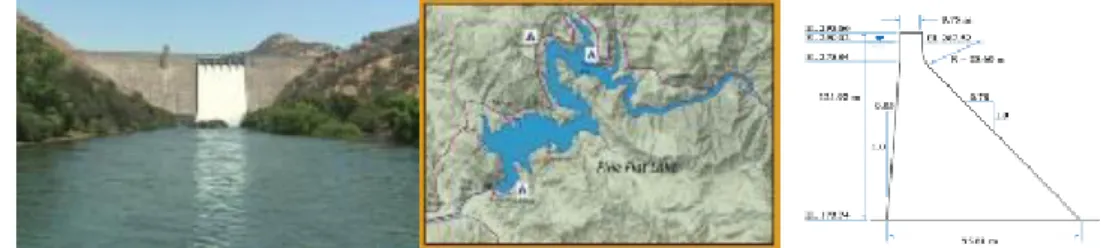
Concrete dams are an important part of superstructures in each country. The safety of these structures is so important due to detrimental consequences of their destruction and damage. Gravity dams are concrete hydraulic structures which maintain their stability and water stored in the reser-voirs by resisting the applied forces often through the ge-ometric shape, weight and strength of concrete. Pine Flat Dam is selected as a case study to investigate the behavior of gravity dams under dynamic loads. Located on the Kings River in California State, this dam consists of 36 monoliths 15 m in width and 1 monolith 12 m in width and forms the Pine Flat reservoir. The crest of the dam is 550 m long and its highest monolith is 122 m in height. The dam section is illustrated in the figure below. The width of the dam is 97 m at the base level and about 10 m at the crest level. The upstream face of the dam is not vertical and has a slope of 5% from the base to the level of 102 m. The dam is employed primarily for flood control and sec-ondarily for irrigation and recreational uses. The Abaqus software is utilized for numerical simulation of the dam. This software can simulate the seismic analysis accurately through its explicit and implicit dynamical solver code and there is a variety of fluid simulation methods and nonlinear behavioral models of materials in the database of this soft-ware, whose specifications can be easily used for modeling purposes. Figure 1 shows the picture and geometric condi-tions of this dam.
Figure 1. Geometric conditions of Pine Flat Dam (2)
3. MODELING
The plane strain 4-node element with reduced integration (CPE4R) is used for the modeling of foundation, the two-dimensional plane strain 4-node linear element (CPE4) is used for the modeling of dam and the acoustic plane strain 4-node element with reduced integration (AC2D4R) is used for the modeling of reservoir behind the dam.
4. VALIDATION OF NUMERICAL MODEL
The model used by Chopra and Fenves is employed to val-idate the modeling method in this study (18). They used the S69E component of Taft earthquake accelerogram in
their study. When the dam-reservoir-foundation system is numerically simulated via Abaqus software (19) and this earthquake is applied, the horizontal displacement time history at the dam crest is derived from the Abaqus and compared to the results of Chopra and Fenves. It is ob-served that the extrema of both charts are the same and the maximum displacements are 1.45 and 1.39 inches, respec-tively, with a difference less than 5%. Therefore, the mod-eling method can be reliably utilized for numerical studies in this research (Figure 2).
Figure 2. Comparison of numerical results of validation model and results of studies by Chopra and Fenves (18)
5. BOUNDARY CONDITIONS
There is the roller boundary condition in lateral edges of the foundation. The acoustic boundary condition is also used at the left end of reservoir to prevent the return of seismic waves. The physical properties of inter-surface contacts are determined via the interaction environment of the software. The contact condition between the dam sides and the bed of the valley is considered rough with node-to-node contact (tie), so that any displacement in the bed of
the valley is transferred to the dam. The contact conditions between the reservoir water and dam and between the res-ervoir water and sides of the valley are considered with the tie without friction.
6. MATERIAL PROPERTIES
The International System of Units (SI) is used to define materials in this study. The units used in this system are given in the Table 1:
Table 1. Units used by Abaqus software
Variable Stress Time Mass Length
Unit Pascal
(N/mm2) Second Kilogram Meter
Hence the model outputs are also presented accordingly. Table 2 represents the numerical properties of materials
used for each section.
Table 2. Material properties
Water Foundation Dam Unit Parameter
2070 24000 27580 (MPa) Elastic modulus (E)
- 0.25 0.2 - Poisson ratio (ν)
1000 2500 2400 (Kg/m3
) Density (ρ)
3 (MPa) Tensile strength of concrete (σt0)
0.00023 - Ultimate tensile strain
The equations proposed by the ASCE and Rashid et al are used to calculate other mechanical properties of concrete and stress-strain curves (20).
7. INTRODUCTION OF APPLIED
ACCELERO-GRAMS
In dynamic analysis, an important part of modeling is to select and apply the earthquake spectra to the model. Six different earthquakes of different natures are chosen to create different natural conditions and applied to the foun-dation-dam interaction boundary in terms of spectral accel-eration. The spectral acceleration, velocity and displace-ment caused by earthquake are then presented, which are calculated using the SeismoSignal software. Entire
accel-erations are scaled up to a maximum value of 0.15g using the software, according to the dynamic analysis of dams by the USBR.
The accelerograms used for this study are as follows:
1. Loma Prieta: The earthquake measuring 9.9 on the Richter scale occurred in 1988 in northern California (21).
2. Friuli: The earthquake measuring 6.5 on the Rich-ter scale occurred in 1976 in northern Italy (22). 3. Hollister: The earthquake measuring 6.8 on the
Richter scale occurred in 1989 in San Francisco (23).
4. Imperial Valley: The earthquake measuring 6.4 on the Richter occurred in 1979 in the southern
Mex-ico City (24).
5. Kobe: The earthquake measuring 6.8 on the Rich-ter occurred in June 1995 within 20 km from Ko-be, Japan (25).
6. Landers: The earthquake occurred in 1992 in Landers, California. This earthquake has been the most severe earthquake in California for the last 40 years (26).
8. DISCUSSION AND CONCLUSION
8.1. Assessment of dam response under vertical component of near-field earthquakes
Figures Figure 3, Figure 4Figure 5, Figure 6Figure 7Figure
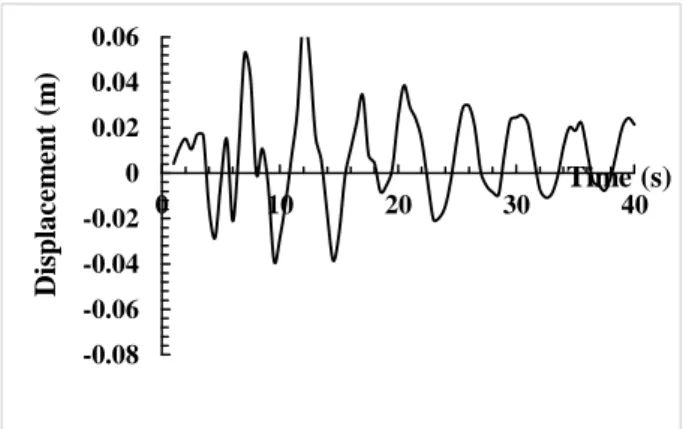
8 demonstrate the displacements of the dam crest under seismic stimuli of near-field earthquakes for the full reser-voir condition, considering the vertical component of earthquake for the full reservoir condition. According to the results, a maximum displacement of 8.1 cm is reported for the Loma Prieta earthquake, when the earthquake ac-celeration reaches its peak. The negative sign indicates that the direction of dam movements is towards the upstream. In the Friuli earthquake, a maximum displacement of 2.2 cm occurs at the third second for this condition.
-0.08 -0.06 -0.04 -0.02 0 0.02 0.04 0.06
0 10 20 30 40
Dis
pla
ce
m
ent
(
m
)
Time (s)
Figure 3. Displacement-time history of dam crest for model Kobe-Nv-1
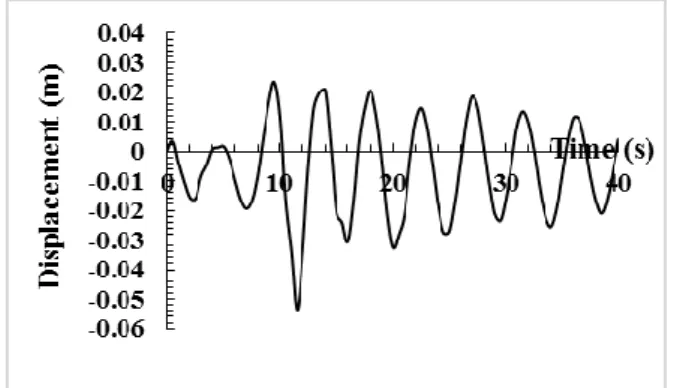
Figure 4. Displacement-time history of dam crest for model Imperial Valley-Nv-1
Figure 6. Displacement-time history of dam crest for model Landers-Nv-1
Figure 7. Displacement-time history of dam crest for model Loma Prieta-Nv-1
Figure 8. Displacement-time history of dam crest for model Friuli-Nv-1
According to Figures Figure 9, Figure 10, Figure 11, Figure 12, Figure13Figure 14, it is observed that in the Imperial
Valley and Loma Prieta earthquakes, the maximum dis-placement of the dam under vertical component of near-field stimuli is low at the beginning moments and then rises significantly and the maximum displacement is seen for these two accelerograms. Small displacements are
ob-served in other parts of the range. According to the charts and occurred displacements, it should be noted that the Kobe and Landers earthquakes may also cause damage to the dam and must not be ignored. In general, however, the maximum displacements are reduced dramatically com-pared to the displacements for the full reservoir condition.
Figure 9. Displacement-time history of dam crest for model Kobe-Nv-2
Figure 10. Displacement-time history of dam crest for model Imperial Valley-Nv-2
Figure 11. Displacement-time history of dam crest for model Hollister-Nv-2
Figure 13. Displacement-time history of dam crest for model Loma Prieta-Nv-2
Figure 14. Displacement-time history of dam crest for model Friuli-Nv-2
When the vertical component of near-field earthquakes is applied for the empty reservoir condition, the displace-ments decrease, so that the maximum displacedisplace-ments of the dam crest are roughly the same for the Kobe and Landers earthquakes and the minimum displacement of the dam crest is reported about 2 cm. As expected according to the
frequency content of accelerograms and the results, the maximum displacement of the dam with an empty reser-voir is reported about 6 cm for the Imperial Valley and Loma Prieta earthquakes (Figure 15, Figure 16, Figure 17, Figure 18, Figure 19Figure 20).
Figure 15. Displacement-time history of dam crest for model Kobe-Nv-3
Figure 17. Displacement-time history of dam crest for model Hollister-Nv-3
Figure 18. Displacement-time history of dam crest for model Landers-Nv-3
Figure 19. Displacement-time history of dam crest for model Loma Prieta-Nv-3
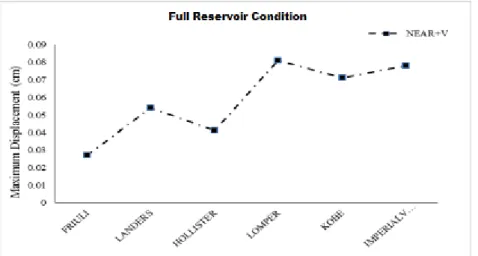
Figure 21. Comparison of maximum displacement of dam crest under vertical component of near-field earthquakes for full reservoir condition
In the full reservoir condition, it is observed that the mini-mum crest displacement occurs for the Friuli earthquake and the maximum crest displacement happens for the Lo-ma prieta earthquake. Given the effect of vertical compo-nent of earthquakes, the maximum displacements for the Loma prieta, Imperial Valley, Kobe and Landers earth-quakes are significant; so that the increase of displace-ments is reported over 50%, indicating the effect of verti-cal component in most of the studied earthquakes. The maximum displacement of the dam is not significant for
the Friuli and Hollister earthquakes due to the frequency nature of the increase. Similarly, the maximum displace-ments of the dam crest for the half-full reservoir condition are shown in the chart of Figure 22. In the half-full reser-voir condition, a maximum displacement of 7.7 cm is de-termined for the near-field earthquake in regard to the ver-tical component of Loma Prieta earthquake. As the verver-tical component of near-field earthquakes is applied, the maxi-mum displacements increase.
Figure 22. Comparison of maximum displacement of dam crest under vertical component of near-field earthquakes for half-full reservoir condition
According to the results of analysis of the dam for the empty reservoir condition, i.e. before impounding (Figure 23), the displacements decrease considerably and the hy-drostatic pressure of the dam reservoir can be explained by
the fact that increased and decreased displacements are observed for the full and empty reservoir conditions, re-spectively (Figure 23).
Figure 23. Comparison of maximum displacement of dam crest under vertical component of near-field earthquakes for empty reservoir condition
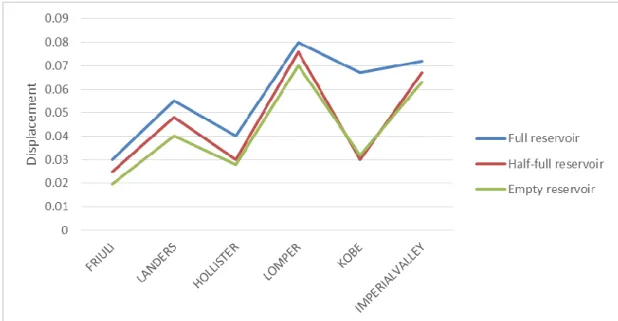
As seen in Figure 24, all charts derived from different res-ervoir conditions are presented and, obviously, the dis-placements increase as the level of impoundment rises in the reservoir. However, the increase of displacements is not significant for some accelerograms, but dramatic dif-ferences are observed for the KOBE earthquake due to the current frequency content. Generally, the increase of water
level in the dam reservoir enhances the displacements; since just the hydrodynamic force is considered for the loading of reservoir, it can be concluded that the increase in the volume of water in the reservoir enhances the hydro-static force applied to the dam by the reservoir and eventu-ally results in the increased displacement of the dam crest.
Figure 24. Comparison of maximum displacement of dam crest in different reservoir conditions
9. RESULTS
The numerical simulation method used in the study can simulate the dam-reservoir-foundation
vertical component of near-field earthquakes are predominated, more displacement is applied to the dam and may cause the dam materials to enter the nonlinear region.
FUNDING/SUPPORT
Not mentioned any Funding/Support by authors.
ACKNOWLEDGMENT
Not mentioned any acknowledgment by authors.
AUTHORS CONTRIBUTION
This work was carried out in collaboration among all authors.
CONFLICT OF INTEREST
The author (s) declared no potential conflicts of interests with respect to the authorship and/or publication of this paper.
REFERENCES
1. Clarke R. Water: the international crisis: Routledge; 2013.
2. Langer EJS. Chemical and biological warfare (I): the research program. 1967;155(3759):174-9.
3. Mekonnen MM, Hoekstra AYJSa. Four billion people facing severe water scarcity. 2016;2(2):e1500323.
4. Escaleras M, Anbarci N, Register CAJPC. Public sector corruption and major earthquakes: A potentially deadly interaction. 2007;132(1-2):209-30. 5. Proulx J, Paultre P, Rheault J, Robert YJEe, dynamics s. An experimental investigation of water level effects on the dynamic behaviour of a large arch dam. 2001;30(8):1147-66.
6. Hu Y-X, Liu S-C, Dong W. Earthquake engineering: CRC Press; 2014. 7. Sepц╨lveda SA, Murphy W, Jibson RW, Petley DNJEg. Seismically induced rock slope failures resulting from topographic amplification of strong ground motions: The case of Pacoima Canyon, California. 2005;80(3-4):336-48.
13. Hamidian D, Seyedpoor S, Salajegheh J. An investigation of dam-water-foundation rock interaction effects on linear and nonlinear earthquake response of concrete arch dams. 2013.
14. Heirany Z, Ghaemian MJG. Effect of foundation in dynamic analysis of concrete gravity dams. 2012;64(8):641-6.
15. Wang G, Wang Y, Zhou W, Zhou CJSd, engineering e. Integrated duration effects on seismic performance of concrete gravity dams using linear and nonlinear evaluation methods. 2015;79:223-36.
16. Ouzandja D, Tiliouine BJAJfS, Engineering. Effects of DamБ─⌠Foundation Contact Conditions on Seismic Performance of Concrete Gravity Dams. 2015;40(11):3047-56.
17. L KM, J VA, B Nn. Evaluation of Eulerian and Lagrangian Methods in the Analysis of Concrete Gravity Dam Including Dam Water Foundation Interaction under Earthquake. Modares Civil Engineering Journal. 2011;11(4):107-31.
18. Fenves G, Chopra AKJEe, dynamics s. Earthquake analysis of concrete
gravity dams including reservoir bottom absorption and
damБ─░waterБ─░foundation rock interaction. 1984;12(5):663-80. 19. Abaqus. 6.11 PR3 user manual.
20. Rashid M, Mansur M, Paramasivam PJJoMiCE. Correlations between mechanical properties of high-strength concrete. 2002;14(3):230-8. 21. Board G, Council NR. Practical Lessons from the Loma Prieta Earthquake: National Academies Press; 1994.
22. Cipar JJBotSSoA. Teleseismic observations of the 1976 Friuli, Italy earthquake sequence. 1980;70(4):963-83.
23. Census Interactive Population Search: CA - Hollister city". US Census Bureau Retrieved July 12, 2004.
24. Wesnousky SGJJoGRSE. Earthquakes, Quaternary faults, and seismic hazard in California. 1986;91(B12):12587-631.
25. Zhang C, Jin F. Seismic Safety Evaluation of High Concrete Dams: Part 1: State-of-the-Art Design and Research. Seismic Safety Evaluation of Concrete Dams: Elsevier; 2014. p. 67-78.
26. Toda S, Stein RS, RichardsБ─░Dinger K, Bozkurt SBJJoGRSE. Forecasting the evolution of seismicity in southern California: Animations built on earthquake stress transfer. 2005;110(B5).