STEP Literacy Assessment
Technical Report of Validity and Reliability
David Kerbow and Anthony BrykSeptember 2004 Introduction
Children, particularly in urban settings, begin school with a variety of strengths and challenges that impact their learning. Some arrive with a firm background in early literacy; others have had extremely limited exposure to books. Teachers and school staff have to respond in a strategic way to provide the kind of instructional support that students at these diverse points need in order for them to be successful as readers and writers. This is crucial especially during the early elementary grades as students are developing foundational skills and knowledge that they will build upon as they move across the grades. The diversity in students’ beginning points as well as in their
trajectories as learners over time places considerable demands on teachers to understand how individual children are processing information, how to organize instruction to accelerate their progress, and how to marshal other resources beyond the classroom to support their growth.
The STEP (Strategic Teaching and Evaluation of Progress) Literacy Assessment was developed by the Center for Urban School Improvement (USI) at the University of Chicago in collaboration with affiliated USI teachers. The assessment provides a set of tools, tightly aligned with scientifically established milestones in reading development, to follow students’ progress from kindergarten through third grade. These tools are
organized into a developmentally sequenced set of tasks that help teachers understand the developmental status of individual students and a class as a whole at any given point, and to analyze their progress over time. The assessments are woven into classroom practice as an integrated part of literacy instruction rather than a separate activity that is external to teaching.
Theoretical Background
A number of related and overlapping theories of developmental reading have been proposed in the last 40 years (Bear, 1991; Chall, 1983; Clay, 1991, 2001; Firth, 1985; Fountas and Pinnell, 1996, 2001). Although varying in their details, these theories share in a common a view of reading as a complex process in which children learn to combine different sources of information including phonemic awareness, understanding of the alphabetic principle, word recognition and decoding, fluency, and comprehension. Each theory provides description (at various levels of detail) of the skills and strategies that readers demonstrate at each of the developmental stages that they pass through as they learn to read.
In the tradition of these developmental frameworks, the STEP Assessment is organized around a “map” of how students grow as readers. These stages are summarized in Table 1, “Developmental Stages of Reading.”
Emergent Readers understand how books work – matching their reading word-by-word
in familiar text, often pointing with their finger. They have a growing knowledge of how letters and sounds are associated and can segment the separate sounds in words. In addition, they are putting this knowledge together to help them problem-solve some new words in books by using initial letters and picture support to confirm their reading. Their writing also demonstrates their growing skills and strategies as they correctly spell some high frequency words and represent others with beginning and increasingly ending letters.
Early Readers are becoming adept at using letter-sound information along with meaning
and language cues to solve new words. They are closely examining letter patterns both in reading and writing as well as developing an increasing number of high frequency and other words that they recognize automatically. Their oral reading, especially with easier texts, is becoming more fluent as they pay attention to punctuation and to expression as they read dialogue. They are also asking questions, making connections with other
information, and working to understand characters’ motivation as the plots of the stories they are reading become more complex.
Table 1. Developmental Stages of Reading
Emergent Readers
Pre-Reading to Step 2 (Book Levels A-B)
• Develop the ability to hear separate sounds in words (phonemic awareness)
• Know most letter names and associated sounds
• Read familiar text orally, matching word-by-word (often following with their finger)
• Use information from pictures for understanding and for support in words solving
Early Readers
Step 2 to Step 6 (Book Levels B-I)
• Recognize many high frequency words automatically
• Use letter-sound information along with meaning and language to solve words
• Read easy text with some fluency and attention to punctuation
• Develop the ability to make inferences and interpret text using various strategies
Transitional Readers
Step 6 to Step 9 (Book Levels I-M)
• Use multiple sources of information flexibly while reading for meaning
• Begin to sustain silent reading of longer texts
• Use pictures for information but do not overly rely on them for comprehension
• Build meaning as they read stories, connecting earlier and later parts of a text
Self-extending Readers
Step 9 to Step 12 (Book Levels M-P)
• Problem solve words flexibly with minimal disruption of the flow of reading
• Sustain reading of texts independently over several days
• Try out multiple strategies to support comprehension in difficult text (e.g., test out own understanding by paraphrasing or self-questioning)
• Incorporate new information into their own understanding of a topic while reading nonfiction text
Transitional Readers draw form a variety of word-solving strategies and apply them
efficiently as they read. They recognize two-syllable words with ease and problem-solve many irregularly spelled words. At these Steps, readers are able to maintain their fluency and reading rate, enabling them to focus more fully on comprehension as they transition into silent reading. Punctuation cues, particularly quotation marks found in dialogue between characters, guide these readers in sustaining meaning. Lengthier texts and more complex plots require Transitional Readers to follow characters through multiple
episodes and nonfiction information through multiple chapters. As a consequence, understanding of the story or subject must be built as readers progress through the text. When reading, they combine different details and explore relationships between earlier and later parts of the text, search for pertinent information to support inferences and draw conclusions, and extend their understanding beyond personal experience.
Self-extending Readers problem solve words flexibly with minimal disruption of the flow
of their reading. Different genres present the reader with new vocabulary and complex words. Context provides some support, as does growing knowledge about word structures, including root words, prefixes, suffixes, and homophones. Self-extending Readers are able to integrate what they read into their own background knowledge and discuss their interpretations and perceptions about stories. They question what authors are trying to convey and why it might be important. In sum, they have developed a system of skills and strategies that propel them to become better readers as they read.
Impetus for Developing the STEP Assessment System
Numerous assessment tasks have been created that directly and indirectly test the separate components that compose the developmental descriptions summarized above. However, these assessments have seldom been combined and sequenced in a comprehensive way nor have the developmental validity of such a system of assessments been examined and validated empirically. Systematic evaluation of the developmental relationships among the components of phonemic awareness, concepts about print, reading fluency, and
comprehension have been lacking. In addition, how such a system of assessments might be adapted for effective classroom use and to help inform teacher practice has been absent as well.
The STEP Assessment system has been purposely designed in response to these
concerns. It integrates a set of component assessments around a scientifically established theory of reading development. This assessment system has been subject to extensive analyses and refinements over 10 years of use with teachers across the Chicago region. We summarize below the processes involved in designing and field testing this
assessment system, the developmental measurement model that undergirds the system, and the empirical evidence that warrants its use. This system is capable of both tracking typical patterns of student reading growth in early literacy and identifying students whose developmental pattern deviates from the norm, and for whom specialized instructional intervention may be warranted.
Comprehensive Literacy Instruction as a Context for Use
Understanding how readers develop has clear implications for approaches to reading instruction. “Comprehensive literacy approaches” attempt to integrate reading, writing, and word study in explicit response to where students are as readers. In addition to discrete skill development, such instruction aims to helps students learn the purposes of literacy and how written language “works.” Students at all levels engage in “learning by doing” though reading and writing in tandem with explicit teaching and guidance from the teacher.
In brief, comprehensive literacy consists of several interrelated elements. Small group reading instruction assures that students learn to comprehend written texts (Person & Fielding, 1991; Pressley, 1998) as well as learn to use phonics skills to take words apart while reading for meaning (Pressley, 1998; Snow, Burns & Griffin, 1998). Instruction is designed to teach comprehension and vocabulary while also providing explicit instruction in reading fluency (NICHD, 2001; Pinnell, et al., 1995). Teachers also provide daily lessons on conventions, skills, and the craft of writing. Students write daily, applying
critical principles to their own production of writing in a range of genres. Instruction in writing, in fact, contributes substantially to children’s understanding about words (Clay, 1991; NICHD, 2001) as they learn to hear the sounds in words (phonemic awarenss) and learn to look at letters and words (Liberman, Shankweiler, & Liberman, 1985; Vellutino & Scanlon, 1987; Lundberg, Frost, & Petersen, 1998) in ways that support both reading and writing achievement.
Teachers marshal the specific activities of the literacy framework in response to students’ needs and their understanding of how their particular children are progressing as readers. Authentic opportunities for reading and writing are scaffold so that students gain
increasing independence. Some activities are explicitly demonstrated by the teacher such as shared writing or the interactive read-aloud of books. Others are accomplished with guided support by teachers as students take increasing control of the process as in
interactive writing and guided reading. Concurrently, in other activities, children assume primary responsibility through independent writing and reading. These elements come together in the reading of quality children’s literature, extensive student writing, and specific attention to letters, words, and how they work (phonics and word study).
More than being separate components of a curriculum, the reading and writing activities become a repertoire of practices that teachers weave together based on their pedagogical knowledge and their observation of children.
Aims of the STEP Assessment System
In sum, a comprehensive literacy approach involves complex teaching practices rooted in a deep understanding of the developmental learning process. Rather than being a
framework that can be scripted and routinely delivered, teachers must actively develop their classroom practice based on evidence about how their students are actually
developing as readers. As a result, reliable and valid assessment of students is not only crucial but central to this teaching endeavor. The STEP Literacy Assessment was specifically designed to support this interactive process of teaching and learning. The design of STEP:
• Builds on a theoretically based description of developmental stages of student reading and empirically establishes a set of diagnostic criteria for understanding their progress;
• Is anchored in a developmental measurement model that allows us to explicitly links critical elements in reading development into an integrated literacy assessment system rather than just providing a collection of loosely related assessment tasks; and
• Provides rich data-based descriptions of students’ developmental profiles that facilitates classroom-level instructional planning while also affording more detailed individual student-level data necessary for diagnosing the needs of particular student readers.
The Process of Assessment Development
Initial Assessment Components
The design of the STEP Assessment System takes its root in the Observation Survey developed for Reading Recovery (Clay 1996). These tools are familiar to many teachers who are engaged in comprehensive literacy instruction, although they have not been used systematically in the classroom context itself. The Center for Urban School Improvement first began using the Observation Survey as a research tool for evaluating the
effectiveness of its School Development Program that focused on strengthening early literacy instruction. Through this initial work, beginning over 10 years ago, we developed detailed information about the psychometric properties of each of the components
included in the Observational Survey. These preliminary studies helped to inform a series of design changes and subsequent field trials that eventually resulted in the current integrated assessment system.
The initial development of STEP drew on several of the separate elements found in the Observation Survey. In the Letter Identification task, children are asked to name both
upper and lower case letters. During Concepts about Print, students participate in reading
a book with the teacher and were asked to indicate directionality from left to right, return sweep at the end of lines, and to point out differences between letters and words on the page. The Hearing Sounds in Words task focuses on a student’s understanding of
letter-sound correspondence and being able to write letters and words from a dictated sentence. The task is scored based on the number individual phonemes the student represents correctly.
The last component that we drew from the Observation Survey was Leveled Text Reading. Students read increasingly higher levels of text from pre-primer to fifth grade.
Within the Observational Survey, teachers record students’ reading accuracy and the assessment ends when a student’s reading accuracy for a text level falls below ninety percent.
Each of the separate assessment tasks within the Observation Survey provides valuable pieces of information about emerging student readers. However, it is not necessarily straightforward to analyze how these elements joined to create a complete portrait of a reader that teachers could use to inform instruction. Students exhibit considerable
performance variation across these sub-tests even at the same grade level and at the same time of year. A first grade student in the fall of the year might, for example, be near test score floor on one sub-test but close to the test score ceiling on another. In short, the component assessments from the Observational Survey present teachers with
considerable data but how best to turn these data into useable information to guide subsequent instruction remained unclear.
Through initial experiences of USI staff in supporting classroom teachers as they sought to use the Observational Survey to inform their own instruction, we gradually came to appreciate the potential utility of a step development framework for organizing the information contained in the various elements that comprise the Observational Survey. Specifically, teachers tend to think about organizing reading instruction for relatively homogenous small groups of students and in this regard the idea of locating students on a
“developmental step” seemed very sensible to them. Moreover, basic research in reading development began to lend some theoretical support for the idea that the discrete skills measured in the Observational Survey might actually align in predictable overall developmental patterns (Stahl and McKenna, 2000; Sainsbury, et al 1999; Ehri, 1995). This prompted us to examine whether the item level data produced by the Observational Study might actually form a developmental scale. Our first attempt at building a
developmental measurement model, using a Rasch item response theory methodology provided encouraging empirical results (Kerbow, Gywne, and Jacob, 1999). The items arranged themselves in a sensible developmental order and the psychometric properties of the scale seemed consistent with a theoretical claim that an underlying developmental metric linked these various assessment elements together. We found for example, that patterns of growth in concepts about print aligned with certain levels of ability in hearing sounds in words. These, in turn, were associated with text reading levels of students – all of which could be placed on the same scale. Thus, we began to see the potential (both statistically and practically) for creating an overall system that illuminated the
relationship of the different components and the reading skills that they were assessing. Such a composite scale permits us to move beyond just describing students’ individual scores on isolated assessments to be able to discern where this fit into a larger picture of how students develop over time an integrated ensemble of strategies for learning to read and construct meaning from text. For instructional support purposes, this scaling provides a mechanism for organizing the data from the separate reading assessment tasks into a set of “steps” that offer both a concise summary of students development to date and an interpretive context that could meaningfully inform subsequent instructional decision making. For research purposes, this composite scale affords us with a single continuous measure for assessing students’ overall reading improvement across the primary grades. This solved the typical “floor and ceiling effects” problems typically associated with analyzing data from the separate assessment tasks within the Observational Survey. In addition, as the empirical basis for the developmental framework began to emerge, our initial analyses also pointed to areas where the assessment information was thin or, in
some case, absent on key concepts. Thus, our analyses of the relative strengths and weakness in the Observational Survey, as discussed below, lead to the design of the final STEP Literacy Assessment System described in this document.
Expanding the Assessment Components
Broadening the Data on Phonological Awareness and Phonics. The Letter
Identification task from the Observational Survey provided reliable and essential information of students’ early development as readers. In our preliminary studies we found that as children’s knowledge of letters increased, their understanding of books as measured by the Concepts about Print assessment also developed. However, for some children their knowledge of letter names was not necessarily accompanied by the ability to articulate a letter’s associated sound. This distinction represented an important gap in our initial assessment protocol.
The Hearing Sounds in Words task did provide some important information about letter-sound association and phonemic awareness. Students were representing the letter-sounds that they heard in words with letters or groups of letters in their writing. They also wrote some high frequency works in the dictated sentence from memory.
When we began to look at these aspects developmentally, however, several key elements needed further attention. We had limited information, for example, about how students were able to orally identify and manipulate sounds such as hearing onset and rime or separating the first sound they heard in words from the remainder of the word. In addition, as children’s understanding of sound and letter association grew more sophisticated, it became clear that how patterns of letters related to sounds in words
needed to be followed more systematically. Children were asked to write several of these patterns in the Hearing Sounds in Words assessment but the patterns did not build
Thus, though the Observation Survey provided some basis for following a student’s development in phonemic awareness and phonics, it became clear that additional elements had to be added in this domain.
Supplementing Reading Accuracy with Data on Fluency and Comprehension. The
core of our assessment was built initially around the idea of level texts, organized similar to an informal reading inventory. The level texts were initially drawn from the text that Reading Recovery used in connection with the Observation Survey. However, the Observation Survey only assesses reading accuracy on leveled text. Early in the process the need for more explicit focus on comprehension became evident. Specifically, we found that the text level reading accuracy was a strong predictor of comprehension through the early levels (approximately through early second grade). However, at higher levels, students with similar reading accurately showed a much wider variance in their comprehension scores on standardized tests. Thus, although reading accuracy appeared to be a necessary component for early comprehension, it was not sufficient in predicting later stages of reading development. As the text levels became more difficult, reading accuracy became less predictive of a student’s understanding of the reading material. Students could decode the words, but not necessarily make meaning from the text. In response, we incorporated several additional components. An essential link between reading accuracy and comprehension is rate and fluency of the student’s reading.
Students who spend an inordinate amount of mental energy decoding words tend to lose the broader meaning of sentence, paragraphs and the larger text. Excessive attention to word level concerns leaves limited space for memory and other cognitive process involved in making meaning. Thus, adding a direct recording of reading rate and a fluency rubric (i.e., a four-point scale of students’ phrasing and expression during oral reading) became crucial to understanding the reading process at this developmental stage (Pinnell, et al., 1995).
Similarly, we added a set of oral questions linked specifically to each leveled text used in the assessment system. A student now reads the book aloud for purposes of assessing
accuracy, rate and fluency and then, upon completion of the read aloud, engages in a structure comprehension conversation with the adult who is conducting the assessment. These comprehension questions probe both the student’s explicit and implicit
understanding of the text.
Thus, in addition to reading accuracy, the STEP assessment system also evaluates fluency and comprehension within an overall developmental framework of the reading process.
Summary of Results from Preliminary Reliability and Validity Studies
Full details about the preliminary studies that helped to inform the final design of STEP can be found in Appendix A. In brief, we learned the following from these pilot research and development activities:
• It is possible to combine data from the Letter Identification task, Concepts about Print, Hearing Sounds in Words, and Text Reading Accuracy into an internally coherent developmental scale with high overall reliability (Cronbach’s alpha of 0.94). Most important, the scaling of the relative difficulty of the items followed closely with that predicted by development reading theory. This was our first empirical evidence supporting the construct validity of an overall developmental scale. The subsequent addition of items assessing fluency and comprehension also scaled in ways consistent with the idea of a single, underlying development metric.
• The STEP developmental scale scores also displayed concurrent validity when compared against a standardized reading assessment measure, the Degrees of Reading Power (Koslin, Zeno, Koslin, 1987; DRP Handbook, 1995). In spring of first grade, a classroom administered STEP correlated 0.51 with DRP reading scale. For spring second graders, the correlation of STEP with DRP was 0.62. These moderately strong correlations were encouraging. While STEP and DRP tap related content, STEP includes a more expansive array of developmental tasks not typically included in standardized reading assessments. Under these
• The developmental scaling also provided an empirical basis for establishing a set of cut scores that define 13 different step levels. Each step level represents a distinct profile of student performance across the multiple reading tasks that comprise the assessment. The development of these step levels subsequently proved highly useful to teachers in planning instruction, and in make decisions about student referral and placement for supplemental reading services.
• Finally, the pilot developmental assessment helped to establish step criterion-based benchmarks for kindergarten, first, and second grade. By comparing students step level against the likelihood of scoring at or above grade level on a spring administered DRP we were able to establish STEP performance
benchmarks for kindergarten, first and second grade. For example, in second grade only 36 percent of the student scoring at step 8 in May scored at or above grade level on a concurrently administered DRP. In contrast, 79 percent of the students at step 9 scored at or above grade level on the DRP. With this kind of empirical evidence, we established step 9 as the “developmental benchmark” for end of second grade. Similar analyses led us to establish step 6 as the benchmark for the end of first grade.
An Overview of the Current Assessment
Overall Organization of the Assessment
The assessment system is organized around a developmental trajectory consisting of 13 distinct steps from pre-literacy to Step 12 that provide a comprehensive map of students’ reading skill acquisition. This generally maps on to the skill development expected of students during the period from K to end of grade 3.1
1 STEP contains two approaches that provide a window into evaluating how students are progressing. The first, described here, draws on a set of formal evaluations that are individually administered and organized around a set of leveled books. The second uses informal observation checklists that create a lens to look at student reading behaviors during classroom and tutoring activities. Combining the formal and informal assessment provides a complete portrait of students’ strengths and weaknesses to support instruction, grounded in the same understanding of developmental reading. The informal observation checklists are still under evaluation.
Central to the assessment is a set of leveled texts that increase in difficulty with each “step.” During individual conferences of 10 to 15 minutes, the teacher records students’ reading accuracy and fluency, observes their reading behaviors, and engages students in comprehension conversations about what they have read. Importantly, however, each Step, in conjunction with the leveled books, also includes assessment tasks that provide a deeper look into specific skills that supplement what is learned from students’ oral reading. That is, STEP explicitly joins the reading of authentic texts with assessments that focus on level appropriate individual skills such as letter-sound association,
phonological awareness, and word knowledge -- providing a complete window into the integrated development of the reading process.
Thus, at the heart of STEP is a set of empirically-grounded relationships about the specific strategies and skills students acquire as they read and understand increasingly complex text. A demonstration of the ability to read and understand text at each level, in essence, represents “steps” in students’ development as readers. The formal assessment provides systematic information about the integrated development of this process by focusing on key components that research shows are essential to assessing the building blocks to reading:
• Concepts about print
• Letter name and sound knowledge
• Phonological awareness
• Reading accuracy
• Reading rate and fluency
• Comprehension
• Developmental spelling
Organization of the Assessment Components by Step
Table 1, “Components of the Assessment,” delineates how each component or task in the assessment system is organized by step level. Many of these tasks are similar to other early literacy assessments contained in DIBELS, the Early Reading Screening Inventory
(ERSI), the Developmental Reading Assessment (DRA), and the Texas Primary Reading Inventory (TPRI). However, the explicit combination of these tasks in developmental sequence is unique to the STEP Assessment and is organized on both a theoretical as well as an empirical basis. (The underlying measurement model that confirms the validity and reliability of this organization is discussed in the next section.)
Table 1
STEP Assessment Components
Pre-Reading Step 1 Step 2 Step 3 Step 4 Step 5 Step 6 Step 7 Step 8 Step 9 Step 10 Step 11 Step 12
Story Retelling 9 9 9 9 9
Comprehension Questions 9 9 9 9 9 9 9-3
written 9-3 written 9-3 written 9-3 written
Reading Rate and Fluency 9 9 9 9 9 9 9 9 9 9 Text Level 9-A 9-B 9-C 9-E 9-G 9-I 9-K 9-L 9-M 9-N 9-O 9-P Developmental Spelling 9 9 9 9 9 9 9 9 9 9 9 9
Phonemic Awareness
Segmentation 9 9 First sounds 9
Letter Identification
Sounds 9 9 9
Names 9 9 9
Concepts about print 9 9 Phonemic Awareness
Rhyming Words 9
Alphabet Recognition. The single best predictor, on its own, of early reading
achievement is accurate naming of the letters of the alphabet (Adams, 1990; Snow, Burns, and Griffin, 1998). The Name Assessment task provides the first indication of students’ knowledge of letters and letter names that will be building more generally across Step 1 and Step 2. The assessment asks the student to write his or her first and last name and, then, to identify several letters in this very familiar context.
The Letter Name Identification task asks students to provide the names of both upper and
lower case letters.2 Students are presented with a page of letters (upper case then lower case) that are in random order. They are asked to point and say the name of the letter. This is not a timed task although if students take more than five seconds with a letter they are prompted to move to the next letter. The Letter Name Identification assessment extends from the Pre-reading Step to Step 2.
Pronouncing the sounds represented by individual letters in isolation is a more
demanding task for students. It requires explicit awareness of individual phonemes and their association with letters. The Letter Sound Identification task uses the lower case
letters, asking students to touch each letter and say the sound it represents. Teachers ask for the alternate sound for a letter that has two (or more) sounds. The focus for vowels is the short sound, and the hard sound for ‘c’ and ‘g.’ For example, a child that gives the long vowel sound would be prompted: Do you know the other sound the letter can make? Do you know the short sound this letter makes? This assessment extends from Step 1 to Step 3.
Taken together these assessments provide a complete sense of a student’s alphabet recognition beginning in the familiar context of his or her name and proceeding to recalling letter names in isolation and producing their associated sounds.
2 The lower case letters include both a print and typescript version of ‘a’ and ‘g’ making a total of 28
Concepts about Print. Understanding how books work is a foundational
knowledge that supports children’s access to text. The emergent reader begins to
recognizes directionality of the text from left to right, at the end of a line to return to the beginning of the next line and then on to the next page, and to start “reading” at the top left of the text. These early concepts about print provide a context for using their building knowledge of letters and sounds.
Developmentally, these early concepts of how text works progress to an understanding of the concept of a word. Ultimately, this refers to the emergent readers’ ability to match spoken words to written words as he or she reads. This involves the integration of
alphabet recognition, letter sounds, and word boundaries in text. Research has shown that a stable concept of word in text facilitates a child’s awareness of the individual sounds within words. Until a child can point to individual words accurately within a line of text, he or she will be unable to learn new words while reading or to attend effectively to letter-sound cues at the beginning of words (Morris, 1993; Morris et al., 2002). Embedded in the Concepts about Print assessment is a series of probes that allow the
student to demonstrate this growing understanding of the concept of a word as well as one-to-one matching of words to print.
Phonological Awareness. Phonological and, more specifically, phonemic
awareness plays a key role in literacy development (Adams, 1990; Whitehurst and Lonigan, 1998). Children who are better at detecting rhymes or phonemes are quicker to learn to read – even after other factors such as vocabulary, memory, and socioeconomic status are taken into account (Wagner and Torgesen, 1987).
Recent research suggests that phonological awareness can be best conceptualized as a single underlying ability that increases in complexity as readers develop (Anthony and Lonigan, 2004). STEP employs three assessment tasks that span these levels of difficulty in order to follow students’ development in this essential skill.
Phonological/phonemic awareness is assessed across several task of increasing
complexity. Components include: Rhyming (Pre-Reading), Matching First Sounds (Step 1), and Segmentation (Step 2-3).
Developmental Spelling. Application of letter-sound knowledge in invented
spelling tasks is an excellent predictor of word recognition in young children (McBride-Chang, 1998) and among the best predictors of word analysis and word synthesis (Torgesen and Davis, 1996).
Research on how children learn to read and spell words in an alphabetic orthography has consistently revealed that orthographic features are internalized for reading and writing in a systematic, developmental progression. The process of learning to read and learning to spell are intricately linked (Ehri, 1997). Therefore, assessing spelling provides
information about students’ understanding of orthographic patterns not only in writing words but also in reading. Invented spelling provides a diagnostic window into students’ understanding of alphabetic orthography and can help teachers determine when to teach what phonics or spelling feature of English orthography (Henderson, 1990). According to this body of research, the acquisition of basic phonics features occurs in a predictable progression: beginning consonants; ending consonants; consonant diagraphs, medial short vowels; consonant blends and pre-consonantal nasals; silent-e marker for long vowels; other long vowel patterns; r-controlled vowel patterns; then ambiguous vowel-diphthongs and digraphs (Bear, et al 2000; Ganske 2000). Table 2 shows how these features are organized by step within the overall assessment system.
Words were selected to represent each feature based on two criteria. First, the word should typically be in the oral vocabulary of children at each level. Second, the word should not be of such high frequency that it would likely be in most children’s writing vocabulary with automaticity. The later criterion ensures that students’ must attend to the features of the word during the assessment. The assessment is scored based on the
teachers with specific information about the spelling patterns that students have under control at each step.
Table 2. Developmental Spelling across Steps
Steps 1-3: Early to Middle Letter Name-Alphabetic Stage
Focus: Beginning, ending consonants; early short vowel recognition
• Most beginning and ending consonants
• Clear letter sound correspondence
• Representing short vowels in C-V-C words (e.g., may write ‘pat’ for ‘pet’)
Steps 4-5: Late Letter Name-Alphabetic Stage
Focus: consonant digraphs; short vowels
• Regular short vowel patterns
• Most consonant blends and digraphs (e.g, frog, ship)
• Long vowels often represented by letter name (e.g., may write ‘tran’ for ‘train’)
Steps 6-7: Early Within Word Pattern
Focus: beginning long vowel patterns; r-controlled vowels
• Using some long vowel patterns, especially V-C-e
• Beginning accuracy on r-controlled vowels in single-syllable words (e.g., bird, fur)
• Consistent with short vowels, blends, and digraphs
Steps 8-10: Middle/Late Within Word Pattern
Focus: long vowel patterns; r-controlled vowels; vowel digraphs
• All of the above plus:
• Single-syllable long vowel and r-controlled words
• Many common vowel diphthongs (e.g., round, point)
Steps 11-12: Early Syllables and Affixes
Focus: -ed/-ing endings; consonant doubling; vowel patterns in syllables
• -ed and most inflections
• Some vowel patterns in two to three syllable words
Text Level Reading. Listening to student read aloud from leveled text provides
direct information for understanding their reading skill and strategies, diagnosing
strengths and weaknesses, and evaluating progress (Johnson, Kress, and Pikulski, 1987). Developing a set of leveled books with appropriate layout and content is essential to this process. As teachers become familiar with these books, they are able to identify key aspects of the texts that reveal students’ approach to problem-solving words and making meaning.
Multiple approaches have been developed in attempting to determine the reading
difficulty of books (Hoffman, et al, 2000). Readability formulas have proliferated and can provide a general guide. However, they can be widely variable in how they rank text, particularly at early levels. Books that support developing literacy (and thus are most appropriate for assessment) contain several crucial characteristics (Fountas and Pinnell, 1996). These include:
• A mixture of natural and literary language patterns;
• An increasing number of high frequency words;
• Opportunities to notice and use spelling patterns within words;
• An increasing syntactical and grammatical complexity in sentence; and
• Interesting and engaging content for children.
Building on the text reading gradient developed in Reading Recovery, Fountas and Pinnell (1996, 1999) propose a leveling system that incorporates the above characteristics to define “benchmark” books. A benchmark book is a reliable exemplar for a particular level in the gradient of difficulty. It has been judged to be readable, at or above 90 percent accuracy, by most students who demonstrate similar reading behaviors at a particular point in time. For example, a benchmark book at level C is read accurately by children who are using first sounds, recognizing several high frequency words, and build meaning using pictures and natural language patterns. Thus, there is an iterative process in defining a books level: examining the characteristics of a book, observing children read the book who are developmentally similar readers, and comparing the book to other
books those children can read. From this process, they have described a series of levels using a letter system ranging from A to P.
It is this process and leveling system (which is closely tied to comprehensive literacy instruction) that was employed in developing the leveled text for the STEP Assessment. The validation of the leveling includes computation of Lexile readability scores to establish general ranges of reading difficulty, comparison to Reading Recovery text, and field testing of the books with students at various achievement levels. The results are detailed in the next section.
Accuracy, Reading Rate, and Fluency. Accuracy and speed may be considered
essential building blocks of reading fluency. If readers have too much difficulty recognizing and reading individual words, their ability to gain overall meaning from a passage will be seriously hampered (Samuels 1994). As readers pause to problem-solve unfamiliar words, the ideas that were developing within the sentence or across the portion of the passage may be disrupted – having a negative impact on students’ ability to
understand the text. If reading proceeds too slowly or mechanically, these connections may become difficult or impossible to make.
The essential building block of accuracy can be measured in a straightforward manner through counting the number of errors (i.e., words read incorrectly or skipped) and comparing this to the number of words read in the text. However, even competent readers may make periodic deviations from the text. In some cases, these deviations may signal a reader’s attempt to make sense of what is being read. In other instances, the errors may be an indication of a further break down of the reading process. Careful analysis of oral reading, thus, includes both attention to the accuracy of the reading but also the type of errors and substitutions that readers are making (Clay, 1996; Hennings & Hughes 1992). Reading rate is also directly measurable through timing oral reading and computing the number of words read per minute. Traditionally, these two aspects of oral reading – accuracy and rate – have been the primary indicators of oral reading ability. They
logically form the foundation for the ability to read with fluency, that is, with phrasing, attention to syntax, and appropriate expression associated with the text.
To develop a simple rating scale for fluency that incorporated aspects of pacing, phrasing, and expression, we adapted the four-point fluency rating scale used by the National Assessment of Educational Progress (Pinnell, et al., 1995). The rubric is displayed in Table 3.
In summary, the STEP Assessment pays close attention to the key aspects of strong oral reading -- accuracy, rate, and fluency – to present a well-rounded view of this central element of the reading process.
Table 3. Fluency Rubric
Level 4
Reading in meaningful phrases; consistently pays attention to punctuation and syntax; reading some or most of text with expression; may slow briefly for problem-solving, but quickly returns to fluent reading
Level 3
Reads primarily in 3-4 word phrases; pays attention to punctuation and syntax most of the time, but read with little expression; may occasionally slow for problem-solving
Level 2
Reads primarily in 2-3 word phrases; seldom pays attention to punctuation ad syntax; slow problem-solving fairly often
Level 1
Read primarily by-word (may reading fast or slow, but rhythm is word-by-word); slow problem-solving
Comprehension. Cognitively based views of reading comprehension emphasize
the interactive nature of reading (Rumelhart & Ortony, 1977; Dole, et al., 1991) and the constructive nature of comprehension (Pressley 1998). In order for assessment to explore this process in young readers, teacher have to engage students in conversation about how their understanding of a text as well as how they support their conclusions. This
“comprehension conversation” is organized around a set of questions in the assessment that span a range of cognitive demands as described in Table 4.
The teacher’s role in this process is not simple one of passive questioner and listener. Instead, she plays the role of discussant with the student, using a structured set of
questions as well as non-leading prompts to encourage students to further explicate their thinking and basis for understanding.
Appropriate prompts do not lead children to an answer, but rather encourage them to elaborate or explain their thinking. To elicit student’s responses, the following prompts help to review students’ prior knowledge, how they are making sense from the text, and what they consider to be important evidence.
• What in the book makes you think that?
• Tell me more about . . .
• What do you mean when you say . . .?
• Why do you think that?
• Why do you think it’s important that . . ?
This approach inherently requires that questions be open-ended. Consequently, teachers have to evaluate whether responses show clear understanding. Although sample answers are provided, judgment about appropriate probes as well as quality of response is still necessary. For each group of teachers, this necessitates conversation among themselves to establish reliability in administration and scoring. Rather than becoming an
impediment, the social practice of establishing reliability of scoring pushes teacher to explore what they perceive to be evidence of student comprehension as well as what are effective questioning and prompting techniques during classroom instruction.
The comprehension questions begin with the early level books at Step 2. As the
complexity of the books increase across steps more elaborate response are possible. At Step 9, in addition to the oral questions, students respond in writing to three questions.
This is an important skill assessed on many standardized tests and allows the teacher to evaluate students’ ability to organize their ideas in writing as well as to elaborate without prompts.
Table 4. Question Categories
Factual/Literal Questions have only one correct answer and are used to assess
whether students understand the literal meaning of a text. Factual questions might ask students to:
Recall details;
Recap descriptions of people, places, or events; Explain relationships among characters; and/or Establish time and sequence.
Inferential Questions generally have only one correct answer. They require students
to look at the text for clues that will lead to the answer and are used to assess whether students can use the text to:
Draw logical conclusions about literal meaning; Deduce the meaning of words through context; Understand cause and effect;
Understand figurative and metaphorical language; and/or Identify problems and solutions.
Critical Thinking Questions can elicit a variety of answers. They require students to
draw upon their powers of analytical and imaginative thinking and use the text to: Explore characters’ traits, feelings, and motivation;
Understand the story’s mood or tone; Articulate central ideas or themes in a story; Originate and support ideas;
Use textual evidence;
Draw conclusions about an author’s viewpoint, or intention; and/or Entertain differing interpretations.
Personal Opinion Questions ask students to move beyond analysis of the text. They
require students to apply their own values and experiences in evaluating their feelings about what they have read and:
Consider if they agree with what characters in the story think or do; Empathize with or judge characters; and/or
Description of Psychometric Studies
As noted earlier, the STEP assessment system emerged out of a design research effort that involving an interplay of co-design work with classroom teachers and literacy coaches using pilot instruments and interpreting results with ongoing small scale studies of the technical properties of the evolving instruments. As the design for the assessment system took final form, we undertook two formal studies to evaluate the reliability and validity of STEP when used in ordinary classroom settings to inform future instruction and supplemental programming for students. The design for these two studies is summarized below.
Construct Validity-Internal Reliability Study
This study served several purposes. First and most importantly it provided data to evaluate the validity of the overall developmental scale. Second, it provided information about the internal reliability of the overall scale and the reliability of its
sub-components(e.g., letter name identification, segmentation, etc) in regular classroom use.
Data were collected in classrooms by regular teachers as part of their normal instructional activities with their own students. Although all teachers were trained to use the
assessments, no other standardized procedures were imposed on test administration. Third, since two different forms of STEP currently exist (a “purple” and a “yellow” form), this study was also designed to examine the parallelism of these two alternative versions.
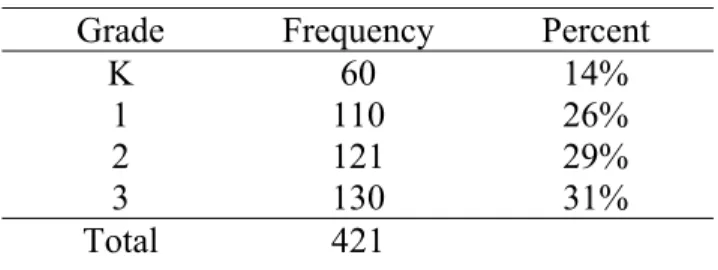
The data for this study were collect during the spring of the 2003 academic year by classroom teachers in six Chicago schools with predominately low-income and minority student populations. Table 5 displays the sample size for this study by grade level.
Table 5. Construct Validity-Reliability Dataset
Grade Frequency Percent
K 60 14%
1 110 26%
2 121 29%
3 130 31%
Total 421
The students in this study were 81% African American and 19% Latino. Some 85% were from low income family eligible for free and/or reduced price school lunch. These
schools, and their student population are modal within the Chicago Public School district. The data consists of item response level information for each assessment task
administered to this student sample. Based on students’ prior STEP results from earlier in the academic year, teachers were asked to administer the next appropriate step level to each child. Since one primary aim of this study was to evaluate the developmental linkages across the 13 steps that comprise the assessment system, it was necessary for some students to be assessed across two or more steps. These students took both their “next step level test” plus the one immediately above it. In addition, in order to evaluate the parallelism of the two forms, it was also necessary for some students to take the same step level on both the “yellow” and “purple” version of the test. For the students who took these double assessments, the first and second administrations were separated by a one week period of time.
Figure 1 displays how students were distributed in this study across the various step levels and forms. The numbers in parentheses within the boxes are students who took only one step at the time of administration. The numbers that link boxes are students who took two step assessments. For example, 47 students took step 7 of the yellow form; 24 students took both steps 6 and 7 of that form, and 12 students took step 7 from both
forms. Another 4 students took the combination of step 6, yellow and step 7, purple, and 3 students took the combination of step 6 purple and step 7 yellow.
In general, the final data set has a relatively high density of observations for steps 1 through 11, but is thin at steps “pre-reading’ and 12. Since a key objective of the study was to assess reliability and validity in the context of classroom use, the data collection was organized around in-tact classrooms. By the spring of kindergarten, relatively few students remained at the pre-reading level. In contrast, relatively few third graders were ready for step 12 at the time of the study since this was a very disadvantaged urban school population. Fortunately, since there is significant item overlap across the levels and forms of the assessment, this data thinness at the lower extreme does not material effect any of the results presented below. Interpretation at Step 12 requires more caution.
Figure 1. Equating Study Design: Linking Students across Steps and Between Forms Yellow Form Purple Form
12
(2)
12
(3)Step
Levels
1 1 1 9 9 2 2 12 3 4 3 4 5 4 7 1 1 111
(17)11
(9)2 0
10
(12)10
(16)6 4
9
(25) (21)
9
7 7
8
(21)8
(20)12 10
7
(47)7
(56) 25 246
(49) (67)
6
Note: The (xx) inside each box indicate the number of students who took that form and step of the test. The counts between the boxes indicate the number of students who took that particular combination of steps and/or forms of the assessments in the construct validity/internal reliability study.
Figure 1 – continued
Yellow Form Purple Form
6
(67)6
(49)5
(47)4
(47)3
(43)2
(33)1
(31) Pre-R (10) 1 1 1 2 4 1 5 2 3 15 3 1 12 1 13 18 20 18 17 3 StepLevels
9 345
(96) 484
(88) 283
(52) 242
(26) 61
(16) 7 Pre-R (10)Concurrent-Predictive Validity Study
This study focused attention on examining the concurrent and predictive validity of the individual step designations which result as an end product of a STEP assessment administration. For a student to be designated as “achieving step level”, he or she must meet a performance target on each assessment component that comprises that step. These target levels were established during the co-design process with classroom teachers and literacy coordinators. (For further details see Kerbow 1999. Evidence on the empirical validity of these step targets is presented later in this report.)
Our concurrent-predictive validity study examined the alignment between these step designations and students concurrent and subsequent performance on two different standardized reading tests. Specifically, we compared students end of year STEP level results with their reading achievement scores from a spring administration of the Iowa Test of Basic Skills (ITBS) in second and third grade and with student results from the required state accountability reading assessment at grade 3, the Illinois Standards Achievement Test (ISAT) In each case, the STEP assessments were administered by regular classroom teachers and results obtained prior to the standardized tests.
This dataset consists of 4 cohorts of students from a single Chicago public school serving 100 percent African American students who were 75 percent low income. Each cohort was followed for a full year from spring of second grade through spring of grade three. Both the STEP Assessment designations at grades 2 and 3 and results from the two standardized reading assessment were recorded. Figure 2 illustrates the overall design for this study. .
Figure 2
Concurrent-Predictive Validity Study
Spring 2000
Spring 2001
Spring 2002
Spring 2003
Spring 2004
24 25 25 47 48
The first row in the figure shows the number of second grade students assessed each spring. The second row displays the number of students who continued with their cohort into grade 3 the following year (e.g., 22 of the original 24 students from the 2000 cohort were retested in spring 2001). In parentheses are the number of students who joined the cohort for the first time in third grade (e.g., 2 in spring 2001). The total dataset consists of 188 students.
Construct Validity of STEP as a Developmental Assessment
As noted in the introduction, STEP was intentionally designed to integrate a set of component assessment tasks, each of which has a separately established scientific basis. The design for the STEP assessment system has been explicitly organized around an overall theory of reading development rooted in several decades of scientific research. Thus, there are good theoretical reasons for hypothesizing that the various assessment
2nd Grade
3rd Grade
tasks we have assemble would integrate into a single developmental scale. The Item Response Theory analyses described below provide key empirical evidence about the adequacy of STEP as an overall development measure rather than as a loose collection of discrete reading tasks. While both theory and previous empirical findings in the literature guided our assessment development work, whether STEP actually functions as a single integrated scale is ultimately a question about its internal psychometric properties.
Use of an Item Response Theory Model to Examine Developmental Scale Properties
In order to investigate the adequacy of STEP as a development scale, we applied a Rasch analysis to the equating design data previously detailed in Figure 1. The Rasch model (Wright & Stone, 1979; Wright & Master, 1982) is a simple form an of item response latent trait model which is now commonly employed in standardized test construction. Test items are used to define a measurement scale based on the relative probability of a respondent’s correct answer to each item. In a properly fitting Rasch scale, the item hierarchically arrange in difficulty order, and individuals are “measured” on this same scale based on their responses to particular sub-set of items administered to them. Individuals do not need to take all of the items that comprise the scale. A valid measure (i.e. scale score) can be assigned based on a child’s responses to the subset of items actually administered. The scale units are measured in logits, (i.e. the log odds of a correct response), and provided the data meet the assumptions of Rasch theory, the scale constitute a linear measurement system suitable for use in standard statistical procedures. A Rasch analysis produces a diverse array of statistics for examining the quality of the underlying measurement system. First are item difficulty statistics, which estimate the likelihood that respondents will produce a correct response for each of the items that compose the overall scale. For example, easier items such as letter identification should tend to have lower difficulty estimates than more advanced items such as comprehension questions associated with higher level texts. Thus, how the item difficulties locate
component tasks, which comprise the integrated scale, are empirically sequencing in the expected theoretical order.
Second, and also important are a set of item infit statistics. These estimates provide information about the degree to which individuals’ responses to a particular item are consistent with its placement in a hierarchically ordered scale. If STEP is truly a developmental scale, individuals who answer correctly a particular item should be more likely to answer correctly the easier items below it in the scale, and be less likely to answer correctly the harder or "more difficult" above it in the scale. In essence, the infit statistic measures the degree to which the item’s behavior deviates from what we would expect in a perfect developmental scale. Under the Rasch model, a probability value can be attached to the estimated infit statistic associated with each item. The underlying null hypothesis associated with this test statistic is of the form “assuming that this item is part of a hierarchically ordered scale, how likely is it that we could get an infit statistic this large by chance alone?” By tallying the percent of items that exceed an expected α value of .05 , we derive empirical evidence for examining whether the tasks and
sub-components cohere as an overall developmental scale. More specifically, within any cluster of items we expect some individual items to misfit to some degree as a matter a statistical error. Evidence of systematic misfit however, e.g. a relatively high incidence of misfits among the items in the spelling assessment task, would indicate that this component follows a different development pattern than the other items in the scale. Thus, this aspect of the Rasch analysis provides critical information for judging whether it is appropriate to view the combination of sub-components as forming one underlying scale, or alternatively whether some more complex multi-dimensional developmental scaling is needed.
Third, the Rasch analysis provides a standard set of statistics about the internal
consistency of the overall scale, and of the specific sub-components that form this scale. The “person reliability statistic” generated in a Rasch analysis is an internal consistency reliability measure similar to Cronbach's alpha coefficient.
Fourth, although not of primary concern for the psychometric studies reported here, it is also worth noting that, assuming an adequate developmental scale exists, the Rasch analysis provides information about model misfit for persons as well as for items. Such person infit statistics can be highly diagnostic in subsequent uses of the STEP assessment system. This creates, for example, the capacity to identify distinct sub-set of children whose reading skill acquisition does not appear to follow the general pattern found in the overall scale. More detailed diagnostic workup and careful documentation of the progress (or failure to progress) of these children could help inform ongoing efforts to improve reading instruction.
Key to accomplishing all of this is the equating study design described above where items from different forms (yellow and purple) and step levels of the test are administered to different sub-samples of students. By organizing this common person equating across all steps and forms, the design allows estimation of the difficulty of each item in each step, the location of all item difficulties on one common scale, and the infit statistics necessary for examining scale adequacy.
An Empirical Test of the Developmental Scale
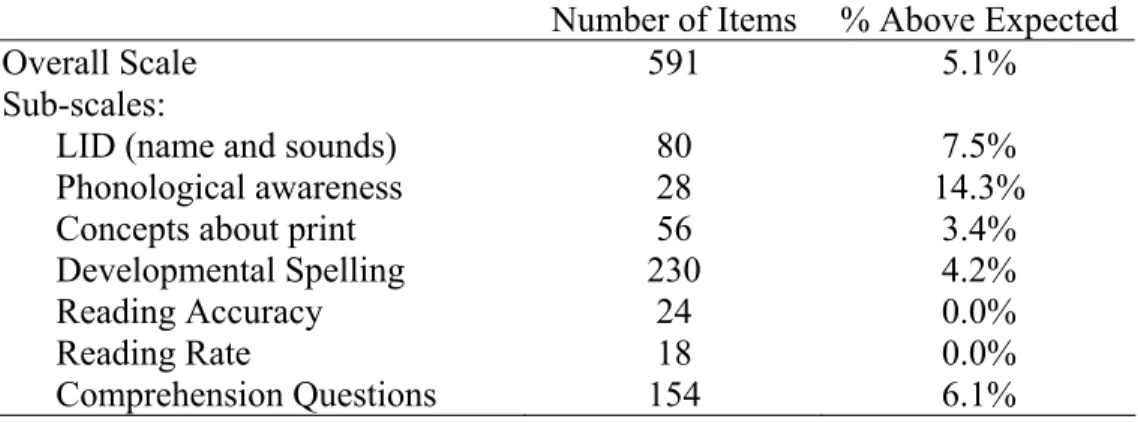
Our first analysis of the construct validity of STEP examined whether the STEP items actually function as a single overall scale. Table 6 provides a summary of results on the infit statistics from the Rasch analysis of the STEP scale. As noted above, The Rasch model postulates a single underlying metric. Even with a perfect developmental scale, we expect under Rasch theory that 5 percent of the items will misfit purely by statistical chance. If the scale is working properly, the actual observed number of misfitting items should not grossly exceed this expectation. In fact, that is exactly what happened here. Overall, we found that out of the 591 items that comprise the total scale, only 5.1 percent had higher than expected mean squared errors.
Table 6. Percent of Items Exceeding Expected Fit Values
Number of Items % Above Expected
Overall Scale 591 5.1%
Sub-scales:
LID (name and sounds) 80 7.5%
Phonological awareness 28 14.3%
Concepts about print 56 3.4%
Developmental Spelling 230 4.2%
Reading Accuracy 24 0.0%
Reading Rate 18 0.0%
Comprehension Questions 154 6.1%
In addition, we found no significant evidence of clustering among the “misfitting items” in any of the assessment sub-components. For example, 3.4 percent of the concepts about print items misfit and 4.2 percent of the developmental spelling items misfit.3 The phonological awareness items, which include the subtasks of rhyming, identifying first sounds, and segmenting words into phonemes, are the only potential point of concern. Given, however that there are only 28 items in this sub-scale, the presence of four misfitting items is not statistically significant. Moreover, the fact that these misfitting items are spread across the three different assessment tasks that comprise this sub-scale (one misfitting item in the rhyming sub-task; one in identifying first sounds, and two in segmenting words) suggests that the misfit may be related to a characteristic of the particular items rather than an indication that Phonological Awareness represents a separate underlying dimension.4 In sum, the infit statistic results support a claim that STEP measures a single underlying developmental phenomenon.
A Theoretical Test of the Developmental Literacy Scale
Next we considered whether the hierarchical ordering of the items within the STEP scale appear theoretical sensible given extant reading development theory. Under the Rasch
3 We note that if the misfitting items clustered by sub-component, this would constitute evidence that this
sub-component did not function consistent with the overall scale.
4 For example, in the segmentation sub-task, students are asked to produces the phonemes that comprise the
analysis, each item has an estimated difficulty which places it in a unique position on the overall scale. If STEP functions as a developmental scale, items should cluster within the scale by sub-component. That is, the Concepts about Print items, for example, should tend to be easier than the Phonological Awareness items which in turn should be easier that than most of the reading accuracy ratings. Similarly, within each sub-component, the items difficulties should also order in theoretically predicable ways, e.g. the rhyming items within Phonological Awareness should generally be easier than items that examine a child’s skill at segmentation.
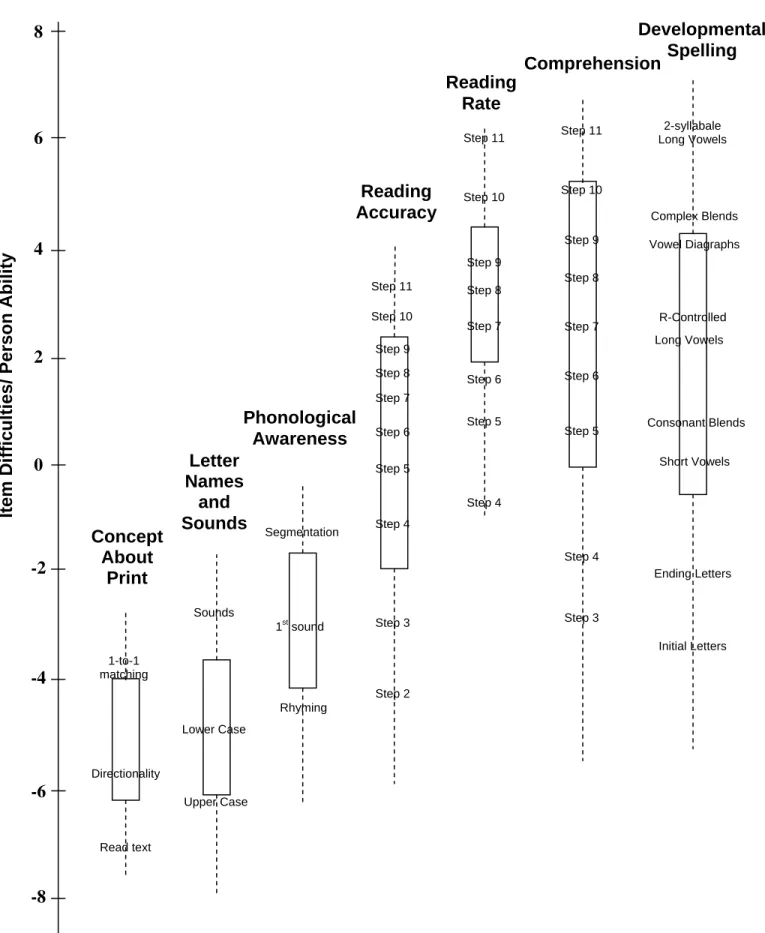
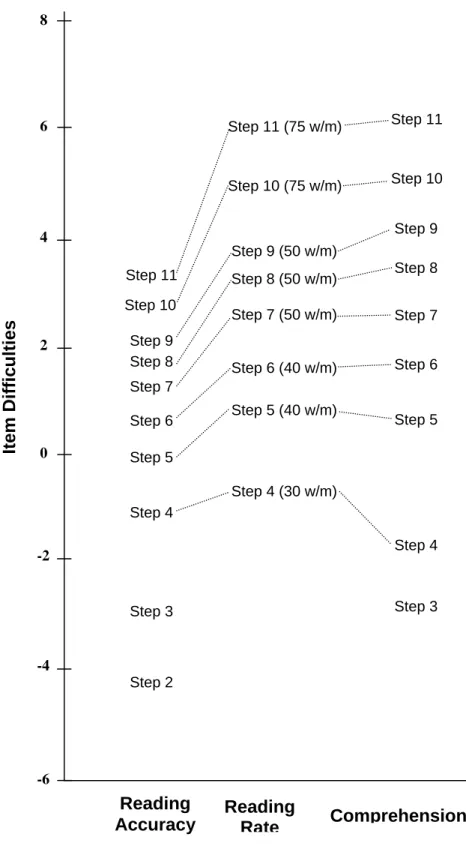
Ordering of the Assessment Sub-Components. Figure 3 displays a box plot of the item difficulties for each assessment sub-component included in STEP. These boxplots highlight the range of item difficulties by sub-component and the relative ordering of the sub-component item clusters within the overall scale. In order to provide some concreteness in the discussion below, we have added to the display information about selected individual item difficulties and/or mean item difficulties for the sub-tasks within various the assessment components.5
Within the Rasch metric, both item difficulties and person measures are expressed in logits and have a direct relationship to one another. Any given person measure can be interpreted as a probabilistic statement about the likelihood that a child will answer correctly each item in the overall scale. For example, a student with a score of -4.00 on the Developmental Literacy Scale would have a .90 probability of answering correctly the average item within the 1-to-1 matching sub task in Concepts about Print (item difficulty/mean difficulty for 3 items -3.7). That same child would have over a 90 percent chance of knowing most letter names, and would very likely be also matching words with the same first sounds in Phonological Awareness. In contrast, we would not expect such a child to read with accuracy a Step 4 text (-1.2 item difficulty).
5 Some of the item labels in Figure 3 represent the mean item difficulty for several items, for example
upper-case letter names, rhyming, etc. For Comprehension, the labels for each step is the mean item difficulty for the comprehension questions at those steps.
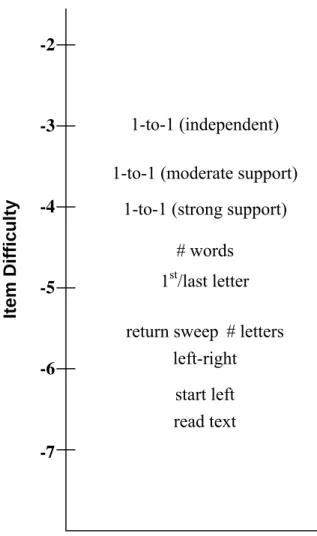
As expected the easiest items within the STEP developmental literacy scale focus on concepts about print and letter names and sounds. Within Concepts about Print, the easiest item is “knowing that you read the text” (and not the pictures). Next students learn about directionality – reading left to right. The most difficult concept about print is understanding 1-to-1 matching of voice to words on the page.
Looking at the next boxplot, representing letter names and sounds, we see that as students are gain more understanding of Concept about Print, they are also learning to identify letters. Children tend to learn upper case letters first (-6.1 mean difficulty for 26 items for upper case; -5.2 mean difficulty for 28 lower case including print and type face fonts for ‘a’ and ‘g’) and to eventually associate letters with the sounds that they make (-3.0 mean difficulty for 26 items.)
The item difficulties for the Phonological Awareness sub-component (the third boxplot in Figure 3) indicate that these skills are developing in tandem with Concepts about Print and Letter Names and Sounds. Rhyming words comes first (-4.3 mean item difficulty) , following by matching words that begin with the same first sound, (-3.4 mean item difficulty) and finally learning to segment words into individual phonemes(-1.6 mean item difficulty). Note that being able to consistently segment words into phonemes does not occur until students are accurately reading text between Step 3 and Step 4.
Next comes the results for Text Reading Accuracy which follows a monotonic
progression. The jumps in item difficulty across Steps 2 through 5 are relatively large. Students at this stage in learning to read are acquiring many new strategies and skills, and correspondingly, the ability to read accurately the next level text represents a significant developmental gain. A child with a scale score of -4.1 has a probability of 0.90 for reading a Step 2 text with mastery. To achieve a similar likelihood of mastery at Step 3 implies a scale score of -3.2; the corresponding jumps to reading accurately at Steps 4 and 5 translate into scale scores of -1.6 and -0.1 respectively. In contrast, for Step levels 5 and beyond, the distance between item difficulties become significantly smaller.