
A note on some physical conditions for cultivating Oxyrrhis marina
6
0
0
Full text
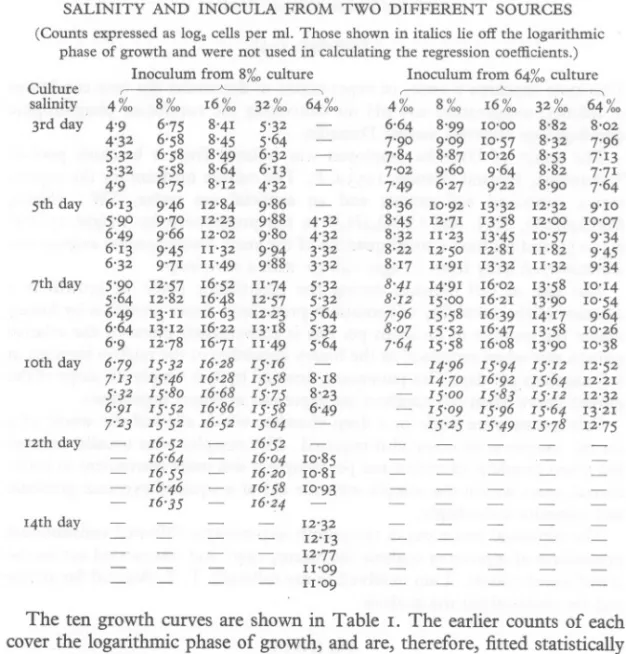
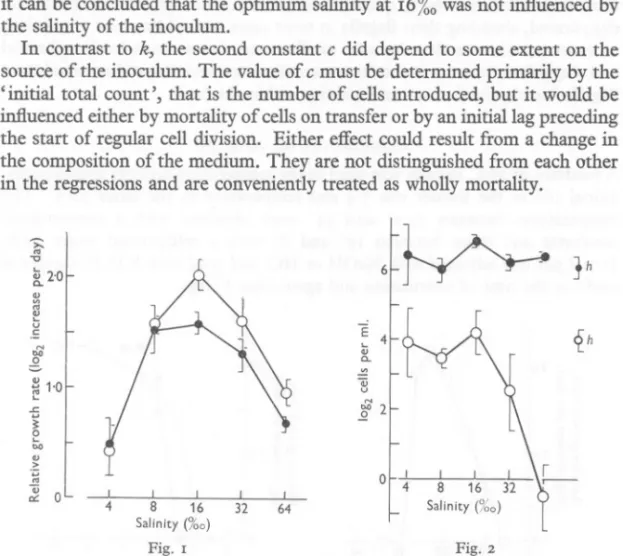
(2) M, R, DROOP. 600. two sets of cultures grown at room temperatures and initial pH 7'4 in the following salinities: 4, 8, 16, 32 and 64%0' from inocula adapted to 8 %0 in the one set and 64 %0 in the other, The parameters to be determined were, relative growth rate, (apparent initial viable count', and (initial total count'. 16'35 16'46 16'55. ---- --. 16'64. -. 16'20 16'52 12'32 6'64 15'00 16'52 16'58 7'84 8,82 16'02 12'81 16'21 8'22 '12 16'22 14'96 --, 16,86 16'28 12'21 8'18 10'26 8'12 13'45 13'32 3'32 10'26 12'02 16'08 12'23 12'00 16,68 16'92 10'81 15'52 10'00 8'02 8,82 9'60 5'58 10'57 9'09 8'32 II 6'75 '49 12'57 12,82 10'57 II'82 II'32 9'34 II'32 8'90 6'27 9'94 5'32 9'64 88'17 '41 7'49 10'54 16'63 9,80 5'64 8'32 16'47 9'70 10'07 13'58 9'88 9'10 8'45 12'32 10'38 15'80 8'23 ,,13'32 TABLE 1.,16'24 GROWTH CULTURES 15'49 16'52 6'58 15'46 12'52 15'83 12'32 8'07 15'75 15'78 15'96 7'13 10'93 13'21 6'49 6'13 7'71 8'64 7'02 6'32 II'91 9'71 10'14 12'57 16'48 7,64 14'17 16'39 12'78 12'23 16'71 9'86 12'71 15'16 8'99 15'94 64%0 15'64 15'58 8'87 9,64 12'75 8'53 15'25OF OXYRRHIS 5,64 8"45 7'96 7'90 15'12 8'49 5'32 8'41 10'85 9'45 14'91 9'22 9'45 '74 II'23 12'50 15'00 13'II 15'58 4'32 13'90 7'96 13'12 13'18 II '49 7'64 10'92. 12'84 9'46 9'66 6'13 8'36 15'32 14'70 16%0 32%0 4%0 4%0 15'09 4'9 16'04 5'90 6'79 88%0 %q Inoculum INfrom 64%0 cultureOF DIFFERENT 12'77 II'09 II '09 12'13 SALINITY INOCULA FROM TWOin DIFFERENT ofInoculum growth were in shown calculating the regression coefficients,) from 8%0culture (Counts phase expressed as AND log.and cells per not m!.used Those italics lie off theSOURCES logarithmic A A. by the equation n = kt+c, cover the general logarithmic phase counts of growth, and are, therefore, fitted statistically The ten growth curves are shown in Table I. The earlier of each 14th day. when n represents log2 cells per ml. at time t, k and c being constants, the former the relative growth rate, the latter the logarithm of the (apparent initial viable count', i.e. n at t = 0, The two constants and their 95 % fiducial limits for the ten regressions are plotted against salinity in Figs. 1 and 2,.
(3) PHYSICAL CONDITIONS FOR CULTIVATING. OXYRRHIS. 601. Since a clear maximum for k occurred at 16%0 in both experiments (Fig. I) it can be concluded that the optimum salinity at 16%0 was not influenced by the salinity of the inoculum. In contrast to k, the second constant c did depend to some extent on the source of the inoculum. The value of c must be determined primarily by the 'initial total count', that is the number of cells introduced, but it would be influenced either by mortality of cells on transfer or by an initial lag preceding the start of regular cell division. Either effect could result from a change in the composition of the medium. They are not distinguished from each other in the regressions and are conveniently treated as wholly mortality.. : 4 a. '". '". ~ 1'0 ..c. ~ eb(l '". > ";:;. v'" 4. c:<:. Salinity. (%0). 0. I832 64 16. I. Fig.. I. I. I. I. I. Of- 4. 8. 16. 32. Salinity. (%0). Fig. 2 Fig. I" Relative growth rate (k) as a function of salinity. Open circles, 8 %0 adapted inoculum; filled circles, 64 %0 adapted inoculum. 95 % fiduciallirnits indicated. Fig. 2. Log 'apparent initial viable count' (c) as a function of salinity. Open circles, 8 %0 adapted inoculum; filled circles, 64 %0 adapted inoculum. Log 'initial total count' (h) in each case is shown on the right. 95 % fiducial limits indicated.. The 'initial total count' was obtained by counting sample 0'06 mI. aliquots from the inoculum cultures and dividing by 6 (since an inoculum of 0'06 ml. was being given to 6'0 ml. of culture medium). h, the logarithm of this, in the 8 %0 experiment was 3'95 (fiducial limits ± 0'30), and in the 64 %0 experiment 6'08 (limits ± 0'31). Fig. 2 shows that h is significantly higher than c only in the case of the two cultures of highest salinity in the 8 %0 experiment, from which the conclusion is drawn that, while the transfer from a high to low salinity was tolerated without shock, the more extreme cases of reverse transfer were not experienced without harm to the population. Microscopic observation of the behaviour of cells on transfer confirmed this conclusion and, moreover, showed that the correct interpretation of the.
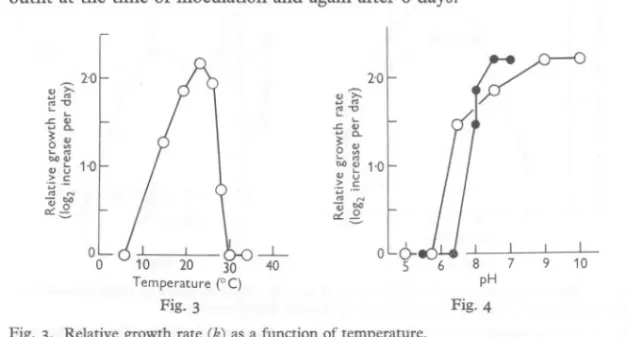
(4) 602. M. R. DROOP. phenomenon was mortality on transfer and not initial lag. Thus, cells suddenly transferred from 8 to 64 %0 quickly became lean and angular and apparently dehydrated, shedding their flagella in most cases and all but 2 or 3 % failing to recover; whereas they became swollen and almost completely spherical and sluggish on transfer in the downward direction and they did not shed their flagella but regained shape and activity within the hour. TEMPERATURE AND pH A medium of 16%0 salinity was used in the temperature and pH experiments. Initial pH in the former was 7'4 and temperature in the latter 22'5°. The temperatures between 22'5° and 34° were obtained with a conventional incubator and those between 19° and 6° with a refrigerated water bath. Initial pH was adjusted with NaOH or Hel and read with B.D.H. capillator outfit at the time of inoculation and again after 6 days.. 2'0. -L40. OLOS. I 7. I 9. I 10. Fig. 3. Relative growth rate (k) as a function of temperature. Fig. 4. Relative growth rate (k) as a function of pH. pH measured: open circles, at start; filled circles, after 6 days.. The results of the two experiments were not subjected to statistical analysis, since the sole parameter required was relative growth rate. They are shown in Figs. 3 and 4, where relative growth rate is graphed against temperature or pH. There was a temperature optimum of 22°-23°, an upper tolerance limit, of 28°, and a QI0 of about 2'7 between 10° and 20°. A pH of 7 or over appears to be suitable. DISCUSSION A maximum division rate of 2'2 per day is higher than is normally met among dinoflagellates and may be correlated with Oxyrrhis's phagotrophic habits. Braarud (1951) obtained maxima of 0'32 for Exuviaella baltica, 0'55 for.
(5) PHYSICAL CONDITIONS FOR CULTIVATING. OXYRRHIS. 603. sp., 0'95 for Peridinium trochoideum; while Braarud & Rossavik (1951) obtained 0'55 for Prorocentrum micans, Braarud & Pappas (1951) 0'89 for Peridinium triquetrum, and Sweeney (1954) 0'67 for Gymnodinium. Amphidinium. splendens. Oxyrrhis is most often encountered in brackish rock pools above the high-. water mark and sometimes occurs in water of very high salinity. At the other extreme, it is seldom found in pools whose salinity is lower than 4 %0' in which respect it differs from many other supra-littoral species which tolerate or even preferthe lower salinities (Droop, 1953 a, table 10; 1955, table 1). The optimum salinity for the neritic species studied by Braarud (1951) ranged from 16 to 20 %0 with upper and lower toleration limits only slightly narrower than those reported here for Oxyrrhis. It seems that salinity tolerance per se cannot satisfactorily account for the absence of neritic species from supra-littoral pools or of Oxyrrhis from the sea. The response to sudden changes in salinity is interesting and shows Oxyrrhis well fitted to its habitat, for the salinity of sea-water marks the limit to which a pool can suddenly be raised by sea splash, any further rise being necessarily by evaporation and therefore slow. In south Finland, where this strain originated, this figure is 6 %0' On the other hand, the reverse change, which is brought about by flooding with rain water, can be quite rapid, especially if mixing is not delayed. It has been observed previously (Hopkins, 1938) that the physiological response to changes in salinity of marine Protozoa not possessing a rigid periplast or contractile vacuoles is to contract or to swell. This is due to a temporary unbalance between the osmotic pressure of the internal and external media. Recovery is stated to be due to adjustment by the passage of salts through the membrane, though it might equally be brought about by mobilization or immobilization of carbohydrate reserves of high osmotic pressure. Oxyrrhis certainly has great powers of adjustment, particularly when the change is made gradually. The fact that dehydration is a greater hazard than bursting speaks for the tensile strength of the periplast. The response to pH was as expected, for a pH 8-9 is normal for a pool containing Oxyrrhis and one below 7 is seldom encountered in the aerobic layers of supra-littoral pools. The temperature curve is conventional: its peak suggests that Oxyrrhis is a summer organism, which indeed it is, though the high rainfall in this country or ice cover in Finland would in any case keep the pools empty of flagellates during the winter months. The upper laboratory temperature limit of 28° is often exceeded for short periods in pools containing large populations of Oxyrrhis during the summer; for instance, I obtained midday records of 30° in Finland (Droop, 1953a). Possibly other more southern races of this species tolerate higher continuous temperatures..
(6) M. R. DROOP SUMMARY. Maximum division rate of the dinoflagellate Oxyrrhis marina Dujardin feeding on Saccharomyces exiguus occurred in cultures of salinity 16%0' temperature 22'5° and pH 8-10, and was 2'2 per day. Salinities below 4%0' pH below 6'5 and continuous temperatures over 28° were not tolerated. Sudden extreme changes in salinity were tolerated in the downward but not in the upward direction. REFERENCES BRAARUD, T., 1951. Salinity as an ecological factor in marine phytoplankton. Physiol. Plant., Vol. 4, pp. 28-34. BRAARUD, T. & PAPPAS,1., 1951. Experimental studies on the dinoflagellate Peridinium triquetrum (Ehrb.) Lebour. Avh. norske VidenskAkad., 1957, No.2, pp.I-23· BRAARUD,T. & ROSSAVIK,E., 1951. Observations on the marine dinoflagellate Prorocentrum micans Ehrb. in culture. Avh. norske VidenskAkad., 1951, No. I, pp. 1-18. DROOP,M. R., 1953a. On the ecology of flagellates from some brackish and freshwater rock-pools of Finland. Acta bot. fenn., Vol. 51, pp. I-52. -I953b. Phagotrophy in Oxyrrhis marina Dujardin. Nature, Lond., Vol. 172, P·250. -1955. Some new supra-littoral Protista. J. mar. biol. Ass. U.K., Vol. 34, PP·233-45· HOPKINS,D. L., 1938. Adjustment of the marine amoeba, Plabellula mira Schaeffer to changes in the total salt concentration of the outside medium. Biol. Bull., Woods Hole, Vol. 75, p. 337. SNEDECOR, G. W., 1946. Statistical methods. 4th Edition. Iowa: State College Press. SWEENEY,B. M., 1954. Gymnodinium splendens, a marine dinoflagellate requiring vitamin B12• Amer. J. Bot., Vol. 41, pp. 821-24..
(7)
Figure
Related documents
The Seckford Education Trust and our schools should be environments in which pupils and students or their parents/carers can feel comfortable and confident
Project Coordinator: National University of Ireland, Galway www.sifem-project.eu Page 34 of 36. 7 SUBMITTED
Keywords: Adult Mental Health Care, User's Views, Cohort Studies, Community Treatment, Qualitative Research, Mental Health Act... For Peer
The aim of this paper was to explore the effects on the French forest sector of three policies to mitigate climate change: a fuelwood consumption subsidy (substitution), a payment
q w e r t y Description Rod cover Head cover Cylinder tube Piston rod Piston Bushing Cushion valve Snap ring Tie rod Tie rod nut Wear rod Rod end nut Back up O ring Rod seal Piston
We nd that if individuals dier in initial wealth and if commodity taxes can be evaded at a uniform cost, preferences have to be weakly separable between consumption and labor
To enhance comprehension, the analysis is presented in two different ways: (1) general analysis of the autonomy (regarding children daily routines) and parental style
Although theoretically the likelihood of finding evidence that dumped imports have in- jured the domestic industry should fall as the industry increases its output, the results from
