How to develop
and implement
a national drug policy
World Health Organization
Second edition
fulfils in part through its extensive programme of publications.
The Organization seeks through its publications to support national health strategies and address the most pressing public health concerns of populations around the world. To respond to the needs of Member States at all levels of development, WHO publishes practical manuals, handbooks and training material for specific categories of health workers; internationally applicable guidelines and standards; reviews and analyses of health policies, programmes and research; and state-of-the-art consensus reports that offer technical advice and recommendations for decision-makers. These books are closely tied to the Organization’s priority activities, encompassing disease prevention and control, the development of equitable health systems based on primary health care, and health promotion for individu-als and communities. Progress towards better health for all individu-also demands the global dissemination and exchange of information that draws on the knowledge and experience of all WHO’s Member countries and the collaboration of world leaders in public health and the biomedical sciences.
To ensure the widest possible availability of authoritative information and guidance on health matters, WHO secures the broad international distribution of its publications and encourages their translation and adaptation. By helping to promote and protect health and prevent and control disease throughout the world, WHO’s books contribute to achieving the
Second edition. Updates and replaces
Guidelines for Developing National Drug Policies, 1988
How to develop
and implement
a national drug policy
WHO Library Cataloguing-in-Publication Data
How to develop and implement a national drug policy. — 2nd ed.
Updates and replaces: Guidelines for developing national drug policies (1988).
1. Essential drugs – standards 2. Drug and narcotic control 3. Drug utilization – standards 4. Legislation, Drug 5. Guidelines
ISBN 92 4 154547 X (NLM classification: QV 704)
The World Health Organization welcomes requests for permission to reproduce or translate its publications in part or in full. Applications and enquiries should be addressed to the Office of Publications, World Health Organization, Geneva, Switzerland, which will be glad to provide the latest information on any changes made to the text, plans for new editions, and reprints and translations already available.
© World Health Organization 2001
Publications of the World Health Organization enjoy copyright protection in accordance with the provisions of Protocol 2 of the Universal Copyright Convention. All rights reserved.
The designations employed and the presentation of the material in this publication do not imply the expression of any opinion whatsoever on the part of the Secretariat of the World Health Organization concerning the legal status of any country, territory, city or area or of its authorities, or concerning the delimitation of its frontiers or boundaries.
The mention of specific companies or of certain manufacturers’ products does not imply that they are endorsed or recommended by the World Health Organization in preference to others of a similar nature that are not mentioned. Errors and omissions excepted, the names of proprietary products are distinguished by initial capital letters.
Contents
Contributors ... v
Abbreviations and acronyms ... vi
Preface ... vii
PART I:
How to develop and implement a national drug policy
1. Introduction ... 31.1 Essential drugs are not used to their full potential ... 3
1.2 What is a national drug policy? ... 4
1.3 Key components of a national drug policy ... 6
2. The national drug policy process ... 11
2.1 Overview of the national drug policy process ... 11
2.2 Formulating a national drug policy ... 12
2.3 Implementing a national drug policy ... 14
2.4 Monitoring and evaluation ... 18
3. Legislation ... 21
3.1 Importance of legislation and regulations ... 21
3.2 Framework for drug legislation ... 21
3.3 Developing drug legislation and regulations ... 24
PART II:
Key components of a national drug policy
4. Selection of essential drugs ... 274.1 Essential drugs ... 27
4.2 Old problems and new challenges ... 28
4.3 Strategies for the selection of essential drugs ... 29
4.4 Traditional and herbal medicines ... 31
5. Affordability ... 33
5.1 Challenges ... 33
5.2 Strategies to increase affordability ... 34
6. Drug financing ... 37
6.1 Challenges ... 37
6.2 Drug financing options ... 37
7. Supply systems ... 41
7.1 Public or private? Or mixed? ... 41
7.2 Drug procurement ... 42
7.3 Local manufacture ... 43
7.4 Distribution strategies ... 44
8. Drug regulation ... 47
8.1 Need for drug regulation and quality assurance ... 47
8.2 Basic requirements for drug regulation ... 48
8.3 Core elements of drug regulation ... 50
8.4 Stepwise approach to drug registration ... 50
8.5 Quality ... 52
8.6 Safety ... 54
8.7 Efficacy ... 55
8.8 Information and drug promotion ... 56
8.9 Information exchange with WHO and with other agencies ... 57
9. Rational use of drugs ... 59
9.1 Why is it important to promote rational use? ... 59
9.2 Challenges ... 60
9.3 Planning for activities to promote rational use of drugs ... 61
9.4 Core strategies to improve drug use ... 62
9.5 Educational strategies ... 63
9.6 Managerial strategies to promote rational drug use ... 66
9.7 Regulatory strategies to promote rational drug use ... 67
9.8 Promoting rational drug use in the private sector ... 68
10. Research ... 69
10.1 Introduction ... 69
10.2 Strategies to promote research ... 70
11. Human resources development ... 73
11.1 Introduction ... 73
11.2 Strategies for human resource development ... 74
12. Monitoring and evaluation ... 77
12.1 Monitoring and evaluation are part of a national drug policy ... 77
Contributors
These guidelines were developed through a series of activities. In June 1995 a meeting of the WHO Expert Committee on National Drug Policy was held, to update the 1988 Guidelines for Developing National Drug Policies.1 Comments and
contributions on successive drafts were received from international groups, organi-zations and individual experts, as well as from staff members from the Department of Essential Drugs and Medicines Policy (EDM) and WHO Regional Offices. The final text was edited by C. Hodgkin, E.D. Carandang, D.A. Fresle and H.V. Hogerzeil. The comments and contributions of the following persons are gratefully acknowl-edged: F.S. Antezana, H. Bale, W. Bannenberg, K. Bremer, P. Brudon, J. Cohen, M. Cone, A. Creese, A.W. Davidson, T. Eriksen, M. Everard, M. Fofana, B.B. Gaitonde, G. Gizaw, V. Habiyambere, M. Helling-Borda, D. Henry, K. Hurst, B. Joldal, K. de Joncheere, Kin Shein, Q. Kintanar, S. Kopp-Kubel, R.O. Laing, R.F. Lobo, Y. Maruyama, B. Merkel, M.Murray, S.Muziki, S.Nightingale, T.L.Paal, M.Paz-Zamora, J.D.Quick, L. Rägo, C. Rambert, J.A. Reinstein, H. Rouppe van der Voort, L.B. Rowsell, G. Sitbon, S. Soesilo, P. Spivey, G. Tomson, A. Toumi, G. Velasquez, C. Voumard, K. Weerasuriya, E. Wondemagegnehu and X. Zhang.
Abbreviations and acronyms
AIDS Acquired immunodeficiency syndrome ASEAN Association of South-East Asian Nations DRA Drug regulatory authorityEDM Department of Essential Drugs and Medicines Policy
EU European Union
GMP Good manufacturing practices
HIV Human immunodeficiency virus
INN International nonproprietary names
INRUD International Network for Rational Use of Drugs MoH Ministry of Health
MSF Médecins Sans Frontières
MSH Management Sciences for Health NDP National drug policy
NGO Nongovernmental organization OAU Organization of African Unity OTC Over-the-counter (drug)
TRIPS (Agreement on) Trade-Related Aspects of Intellectual Property Rights TFHE Task Force on Health Economics
UNAIDS Joint United Nations Programme on HIV/AIDS UNICEF United Nations Children’s Fund
UNFPA United Nations Population Fund
WHA World Health Assembly
WHO World Health Organization WTO World Trade Organization
Preface
In 1975, the World Health Assembly in resolution WHA28.66 requested WHO to develop means to assist Member States in formulating national drug policies. It also urged WHO to assist countries in implementing strategies, such as the selection of essential drugs and appropriate procurement of quality drugs based on health needs, and in providing education and training in various elements of pharmaceutical programmes. This resolution was followed by a series of events that marked the evolution of country drug programmes with the assistance of WHO.
The first WHO Model List of Essential Drugs was published in 1977. A year later the WHO/UNICEF Conference on Primary Health Care at Alma-Ata included access to essential drugs as one of the eight elements of primary health care. In 1979, the WHO Action Programme on Essential Drugs was established. Another landmark in promoting strategies to improve the pharmaceutical situation in countries was the 1985 Conference of Experts on Rational Use of Drugs in Nairobi. The following year’s World Health Assembly adopted resolutions that reflected the Conference recommendations on promoting rational use. Also in 1986, a WHO Expert Committee on National Drug Policies met to develop practical guidance for Member States, published as Guidelines for developing national drug policies.1 This publication has
proved very useful over the years.
The efforts of countries, WHO and other agencies have had a considerable impact. The number of people with access to essential drugs has grown from roughly 2,100 million in 1977 to an estimated 3,800 million in 1999. By 1999, 66 countries had formulated or updated a national drug policy within the previous 10 years, compared with 14 countries in 1989. By the end of 1999, 156 WHO Member States had a national essential drugs list; 127 of the lists had been revised within the previous five years.2
Nevertheless, problems of access to quality drugs and rational use persist. Although few hard data are available, it is likely that in the poorest parts of Africa and Asia more than half the population still lacks access to essential drugs. And there are new challenges that may have an impact on access, such as the expansion of the private sector’s role in pharmaceuticals, health sector reforms and the effects of globalization. The changing pattern of diseases, antimicrobial resistance and emerging new diseases are other factors. Particularly important is the current trend of governments to reduce health care spending because of inadequate resources, despite increasing health needs.
After a decade, and with new problems to be addressed, there was a clear need to revise the 1988 guidelines. The Expert Committee on National Drug Policies met in 1995 to review the current pharmaceutical situation and to start the updating process. Their deliberations resulted in a report that became the basis of the present guidelines.3
These updated guidelines focus on the national drug policy process, strategies and options which can be used by Member States and organizations active in the
pharmaceutical sector. Each policy component is discussed, with a focus on current problems and new challenges. And each chapter presents strategies and practical approaches that can be used to improve the situation. All chapters include references to publications that provide additional technical and practical details.
P A R T O N E
How to develop and
implement a national
drug policy
1.1 Essential drugs are not used to their full
potential
Health is a fundamental human right. Access to health care, which includes access to essential drugs, is a prerequisite for realizing that right. Essential drugs play a crucial role in many aspects of health care. If available, affordable, of good quality and properly used, drugs can offer a simple, cost-effective answer to many health problems. In many countries drug costs account for a large share of the total health budget.
Introduction
1
Despite the obvious medical and economic importance of drugs there are still widespread problems with lack of access, poor quality, irrational use and waste. In many settings essential drugs are not used to their full potential.
Lack of access to essential drugs
An increasing number of pharmaceutical products are available in the world market, and there has been rapid growth in both drug consumption and expenditure. However, many people throughout the world cannot obtain the drugs they need, either because they are not available or too expensive, or because there are no adequate facilities or trained professionals to prescribe them. Although hard data are unavailable, WHO has estimated that at least one-third of the world’s population lacks access to essential drugs; in poorer areas of Asia and Africa this figure may be as high as one-half.2 Millions of children and adults die each year from diseases that
could have been prevented or treated with cost-effective and inexpensive essential drugs.
Poor quality
In many countries drug quality assurance systems are inadequate because they lack the necessary components. These components include adequate drug legislation and regulations, and a functioning drug regulatory authority with adequate resources and infrastructure to enforce the legislation and regulations. Without these, substandard and counterfeit products can circulate freely. In addition, inappropriate handling, storage and distribution can alter the quality of drugs. All these factors may have serious health consequences and lead to a waste of resources.
Irrational use of drugs
Even people who have access to drugs may not receive the right medicine in the right dosage when they need it. Many people buy, or are prescribed and dispensed, drugs that are not appropriate for their needs. Some use several drugs when one would do. Others use drugs that carry unnecessary risks. The irrational use of drugs may unnecessarily prolong or even cause ill-health and suffering, and results in a waste of limited resources.
Persistent problems and new challenges
These problems have persisted despite all the work done to improve access to essential drugs, to ensure drug quality and to promote rational drug use. The reasons are complex and go beyond simple financial constraints. To understand them it is necessary to look at the characteristics of the drug market, and to study the attitudes and behaviour of governments, prescribers, dispensers, consumers and the drug industry. Health sector development, economic reform, structural adjustment policies, trends towards liberalization, and new global trade agreements all have a potential impact on the pharmaceutical situation in many countries. They may also affect the ultimate goal of achieving equity in health.
Changes in the patterns of disease and drug demand also represent major challenges. The rise of new diseases, such as acquired immunodeficiency syndrome (AIDS), the re-emergence of other diseases and increasing drug resistance of potentially fatal diseases, such as malaria and tuberculosis, all contribute to increased spending on drugs and growing pressure on health resources. Changes in life expectancy and in lifestyles have led to an increase in chronic diseases and diseases of the elderly, and an increase in the need for drugs to treat these chronic diseases.
A national drug policy as a common framework to solve problems in
pharmaceuticals
Experience in many countries has shown that these complicated and interdependent problems can best be addressed within a common framework, as piecemeal approaches can leave important problems unsolved and often fail. In addition, the different policy objectives are sometimes contradictory, and so are the interests of some of the stakeholders. On the basis of this experience, WHO recommends that all countries formulate and implement a comprehensive national drug policy (NDP).
1.2 What is a national drug policy?
A commitment to a goal and a guide for action
A national drug policy is a commitment to a goal and a guide for action. It expresses and prioritizes the medium- to long-term goals set by the government for the pharmaceutical sector, and identifies the main strategies for attaining them. It provides a framework within which the activities of the pharmaceutical sector can be coordinated. It covers both the public and the private sectors, and involves all the main actors in the pharmaceutical field.
A national drug policy, presented and printed as an official government statement, is important because it acts as a formal record of aspirations, aims, decisions and commitments. Without such a formal policy document there may be no general overview of what is needed; as a result, some government measures may conflict with others, because the various goals and responsibilities are not clearly defined and understood.
The policy document should be developed through a systematic process of consul-tation with all interested parties. In this process the objectives must be defined, priorities must be set, strategies must be developed and commitment must be built.
Why is a national drug policy needed?
A national drug policy is needed for many reasons. The most important are:
■ to present a formal record of values, aspirations, aims, decisions and medium- to long-term government commitments;
■ to define the national goals and objectives for the pharmaceutical sector, and set priorities;
■ to identify the strategies needed to meet those objectives, and identify the various actors responsible for implementing the main components of the policy;
■ to create a forum for national discussions on these issues.
The consultations and national discussions preceding the drug policy document are very important, as they create a mechanism to bring all parties together and achieve a sense of collective ownership of the final policy. This is crucial in view of the national effort that will later be necessary to implement the policy. The policy process is just as important as the policy document.
The main objectives of ensuring equitable access, good quality and rational use are usually found in all national drug policies, but clearly not all of these policies are the same. The final definition of objectives and strategies depends on the level of economic development and resources, on cultural and historical factors, and on political values and choices. The guidelines set out here are intended to help countries develop and implement a comprehensive policy framework that is appropriate to their own needs, priorities and resources.
A national drug policy is an essential part of health policy
A national drug policy cannot be developed in a vacuum – it must fit within the framework of a particular health care system, a national health policy and, perhaps, a programme of health sector reform. The goals of the national drug policy should always be consistent with broader health objectives, and policy implementation should help to achieve those broader objectives.
The health policy and the level of service provision in a particular country are important determinants of drug policy and define the range of choices and options. On the other hand, the drug situation also affects the way in which health services are regarded. Services lose their credibility if there is no adequate supply of good quality drugs, or if these are badly prescribed. Thus the implementation of an effective drug policy promotes confidence in and use of health services.
There are also economic arguments. In many countries a large proportion of health care spending is on drugs. Health care financing is therefore closely related to drug financing. It is very difficult to implement a health policy without a drug policy.
Objectives of a national drug policy
In the broadest sense a national drug policy should promote equity and sustainability of the pharmaceutical sector.
The general objectives of a national drug policy are to ensure:
■ Access: equitable availability and affordability of essential drugs
■ Quality: the quality, safety and efficacy of all medicines
■ Rational use: the promotion of therapeutically sound and cost-effective use of drugs by health professionals and consumers.
The more specific goals and objectives of a national policy will depend upon the country situation, the national health policy, and political priorities set by the government. In addition to health-related goals there may be others, such as economic goals. For example, an additional objective may be to increase national pharmaceutical production capacity.
It is critical that all the drug policy’s objectives are explicit, so that the roles of the public and private sectors and of the various ministries (health, finance, trade and industry) and government bodies (such as the drug regulatory authority) can be specified.
Importance of the essential drugs concept
The essential drugs concept is central to a national drug policy because it promotes equity and helps to set priorities for the health care system. The core of the concept is that use of a limited number of carefully selected drugs based on agreed clinical guidelines leads to a better supply of drugs, to more rational prescribing and to lower costs.
The reasons are clear. Essential drugs, which are selected on the basis of safe and cost-effective clinical guidelines, give better quality of care and better value for money. The procurement of fewer items in larger quantities results in more price competition and economies of scale. Quality assurance, procurement, storage, distribution and dispensing are all easier with a reduced number of drugs. Training of health workers and drug information in general can be more focused, and prescribers gain more experience with fewer drugs and are more likely to recognize drug interactions and adverse reactions.
By the end of 1999, 156 developed and developing countries had national or institutional lists of essential drugs for different levels of care, in both the private and public sectors; 127 of these lists had been updated in the previous five years, and 94 were divided into levels of care. There is substantial evidence that the use of national lists of essential drugs has contributed to an improvement in the quality of care and to a considerable saving in drug costs.
1.3 Key components of a national drug policy
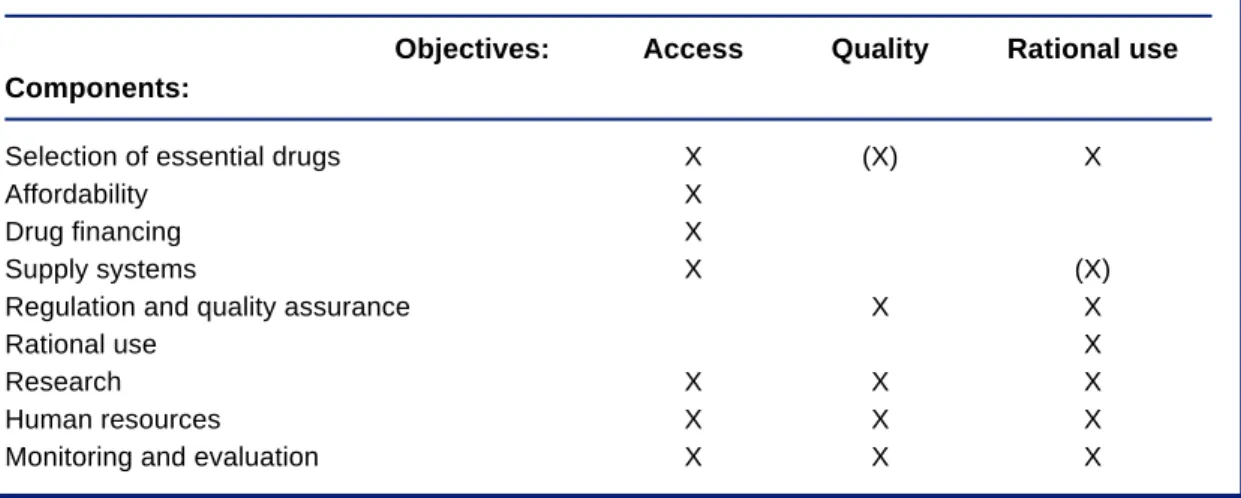
A national drug policy is a comprehensive framework in which each component plays an important role in achieving one or more of the general objectives of the policy (access, quality and rational use). The policy should balance the various goals and objectives, creating a complete and consistent entity. For example, access to
essential drugs can only be achieved through rational selection, affordable prices, sustainable financing and reliable health and supply systems. Each of the four components of the “access framework” is essential but not sufficient in itself to ensure access. Similarly, rational drug use depends on many factors, such as rational selection, regulatory measures, educational strategies and financial incentives. Table 1 lists the key components of a national drug policy and shows how they relate to the three main objectives of the policy.
Table 1
Components of a national drug policy, linked to key policy objectives
Objectives: Access Quality Rational use Components:
Selection of essential drugs X (X) X Affordability X
Drug financing X
Supply systems X (X) Regulation and quality assurance X X Rational use X Research X X X Human resources X X X Monitoring and evaluation X X X
X = direct link; (X) = indirect link
As can be seen from the Table, most components cannot be linked to one objective only. The components are briefly summarized below and are discussed in detail in Part II (Chapters 4–12).
Selection of essential drugs
Drug selection, preferably linked to national clinical guidelines, is a crucial step in ensuring access to essential drugs and in promoting rational drug use, because no public sector or health insurance system can afford to supply or reimburse all drugs that are available on the market. Key policy issues are:
■ the adoption of the essential drugs concept to identify priorities for government involvement in the pharmaceutical sector, and especially for drug supply in the public sector and for reimbursement schemes;
■ procedures to define and update the national list(s) of essential drugs;
Affordability
Affordable prices are an important prerequisite for ensuring access to essential drugs in the public and private sectors. Key policy issues are:
■ government commitment to ensuring access through increased affordability;
■ for all drugs: reduction of drug taxes, tariffs and distribution margins; pricing policy;
■ for multi-source products: promotion of competition through generic policies, generic substitution and good procurement practices;
■ for single-source products: price negotiations, competition through price information and therapeutic substitution, and TRIPS-compliant measures such as compulsory licensing, “early workings” of patented drugs for generic manufacturers and parallel imports.
Drug financing
Drug financing is another essential component of policies to improve access to essential drugs. Key policy issues are:
■ commitment to measures to improve efficiency and reduce waste;
■ increased government funding for priority diseases, and the poor and disadvantaged;
■ promotion of drug reimbursement as part of public and private health insurance schemes;
■ use and scope of user charges as a (temporary) drug financing option;
■ use of and limits of development loans for drug financing;
■ guidelines for drug donations.
Supply systems
The fourth essential component of strategies to increase access to essential drugs is a reliable supply system. Key policy issues are:
■ public–private mix in drug supply and distribution systems;
■ commitment to good pharmaceutical procurement practices in the public sector;
■ publication of price information on raw materials and finished products;
■ drug supply systems in acute emergencies;
■ inventory control, and prevention of theft and waste;
■ disposal of unwanted or expired drugs.
Regulation and quality assurance
The drug regulatory authority is the agency that develops and implements most of the legislation and regulations on pharmaceuticals, to ensure the quality, safety and efficacy of drugs, and the accuracy of product information. Key policy issues are:
■ government commitment to drug regulation, including the need to ensure a sound legal basis and adequate human and financial resources;
■ independence and transparency of the drug regulatory agency; relations between the drug regulatory agency and the ministry of health (MoH);
■ stepwise approach to drug evaluation and registration; definition of current and medium-term registration procedures;
■ commitment to good manufacturing practices (GMP), inspection and law enforcement;
■ access to drug control facilities;
■ commitment to regulation of drug promotion;
■ regulation of traditional and herbal medicines;
■ need and potential for systems of adverse drug reaction monitoring;
■ international exchange of information.
Rational use
The rational use of drugs means that patients receive medicines appropriate for their clinical needs, in doses that meet their individual requirements, for an adequate period of time, and at the lowest cost to them and their community. Irrational drug use by prescribers and consumers is a very complex problem, which calls for the implementation of many different interventions at the same time. Efforts to promote rational drug use should also cover the use of traditional and herbal medicines. Key policy issues are:
■ development of evidence-based clinical guidelines, as the basis for training, prescribing, drug utilization review, drug supply and drug reimbursement;
■ establishment and support of drugs and therapeutics committees;
■ promotion of the concepts of essential drugs, rational drug use and generic prescribing in basic and in-service training of health professionals;
■ the need and potential for training informal drug sellers;
■ continuing education of health care providers and independent, unbiased drug information;
■ consumer education, and ways to deliver it;
■ financial incentives to promote rational drug use;
■ regulatory and managerial strategies to promote rational drug use.
Research
Operational research facilitates the implementation, monitoring and evaluation of different aspects of drug policy. It is an essential tool in assessing the drug policy’s impact on national health service systems and delivery, in studying the economics
of drug supply, in identifying problems related to prescribing and dispensing, and in understanding the sociocultural aspects of drug use. Key policy issues are:
■ the need for operational research in drug access, quality and rational use;
■ the need and potential for involvement in clinical drug research and development.
Human resources development
Human resources development includes the policies and strategies chosen to ensure that there are enough trained and motivated personnel available to implement the components of the national drug policy. Lack of motivation and appropriate expertise has been a decisive factor in the failure to achieve national drug policy objectives. Key policy issues are:
■ government responsibility for planning and overseeing the development and training of the human resources needed for the pharmaceutical sector;
■ definition of minimum education and training requirements for each category of staff;
■ career planning and team building in government service;
■ the need for external assistance (national and international).
Monitoring and evaluation
Monitoring and evaluation are essential components of a national drug policy, and the necessary provisions need to be included in the policy. Key policy issues are:
■ explicit government commitment to the principles of monitoring and evaluation;
■ monitoring of the pharmaceutical sector through regular indicator-based surveys;
■ independent external evaluation of the impact of the national drug policy on all sectors of the community and the economy.
The national drug policy process
2
2.1 Overview of the national drug policy process
A national drug policy involves a complex process of development, implementation and monitoring. First, the policy development process results in the formulation of the national drug policy. Second, strategies and activities aimed at achieving policy objectives are implemented by the various parties. Finally, the effect of these activities is monitored and the programme adjusted if necessary. Throughout the process careful planning and the involvement of all parties are needed, and the political dynamics have to be considered at all times.
Planning
A drug policy without an implementation plan remains a dead document. Careful planning of the implementation steps and activities necessary to arrive at the expected outcome is important throughout the process.
There are various types of plans. The first is probably the strategic plan to develop the policy itself, which should specify the various steps in the development process, and especially plan for the involvement of as many stakeholders as possible. After the policy has been adopted, an implementation plan, or master plan, is needed, which typically covers a 3–5-year period. This details the various activities for each component of the policy. The implementation plan spells out what needs to be done and who is responsible, estimates the budget and proposes a time frame. If resources are insufficient without external input, a set of priority activities should be identified that can be executed within the existing means. The master plan can be broken down into individual annual work plans for the various departments.
Involving all parties
Throughout the policy process (and not only in the development phase) there should be consultation, dialogue and negotiations with all interested groups and stakeholders. These include other ministries (higher education, trade, industry), doctors, pharma-cists and nurses, local and international pharmaceutical industries, drug sellers, academia, nongovernmental organizations (NGOs), professional associations and consumer groups. It is also important to consult with provincial and district medical and administrative personnel, and to make an effort to include traditional and herbal medicine practitioners. Other government agencies (such as the drug regulatory agency), insurance companies and groups paying for health care must be involved. The media can be helpful, and support from international organizations is important. It is recommended that the national drug policy committee meets regularly to review the implementation of the policy with all interested parties in a national drug policy forum.
There is likely to be some disagreement among the various stakeholders. For example, drug manufacturers may feel that their commercial interests are
threatened, and doctors may fear the loss of clinical freedom. Any party that benefits from the existing situation will be worried about change. It is a real challenge to create and maintain a process that delivers the broad consensus essential to imple-menting the policy. In general it can be said that the more the existing pharmaceutical system needs to be improved, the more important it is to involve all interested parties in discussing the necessary reforms.
Political dynamics
Formulating and implementing a national drug policy are highly political processes. This is because such a policy usually seeks to achieve equity of access to basic health care, primarily by making the pharmaceutical sector more efficient, cost-effective and responsive to health needs. Such responsiveness may include redistribution of goods and power, leading to increased competition among the groups affected by reform. Given the diverse interests and the economic importance of the issues involved, opposition to the new policy and attempts to change it during implementation can be expected, as happened in Bangladesh and the Philippines.4,5
For this reason it is important to identify political allies, and to maintain their support throughout the process. Strategies to deal with opponents should be developed and ways of working with them must be identified. Decisions and priorities touching on the interests of these stakeholders must be balanced on the basis of estimated gains and losses. Strong political leadership and sustained commitment are vital for the formulation and implementation of a national drug policy.
2.2 Formulating a national drug policy
By the end of 1999, 66 countries had formulated or updated their national drug policy within the previous 10 years. Very often an acute emergency or an important political change created a window of opportunity to start the policy formulation process. In some countries this was a change to a government committed to reform; in other countries it was an economic or political change, such as the sudden devaluation of the CFA (Communauté financière d’Afrique) franc, or the collapse of the Union of Soviet Socialist Republics, which created the need to harmonize and improve certain aspects of the pharmaceutical system. Other factors could be a political drive towards expansion of the local industry or the implementation of global trade agreements.6
Step 1: Organize the policy process
The ministry of health is the most appropriate national authority to take the lead role in formulating a national drug policy. The first step is to decide how to organize the development process that will identify the structure of the policy, its major objectives and its priority components.
At this stage it is important to identify all the interested parties that need to be involved, the necessary resources, and how these can be obtained. The need for assistance from WHO, donors or countries with relevant experience should also be assessed. This stage can be carried out within the ministry of health with support from a small committee of selected experts.
Step 2: Identify the main problems
In order to set realistic objectives a thorough analysis and understanding of the main problems in the pharmaceutical sector are needed. There are various ways of carrying out an initial situation analysis.
One successful approach has been to bring together a small team of experts, some of whom should have performed similar analyses in other countries. These experts should come not only from the ministry of health but also from other disciplines and backgrounds. They should be asked to examine the situation systematically, to identify the main problems, to make recommendations about what needs to be done and what can be done, and to identify possible approaches. They should act as impartial advisers. Once they have formulated their recommendations, these can be discussed at one or more multidisciplinary workshops, in order to formulate consolidated advice to the government. Examples of such reports are available from the WHO Department of Essential Drugs and Medicines Policy.
Step 3: Make a detailed situation analysis
A more detailed situation analysis of the pharmaceutical sector and its components may be needed. This should further analyse the source of the problems, in order to identify potential solutions, choose the most appropriate strategies, set priorities, and serve as a baseline for future systems of monitoring and evaluation.
Step 4: Set goals and objectives for a national drug policy
Once the main problems have been defined, goals can be set and priority objectives identified. For instance, if one of the priority problems is lack of access to essential drugs, one of the priority objectives should be to improve the selection, affordability and distribution of essential drugs.
The selection of appropriate strategies to achieve the objective is more complex, since it may involve choosing from among very different approaches. A workshop involving a small number of key policy-makers may be helpful. The situation analysis should justify the choices and serve as the basis for decisions.
Once the main objectives and strategies have been outlined, they should be discussed with all interested parties. Broad consultation and careful consideration of conflicting interests and structural constraints are necessary to set achievable objectives and to formulate appropriate strategies to attain them.
Step 5: Draft the text of the policy
Once a thorough analysis of the situation and an outline of the main goals, objectives and approaches have been completed, a draft text of the national drug policy should be prepared. It should set out the general objectives of the policy. In most countries this will be to ensure that essential drugs are accessible to the entire population; that the drugs are safe, efficacious and of good quality; and that they are used rationally by health professionals and consumers. The specific objectives should also be described, followed in each case by the strategy to be adopted. Drafting of the policy can be done by a small group of experts who have been involved in the earlier
stages of the process. Examples of national drug policy documents from other countries may be consulted.
Step 6: Circulate and revise the draft policy
The draft document should be widely circulated for comments, first within the ministry of health, then in other government ministries and departments, and finally to relevant institutions and organizations outside the government, including the private and academic sectors. Endorsement by government sectors responsible for planning, finance and education is important since the successful implementation of many elements of the policy will depend on their support as well. Once this wide consulta-tion is complete, the draft document should be revised in the light of the comments received, and finalized.
Step 7: Secure formal endorsement of the policy
In some countries the document can then go to the cabinet or parliament for endorsement. In others it will remain an administrative document that serves as a basis for implementation plans and changes in the law and regulations. In some countries the entire national drug policy document has become law. This is a powerful demonstration of political commitment but it can also cause problems, as future adjustments to the policy may become difficult. It is therefore recommended that only certain enabling components of the policy are incorporated into law, without too many operational details.
Step 8: Launch the national drug policy
Introducing a national drug policy is much more than a technical task. To a large extent the policy’s success will depend on the level of understanding of different sectors of society, and on their support for its objectives. The implications and benefits for all interested parties should therefore be stressed.
The policy should be promoted through a clear and well-designed information campaign. Public endorsement by respected experts and opinion leaders can be very useful. Information should be disseminated through a variety of channels to reach different target groups. The media can play a major role in ensuring public understanding and support for the policy. Some countries have organized high profile launches.
2.3 Implementing a national drug policy
A policy, however carefully formulated, is worthless if it is not implemented. Every drug policy needs an overall implementation plan or “master plan”; each component of the policy needs a detailed strategy and specific action plans. In this section some general observations on implementation are made. More detailed technical recom-mendations for each component of a national drug policy are made in subsequent chapters (see also Box 1).
Priorities for implementation
For each country the priorities for implementation will be different. For example, when health care coverage is broad and access to drugs is not a problem, rational use and the cost of drugs are likely to be of concern. In such a situation, implemen-tation of a drug policy will focus on regulating the market and on containing costs without decreasing sustainable access and equity. In least developed countries total spending on health and pharmaceuticals may be very low, and the private sector not geared to meeting the needs of the majority of the population. In this situation the focus of the policy will be more on increasing access to essential drugs.
Priorities for implementation should be based on the severity of the problems, and on the potential for success in achieving the objective and making an impact with available resources.
Master plan and work plans
The national drug policy leads to an implementation plan or master plan, which may cover a 3–5-year period. This implementation plan spells out for each component of the policy what needs to be done and who is responsible, estimates the budget requirement and proposes a rough time frame. If resources are insufficient without external input, a set of priority activities should be identified that can be executed within existing means. Potential donor inputs should also be included, and gaps in funding can be identified as a guide for future donor support. The master plan facilitates monitoring and follow-up, and it is important that it is communicated to all parties involved.
The master plan should be broken down into annual action plans and work plans, which should be carefully developed with the various agencies involved in implemen-tation. These plans should outline the approaches and activities for each component, specifying in detail who is responsible, listing the major tasks, and describing the target output, the detailed time frame and the exact budget.
Responsibilities in implementation
As lead agency, the ministry of health should oversee and coordinate all activities, and monitor the extent of implementation and the achievement of targets. In some countries a separate unit within the ministry, with its own budget and personnel, acts as the coordinating body.
Apart from the coordinating body, it is recommended that a national consultative forum is created to oversee policy implementation. This is essential to create and maintain countrywide support for the policy, and to ensure that the major stakeholders remain informed and involved. The same could be done for some specific policy components, for example, all activities dealing with quality assurance or rational drug use.
National institutions, such as the drug regulatory agency, the pharmacy department in the ministry of health, the central medical stores, and district or provincial health offices, are key players in drug policy implementation. So too are other agencies dealing with finance, trade, economic planning and education. Given the multisectoral nature of pharmaceutical issues it is important not only to obtain but also to maintain
consensus on the policy objectives. This can be achieved by agreement on implementation plans and through regular progress reports.
Financial resources
It is important to match the strategies and action plans with available financial resources. Allocations from government funds and revenue from drug registrations and fees are the usual funding sources. The responsible agencies should have a mechanism for actively seeking funds and be able to secure regular funding from the government. Contributions from international and local donors are also possible sources. However, there should be no conflict of interest in accepting donor contri-butions, for example, when donors are interested in funding activities that are of low priority in the national drug policy.
Box 1
Practical aspects of policy implementation
A drug policy can be successfully implemented only if the government is committed and proactive. Some successful strategies are:
• At an early stage, prepare the relevant legislative structure to enable the development and implementation of the national drug policy.
• Seize a window of political opportunity, such as a specific political change or developments in neighbouring countries, to advance policy development or implementation.
• Start implementing the policy in relatively easy subject areas, in order to ensure initial high visibility and success, and support for the policy at the critical early stage.
• Adopt a flexible approach; be prepared to postpone an activity if more time is needed to prepare for it, to explain it and to build consensus for it.
• Have national experts and respected political figures publicly express support for the policy and vouch for its technical soundness. It is important that the public feels confident about the policy. • Mobilize key groups in society to support the policy. Consumer organizations, trade unions,
religious organizations and the media, for example, can be important in building such support. • Anticipate shifts in opponents’ positions, and identify strategies to involve them and to win their
support. For example, the pharmaceutical industry may oppose drug pricing policies and the introduction of an essential drugs list, but will usually support strategies to strengthen drug regulation and improve drug quality assurance.
• Create constituencies that support the policy both inside and outside the government. This is crucial to the policy’s long-term success and sustainability.
Regional cooperation
Regional cooperation can be useful in implementing drug policies. Countries, institutions and organizations can share information, expertise, skills and facilities. Exchanging experiences helps to ensure that best practices are promoted, that mistakes are not repeated and that limited resources are used effectively.
Increasingly, countries cooperate on a regional basis on a wide variety of economic and policy issues. The Association of South-East Asian Nations (ASEAN), the European Union (EU) and the Organization of African Unity (OAU) are just three examples of regional partnerships.
Box 2
ASEAN cooperation in pharmaceuticals
For more than a decade, the ASEAN countries have collaborated in various aspects of the pharmaceutical sector. The following factors have contributed to success:
• Similarity in language and cultural affinity of most of the cooperating countries. • Consultative and participatory planning by all countries from an early stage.
• Technical, financial and organizational support from international organizations such as WHO and the United Nations Development Programme.
• Careful selection of priority areas for cooperation with an immediate and visible impact.
• Continuing and sustained activities over a period of time, with one lead country coordinating each project and other countries actively participating.
• Dissemination of outputs and relevant information from each project to all participating countries at annual meetings.
• A political climate in the region conducive to cooperation in many areas.
• Absence of significant opposition from any sector or vested interest in any of the participating countries.
Sharing information and technical expertise can be particularly effective if the policies and strategies are mutually relevant and easy to adapt. Harmonization of drug regulatory standards can be one outcome of successful technical and regulatory cooperation among countries. Harmonization in these areas could lead to a more economical use of human, animal and material resources, and to the development of regionally or internationally agreed standards. However, the issue of sovereignty has to be considered. During the process of harmonization each country must ensure that the areas being harmonized can be implemented and are relevant to national interests.
Technical cooperation with WHO
WHO can provide a forum for exchange of information, and can promote cooperation through regional and international training courses and through inter-country research projects. WHO collaborating centres and other centres of excellence are also involved in training and research, forming professional networks and exchanging information among cooperating countries.
New information technologies present a wealth of opportunities for efficient and low-cost exchange of information, consultation, collaboration and technical cooperation. WHO’s Medicines web site contains most of the technical information and key documents relevant for developing national drug policies.7 Another key
reference is Managing drug supply, a textbook developed by Management Sciences for Health (MSH) in close collaboration with WHO.8
A training course on drug policy issues is conducted regularly for key officials involved in pharmaceuticals,a and the International Conference of Drug Regulatory
Authorities (ICDRA) meets every two years to discuss drug regulatory matters.
a Detailed information on these and other courses and conferences is available from the WHO Department of
2.4 Monitoring and evaluation
Why are monitoring and evaluation important?
Monitoring and evaluating the impact of a national drug policy are challenging. Apart from a lack of time, human resources and budget, there is often a basic lack of understanding of the value of monitoring in the first place, and even a certain resist-ance to objectively or critically reviewing the effects of activities formulated in the master plan.
Monitoring is a form of continuous review which gives a picture of the implementation of planned activities and indicates whether targets are being met. It can be carried out using a combination of various methods, including supervisory visits and both routine and sentinel reporting.
Evaluation is a way of analysing progress towards meeting agreed objectives and goals. It should build on, and use, monitoring systems. At the start of a programme it is used to provide a clear needs assessment. A mid-term evaluation can provide valuable information about whether the programme is working, and if not, why not. Final evaluation allows a complete review of programme achievements from which lessons can be drawn for the future.
A system for monitoring and evaluation is a constructive management tool that enables a continuous assessment of progress, and helps to make the necessary management decisions. It also provides transparency and accountability, and creates a standard by which comparisons can be made between countries and areas and over time. All of this may produce the necessary evidence that progress is being made (or not), in order to support the policy in discussions with interested parties and policy-makers. Some practical aspects are presented in Box 1.
Indicators for monitoring national drug policies
To determine whether adequate progress is being achieved it is helpful to set realistic targets or performance standards. Indicators can be selected and used to measure changes, make comparisons and assess whether the targets are being met. If indicators are used they should be clear, useful, measurable, reliable and valid. WHO and MSH have done a great deal of operational research to develop and refine indicators for monitoring drug policies.9,10 Currently there are four categories
of drug policy indicators: background information, structural indicators, process indicators and outcome indicators. It is possible to use selected subsets of these indicators to meet the needs of countries.
WHO and MSH have also agreed on a subset of core indicators for routine use and sentinel reporting. These indicators are highly standardized so that trends can be identified. A detailed manual on their use is available.11 Data collection is relatively
easy, so that monitoring can be done on a regular basis. Core indicators cover the following aspects:
■ access to essential drugs, and other indicators on drug financing schemes, and public supply management; these provide information on access to essential drugs;
■ functions and efficiency of the drug regulatory authority, the quality control laboratory and how drugs are handled to maintain good quality; these provide information about drug quality;
■ drug prescribing and dispensing, use of the list of essential drugs and clinical guidelines; these provide information about drug use patterns.
Routine reporting or sentinel reporting?
A routine reporting system, as part of a drug management information system, can provide much of the information needed to monitor the drug policy’s implementation. However, in reality much of the routine information is not collected systematically and whatever is collected is rarely used. With a sentinel reporting system a selected sample of health facilities is regularly surveyed. Some countries, such as Zimbabwe, have successfully used a sentinel reporting system to collect, every two years, standard information about the status, strengths and weaknesses of the national pharmaceutical system. This has proved to be a very useful management tool.12
Who can use the results?
The indicator-based method of assessing the pharmaceutical situation can be useful for various parties involved in the pharmaceutical field. Policy-makers, implementers and managers can get a clear picture of the problems in the country so that they can reassess their strategies and priorities. Results can be used as a guide to setting priorities and to strengthening those strategies that can have the best impact.
Results can also be used by the government and health ministry to synchronize policies. For example, a low level of availability and affordability of essential drugs could indicate that the directions on health and drug financing should be reviewed. Economic policies may be too focused on joining the global economy without looking into the implications for drug pricing, or affordability and availability of relevant drugs. The presence of substandard drug products in the market could indicate the need to assess the implications of the government’s emphasis on a free market that allows more products and business entities than the drug regulatory authority (DRA) can efficiently regulate.
International agencies and donors can use the results to focus on priority areas that need support and to determine the viability of investing resources in areas where best impact can be achieved. Professional groups and NGOs can also be guided on areas where advocacy campaigns and information can be focused.
Multi-country comparative evaluations
Multi-country studies based on standard methodologies can assist national policy-makers in learning about innovative approaches that may be applicable in their own country. They also encourage international exchanges and collaboration on drug policy issues. One example is the 12-country study on national drug policy monitor-ing.13 Its results indicate that in most countries the structure and the system are in
place, but that it is much easier to create structures than to make them work. One example is the DRA: although it has the mandate to register drugs and inspect
manufacturer and retail outlets, enforcement of regulations is often limited. In many countries public drug financing is weak.
The core indicators mentioned above are collected by WHO for international comparisons and are kept in the Organization’s database and used for WHO’s report on the world drug situation.14
Box 3
Practical aspects of monitoring national drug policies
• Identify the right questions: focus on questions with answers that are relevant for management decisions.
• Limit data collection to data that are relevant and are likely to be used. If too many data are collected the process will become expensive, and data analysis will become too complicated and probably less accurate.
• Establish a reliable data collection system; remember that the data will be reliable only if they are also of relevance to the people who collect them. Wherever possible, build on and strengthen existing systems; data collection should as much as possible be built into the routine functioning of the system. This requires staff to be trained and resources to be allocated. Rapid feed-back of results is important.
• Apart from being used by district or provincial health managers, the aggregated results should flow back to the central policy and management level, and be used for management decisions at the central level. If the data are used to prepare a monitoring report, the report should be shared with all those who contributed to it, including those who collected the data.
Periodic evaluations of the national drug policy
The national drug policy should be periodically evaluated, for example every four years. Independent consultants or professionals from other countries or from WHO may be invited to complement a national evaluation team. Such evaluations should form an integral part of the pharmaceutical master plan, with the necessary resources allocated from the start.
Legislation
3
3.1 Importance of legislation and regulations
A legislative framework is needed in order to implement and enforce the various components of a national drug policy, and to regulate the activities of the different parties in both the public and private sectors. Permitting the circulation of poor-quality, ineffective products and harmful ingredients in a country has an impact on the population’s health and on the national economy. Lack of legislation and regulations on other aspects of pharmaceuticals, such as financing, supply and the use of drugs, affects cost-effectiveness in health delivery.
Two types of legal framework cover pharmaceuticals. Laws are passed by a country’s legislative bodies, and are formulated in general terms to meet current and future needs. Regulations enable government authorities to set out in more detail how the laws should be interpreted, and how they will be implemented and enforced. Regulations can be changed more easily than laws, and create the necessary flexibility in a changing environment. In some countries, regulations require only the approval of the head of a ministry or department.
Legislation and regulations ensure that the responsibilities, qualifications, rights and roles of each party are defined and recognized (including those of medical practi-tioners, pharmacists and the drug regulatory authority). They also create the legal basis enabling the regulatory control of activities such as drug manufacture, import, export, marketing, prescribing, dispensing and distribution, and the enforcement of such laws and regulations.
The purpose of the legislation is therefore the same as that of the drug policy: to ensure that only safe, effective, quality drugs are produced, imported and distributed, and that these drugs are made available, as well as managed and used appropriately.
3.2 Framework for drug legislation
What is covered by the legislation?
Pharmaceutical legislation is mostly concerned with ensuring that effective and safe drugs of good quality are made available, and that correct information is provided about them. These tasks are covered in drug laws, pharmacy acts and drug regulations. The drug regulatory authority is the enforcing body.
There are also other laws and regulations that may support the implementation of the national drug policy, such as those that support generic substitution, those relating to patents and intellectual property rights, and tax laws. In some countries there are laws and regulations that deal with prescribing and dispensing practices to ensure the appropriate use of drugs. The most important aspects of a national drug policy which need legislative and regulatory support are listed in Table 2.
Table 2
Examples of components of a national drug policy
which need political and legislative support
Component Political and legislativeb support on:
Selection of essential drugs • Use of the national list of essential drugs • Selection and use of traditional medicines Affordability • Removal of import taxes on essential drugs
• Distribution margins • Pricing policy
• Generic policy, generic substitution • Equity pricing
• Parallel importc
• Compulsory licensingc
Drug financing • Increased government funding of drugs for priority diseases, the poor and disadvantaged
• User charges, cost-sharing mechanisms • Support for health insurance and social security • Drug donations
Supply systems • Public drug supply based on essential drugs list • Public-private mix in drug supply and distribution • Support to national pharmaceutical industry • Disposal of unwanted or expired drugs
Regulation and • Establishment and funding of the drug regulatory agency quality assurance • Good manufacturing practices and other quality standards
• Licensing of products, premises and personnel • Inspection
• Quality control
• Regulation of traditional and herbal medicines
Rational use • Scheduling of drugs (over-the-counter, prescription-only) • Minimum requirements of professional training
• Essential drugs concept as basis for training curricula • Training of informal drug sellers
• Use of financial incentives for prescribers • Dissociation of prescribing/dispensing functions • Drug promotion
Research • Clinical trials
b Legislative support includes laws, decrees and regulations. c In accordance with the TRIPS Agreement
Legislation framework
Legislative models and structures for drug regulation vary from country to country, but the basic elements listed below represent a reasonable common framework. The applicable legislation must be broad in its scope in order to address all the essential issues and be flexible enough to make the legislation specific to problems. The list below can be useful as the basis for planning new drug laws or for revising existing legislation.
Box 4
Elements of drug legislation
What should be regulated
• Premises, persons and practices involved in the manufacture, importation, distribution, procurement, supply and sale of drugs, as well as the promotion and advertising of drugs. • Drug products.
Who regulates
• Governments have primary responsibility, but public and private professional associations also have a role to play.
Scope/extent of regulation
• Geographical area.
Which sanctions
• Administrative measures.
• Legal sanctions (warnings, fines, withdrawal of licences, imprisonment).
Organization of the text and general provisions
• Title or name of the law.
• Date of entry into operation of the entire law or certain parts, sections and articles. • Area of operation (geographical) and application (state, private and public sector). • Purposes and objective.
• Relationship to other existing laws.
• Definitions of selected terms and concepts, exclusions.
• Statutory powers, duties and responsibilities of the regulatory authority, its organization, resources and staff.
• Licensing and registration system (products, companies and individuals in the contexts of manufacture, import, export, transit, procurement, distribution, prescribing, dispensing, storage, use); statutory requirements, standards and procedures.
• Information (labelling), advertising and promotion.
• Enforcement procedures (seizures), penal provisions and administrative penalties.
• Special issues (patents, pricing, clinical trials, post-marketing surveillance, national essential drugs list and formulary, generic drugs, traditional medicines, orphan drugs).
3.3 Developing drug legislation and regulations
Box 5
Some practical aspects of developing or updating drug legislation
• Pharmaceutical legislation and regulations cannot be developed or updated in a vacuum, but must fit into the country’s existing legal framework. It is imperative to define clearly the objectives of drug legislation in relation to national health objectives, government policies and available resources. • The legislation should cover the basic principles. It should also enable the issuing of lower-level
legal acts and regulations covering technical and operational details, which can be changed more easily.
• Political commitment is required and all stakeholders must be consulted. Moreover, opposition may be mounted by those whose interests will be affected. This can often result in lengthy negotiations, and drafting and passing laws and regulations can therefore be time-consuming.
In some countries there are opportunities to review all relevant drug laws and bring them together in one law, while in other countries drug issues are covered in different laws and regulations.
In drafting or revising drug legislation it is important, first, to make a full inventory of existing laws and regulations, and carefully decide what type of legislation is required. Then, legal experts should collaborate closely with health experts and other stakeholders in drafting the new text. After drafting, a wide consultative process is needed to inform interested parties and to enable them to comment and express their concerns. At this time it is important to ensure that there is political support for the proposed changes and that this support is maintained throughout the process. When writing the law, the practicalities of future enforcement should be kept in mind. If there are no strategies, facilities and resources for implementation and enforce-ment, legislation on its own will achieve nothing. A law with modest aims and objectives that is properly enforced is preferable to a more comprehensive one that cannot be implemented.
Key components of a
national drug policy
Selection of essential drugs
4
Key policy issues
Drug selection, preferably linked to national clinical guidelines, is a crucial step in ensuring access to essential drugs and in promoting rational drug use, because no public sector or health insurance system can afford to supply or reimburse all drugs that are available on the market. Key policy issues are: • the adoption of the essential drugs concept to identify
priorities for government involvement in the pharmaceutical sector, and especially for drug supply in the public sector and for reimbursement schemes;
• procedures to define and update the national list(s) of essential drugs;
• selection mechanisms for traditional and herbal medicines.
4.1 Essential drugs
The selection of essential drugs is one of the core principles of a national drug policy because it helps to set priorities for all aspects of the pharmaceutical system. WHO has defined essential drugs as “those that satisfy the needs of the majority of the population and therefore should be available at all times, in adequate amounts in appropriate dosage forms and at a price the individual and the community can afford”.15 This is a global concept that can be applied in any country, in the private
and public sectors and at different levels of the health care system.
Essential drugs concept
The concept of essential drugs is that a limited number of carefully selected drugs based on agreed clinical guidelines leads to more rational prescribing, to a better supply of drugs and to lower costs. The reasons are obvious:
■ Essential drugs which are selected on the basis of safe and cost-effective clinical guidelines lead to more rational prescribing,16 and therefore to higher quality of
care and better value for money;
■ Training of health workers and drug information in general can be more focused;
■ Prescribers gain more experience with fewer drugs, and recognize drug interactions and adverse reactions more easily;
■ Quality assurance, procurement, storage, distribution and dispensing are all easier with a reduced number of drugs;
■ The procurement of fewer items in larger quantities results in more price competition and economies of scale.
All of this is even more important in resource-poor situations where the availability of drugs in the public sector is often erratic. Under such circumstances measures to