Journal Homepage : https://jurnal.umj.ac.id/index.php/JASAT
Corresponding author.
Analysis Optimization of Switchyard Earthing System Using MATLAB
Deni Almanda
1*, A I Ramadhan
21Department of Electrical Engineering, Faculty of Engineering, Universitas Muhammadiyah Jakarta, Indonesia 2Department of Mechanical Engineering, Faculty of Engineering, Universitas Muhammadiyah Jakarta, Indonesia
A R T I C L E I N F O A B S T R A C T
JASAT use only:
Received date : 19 January 2020 Revised date : 21 February 2020 Accepted date : 28 March 2020
Keywords:
switchyard earth system grid
ground rod optimization
One of the main factors in securing an electric power system is the earthing system. The earthing system in the generating unit is closely related to the switchyard. Switchyard earthing system analysis is done by adjusting the grid distance and ground rod length to get the most optimal quality and cost combination. The definition of optimal conditions in this case is limited to circumstances where there is a combination of quality that does not exceed the technical tolerance threshold and has cost efficiency. The analysis of the switchyard earthing system was taken as a case study. Calculation results and analysis concluded that the grid distance of 23 m and the length of the 6 m ground rod is the best choice in the optimization of this earthing system by meeting the safety quality criteria for earth resistance is Rg = 0.13806 Ω less than 0.5 Ω with a minimum cost of Rp. 1,220,104,730.Technical standards are carried out based on IEEE Std 80-2000. Calculations for obtaining technical parameters and costs are carried out one-by-one in the range of grid spacing and length of certain ground rods to determine the optimum point using MATLAB-GUI as a programming tool and MATLAB R2011a as a tool mathematical computing.
© 2020 Journal of Applied Science and Advanced Technology. All rights reserved
INTRODUCTION
Earthing system or commonly referred to as a grounding system is a security system for devices relating to soil type resistance, earthing resistance also has a large effect on the size of the soil type resistance, the higher the grounding resistance value the higher the soil type resistance. Measurement of soil type resistance is usually done by measuring soil resistance and the level of security in the earthing system [1-10].
Table 1. Soil Characteristics [2]
Type of Soil
Average Soil Resistance
(Ω ·m)
Wet Organic Soil 101
Moist Land 102
Dry soil 103
Hard Soil Layer 104
Specifically, the safety function of the earthing system can be related to three interrelated aspects, namely (1) limiting voltage due to lightning, wave lines, or short circuit with high voltage lines, (2) stabilizing voltage, (3) providing a way to facilitate operation over current device [11-16]. The total length of conductor planting is the sum of the horizontal (grid) and vertical (rod) conductors with the following equation (1):
LT = LC + LR (1) Wherein:
LC : total length of the grid conductor (m)
LR : total length of conductor rod (m)
Knowing the number of grid conductors and the length of the grid conductors in the direction of the grid planting, according to the following equation (2):
(2)
From equation (2) above, to get the length of the conductor which is affected by the grid distance, the number of conductors Nx and Ny becomes Nx =
Lx/D and Ny = Ly/D, so the above equation becomes the following equation:
(3)
Where:
Ny : total grid conductor in Y direction
Nx : total grid conductor in X direction
Ly : length of conductor Y direction (m)
Lx : length of conductor X direction (m)
D : grid conductor distance (m)
Initial Parameter Data
The optimization of the earthing system is based on the influence of the grid spacing and the length of the ground rod in finding the optimal earthing system value in terms of safety and the total cost to be incurred [17]. The data that need to be included in determining the optimization of the earthing system design are obtained from IEEE Std 80-2000 [17] and the Cilacap Adipala Power Plant Data with a Tolerance Touch Voltage of 240 V as contained in the contract documents. In this case study the data used are 777.8 MVA X” generator d = 21.4%, 800 MVA transformer voltage 22/500 kV, Xt = 16.19%, then the If value of the 500 kV voltage side fault is as follows Fig. 1.
Fig. 1. Single Line Switchyard Diagram 500 kV To run the program, the initial parameter data will be used as input in the analysis of earthing system optimization in the Matlab program. Before the program reads the input data, the program first reads the length of the ground rod, which was first included in the Matlab program.
Optimization
Optimization is the results achieved in accordance with the wishes, so optimization is the achievement of the results according to expectations effectively and efficiently. Much optimization is also defined as a measure by which all needs can be met from the activities carried out [18].
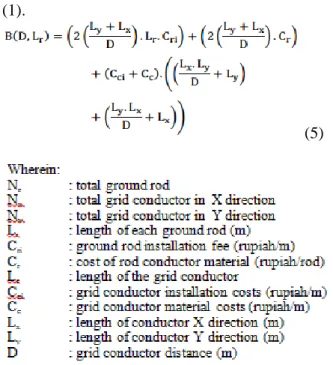
To get the optimal design, it can be done by fulfilling the following minimum cost functions:
(4) From the cost function above, to get the minimal cost function influenced by grid distance, equation (1).
(5)
EXPERIMENTAL METHOD
In analyzing Earthing performance analysis by taking conductor length data, general system data parameters and soil characteristics. In the case of a simple performance analysis, the program requests data related to the length of the grid conductor, number of ground rods, data about switchyard, general data related to the power system for safety criteria, conductor size and materials and others.
RESULTS AND DISCUSSION
The conductor used in the design of this earthing system is Copper, annealed soft-drawn, obtained from the calculation of the grid conductor
size 177,4066 mm2, then conductors with a
cross-sectional area of 240 mm2. The reduction factor (Cs)
value equals 0.71264 is used to calculate the touch voltage and tolerance step voltage. The touch tolerance value is 240,0002 V and the tolerance step voltage is 612,0009 V. As for the maximum grid current with a disturbance current rms value of 5.7 kA, the maximum grid current value is 7506.33 A.
Fig. 2. Display of the Earthing System Optimization Calculation Program
Fig. 3. Grid Distance Graph (D) against RgIG
Fig. 4. Display Program Distance Range Grid Results
Fig. 5. (a) Effect of Grid Distance on Em, (b) Effect of Grid Distance on El
Fig. 6. Graphic Effect of Ground Rod Length on grid distance and cost
Fig. 7. Graph of Results of Earthing System Optimization Program
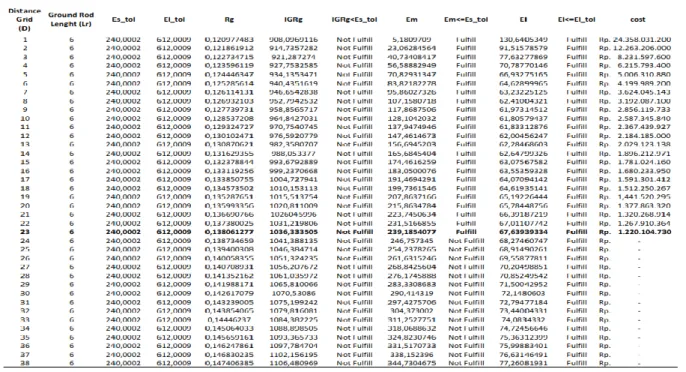
Table 2. Analysis Optimization of Switchyard Earthing System Using MATLAB
CONCLUSION
Based on the results of the optimization program using Matlab GUI and Matlab R2011a, it can be concluded that the grid distance of 23 m and the length of the 6 m Ground rod provides the most optimal grounding system design results, with a safety quality for Earthing Resistance (Rg) of 0.13806Ω smaller than The maximum limit of Earthing Resistance is 0.5 Ω (IEC 60694) and the value of the mesh voltage is smaller than the touch tolerance voltage (Em = 239.1854 V <Es_tol = 240,0002 V) and the tolerance step voltage is more than Rp. 1,220,104,730.
REFERENCES
[1] Tabatabaei, N. M., & Mortezaeei, S.
R. (2010). Design of grounding systems in substations by ETAP
intelligent software. International
Journal on «Technical and Physical
Problems of Engineering, (2), 45-49.
[2] Bendito, E., Carmona, Á., Encinas, A.
M., & Jiménez, M. J. (2004). The
extremal charges method in
grounding grid design. IEEE
transactions on power delivery, 19(1),
118-123.
[3] Ghoneim, S., Hirsch, H., Elmorshedy,
A., & Amer, R. (2007, June). Optimum grounding grid design by using an evolutionary algorithm. In
2007 IEEE Power Engineering
Society General Meeting (pp. 1-7).
IEEE.
[4] Kasim, I., Abduh, S., & Fitryah, N.
(2017, July). Grounding system
design optimization on 275 KV betung substation based on IEEE
standard 80-2000. In 2017 15th
International Conference on Quality in Research (QiR): International
Symposium on Electrical and
Computer Engineering (pp. 400-407).
IEEE.
[5] Hendrawati, T. Y., Siswahyu, A., &
Ramadhan, A. I. (2017).
Pre-Feasibility Study of Bioavtur
Production with HEFA Process In
Indonesia. International Journal of
Scientific & Technology Research,
6(04).
[6] Chow, Y. L., Elsherbiny, M. M., &
Salama, M. M. A. (1995, September). Earth surface voltages at a grounding system of buried grid and rods from the fast Galerkin's moment method. In
Proceedings 1995 Canadian
Conference on Electrical and
Computer Engineering (Vol. 2, pp.
668-671). IEEE.
[7] Ghoneim, S., Hirsch, H., Elmorshedy,
A., & Amer, R. (2008). Optimization
Design. Journal of Electrical and
Electronic Systems Research, 1.
[8] He, Z., Wen, X., & Wang, J. (2007,
August). Optimization design of substation grounding grid based on
genetic algorithm. In Third
International Conference on Natural
Computation (ICNC 2007) (Vol. 4,
pp. 140-144). IEEE.
[9] Almanda, D., Dermawan, E.,
Diniardi, E., Ramadhan, A. I., & Hidayat, S. (2016). Design And Test Equipment Model Rain Water Based Energy Effect of Size of Printed Material of Piezoelectric In Indonesia.
International Journal of Engineering
Inventions, 5(7), 48-55.
[10]Elrefaie, E. M., Ghoneim, S., Kamal,
M., & Ghaly, R. (2012, July). Evolutionary strategy technique to optimize the grounding grids design.
In 2012 IEEE Power and Energy
Society General Meeting (pp. 1-6).
IEEE.
[11]Almanda, D., Dermawan, E.,
Ramadhan, A. I., Diniardi, E., & Fajar, A. N. (2015). Analisis Desain Optimum Model Piezoelektrik PVDF Untuk Sumber Pembangkit Listrik Air
Hujan Berskala Mini. Prosiding
Semnastek.
[12]Hardi, S., Nasution, A., &
Purnamasari, F. (2019). Modeling of Substation Grounding Grid Design Using Lab View Graphical User
Interface. In 2019 3rd International
Conference on Electrical,
Telecommunication and Computer
Engineering (ELTICOM) (pp.
149-154). IEEE.
[13]Gholami Farkoush, S., Khurshaid, T.,
Wadood, A., Kim, C. H., Kharal, K. H., Kim, K. H., & Rhee, S. B. (2018). Investigation and optimization of grounding grid based on lightning response by using ATP-EMTP and
genetic algorithm. Complexity, 2018.
[14]Salam, M. A., & Noh, M. (2012).
Measurement of grounding resistance with square grid and rods near
substations. In 2012 IEEE Electrical
Power and Energy Conference (pp.
123-127). IEEE.
[15]Almanda, D., & Ramadhan, A. I.
(2019). Design Optimization of
Distance Grid and Ground Rod in The
Earth System. Journal of Applied
Sciences and Advanced Technology,
2(2), 53-58.
[16]Mahmud, K. H., Yudistirani, S. A., &
Ramadhan, A. I. (2017). Analysis of
power characteristics of model
thermoelectric generator (TEG) small
modular. International Journal of
Scientific & Technology Research,
6(4), 161-167.
[17]Khodr, H. M., Salloum, G. A.,
Saraiva, J. T., & Matos, M. A. (2009). Design of grounding systems in substations using a mixed-integer
linear programming formulation.
Electric Power Systems Research,
79(1), 126-133.
[18]Ma, J., Dawalibi, F. P., & Southey, R.
D. (2002, October). Effects of the changes in IEEE Std. 80 on the design
and analysis of power system
grounding. In Proceedings.
International Conference on Power
System Technology (Vol. 2, pp.
![Table 1. Soil Characteristics [2]](https://thumb-us.123doks.com/thumbv2/123dok_us/8385512.2227993/1.892.116.447.892.1107/table-soil-characteristics.webp)