3.1 Innovation
Product innovation is essential for a country’s econo-mic growth and for the competitive position of indus-try. Companies operate in a rapidly changing world in which customers’ needs and wants are not fixed and where they face increasing competition due to open markets and globalization. Companies that effectively integrate innovation in the product development process can gain significant competitive advantage.
Innovation is a broad concept that is used in many different contexts. As a result, there are many defini-tions of innovation. One useful definition is: “the com-mercial or industrial application of something new– a new product, process or method of production; a new market or source of supply; a new form of commercial, business or financial organization”.
Most definitions of innovation emphasize ‘newness’ and ‘successfulness’. There are distinctions made between product versus process innovation and some-times amongst market,businessand management innova-tion. For example:
> Product innovation is the introduction of new
products that have characteristics and/or use applica-tions that differ from existing products on the market.
> Process innovationis the introduction of a new
methodof production, that has not previously been used and/or a new way of handling a commodity commercial-ly to make production more efficient or to be able to produce new or improved products.
> Market innovation involves entering new markets,
new ways of serving customers, and/or market expansion.
> Business and management innovationinvolves
developing new reward systems, organizational struc-tures, ways of handling responsibilities and human resources etc. that positively affects product sales.
Within D4S the focus is on product and market innovation. Process innovation is often more linked to cleaner production and management innovation to envi-ronmental management systems like ISO 14000.
3.2 Innovation levels
Innovation happens in different degrees and can be cate-gorized into three levels: incremental, radical and funda-mental (see Figure 6). Each category is progressively more significant and more far-reaching.1> Incremental innovation_ Entails step-by-step
improvements of existing products and tends to strengthen market positions of established companies in the industry.
2> Radical innovation_Drastically changes existing
products or processes. The risks and required invest-ments in radical innovation are usually considerably greater than those needed for incremental innovation but they offer more opportunity for new entrants to the market.
3> Fundamental innovation_Depends on new
scien-tific knowledge and opens up new industries, causing a pa-radigm shift. In the early stage of fundamental innovation, the contributions of science and technology are important.
P
Pr
ro
od
du
uc
ct
t IIn
nn
no
ov
va
at
tIIO
On
n
D4S is based on a combination of product innovation and sustainability. Understanding the underlying concept of product innovation can help in imple-menting D4S projects. This chapter discusses different (product) innovation approaches and explains the product development process. These insights can assist during the Needs Assessment (Chapter 4) to identify the appropriate innovation level and D4S approach for the participating companies in demon-stration projects.
0
The majority of innovation efforts take place in com-panies that work from the incremental or radical inno-vation perspective.There is a wide range of innoinno-vation possibilities between these two extremes. Funda-mental innovation often takes place only in large multi-national companies, company clusters or (inter)multi-national research programs because of the large human and ca-pital investment needed. For D4S in developing econo-mies it is less relevant.
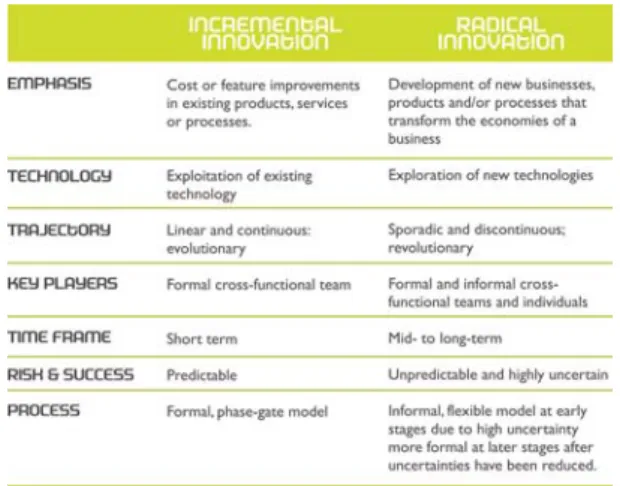
Successful incremental or radical innovation requires different kinds of thinking, ways of working, and risk ta-king.To get more insight and a better understanding of both types of innovation, they are discussed in more detail below.
3.2.1 Incremental innovation
As the name suggests, this type of innovation makes small changes at one given time and is sometimes refer-red to as continuous improvement. A simple product may be improved (in terms of better performance or lower costs) through the use of higher performance components or materials. A complex product that con-sists of integrated technical subsystems can be improved by partial changes at one level of a sub-sys-tem. Incremental innovations do not involve major investments or risk. User experience and feedback is important and may predominate as a source for innova-tion ideas.As an example, customer wants can be iden-tified and added as features to the existing product.
Incremental innovation and the redesign of existing products are economically and commercially as impor-tant as radical innovations. Incremental innovation and
design improvement are known as the ‘bread and but-ter’ of new product development for many firms. Many firms do not even attempt to explore radical innovation for a variety of reasons having to do with their size and resources, the nature of the industry, the level of re-search and development necessary, or the amount of risk involved. Even firms that successfully introduce ra-dical innovation may not do so very often. Incremental innovation projects, due to the low level of involved risk usually follow a structured and predictable process.
3.2.2 Radical innovation
Radical innovation involves the development of key new design elements such as change in a product component combined with a new architecture for linking components. The result is a distinctively new product that is markedly different from the company’s existing product line.
A high level of uncertainty is associated with radical innovation projects, especially at early stages. Due to high levels of uncertainty, the process cannot be described as an orderly structured process. Radical innovations are confronted with uncertainties on different levels. To be successful, uncertainty must be reduced in the following dimensions:
> Technical uncertainty_are issues related to the
completeness and correctness of the underlying scien-tific knowledge and the technical specification.
> Market uncertainty_ are issues related to
cus-tomer needs and wants. Figure 6 ___ Different degrees of innovation.
Table 3 ___ Comparison of incremental and radical innovations characteristics.
31
> Organisational uncertainty_refers to
organiza-tional resistance that stems from conflict between the mainstream organization and the radical innovation team.
> Resource uncertainty_includes project
disconti-nuities that influence the project’s funding, staffing, and management requirements. Radical innovations need a number of enabling factors such as a high level of tech-nological capability, strong R&D and a pool of multidis-ciplinary skills whereas the incremental innovation adoption process needs less.
3.2.3 Product innovation
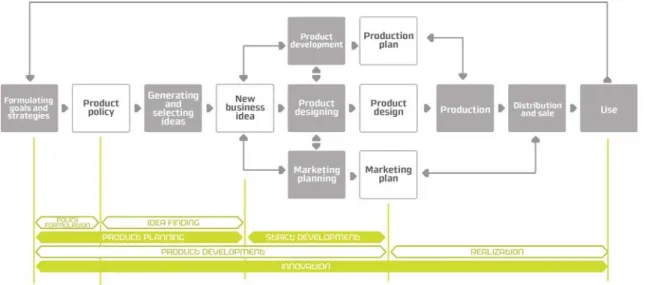
The product innovation process involves a series of sub-processes dominated by the product development process followed by the realization (see Figure 7).
Product Innovation = Product Development + Realization In the following paragraphs a general step-by-step prod-uct development process will be outlined.
3.3 Product
development process
Product development can be defined as “the process that transforms technical ideas or market needs andopportunities into a new product and on to the market”. It includes strategy, organization, concept generation, product and marketing plan creation and evaluation, and the commercialization of a new product.
The product development process is a disciplined and defined set of tasks, steps, and phases that describe how a company repetitively converts ideas into salable products and/or services. The product development process itself can be split up into three phases: policy formulation, idea finding and strict development (see Figure 7).
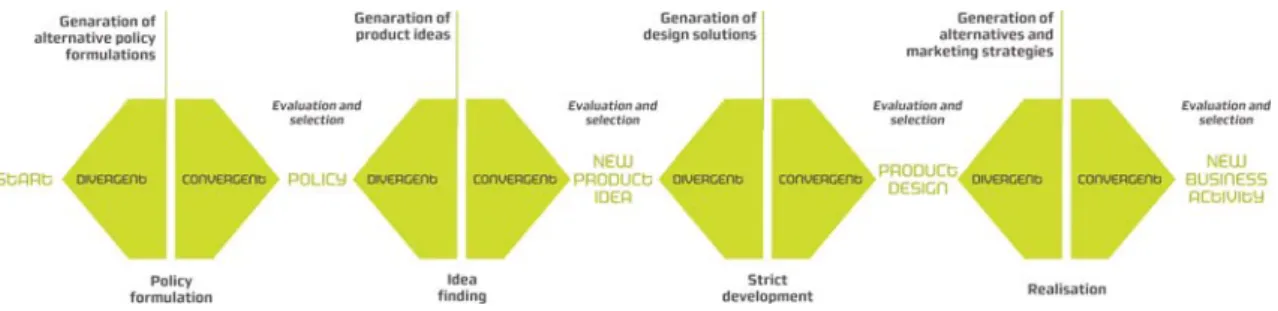
Every step has two different kinds of activities (see Figure 8): first a divergent activity, followed by a conver-gent activity. These approaches identify relevant infor-mation in a creative way and then evaluate it. Divergent methods search for ideas and include searching for information, to explore the problem, to redefine it, to generate ideas and to combine concepts. Convergent methods impose value judgments and include methods to make sense of information, to prioritize items, to compare solutions, to assess ideas and to reject or select concepts. The product development process is often presented as a linear process. However, in prac-tice it is often characterized as a linear process with iterative cycles, meaning that design teams often go back to earlier stages and decisions in the product development process to re-evaluate previous decisions that have been made.
3
3..4
4 Policy formulation
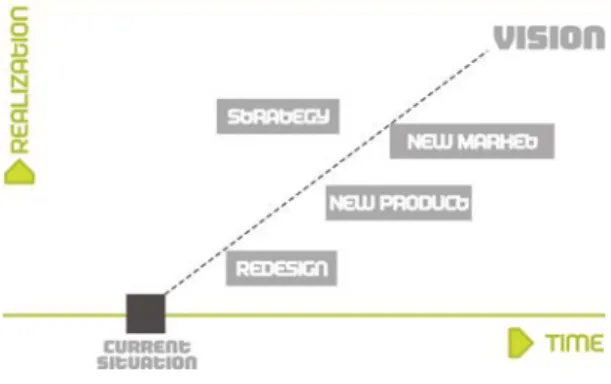
The product development process starts with formula-ting goals and strategies. Developing new or redesigned products without having clear goals and product strate-gies may lead to unsuccessful products and failures. For this reason, it is essential for a company to define its vision, mission, goals and (product) innovation strategies (see Figure 9).
3.4.1 Mission statement
A company’s mission is its reason for being.The mission often is expressed in the form of a mission statement, which conveys a sense of purpose to employees and projects a company image to customers. The mission statement defines the purpose or broader goal for being in existence. It serves as a guide in times of uncer-tainty or vagueness. It is like a guiding light. It has no time frame and can remain the same for decades if crafted correctly.
When defining its mission statement, a company can consider including some or all of the following aspects:
> The moral/ethical position of the enterprise; > The desired public image;
> The key strategic influence for the business; > A description of the target market; > A description of the products/services; > The geographic domain; and
> Expectations of growth and profitability.
The mission statement of a
plastics manufacturer in
Tanzania_
> Our mission is to become a world-class
provider of proprietary and innovative solutions in the East and Central African market.
> We will double turnover every three years. > We shall take pride in becoming preferred
part-ners to all our stakeholders and in exceeding their expectations.
Text box 2 ___ Example of mission statement.
3.4.2 Vision statement
The vision statement describes how the company man-agement sees events unfolding over 10 or 20 years if everything goes exactly as hoped. A vision statement is short, succinct, and inspiring about what the organiza-tion intends to become and to achieve at some point in the future stated in competitive terms.Vision refers to the category of intentions that are broad, all-inclusive and forward-thinking. It is the image a business has of its goals before it sets out to reach them. It describes future aspirations, without specifying the means that will be used to achieve them.
Figure 9 ___ mission, Vision, goals and strategy.
Figure 8 ___ Step-by-step design approach characterised divergent and convergent activities.
33
A vision statement for a new or small firm spells out goals at a high level and should coincide with the foun-der’s goals for the business. Simply put, the vision should state what the founder ultimately envisions the business to be, in terms of growth, values, employees, and contri-butions to society. This vision may be as vague as a dream or as precise as a goal. The vision may contain commitment to:
>Developing a new product or service;
>Serving customers through the defined service portfolio;
>Ensuring quality and responsiveness of customer services;
> Providing an enjoyable work environment for employ-ees; or
> Ensuring financial and sustainable growth of the com-pany for the benefit of its stakeholders.
3.4.3 Goals and objectives
After defining (or redefining) the company’s mission and vision, it is time to set practical goals and objectives for the organization based on these statements. The goals
often lack specificity. The objectives are aims that are formulated exactly and quantitatively including time-frames and magnitudes. For example, the objectives of an annual earning growth target should be challenging but achievable.They also should be measurable so that the company can monitor its progress and make cor-rections as needed.
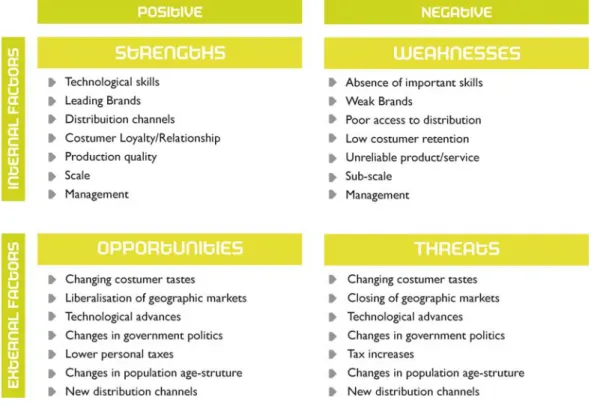
Once the firm has specified its objectives, it can ana-lyze its current situation to devise a strategic plan to reach the objectives.This can be done for example with a Strengths, Weaknesses, Opportunities and Threats (SWOT) analysis or by evaluating the product life cycle stage of its product portfolio.
3.4.4 SWOT Analysis
In order to succeed, businesses need to understand their strengths and where they are vulnerable. Success-ful businesses build on their strengths, correct weak-nesses and protect against vulnerabilities and threats. They also understand the overall business environment and spot new opportunities faster than competitors.
A tool that helps in this process is the SWOT analysis.
Strengthsare attributes of the organization that are helpful to achieve the objective. They have to be main-tained, built upon, or leveraged.
Weaknesses are attributes of the organization that are harmful to the achievement of the objective. They need to be remedied or stopped.
Opportunitiesare external conditions that are help-ful to the achievement of the objective.They need to be prioritized and optimized.
Threats are external conditions that are harmful to the achievement of the objective.They need to be coun-tered or minimized.
In addition, the company can explore its core com-petences - those capabilities that are unique to it and that provides it with a distinctive competitive advantage and contribute to acquiring and retaining customers (see Figure 10).
3.4.5 Product life cycle from
a market perspective
A new product progresses through a sequence of stages in the market from introduction to growth, maturity and decline (see Figure 11). After a period of develop-ment, the product is introduced or launched into the market. It gains more and more customers as it grows. Eventually the market stabilizes and the product becomes mature.Then after a period of time, the prod-uct is overtaken by development and the introdprod-uction of superior competitors, and it goes into decline and is eventually withdrawn. It is essential for a company to be aware of at which stage the products in its product
portfolio are in order to start up new innovation initia-tives in a timely manner.
This product life cycle perspective from a marketing point of view should be not be confused with the ‘sus-tainability’ life cycle approach (from cradle to cradle) as introduced in Chapter 2.
3.4.6 Strategic innovation gap
Product innovation is necessary to survive and grow in a competitive market. Because sales of recent products tend to decline due to competitors development, a ‘strategic innovation gap’ develops, which interferes with growth.The strategic gap of a company can be measured as the difference between expected and desired turnover and profits from currently planned new products and the company objectives (as stated in the vision statement) (see Figure 12).
If there is a gap between future desired sales and projected sales, a company will have to develop or acquire new businesses and innovation activities to fill this strategic gap.
3.4.7 Product innovation
strategy formulation
Once a clear picture of the firm and its environment is in hand, specific product innovation strategy alternatives can be developed.There are different (product) innova-tion strategies for companies to innovate in order to become more competitive (see Figure 13).The compet-itiveness of companies in the long-run is often directly related to their new product development capabilities.
Figure 12 ___ Innovation Gap. Figure 11 ___ Product Life cycle (marketing
per-spective).
35
While firms may develop different alternatives depending on their situation, generic categories of strategies exist that can be applied to a wide range of firms. The innovation models of Ansoff and Porter are two approaches that companies and organizations can apply to analyse their current (and competitors’) pro-duct portfolio and can provide direction to new propro-duct innovation strategies.
3.4.8 Growth matrix
The Ansoff Growth matrix is a tool that can help a busi-ness choose a product and market growth strategy. A company can address the innovation gap in 4 differ-ent ways that are based upon a combination of market and product innovation:
First, a company can determine performance impro-vement opportunities. The growth matrix proposes 3 major intensive growth strategies:
> Market penetration strategy_ Management looks for ways to increase the market share of its cur-rent products in their curcur-rent markets.
> Market development strategy_ Management looks for new markets for current products.
> Product development strategy_ Management considers new product possibilities.
Diversification can offer strong opportunities out-side the business. Three types of diversification exist. The company could seek new products that have tech-nological and/or marketing synergies with existing pro-duct lines, although the propro-duct may appeal to a new class of customers. Second, the company might search
for new products that might appeal to its current cus-tomers though technologically unrelated to its current product line. Finally, the company might seek new busi-nesses that have no relationship to the company’s cur-rent technology, products, or markets.
3.4.9 Competitive strategies
matrix
Another potentially useful approach is the Porter matrix that describes common types of competitive strategies as ‘overall cost-leadership’, ‘focus’, and ‘diffe-rentiation’ (see Figure 15):
> Overall Cost Leadership_ The business works hard to achieve the lowest production and distribution costs so it can have a lower price than its competitors and win a larger market share. Firms pursuing such strategy must be good at engineering, purchasing, manu-facturing, and physical distribution. They have less need for marketing skills.
Figure 14 ___ aNSOFF GROWTH Matrix (ANSOFF, 1968)
Figure 15 ___ pORTER Strategy Matrix (Porter 1980). Figure 13 ___ Innovation strategies to close the
> Differentiation_The business concentrates on
achieving superior performance in an identified cus-tomer benefit area valued by a large part of the market. It strives to be a leader in quality, technology, service, style etc. The firm cultivates the strengths that give it competitive advantages.Thus, the firm that wants to be a quality leader will make or buy the best components, put them together expertly, and inspect them carefully.
> Focus_The business focuses on one or more narrow
market segments rather than going after a large market. The firm gets to know the needs of these segments and pursues either cost leadership or a form of differentia-tion within the target markets.
These 3 generic types of strategies can be combined (see Figure 15).
A company should evaluate its current and future product portfolio with both models.
3.4.10 Risk and strategy
selection
Companies will face conflicting goals trying to maximi-zing economic success while reducing risk. Only a small percentage of product innovation projects actually end-up in the market. The more the projects differentiate, the higher the risk (see Figure 14). The risk of failure can be minimized if:
> Innovation is based upon mid- and long-term
objec-tives and strategies;
> Innovations are appropriate for company size and
resources;
> Information systems exist to integrate new and
changing needs;
> Innovation is initiated by the market and not by
tech-nological developments;
> Innovation concentrates on the linkages within the
value chain (they are more difficult to copy); or
> Innovation helps to differentiate a company from its
competitors.
At the end of this stage, the company should be able to select a product innovation strategy that fits best to its internal and external environment and vision.
3.5 Idea generation
The idea generation phase often refers to the creative component of the product development process in which solutions are put forward, built upon, and used to spawn new solutions.
Idea generation can involve many different tech-niques and people prefer different kinds of techtech-niques. Typical methods include generating ‘search fields’ and creativity sessions. Idea management is important at this stage due to the large number of ideas that are gene-rated and need to be selected and their diversity. Based upon a combination of the most promising ideas, pro-duct concepts are proposed.
3.5.1 Search fields
The first step of the idea generation process is to develop ‘search fields’. For developing these search fields, the internal ‘strategic’ strengths of a company are the best place to start, for example, company strengths like its financial situation, knowledge on specific technologies or its export know-how. By combining the strengths of the company with the indicated opportunities and trends in the SWOT analysis, search fields for new pro-duct ideas can be generated (see Figure 16).
In order to use the results from a SWOT Matrix, it has to be adjusted to the search field matrix (see Figure 17). On the horizontal axis (cells A to F), the opportunities identified early in the SWOT analysis are written down.
Figure 16 ___ Search fields that combine the iden-tified strengths and opportunities of a SWOT
matrix (Buijs and Valkenburg, 2000).
37
Next, the internal strengths are put in the cells 1 to 8 on the horizontal axis. By combining the internal stren-gths with the external opportunities new product ideas can be generated.
As a result, the company might come up with several promising search fields. To facilitate the evaluation and selection of the best search field, it is useful to work them out in more detail. After selecting the most promising search fields, product ideas can be generated within them.
3.5.2 Creativity sessions
Creativity sessions enable the production of a lot of ideas for new products. All ideas - no matter how ludi-crous or extreme they may sound - should be gathered. Depending upon the search fields, the product develop-ment team can apply different kinds of creativity tech-niques to generate product ideas.
Chapter 9 presents different creative techniques in more detail with examples.
3.5.3 Concept development
The concept development builds upon the creative ideas generated, merging them and developing more fleshed out concrete options for evaluation. A concept is a clearly written and possibly visual description of the new product idea, including primary features, consumer benefits, and an outline of technology needed. Concept generation can involve:
> Definition of target market and customers;
> Identification of the competition and formulation of a
competitive strategy;
> Development of preliminary technical product and
testing scheduling;
> Estimation of required resources for product
deve-lopment; and
> Creation of a preliminary business plan.
After the selection of the best concept, it is worked out in detail.
3.6 Realization
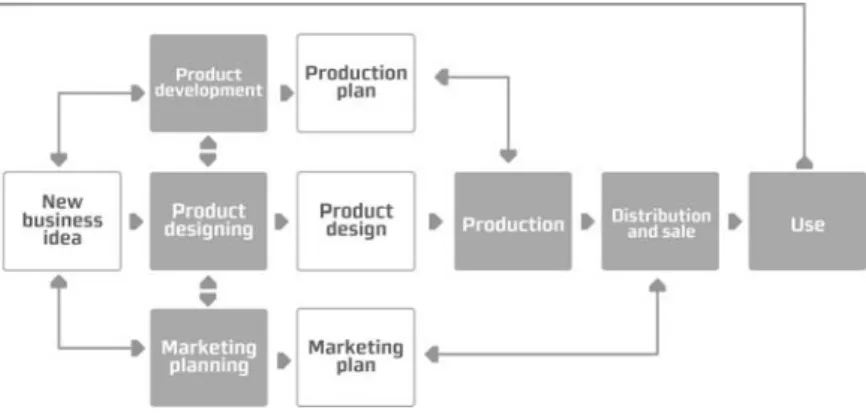
Product development is not a stand-alone process. Parallel to the product development process the produc-tion development and marketing planning takes place (see Figure 18).
The production planning is directly linked to design and visa versa. Equipment availability and investment needs should be considered during the design phase. Production management will need to plan how to intro-duce any production changes that result from design changes.
It is essential to market a new product targeting the needs and wishes of the customer. Therefore, informa-tion on market analysis, consumer behaviour, trends and future scenarios, government policies, environmental concerns, new technologies and materials can be useful. Company policies and needs should also be taken into account. The plan will provide guidance to design and marketing decisions.
Once the design has been set, it is essential to decide how best to communicate the product’s strengths, price, and distribution. Strategies need to be developed for these aspects.
3.7 Product
Development in
Developing Economies
Traditionally, product development activities were focused in developed countries. However, these activitiesare increasingly important for international competiti-veness and developing economies are beginning to focus on building this expertise.
Up until the 1970s, developing economies had indus-trialization policies that subsidized locally produced products acted as barriers to imported products.In addition, high levels of state involvement in manufactu-ring and (partially) state run enterprises had a tendency to be more production- than market-driven. Closed markets economies created low incentives for compa-nies to innovate.
Nevertheless, developing economies are increasingly concerned with design promotion and practice, espe-cially in the light of globalisation of markets. For example, in South East Asia, formal product design activities have been established parallel to the industrial development policies. A successful example is South Korea. Due to the role played by foreign markets and multinational companies, South Korea began to differentiate products by incorporating product innovation into its economic policies. As a result, South Korea has developed from a country competing on low technologies, imitation and cost leadership in the 1960s towards a nation compe-ting on user-centered design and pioneering approaches (see Figure 19).
In developing economies the bulk of product develop-ment activities are of an adaptive rather than innovative type, with minor changes in products. Product developers are often still seen more as “stylists” instead of “pro-duct innovators”.
Figure 18 ___ Parallel activities: product development, production development and marketing planning.
39
Research shows that SMEs in developing economies have different attitudes towards product design com-pared to SMEs in developed economies. Some of the observed differences are:
> A tendency to design incremental improvements for existing products;
> Concern with product appearance over product function;
> An approach to design based on a tradition of tech-nology import rather than a tradition of invention or innovation:
> A tendency not to design solutions that have no
precedence in the market place (international and local);
> Lack of tools and experience to compare and
eva-luate alternative approaches to design problems; and a
> Difficulty in developing clear project briefs.
These aspects highlight the need to build capacity in product development. The next chapters provide step--by-step instructions on how to identify and carry out 2 different kinds of D4S efforts.