General Description
The MAX6412–MAX6420 low-power microprocessor supervisor circuits monitor system voltages from 1.6V to 5V. These devices are designed to assert a reset signal whenever the VCC supply voltage or RESET IN falls below its reset threshold or the manual reset input is asserted. The reset output remains asserted for the reset timeout period after VCC and RESET IN rise above the reset threshold and the manual reset input is deasserted. The reset timeout is externally set by a capacitor to provide more flexibility.
The MAX6412/MAX6413/MAX6414 feature fixed thresholds from 1.575V to 5V in approximately 100mV increments and a manual reset input. The MAX6415/MAX6416/ MAX6417 are offered with an adjustable reset input that can monitor voltages down to 1.26V and the MAX6418/ MAX6419/MAX6420 are offered with one fixed input and one adjustable input to monitor dual-voltage systems. The MAX6412/MAX6415/MAX6418 have an active-low, push-pull reset output. The MAX6413/MAX6416/ MAX6419 have an active-high, push-pull reset output and the MAX6414/MAX6417/MAX6420 have an active-low, open-drain reset output. All of these devices are offered in a SOT23-5 package and are fully specified from -40°C to +125°C.
Benefits and Features
● Monitor System Voltages from 1.6V to 5V ● Capacitor-Adjustable Reset Timeout Period ● Manual Reset Input
(MAX6412/MAX6413/MAX6414)
● Adjustable Reset Input Option (MAX6415–MAX6420) ● Dual-Voltage Monitoring
(MAX6418/MAX6419/MAX6420) ● Low Quiescent Current (1.7μA, typ) ● 3 RESET Output Options
• Push-Pull RESET
• Push-Pull RESET • Open-Drain RESET
● Guaranteed Reset Valid to VCC = 1V ● Power-Supply Transient Immunity ● Small SOT23-5 Packages
● AEC-Q100 Qualified, Refer to Ordering Information for Specific /V Parts
Applications
● Automotive ● Medical Equipment ● Intelligent Instruments ● Portable Equipment
● Battery-Powered Computers/Controllers ● Embedded Controllers
● Critical μP Monitoring ● Set-Top Boxes ● Computers
Selector Guide, Ordering Information, and Typical Operating Circuit appear at end of data sheet.
GND
SRT
1 5 VCC
MAX6412 MAX6420
SOT23-5 TOP VIEW
2
3 4
RESET/RESET
RESET IN (MR)
( ) FOR THE MAX6412/MAX6413/MAX6414.
Pin Configuration
All Voltages Referenced to GND
VCC ...-0.3V to +6.0V SRT, MR, RESET IN ... -0.3V to (VCC + 0.3V) RESET, RESET (Push-Pull) ... -0.3V to (VCC + 0.3V) RESET (Open-Drain) ...-0.3V to +6.0V Input Current (All Pins) ...±20mA Output Current (RESET, RESET) ...±20mA Continuous Power Dissipation (TA = +70°C)
5-Pin SOT23 (derate 7.1mW/°C above +70°C) ...571mW
Operating Temperature Range ... -40°C to +125°C Junction Temperature ...+150°C Storage Temperature Range ... -65°C to +150°C Lead Temperature (soldering, 10s) ...+300°C Soldering Temperature (reflow)
Lead(Pb)-free packages ...+260°C Packages containing lead (Pb) ...+240°C
www.maximintegrated.com Maxim Integrated │ 2
Absolute Maximum Ratings
Stresses beyond those listed under “Absolute Maximum Ratings” may cause permanent damage to the device. These are stress ratings only, and functional operation of the device at these or any other conditions beyond those indicated in the operational sections of the specifications is not implied. Exposure to absolute maximum rating conditions for extended periods may affect device reliability.
SOT23-5
PACKAGE CODE U5+2/U5+2A
Outline Number 21-0057
Land Pattern Number 90-0174
Thermal Resistance, Single-Layer Board:
Junction to Ambient (θJA) 324.3°C/W
Junction to Case (θJC) 82°C/W
Thermal Resistance, Multi-Layer Board:
Junction to Ambient (θJA) 255.9°C/W
Junction to Case (θJC) 81°C/W
Package thermal resistances were obtained using the method described in JEDEC specification JESD51-7, using a four-layer board. For detailed information on package thermal considerations, refer to www.maximintegrated.com/thermal-tutorial.
For the latest package outline information and land patterns (footprints), go to www.maximintegrated.com/packages. Note that a “+”, “#”, or “-” in the package code indicates RoHS status only. Package drawings may show a different suffix character, but the drawing pertains to the package regardless of RoHS status.
(VCC = 1V to 5.5V, TA = TMIN to TMAX, unless otherwise specified. Typical values are at VCC = 5V and TA = +25°C.) (Note 1)
Note 1: Devices production tested at TA = +25°C. Over temperature limits are guaranteed by design.
PARAMETER SYMBOL CONDITIONS MIN TYP MAX UNITS
Supply Voltage Range VCC 1.0 5.5 V
Supply Current ICC
VCC ≤ 5.0V 2.6 4.5
µA
VCC ≤ 3.3V 2 3.5
VCC ≤ 2.0V 1.7 2.5
VCC Reset Threshold
Accuracy VTH
TA = +25°C 1.25%VTH - 1.25%VTH +
V TA = -40°C to +125°C V2.5%TH - V2.5%TH +
Hysteresis VHYST 4 x VTH mV
VCC to Reset Delay tRD VCC falling at 1mV/µs 100 µs
Reset Timeout Period tRP CSRT = 1500pF 3.00 4.375 5.75 ms
CSRT= 0F 0.275
VSRT Ramp Current IRAMP VSRT= 0 to 0.65V; VCC = 1.6V to 5V 240 nA
VSRT Ramp Threshold VTH-RAMP VCC = 1.6V to 5V (VRAMP rising) 0.65 V
RAMP Threshold Hysteresis VRAMP falling threshold 33 mV
RESET Output Voltage LOW VOL
VCC ≥ 1.0V, ISINK = 50µA 0.3 V VCC ≥ 2.7V, ISINK = 1.2mA 0.3 VCC ≥ 4.5V, ISINK = 3.2mA 0.4 RESET Output Voltage HIGH,
(Push-Pull) VOH
VCC ≥ 1.8V, ISOURCE = 200µA 0.8 x VCC
V VCC ≥ 2.25V, ISOURCE = 500µA 0.8 x VCC
VCC ≥ 4.5V, ISOURCE = 800µA 0.8 x VCC RESET Output Leakage
Current, (Open-Drain) ILKG VCC > VTH, reset not asserted 1.0 µA
RESET Output Voltage HIGH VOH
VCC ≥ 1.0V, ISOURCE = 1µA 0.8 x VCC
V VCC ≥ 1.8V, ISOURCE = 150µA 0.8 x VCC
VCC ≥ 2.7V, ISOURCE = 500µA 0.8 x VCC VCC ≥ 4.5V, ISOURCE = 800µA 0.8 x VCC RESET Output Voltage LOW VOL
VCC ≥ 1.8V, ISINK = 500µA 0.3 V VCC ≥ 2.7V, ISINK = 1.2mA 0.3 VCC ≥ 4.5V, ISINK = 3.2mA 0.4
RESET IN Leakage Current 10 nA
RESET IN Threshold VRST VRST falling, VCC= 1.6V to 5.0V 1.205 1.255 1.305 V
MR Input
VIL V
CC > 4.0V 0.8
V
VIH 2.4
VIL V
CC < 4.0V 0.3 x VCC
VIH 0.7 x VCC
MR Minimum Pulse Width 1 µs
MR Glitch Rejection 75 ns
MR to RESET Delay 20 ns
MR Pullup Resistance Pull up to VCC 12 20 28 kΩ
(VCC = 5V, CSRT = 1500pF, TA = +25°C, unless otherwise noted.) 4.05 4.10 4.20 4.15 4.25 4.30
-50 -25 0 25 50 75 100 125 RESET TIMEOUT PERIOD
vs. TEMPERATURE
MAX6412-20 toc04
TEMPERATURE (C)
RESET TIMEOUT PERIOD (ms)
CSRT = 1500pF
RESET TIMEOUT PERIOD vs. TEMPERATURE MAX6412-20 toc05 200 250 350 300 500 550 450 400 600
RESET TIMEOUT PERIOD (µs)
-50 -25 0 25 50 75 100 125 TEMPERATURE (°C)
CSRT = 0
1.250 1.260 1.255 1.270 1.265 1.275 1.280
-50 -25 0 25 50 75 100 125 RESET IN THRESHOLD VOLTAGE
vs. TEMPERATURE
MAX6412-20 toc06
TEMPERATURE (°C)
RESET IN THRESHOLD VOLTAGE (V)
0 50 25 100 75 150 125 175
0 200 400 600 800 1000
MAXIMUM TRANSIENT DURATION vs. RESET THRESHOLD OVERDRIVE
MAX6412-20 toc07
RESET THRESHOLD OVERDRIVE (mV)
TRANSIENT DURATION (µs)
RESET OCCURS ABOVE THE CURVE
VTH = 3.0V 0 1.0 0.5 2.0 1.5 3.0 2.5 3.5
-50 -25 0 25 50 75 100 125 SUPPLY CURRENT vs.
TEMPERATURE
MAX6412-20 toc02
TEMPERATURE (°C)
SUPPLY CURRENT (µA)
VCC = 5V VCC = 3.3V VCC = 1.8V
VCC = 1V
0.1 1 100 10 1000 10,000
0.001 0.01 0.1 1 10 100 1000 RESET TIMEOUT PERIOD vs. CSRT
MAX6412-20 toc03
CSRT (nF)
RESET TIMEOUT PERIOD (ms)
4
3
2
1
0
0 1 2 3 4 5 6
SUPPLY CURRENT vs. SUPPLY VOLTAGE
MAX6412-20 toc01
SUPPLY VOLTAGE (V)
SUPPLY CURRENT (µA)
TA = +125°C TA = +25°C
TA = -40°C
Maxim Integrated │ 4 www.maximintegrated.com
Detailed Description
The MAX6412–MAX6420 low-power microprocessor (μP) supervisory circuits provide maximum adjustability for supply-voltage monitoring and reset functionality. In addi-tion, the MAX6412–MAX6420 reset timeout period is adjustable using an external capacitor.
The MAX6412/MAX6413/MAX6414 have factory-trimmed reset threshold voltages in approximately 100mV incre-ments from 1.575V to 5.0V with a manual reset input. The MAX6415/MAX6416/MAX6417 contain a reset threshold that can be adjusted to any voltage above 1.26V using external resistors. The MAX6418/MAX6419/MAX6420 offer both a factory-trimmed reset threshold and an adjust-able reset threshold input for dual-voltage monitoring. A reset signal is asserted when VCC and/or RESET IN falls below the preset values or when MR is asserted. The reset remains asserted for an externally programmed interval after VCC and/or RESET IN has risen above the reset threshold or MR is deasserted.
Reset Output
The reset output is typically connected to the reset input of a μP. A μP’s reset input starts or restarts the μP in a
known state. The MAX6412–MAX6420 μP supervisory circuits provide the reset logic to prevent code-execution errors during power-up, power-down, and brownout con-ditions (see Typical Operating Circuit).
For the MAX6413, MAX6416, and MAX6419, RESET changes from low to high whenever VCC or RESET IN drops below the reset threshold voltages. Once RESET IN and VCC exceed their respective reset threshold voltage(s), RESET remains high for the reset timeout period, then goes low.
On power-up, once VCC reaches 1V, RESET is guaran-teed to be a logic high. For applications requiring valid reset logic when VCC is less than 1V, see the section
Ensuring a Valid RESET/RESET Output Down to VCC = 0V.
The active-low RESET output of the remaining super-visors is the inverse of the MAX6413, MAX6416, and MAX6419 active-high RESET output and is guaranteed valid for VCC ≥ 1V.
Reset Threshold
The MAX6415–MAX6420 monitor the voltage on RESET IN with an external resistor voltage-divider (Figure 1).
PIN
NAME FUNCTION
MAX6412/ MAX6413/ MAX6414
MAX6415/ MAX6416/ MAX6417
MAX6418/ MAX6419/ MAX6420
1 1 1
RESET
RESET changes from high to low whenever VCC or RESET IN drops below the selected reset threshold voltage (VTH or VRESET IN, respectively) or manual reset is pulled low. RESET remains low for the reset timeout period after all reset conditions are deasserted and then goes high.
RESET
RESET changes from low to high whenever the VCC or RESET IN drops below the selected reset threshold voltage (VTH or VRESET IN) or manual reset is pulled low. RESET remains high for the reset timeout period after all reset conditions are deasserted and then goes low.
2 2 2 GND Ground
— 3 3 RESET IN Reset Input. High-impedance input to the adjustable reset comparator. Connect RESET IN to the center point of an external resistor-divider network to set the threshold of the externally monitored voltage. See Reset Threshold section. 3 — — MR Manual Reset Input. Pull this pin low to manually reset the device. Reset remains asserted for the reset timeout period after MR is released. 4 4 4 SRT Set Reset Timeout Input. Connect a capacitor between SRT and ground to set the timeout period. Determine the period as follows:
tRP = (2.71 x 10⁶) x CSRT + 275µs with tRPin seconds and CSRTin Farads. 5 5 5 VCC Supply Voltage and Input for Fixed-Threshold VCC Monitor
Use the following formula to calculate the externally moni-tored voltage (VMON_TH):
VMON_TH = VRST x (R1 + R2)/R2
where VMON_TH is the desired reset threshold voltage and VRST is the reset input threshold (1.26V). Resistors R1 and R2 can have very high values to minimize current consumption due to low leakage currents. Set R2 to some conveniently high value (1MΩ, for example) and calculate R1 based on the desired monitored voltage, using the following formula:
R1 = R2 x (VMON_TH/VRST - 1) (Ω)
Manual Reset Input
(MAX6412/MAX6413/MAX6414)
Many μP-based products require manual reset capabil -ity, allowing the operator, a technician, or external logic circuitry to initiate a reset. A logic low on MR asserts reset. Reset remains asserted while MR is low and for the reset timeout period after MR returns high.
The MR has an internal 20kΩ pullup resistor so it can be left open if not used. Connect a normally open momentary switch from MR to ground to create a manual reset func-tion (external debounce circuitry is not required for long reset timeout periods).
A manual reset option can easily be implemented with the MAX6415–MAX6420 by connecting a normally open momentary switch in parallel with R2 (Figure 2). When the switch is closed, the voltage on RESET IN goes to zero, initiating a reset. Similar to the MAX6412/MAX6413/ MAX6414 manual reset, reset remains asserted while the switch is closed and for the reset timeout period after the switch is opened.
Monitoring Voltages Other than VCC
(MAX6415/MAX6416/MAX6417)
The MAX6415/MAX6416/MAX6417 contain an adjust-able reset threshold input. These devices can be used to monitor voltages other than VCC. Calculate VMON_TH as shown in the Reset Threshold section. (See Figure 3.)
Figure 1. Calculating the Monitored Threshold Voltage (VMON_TH) Figure 3. Monitoring External Voltages
Figure 2. Adding an External Manual Reset Function to the MAX6415–MAX6420
MAX6415 MAX6416 MAX6417 SRT
GND
RESET IN VCC R1
VMON_TH
VMON_TH = 1.26 x (R1 + R2)/R2
R2 MAX6415
MAX6416 MAX6417 SRT
GND
RESET IN VCC VCC
R1 VMON_TH
R2
MAX6415 MAX6420
SRT GND
RESET IN VCC R1
VCC
R2
Dual-Voltage Monitoring
(MAX6418/MAX6419/MAX6420)
The MAX6418/MAX6419/MAX6420 contain both factory-trimmed threshold voltages and an adjustable reset threshold input, allowing the monitoring of two voltages, VCC and VMON_TH (see Figure 4). Reset is asserted when either of the voltages falls below its respective threshold voltage.
Application Information
Selecting a Reset Capacitor
The reset timeout period is adjustable to accommodate a variety of μP applications. Adjust the reset timeout period (tRP) by connecting a capacitor (CSRT) between SRT and ground. Calculate the reset timeout capacitor as follows:
CSRT = (tRP - 275μs) / (2.71 x 10⁶) where tRP is in seconds and CSRT is in Farads
The reset delay time is set by a current/capacitor-con-trolled ramp compared to an internal 0.65V reference. An internal 240nA ramp current source charges the external capacitor. The charge to the capacitor is cleared when a reset condition is detected. Once the reset condition is removed, the voltage on the capacitor ramps according to the formula: dV/dt = I/C. The CSRT capacitor must ramp to 0.65V to deassert the reset. CSRT must be a low-leakage (<10nA) type capacitor, ceramic is recommended.
Operating as a Voltage Detector
The MAX6412–MAX6420 can be operated in a voltage detector mode by leaving SRT unconnected. The reset delay times for VCC rising above or falling below the threshold are not significantly different. The reset output is deasserted smoothly without false pulses.
Figure 4. MAX6418/MAX6419/MAX6420 Monitoring Two Voltages
RESET CIRCUITRY LASER-TRIMMED
RESISTORS VCC
VCC
1.26V
RESET IN GND R1
R2
SRT CSRT
(RESET) RESET VMON_TH
MAX6418 MAX6419 MAX6420
MAX6420 ONLY
RL
Interfacing to Other Voltages for Logic
Compatibility
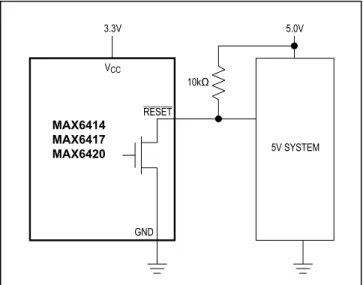
The open-drain outputs of the MAX6414/MAX6417/ MAX6420 can be used to interface to μPs with other logic levels. As shown in Figure 5, the open-drain output can be connected to voltages from 0 to 5.5V. This allows for easy logic compatibility to various microprocessors.
Negative-Going V
CCTransients
In addition to issuing a reset to the μP during power-up, power-down, and brownout conditions, these supervisors are relatively immune to short-duration negative-going transients (glitches). The Maximum Transient Duration vs. Reset Threshold Overdrive graph in the Typical Operating Characteristics shows this relationship.
The area below the curve of the graph is the region in which these devices typically do not generate a reset pulse. This graph was generated using a negative-going pulse applied to VCC, starting above the actual reset threshold (VTH) and ending below it by the magnitude indicated (reset-threshold overdrive). As the magnitude of the transient decreases (farther below the reset thresh-old), the maximum allowable pulse width decreases. Typically, a VCC transient that goes 100mV below the reset threshold and lasts 50μs or less will not cause a reset pulse to be issued.
Ensuring a Valid RESET or RESET
Down to V
CC= 0V
When VCC falls below 1V, RESET/RESET current sinking (sourcing) capabilities decline drastically. In the case of the MAX6412, MAX6415, and MAX6418, high-impedance
CMOS-logic inputs connected to RESET can drift to undetermined voltages. This presents no problems in most applications, since most μPs and other circuitry do not operate with VCC below 1V.
In those applications where RESET must be valid down to 0, adding a pulldown resistor between RESET and ground sinks any stray leakage currents, holding RESET
low (Figure 6). The value of the pulldown resistor is not critical; 100kΩ is large enough not to load RESET and small enough to pull RESET to ground. For applications using the MAX6413, MAX6416, and MAX6419, a 100kΩ pullup resistor between RESET and VCC will hold RESET high when VCC falls below 1V (Figure 7). Open-drain
RESET versions are not recommended for applications requiring valid logic for VCC down to 0V.
Figure 5. MAX6414/MAX6417/MAX6420 Open-Drain RESET
Output Allows use with Multiple Supplies
Figure 6. Ensuring RESET Valid to VCC = 0V
Figure 7. Ensuring RESET Valid to VCC = 0V
MAX6414 MAX6417 MAX6420
VCC
GND
3.3V 5.0V
RESET 10kΩ
5V SYSTEM
MAX6412 MAX6415 MAX6418
GND
VCC VCC
RESET
100kΩ
MAX6413 MAX6416 MAX6419
GND VCC
VCC
RESET
100kΩ
Layout Consideration
SRT is a precise current source. When developing the layout for the application, be careful to minimize board capacitance and leakage currents around this pin. Traces connected to SRT should be kept as short as possible. Traces carrying high-speed digital signals and traces with large voltage potentials should be routed as far from SRT as possible. Leakage current and stray capacitance (e.g., a scope probe) at this pin could cause errors in the reset timeout period. When evaluating these parts, use clean prototype boards to ensure accurate reset periods. RESET IN is a high-impedance input, which is typically driven by a high-impedance resistor-divider network (e.g., 1MΩ to 10MΩ). Minimize coupling to transient signals by keeping the connections to this input short. Any DC leak-age current at RESET IN (e.g., a scope probe) causes errors in the programmed reset threshold.
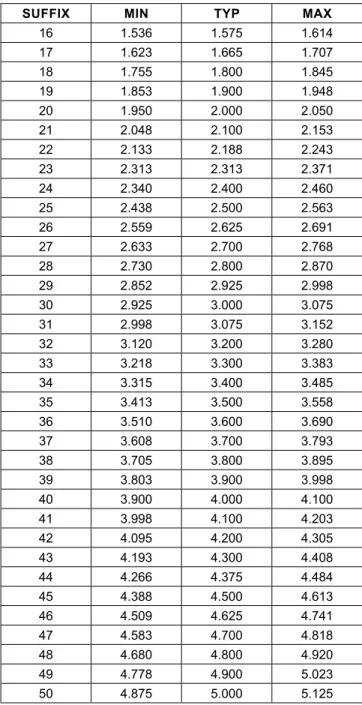
Table 1. Reset Voltages Suffix Table
SUFFIX MIN TYP MAX
16 1.536 1.575 1.614
17 1.623 1.665 1.707
18 1.755 1.800 1.845
19 1.853 1.900 1.948
20 1.950 2.000 2.050
21 2.048 2.100 2.153
22 2.133 2.188 2.243
23 2.313 2.313 2.371
24 2.340 2.400 2.460
25 2.438 2.500 2.563
26 2.559 2.625 2.691
27 2.633 2.700 2.768
28 2.730 2.800 2.870
29 2.852 2.925 2.998
30 2.925 3.000 3.075
31 2.998 3.075 3.152
32 3.120 3.200 3.280
33 3.218 3.300 3.383
34 3.315 3.400 3.485
35 3.413 3.500 3.558
36 3.510 3.600 3.690
37 3.608 3.700 3.793
38 3.705 3.800 3.895
39 3.803 3.900 3.998
40 3.900 4.000 4.100
41 3.998 4.100 4.203
42 4.095 4.200 4.305
43 4.193 4.300 4.408
44 4.266 4.375 4.484
45 4.388 4.500 4.613
46 4.509 4.625 4.741
47 4.583 4.700 4.818
48 4.680 4.800 4.920
49 4.778 4.900 5.023
50 4.875 5.000 5.125
Chip Information
TRANSISTOR COUNT: 329 PROCESS: BiCMOS*Sample Stock is generally held on all standard versions. Contact factory for availability of nonstandard versions.
Note: The MAX6412/MAX6413/MAX6414 and MAX6418/ MAX6419/MAX6420 are available with factory-set VCC reset
thresholds from 1.575V to 5.0V in approximately 0.1V incre
-ments. Insert the desired nominal reset threshold suffix (from Table 1) into the blanks following the letters UK. There are 33 standard versions with a required order increment of 2500 pieces. Sample stock is generally held on standard versions only (see Standard Versions Table). Required order increment is 10,000 pieces for nonstandard versions. Contact factory for availability. All devices are available in tape-and-reel only. Devices are available in both leaded (-) and lead-free (+) packaging. /V denotes an automotive qualified part.
For top mark information, please visit Maxim’s website at
www.maximintegrated.com.
*Future product—contact factory for availability. PART*
MAX6412UK16-T MAX6412UK22-T MAX6412UK26-T MAX6412UK29-T MAX6412UK46-T MAX6413UK16-T MAX6413UK22-T MAX6413UK26-T MAX6413UK29-T MAX6413UK46-T MAX6414UK16-T MAX6414UK22-T MAX6414UK26-T MAX6414UK29-T MAX6414UK46-T MAX6415UK-T MAX6416UK-T MAX6417UK-T MAX6418UK16-T MAX6418UK22-T MAX6418UK26-T MAX6418UK29-T MAX6418UK46-T MAX6419UK16-T MAX6419UK22-T MAX6419UK26-T MAX6419UK29-T MAX6419UK46-T MAX6420UK16-T MAX6420UK22-T MAX6420UK26-T MAX6420UK29-T MAX6420UK46-T
www.maximintegrated.com Maxim Integrated │ 10
Standard Versions Table
PART TEMP RANGE PIN-PACKAGE MAX6412UK_ _-T -40°C to +125°C 5 SOT23 MAX6412UK_ _+T -40°C to +125°C 5 SOT23
MAX6413UK_ _-T -40°C to +125°C 5 SOT23 MAX6413UK_ _+T -40°C to +125°C 5 SOT23
MAX6414UK_ _-T -40°C to +125°C 5 SOT23 MAX6414UK_ _+T -40°C to +125°C 5 SOT23 MAX6414UK_ _/V+T* -40°C to +125°C 5 SOT23 MAX6414UK29/V+T -40°C to +125°C 5 SOT23 MAX6414UK31/V+T -40°C to +125°C 5 SOT23 MAX6414UK175/V+T -40°C to +125°C 5 SOT23
MAX6415UK+T -40°C to +125°C 5 SOT23
MAX6416UK+T -40°C to +125°C 5 SOT23
MAX6417UK+T -40°C to +125°C 5 SOT23
MAX6418UK_ _-T -40°C to +125°C 5 SOT23 MAX6418UK_ _+T -40°C to +125°C 5 SOT23
MAX6419UK_ _-T -40°C to +125°C 5 SOT23 MAX6419UK_ _+T -40°C to +125°C 5 SOT23
MAX6420UK_ _-T -40°C to +125°C 5 SOT23 MAX6420UK_ _+T -40°C to +125°C 5 SOT23 MAX6420UK_ _/V-T* -40°C to +125°C 5 SOT23
Ordering Information
PART FIXEDV
TH MANUAL RESET RESET IN PUSH-PULL RESET PUSH-PULL RESET OPEN-DRAIN RESET
MAX6412 ü ü — ü — —
MAX6413 ü ü — — ü —
MAX6414 ü ü — — — ü
MAX6415 — — ü ü — —
MAX6416 — — ü — ü —
MAX6417 — — ü — — ü
MAX6418 ü — ü ü — —
MAX6419 ü — ü — ü —
MAX6420 ü — ü — — ü
MAX6412 MAX6413 MAX6414
SRT GND
VCC
VCC
MR
RESET/RESET µP RESET/RESET
Selector Guide
REVISION
NUMBER REVISIONDATE DESCRIPTION CHANGEDPAGES
0 01/02 Initial release —
1 8/03 Corrected top marks 10
2 12/05 Added lead-free information in Ordering Information 1
3 3/10 Deleted RESET in Hysteresis parameter in the Electrical Characteristics table 3
4 2/11 Corrected formula for SRT 5, 7
5 8/12 Added automotive qualified part to Ordering Information 1
6 3/14 Added MAX6414UK_ _/V+T to Ordering Information 1
7 12/15 Added lead-free part numbers to Ordering Information table, updated package code and removed top mark information from page 10. 1, 10 8 3/18 Updated Benefits and Features and Ordering Information tables 1, 10
9 12/18 Added Package Information 2
10 2/19 Updated Transistor Count 9
11 7/19 Updated Electrical Characteristics 3
Maxim Integrated cannot assume responsibility for use of any circuitry other than circuitry entirely embodied in a Maxim Integrated product. No circuit patent licenses are implied. Maxim Integrated reserves the right to change the circuitry and specifications without notice at any time. The parametric values (min and max limits) shown in the Electrical Characteristics table are guaranteed. Other parametric values quoted in this data sheet are provided for guidance.
Maxim Integrated and the Maxim Integrated logo are trademarks of Maxim Integrated Products, Inc. © 2019 Maxim Integrated Products, Inc. │ 12