Chapter Seven
Principles Underlying the Economic
Analysis of Projects
7.1 Objectives for Economic Investment Appraisal
While the financial analysis of a project focuses on matters of interest to investors, bankers, public sector budgets, etc., an economic analysis deals with the impact of the project on the entire society. The primary difference between the economic and the financial evaluation is that the former aggregates benefits and costs over all the country’s residents to determine whether the project improves the level of economic welfare of the country as a whole, while the latter considers the project from the point of view of the well-being of a particular institution or subgroup of the population.
A broad consensus exists among accountants on the principles to be used in undertaking a financial appraisal of a potential investment. There is also considerable agreement among financial analysts on the cash flow and balance sheet requirements for a public sector project to pay for itself on a cash basis. However, these accounting and financial principles are not a sufficient guide for undertaking an economic appraisal of a project.
The measurement of economic benefits and costs is built on the information developed in the financial appraisal, but in addition, it makes important use of the economic principles developed in the field of applied welfare economics. For a person to be a proficient economic analyst of capital expenditures, it is as imperative that he be conversant with the principles of applied welfare economics as it is for the financial analyst to be knowledgeable of the basic principles of accounting. In the measurement of economic values, we begin by looking to the market for a specific good or service. The initial information for measuring its economic costs and benefits is obtained from the observation of the actual choices of consumers and producers in that market.
To better understand the nature of an economic analysis and how it relates to the financial analysis, let us consider the case of a cement plant
constructed on the outskirts of a town. In the financial analysis, the owners of the plant determine the profitability and financial attractiveness of the project. If the project has a positive financial net present value (NPV), and relatively low risk, the owners will undertake the project because it will increase their net wealth.
If no one else in the country gains or loses as a result of the project, there would be almost no difference between the financial and the economic analyses. Consequently, when conducting an economic analysis, it may help from a conceptual standpoint to determine what groups, in addition to the project sponsors, gain or lose as a result of the project. For example, if the cement project pays wages higher than the prevailing market wages, the excess constitutes a benefit to workers. Thus, an adjustment to reflect their benefit would have to be included in the economic analysis. If the project pays income tax, this represents a financial cost to the project owners but a benefit to the government, and it would have to be estimated and included in the economic analysis. Furthermore, if one of the town’s neighbourhoods is affected by pollution due to emissions from the plant, the associated costs in terms of health and other lost amenities should also be taken into account in the economic analysis.
If the project’s workers, town residents, consumers of cement (project and non-project), and the government represent all the parties impacted by the project, then the net economic benefit or cost would be determined by adding all the gains and losses of these stakeholders to the gains or losses of the plant owners. If the final result is a net gain, then the cement plant increases the net welfare of the economy and should be undertaken; otherwise, it should not be undertaken. Note that economic viability does not require that every stakeholder perceive a net benefit from a project. Most projects will have both losers and gainers. However, if the gains outweigh the losses, the project is economically viable and should be undertaken. The underlying rationale is that a net gain implies that losers from the project could be compensated.
The above simple example explains the economic analysis of a project in its basic form. There are generally further adjustments that need to be carried out due to differences between the market price and the economic price of tradable and non-tradable goods as well as differences between the financial cost of capital and its economic cost. These adjustments will be discussed later.
This chapter is organized as follows. Section 7.2 presents the three postulates underlying the methodology of economic valuation. Section 7.3 shows how these postulates are applied to the economic valuation of
non-tradable goods and services when there are no distortions in their markets. Section 7.4 introduces the concept of distortions and their applications to the economic valuation of non-tradable goods and services. Section 7.5 briefly discusses a few other issues involving the three postulates. Concluding remarks are made in the last section.
7.2 Postulates Underlying the Economic
Evaluation Methodology
The methodology adopted in this book to evaluate the economic benefits and costs of projects is built on the three postulates of applied welfare economics as summarized by Arnold Harberger (1971 and 1987). These postulates in turn are based on a number of fundamental concepts of welfare economics.
1. The competitive demand price for an incremental unit of a good or service measures its economic value to the demander and hence its economic benefit.
2. The competitive supply price for an incremental unit of a good or service measures its economic resource cost.
3. Costs and benefits are added up without regard to who the gainers and losers are. In other words, a dollar is valued at a dollar regardless of whether the benefit of the dollar accrues to a demander or a supplier or to a high-income or a low-income individual.1
What is the implication of these postulates for the economic analysis of a project? When a project produces a good or a service (output), the economic benefit or the economic price of each incremental unit is measured by the demand price or the consumer’s willingness to pay for that unit. These postulates are firmly based on standard economic theory, but they also involve certain subtleties and conditions. The demand curve represents the maximum willingness to pay for successive units of a
1This methodology can, however, be easily extended to allow for the
benefits received by certain groups (e.g., the poor) to receive greater weight. The particular avenue that we follow to accomplish this goes under the label of basic needs externalities and assigns special additional benefit values to projects that enhance the fulfillment of the basic needs of the poor.
good. As such, the demand curve reflects indifference on the part of the consumer between having a particular unit of a good at that price and spending the money on other goods and services. As adjustments take place as a result of a project or other underlying event, the base assumption is that these are full adjustments over the whole economy. Individual prices and quantities may change in this and other markets, wages and incomes of different groups may rise or fall, but the economy is thought of as being always in equilibrium, with all markets being cleared.
The economic cost of a resource (input) that goes into the production of the project’s output is measured by the supply price of each incremental unit of that resource. In other words, the economic cost of each incremental unit of an input is the price at which the supplier would just barely be willing to supply that unit. The supply curve is the locus of the successive minimum prices that suppliers are willing to accept for successive units of a good or service that they supply. These minimum prices represent the opportunity cost of these goods. Suppliers will be indifferent between selling these particular units of the good at their supply prices and using the inputs for alternative purposes. Again, adjustments along a supply curve take places in the context of the economy staying within its resource constraint, with equilibrium in all markets.
Finally, the third postulate concerns the distributional aspects of a project and how they should be incorporated in the economic analysis of projects. By accepting each individual supplier’s and demander’s valuations and then taking the difference between total benefits and total costs, the basic methodology of applied welfare economics focuses on economic efficiency.2 The methodology in this book measures the net
economic benefit of the project by subtracting the total resource costs used to produce the project’s output from the total benefits of the output. In measuring the economic efficiency of projects, it adds up the dollar values of the net economic benefits regardless of who the beneficiaries of the project are.
The first step in moving beyond pure efficiency considerations consists of what is called stakeholder analysis, which simply breaks down the overall benefits and costs of a project into component pieces delineating the benefits and costs of particular institutions (business
2The approach with basic needs externalities can be used as an alternative to
firms, banks, etc.) or groups (consumers, farmers, labourers, the poor, etc.). This is clearly an important part of an economic appraisal. To help us deal with these issues, the chapter on stakeholder analysis contains a framework for identifying and measuring these distributive effects and offers some suggestions as to how this information may be included in the economic appraisal of a project.
7.3 Applying the Postulates to Determine Economic
Evaluation of Non-tradable Goods and Services
in an Undistorted Market
In this section, we work through a number of simple examples to illustrate how economic costs and benefits of non-tradable goods and services in a project are estimated using these three postulates in undistorted markets.3 Distortions are defined in the context of this book
to include taxes, subsidies, trade taxes, licences and quotas, monopoly markups, environmental externalities, congestion costs, and any other types of price or quantity restriction that causes the demand price of the item to diverge from its supply price.
Although one would be hard pressed to find a market without distortions, we nevertheless start the analysis in the context of non-distorted markets so as to present the methodology in its simplest form. This simple case demonstrates that a difference may exist between financial and economic prices even in the absence of distortions.
To understand the impact of a project’s demand for an input on the market for that input, we start by analyzing that market. Similarly, to understand the impact of a project’s output on the market for an output, we start by analyzing the market for that output. Consequently, we start our presentation below by developing a framework to show how the three postulates can be used to estimate economic costs and benefits in an existing market for a good or service (in the absence of a new project). We then proceed to show how the economic benefit of an
3A fuller explanation of the definition of a non-tradable is found in Chapter
Eleven. At this point, it is sufficient to consider a non-tradable as a good or service where there is no incentive for domestic suppliers to export the item or consumers to import the item. In this case, the price of the item will be determined by the demand of local consumers interacting with the supply response of local suppliers.
output produced by a project can be estimated and finally how the economic cost of an input used by a project is estimated.
7.3.1 Analyzing Economic Costs and Benefits in an Existing
Market (in the Absence of a New Project)
Figure 7.1(a) presents the demand curve for a good in an undistorted market. The demand curve of a good shows the maximum price that consumers are willing to pay for successive units of the good. If the market-determined price of the good is Pmand the quantity consumed at that price is Qm, then the economic benefit of the last (marginal) unit consumed is Pm, but the benefits of earlier (inframarginal) units will be greater than Pm. The maximum benefit derived from the first unit consumed is Pmax, as shown in Figure 7.1(a). Applying the first postulate, the benefits of the successive units consumed are determined by the corresponding prices on the demand curve. Consequently, the economic benefit of the output of this industry (the quantity Qm) is given by the area OPmaxCQm.
Figure 7.1(b) presents the other side of the market — namely, the supply side. The supply curve or marginal cost curve reflects the resource cost of producing successive units of the good. At the market-determined price Pm, the quantity Qm is produced. While the resource cost of the marginal unit produced is Pm, that of each of the inframarginal units is less than Pm. Following the second postulate, the economic resource cost of producing Qm is OECQm.
Figure 7.1(c) combines the demand and supply curves for this market. Following the third postulate, we add up the economic costs and benefits to determine the net gain or loss in this industry. Since the benefits are represented by the area OPmaxCQm in Figure 7.1(a) and the costs are given by the area OECQm in Figure 7.1(b), we have a net economic benefit given by the triangle EPmaxC in Figure 7.1(c).
Although from this analysis it is clear that the industry is adding to the net wealth of the economy, we have not yet determined which group receives this net benefit of EPmaxC. To answer this question, let us return to Figure 7.1(c). The only price observable in the market is Pm, and all Qm units are bought and sold at this price. Consumers value each unit they consume at its corresponding price, as given by the demand curve, but they pay less than that price for all units consumed except the last one. This difference between what consumers value the output at and what they actually pay for it is a net gain to consumers and is known as
Figure 7.1: Economic Costs and Benefits in an Existing Market
consumer surplus. Consumers pay an amount equal to OPmCQm but enjoy a gross benefit of OPmaxCQm. The amount of income saved by consumers because they are able to purchase all units at a price Pm is equal to the triangle PmPmaxC in Figure 7.1(c). This triangle is the consumer surplus.
The fact that all units are sold at a price Pm implies that industry revenues, OPmCQm, are larger than the economic costs, OECQm. The excess of revenues over resource cost, the triangle in Figure 7.1(c) EPmC, represents a net profit (over and above their normal or “required” rates of return or other supply prices) to the owners of the factors of production. This difference is known as economic rent or producer surplus. It now becomes evident that the net economic benefit in this industry, as determined using the three postulates, is shared between the owners of the production factors used in the industry and the consumers of its output.
The analysis above indicates that the gross economic benefits of the total output from this industry are greater than the financial revenues received by the suppliers in this industry — the difference being the consumer surplus enjoyed by the consumers of the output. It also indicates that the economic cost of producing the output is less than the financial revenues received by the suppliers — the difference here being the producer surplus enjoyed by the suppliers. The implication of these two facts is that the financial prices of inframarginal units are typically different from their economic prices (i.e., the price of the last or marginal unit), even in the absence of distortions. This point is further addressed below.
7.3.2 Analyzing the Economic Benefits of an Output Produced
by a Project
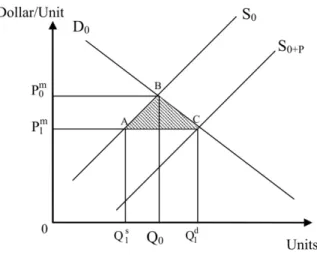
The previous analysis focused on an industry. In this section, we consider the more common case of a new project. Suppose our project produces a non-tradable good such as cement. Figure 7.2 shows the supply and demand for this non-tradable good. The industry demand and supply curves prior to the introduction of the new project are denoted by D0 and S0, respectively. The new project produces a quantity, Qp, and results in a shift in the industry supply curve from S0 to S0+P. The
additional supply by the project results in a drop in the market price from Pm0 to P1m. As a result of the decrease in price, consumers demand more,
and total consumption increases from Q0 to Q1 .d Also due to the decline
in price, existing suppliers will cut back their production from Q0 to Q1s,
as some of them can no longer profitably supply the same amount of the good at the new (lower) price, Pm
1 . Qp, the quantity produced by the project, equals the sum of the two quantities Q1d– Q0 and Q0–Q1s.
Since the project sells its output at the new prevailing market price, P1 ,m the gross financial receipts to the project are given by (Qp × P1m),
which is area Qs 1AC Q
d
1 . To estimate the gross economic benefits of the
project, we need to determine the economic value of the new consumption to the demanders and the value of the resources released by existing suppliers. These values are estimated using the first two postulates, as follows:
Figure 7.2: Economic Benefits of a New Project in an Undistorted
Market
1. The additional consumption is valued, according to the first postulate, by the demand price for each successive unit or by the area under the demand curve (Q0BC Qd
1 ).
2. The resources released by other producers are valued, according to the second postulate, by the supply price (resource cost), along the “old” supply curve, not counting project output, of each successive unit or by the area under the supply curve (Q0BA Qs
1).
The gross economic benefits are given by the sum of the two areas above (Q1sABC Qd
1 ). It is important to emphasize that these benefits are
gross. In other words, we have not yet netted from them the economic costs of producing the project’s output. Saying that a project has positive gross economic benefits is the economic equivalent of saying that a project has positive gross financial receipts. The positive gross benefits alone do not indicate whether the project is economically viable or not, the same way that positive gross financial receipts do not indicate whether the project is financially profitable or not.
The gross benefits are equal to the sum of the financial receipts to the project’s owners (Q1sAC Qd
1 ), plus the gain in consumer surplus (Pm0 BC
gross receipts to the project owners, consumers gain due to the reduction in price, and producers lose economic rents due to the reduction in price. It is worth noting that the gross economic benefits exceed the financial receipts to the project’s owners due to the net gain to consumers as the consumers’ gain more than fully offsets the loss in economic rents to the existing producers.
It is often the case that when the quantity produced by the project is relatively small compared to the size of the market, there will be only a small, but not zero, induced change in the market price. In such a situation and given that we are operating in an undistorted market, the gross financial receipts will be almost equal to the gross economic benefits. In other words, there is little difference between the financial revenues generated by a project and its economic benefits to the society. The difference will become significant only when the quantity produced by the project is sufficiently large to have a meaningful impact on the prevailing market price in the industry.
7.3.3 Analyzing the Economic Cost of an Input Demanded
by a Project
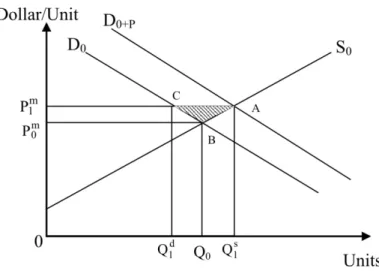
The following example demonstrates how the economic cost of a non-tradable input demanded by a project can be estimated using the three postulates. The industry demand and supply curves without the additional demand by the new project are denoted by D0 and S0, respectively (Figure 7.3). The new project demands a quantity, Qp, and results in a shift in the industry demand curve from D0 to D0+P. The
additional demand by the project results in a rise in the market price from Pm0 to P1m. As a result of the increase in price, existing consumers will
cut back their consumption from Q0 to Q1 d , and producers will increase their production from Q0 to Q1s at the new (higher) price, P1m. Qp, the
quantity demanded by the project, equals the sum of the two quantities Q0–Q1 d and Q
s
1– Q0.
The project buys its requirement at the new prevailing market price, P1m, and incurs a gross financial expenditure of (Qp×P1m),which is the
area Q1dCA Qs
1. To estimate the gross economic costs of the input
Figure 7.3: Economic Cost of an Input Demanded by a Project in an Undistorted Market
the consumption that is foregone by the existing consumers and the value of the additional resources used to accommodate the project’s demand. These values are estimated using the first two postulates, as follows:
1. The cutback in consumption is valued, according to the first postulate, by the demand price for each successive unit given up by other consumers — the area under the demand curve (Q0BC Q1d).
2. The additional resources used to accommodate the expansion in output are valued, according to the second postulate, by the supply price (resource cost) of each successive unit — the area under the supply curve (Q0BA Q1s).
The gross economic cost of this input is given by the sum of the two areas above (Q1dCBA Q
s
1), which is equal to the financial cost to the
project (Q1dCA Q
s
1), plus the loss in consumer surplus (P1mCB Pm0 ), less
the gain in producer surplus (P1mAB Pm0 ). Due to the increase in price
brought about by the project’s demand, existing consumers lose consumer surplus, while producers gain economic rents. The economic
cost per unit with the implementation of the project can be measured by (Pm0 +P1m)/2, with linear demand and supply curves of any slope.
However, it is worth noting that in this case, the gross economic cost is less than the financial cost paid by the project due to the fact that net gain to producers in economic rent exceeds the loss in consumer surplus to the existing consumers. The changes in consumer and producer surplus are a direct result of the price increase.
If the quantity demanded by the project is relatively small compared to the size of the market, there will be a very small change, but not zero, in the market price. In such a situation, and given that we are operating in an undistorted market, the gross financial cost to the project will be virtually equal to the gross economic cost. In other words, the triangle difference between the financial cost paid by a project for an input and its economic cost to the society will be negligible. The difference will become important only when the quantity demanded by the project is sufficiently large to have a large impact on the prevailing market price in the industry.
By determining the economic cost of each input used by the project, as outlined above, and the economic benefit of its output, as presented above, we will be in a position to determine the economic viability of the project by subtracting all economic costs from the gross economic benefits.
7.4 Applying the Postulates to Determine Economic
Evaluation of Non-tradable Goods and Services
in Distorted Markets
This section describes the impact of distortions on markets for goods and services whose domestic production satisfies all the domestic market demand for these items and whose domestic prices are not determined by their world prices. These are referred to as non-traded goods. In general, the markets for a project’s outputs and inputs are distorted, where distortions are defined as market imperfections. The most common types of these distortions are in the form of government taxes and subsidies. Others include quantitative restrictions, price controls, and monopoly markups (the excess of price over marginal cost). In project appraisal, we take the type and level of distortions as given when estimating the economic costs and benefits of projects. The task of the project analyst or
economist is to select the projects that increase the country’s net wealth, given the current and expected regime of distortions in the country.
While the presence of distortions in the markets of internationally non-tradables will render the estimation of the economic costs and benefits, as well as the distributional impacts, slightly more involved, the methodological framework is still entirely based on the three postulates of applied welfare economics. When dealing with undistorted markets in the examples above, the only difference between the financial receipts to the owners and the economic benefits is the gain in consumer surplus minus the loss in producer surplus. Similarly, the difference between the economic cost of the inputs used by the project and the financial expenditures borne by the project owners is the gain in producer surplus minus the loss in consumer surplus. In the absence of distortions, if a project causes a relatively small change in financial prices, the financial receipts from the sale of the output will be for all practical purposes equal to the gross economic benefits, and the financial expenditures on the inputs will be similarly equal to their economic cost.
When a project produces an output in a distorted market, the market price will fall due to the increase in supply. Demanders will increase their demand, while non-project suppliers will reduce their supply. This outcome is identical to the case of an undistorted market. The economic benefit of the project’s output will be measured as the sum of the value of the additional demand measured by the demand price and the value of the additional resources measured by the supply price. Here again, we see that the estimation process is similar to that of an output in an undistorted market.
7.4.1 Sales Taxes Levied on Output of Project
Taxes are imposed by governments primarily in order to raise revenues to pay for public sector expenditures.4 When a value-added tax or a
general sales tax (ts) is imposed on an internationally non-tradable, a
4Some theorists of public economics assert that the purpose of raising
revenues is to enable the government to perform functions that cannot be undertaken by the private sector due to “market failures”. These theorists sometimes add that the government is also required to adopt appropriate fiscal and monetary policies for the stabilization of the economy. Finally, they and others often justify expenditures in social sectors (health care, education) as being necessary for reducing income disparities and promoting equity.
divergence is created between the marginal value to consumers (Pd), which includes the sales tax and the marginal cost of the resources used in production (Ps), which does not include the sales tax. In a situation when there is no other distortion in the supply of the item, then the market price, Pm, will be equal to the marginal cost of production, which is defined here as the supply price, Ps. As a consequence, in this situation Pd = Ps (1 + t
s) or Pd = Pm (1 + ts).
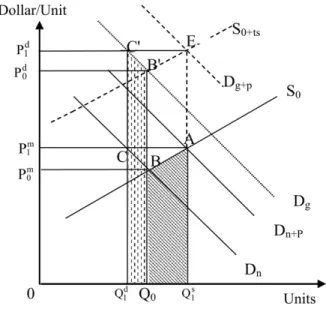
Let Dgdenote the undistorted industry demand curve for an item, as shown in Figure 7.4. This curve shows the value of each unit of the commodity to the demander, or what the demanders are willing to pay. However, what they are willing to pay to suppliers (net of the tax) is given by Dn, as shown in Figure 7.4. This is what suppliers will receive in order to cover their costs of production. The net of tax marginal cost of production is shown as the supply curve, S0.
Suppose a new project demands a quantity, Qp, causing the net-of-tax industry demand curve to shift from Dnto Dn+P. The additional demand by the project results in a rise in the net-of-tax market price from P0m to
P1m. As a result of the increase in price, existing consumers, who now
must pay Pd
1 = P1m(1 + ts) per unit, will cut back their consumption Figure 7.4: Economic Cost of an Input Demanded by a Project
from Q0to Q1d, while producers will increase their production from Q0 to
Q1s, the quantity demanded by the project (Qp), which equals the sum of the two quantities, Q0 –Q1 d and Q
s
1–Q0.
When the project buys its requirement, the effect is to shift the net-of-tax demand curve to the right by the amount [(Q1s– Q
d
1 ) = Qp] of project purchases, i.e., Dn+p. The gross-of-tax demand curve will also shift to Dg+p. The project will make a gross-of-tax financial expenditure of Qp ×P1d (=Q1dC'E Q
s
1), but the suppliers of this input will receive an
amount equal to net-of-tax price times the quantity sold, Qp× Pm, or Q1d
CA Q1s, to cover their costs. However, we see that the producers of this
item do not increase their production by the full amount of the additional demand. To estimate the gross economic costs of the input demanded by the project, we need to determine the economic value of the incremental consumption that is foregone by the existing consumers and the value of the additional resources used to accommodate the project’s demand. These values are estimated using the first two postulates, as follows: 1. The cutback in consumption is valued, according to the first
postulate, by the demand price for each successive unit given up by other consumers — the area under the demand curve inclusive of tax (Q1dC'B'Q0). This is reflected by the gross-of-tax demand price Pd. 2. The additional resources used to accommodate the expansion in
output are valued, according to the second postulate, by the supply price (resource cost) of each successive unit — the area under the supply curve (Q0BA Qs
1). This is reflected by the net-of-tax supply
price Ps or, in this case, the market price.
Thus, the economic cost of a project input can be measured by the sum of the supply price (Ps) times the change in quantity supplied (∆Qs) and the demand price (Pd) times the change in quantity demanded (∆Qd). That is:
PeQ
p = Ps∆Qs + Pd∆Qd (7.1) where Qp = ∆Qs + ∆Qd. The ratio of ∆Qs and ∆Qd to Qp becomes the respective weight of supply and demand, ws and wd, as a consequence of
the project demand for the good. One can also rewrite equation (7.1) and calculate the economic cost as the quantity demanded by the project input times the following expected economic price of the good (Pe):
Pe = ws Ps + wd Pd (7.2) The weights become an important factor in determining the economic price and, consequently, the economic cost of the good. These weights are generally determined by the own price elasticities of supply (ε) and demand (η) of the good, which reflect the responsiveness of the quantity supplied to and demanded from a change in price of the good. They can be calculated below:
ws = ε / (ε–η), and wd = –η / (ε–η) (7.3) These elasticities refer to an average elasticity representing the adjustments made by the market; as such, they are long-run elasticities of supply and demand. The relative share of demand and supply depends upon the market force of the specific good or service in question. A longer time frame, however, tends to bring more firms or producers into the supply process, thus providing a greater weight in supply, unless there is a constraint in some of the production factors.
For example, suppose there is a greater response in the existing supply than demand in the economy to the project demand. Let us assume ws = 0.75 and wd = 0.25 with the market price and sales tax rate, in which P0m= $90 and ts = 0.15. The economic price will then be
calculated as:
Pe = ws Ps + wd Pd
= 0.75 × 90 + 0.25 × [90 × (1+0.15)] = $93.375
If instead of a project demanding this good as an input into its production, suppose we have a project that will increase the production of the good. The increase in project supply will shift the supply curve to the right, from Snto Sn+P,as shown in Figure 7.5. The additional supply by the project results in a decrease in the net-of-tax market price from Pm0 to P1m. The fall in the market price will cause consumers to increase
Figure 7.5: Economic Benefit of an Output Supplied by a Project (When a Tax Is Imposed on Sales)
falls from P0d to P1d.. The decline in price received (net of tax) by
producers of P1mwill cause some of the existing producers to cut back
their production from Q0 to Q1s.
Since the project sells its output gross of tax at P1d but receives net of
tax P1 ,m the gross financial receipts including taxes collected by the
project are given by (Qp × P1d), but the amount the project gets to keep
net of taxes is shown by the area Q1sCA Q1d. However, the economic
benefits produced by the project are measured by the following: • For the incremental increase in consumption of Qd
1 – Q0, the
consumers’ willingness to pay, according to the first postulate, is the gross-of-tax demand price. This is shown as the sum of the amount consumers are willing to pay the suppliers plus the increase in the amount of taxes they are willing to pay to the government (the area BAA'B') for the additional consumption.
• The value of resources released, according to the second postulate, is measured by the supply price Ps = Pm times the reduction in quantity
supplied of Q0 – Q1s. This is shown in Figure 7.5 as the area under
the supply curve Q0BC Q1s.
For example, suppose ws = 2/3, wd = 1/3, Pm
0 = $120, and ts = 0.15,
then the economic price of the good is: Pe = ws Ps + wd Pd
= 2/3 × 120 + 1/3 × [120 × (1+0.15)] = $126
In this case, when the change in the market price is small, the net economic benefits are greater than the financial benefits by the amount of additional tax revenue collected by the government. The additional tax accruing to the government will depend on the size of the tax rate and the incremental increase in the total supply of the good sold in the market as a consequence of the project.
7.4.2 Subsidies on Production
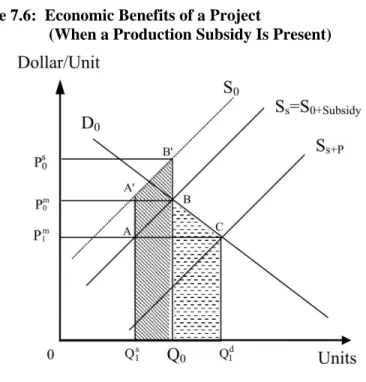
When a government wants to encourage the production of a non-tradable good, it may subsidize private producers to increase their output of the good or service. Figure 7.6 shows that the industry demand and supply curves in the absence of distortions prior to the introduction of the new project are denoted by D0 and S0, respectively. With a unit subsidy, where the government gives the producer a fixed amount per unit sold, the market supply curve will shift downward to the curve denoted by Ss (= S0+subsidy). Now suppose a new project produces a quantity Qp, equal to (Q1d – Q1s), which causes the industry supply to shift from Ss to Ss+P. The
additional supply by the project results in a movement of the market price from Pm
0 to P1m. As a result of the decrease in price, consumers
increase the quantity demanded, and total consumption increases from Q0 to Q1 .d Also due to the decline in price, existing suppliers will cut back their production from Q0 to Q1s as they will no longer supply the same
amount of the good at the lower price P1m. The quantity produced by the
project, Qp, equals the sum of the two quantities Q1d–Q0 and Q0 –Q
s
Figure 7.6: Economic Benefits of a Project
(When a Production Subsidy Is Present)
Since the project sells its output at the new prevailing market price P1 ,m 5 the gross financial receipts to the project are given by (Qp × P1m),
which is area Q1sAC Qd
1. To estimate the gross economic benefits of the
project, we need to determine the economic value of the additional new consumption to the demanders and the value of the resources released by existing suppliers. These values are estimated using the first two postulates, as follows:
• The additional consumption is valued, according to the first postulate, by the demand price for each successive unit — the area under the demand curve (Q0BC Qd
1).
• The resources released by other producers are valued, according to the second postulate, by the supply price (resource cost) of each
5Here we assume that the project does not receive the subsidy. However, the
economic value of the project output is the same whether or not the project output receives the subsidy.
successive unit — the area under the supply curve without subsidy (Qs
1A'B'Q0). This area includes the amount of production cost that
was being paid by consumers through the item’s sales price and the amount of reduction in government subsidy shown by the area (AA'B'B).
Subsidy may be expressed as either a percentage of the market price or a proportion of total production cost. In this example, suppose subsidy is given at 40 percent of resources (k) spent on production of the good, and we also assume the responsiveness of the existing supply and demand to the change in price as a result of the project output as follows: ws = 1/3, wd = 2/3,
Pm0 = $90, and k = 0.40, then the economic price of the
good can be calculated as: Pe = ws Ps + wd Pd
= 1/3 × [90/(1–0.40)] + 2/3 × 90 = $110
With the introduction of distortions in the form of taxes and subsidies, another stakeholder enters the picture in the form of the government. When there are other externalities created by pollution, monopoly markups, and price controls, the project will affect other groups in society. Consequently, when estimating the economic costs and benefits of goods and services in these distorted markets, we may expect additional benefits or costs and new players added to the list of beneficiaries or losers affected by the project.
The three basic postulates can also be used to determine the economic values for tradable goods and foreign exchange. These situations are treated in detail in later chapters.
7.4.3 Environmental Externalities
Suppose pollution is being created by an industry that is producing an input for our project. For example, some firms create waste products or effluents that are deposited in the atmosphere, in the waterways, and on the ground. This has a damaging effect on people and properties that are not directly involved with the production or consumption of the output. Assume resources will have to be used now or at some future date to deal with this environmental damage. These are resource costs that are not
recognized by the consumers of the industry’s output in the financial price of the item, and they must be included in the economic cost.
Let D0 and S0 denote the industry demand and supply curve of the good. If the impact on the environment is not completely internalized in the private production costs, then the damage caused by the external impact of the pollution should be estimated and added to the input cost to the project, as shown in Figure 7.7.
Suppose the project demands the good as a project input and causes the demand curve to shift from D0 to D0+P. As a result, the market price rises from Pm0 to P1m. The total consumption will decrease from Q0 to Q1d, and other existing suppliers will expand their production from Q0 to Q1s. Qp, the quantity demanded by the project, equals the sum of the two quantities Q0 –Q1d and Q
s
1 –Q0.
In this case, the gross financial costs to the project are given by (Qp× P1m),which is shown by the area Q
s
1AC Q
d
1 . The gross economic costs of
the project are determined by the economic value of the foregone consumption by some demanders and the value of the resources increased by other existing suppliers plus the additional pollution cost. These values are estimated using the first two postulates, as follows:
• The reduced consumption is valued, according to the first postulate, by the demand price for each successive unit — the area under the demand curve (Q0BC Qd
1).
• The additional resources demanded by producers alone are valued by the area under the supply curve as Q0BA Q1s. However, the total
economic cost of production must also include the polluter externality of BB'A'A, yielding a total economic cost for Q0Q1s of
Q1sA'B'Q0.
In this case, the economic cost of the project’s input is greater than its financial cost to the project.
On the other hand, there are projects that may reduce the level of production of other producers who pollute the air or water. In this case, the project will create a positive externality due to a reduction of the adverse impact on the environment by the other producers, who now cut back their level of output.
In any event, the evaluation of environmental impacts may not be always straightforward and will often require a special environmental impact study. It may be noted that infrastructure projects as well as natural resource extraction and energy projects produce a great variety of environmental externalities, including atmospheric emissions (sulfur, nitrogen, and carbon gases), which damage the forests and ecosystems. These environmental externalities are real and genuinely impose costs on the well-being of people within a country. Hence, these economic costs should be included as part of the economic costs of a project.
7.5 Other Distortions
There are other distortions in an economy to which the principles of the three basic postulates also apply. Important areas where other distortions play a significant role in causing divergences between economic and financial prices are the economic opportunity cost of capital (invested in the project) and the economic cost of workers employed in the project. These are briefly discussed in this section.
7.5.1 Economic Opportunity Cost of Capital
Different approaches have been used to determine the economic cost of capital. However, economic analysis suggests that the most plausible and widely applicable approach is to postulate that new expenditures are “sourced” in the capital market and that the normal destination of “free” funds is that they are returned to the capital market. In a small and open economy, this “sourcing” comes from three places. These sources are a)displaced investment (i.e., resources that would have been invested in other investment activities but are either displaced or postponed by our project’s extraction of funds from the capital market), b) newly stimulated saving (as economic agents respond to increased interest rates), and c) additional foreign capital inflows (as foreign suppliers of funds also respond to the same stimulus).
Based on these three alternative sources of public funds, the economic cost of capital can be estimated as a weighted average of the rate of return on displaced or postponed investments, the rate of time preference applicable to those who make additional savings, and the marginal cost of additional foreign capital inflows. In general, various distortions are associated with each of the three alternative sources of funds. The methodology will be described in detail in Chapter Eight.
7.5.2 Economic Opportunity Cost of Labour
In the labour market, there are a variety of factors that may create a divergence between the market wage and the economic cost of a worker at the project. This cost of employment, referred to as the supply price of labour, reflects the whole panoply of market and non-market incentives facing workers as they consider the options of being in the workforce or not, and once they are there, as they consider all the monetary and non-monetary factors that govern the desirability of working at our project vis-à-vis the many alternative options they face. The supply price of labour will also take into account any tax differential that a worker may face as a result of moving to the project from another employment.
Sometimes the project is expected to pay net wages that are higher than the supply price of labour in the market. This is mostly true when there are minimum wage laws or unionized labour. One can also find other reasons why some employers offer wages that exceed the prevailing market rates. In all such cases, a wedge is created between the
wage actually paid to workers in a project and the cost incurred by the economy when such workers are employed on a project.
Whereas in calculating the economic cost of capital or foreign exchange we are dealing with a fairly homogeneous item, virtually the opposite is true in the case of labour. Wages differ by occupation, skill, experience, location, type of job, etc. We will be fully conscious of this extreme heterogeneity when we estimate the economic prices of different categories of labour in Chapter Twelve.
7.6 Conclusion
This chapter has presented the three postulates underlying the methodology of economic evaluation. We have first shown how the three postulates are applied to the economic valuation of non-tradable goods and services in an undistorted market and later how they apply when distortions are present.
In general, there will likely be many distortions prevailing in an economy under evaluation. These distortions include, among others, value-added taxes, excise duties, import duties, and production subsidies.
Later chapters will give detailed explanations of how distortions of various kinds enter into the estimation of the economic opportunity costs of foreign exchange, of capital, and of labour of different types, as well as of specific inputs and outputs, both tradable and non-tradable. We hope that the present chapter has given readers a useful overview, a point of departure for the more detailed analyses to come.
References
Boardman, A.E., D.H. Greenberg, A.R. Vining, and D.L. Weimer. 2001. Cost-Benefit Analysis, Concepts and Practice, 2nd edition. Englewood Cliffs, NJ:
Prentice Hall.
Curry, S. and J. Weiss. 1993. Project Analysis in Developing Countries. New York: St. Martin’s Press.
Harberger, A.C. 1971. “Three Basic Postulates for Applied Welfare Economics”, Journal of Economic Literature 9(3), 758–797.
— 1978. “On the Use of Distributional Weights in Social Cost-Benefit Analysis”, Journal of Political Economy 86(2), Part 2: Research in Taxation, S87–S120.
— 1984. “Basic Needs Versus Distributional Weights in Cost-Benefit Analysis”, Economic Development and Cultural Change 32(3), 455–474. — 1987. “Reflections on Social Project Evaluation”, in G.M. Meier (ed.),
Pioneers in Development, Vol. II. Washington, DC: The World Bank and Oxford: Oxford University Press.
Harberger, A.C. and G.P. Jenkins. 2002. Introduction to A.C. Harberger and G.P. Jenkins (eds.), Cost-Benefit Analysis. Cheltenham: Edward Elgar Publishing Limited.
Harberger, A.C., G.P. Jenkins, C.Y. Kuo, and M.B. Mphahlele. 2003. “The Economic Cost of Foreign Exchange for South Africa”, South African Journal of Economics 71:2 (June), 298–324.
Hartwick, J.M. and N.D. Olewiler. 1986. The Economics of Natural Resource Use. New York: Harper and Row Publishers.
Hirshleifer, J., J.C. DeHaven, and J.W. Milliman. 1960. Water Supply: Economics, Technology, and Policy. Chicago, IL: University of Chicago Press.
Jenkins, G.P. 1999. “Evaluation of Stakeholder Impacts in Cost-Benefit Analysis”, Impact Assessment and Project Appraisal 17(2).
Jenkins, G.P. and C.Y. Kuo. 1998. “Estimation of the National Parameters for Economic Cost-Benefit Analysis for the Philippines”, Development Discussion Paper, Harvard Institute for International Development, Harvard University (May).
Jenkins, G.P. and H.B.F. Lim. 1998. “An Integrated Analysis of a Power Purchase Agreement”, Development Discussion Paper, Harvard Institute for International Development, Harvard University.
Little, I.M.D. and J.A. Mirrlees. 1974. Project Appraisal and Planning for Developing Countries. London: Heineman Educational Books.
Mason, S., C. Baldwin, and D. Lessard. 1983. “Budgetary Time Bombs: Controlling Government Loan Guarantees”, Canadian Journal of Public Policy 9(3).
Mishan, E.J. and E. Quah. 2007. Cost-Benefit Analysis, 5th edition. London and
New York: Routledge.
Roemer M. and J.J. Stern. 1975. The Appraisal of Development Projects. New York: Praeger Publishers.
Squire, L. and H. van der Tak. 1975. Economic Analysis of Projects. Baltimore and London: Johns Hopkins.
United Nations Industrial Development Organization. 1972. Guidelines for Project Evaluation. New York: United Nations.
Vega, A.O. 1997. “Risk Allocation in Infrastructure Financing”, The Journal of Project Finance 3(2).
Wells, L.T. and E.C. Gleason. 1995. “Is Foreign Infrastructure Investment Still Risky?” Harvard Business Review (September-October).
Zerbe, R.O. Jr. and D.D. Dively. 1994. Benefit-Cost Analysis in Theory and Practice. New York: Harper Collins College Publishers.