Stakeholder Communication in Software Project Management.
Modelling of Communication Features
IOAN POP
*and ALEXANDRA-MIHAELA POP
***
Department of Mathematics and Informatics
**
Department of Industrial Engineering and Management
“Lucian Blaga” University of Sibiu
5-7 dr. I. RaŃiu str. 550012, Sibiu
ROMANIA
[email protected]
Abstract: - Internal communication in software development projects has a number of features that by their efficiency lead to an efficient management of the Project Manager.This paper focuses on pointing out these communication characteristics. For analyzing and interpreting the communication characteristics of the software development projects we created a model with the help of the Weka modelling tool. The AMCFSP model was created after studying the communication characteristics and after surveying and questioning more software development designers. This model itself is a helpful tool in managing software projects portfolio.
Key-Words: - Project Modeling, Analysis, Communication, Classification and Clustering Methodes
1 Introduction
Merriam-Webster dictionary defines communication as “a process by which information is exchanged between individuals through a common system of symbols, signs, or behavior”. But this communication process has a special meaning within a project. The communication process in project management has as a main role transmitting official messages between the projects’ stakeholders. More factors are involved in this process such as: the transmitter of the information, the means through which information is transmitted and the receiver of the information. Also internal communication and especially internal communication within the software projects has a set of characteristics that by their efficiency lead to a preferment management of projects [01].
A successful completion of a project is only achieved by good management. But within the project management process there always exist a sub-process called „Communications Management Process”. The successful approach of the communications management process also depends on the management process model.
For example the communication process in a software development project can be modeled as a system as shown in figure 1. [02]
In the communication model shown in figure 1 we can see the complexity of the internal communication between the projects’ stakeholders. Communication can take place directly between
persons (e.g. Team Leader vs Member) and also indirectly (e.g. Manager vs Member). Communication can happen in a one-way or bidirectional.
Fig.1 A systemic model of communication in projects [02].
From this figure we cannot detect the communication channels, the accuracy, the efficency or the intensity this is why in the following sections we will develop this issues in more detail and we will present a model for analyzing and interpreting the communication characteristics of software projects. The aim of our investigation is to highlight the characteristics of communication about communication channels, and efficiency messages communicated between
different people involved in software development projects.
2 Communication in the Context of
Agile Software Development Projects
The management of software projects is a process which can be modelled according to the known methodologies such as: the waterfall model, the spiral model, the iterative model, the incremental model or the Agile Model. The Agile Model is based on the Agile Methodology which respects a set of values and principles based on the efficient developent practice of the software projects. Figure 2 illustrates the agile model as being an iterative and evolutive model which gets enriched with new values and new adaptive features as it moves forward.
Fig.2. Agile Model [03].
As shown in Fig. 2 an Agile Model focuses on agile teamwork with a spirit that is based on adaptability, transparency, simplicity, unity. Also, visibility of project management software focuses on burndown, velocity, burnup, tests. All of this together takes place iterative and through continuous communication to accelerate the completion of deliverables.
In software project management, the Agile methodology is not set of methods you can work with, but rather a collection of eficient software modelling practices. An Agile model does not respect detailed procedures, it is more of a chaordic model, meaning it is amix of chaos and order for agile and efficient applying of values by respecting the visibility of the design principles in order to speed up the completion of the deliverables [04].
The 12 principles of the agile methodology were presented in the Manifesto for Agile Software Development , where at the 6th position we can find
the conversation principle: „the most efficient and effective method of conveying information to and within a development team is face-to-face conversation” [05]. Agile software development methodologies that share these principles, but differ in some development practices are: eXtreme Programming (XP), Scrum, Evolutionary Project Management (Evo), Unified Process (UP), Crystal, Lean Development (LD), Adaptive Software Development (ASD), Dynamic System Development Method (DSDM), Feature Driven Development (FDD). Also, the common values of these Agile methodologies are: communication, simplicity, feedback, courage, humility [04]. We can see from this, that communication is one of the main values from the Agile development process, a management process through which we can send information between: manager, operating staff, users and clients. These are the stakeholders of the management of software development.
Stakeholders can be: the client, the public which is informed through presentations and the managers. The Agile Methodology has as a first and very important value, “communication”. The characteristics of communication in this type of project management can be find based on communication criteria such as: communication channels (formal, informal, unofficial); communication flows (downward, upward, horizontal, transversal) and the way the message is conveyed (oral, written, body language); etc.[06]. A way of interpreting the communication efficiency based on the „communication channel” characteristic is shown in figure 3.
Fig.3. Effectiveness of different modes of communication [06].
The graphic from figure 3 helps us analyze the communication characteristics from the perspective of the communication route on different channels. We can see that on the bidirectional channels (people: on e-mail, on phone or at whitboard)
communication is richer and therefor more effective. On the unidirectional channels (paper, audio tape, video tape) communication is less richer so not that effective as the communication on bidirectional channels. This is a relevant way of analyzing communication. There are other perspectives of measuring the communication efficiency as we can see further on in the model created in the third section of this paper.
If the Agile Model is applied in the software development projects, then according to the following priciple „The most efficient and effective method of conveying information to and within a development team is face-to-face conversation” we can see that communication is widely used here. This communication principle leads us to more profound analyzes of the communication behaviours in software project management. On the other hand we must consider that the stakeholders in the software development projets are: internal (clients, informed publics) and external [07]; [08]; [09].
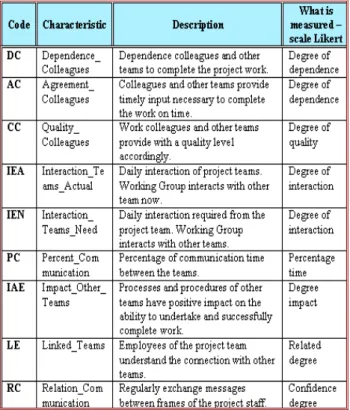
These considerations leads us to creating a set of communication characteristics based on behaviour citeria in communication.
Table 1. Features of team communication and project management environment.
Communication characteristics in this type of project management can be grouped based on the communication criteria such as: communication channels (formal, informal, unofficial), communication flows (downward, upward,
horizontal, transversal) and the way the message is sent (oral, scris, body language), etc.
For the analysis model that we created we selected the team communicaton characteristics and the characteristics of the project environment which we presented in table 1.
The team communication characteristics were measured with the help of questionnaires applied to the participants of the software development department from „Lucian Blaga” University and other specialized software companies.
3 Analytic Model for Communication
Flow in Software Projects – AMCFSP
The communication between stakeholders in software projects is a very intense one and it is one of the most important values in the Agile Methodology. In this model, data describing the characteristics of communication are processed by different methods from Machine Learning, methods implemented within the WEKA modelling tool [10]. As the communication instances are processed, these methods offer conclusive interpretations of the communication management in software projects.
For the AMCFSP model presented in this paper we chose only the software projects communication characteristics presented in table 2.
Code
Characte-ristics Likert Scale FIsj Downward Nominal:
(Always, Frequently, Sometimes, Rarely, Never) Numeral: {5, 4, 3, 2, 1} FIjs Upward
FIo Horizontal FIt Transversal
Table 2. Characteristics of flow communication used in software project.
As shown in section 2 we must highlight that in the measuring methodology of the communication characteristics in software projects we focused on measuring the intensity of communication by appreciating the dependency degree: quality, interaction, impact, interconnection, trust. This appreciation was made on a Likert scale.
The data collected through questionnaires and in-depth interviews was structured in a spreadsheet. Consequently from this spreadsheet we created an input relation for the AMCFSP model composed of communication instances for each questioned stakeholder based on the communication operation from a certain project. Each instance from the relation has more communication attributes with the values established by the stakeholders through their responses to the questionnaire. For the examples in this paper we focused of the communication
characteristics from the criteria „Flow communication” presented in table 2.
The attributes in the input relation correspond to these characteristics but we added another three supplementary attributes: Project Code, Stakeholder and Communication Class.
The class communication attribute was established by pre-processing the communication relation. The values of the class attribute belong to the {yes, no} domain. After a discretization the nominal values we calculated the arithmetic average of the values of a communication instance and if the average is lower then 3 the values of class is no,
otherwise it is yes.
Processing the data with the help of the AMCFSP model is made based on the classifying and clustering algorithms implemented in Weka. In this paper we used a algorithm from the Naïve-Bayes class and an algorithm from the Hierarchical Clustering class for analysing and interpreting the communication characteristics.
A first result of pre-processing the communication characteristic relation is shown in figure 4.
Fig.4. Statistical graphs of the communication flow attributes. Source: AMCFSP Application in Weka-3.7.8 (2013).
In the graphics from figure 4, the blue colours highlights the intensity of communication, computed as an average of four communication flow characteristics and the red colour highlights a lower intensity on the communication flow. A first interpretation of communication, on the channels used in software project management, can be that the communication through different teams and different members is lower.
By applying the Naive Bayes classification on the communication instances we obtain a series of results on the accuracy of classification [11] (see fig.5).
Fig.5. The results of the BayesNet classification: Accuracy by Class and Confusion Matrix. Source: AMCFSP Application in Weka-3.7.8 (2013).
The accuracy of the classification of communication instances is expressed through different computing methods such as: Precision, Recall, F-measure or ROC-Area. The Confusion Matrix with numerical elements represents THRU predictions of the communication instances (e.g., it is "Member" and got predicted as "Member"), and the other elements are the FALSE ones.
Also following the BayesNet classification we obtain the probability distribution of the communication attributes related to the stakeholders from the software projects that were questioned here (see fig. 6).
Fig.6. A graphic visualisation of the communication instances classification – with the BayesNet algorithm. Source: AMCFSP Application in Weka-3.7.8 (2013).
We can interpret here that the biggest probability of effective communication is assigned to the Member stakeholders from the project team.
If we apply a grouping algorithm from the Hierarchical Clustering class we can obtain results which help us interpret the communication instances with their attributes. By applying the HierarchicalClusterer algorithm with the EuclideanDistance methods we can obtain four types of clusters shown in fig. 7.
Fig.7. Graphical illustration of the clusters obtained with HierarchicalClusterer. Source: AMCFSP Application in Weka-3.7.8 (2013).
On a scale from 3 to 5 of the communication attributes we can see that the stakeholders form instance groupings. For example in the „Member” zone we have three red coloured grouped: a smaller group with communication values from the third scale, a bigger group on the fourth scale and a middle group on the fifth scale. The grouping resulted after this clustering also points out the communication intensity in the software development projects.
It is obvious that if we apply the other classification and clustering algorithms on the communication instances we can obtain conclusive results for interpreting communication in software project development.
4 Conclusion
In order to improve the communication software projects, regardless of development methodology is applied, it takes a post-mortem analysis of communication characteristics. To make a complex analysis model of communication from these projects should be a ranking of characteristics communicate accurately based on clear criteria that accurately reflect the main components of the communication process: emitter, channel, message, receiver.
With the help of AMCFSP model we can obtain several interpretations of the characteristics of project communications which help improve the communication process. Also, by applying various methods of classification and clustering model of communication is important for project managers and software developers for organizations managing software project portfolio.
The model deliverables (diagrams, graphics, statistic summaries, textual reports) makes more
efficient communication analysis in software project management.
AMCFSP is a scalable model that the structural adaptations and methodological can be applied for other values characteristic Agile (adaptively, transparency, simplicity, unity) measured in project management software based on Agile Methodologies type.
References:
[01]Jha S., The project manager’s communication toolkit, Taylor and Francis group, USA.
[02] Pop A-M., 2-th Report of Doctoral theses Communication, ULB-Sibiu, Romania, November, 2012.
[03] Agile Software Modeling from Wikipedia, available at
http://en.wikipedia.org/wiki/Agile_software_develo pment
[04] Scott W. Ambler, Agile Modeling Effective Practices for Extreme Programming and the Unified Process, available at
http://www.agilemodeling.com/essays/communicati on.htm , accessed on mar. 2013.
[05] Manifesto for Agile Software Development, available at http://agilemanifesto.org.
[06] Alistair Cockburn, Agile Software Development - The Cooperative Game, 2nd Edition, Addison-Wesley Professional, 2006.
[07] Jim Highsmith, Agile project management: creating innovative products, Second Person Education Inc. Boston MA, 2009.
[08] Mike Cohn, Succeeding with Agile: Software Development Using Scrum, Person Education Inc. Boston MA, 2010.
[09] Suresh Malladi, Fostering Project
Communication – is about planning, process and people!, Published in PM World Today - Vol. IX, Issue IV – April 2007, pp 1 – 5.
[10] Weka-3.7.8, Weka 3: Data Mining Software in Java, available at
http://www.cs.waikato.ac.nz/ml/weka/
[11] Ian H. Witten, Eibe Frank, Mark A. Hall, Data Mining: Practical Machine Learning Tools and Techniques, Third Edition, Morgan Kaufmann, 2011.
[12] Craig Larman, Agile and Iterative Development: A Manager's Guide, Person Education Inc. Boston MA, 2004.
[13] Vladimir I Voropajev and Yan D Gelrud, Mathematical Models of Project Management For Interested Parties, Published in PM World Today -Vol. I, Issue III – October 2012, pp 1 – 20.