TOPOLOGICAL SPATIAL RELATIONS AND FRAMES OF
REFERENCE IN SANTO DOMINGO DE GUZMÁN PIPIL:
TYPOLOGICAL AND HISTORICAL IMPLICATIONS
Álvaro Hugo Salgado Rodríguez
A thesis submitted to the faculty of the University of North Carolina at Chapel Hill in partial fulfillment of the requirements for the degree of Master of Arts in the Department of Linguistics.
Chapel Hill 2014
Approved by:
David Mora-Marín
Randall Hendrick
ii ©2014
iii
ABSTRACT
ÁLVARO HUGO SALGADO RODRÍGUEZ: Topological Spatial Relations and Frames of Reference in Santo Domingo de Guzmán Pipil: Typological and Historical Implications
(Under the direction of David Mora-Marín)
Pipil is an under-documented and severely endangered Uto-Aztecan language spoken in El Salvador. In this thesis, using data from four native speakers of Pipil, I describe topological relations and frames of reference in the Santo Domingo de Guzmán (SD) dialect of Pipil with a typological and historical approach.
I find that SD Pipil is a Type Ib language in the Ameka & Levinson (2007) typology of locative predicates (one locative verb used in locative predicates), whereas other Nahua varieties belong to Type II (small set of contrasting locative posture verbs in locative predicates). I argue that Spanish influence on SD Pipil determined this innovation.
iv
TABLE OF CONTENTS
LIST OF FIGURES ...viii
LIST OF TABLES ...x
LIST OF ABBREVIATIONS ...xi
1. INTRODUCTION...1
2. PIPIL LANGUAGE OVERVIEW ...3
2.1 The Pipil-Nicarao Peoples ...3
2.2 The Pipil Language ...7
2.2.1 Language Classification ...8
2.2.2 Phonology ...10
2.2.3. Writing System ...12
2.2.4 The Santo Domingo de Guzmán Dialect ...14
2.2.5 Grammatical Sketch ...15
2.2.6 Relational Nouns in SD Pipil ...17
v
3.1 Native Speakers ...18
3.2 Stimuli ...18
3.3 Pipil and Nahua Written Sources ...21
4. THE SEMANTIC DOMAIN OF SPACE ...22
4.1 Semantic Typology and Space ...22
4.2 The Basic Locative Construction (BLC) and the BLC Hierarchy ...24
4.3 Typology of Locative Predicates ...28
4.4 The Elements of Locative Predicates ...34
5. THE TOPOLOGY SUBDOMAIN IN SD PIPIL: THE BASIC LOCATIVE CONSTRUCTION ...36
5.1 BLC in SD Pipil in Typological Perspective ...36
5.2 BLCs in other Nahua Languages ...39
5.3 BLC Hierarchy in SD Pipil ...42
5.4 Relational Nouns, Prepositions and Spanish Influence in BLCs ...43
5.5 Positional Verbs ...49
6. THE TOPOLOGY SUBDOMAIN IN SD PIPIL: SEMANTICS OF LOCATIVE RELATIONAL NOUNS ...50
vi
6.2 Locative Relational Nouns in SD Pipil ...52
6.2.1 -jpak, pak ...52
6.2.2 -itan ...53
6.2.3 -tech, tech ...54
6.2.4 -ipan ...58
6.2.5 -ishpan ...58
6.2.6 -tzunpan ...59
6.2.7 -tzinu ...60
6.2.8 -tzalan ...60
6.2.9 -tajku ...61
6.2.10 ijtik, tik ...62
6.2.11 -nawak ...63
6.2.12 -nakastan ...65
6.3. Semantic Classification of Locatives in SD Pipil ...66
7. FRAMES OF REFERENCE IN SD PIPIL ...68
7.1 Introduction ...68
vii
7.3 Frames of Reference in SD Pipil ...72
8. CONCLUSIONS ...75
Appendix 1. Pipil-Speaking Localities in The 70’s ...77
Appendix 2. Nahua Languages and Dialects ...78
Appendix 3. Topological Relations Picture Series ...79
Appendix 4. Ball and Chair Picture Series ...80
Appendix 5. Miscellaneous Stimuli ...81
viii
LIST OF FIGURES
Figure 1. Classification of Pipil according to Canger ...9
Figure 2. Classification of Pipil according to Campbell ...10
Figure 3. Language sample in the space semantics study ...23
Figure 4. Conceptual subdivisions of the spatial domain ...24
Figure 5. Cardinal scenes for the BLC hierarchy ...27
Figure 6. Implicational BLC hierarchy across topological space ...28
Figure 7. Four basic types of locative predication in an unmarked locative statement ...28
Figure 8. Inventory of morpho-syntactic elements of basic locative constructions ...34
Figure 9. BLC in SD Pipil ...36
Figure 10. Topolocial ‘map’ for SD Pipil ...43
Figure 11. Stimuli affiliated with -jpak, pak ...53
Figure 12. Stimuli affiliated with -itan ...54
Figure 13. Stimuli affiliated with -tech, tech ...56
Figure 14. Absolute locatives in SD Pipil ...57
Figure 15. Stimuli affiliated with -ipan ...58
ix
Figure 17. Stimuli affiliated with -tzunpan ...60
Figure 18. Stimuli affiliated with -tzinu ...60
Figure 19. Stimuli affiliated with -tzalan ...61
Figure 20. Stimuli affiliated with -tajku ...62
Figure 21. Stimuli affiliated with tik ...63
Figure 22. Stimuli affiliated with ijtik ...63
Figure 23. Semantic classification of -tech/tech and -nawak in SD Pipil ...65
Figure 24. Stimuli affiliated with -nawak ...65
Figure 25. Stimuli affiliated with -nakastan ...66
Figure 26. Semantic classification of locatives in SD Pipil ...67
Figure 27. Absolute FoR in Tenejapan Tzeltal ...69
Figure 28. Ball and Chair 1 ...71
Figure 29. Ball and Chair 2 ...71
Figure 30. Stimuli affiliated with -ishpan ...73
Figure 31. Stimuli affiliated with -ipan ...74
x
LIST OF TABLES
Table 1. Consonant inventory of Pipil ...11
Table 2. Vowel inventory of Pipil ...11
Table 3. Pipil alphabet proposed by the SLN ...13
Table 4. Person prefixes and number suffixes in Pipil ...15
Table 5. Endings for the present and participle tenses ...16
Table 6. Possessive prefixes in Pipil ...16
Table 7. Relational nouns/prepositions with locative meaning in Campbell and own fieldwork ...51
xi
LIST OF ABBREVIATIONS
1 First person
2 Second person
3 Third person
A Subject of transitive verb
ART Article
CL Classifier
DAT Dative
DEF Definite article
DET Determinant
DIM Diminutive
EXIST Existential
FEM Feminine
FoR Frame of reference
GEN Genitive
LNK Linker
xii PART Participle
PAST Past tense
O Object of transitive verbs
PL Plural
POSS Possessive
PREP Preposition
POSTP Postposition
PRSUP Presuppositional marker
PUA Proto-Uto-Aztecan
REDUP Reduplication
REFL Reflexive
SD Santo Domingo de Guzmán
SG Singular
1
CHAPTER 1: INTRODUCTION
12This study focuses on the topological spatial relations and frames of reference in the Santo Domingo de Guzmán (SD) dialect of Pipil, an indigenous Uto-Aztecan language within the Mesoamerican cultural area spoken in El Salvador3. My work aims at fulfilling three main objectives:
-Describing topological relations and frames of reference in SD Pipil in detail for the first time, thus contributing to the literature on this under-documented language.
-Determining how the semantics of space in SD Pipil fit within the typologies of space description and frames of reference that have been recently proposed. Specifically, I will assess how static spatial description in SD Pipil fits within the Basic Locative Construction hierarchy advanced by Levinson and Wilkins (2006), the typology of locative predicates by Ameka & Levinson (2007), and the typology of frames of reference by the MesoSpace Project (O’Meara & Perez 2011).
1
The fieldwork for this study was carried out with the help from a grant by the Department of Linguistic of the University of North Carolina at Chapel Hill and with the invaluable collaboration of four native speaker of Pipil in Santo Domingo de Guzmán, in El Salvador.
2
IRB Number: 13-2428
2
-Assessing spatial language in SD Pipil from a historical and comparative perspective. I will compare spatial language in SD Pipil with that of Classical Nahuatl, the oldest attested relative of SD Pipil, and other modern varieties of Nahua4. Moreover, I will offer a historical perspective of modern SD Pipil locatives by comparing them with those found in the most important Pipil written sources that have survived from colonial times and with locatives found in other modern and extinct Nahua varieties of Mexico.
Although detailed fieldwork on the semantics of space has been carried out in Mayan and Otomanguean languages (O’Meara & Perez 2011: 837), no detailed description of topological spatial relations or frames of reference has been carried out in any Nahua language to this date. This study, thus, has implications on several dimensions: historical, as a comparative study on Nahua locatives can help understand the development of Pipil; theoretical, as the study of
topological spatial relations and frames of reference in SD Pipil can contribute to the typological studies on space semantics that have been recently proposed; and practical, as this study can prove to be useful for language teaching and learning. This is especially important in a moment when new movements for Pipil revitalization are starting to appear in El Salvador.
This thesis begins with a summary of the ethnohistory of the Pipil-Nicarao peoples, followed by an overview of the Pipil language and a discussion of the methodology used in this research. Next, I will assess the Basic Locative Construction in SD Pipil and discuss all the locatives found during the fieldwork individually. A description of the frames of reference in SD Pipil will follow, while the final section will be devoted to the conclusions.
3
CHAPTER 2: PIPIL LANGUAGE OVERVIEW
2.1 The Pipil-Nicarao Peoples
Pipil5 was the language spoken by the Pipil-Nicarao peoples, whose tribes occupied territories in Guatemala and El Salvador (the Pipils), and Nicaragua (the Nicarao) at the time of the arrival of the Spanish6. The current consensus among scholars is that the Pipil-Nicarao peoples arrived in Central America in one or more migration waves from central Mexico (Martínez-Marín 2001; Fowler 1989: 32; Campbell 1985: 9). All other details surrounding their arrival, such as the number of migration waves, the exact routes and dates of their migrations, and even the place of origin of the Pipil-Nicarao who arrived in Central America, are still subjects of debate (Fowler 1989: 49).
Fowler (1989: 32) and Campbell (1985: 6-13) have summarized the diverse accounts and hypotheses regarding the origins of the Pipil-Nicarao people that have been advanced by
different scholars through time. The most informative and influential early account is that recorded by Colonial historian Fray Juan de Torquemada. In his Monarquía Indiana
(Torquemada 1983/1615: 452), he reports an oral tradition of the Nicarao stating their origin as
5
Speakers of Pipil refer to their language as nawat; however, since the name Pipil is well-established in the literature, and because it serves to distinguish it from other Nahua languages of Mexico, it is the name I will be using throughout this work.
4
Mexicans from the Anahuac Valley who lived in the land of Soconusco, in the Mexican state of Chiapas, when they were forced to leave their lands and migrate to the South because of the growing oppression of the neighboring Olmecs7. A group of these migrants settled in Guatemala and El Salvador (the Pipils), and the others in Nicaragua (the Nicaraos). The oral tradition as recorded by Torquemada includes an estimate of the time of the migration from Soconusco as ‘eight or seven lifetimes of old men’ before.
Scholars have interpreted this tradition in various ways, yielding very different hypotheses as to the origin of the Pipil-Nicarao peoples and the time of their migration. However, in the words of Fowler (1989: 38), who reviews these first reconstructions, they are “based on flimsy evidence” and “involve a good deal of speculation.” For example, German
scholar Walter Lehmann (1920) estimated each of the ‘lifetimes of old men’ as 80 eighty years, and taking the date in which Torquemada recorded the oral tradition as 1600, he dated the Pipil-Nicarao migrations at around 960 CE-1040 CE. Furthermore, he sustained, without any real linguistic or archaeological evidence, that the Pipil variety spoken in El Salvador was more archaic than the one spoken by the Nicaraos and hypothesized that the former had arrived in Central America at an earlier date: 300 CE. He also proposed, probably influenced by
Ixtlilxochitl (1891/1615: 36), that the Pipil-Nicarao were ultimately Toltecs who migrated during the Toltec diaspora, a now widespread idea among modern scholars (Schultze-Jena & King 2012: 7). Subsequent authors have defended Lehmann's theory of Toltec filiations and multiple migrations. Schultze-Jena (1977/1935: XIII) replicates this idea and Lothrop (1927: 217), based on archaeological evidence, defended the Toltec connection and multiple migrations of the
5
Nicarao albeit with very different dates: around 1000 CE for the arrival of the Pipils in Guatemala and El Salvador, and 1400 CE for the Nicarao.
Years later, in the same line as Lehmann, Thompson (1948: 11) considered that the ‘lifetimes of old men’ in Torquemada were alluding to the Mexican huehuetiliztli, a period of
time consisting of two 52-year cycles. Assuming that Torquemada recorded the Nicarao tradition around 1550, he concluded that their migration from Soconusco took place around 750 CE-800 CE. Jiménez Moreno (1959: 1097), following a very similar approach, but taking the year 1580 as his base, proposed a migration from Soconusco around 748 CE-852 CE. He further
hypothesized that the Pipil-Nicarao were ultimately the inhabitants of a Nahua-speaking Teotihuacan who had migrated to Soconusco after the fall of Teotihuacan around 650 CE, and who later moved to Central America as the neighboring Olmecs became more aggressive. This Teotihuacan filiation is defended by some authors, such as Molina (1974: 14) and Borhegyi (1965: 40), who proposed that the Pipil-Nicarao peoples arrived in Central America around 1000 CE-1200 CE.
The most recent and articulate hypothesis, combining linguistic and archaeological evidence, is that by Fowler (2011; 1989; 1981). According to this author, there is no
archaeological or linguistic evidence supporting Pipil-Nicarao presence in Central America prior to the Early Postclassic period (900 CE-1250 CE)8. The first sites showing unequivocal Mexican traits in their architecture and ceramics, in strong contrast with the material cultures of
neighboring regions and past settlements, can be found in central El Salvador (in Cihuatán and Santa María) which show no sign of occupation before the Early Postclassic. He further
8
6
compared this archaeological evidence against a Nahua glottochronological model, finding that these dates of occupation match with a divergence node within Nahua between 900-1100 CE. Moreover, Fowler finds great similarity between the material cultures and iconography of these sites and those of Tula, and proposes a Toltec origin for the Pipils. These Early Postclassic settlements, according to this researcher, represent the first Pipil migration wave into Central America.
Fowler further identifies a final series of migrations into Central America during the first half of the Late Postclassic, evidenced in archaeological sites in Guatemala and Western El Salvador that show no sign of Early Postclassic antecedents, and links them with the fall of Tula and the subsequent Toltec diaspora. He again finds a correspondence between these dates and his Nahua glottochronological model, which shows another divergence node at 1200 CE-1350 CE. According to Fowler, these new Pipil speakers of Toltec filiation, the Nonoalca Pipils, were a threatening military and economic force for the older Pipils already established in El Salvador and, as the new Nonoalca invaders founded powerful settlements in Western and Central El Salvador, they determined the destruction of older Pipil sites such as Cihuatán and Santa María and the separation of the Pipil and Nicarao, who migrated and settled in Nicaragua sometime after 1200 CE. This territorial configuration, with powerful Pipil-speaking states in Western and Central El Salvador, and in Pacific Nicaragua, would be the one found by the Spanish at the time of their arrival to Central America in 1524.
Fowler’s claims, however, have not gone undisputed. Campbell (1985: 12) considers the
7
or linguistic evidence to elucidate these matters, it seems that the situation remains largely as described by Fowler in 1989: “The specific events and chronology of the Pipil-Nicarao
migrations to Central America are still largely unknown, and the patterns that can be traced from the available evidence are only vague approximations.” (Fowler 1989: 49)
2.2 The Pipil Language
Pipil, the southernmost Uto-Aztecan language, is the only indigenous language still spoken in El Salvador (Lemus 2010: 50; Rivas 2004: 37; CONCULTURA 2003: 12). Prior to the arrival of the Spanish, it was spoken in a wide area ranging from Escuintla, in Guatemala, to Nicaragua, and possibly even parts of Costa Rica and Panama (Fowler 1989: 70; Campbell 1985: 2; Molina 1974: 10); nevertheless, following centuries of systematic cultural repression by succeeding governments and language shift, Pipil is now only spoken by a few dozen elderly people in Western of El Salvador, specifically in the departamentos of Sonsonate and
Ahuachapán (see Appendix 1). Schultze-Jena (1977/1935: xiii) already considered Pipil in “process of extinction” and spoken in only a few scattered places in Central America when he
did his fieldwork in El Salvador in 1930. Few years later, in 1932, the language received a powerful blow after the genocide of thousands of Pipil speakers in El Salvador for being
8
In more recent times, the exact number of fluent Pipil speakers remains unknown and calculations vary by source. Campbell (1985: 2) deemed the language as “quite moribund” in the 1970s and estimated around 200 speakers. Ethnologue (2013), using data from 1987, reports only 20. However, more recently, the 2007 National Census declared 97 living Pipil speakers in El Salvador, while Lemus (2010: 49) has estimated less than 200 speakers based on personal observations. These higher numbers do not imply by any means that the number of speakers grew during these years; they rather reflect different attitudes towards the language: speakers who were afraid to speak Pipil due to the dangerous consequences and negative connotations are now more willing to recognize themselves as fluent in Pipil than in the past (Campbell 1985: 2).
All remaining Pipil speakers are bilingual in Spanish and Pipil, with Spanish being the dominant language. As a result of this situation of intensive contact, the structure of Pipil has been significantly influenced by Spanish. This is not only evidenced in the amount of loanwords from Spanish (see texts in Campbell 1985: 886-910; Schultze-Jena & King 2012) but also in the syntax of modern Pipil (Campbell 1987).
2.2.1 Language Classification
9
root and *-ka the past suffix, yields the following forms in different modern Nahua varieties:
ki:s, ki:s-ki, and ki:sa-k. Those Nahua varieties that lose the stem final vowel in the preterite verb forms are classified as Central, those that preserve it are Peripheral.
Based on this criteria, Canger groups Pipil as a Peripheral variety and, claiming a number of shared innovations, such as the shift from Proto-Nahuatl *tl to t, the plural morpheme of personal pronouns, and the retention of word-initial e- when other varieties have ye-, groups it together with other Nahua dialects spoken in the Mexican states of Puebla, Veracruz, and Tabasco in an Eastern subgroup.
Figure 1.Classification of Pipil according to Canger (1980)9
o Nahuan
Pochutec (extinct)
General Aztec o Central o Peripheral
Western
Eastern
o Sierra de Puebla, East Puebla, South Guerrero, Isthmus o Pipil
Campbell (1985: 928), however, has challenged this classification of Pipil and the validity of the defining isogloss of Central/Peripheral dialects, demonstrating that most verbs in Pipil do in fact lose their stem final vowel in the preterite form. Furthermore, he finds evidence that the shared innovations proposed by Canger for the Eastern group are also shared by other Nahua
10
varieties outside it, even Central varieties, and thus cannot be considered diagnostic for classification.
Campbell (1985: 6) argues that the retention in Pipil of ancient Proto-Nahuatl features, such as the plural suffix *-t in verbs, when all other Nahua languages have -h or -ʔ, and which is only attested in Pochutec –widely regarded as the earliest split in the Nahuan subgroup–, along with other marked differences, secure its independence from the Eastern group defined by Canger and the position of Pipil as an independent clade within Core Nahua. Thus, the position of Pipil within Uto-Aztecan, as proposed by Campbell (1997: 137), is as follows:
Figure 2. Classification of Pipil according to Campbell (1997)
Uto-Aztecan
o Southern Uto-Aztecan
Corachol-Aztecan o Nahuan
Pochutec (extinct)
Core Nahua o Pipil
o Nahuatl (many languages and dialects)
2.2.2 Phonology
11
Table 1. Consonant inventory of Pipil10
Labial
Dental
Alveo-palatal
Velar
Labio-Velar
Glottal
Stops
p
t
k [g ɣ]
k
wAffricates
ts
tʃ
Fricatives
s
ʃ
h
Liquids
l
Nasals
m
n [m ɲ ŋ]
Approximants
y
w
During my fieldwork, I could attest that these consonants were all valid and accurately described those found in the Santo Domingo de Guzmán (SD) dialect. In SD Pipil, [g] and [ɣ] are very common allophones of /k/ word-initially and between sonorant segments, respectively (Lemus 1997: 16; Campbell 1985: 27). In addition to these native consonants, SD Pipil speakers make extensive use of Spanish phonemes, such as /b d g f ɾ r/ and their allophones, in loanwords.
Likewise, scholars agree on the existence of the following vowels in Pipil, also attested in fieldwork in Santo Domingo de Guzmán:
Table 2. Vowel inventory of Pipil
Front
Central
Back
High
i
u
Mid
e
[o]
11Low
a
10Segments in brackets in Table 1 represent allophones.
12
Phonemic vowel length was reported by Schultze-Jena (19782/1935: 18) in his fieldwork in 1930 in Izalco although he does not transcribe it systematically in his texts and vocabulary. Aráuz (1960: 31) briefly discusses “strong and weak” vowels, which may allude to vowel length distinctions, but does not define their properties. More recently, Campbell (1985: 25)
documented phonemic vowel length in SD Pipil but cautioned that the distinction was not made by all his consultants. Indeed, King (2012: 14) and Lemus (1997: 30) claim that this contrast has been lost among modern speakers. During my fieldwork, I could attest that none of my
consultants made a contrast in vowel length, and for this reason I do not list long vowels as part of the vowel inventory of SD Pipil.
In native Pipil words, the maximal syllable template is (C1)V(C2) and stress is for the most part placed in the penultimate syllable of each word (King 2012: 15-6; Campbell 1985: 14; Rivas 1969: 11-2).
2.2.3 Writing System
Until recent times, Pipil lacked a standardized writing system. As a consequence of the fact that almost every author followed his own conventions when writing in Pipil, there are many different alphabets that have been used to write the language in printed media since Colonial times. The most recent efforts to develop a standard Pipil writing system that goes beyond the merely descriptive purposes and is aimed at facilitating learning by native and new Pipil speakers are those by Lemus (1997) and the Seminario Lingüístico de Náhuat (SLN) (2003). Both
alphabets are currently in use in different publications.
Whereas Lemus’ alphabet adheres to the rule of “one symbol per phoneme,” the one
13
writing, namely: i) the alphabets influenced by Spanish orthography and phonology used by the older sources and native Pipil writers, and ii) the phonemic or more ‘linguistic’ alphabets represented by Rivas (1969), Schultze-Jena (1982/1935), Campbell (1985), and Lemus (1997). In this work, I will use the alphabet proposed by the SLN, since it has been quickly adopted by the community of new Pipil learners in recent years, and it is the writing system used in the recent versions of the most important texts in the language, such as student texts (King 2011), and the Tajtaketza pal Ijtzalku (Schultze-Jena & King 2012).
Table 3 shows the symbols for the consonants of Pipil in the alphabet proposed by the SNL.The symbols representing native Pipil sounds are shown in bold font and their allophones are within brackets. When a given symbol is not identical to its IPA equivalent, the IPA symbol is shown in normal font.
Table 3. Pipil alphabet proposed by the SLN (2003)
Labial
Dental
Alveo-palatal
Velar
Labio-Velar
Glottal
Stops
p
t
k [k g ɣ]
kw
Affricates
tz ts
ch tʃ
Fricatives
s
sh ʃ
j h
Liquids
l
Nasals
m
n [m n ɲ ŋ]
Approximants
y
w
14
2.2.4 The Santo Domingo de Guzmán Dialect
Santo Domingo de Guzmán, or Witzapan in the Pipil language, is a town in Western El Salvador (see Appendix 1) with a population of 7,055 inhabitants as to 2007 according to the latest census (Censo de Población y Vivienda 2007). By the time of the arrival of the Spanish, Santo Domingo de Guzmán was populated by Pipil-speaking peoples and remained
predominantly monolingual in Pipil until at least the 19th century (Lara 2005: 3). In present times, Santo Domingo de Guzmán is very likely the town with the highest concentration of Pipil speakers in El Salvador (Lemus 2010: 55; CONCULTURA 2003: 14;Campbell 1985: 2),
although the exact number of speakers is unknown. In conversation, the consultants estimated around 30 Pipil speakers with different levels of proficiency in Santo Domingo de Guzmán alone.
Although dialectal differences in Pipil have barely been documented and much work remains to be done to identify regional isoglosses and individual traits for the modern dialects, Campbell (1985: 14) and King (2012) have characterized SD Pipil as featuring:
1. Voicing and sometimes fricativization of /k/ word-initially and between sonorant segments12.
2. The use of some lexical items that are unique to this dialect and sometimes shared with other neighboring varieties; for example, SD has maya ‘only,’ where all other dialects have semaya. SD has an ‘today, now,’where all other dialects have ashan or ashkan. It must be noted that all varieties of Pipil are thought to be mutually intelligible (Schultze-Jena & King 2012: 14).
15
2.2.5 Grammatical Sketch
13Pipil is a VO language with agglutinative verb morphology. The different person prefixes, listed in Table 4, are added to the verb root, as seen in (1)-(2). Verbs with plural subjects additionally take the plural suffix -t in most tenses.
Table 4. Person prefixes and number suffixes in Pipil. Source: Campbell (1985)
Number Person Prefix Suffix
Singular
1 ni-
-Ø
2 ti-
3 Ø-
Plural
1 ti-
-t
2 an-
3 Ø-
(1) ni-chuka-Ø
1S-cry-Ø ‘I cry’
(2) Ø-chuka-t
3PL-cry-PL ‘They cry’
Most Pipil verbs belong to one of two major classes: intransitive or transitive. Intransitive verbs only take the subject prefixes; transitive verbs additionally take an object prefix.
16
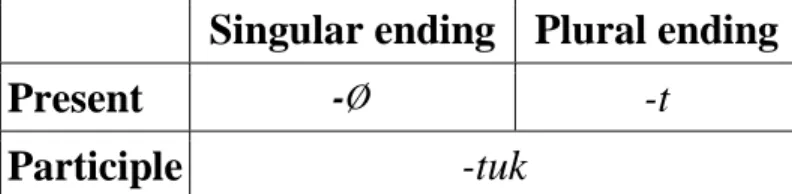
Nine tenses (which also include aspect and mood categories) have been described for modern Pipil (King 2012: 104), each one characterized by distinct suffixes. Only the present and the participle are listed in Table 5.
Table 5. Endings for the present and participle tenses. Source: Campbell (1985)
Singular ending Plural ending
Present
-Ø-t
Participle
-tuk
Non-possessed nouns in Pipil usually feature the absolutive suffixes -t or -ti, although many nouns have -Ø. Plurality in non-human nouns is usually marked by reduplication and in human nouns by suffixation. In Pipil, possession is expressed by means of the possessive prefixes in Table 6.
Table 6. Possessive prefixes in Pipil. Source: Campbell (1985)
Singular Possessor Plural Possessor
nu-
'my'
tu-
'our'
mu-
'your'
anmu-
'your'
i-
'his/her/its'
in-
'their'
A possessive prefix coreferences the possessor and agrees with it in number, as in (3)-(4).
(3) ne i-pelu ne takat
17 (4) ne in-kal ne taka-met
the 3PL.POSS-house the man-PL
“The house of the men”
2.2.6 Relational Nouns in SD Pipil
In Pipil, locative meaning is generally expressed by means of relational nouns, a term widely used in the Mesoamerican literature. Relational nouns behave like common nouns in that they take possessive prefixes that exist in corefence with the possessor, or the Ground in locative sentences, as can be seen in (5)-(6):
(5) ne mishti nemi tu-jpak
the cloud LOC 1PL.POSS-on ‘The cloud is over us’
(6) ne kwawit nemi i-nawak ne tiupan
18
CHAPTER 3: METHODOLOGY
3.1 Native Speakers
Linguistic fieldwork took place in Santo Domingo de Guzmán in August of 2013 with the collaboration of 4 Native Speaker Consultants (NCS), three females and one male. All of them were born in Santo Domingo de Guzmán, learned Pipil from their parents, and are bilingual in Spanish and Pipil. The youngest speaker, a woman, was 55 years old, while the oldest speaker, a man, was 83. With the exception of the oldest consultant, the informants were not fully proficient in writing and reading. The youngest consultant has worked as a Pipil teacher in the local school as part of the language revitalization program promoted by Universidad Don Bosco (Lemus 2008).
3.2 Stimuli
19
This picture series depicts several objects in a variety of spatial arrangements. In every image, one of the objects is highlighted in yellow. The objective is to elicit an utterance
describing the location of the highlighted object in terms of its relation with the non-highlighted objects in the image. The stimuli in the BowPed image series are numbered (see Appendix 3) and arranged in a random order (that is, contiguous stimuli for the most part depict very different spatial configurations). Each stimulus was printed onto an individual piece of paper, size A4.
The procedure for all elicitation sessions was as follows: first, native speakers were shown a given stimulus for 10 seconds. Then, stimulus still at hand, they were asked to identify the objects in each picture by answering the question asked in Pipil:
(7) tay ti-k-ita ka nikan
what 2SG.A-3SG.O-see at here ‘What do you see here?’
Once the objects in each picture were identified, consultants had to identify the position of the highlighted object in each image by answering the question:
(8) kan nemi ne X
where LOC the X ‘Where is the X?’
Where X stands for the name of the highlighted object in the image. All the responses by the native speaker were recorded and elicitation followed the original numerical order in the BowPed series. Not all BowPed images were used in this study, however, as some of the items portrayed were alien to the material culture of the consultants and a source of undesired
20
After eliciting utterances describing all items in BowPed, native speakers were given a 10-minute break followed by the next set of stimuli. In order to document frames of reference in SD Pipil, I used the images in the Ball and Chair picture series from the MesoSpace Field Manual by Jürgen Bohnemeyer (2008) (See Appendix 4 for a list of used images). As in the BowPed image series, stimuli in the Ball and Chair picture series were randomized and numbered, and they were presented to the native speakers in their original order, each one
printed in an individual piece of paper. The methodology used for this component of my research was very similar to that illustrated in (8): speakers were shown each stimulus for 10 seconds and asked to identify the position of the ball in terms of its relation with the chair by answering the question:
(9) kan nemi ne pelotaj
were LOC the ball ‘Where is the ball?’
Again, all the responses by the native speaker were recorded. Another 10-minute break followed this second series of questions. In order to disambiguate the semantics of some
relational nouns and define them with more precision, I used a combination of stimuli consisting of images from other sources, images created by me, and groups of real-life objects such as stones and griddles (see a list of these stimuli in Appendix 5). They were printed in individual pieces of paper. In this third round of questions, I showed each stimulus to speakers for 10 seconds and asked:
(10) ni-weli n-ina ka ne X nemi Y
21
Where X was the name of an object and Y was a locative predicate including one relational noun. The purpose of this methodology was to assess the situations in which speakers accepted the use of one relational noun with locative meaning and rejected the use of others. Elicitation sessions were recorded with a digital audio recorder.
In total, I used around 100 different visual stimuli and recorded around 395 utterances from the Pipil native speakers.
3.3 Pipil and Nahua Written Sources
Most of the examples used in this work were obtained first-hand during my fieldwork in the summer of 2013. However, it is important to list some of the most important Pipil written sources that are relevant to this study.
-The Pipil Language of El Salvador by Lyle Campbell, published in 1985, presents the results of his fieldwork in El Salvador during the 1970s. It includes a grammar sketch, an extensive Pipil-English-Spanish vocabulary, and some texts.
-Ne Tajtaketza Pal Ijtzalku (Schultze-Jena & King 2012) is a revised edition by Alan King of the most important work in the Pipil corpus: the texts on a wide array of topics that the German linguist Leonhard Schultze-Jena collected from Ynés Masin and other anonymous Pipil speakers in the Salvadoran municipality of Izalco in 1930. This text is only in Pipil.
22
CHAPTER 4: THE SEMANTIC DOMAIN OF SPACE
4. 1 Semantic Typology and Space
Semantic typology is the branch of linguistic typology that studies the vast diversity in expression of meaning across languages in order to find the underlying regularities and universal patterns within it. Compared with other typological studies in linguistics, such as phonological and syntactic typology, it has been a relatively neglected field. Pioneering works in semantic typology with comparative cross-linguistic approaches were in fact originally carried out by anthropologists and ethnobiologists studying kinship terminologies (Morgan 1997/1871), color terms (Berlin & Kay 1969), and taxonomical classifications of plants and animals in different languages.
Most modern works in semantic typology consider a given function in language (‘what are the terms for colors?’ for example) and asks how different languages satisfy it and by what formal means, with the goal of identifying patterns among them. As semantic typology has a cross-linguistic and comparative scope, it requires more control in the methodology used for data collection to allow for more precise comparisons across very different languages (Levinson & Wilkins 2006: xv).
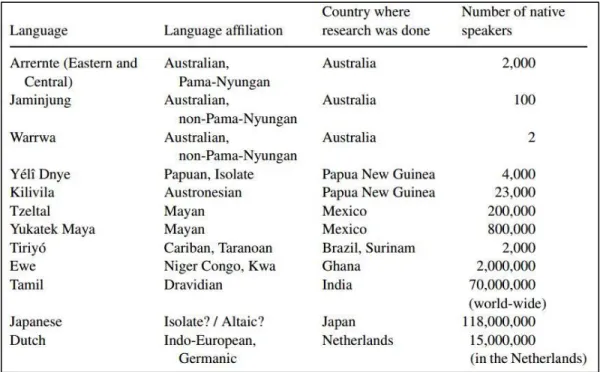
23
descriptions remained closely comparable, did fieldwork in 12 different languages (See Figure 3) guided by a very specific functional base or question: document how speakers of different
languages belonging to diverse language families around the world answer ‘Where’-questions.
Figure 3. Language sample in the space semantics study.
Source: Levinson & Wilkins (2006)
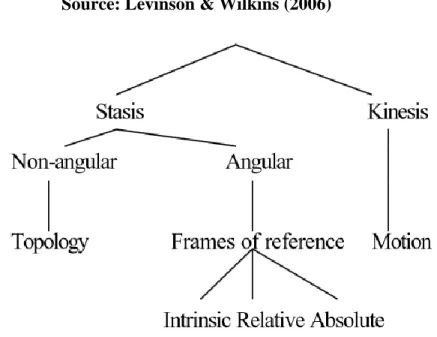
Upon analysis of the results, Levinson & Wilkins (2006: 3) proposed two main conceptual subdomains within the space domain (See Figure 4): stasis (pertaining spatial
24
Figure 4. Conceptual subdivisions of the spatial domain.
Source: Levinson & Wilkins (2006)
In this study, I will focus on the description of the stasis subdomain of the spatial domain in SD Pipil, comprising topology and frames of reference.
4.2 The Basic Locative Construction (BLC) and the BLC Hierarchy
Data comparability is a key issue in semantic typology. In order to ensure that the results from very different languages remained as closely comparable as possible, the team of linguists that worked on space semantic typology (Levinson & Wilkins 2006) parted from a common functional base: documenting how speakers of different languages answer ‘Where’-questions. This methodology determined the introduction of the Basic Locative Construction (BLC), a key concept for discussing the stasis subdomain in language.
The BLC has been defined as the most common sentence in response to a question of the form ‘Where is the X? As all human languages appear to have ‘Where’-questions, BLCs are very
25
introduced in linguistics by Talmy (1972: 11), known as the Figure and the Ground. The Figure is the entity situated with respect to another entity, known as the Ground (Talmy 2010: 311; Levinson & Wilkins 2006: 3).
Examples in (11)-(13) illustrate the BLCs used to describe three spatial configurations in Japanese (isolate), Tzeltal (Mayan), and Dutch (Indo-European), respectively:
(11) Japanese: ringo-wa booru-no naka-ni a-ru
apple-TOP bowl-GEN in-DAT be-PRS ‘The apple is in the bowl’ (Kita 2006: 439)
(12) Tzeltal: pachal-Ø ta ba mexa te ala baso-e
26
(13) Dutch: de ketting zit om de nek van de vrouw
the necklace sits around the neck of the woman
‘The necklace is around the neck of the woman’ (Staden, Bowerman & Verhelst 2006: 486)
One of the most important typological findings by Levinson and Wilkins (2006: 516), upon analysis of the data from the 12 languages in the sample, is that the BLC seems to be the preferred construction for describing certain spatial scenes in the BowPed image series, while other spatial scenarios tend to be described by using other contrastive types of constructions, such as resultative constructions that describe the position of the Figure rather as the result of the completion of an event. They found that scenes identified with a prototypical setting of a small, inanimate, independent, and manageable object in close proximity to a larger and immobile Ground object (such as a cup on a table or an apple in a bowl), were more likely to prompt a BLC from speakers(as those illustrated in (11)-(13)), while scenes deviating from this setting, especially those featuring an animate Ground, or those in which the Figure is strongly attached to the Ground (such as a ring on a finger, or a stamp on an envelope) were more likely to be
27
Levinson & Wilkins (2006: 519) argue that the degree to which speakers of a given language extend the use of the Basic Locative Construction to cover even non-prototypical situations is language-specific and works as an implicational hierarchy: “any language that uses the BLC for scene i will also use it for j, where i is higher in the scale than j” (Levinson &
Wilkins 2006: 514). The authors selected eight representative pictures from the BowPed image series (see Figure 5) that had maximal contrasts in contact/non-contact,
attachment/non-attachment, and Figure/Ground alternations to model how this cross-linguistic hierarchy worked in different languages (Figure 6).
Figure 5. Cardinal scenes for the BLC hierarchy.
28
Figure 6. Implicational BLC hierarchy across topological space.
Source: Levinson & Wilkins (2006)
In Japanese, for example, speakers would use the BLC to describe only the prototypical core-scenes in the hierarchy (Cup on table, Fruit in bowl, Lamp over Table, Ball under Chair); all scenes of adhesion and beyond would be described using alternate constructions (Kita 2006: 474). In contrast, Tzeltal speakers use the BLC to cover all scenes up to Figure-Pierced
situations, and use other constructions for spatial scenes higher in the scale (Levinson & Wilkins 2006: 558). On the other extreme, languages like English or Dutch (Staden, Bowerman &
Verhelst 2006: 486), can apply their BLCs to describe all the situations in the scale.
4.3 Typology of Locative Predicates
Languages differ greatly in the structure of their BLCs. However, building from the data in Levinson & Wilkins (2006), Ameka and Levinson (2007: 863) argue that locative predicates can be classified into four main categories according to the morphosyntactic elements in them, proposing the following typology of locative predicates:
Figure 7. Four basic types of locative predication in an unmarked locative statement.
Source: Ameka & Levinson (2007)
Type 0 No verb in basic locative construction: Saliba.
Type I Single locative verb (or suppletion under grammatical conditioning): Type Ia: Copula (dummy verb used in many other constructions): English,
29
Type Ib: Locative (+Existential) verb: Japanese, Yukatek.
Type II A small contrastive set of locative verbs (3–7 verbs): Arrernte, Dutch.
Type III Multiverb positional verbs (a large set of dispositional verbs, 9–100): Tzeltal, Zapotec, German, Laz, Likpe.
The different categories of the Ameka & Levinson typology of spatial predicates are illustrated in (14)-(22).
Saliba (Austronesian) is a Type 0 language (no verb in its BLC). The generic postposition
unai is only inflected for the number of the Figure in the sentence:
(14) Saliba: kaputi-wa iya ede tebolo-ne unai
cup-TOP 3SG PRSUP table-DET POSTP.SG
‘The cup, it is on the table’ (Dunn, Margetts, Meira & Terril 2007: 875)
30
(15) French: la tasse est sur la table
DEF.FEM cup is on DEF.FEM table ‘The cup is on the table’ (Fortis 2010: 1)
Type Ib languages feature a single locative verb in their BLCs. Some languages feature more than one locative verb and their usage is determined by grammatical categories. For example, Japanese (isolate) features two locative verbs in its BLC: i-ru for animate Figures and
a-ru for inanimate ones:
(16) Japanese: ringo-wa booru-no naka-ni a-ru
apple-TOP bowl-GEN in-DAT be-PRS ‘The apple is in the bowl’ (Kita 2006: 439)
31
as ‘stand,’ ‘sit,’ and ‘lie’ (although less anthropomorphic positionals such as ‘hang’ are also
common). The choice of a given locative verb in a locative construction depends on the abstract geometrical properties and the orientation of the long axis of the Figure object (which is also the subject of the verb): ‘stand’ is used when the long axis is vertical, ‘lie’ is used when the long axis is horizontal, ‘sit’ is used when there is no major axis, and ‘hang’ is used when Figures are not supported from below. Languages in this category sometimes feature a general locative verb that can be used if more specific positionals are not relevant or when dealing with abstract nominals and large scale space location (Ameka & Levinson 2007: 858). The use of these locative
positional verbs in Dutch (Indo-European), describing scenarios in the BowPed series, is illustrated in (17)-(19):
(17) Dutch: het kopje staat op de tafel
the cup.DIM stands on the table
32
(18) Dutch: de postzegel zit op de envelop
the stamp sits on the envelope
‘The stamp is (sits) on the envelope’ (Staden, Bowerman & Verhelst 2006: 486)
(19) Dutch: de lamp hangt boven de tafel
the lamp hangs above the table
‘The lamp is (hangs) above the table’ (Staden, Bowerman & Verhelst 2006: 487)
Languages belonging to Type III in the Ameka & Levinson typology feature a very large number of locative positional verbs in their BLCs. Tzeltal (Mayan), for example, has 200
33 (20) Tzeltal: pachal-ø ta setz’ baso
bowl.sitting-3A PREP plate cup
‘The cup is sitting at (i.e. on) the plate’ (Brown 2006: 247)
(21) Tzeltal: kajal-ø ta s-ba na (te winik-e)
mounted.on-3A PREP 3E-top house (ART-man-CL) ‘He (the man) is on top of the house’ (Brown 2006: 247)
(22) Tzeltal: tekel-ø ta s-tz’eel eskwela te’
standing.tree-3A PREP 3E-side school tree
34
4.4 The Elements of Locative Predicates
Grinevald (2006: 8) has detailed the morpho-syntactic elements that can be found in BLCs across languages as follows:
Figure 8. Inventory of morpho-syntactic elements of Basic Locative Constructions.
Source: Grinevald (2006)14
FIGURE SPATIAL RELATION GROUND
Noun Phrase (NP) LOCATIVE PREDICATE ADPOSITION NP -SIMPLE LOCATIVE PREDICATES locative verbs posture verbs positionals -SATELLITES preverbs verbal particules directionals -BI-PARTITE STEMS
The Figure and Ground elements in Grinevald’s inventory refer to the two essential cognitive functions in space description first introduced in linguistics by Talmy (1972: 11). Simply put, the Figure is the entity situated with respect to another entity, known as the Ground (Talmy 2010: 311; Levinson & Wilkins 2006: 3). The Spatial Relation element features a locative predicate and adpositions, a category that includes prepositions and postpositions, as well as case endings and relational nouns (Grinevald 2006: 9). Verbs of the kind ‘sit,’ ‘stand,’ ‘squat,’ and ‘hang’ are called positional verbs. Ameka and Levinson (2007: 854) hypothesize
that languages that rely on very developed positional verb systems for spatial location (those belonging to Type III in their typology, such as Tzeltal) tend to feature weak directional
35
specifications: for instance Tzeltal features only one preposition. On the other hand, languages with extensive adpositional systems tend to be less dependent on positional verbs.
36
CHAPTER 5: THE TOPOLOGY SUB-DOMAIN IN SD PIPIL:
THE BASIC LOCATIVE CONSTRUCTION
5.1 BLC in SD Pipil in Typological Perspective
As attested during fieldwork, the BLC template in SD Pipil, in its unmarked word order, is as follows:
Figure 9. BLC in SD Pipil15
FIGURE SPATIAL RELATION GROUND
NP
nemi
+(Positional Verb)+(
ka
)+Relational Noun NP
In SD Pipil, a locative predicate consists of the obligatory locative verb nemi ‘to be, to exist,’an optional positional verb in the participle from, an optional preposition ka, and an
obligatory adposition, which is usually a relational noun and sometimes a preposition with locative meaning. The BLC in Pipil is illustrated in (23)-(24):
37
(23) ne tasaj nemi i-jpak ne patznaj wan ij-ikshi
the cup LOC 3POSS-on the plank with REDUP-leg ‘The cup is on the table’
(24) ne konejoj nemi mu-es-tuk ijtik ne jawlaj
the rabbit LOC REFL-sit-PART inside the cage ‘The rabbit is sitting inside the cage’
The optional use of the preposition ka before a relational noun with locative meaning, see (25), was already documented by Campbell (1985: 60). He defines ka as meaning ‘to, in, at,
where, where?’ (Campbell 1985: 257). This preposition is also used in temporal constructions
(King 2012: 80), as in (26). King argues that there are not any differences in meaning between constructions with ka and without ka, and considers them to be basically synonyms (King 2012: 80). It is interesting to note that only the male native speaker consultant, the oldest one, made extensive use of this construction and that the preposition ka only co-occurred with relational nouns having a possessive prefix, never with a preposition or forms without the possessive prefixes (see section 5.4).
(25) ne pelotaj nemi ka itan ne siyaj
38 (26) nemanha ka tayua asi-k ne seuk
later at night arrive-PRET the other
‘Later at night, the other (man) arrived’ (Schultze-Jena & King 2012: 147)
Upon inspection of the BLC in SD Pipil, we can draw a few typological conclusions. SD Pipil is a Type Ib language in the Ameka & Levinson typology of locative predicates, identified as the least common type of locative predication among world languages (Ameka & Levinson 2007: 856); namely, it features a single locative verb nemi in locative constructions. It must be noted, however, that the functions of nemi seem to exceed the defining characteristic of locative verbs in Type Ib languages, namely that they appear only in locative predicates; indeed, nemi
also functions as an auxiliary verb in progressive constructions such as (29). Nevertheless, I consider that there is enough evidence to classify SD Pipil as a Ib rather than a Type Ia language, which feature a copula that is used in BLCs and many other types of construction, as French or English.
First, the verb nemi is not used as a copula in equative sentences (Campbell 1985: 111); instead, the person prefixes (see Table 4) are attached to nouns and adjectives, as seen in (27). Second, the verb nemi in SD Pipil functions additionally as an existential verb, a function that has been found to be cross-linguistically characteristic of locative verbs in Type Ib languages such as Japanese (Kita 2006: 439), Yukatek Maya (Bohnemeyer & Stolz 2006: 290) and Ewe (Ameka & Essegbey 2006: 372); this is illustrated in (28). Finally, as an auxiliary in progressive constructions, nemi functions as an aspect marker and not as a copula.
(27) naja ni-siwat
39
(28) nemi miak kwaj-kwawit Ø-ki-cha-t in-takil.
EXIST many REDP-tree 3A-3O-make-PL 3PL.POSS-fruit ‘There are many trees that bear fruit’ (Schultze-Jena & King 2012: 21)
(29) nemi ni-takwa
PROG 1SG-eat
‘I am eating (Campbell 1987: 272)
Although the most common constituent order in the BLC in SD Pipil is the one already discussed, it should be noted that displacements such as the one in (30), where the adposition and Ground are taken to the beginning of the sentence, are possible and common. These seem to be pragmatically motivated.
(30) i-tajku ne kulal nemi ne kal
3POSS-middle the pen LOC the house ‘In the middle of the pen is the house’
5.2 BLCs in other Nahua Languages
There are no specialized studies on spatial language in other Nahua languages, making a comparative study difficult. However, scattered information in grammars of Classical Nahuatl, the language spoken by the Aztecs and the oldest attested relative of Pipil, provides insight into the particularities of spatial predication in this language and offer valuable evidence of a very different strategy to convey static spatial meaning:
40
Spanish ‘estar’). The verb ca'16 is used for general location. The choice of the other three,
i'cac, onon, and mani, depends on the shape and nature of the subject as viewed in the Nahuatl world.” (Sullivan 1988: 189)
The use of the general locative verb ca' in Classical Nahuatl is illustrated in (31):
(31) ōmpa ilhuica-c ca-te' in cī-citlāl-tin
there sky-at LOC-PL LNK REDUP-star-PL ‘Stars are there in the sky’ (Launey 1992: 116)
The locative verb i'cac ‘to be standing’ is applied to long things that are usually erect
such as sticks, trees, and columns:
(32) i-cpac i'cac in yehuatl in cuauhtli
3POSS-on LOC.to be standing LNK 3SG LNK eagle ‘An eagle is (standing) on it (i.e.: a cactus)’ (Sullivan 1988: 194)
The verb mani ‘to be extended’is applied to flat objects, such as books, blankets and paper, as well as to calm water, houses, and cities. According to Sullivan (1988: 197), it denotes ‘calmness, tranquility, and lastingness.’
(33) tezcatl i-cpac mani
mirror 3POSS-on LOC.to be extended
‘A mirror is (extended) on its head’ (Sullivan 1988: 199)
The verb onoc ‘to be lying down, stretched out, or seated’ was applied to long objects
extended on the floor, such as planks, trunks, sticks, and plants, as well as to inhabitants of a place. Sullivan (1988: 195) argues that the basic meaning of the verb is ‘to be on the ground’:
41
(34) auh in oncan ono-ca in i-teopan
and LNK there LOC.to be seated-PAST LNK 3POSS-temple ‘And there was (sitting) his temple’ (Sullivan 1988: 197)
I argue that this data provide strong evidence that Classical Nahuatl belonged to a different category than SD Pipil in the Ameka & Levinson typology of locative predicates. Indeed, Classical Nahuatl seems to show all the traits of a prototypical Type II language, characterized by using small and contrastive sets of posture verbs in its BLC determined by the shape and posture of the Figure in a spatial configuration. The Classical Nahuatl system of locative verbs consisting of i'cac ‘to be standing,’ onon ‘to be siting, lying,’ and mani ‘to be
extending’ plus the verb for general location ca' is certainly similar to that found in Dutchas illustrated in (17)-(19).
Additionally, David Tuggy (personal communication, March 18, 2014), a specialist in two modern Mexican varieties of Nahua, Tetelcingo Nahuatl, spoken in the state of Morelos, in South-Central Mexico (Tuggy 1979: 5), and Orizaba Nahuatl, spoken in the state of Veracruz, in Eastern Mexico (Tuggy 1991: 1), informed me that a similar system of contrastive locative verbs is also used in these two Nahua varieties.
In Tetelcingo Nahuatl, the general locative verb is ika, often used in combination with locatives, as in ipan-ka ‘to be in.’ In Orizaba Nahuatl, the general locative verb is kahki. However, in the two languages, other verbs can be used in some circumstances: kā ‘to be seated’ is used in Tetelcingo and Orizaba, ihkatok ‘to be standing’ and ilōt k ‘to be hanging’
are locative verbs used in Orizaba, while pilkatika ‘to be hanging’ is used in Tetelcingo. It must
42
in languages belonging to Type II in the Ameka & Levinson typology of locative predicates (2007: 858).
Although more data from other Nahua varieties is needed before making stronger claims, the available information suggests that at least some Nahua varieties, extinct and modern, belong to Type II in the typology of locative predication. This finding, in turn, brings forth the question as to why SD Pipil uses such a different strategy of locative predication (namely, the use of only one locative verb in locative constructions). I argue in 5.4 that the influence of Spanish can be considered as a powerful candidate behind this development.
5.3 BLC Hierarchy in SD Pipil
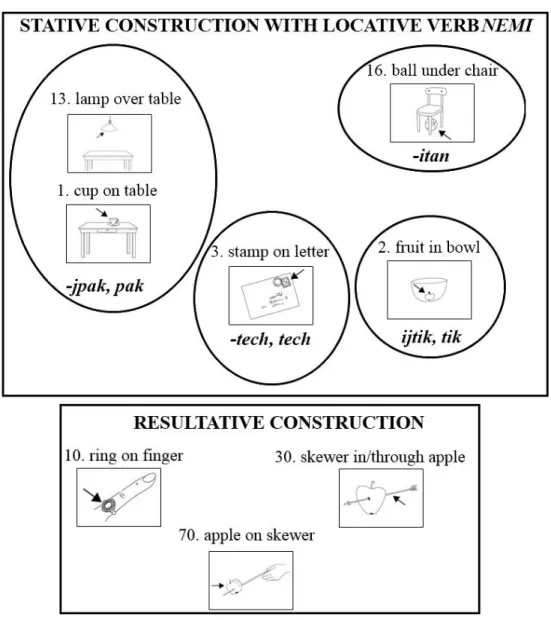
My fieldwork in SD Pipil yielded results that are in agreement with the BLC hierarchy proposed by Levinson & Wilkins (2006) and discussed in section 4.2; that is, SD Pipil speakers would consistently use the BLC to describe a certain group of situations (those that include the Core and Adhesion scenes. See Figure 6 in section 4.2) and use alternate constructions, similar to (35), for those in higher positions in the hierarchy:
(35) ne mapipil ki-pia ne anilloj
43 This is illustrated in the following topolocial map:
Figure 10. Topolocial ‘map’ for SD Pipil
5.4 Relational Nouns, Prepositions and Spanish Influence in BLCs
As seen in section 2.2.6, locative meaning in SD Pipil is expressed by means of relational nouns. Relational nouns in Pipil take possessive prefixes that exist in coreference with the
44
instance, the possessive prefix i- of the relational noun -tech has been dropped, and in (37), not only is the possessive prefix i- missing, but also the glottal fricative of the relational noun -jpak:
(36) ne pelu nemi tech ne i-kal
the dog LOC near the 3POSS-house ‘The dog is near its house’
(37) ne takat nemi pak ne kal
the man LOC on the house ‘The man is on the house’
Out of 347 elicited sentences featuring relational nouns, 29% of them feature relational nouns without possessive prefixes. Relational nouns -tech ‘on, near’ and -jpak ‘on, above’ show the highest percentage of occurrence without prefixes: 45% of the times -tech was shortened to
tech and 55% of the times -ijpak was pronounced as pak. These forms were particularly common among female NSCs and its occurrence was not predictable: speakers would use the form without a prefix in one sentence and the full relational noun in others. On the other hand, the only male consultant expressed that relational nouns without possessive prefixes should be considered ungrammatical.
This situation has already been described by Campbell (1987: 269), who interprets it as evidence that, influenced by Spanish, relational nouns in modern Pipil are undergoing
45
The development of prepositions out of relational nouns in Pipil is the latest innovation in the interesting history of locatives in Nahua languages, in which three main stages can be
identified. Proto-Uto-Aztecan (PUA), the reconstructed common ancestor of all Uto-Aztecan languages (see Figure 2), was predominantly postpositional and all reconstructed locatives are indeed bound postpositions that are attached to nouns of pronominal elements (Langacker 1977: 94), as in the PUA postposition *-pa(-na) ‘on.’ In a second stage, Nahua languages, which
underwent extensive innovations due to contact with neighboring Mesoamerican languages (a process known as Mesoamericanization), acquired, among other things, the basic Mesoamerican pattern of locative relational nouns and for the most part abandoned the original PUA system of locative postpositions (Campbell 1987: 268), explained in 2.2.6 and illustrated in (5)-(6). Finally, in a change determined by intensive contact with Spanish, a fundamentally prepositional
language, Pipil and other Nahua languages (Flores 2008) have started to develop prepositions from the original Proto-Nahuatl relational nouns. This chain of changes is clearly illustrated in the history of the reconstructed PUA locative postposition *-kupa ‘in,’ which derived into the locative relational noun *-ɨkpak ‘in, on’ in Proto-Nahuatl (Dakin 1982: 120), and finally derived into the pure locative preposition pak ‘on, above’ in Pipil and all its dialects (Campbell 1987:
269).
Besides determining the development of true preposition from relational nouns, I
consider that there is enough evidence to support the claim that Spanish has influenced the very construction of locative predicates in SD Pipil. This argument is based on 1) traces of verbal locative roots in SD Pipil and 2) the nature and function of the verb nemi.
46
whereas these three varieties belong to Type II, SD Pipil belongs to Type Ib, the same as Spanish (Fortis 2010: 2). However, the existence of remnants in Pipil of the verbal locative roots found in Classical, Tetelcingo, and Orizaba Nahuatl suggest that locative predication in Pipil could have been similar in the past to that of these other varieties. As an illustration, Campbell (1985:222) documents ijkatuk ‘standing,’ a defective verb found only in the participle in SD Pipil, and a
variation ejkatuk is also found in numerous occasions in the Tajtaketza pal Ijtzalku (Schultze-Jena & King 2012). These forms are clearly cognates with the locative verbs ihkatok ‘to be
standing’ in Tetelcingo and Orizaba Nahuatl and i'cac ‘to be standing’ in Classical Nahuatl.
During my fieldwork, I found that theform ejkatuk is used only as an optional posture verb (which are always in the participle form) in spatial predicates, unlike the verb nemi, which is mandatory. This use is illustrated in (38):
(38) ne takat nemi ejka-tuk i-jpak ne kal
the man LOC to stand-PART 3POSS-on the house ‘The man is standing on the house’
47
respectively is found in Pipil katka, now an imperfective aspect particle in tense-aspect constructions (Campbell 1985: 272):
(39) ni-tumawak katka
1SG-fat used to ‘I used to be fat’
The Classical Nahuatl locative verb mani ‘to be extending’has a cognate in SD Pipil in the transitive verb -mana ‘to cook, to boil’ (Campbell 1985: 334)17. I have not found any cognate form of the Classical Nahuatl verb onoc ‘to be siting, lying’ in modern Pipil.
Another stronger argument is produced when we consider the nature and functions of the verb nemi in modern Pipil. It has been already noted that the verb nemi in Pipil shows
considerable Spanish influence in its functions (Campbell 1987: 272). While in other Nahua languages the verb nemi means simply ‘to live,’ in modern Pipil its meaning has been glossed rather as ‘to be, to exist’ (King 2012: 200; Campbell 1985: 365), and it functions have come to closely mirror those of the verb estar ‘to be’in Spanish. For instance, nemi is used as an
auxiliary in progressive constructions much in the same way as the verb estar in Spanish, a usage that is not found in other Nahua varieties (Campbell 1987: 272)18 . Compare, as illustration, the progressive clause in Pipil in (29) with its Spanish equivalent in (40):
17However striking, the cognate status of these forms is demonstrable. A very Uto-Aztecan trait found in Nahua languages is the existence of many pairs of intransitive/transitive verbs marked by the alternation of the vowels -i
and -a suffixed to certain verbal roots(Stubbs 2010). Hence the Classical Nahuatl pair mani ‘to be extended’ and -mana ‘to extend, put something on the floor.’ This last form -mana could also mean ‘to make tortillas’ in Classical
Nahuatl (Campbell 1985: 334), undoubtedly a cognate of Pipil -mana ‘to cook, to boil,’ the result of metonymy and
semantic widening.
48 (40) estoy com-iendo
1SG.be eat-GERUN ‘I am eating’
Moreover, the verb nemi in its locative function also closely parallels the use of estar in locative constructions in Spanish: “in sentences meaning 'to be + location,’ where Spanish requires estar (not ser) 'to be,’ Pipil always requires nemi (never ∅ copula), showing the influence of the Spanish construction” (Campbell 1987: 272). Indeed, it could be said that the very structure of the BLC in SD Pipil mirrors the BLC in Spanish, not only in the order of the elements, but in the form requirements for the positional verbs, which must always be in the perfect participle. Compare, for instance, the locative predicate in SD Pipil in (41), found during fieldwork, with an example of the very similar Spanish BLC in (42):
(41) ne tukat nemi saluj-tuk tech ne tapepechul
the spider LOC stick-PART on the wall ‘The spider is stuck to the wall’
(42) el teléfono está pega-do a la pared
the telephone LOC stick-PART to the wall
49
I argue that the use of a sole locative verb in the BLC in SD Pipil, as well as the syntax and tense requirements of the optional positional verbs, show that spatial predication in SD Pipil has been heavily influenced by Spanish, a language in which there is also only one locative verb
estar ‘to be’ and optional positional verbs must be in the participle. However, to strengthen this
claim, it will be necessary to compare locative predicates in other Nahua varieties with a typological approach.
5.5 Positional Verbs
Overall, the use of positional verbs in SD Pipil agrees with the typological hypothesis by Ameka and Levinson. SD Pipil, featuring a fairly developed system of locative adpositions, does not require the use of positional verbs: only 82 or 21% of the elicited sentences feature a
positional verb in the participle. However, I could attest that some relational nouns, especially
-tech ‘on, near,’ do seem to prefer positional verbs more than others, as will be seen in the