Mission accomplished?
A study of the successfulness of the EU CSDP missions EUPM
Bosnia-Herzegovina, EUPOL Afghanistan & EUJUST LEX-Iraq
Kirsten Floris (s1940996)
Master Thesis Crisis and Security Management Supervisor: Prof. dr. Dimitrova
2
Abstract
The European Common Security and Defense Policy (CSDP) gives the European Union the ability to start military and civil missions around the world. Since the start in 2003 the EU started 36 different CSDP missions, of which 18 are still ongoing at time of writing. The high number of finished and ongoing missions calls for a study into the relevance of indicating whether this policy also delivers successful missions.
The purpose of this research is to indicate whether the EUPM mission in
Bosnia-Herzegovina, the EUPOL mission in Afghanistan and the EUJUST LEX mission in Iraq have been successful. The first part of the research provides a brief insight into the genesis and practices of the CSDP. It introduces a theoretical framework which discusses several indicators which can determine the successfulness of a military mission. The framework that is used is the Military Conflict Management Model by Peen Rodt (2011). This framework delivers four indicators of success: internal and external appropriateness, and internal and external goal attainment. Still this framework was developed to assess the successfulness of military missions, this research will apply the framework to non-military missions in order to investigate the use in other missions.
3
Table of contents
1. Introduction ... 5
1.1 Method and approach ... 6
1.2 Academic relevance ... 7
1.3 Societal relevance ... 8
1.4 Reading guide ... 8
2. The European Common Security and Defense Policy ... 9
3. Theoretical framework ... 14
3.1 Criteria of success ... 14
3.2 Military Conflict Management Model ... 18
3.3 The assessment of success ... 20
3.4 Conclusion ... 21
4. Method and approach ... 22
4.1 Units of analysis ... 22
4.2 Operationalization into concepts, definitions and indicators ... 23
4.3 Methods of data collection ... 23
4.4 Reliability ... 24
4.5 Pitfalls research design and data gathering ... 24
5. EUPM Bosnia-Herzegovina ... 25
5.1 The mission ... 25
5.2 Analysis... 27
5.3 Conclusion ... 32
6. EUPOL Afghanistan ... 34
6.1 The mission ... 34
6.2 Analysis... 36
6.3 Conclusion ... 41
7. EUJUST LEX-Iraq ... 43
7.1 The mission………..………46
7.2 Analysis... 44
7.3 Conclusion ... 48
8. Conclusion ... 50
8.1 The missions successes ... 50
8.2 Limitations of the research and avenues for future research ... 52
8.3 Policy recommendations ... 53
4
List of abbreviations
ANP Afghan National Police
BiH Bosnia-Herzegovina
CFSP Common Foreign and Security Policy CSDP Common Security and Defense Policy
EU European Union
ESDP European Security and Defense Policy ESDI European Security and Defense Identity EUISS European Union Institute for Security Studies EEAS European External Action Service
EUNAVFORMED European Union Naval Force Mediterranean (Operation Sophia) EUPOL European Union Police Mission in Afghanistan
EUPM European Union Police Mission in Bosnia-Herzegovina EUJUST LEX-Iraq European Union Integrated Rule of Law Mission for Iraq NATO North Atlantic Treaty Organization
US United States of America
UK United Kingdom
5
1. Introduction
The ongoing conflicts in Ukraine, Syria, Libya, Iraq and Yemen, a major refugee crisis and the need for a concerted humanitarian response are some of the complex security issues the European Union (EU) is currently facing. This has led to a fundamentally changed strategic environment of the EU over recent years. Moreover it has triggered and developed the idea that a safer EU can be resolved by security and defense cooperation (European Movement, 2016).
In the last couple of years, the EU has become a more relevant security actor because the meaning of security itself and the linked international security governance structures have changed significantly. As a response this has led to European governments contributing more actively to international crisis management operations. Consequently, European governments have developed a complex and intertwined institutional architecture in the policy domain that focusses on crisis management (Hofmann, 2011).
According to Hofmann (2011) various institutional expressions of European security policy, as well as their inter-relationships, are contested. However they all attempt to deliver security, the coordination of and cooperation between the institutions is difficult. The European
security institutional environment shaped the creation and development of the Common Security and Defense Policy (CSDP) (Hofmann, 2011).
The European Security and Defense Policy (ESDP) was developed by the European Union in 1998. The aim of this policy is to enable the EU to take a leading role in peace-keeping operations, conflict prevention and in the strengthening of the international security (European Union External Action, 2018). The name of ESDP changed into the Common Security and Defense Policy (CSDP) in 2009 as a result of the Lisbon Treaty (Howorth, 2007). As the European Union (2018, p.1) explains, the CSDP is an “integral part of the EU's comprehensive approach towards crisis management, drawing on civilian and military
assets”. Since the development of this policy the Union has started several civil and military missions, in three different continents: Europe, Asia and Africa (European Union External Action, 20161).
6
Institute for Security Studies (EUISS) (2017, p.1) are “overambitious (and often too Western model-driven) mandates, fluctuating support from member states over time, weak local buy-in, difficult coordination with other international and local partners, lack of insertion into a broader EU strategy, and a gap between what these missions bring and what the country actually needs or wants”. In addition they point out that the size of the CSDP missions makes it difficult to generate a significant impact (EUISS, 2017, p.1).
Although many military missions have started since the development of the CSDP, not much has been written about the effectiveness or successfulness of the CSDP missions (in academic literature). Scholars have mostly written about various other aspects of CSDP, for example the genesis of the CSDP, their operational planning and institutional set-up and the
relationship between the CSDP and the NATO (Zarembo, 2017). An example of a scholar who has written about the successfulness of military missions is Peen Rodt (2011), who focused specifically on the evaluation of the success of the crisis management operations, and developed the Military Conflict Management model.
The goal of this research is to assess the success of three military and civil operations that were finished before 2018 from the EU’s CSDP. This research analyses whether these operations were successful or not on the basis of the Military Conflict Management model of Peen Rodt (2011). Although Peen Rodt’s (2011) theory is developed for the evaluation of military CSDP missions, in this research the theory will be applied to police and rule of law missions. The objective of this study is to explore whether the success indicators of the military missions also can be applied to non-military missions. Therefore the following research question is developed:
To what extent have the EU’s Common Security and Defense Policy operations EUPM
Bosnia-Herzegovina, EUPOL Afghanistan and EUJUST LEX-Iraq been successful, and is the
Military Conflict Management model by Peen Rodt (2011) applicable to non-military
missions?
1.1 Method and approach
7
chapter they are operationalized. The cases that are researched are two police missions, EUPOL in Afghanistan and EUPM in Bosnia Herzegovina, and a rule of law mission in Iraq (EUJUST LEX-Iraq).
This research is a deductive research, which explores a known theory or phenomenon and tests if that theory is valid in given circumstances (Pellisier, 2008). The internal validity and reliability of this research may be influenced by the researcher’s personal bias and by the interpretation of documents and data. The causality of the policy and the potential effects is also something to take into consideration. Other effective and successful policies/actions also influence the successfulness of the CSDP operations. It might be possible the mandate of a mission has been achieved, but is not directly (or fully) the result of the mission’s actions. This could influence the internal validity.
The generalizability, and therefore the external validity, of the research is low, because the research only focuses on three CSDP operations. However, similar pitfalls or success factors can be identified in these three cases which could increase the external validity of the
research. Future research into more CSDP operations could also increase the external validity. For this research it is difficult to generalize findings and make these findings applicable to other cases or policies.
1.2 Academic relevance
This research is academically relevant because a lot has been written about the CSDP and the EU’s crisis management operations in literature, but there is not a lot of research into the successes of these CSDP operations. As mentioned before, Peen Rodt (2011) is one of the few scholars that researched the success of a military operation. In her research, Peen Rodt (2011) created the Military Conflict Management model to assess the success of these EU operations and used this model to research the success of three operations between 2003-2010. After 2010, the EU started and finished new operations. Therefore this research will focus on researching the success of three operations that finished between 2010 and 2018. The research seeks to make a contribution to the debate about the CDSP and the
8
1.3 Societal relevance
Recently, one of the EU’s military missions (EUNAFOR MED) dealt with a lot of criticism. The mission EUNAFOR MED, better known as Operation Sophia, has the objective to fight against human smuggling and trafficking in the Southern Central Mediterranean and aims to prevent further loss of life at sea (EUNAVFOR MED, 2016). Operation Sophia, which was launched in 2015, had little effect in deterring migration. It may even have led to higher death tolls on the Mediterranean Sea and to an increase of 18 percent of migrants crossing the sea to Europe (The Independent, 2017). Despite the findings of the UK’s EU External Affairs Committee and the criticism from several organizations like Amnesty International,
Operation Sophia’s mandate was extended until the end of 2018 (European Council, 2017). These recent discussions on EU military mission makes this research about the
(non)successes of past military missions socially relevant. Since there is a lot of discussion about current missions, a positive or negative evaluation of the success of past military operations could influence this discussion. Also, this research will highlight ways to evaluate EU operations, which could impact EU decision making and implementation of the Common Defense and Security Policy (CSDP).
1.4 Reading guide
The next chapter elaborates more on the history and creations the Common Security and Defense Policy. After this, chapter three explains the theoretical basis of the research, discusses general findings of success indicators of missions, and introduces the theory that is used to assess success of the CSDP operations: the Military Conflict Management model by Peen Rodt (2011).
9
2. The European Common Security and Defense Policy
This chapter will briefly outline the genesis of the European Common Defense and Security Policy (CSDP) and its practices. As the cases that will be analyzed within this research arise from this policy, this chapter can put the missions into the context of the CSDP.
After the Second World War various European countries were dreaming of European defense and security arrangements, based on the observation that nation-states had been the primary cause of destruction and suffering over the last decades (Duke, 2002). West European countries, and in particular the United Kingdom and France, believed that European stability could only be assured with the assistance of the United States of America. This resulted, besides smaller European self-defense treaties, in the ratification of the Washington Treaty in 1949, founding the North Atlantic Treaty Organization (NATO) which supposed to defend the West from communist threats (Duke, 2002). When the Cold War ended in the early 90’s, it brought a new dynamic into European security. The immediate threat of a nuclear attack or armed conventional had faded away with the dissolution of the Warsaw Treaty and the Soviet Union (Duke, 2002). This created a new security environment. Previous attempts, during the Cold War, to form a variety of European defense or security bodies were generally
10
matters. From 1990 onwards, several proposals for a common security and foreign policy were made, mainly caused by the growing role of the U.S. These proposals called for a “new security architecture for a new era” and the ambiguity that came with this statement (Duke, 2002). There were concerns that this would lead to a ‘European only’ security and defense unity and that European security would polarize between those who were in favor of more autonomous European powers (mostly France and Germany) of those who were supporting a more active U.S. contribution in Europe. The United Kingdom was one country that had these concerns. Despite these concerns, a first attempt for an European security and defense unity was made: the European Security and Defense Identity (ESDI). The ESDI “would have an important role to play in enhancing the Allies’ ability to work together in the common the defense” (Trifunovska, 1996, p.287). This meant that the ESDI was intended to allow
European forces, in crisis situations with no or little interest of the U.S., to borrow American military assets via NATO (Howorth, 2007). As storm clouds mustered around the EU’s close neighbors, such as the Caucasus and Baltics, and the U.S. was preoccupied elsewhere, the EU had little choice but to take responsibility for the security of its hinterlands (Howorth, 2007). Therefore, ESDI developed into the European Security and Defense Policy (ESDP).
The Saint Malo Declaration was signed by France and the United Kingdom in December 1998 in order to advance the creation of the ESDP. The Declaration was seen as
revolutionary and initiated a new political process and a substantial new policy area in the European Union (Howorth, 2007). In the Declaration, a reference was made of the gradual emergence of a European military force that would be capable of autonomous action (Duke, 2002). The Declaration also stated that the EU should be given appropriate structures to take decisions and to implement these. Finally, it noted that credible military forces and the means to decide to use these forces should be developed, which could be seen as a major revolution in European military policy as this gave the EU a new role (Howorth, 2007). This new approach was rapidly called the European Security and Defense Policy (ESDP). The main goal of the European member states was to “engage in international crisis management to effectively counter external threats to European security” (Asseburg & Kempin, 2011, p.179). The EU established the necessary structures that military and civil capabilities require, to deploy the stabilization of missions and operations to different crisis spots throughout the world (Asseburg & Kempin, 2011).
11
ultimate nature and purpose of the policy (Bickerton, Irondelle & Menon, 2010). At the time of writing the Saint-Malo Declaration there was a ‘constructive misunderstanding’ between the French and British governments on two aspects of the policy (Howorth, 2003). First, there was a disagreement about the meaning of the term ‘autonomy’ and what it implicated for the relationship between the EU and NATO. Secondly, both countries saw the ESDP as a
different tool. France saw the policy as a tool to further establish the construction of
European politics, while the British saw it as an instatement which was designed to improve European military capabilities which could revitalize NATO (Howorth, 2003). Because of these underlying tensions, the ESDP evolved rapidly from its inception. As the ESDP was intended to secure peace in Europe and would provide Europeans with the military capacity to manage large scale operations in the EU’s neighboring countries, it soon became as Javier Solana (2007) explained, “about being a peace-builder in the rest of the world” (Bailes, 2008).
The Petersberg tasks were an integral part of the ESDP and defined the spectrum of military actions that the EU could undertake in crisis management operations. The Petersberg tasks were already agreed upon in 1992 by the Western European Union (WEU) Council of Ministers. The tasks integrated into the EU in 1997 (European Union External Action, 20162). The three purposes for which military units could be deployed were: humanitarian and rescue tasks, peacekeeping tasks, and tasks of combat forces in crisis management, including peace making (European Union External Action, 20162).
The Treaty of Lisbon in 2009 further expanded the Petersberg tasks in order to also include extra tasks, such as: joint disarmament operations, military advice and assistance tasks, and post-conflict stabilisation tasks (European Union External Action, 20162). The tasks will contribute to the fight against terrorism, including by supporting third countries in combating terrorism in their territories. The Treaty also contained extra new important provisions, including a mutual assistance and a solidarity clause, the creation of a framework for
Permanent Structured Cooperation, and the creation of the European External Action Service (European Union External Action, 20162). The Lisbon Treaty was a new phase in the
12
Since the development of this policy, the Union has started several civil and military missions in three different continents (Europe, Asia and Africa). Examples are the military operations Concordia in the former Yugoslav Republic of Macedonia and Artemis in the Democratic Republic of Congo (European Union External Action, 20161). Currently, there is little doubt that the EU will deploy more peacekeeping missions in the future. The world in and around the EU might become more unstable. There are some identified threats that remain
unresolved, for example the increase of weapons of mass destruction (Keohane, 2011). Also an unstable mix of demographic, economic and political pressures around Europe mean that the EU’s already challenging security agenda could become more difficult in the future and new risks will emerge (Gnesotto & Grevi, 2006).
After the implementation of the European Security and Defense Policy in 1999, few people could have predicted that the EU would send its fleets to Somalia, its police to Afghanistan, or its soldiers to Chad. However, years later, this is exactly what the EU is doing (Keohane, 2011). The ESDP was launched shortly after NATO’s war in Kosovo in June 1999. It was created in order to ensure that Europe was able to respond to international crises and able to launch operations, without depending on the U.S. (Keohane, 2011). The question arises: has the EU been successful? And maybe more importantly, are the launched operations after 1999 a success?
According to Keohane (2011), the EU has been more successful than often is reported in the media. Not many headlines were about the CSDP missions, except about disagreements between governments. An example is the relationship between the EU and NATO. Most EU operations have been a combination of the use of civil and military resources, while NATO, in contrast, only has access to military means (Keohane, 2011). Most of the CSDP missions deployed police, border guards, monitors, judges and administrators. By 2018, the CSDP has completed 18 missions, varying from fighting organized crime in Kosovo, reforming the Congolese army and monitoring the Rafah crossing point in Gaza. Now, 18 missions are still ongoing (European External Action Service, 2016).
13
operation that made a difference on the ground. It created a ceasefire between Georgia and Russia, when no other international actor was able to intervene (Keohane, 2011).
2.1 Conclusion
This chapter showed the shift towards European security and defense arrangements after the Cold War. The Saint Malo Declaration initiated a new policy area for the EU with the
creation of the ESDP. The EU was now able to establish the necessary structures that military and civil capabilities required. After the Saint Malo Declaration the Petersberg tasks formed an integral part of the ESDP and defined the possibilities for the EU to undertake military actions in crisis management operations. This lead to the launch of the first ever CSDP mission in 2003, operation Concordia in the Former Yugoslav Republic of Macedonia.
14
3. Theoretical framework
In this chapter, the theoretical framework is discussed. It outlines some general criteria and definitions of the success of military crisis management operations. Finally, the theory that is used to assess success cases EUPOL in Afghanistan, EUPM in Bosnia-Herzegovina and EUJUST LEX in Iraq is explained: the Military Conflict Management Model by Peen Rodt (2011).
3.1 Criteria of success
How can CSDP operations be defined as a success, which elements or reached goals make an operation successful? As explained in the introduction of this research, little has been written by scholars about the success of the EU’s military operations. A great deal of research on various aspects of CSDP, such as the genesis of the CSDP, the operational planning and the institutional set-up. However, sporadic attempts have been made to assess and evaluate the success of CSDP (Zarembo, 2017).
Success is considered as something obvious: you know success when you see it (Peen Rodt, 2014). Nevertheless, scholars often disagree about the exact definition of success. Whether an operation can be qualified as a success or failure can be assessed in different stages of the operation. In this paragraph three theories around the definition of success will be introduced. Merlingen (2013) created a toolkit that systematically assesses success in CSDP operations and goes beyond the existing evaluation research of the European Union into CSDP. Merlingen (2013) explains the toolkit as largely ad hoc and idiosyncratic in character. The toolkit classifies operations on the basis of their mandate activities and the roles and functions of decision makers in the implementation process. According to Merlingen (2013, p.43) the CSDP operations perform three roles for decision makers: bargaining (engagement in deterrence or the facilitation of EU conditionality), arguing (engagement in mentoring, advising or training activities) and information brokerage (engage in monitoring and mediation). The toolkit identifies the scope and conditions that enable the successful completion of these roles (Merlingen, 2013). Therefore, the toolkit is only suitable for implementation-based evaluations, rather than result-based evaluation.
15
between EU actors. The first factor that can be identified from these lessons learned is the comprehensive approach, which combines political, civilian and military instruments. This is not a new approach. For both the EU and NATO this approach has been at the core of the strategic vision and it has become clear that operations initially planned for periods of one or two years actually require much longer timeframes to deliver, which resulted in lack of time to deliver the mandate (Keohane, 2011; NATO, 2016). As NATO (20161) itself explains: “the effective implementation of a comprehensive approach to crisis situations requires nations, international organizations and non-governmental organizations to contribute in a concerted effort”. The second factor of success given by Keohane (2011) is the scale of the challenge to stabilize conflict areas and build the conditions for long-lasting peace, but also the resilience of the political and material commitment of crisis management actors.
Although Keohane (2011) states that these two factors are fundamental for the success of CSDP operations, he identified more critical factors based on the lessons that can be learned from previous operations. As he showed from the example of the EU involved in Georgia in 2008: “the stronger the political cohesion between EU Member States, the larger the potential for a CSDP mission to be effective in the field” (Keohane, 2011, p. 204). However, the operations cannot replace the political convergence of EU Member States on sensitive foreign policy matters. The success of CSDP operations therefore depend on the joint political
assessment by EU Member States of the facing challenges and threats, on their ability to identify their key common interests and on whether or not a CSDP operation is the most suitable tool to use (Keohane, 2011). Furthermore, a strong, integrated institutional system is required for the successful management of operations. Meaning that decisions should be made together with all EU member states, and that decisions should be formulated, adopted and implement while enhancing the convergence of national positions and improving the coherence of EU foreign policy (Keohane, 2011). Other factors that influence the success of operations that he mentioned are the availability of resources, it is obvious that every
operation requires resources, money, personnel and equipment of Member States. However, EU operations have sometimes experienced real difficulties in enough or appropriate
resources, such as a lack of qualified civilian personnel or adequate military equipment (Keohane, 2011) . Finally, the relationships between the EU and different partners is an important factor. The effectiveness of partnerships, for example the relation of the EU with
1
16
partners like with the UN, NATO, the OSCE and the African Union can have a positive influence of the operation (Keohane, 2011). These partners can also deliver resources, such as qualified staff, training and knowledge.
Where Keohane (2011) mostly focused on the fundamental factors of success that influence the start of an operation, and influence beforehand, Annemarie Peen Rodt (2011) constructed an analytical framework, the Military Conflict Management model, focusing on the
evaluation of the success after the operation. She used key perspectives from other relevant theories and studies to define success, and developed a criteria model which can be used to assess the success of military conflict management operations specifically based on what happened during the operations (Peen Rodt, 2014).
3.2 Defining success
To be able to decide whether an operation has been successful or not, Peen Rodt (2014) states it is important to know which conditions success constitutes. In this paragraph different
definitions of the term of success by Peen Rodt (2011) and others will be further analyzed. In general, success means a favorable or desired outcome (Merriam-Webster, 2018). However, in the matter of military conflict management operations, it is important to decide to whom or what the outcome is desirable. The conceptualization of success is often actor-centered, the evaluation of success is depending on the operations own aims and objectives (Peen Rodt, 2014). Regarding military operations, success is often explained as mandate fulfillment. This mandate could include considerations on behalf of the target, but usually the success of the mandate is internally defined and reflected in internal goals (Peen Rodt, 2014). Therefore, the EU should be judged on its own merits and the success of the EU depends on the fulfillment of their mandate in the EU military operations.
However, Peen Rodt (2014) explains that the internal definition is problematic and not only an appropriate definition of success for military conflict management for three reasons. First of all, this means that an operation can be claimed successful only when the outcome is compatible with the interveners (in this case EU) aims and objectives, regardless of the needs of the target (the conflict) or the overall purpose of the operation (Peen Rodt, 2014).
17
by Merlingen (2013), who states that many analysts argue that CSDP operations suffer from overly easy mandates, preventing missions from becoming a more powerful force for good in world politics. Clear mandates help CSDP decision makers and implementers improve the design and management of missions. Better designed and managed missions are likely to be more effective change makers (Merlingen, 2013). Finally, the internal definition of success does not evaluate the means that were used to reach the operations goals. It only evaluates the achievement of goals, not the plan itself.
Another way to define success is from a target-focus perspective (Peen Rodt, 2014). According to Fetherston and Johansen interests of target are explained as ‘higher values’, such as world peace, justice and the reduction of human suffering (Druckman et al., 1997). This suggests that success should be determined apart from the objectives and aims of the intervener, but according to external criteria. Among scholars there is much discussion about what these external criteria include; end of violence, end of sustainable ceasefire or the limitation of armed conflict (Peen Rodt, 2014)? Howard (2009) explains that success can be defined according to the legacy of peacekeeping operation after departure: whether there is incorporating maximalist standards and positive peace. Though, Howard (2009) does not clarify to what extend characteristics of peace should be present.
When evaluating success, the results of the evaluation may vary much depending on the internal or external definition. The external definition makes it for an operation almost impossible to succeed, and should not introduce false expectations that crisis operations always solve the conflict (Johansen, 1994). The definition of success should reflect the purpose of conflict management and the reality that solving conflicts is ultimately dependent on one intervener, but that this is the responsibility of several parties (Johansen, 1994). Therefore, an appropriate definition of success should not be internal or external, but a combination between these two. This will reflect the interest of the intervener, the target and the purpose of the operation (Peen Rodt, 2014). The internal perspective should take into account whether the operation was well implemented, it fulfilled its mandate and whether it achieved its goals in a timely, cost-effective and efficient way. The external perspective should reflect whether the operation managed the violent aspect of the conflict and by which means this has been done (Peen Rodt, 2014).
18
developed to assess success, which will be introduced in the next paragraph. These criteria are based on the internal and external definitions of success as these where mentioned in this paragraph. Although this theory is developed to assess the successfulness of military
missions, this theory will be applied to non-military missions. The reason for basing the analysis on these criteria is because these focus on what happened during the operation in several stages and applying the theory to new sorts of missions will give new insights.
3.3 Military Conflict Management Model
In this paragraph the indicators of success given by Peen Rodt (2011) will be explained.
Internal success
An important part of the evaluation is the assessment whether an operation has been internally successful or not. The operation must be considered as a success for the EU, in order to conclude the overall success (Peen Rodt, 2014). The two criteria of internal success are internal appropriateness and internal goal attainment.
As explained before, military operations are often evaluated according to the extend in which the interveners mandate goals have been fulfilled. EU operations should also be evaluated on whether it achieved its set out goals (Peen Rodt, 2014). This can be done by the first
criterion: internal goal attainment. This evaluates to what extend the key objectivities in the operation’s mandate are achieved. It is important to take into account that military objectives and political goals can differ, which means that operations have multiple goals and can change over time. Peen Rodt (2014) explains that goal attainment is a matter of degree. Since this can complicate the evaluation process and not all goals are equally important to the intervener, operational objectives will be ranked and identified as military or political goals in order to evaluate whether it successfully obtained the objectives set out buy the intervener. Evaluating all objectives evenly would be misleading (Peen Rodt, 2014).
The second criterion of internal success is internal appropriateness. To determine the level of internal success, not only determining whether goals are obtained is important, but also in which way the operation was implemented to obtain these objectives and whether this was appropriate (Peen Rodt, 2014). It determines whether the operation’s mandate was well implemented on the ground and whether it had the desired political effects.
19
The first objective is the timelineness implementation. It refers to the speed in which the force is deployed after mandates agreement. This includes the time in with the force is on ground, the time to reach the Full Operational Force (FCO) and the time to effectively implement the mandate (Peen Rodt, 2014, p. 24).
The second key objective is efficiency, which is equally as important. The operation should be implemented as quickly and efficiently as possible, without compromising the effects (Peen Rodt, 2014, p.24).
The final objective is the cost-effectiveness. It is important that the costs of the operation do not outweigh the benefits for the intervener. Costs for the Union are not as much financial as political, since the financial burden is covered by member states. Therefore the costs should be evaluated from the whole EU point of view. Not only financial costs shall be taken into account, but also human costs are part of the cost-effectiveness (Peen Rodt, 2014, p.24).
External success
The second part of the overall framework in evaluating success is external success, which reflects on the interest of the target and the purpose of the operation. The external definition of success determines that an operation should help managing the violent aspect of the conflict without an inappropriate use of force (Peen Rodt, 2014).
The first criterion of external success is complementing the first criterion of internal success: external goal attainment. From this perspective goal attainment reflects on the overall
20
military but all take place in (soon after) warlike environments, this indicator will focus on the influence the mission had on the stability of the situation within the country. This means that there has to be no continuation, diffusion, escalation and the intensification of the
problems within the missions overall purpose during the time of mission. The mission should not make the situation of the focus area worse than it was before the mission started.
The final criterion is external appropriateness, one which is much neglected in the studies on EU crisis operations. External appropriateness evaluates the implementation of the operation according to a set of standards external from the intervener (Peen Rodt, 2014). The criteria as developed by Peen Rodt (2011) are based on the just war theory by Guthrie & Quilan (2007), which sets out an fundamental condition of how military operations can do more good than harm. External appropriateness focuses on the implementation of the operation and its use of force (Peen Rodt, 2014). Two key principles of the just war theory are that the criterion focuses on the principles of proportionality, which refers to the proportional use of force to the challenge. The second principle is discrimination, and refers to an appropriate distinction drawn between combat and non-combat. This means that to meet the criteria of success the benefits of the use of force should always overweigh the harm that it will cause (Peen Rodt, 2014).
However this research will not research military missions, this does not have to mean that there has been no use of force. As the missions all took place in (after) warlike environments, it could be that there are situations the EU had to use force to maintain a safe environment.
The four criteria defining success are illustrated in figure 1.
Figure 1: Criteria of success (Peen Rodt, 2011)
The assessment of success
After identifying the definition of success, it is necessary to indicate how these criteria can indicate an operations success. In the practice of military conflict management success is often a matter of degree. It hardly occurs that a successful operation did not have any
Success
Internal goal attianment: mandate succesfully
completed.
Internal appropriateness: Timely, efficient and cost effective implementation of
operations.
External goal attainment: No continuation, diffusion, escalation or intensification of
violence or problems.
External approriateness: Discrimination and proportionality in the
21
negative side effects, or the other way around (Peen Rodt, 2014). To indicate success, the extend in which criteria are met should be evaluated and not measured. Evaluation should not be about ticking boxes, but about investigation, careful consideration and analysis. This means that the absence of success criteria does not necessarily mean the operation is a failure, as the absence of failure does not necessarily mean the operation was a success (Peen Rodt, 2014). Success in a military conflict management is a multi-dimensions phenomena and it would be too simple to categorize into a dichotomous framework of ‘success’ or ‘failure’. Also there is no shared standard value that would allow different levels of success that could be quantitatively assessed (Peen Rodt, 2014). Peen Rodt (2011) therefore promotes with here theory to undertake a qualitative assessment of the operation’s achievements and taking its relevance to the intervener, to the dynamics of the conflict and the purpose of the conflict management into account. This will allow an in-depth analysis to the extent of internal and external success in terms of goal attainment. This analysis can then be complemented with the evaluation of the internal and external appropriateness of the implementation (Peen Rodt, 2014).
3.5 Conclusion
22
4. Method and approach
The objective of this research paper is to determine whether the three CSDP missions EUPOL, EUPM and EUJUST LEX-Iraq have been successful according to the criteria of success by Peen Rodt (2011). The research method is a case study, using written documents to assess whether the cases contain indicators of the success criteria of Peen Rodt (2011). These concepts are operationalized to be made measurable.
For this research a qualitative research method is used. This research focusses on extensive case studies by using an explanatory model, and is therefore deductive.
4.1 Units of analysis
The units of analysis of this research are chosen by convenience sampling. Those cases are EUPOL Afghanistan from 2007-2017, EUPM Bosnia-Herzegovina from 2003-2011 and EUJUST LEX-Iraq from 2005-2013. The reason for choosing the following cases is that these missions have finished between 2010 and 2018, since Peen Rodt focused her research on missions that were finished before 2010. After 2010 not much has been written in
academic literature about the success of new missions. This research therefore will try to add new insights into the successfulness of missions that were finished after 2010. Most available evaluations on this mission were done by the EU itself. The criteria for researching the cases are the availability of data and that the missions are completed, otherwise the evaluating theory of Peen Rodt (2011) is not applicable.
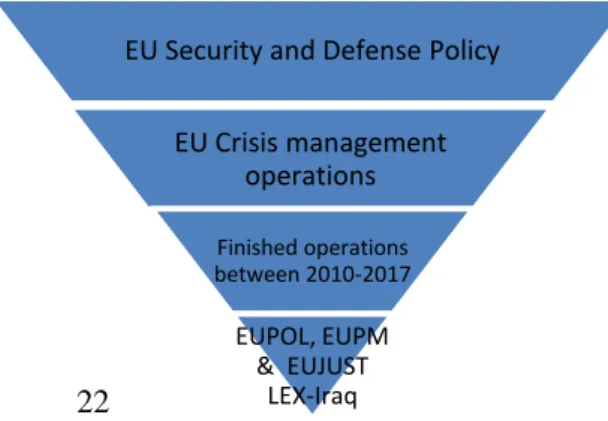
The missions mostly had different goals and were implemented in a different structure, for example a police or rule of law mission. However the missions seem to be very different at first, all missions faced challenges that influenced the successfulness of these missions. Because of the presence of challenges in all cases, but also successes, the indicators as developed by Peen Rodt (2014) in the Military Conflict Management model can be applied. The process of case selection is also
presented is the following funnel;
Figure 2: Funnel case selection
EU Security and Defense Policy
EU Crisis management operations
Finished operations between 2010-2017
EUPOL, EUPM & EUJUST
23
4.2 Operationalization into concepts, definitions and indicators
By using the criteria of success by Peen Rodt (2011) and operationalizing these concepts this research endeavors to make the evaluation more measurable.
Table 1: Operationalization concepts
Concept Definitions according to Peen Rodt (2014)
Indicators according to Peen Rodt (2011)
Internal goal attainment
Achievement of tasks EU operations set out to do (p.23).
Mandate successfully completed. Must match outlined key
objectives. Internal
appropriateness
Assesses whether an
operation’s mandate was well implemented and had desired political effect (p.24).
Timely, efficient and cost effective implementation of operations.
External goal attainment
Managing the violent aspect of the conflict (p.25).
No continuation, diffusion, escalation or intensification of violence or problems.
External
appropriateness
Assess the manner in which the operation has sought the achieve goals (p.26).
Discrimination and proportionality in the application of force.
4.3 Methods of data collection
The following two methods of data collection will be applied to this research:
Document analysis
24
Desktop research
To find all needed documents about the implementation and results of the missions and supporting literature about the CSDP and the successes of this policy the database of
University Leiden will be used, aiming to try to find as many documents through websites of involved organization as possible. The websites of the European External Action Service (EEAS) and European Institute for Security Studies (EUISS) and the reports of the meetings of the European Council contain much information about the course and outcomes of the three CSDP missions.
4.4 Reliability
Reliability is one of the main requirements within the research process, and focusses on the consistency, dependability and replicability of research. This can be difficult in qualitative research, because documents are in narrative (Zohrabi, 2013). To increase the reliability of this research every phase of the inquiry and processes will be elaborated, together with formulating a clear research design. Also by explaining how the data is collected and analyzed, the reliability will increase (Zohrabi, 2013).
4.5 Pitfalls research design and data gathering
A pitfall of this research design could be that the researcher is not sufficiently critical enough about the literature, or is not discriminating relevant and irrelevant materials. By providing a proper justification of the research this can be fought (University of Queensland, n.d.).
25
5. EUPM Bosnia-Herzegovina
In this chapter the case of EUPM Bosnia-Herzegovina (BiH), the European Union’s first ever CSDP mission, will be introduced and analyzed. After the brutal ethnic war in Bosnia ended, the Bosnian police remained ethnically, legally and politically divided (Merlingen, 2009). The EU launched the police mission EUPM at the beginning of 2003, and followed up the previous UN International Police Task Force (IPTF). The bitter experience of failure in the 1990s conflicts in the Balkans provided the trigger for this action which in a way became the prototype for a lot of the EU’s external policies that came after this mission. It was the start of EU crisis management as we know it today (EUISS, 2013).
5.1 The mission
The inception of and decision on EUPM took place in parallel with the appointment of the first formal EU Special Representative (EUSR) for BiH on 11 March 2002. These decisions marked the starting point of a new era in the bilateral relations between BiH and the EU, where BiH continued to remain the testing ground for EU foreign policy instruments. EUPM became the ‘guinea pig’ and trail blazer for the development of CSDP and for the EU and its foreign policy bodies a laboratory to experiment with ‘learning by doing’. EUPM existed throughout an exceptionally formative decade for the EU (EUISS, 2013).
The objective of the mission was to establish sustainable policing arrangements, on the same level of the best European and International practice. The EUPM concentrated on the
strategic priorities of institution and capacity building at the management level, fighting organized crime and corruption and developing the financial viability and sustainability of the local police and the promotion of police independence and accountability (The European Union and Peacebuilding, 2011). The EU Police Mission also provided operational advice to the EUSR, Valentin Inzko. Through its work and its network within the country, the EU Police Mission contributed to overall efforts ensuring that the European Union was fully informed of developments in BiH (EUPM, 2008). The mission its mandate key tasks were the following:
1. “To strengthen the operational capacity and joint capability of the law enforcement agencies engaged in the fight against organized crime and corruption;
26
3. To assist and promote development of criminal investigative capacities; 4. To enhance police-prosecution cooperation;
5. To strengthen police-penitentiary system cooperation;
6. To contribute to ensuring a suitable level of accountability (EUPM, 20082)”.
The mandate of the mission was set to expire at the end of 2005, but the EU Council adopted a joint action allowing the mission the continue until 2012 (The European Union and
Peacebuilding, 2011). In order to carry out this new mandate successfully EUPM was
originally provided with around 500 police officers, 50 international civilian experts and 300 local staff. Approximately 80% of the police officers were nationals of EU member states and the remaining 20% came from non-EU countries (Celador, 2007).
To counteract the problems posed by corruption among the Bosnian police, the mission focused on implementing an accountability mechanism that would make police officers internally answerable, to their own hierarchy, as well as externally, to the public at large (Merlingen, 2009). Before that, EUPM established professional standards units as well as public complaints bureau, where none existed, or pushed local authorities to complete the setting-up process where such structures were present but not yet fully operational
(Merlingen,2009). In addition, the mission worked on personnel policy seeking to limit political interference with nominations while at the same time increasing the motivation of police officials. This resulted in the creation of a new career development system that would recompense personnel based on merit and set equivalent salary grids, while at the same time, do away with quick position advancements (Merlingen, 2009).
However, reforming the police in BiH proved to be a challenging task for the EU. Evaluations of the first EUPM mandate (2003–2005), in terms of EU coherence and
effectiveness revealed a number of initial difficulties that hampered the implementation of the mission’s mandate (Juncos, 2007). In terms of EU’s coherence of action, a number of
problems were reflected by the fragmented EU presence on the ground and the poor coordination and communication, for example between the various EU bodies tackling organized crime and the lack of an overall strategy for engagement as the EU was just starting to develop its crisis management capabilities. The latter reason was also an obstacle for the effectiveness of the mission, together with the absence of adequate human and
2EUPM (2008). Our mandate. Retrieved on May 6th, on
27
financial resources, including at times, the inexperience of personnel seconded from EU Member States and the short time they spent with the mission (Juncos, 2007).The domestic political environment had not been conducive to attempted state-building reforms. The reason for this were the weak state institutions and an ethnically divided government. There was much political-ethnical polarisation and distrust, combined with economic underdevelopment (Merlingen, 2009). But not only the political environment faced difficulties, also the law enforcement faced serious structural problems. The political interference and high-level organized crime continued and the state institutions were hampered by the lack of resources and manpower (Merlingen, 2009).
As part of its institution-building efforts, the mission combined strategic, operational and legal approaches, including top-down, bottom-up and horizontal engagements, in an effort to have as much impact as possible. These approaches evolved in time as the mission adapted to conditions on the ground and followed EU objectives, so much so that at the end of its
mandate, EUPM had a comprehensive experience in exploring what would work best in BiH’s setting (Padurariu, 2012).This approach also demonstrated in some successes rendering the CSDP operational and the transformation of the Bosnian police into a
professional service. This caused significant changes in the policing mentalities, institutions and practices (Merlingen, 2009). The local police became more accountable thanks to the setup of a professional police training. Also the mission had installed a modern human resource management in the police apparatus, including a gender and ethnicity blind
recruitment system. Another success was the growing capacity of the Bosnian police, which influenced the numbers of investigated organized crimes (Merlingen, 2009).
5.2 Analysis
As EUPM was the first ever CSDP mission, there was no EU template for intervening in crisis situations and it was to a large extent a case of ‘learning by doing’. EUPM later became the template for other missions, as they had to create the machinery, the institutional
structures, but also develop the human capacity (EUISS, 2013).
28
an EU membership perspective was conformed for BiH and other Western-Balkan countries. The mission witnessed two waves of EU enlargement and the consequent re-assessment and controversies regarding the sustainability of reforms in the areas of the rule of law,
particularly in southeastern EU member states. Operationally and politically it was affected by the constitutional debate of the 2000s and the continuous build-up of crisis management structures and the growth of CSDP (EUISS, 2013). All of these developments played out in BiH, where the mission oversaw the development of the police system and the rule of law in the country and the wider region and witnessed the emergence of the EU area of justice, liberty and security (EUISS, 2013). To determine the successfulness of the EUPM mission, this paragraph will assess the indicators of success given by Peen Rodt (2011) in the
theoretical chapter.
Internal goal attainment
To determine whether the EUPM mission meets the internal goal attainment, the mission has got to have fulfilled its mandate successfully. As discussed in the previous paragraph, the mandate of the mission mainly focused on reforming the police system in BiH. The action was delivered predominantly by mentoring, monitoring and inspecting within the police system, with an initial strong emphasis on police reform and accountability. The mission its focus later shifted towards support in the fight against organized crime and corruption and to fostering of the police-prosecutors relationships (EU Council, 2014). According to the final EUPM evaluation report of the EU (2014), the mission had facilitated improvements in policing issues, but mainly worked as an impediment to move initiatives forward. Throughout the mission’s presence the eternal discussion on laws on internal affairs, defining operational independence, and the oversight and accountability of the police highlighted the difficult discourse.
The mission has been successful in concentrating mainly on technical issues in law
29
According to the European External Action Service (2012, p.2) the following successes of the mandate were identified after ten years of mission:
“Law enforcement agencies at state and entity level have reached joint strategic and operational capacity;
The police and judiciary at state level have developed and applied investigative capability in consistent cooperation with police and judiciary at other levels;
Institutions and mechanisms prescribed by the police reform laws have been established and reached initial functionality;
The police at all levels is able to acknowledge and effectively assume responsibility towards its community for its actions in line with domestic legislation, human rights standards and good governance principles;
BiH police agencies have fulfilled all requirements from the Roadmap to visa liberalization, leading to visa-free travel for its citizens since December 2010;
The number of large scale anti-organized crime operations conducted by BiH police, including cross-border operations, has significantly increased.
EUPM helped the police to develop its outreach activities and to raise its image, integrity and accountability towards the citizens through public information campaigns.
EUPM is also leaving behind two police brands – 122 as a unique BiH police number and Crime Stoppers hotline staffed by the State Investigation and Protection Agency” (EEAS, 2012, p.2).
30
political leaders will need to build on the positive legacy of EUPM by further depoliticizing the rule of law and consolidating security reforms.
By the time the mission ended, some of the most difficult tasks within the reform of the police system had still not been tackled. These included reforms relating to the structure of the police services, their financing, and their relationship to the courts. Monitoring, mentoring and inspecting Bosnian police authorities on these types of reforms required skills that were more likely to be found among civilians specialized in the fields of management consulting and organizational change, than among police officers. A larger presence of civilians could have assisted in the good work carried out in the preliminary stages by senior police officers and helped redress some of the problems encountered when more junior police officers began to arrive (Celador, 2007).
Overall the successes of the mission are in line with the EUPM’s mandate, as the mission was able to reform the police system and counteract organized crime and corruption within the police. The mission’s influence went even beyond its own mandate. EUPM did not have mandate to lead political debate about police restructuring. Although systemic police
restructuring was politically unfeasible during the tenure of EUPM, “the mission nevertheless produced positive political effects” (EUISS, 2013, p.70). Therefore the EUPM mission meets the internal goal attainment.
Internal appropriateness
31
documentation available that explains the high increase of the total expenses by the EU: this information is classified.
One of the problems that were encountered during the mission was the difficulty of recruiting international seconded staff. The post requirements defined by EUPM's mandate were that many posts remained vacant due to a lack of candidates meeting the requirements of the advertised posts, including basic knowledge of English (EU Council, 2014). While short-listing, interviewing and selecting candidates, EUPM had to rely on the preliminary assessments made by the EU states. On several occasions, due to a lack of qualified candidates, the mission eventually had to select applicants who met only some of the
requirements (EU Council, 2014). The lack of qualified personnel had some consequences for the quality of the mission.
The mission was at first intended to last only for two years, until 2004. After this period, the mission was extended serval times. With this extension the mandate was expanded with a new task, counteracting organized crime and corruption within the police system, but also remained the mandate with which the mission had started in the first place. In December 2009, the Council of the EU decided to extend the mission one last time, until 31 December 2011 (EUISS, 2013).
In the end, the first CSDP mission did successfully fulfil its mandate. But it did cost the Union many more years than expected at first and exceeded the budget more than three times. Partly this was caused by the lack of qualified personnel and the lack of experience from the administration when setting up the mission.
External goal attainment
To indicate whether the mission meets the external goal attainment it is necessary that the mission leaves behind a situation which is in better state that when the mission started. After the war in BiH ended in 1995 the EU wanted to play a role in the stabilization and
reconstruction of the country.
32
services became professionally capable organizations able to execute both general and specialized police and security functions (EUISS, 2013). The functional effects of EUPM were measurable across time. For example, EUPM provided assistance in setting up or implementing legal frameworks, lobbied for the adoption of legislation and participated in drafting laws, such as the Immigration Service Law (EUISS, 2013).
When the mission started soon after the war the police system perhaps could not have been in a more worse state than it was. Improving the system after ten years of mission might
therefore not have been the biggest challenge of the mission. EUPM left behind a better, more structured and less corrupt, police system than what was there when EUPM started.
External appropriateness
The external appropriateness of the mission depends on the discriminated and proportional application of force. Within the ten years of the mission the overall security situation in BiH was generally calm and stable, the level of violence was low. There has been no relevant threat against any EUPM staff, and also no incidents against EUPM premises, assets and EU classified information. The mission experienced no problems installing and man all the physical security measures at all facilities throughout the country (European Council, 2014). Because of this low violence environment, there was no need to use force during the
mission’s mandate. Therefore the mission meets the indicator external appropriates.
5.3 Conclusion
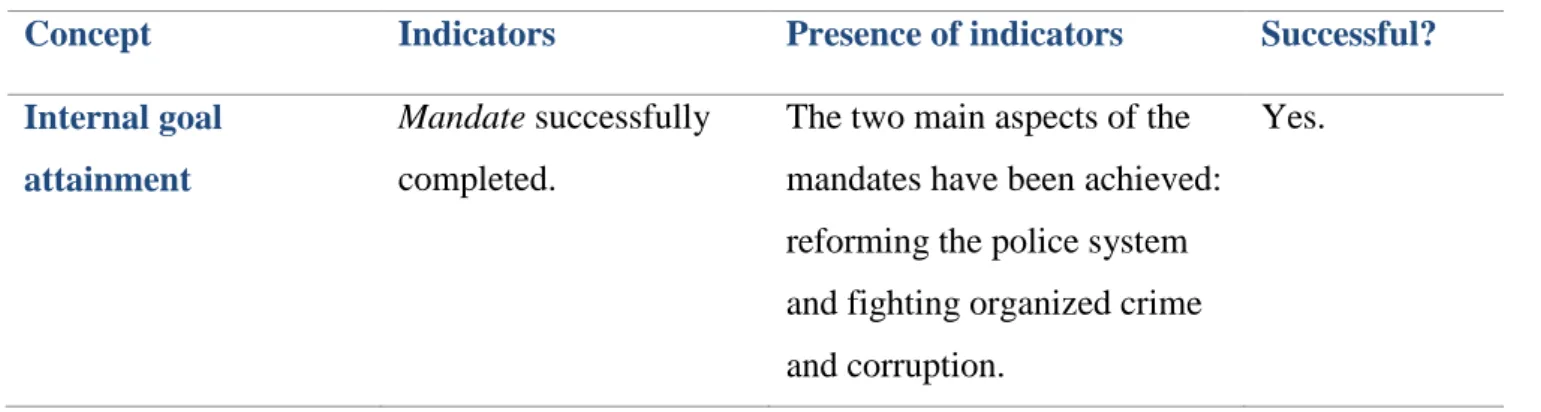
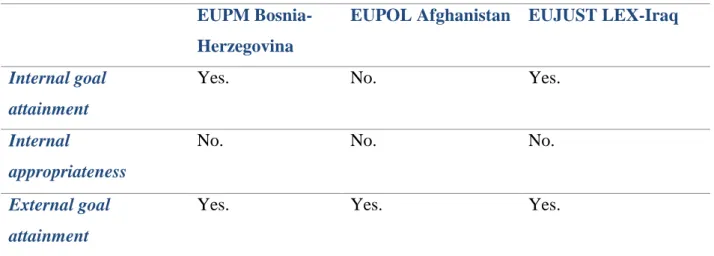
As the analysis showed, the mission only was not able the meet the internal appropriateness. The mission was extended several times and has costed more than was expected beforehand. All the indicators are summarized in the scheme below.
Table 2: Indicators EUPM Bosnia-Herzegovina
Concept Indicators Presence of indicators Successful?
Internal goal attainment
Mandate successfully
completed.
The two main aspects of the mandates have been achieved: reforming the police system and fighting organized crime and corruption.
33
Internal
appropriateness
Timely, efficient and
cost effective
implementation of operations.
The mission was extended several times and cost more than three times the expected budget
No.
External goal attainment
No continuation,
diffusion, escalation or
intensification of
problems.
There has been an improvement of the BiH police system, no
continuation, diffusion, escalation or intensification of problems.
Yes.
External
appropriateness
Discrimination and
proportionality in the
application of force.
The overall security situation
was generally calm and stable,
low level of violence. No need
for the mission to use force.
Yes.
However EUPM Bosnia-Herzegovina was the CSDP’s first mission and the EU was not yet experienced in starting crisis management operations, the mission can be defined as
34
6. EUPOL Afghanistan
Following the overthrow of the Taliban regime by the U.S. in 2001, the European Union committed to supporting the Afghan Government in the establishment of a stronger
framework of rule of law in the country (ECA, 2015).On May, 30 2007 the civilian mission EUPOL Afghanistan was established by the Council of Europe. The mission officially launched in mid-June 2007 and was terminated after a period of little over ten years, until December 2016 (EUISS, 2017).
6.1 The mission
EUPOL was a small civilian mission with a large task: reforming the Afghan National Police (ANP) (Larivé, 2012).It had to build on the efforts of the German Police Project Office and was instructed to harmonize the approaches and efforts of the various partners involved in the police reform (ECA, 2015). The mandate of the mission was “to contribute to the
establishment of sustainable and effective civilian policing arrangements that will ensure
appropriate interaction with the wider criminal justice system under Afghan ownership. The mission is supporting the reform process towards a trusted police service working within the framework of the rule of law and respect of human rights” (EUISS, 2017, p.2).
It is important to highlight the mandate’s key elements, in order to lay the groundwork for further analysis. These are reflected in the following objectives which state the three strands of the EUPOL mission (ECA, 2015, p.12). These strands were;
1. Institutional reform of the Ministry of Interior; 2. Professionalization of the ANP;
3. Connecting police to a wider justice system.
35
The implementation of EUPOL not only aimed to contribute to the EU’s overall political and strategic objectives in Afghanistan, but also in boosting the EU’s image as a credible global actor in the field of civilian crisis management (Tripathi, 2016). The modus operandi of EUPOL included monitoring, mentoring, advising and training. The mission itself was unique for the EU, as it was the first civilian CSDP mission that was deployed in a war-like
environment (EUISS, 2017).
Financing is a key element to sustaining a long-term intervention. Starting a mission is a durational investment, with diverse demands of financing. The sometimes differing interests from the international community generate a division of funds to the respective priorities. This causes the issue of prioritization and conflicting agendas to a particularly critical issue when financial resources are scarce. The mission’s financial means were budgeted on a total amount of 345 million (Cash, 2002).
Part of this budget included staff. The EUPOL mission started with a total of 160 staff members, from 18 EU member states as well as from Canada, New Zealand and Norway. This number was relatively small compared to the number of the mission’s contributing countries and especially meager in relation to the mandate and objectives of the mission. As a result, understaffing became a consistent issue over the course of the mission. In 2008 there was an agreement to work towards a staff of 400 seconded personnel; but until 2011, the total never reached above 306. This meant that a working force operating under conditions of full strength, capability and commitment to the set-out tasks was never realized, this provides fertile ground for criticism and analysis (European Committee, 2011). Its staffing and funding however showed the severe lack of contribution from the EU’s CSDP but also from its
member states.
The mission itself was run by the International Police Coordination Board (IPCB), and chaired by the Afghan Minister of Interior Affairs (Gya, 2007). The board’s main tasks based on coordination, prioritization and the guiding of international police reform processes. Although this board did not receive much attention it was situated at the center of
communication between donors and the those guiding the police reforms in Afghanistan. The training component of EUPOL resulted in a short-term curriculum of basic lectures and training on human rights, legal norms and basic policing tasks (Gya, 2007).
36
impacted the operationalization of EUPOL. It aimed to provide an alternative to the quick-fix and short term approach of the U.S., but ended up as a similar model. As a result the mission did not achieve the impact that the EU wanted, which was a reformed and professionalized police system (Tripati, 2016). Despite the negative aspects, there were also some gains during the years. The largest achievements were the introduction of civilian policing; the training of national police chiefs encouraged local Afghan ownership over the police force and promoted sustainable training activities and the establishment of the Police Staff College in Kabul, that provides training for police officers in the field of leadership, management, gender and human rights awareness (Tripathi, 2016). Other achievements, as summarized by the EUPOL press office were the development of policies and strategies including ones on the training of female police officers, which constituted a firm strategic and operational framework within the overall police reform process, and the Establishment of the Office of the Police
Ombudsman and the Department of Human Rights and Gender.
In the end, the total expenditure for the EUPOL mission reached approximately 450 million euros. The overall costs made it the second most expensive civilian mission ever, after the EULEX mission in Kosovo. During the ten years of mission three casualties were reported (EUISS, 2017).
After analyzing the first information on the EUPOL Afghanistan mission from 2007 to 2017, the expectation is that the mission will be evaluated as unsuccessful, according to the theory op Peen-Rodt (2014). As Tripati (2016) states, the mission was one of the most negatively rated missions, partly due to an unclear mandate. As this is one of the indicators of the Military Conflict Management model theory, the expectation is that more indicators will be evaluated as absent, or as unclear. For a full analysis of the mission based on this model, see paragraph 5.2.
6.2 Analysis
37
The EU’s efforts should be evaluated according to the relative environment from which these commenced. This paragraph analyses the internal and external goal attainment and the
internal and external appropriateness, to determine whether the EUPOL was successful.
Internal goal attainment
To determine whether the internal goal attainment had a positive impact on the success of EUPOL, the mandate of the mission should be successfully completed. As discussed in the previous paragraph the small civil mission had a large task: reforming the Afghan National Police (Larivé, 2012). The mandate contained many elements that had to contribute to this one large task, such as interaction with wider criminal justice systems.
The European Court of Auditors (ECA, 2015) found that EUPOL had been partly effective in delivering its mandate. They examined EUPOL’s results per type of activity and found that EUPOL has been largely successful in training-related activities. The main achievements of the mission can be summarized as follows:
“The establishment of training institutions for senior leaders of the ANP and detectives;
Development of policies and strategies at the MoI, including on female police, that constitute a firm strategic and operational framework to the overall police reform process;
More community oriented policing practices;
Enhanced cooperation between police and prosecutors in investigations;
Establishment of the Office of the Police Ombudsman and the Department of Human Rights and Gender in the MoI;
Establishment of Family Response Units of the ANP;
Advanced awareness on human rights, including women and child rights within the ANP; New Afghan Penal Code through the Criminal Law Reform Working Group;
Improved legal framework for police disciplinary procedures” (ECA, 2015, p. 19). Improvements were more notable in two of EUPOL’s three main lines of operations. Though the mission has been successful in training-related activities, it was less successful in
38
of policing - ensured that the EU would add value. However, EUPOL faced a laborious task in delivering its mandate owing to the almost complete lack of a functioning police force, high illiteracy rates and widespread corruption (ECA, 2015). The reason for the mission’s inability to achieve the two other strands were the difficulties in the deployment of the mission, as well as EUPOL’s also suffering from inherent limitations relating to the
recruitment of staff and logistical problems. Member States found it hard to supply qualified staff in sufficient numbers, which led to serious delays in reaching the required operational strength. Deployment in the provinces was equally complicated, mainly due to logistical issues and insecurity. In most provinces, EUPOL was unable to deploy sufficient staff to ensure the proper delivery of its mandate (ECA, 2015).
Internal appropriateness
A mission’s internal success is not only depending on whether the mandate is successfully completed, but also depends on the way in which the operation was implemented to reach these objectives and whether this method was appropriate. The internal appropriateness depends on the timely, efficient and cost effective implementation of operations (Peen Rodt, 2014).