Large-Scale Bioinformatics Analysis of
Bacillus
Genomes Uncovers Conserved
Roles of Natural Products in Bacterial
Physiology
Kirk J. Grubbs,aRachel M. Bleich,bKevin C. Santa Maria,cScott E. Allen,b Sherif Farag,bAgBiome Team,d Elizabeth A. Shank,a,eAlbert A. Bowersb
Department of Biology, University of North Carolina, Chapel Hill, North Carolina, USAa; Eshelman School of Pharmacy, University of North Carolina, Chapel Hill, North Carolina, USAb; Department of Chemistry, University of North Carolina, Chapel Hill, North Carolina, USAc; AgBiome, Research Triangle Park, North Carolina, USAd; Department of Microbiology and Immunology, University of North Carolina, Chapel Hill, North Carolina, USAe
ABSTRACT Bacteria possess an amazing capacity to synthesize a diverse range of structurally complex, bioactive natural products known as specialized (or secondary) metabolites. Many of these specialized metabolites are used as clinical therapeutics, while others have important ecological roles in microbial communities. The biosyn-thetic gene clusters (BGCs) that generate these metabolites can be identified in bac-terial genome sequences using their highly conserved genetic features. We analyzed an unprecedented 1,566 bacterial genomes from Bacillus species and identified nearly 20,000 BGCs. By comparing these BGCs to one another as well as a curated set of known specialized metabolite BGCs, we discovered that the majority ofBacillusnatural products are comprised of a small set of highly conserved, well-distributed, known natu-ral product compounds. Most of these metabolites have important roles influencing the physiology and development ofBacillusspecies. We identified, in addition to these char-acterized compounds, many unique, weakly conserved BGCs scattered across the genus that are predicted to encode unknown natural products. Many of these “singleton” BGCs appear to have been acquired via horizontal gene transfer. Based on this large-scale characterization of metabolite production in theBacilli, we go on to connect the alkylpy-rones, natural products that are highly conserved but previously biologically uncharac-terized, to a role inBacillusphysiology: inhibiting spore development.
IMPORTANCE Bacilliare capable of producing a diverse array of specialized metabo-lites, many of which have gained attention for their roles as signals that affect bac-terial physiology and development. Up to this point, however, the Bacillus genus’s metabolic capacity has been underexplored. We undertook a deep genomic analysis of 1,566 Bacillus genomes to understand the full spectrum of metabolites that this bacterial group can make. We discovered that the majority of the specialized metab-olites produced by Bacillus species are highly conserved, known compounds with important signaling roles in the physiology and development of this bacterium. Ad-ditionally, there is significant unique biosynthetic machinery distributed across the genus that might lead to new, unknown metabolites with diverse biological func-tions. Inspired by the findings of our genomic analysis, we speculate that the highly conserved alkylpyrones might have an important biological activity within this ge-nus. We go on to validate this prediction by demonstrating that these natural prod-ucts are developmental signals inBacillusand act by inhibiting sporulation.
KEYWORDS Bacillus, bioinformatics, natural products, nonribosomal peptide synthetase, polyketides, secondary metabolism, specialized metabolites, sporulation, thiopeptides
Received9 May 2017Accepted3 October 2017 Published14 November 2017 CitationGrubbs KJ, Bleich RM, Santa Maria KC, Allen SE, Farag S, AgBiome Team, Shank EA, Bowers AA. 2017. Large-scale bioinformatics analysis ofBacillusgenomes uncovers conserved roles of natural products in bacterial physiology. mSystems 2:e00040-17.https://doi .org/10.1128/mSystems.00040-17.
EditorCasey S. Greene, University of Pennsylvania
Copyright© 2017 Grubbs et al. This is an open-access article distributed under the terms of theCreative Commons Attribution 4.0 International license.
Address correspondence to Elizabeth A. Shank, [email protected], or Albert A. Bowers, [email protected].
K.J.G. and R.M.B. contributed equally to this article and are co-first authors.
Large-scale bioinformatics analysis of Bacillus genomes uncovers conserved roles of natural products in bacterial physiology
Molecular Biology and Physiology
B
acteria devote large portions of their genomes to the genes necessary for natural product biosynthesis. These specialized metabolites (formally called secondary metabolites) have historically been crucial to the development of clinically relevant antibiotics. More recently, they have garnered attention as intraspecies and interspecies signals that affect bacterial physiology and development (1–5). In light of the important therapeutic and ecological roles that specialized bacterial metabolites play, there is broad interest in identifying the entire repertoire of metabolites that bacteria are capable of generating, as well as in identifying their biological functions.Most specialized metabolites are structurally complex biomolecules that fall into distinct structural classes synthesized by conserved classes of biosynthetic metabolites. This association between metabolite class and a metabolite’s gene signature allows genome sequences to be searched to identify predicted biosynthetic gene clusters (BGCs). Such genome mining has dramatically increased the rate of discovery of specialized metabolites compared to those of traditional methods, which rely on the isolation of individual compounds (6, 7). A number of large-scale genome-mining projects have focused on defining the metabolite-encoding potential ofActinobacteria, a bacterial group known to be prolific producers of natural products and the taxon that has supplied the majority of clinically deployed antibiotics (8). In contrast, we focus here on the Gram-positive Bacilli. Bacillus is a metabolically underexplored genus that nevertheless possesses substantial biosynthetic potential.
Bacillus species are omnipresent in soils and in the plant rhizosphere, and many have also been harnessed for industrial and agricultural applications. Some species are considered safe biological agents and are used as plant-growth-promoting bacteria or food additives, while others are pathogens (9, 10). In addition to having agricultural importance and ecological diversity, the specialized metabolites ofBacilliplay signifi-cant roles in the interactions and life cycles of these bacteria as both intra- and interspecies signals. Many specializedBacillusmetabolites coordinate cellular differen-tiation (11, 12). For example, the nonribosomally produced lipopeptide surfactin is important for development of multicellularity inBacillus subtilis, acting as a quorum-sensing-like signal that stimulates biofilm production (13, 14). Surfactin also acts as an interspecies signal, inhibiting aerial hyphal formation in Streptomyces coelicolor (15), and as an antibiotic (it is one of more than two dozen antibiotics that have been isolated from strains ofBacillus subtilis). Bacillaene, a hybrid nonribosomal peptide and polyketide, is also involved in interspecies interactions; bacillaene inhibits prodiginine production in Streptomycesspecies (16) and protectsB. subtilisagainst predation by Myxococcus xanthus (17). More recently, a group of ribosomally synthesized and posttranslationally modified peptides (RiPPs) produced byB. cereusknown as thiocillins have been shown to stimulate B. subtilis to produce biofilm in a manner that is independent of antibiotic activity (18, 19). Thus, these specialized metabolites are an important means by whichBacilliinteract with themselves and their surroundings.
RESULTS
Genome database and analysis.One of the distinctive features of our analysis is the large number of sequences from a single genus that we examined. We analyzed the 221Bacillusgenomes that were publicly available at the time that we began this work, as well as 1,345 proprietaryBacillusgenomes from AgBiome. By comparison, we have evaluated nearly five times more genomes than the next-most-extensive published analyses (20) and significantly more than other similar analyses of other bacterial genera (8). Additionally, the genomes that we analyzed are being made newly available to the public together with this analysis, greatly enhancing the number of Bacillus genome sequences available to the research community.
In order to designate species names with the sequences in our data set, we used Barrnap to identify 16S and 23S ribosomal gene sequences in each genome and used the predicted sequences in a BLAST search against the Genomic Reference Sequence Database (GenomicRefSeq). To streamline the presentation of our results, we have assembled theBacilliin our data set into groups containing phylogenetically related species: the cereus, subtilis, flexus, coagulans, and “other” groups (see Fig. 2A for a summary of all species, group members, and numbers of strains per species). While members of both of the best-characterized Bacillus clades (the subtilis and cereus groups) live in the soil, they occupy distinct niches within that habitat: thesubtilisgroup is associated primarily with plants, while thecereusgroup is associated primarily with insects.
To evaluate the biosynthetic potential of these Bacilli, we developed the analysis pipeline outlined in Fig. 1. Our workflow integrates several methods to effectively analyze and visualize the biosynthetic capabilities of Bacilli and draw meaningful comparisons. We began by using antiSMASH (21) to analyze the biosynthetic capacities of our 1,566 genomes. The cumulative output from antiSMASH was 19,962 biosynthetic gene clusters (BGCs), which included nonribosomal peptide synthetases (NRPSs), polyketide synthases (PKSs), bacteriocins, thiopeptides, lanthipeptides, terpenes, ecto-ines, phosphonates, siderophores, and hybrid/nontraditional BGCs. Representatives of 23 characterizedBacillusBGCs (where a natural product is associated with a BGC [see Table S1 in the supplemental material]) were combined with these predicted BGCs for a 19,985-member MultiGeneBlast (MGB) library. The BGCs were analyzed using Multi-GeneBlast (22), a program that does an all-by-all comparison and calculates an MGB score for each BGC pair based on the synteny of the genes within each BGC and their BLAST scores. MGB scores were normalized and used as input for density-based spatial clustering of applications with noise (DBSCAN) (23) to cluster similar BGCs. Parameters selected for DBSCAN clustering (see Materials and Methods) were conservative, such that only highly related BGCs were placed in the same DBSCAN cluster. In some cases,
Identify highly conserved BGCs and unique singletons Map ‘known’ natural product clusters onto network map Visualize the DBScan cluster relationships using network maps
Create averaged distance matrix between DBScan clusters Use DBScan to cluster similar BGCs
Use MultiGeneBlast scores to generate a distance matrix for BGCs Run an “All vs. All” MultiGeneBlast analysis of BGC Database Obtain list of ‘known’ Bacillus natural product BGCs from literature
Combine the cumulative output into an BGC Database Analyze Bacillus genomes using antiSMASH
this led to multiple DBSCAN clusters being generated for related molecular families. Although the stringency in our cutoffs may be a potential source of error, it should result in only significant relationships being exposed. The quality of the DBSCAN clustering was confirmed through a silhouette coefficient calculation (24) for each class of metabolites (Table S2). Using the averaged MGB scores, we then generated a distance matrix to describe the relatedness of each DBSCAN cluster to all other DBSCAN clusters in our MGB database. We sorted the resulting DBSCAN clusters by the class of natural product that they contained (e.g., NRPS, PKS, etc.) based on antiSMASH’s assignments. We then used Cytoscape (25) to build network maps that allowed the relationships between the DBSCAN clusters to be visualized. These network maps provide an overview of the overall placement in clades of specialized metabolites within theBacilli. By mapping the characterized, known BGCs onto the network maps, the vast unknown diversity of specialized Bacillus metabolites was revealed, as de-scribed below.
In addition to performing these analyses, we used Alien_hunter (26) to predict DNA regions that are likely to have been obtained via horizontal gene transfer (HGT). We overlaid these results with those obtained from antiSMASH to determine how much of each BGC was obtained via HGT. antiSMASH is highly conservative in defining the boundaries of BGCs (so as to avoid excluding uncharacterized tailoring enzymes), which frequently leads to nonbiosynthetic regions of the genome being included in antiS-MASH’s output of BGCs. Because of this, we used a cutoff of 75% overlap for desig-nating BGCs as predicted to be obtained via HGT.
To verify our bioinformatics methods, we examined a subset of bacterial strains predicted to produce known metabolites. For structures of knownBacillusmetabolites, see Fig. S1. Using established procedures, we used high-resolution liquid chromato-graphy-mass spectrometry (LCMS) to survey the cell surface extracts of strains pre-dicted to produce kurstakins (2 public and 36 AgBiome strains) and those prepre-dicted to produce bacillamide (3 public and 16 AgBiome strains). We found masses correspond-ing to kurstakin and bacillamide production in 79% and 58% of the strains predicted to produce these metabolites, respectively (Fig. 3C and Fig. S2). We speculate that other strains (those predicted to make these compounds but which have not been detected to make them) may contain “silent” BGCs, where the metabolites are not expressed under laboratory growth conditions (27). This analysis confirms the effectiveness of our bioinformatics predictions and underscores the prevalence of these compounds in Bacillusstrains.
General insights. Overall, we find that theBacilli are relatively homogeneous in their metabolite class distributions, particularly within each phylogenetic clade. For instance, species from thecereusandsubtilisgroups have large numbers of NRPSs and bacteriocins, while the flexus and “other” groups are highly enriched in terpenes (Fig. 2A).Bacilliaverage 11 BGCs per strain, but this number can vary between 1 and 16, depending on the strain (Fig. 2A). Note that a large proportion of the strains that we have analyzed are in thecereusgroup; this bias also afforded us the chance to more deeply sample this important portion of theBacillustaxon and gain further insight into metabolite conservation within a single bacterial species.
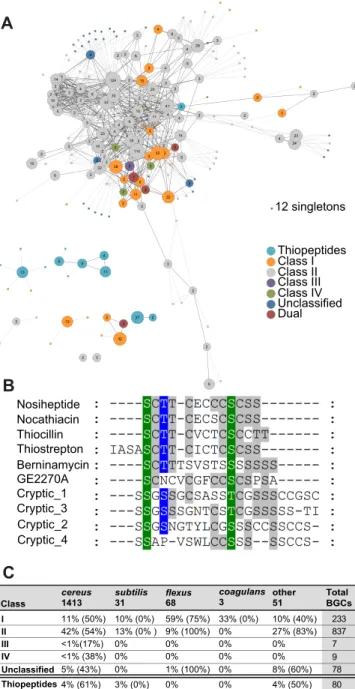
the PKS modules within the BGC, but instead a separate protein encoded in the BGC will act intrans); with only a few exceptions, type II PKS BGCs appear to be predomi-nantly absent fromBacillus. We also observed that hybrid NRPS-PKS enzymes are more abundant inBacillithan PKS BGCs are (Fig. 2B). Zwittermicin, a type I PKS-NRPS hybrid, accounts for the majority of all hybrid BGCs; the remaining hybrid systems predomi-nantly use the trans-AT PKS-NRPS machinery. Like the NRPSs, the majority of hybrid NRPS-PKS BGCs fromBacilliare predicted to produce known compounds, but there is a small cohort (133 BGCs) that can be attributed to unknown and potentially new or novel compounds. Lastly, canonical RiPPs (e.g., lanthipeptides and thiopeptides) have a much smaller percentage of known members. We identify only 5 known compounds from the 1,164 detected lanthipeptide BGCs, while the thiopeptides exhibit only 1 known representative among the 80 identified BGCs.
Thus, depending on the metabolite class, many of the identified BGCs in our data set appear to be conserved (i.e., present in a significant proportion of strains) among the Bacilli. Most of the NRPS BGCs are highly conserved across different Bacillusspecies, indicating their importance to the genus. Correspondingly, these NRPSs show little evidence of HGT. Although theBacillusPKSs are mostly attributed to unknown natural products (with the exception of zwittermicin, the only PKS identified in the cereus group), the few PKS BGCs that were found appear to be core constituents of the genus and show little evidence of HGT. Remarkably, essentially all of the unique singletons in our data set (661 total BGCs) are attributed to unknown compounds, irrespective of their metabolite class. Many of these poorly conserved, rare BGCs that are scattered throughout theBacillus genomes appear to have been acquired by HGT. Below, we discuss the known and highly conserved BGCs, the unknown and highly conserved BGCs, and a few compelling examples of poorly conserved BGCs.
A
B
NRPS bacteriocin terpene siderophore lanthipeptide other NRPS-PKS
other
lanthipeptide NRPK-PKS thiopeptide Bacillus spp.
B. selenitireducens (MLS10) B. cellulosilyticus (DSM 2522) B. pseudofirmus (OF4) B. halodurans (C-125) B. coagulans (2-6) B. clausii (KSM K16) B. subtilis (BEST7613)
B. amyloliquefaciens (DSM 7)
B. atrophaeus (1942)
B. licheniformis (DSM 13)
B. pumilus (SAFR 032)
B. megaterium (DSM 319
B. flexus (AUCAB22)
B. cytotoxicus (NVH 391 98) B. pseudomycoides (DSM 124424) B. cereus (03BB102)
B. anthracis str. (A0248) B. thuringiensis (ATCC 10792) B.weihenstephanensis (KBAB4) B.mycoides (DSM 2048)
Average # of BGCs 11 9 13 8 10 16 6 6 7 7 9 12 13 11 4 1 6 5 4 2 7 coagulans group PKS # of strains
100 1 282 49 980 1 1 1 67 3 1 1 11 15 1 2 1 2 1 1 cereus group flexus group subtilis group 46
All Bacillus strains 1567 11
BGC Types
Total
BGCs % Unknown
% Unknown Singletons % HGT Singletons % HGT Total
NRPSs 5081 29 482 100 23 46
PKSs 194 93 29 100 13 46
Hybrids 536 30 27 100 62 44
Lanthipeptides 1164 100 112 100 54 52
Thiopeptides 80 99 11 100 59 40
Total Singletons
2 4 6 8 10
0 12 14 16
Known, highly conserved BGCs.Many of the highly conserved BGCs in our data set encode NRPSs; a few additional hybrid NRPS PKSs, such as zwittermicin and bacillaene, are also well conserved. Although several of these compounds have already been linked to important signaling roles inBacilli, the native biological activities of many of them remain poorly understood.
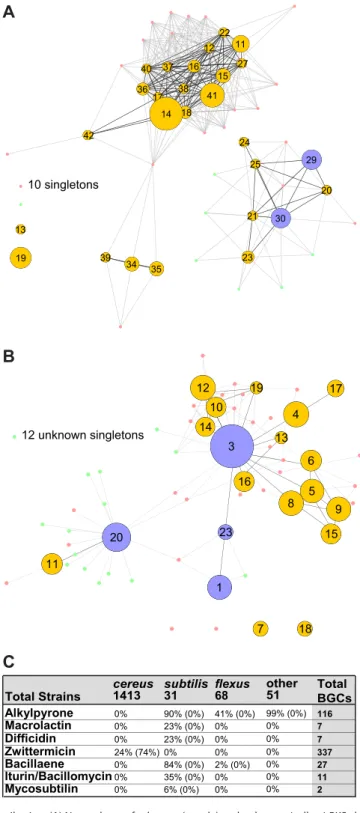
The most abundant NRPS BGC in the data set by far is the biosynthetic pathway for the siderophore bacillibactin, the primary iron scavenger for most Bacillus species (Fig. 3B, cluster 2) (28). Bacillibactin was identified in 90.9% of the public strains (200 genomes) as well as 90.7% of the AgBiome strains (1,220 genomes). Of the remaining 146 strains that lack bacillibactin, 130 were found to contain putative petrobactin BGCs; petrobactin is the primary siderophore in Bacillus anthracis(29). With regard to the remaining 16 strains, we hypothesize that either (i) they generate alternative,
unknown siderophores or (ii) they do not make their own siderophores but instead exclusively “pirate” siderophores produced by other bacteria (30).
The second-most-common group of NRPS BGCs was the kurstakin synthetases. The kurstakins are cyclic lipopeptides that control swarming and biofilm formation in Bacillus thuringiensis(31). BGCs for the kurstakins were identified in 42.5% of the public
35
23 34
39
25 29
20
21 30
19 13
11 12
22
37 16 27
40
36 17
15 38
41
18
42
24 14
A
C
10 singletons
B
6 17
5 9
15 8
4
20
12
14 10
16 19
3 13
1 23
18 7 11
12 unknown singletons
Alkylpyrone Macrolactin Difficidin Zwittermicin Bacillaene Iturin/Bacillomycin Mycosubtilin Total Strains
0% 0% 0% 24% (74%) 0% 0% 0%
1413 cereus
90% (0%) 23% (0%) 23% (0%) 0% 84% (0%) 35% (0%) 6% (0%)
31 subtilis
41% (0%) 0% 0% 0% 2% (0%) 0% 0%
flexus 68
116 7 7 337 27 11 2 Total BGCs
99% (0%) 0% 0% 0% 0% 0% 0%
other 51
strains (94 genomes) and 50% of the AgBiome strains (998 genomes); these BGCs are found only in thecereusgroup and in one strain from the “other” group (Fig. 3B, clusters 3 and 13). In addition to the high conservation of the six kurstakin biosynthetic genes, there is high conservation within the amino acids incorporated by these synthetases in our data set strains; variation was typically limited to the sixth amino acid.
Bacillamide biosynthetic genes were unexpectedly common in the data set (Fig. 3B, cluster 4). To date, the algicidal bacillamides have been isolated only from marine Bacillusstrains (32–34). However, these BGCs were present in 45.7% of the public strains (101 genomes) and 42.8% of the AgBiome strains (849 genomes). They were observed inB. thuringiensis,B. cereus,B. anthracis,Bacillus mycoides, and several of the “other” strains. Other than their algicidal properties and activities against one strain of cyano-bacteria, little is known about whether bacillamides play signaling roles within the Bacilli; their prominence indicates that they may serve an important biological function in thecereusgroup in particular.
Zwittermicin (Fig. 4B, cluster 3) is an aminopolyol with broad-spectrum antibiotic activity that was first isolated fromB. cereus(35). This type I PKS-NRPS hybrid BGC has been identified in a number ofBacillusstrains since then, and it appears in 8.1% of the public strains (18 genomes) and 23.7% of the AgBiome strains (319 genomes) (Fig. 4C). Although the zwittermicin BGC is common within these Bacillus strains, our data indicate that it was likely acquired via HGT (Fig. 4C). Zwittermicin has been noted for its synergistic activity with other microbial metabolites. For instance, it synergizes with kanosamine to inhibit the growth of Escherichia coli and oomycetes; it was later discovered that in some strains, the kanosamine biosynthesis genes are found within the zwittermicin BGC (36, 37). Our data set reveals that zwittermicin is also frequently associated with other BGCs, including three separate class II lanthipeptides and a group of NRPS BGCs with a conserved CATCATR modularity. Although the products of these BGCs are unknown, their consistent integration into the zwittermicin cluster suggests a potential synergistic or regulatory role.
There are a number of other notable, highly conserved, and known NRPS-derived BGCs within our data set. Specifically, bacillaene, a hybrid NRPS PKS (Fig. 4B, cluster 20), and surfactin and fengycin, NRPSs (Fig. 3B, clusters 29 and 27, respectively), are common amongsubtilisgroup members, while bacitracin (Fig. 3B, clusters 22 and 23) and cereulide (Fig. 3B, cluster 28) are predominantly found within cereus group members (Fig. 3A). Many of the best-known and best-characterized Bacillus NRPS metabolites, such as bacillibactin, bacillamide, cereulide, surfactin, and fengycin, exhibit a very low likelihood of HGT, at least within thecereusgroup (Fig. 3A). In contrast, two other known compounds (kurstakin and bacitracin) showed a high likelihood of having been acquired by HGT (Fig. 3A).
Unknown, highly conserved BGCs. A number of well-conserved BGCs did not readily connect with known natural products in our analysis, suggesting that they may synthesize new or novel compounds. Two such BGCs were particularly prevalent: (i) a group of NRPS BGCs with a conserved CATCATR architecture and (ii) a type III PKS which had previously been hypothesized to make a series of alkylpyrones inB. subtilis.
The stringent parameters used in our analysis meant that the CATCATR BGC was split into a number of smaller DBSCAN clusters (Fig. 3B, clusters 5, 11, 12, 15, 17, 19, 24, and 26; cluster 11 groups separately from the others due to its unique genomic context). Although these BGCs were found in 5.4% of public strains (12 genomes) and 24.4% of AgBiome strains (316 genomes), this BGC remains largely uncharacterized. Its NPRS gene architecture suggests that it generates a modified dipeptide which may be structurally related to a series of diketopiperazines recently found to regulate virulence inStaphylococcus aureus(38, 39). Notably, these BGCs show a high likelihood of having been acquired via HGT (Fig. 3A).
homologous overexpression of the two biosynthetic genes bpsAandbpsB (40). This approach yielded a number of triketide pyrones as well as small amounts of tetraketide alkylresorcinols with various chain lengths, but no native expression could be detected (40). Similar molecules isolated from Azotobacter vinelandiiand Streptomyces griseus have been implicated in cyst formation and beta-lactam resistance, respectively, but no function could be ascribed to these putative alkylpyrones fromB. subtilis(41, 42). The bpsA-bpsB operon is particularly well distributed amongsubtilis group strains, being found in Bacillus amyloliquefaciens,Bacillus atrophaeus,Bacillus flexus,Bacillus subtilis, andBacillus megateriumstrains. Moreover, 15% of the publically available genomes and 5% of the AgBiome genomes possess this BGC. The prevalence of this operon sug-gested that the products might have an important biological function within theBacilli. We tested this prediction, and below we ascribe, for the first time, a role for the bpsA-bpsB operon in affecting Bacillusphysiology, impacting both biofilm formation and sporulation.
Exceptions and unique singletons.Given the limited number of natural products that have been isolated from Bacillus, we identified a remarkably large number of unknown BGCs in the data set. The majority of these unknown BGCs comprise unique singletons that did not cluster with any other BGC; some were so rare that they did not connect with the rest of the network map. These highly unusual BGCs are potentially promising leads for discovering new compounds and biological activities.
One unexpected rare find in theBacillus genomes was a small set of type II PKS BGCs. Although some polyketides have been isolated fromBacilli, they are predomi-nantly of the extended, linear form, common to type I and III PKSs. To date, there have been few reports of the polyaromatic type II polyketides outside theActinomycetesand none from the Bacillales. Remarkably, we identified four unique type II PKSs within Bacillusgenomes from the AgBiome strains (twoB. cereusstrains, oneB. megaterium strain, and oneB. mycoidesstrain). The two easily identifiable PKS genes in these BGCs (the two ketosynthases) show approximately 45% homology to BGCs in a parcubacte-rial strain, the cyanobacteriumGloeobacter violaceus, and a number ofDelftiaspecies. These BGCs contain, in addition to the two ketosynthase genes, multiple genes responsible for other structural modifications. The metabolites produced by these BGCs are completely unknown, and it is likely that the presence of these BGCs in these Bacillusgenomes is due to HGT.
Lanthipeptides and thiopeptides in particular represented a disproportionate num-ber of the weakly conserved BGCs that are predicted to generate new or novel compounds. Lanthipeptides are characterized by lanthionine or methyllanthionine bridges formed by a thioether linkage between two alanine residues (43, 44). In Streptomyces, SapB, the canonical lanthipeptide, plays a critical role in the development of aerial mycelia (45). Similarly, lanthipeptides may have important signaling roles in Bacilli. Lanthipeptides proved ubiquitous inBacillusgenomes. We identified lanthipep-tide BGCs in 45% of public strains (100 genomes) and 79% of AgBiome strains (1,064 genomes) (Fig. 5A), but they are highly understudied; only five of these BGCs are associated with a known natural product. Most of these BGCs are class I and class II lanthipeptides from the B. cereusgroup, although at least one lanthipeptide can be found in every phylogenetic group (Fig. 5C). Additionally, our analysis predicts a few of the substantially more rare class III and IV lanthipeptides, as well as some severe outliers with unique combinations of multiple small type II enzymes. A few lanthipeptides produced byBacillihave been studied for their antibiotic activity against Gram-positive organisms; the ceredins, lanthipeptides from thecereusgroup, are hypothesized to be produced during competence in late exponential phase, and haloduracin, a lanthipep-tide produced byB. halodurans, can inhibitB. anthracisspore outgrowth (46). Little else is understood about the roles of this metabolite class inBacilli, but their prominence suggests a significant role in the genus.
oxidation states and often contain dehydrated residues (43). Thiopeptides have histor-ically been found in streptomycete species; only one thiopeptide (thiocillin) is known to be produced by aBacillusspecies (B. cereusATCC 14579) and was recently found to play a role inBacillus subtilisbiofilm induction. We identified a total of 80 new thiopeptide BGCs in theseBacillusgenomes. Many of theseBacillusthiopeptides possessed unique and remarkably diverse precursor peptide sequences relative to those present in previously characterized thiopeptides (Fig. 5B). It will be of interest to see if these new thiopeptides play roles similar to those of the thiocillins fromB. cereusATCC 14579.
Activity of bpsA-bpsB operon products.Many of the BGCs identified in our exten-siveBacillusgenome database are unknown, while most of the highly prevalent and
A
B
C
Thiostrepton Thiocillin Nocathiacin GE2270A Nosiheptide Berninamycin Cryptic_1 Cryptic_3 Cryptic_2 Cryptic_4 12 singletons Class I Class II Class III Class IV Unclassified Dual Thiopeptides 4 3 2 14 2 2 2 22 2 10 3 6 3 3 2 19 2 23 2 2 10 5 2 4 3 6 43 2 2 27 3 2 2 12 32 3 2 2 22 3 2 3 3 2 11 2 3 6 5 11 4 13 5 9 2 2 2 2 6 10 2 124 4 9 35 4 9 41 14 4 2 11 4 2 2 5 2 12 3 2 52 5 2 2 7 110 38 4 6 3 3 15 2 30 4 20 2 3 5 29 4 5 3 3 2 4 3 2 3 24 2 2 234% (61%) 3% (0%) 0% 0% 4% (50%)
I II III IV Unclassified Class 1413 cereus 31
subtilis Total
BGCs other 51 11% (50%) 42% (54%) <1%(17%) <1% (38%) 5% (43%) 10% (0%) 13% (0% ) 0% 0% 0% 59% (75%) 9% (100%) 0% 0% 1% (100%) 33% (0%) 0% 0% 0% 0% 10% (40%) 27% (83%) 0% 0% 8% (60%) 3 coagulans flexus 68 Thiopeptides 233 837 7 9 78 80
conserved BGCs have already been shown to have important roles impacting bacterial physiology. We hypothesized that other conserved but uncharacterized BGCs might also act as cell-cell signals and have physiological effects on Bacillus. Thus, we examined the bpsA-bpsB operon from the most common PKS BGC for potential biological activity.
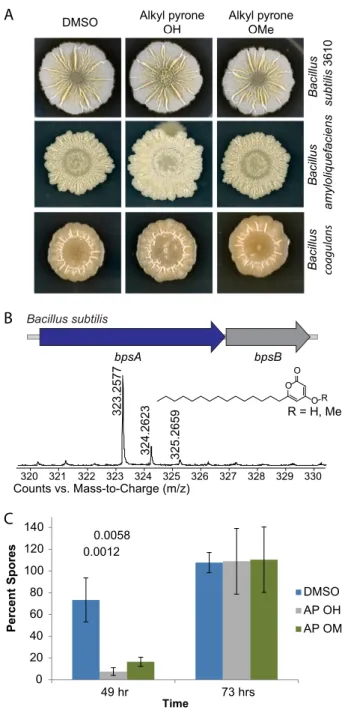
Products of thebpsA-bpsBoperon have never been isolated from wild-type strains. Moreover, efforts to ascribe biological function to putative compounds from engi-neered strains have not been able to uncover biological activity. Two of the best-studied phenotypes ofBacillusspecies are their ability to form distinctive biofilms on solid agar (47) and their ability to sporulate; these two processes are often coregulated (12). When we examined the SubtiExpress database (48) for clues about the potential biological function of this operon, we observed that transcription ofbpsA(the type III PKS in the BGC) is upregulated during sporulation. We therefore grewB. subtilis3610, a modelBacillusstrain, in MSgg, a biofilm-inducing medium, for 72 h, in order to allow B. subtilisto sporulate (47). LCMS analysis showed production of alkylpyrones with C15
side chains in wild-typeB. subtilis(Fig. 6B). To further probe the biological activities of these alkylpyrones, we synthesized two variants that we identified fromB. subtilis; both had straight C15chains, but one was methylated at the 4-hydroxy position (Fig. 6B and
Fig. S3).
To discover the activities of these alkylpyrones, we screened a panel of Bacilli comprised of representative members from 13 different species in the presence of either one of the two purified alkylpyrones or a dimethyl sulfoxide (DMSO) solvent control when the organisms were grown on two different media (Luria-Bertani broth [LB] and MSgg) (Fig. 6A). No effect could be seen in growth or colony morphology in the presence of the unmethylated alkylpyrone. However, the 4-hydroxyl alkylpyrone affected the biofilm colony morphology of B. subtilis 3610 on MSgg and those of B. amyloliquefaciensandB. coagulanson LB; in all cases, we observed a hyper-wrinkling in the center of the colonies as well as other, more-subtle morphological changes (Fig. 6A). It has previously been reported that hyper-wrinkling inB. subtilisbiofilms is due to increased cell death (49), but our data indicate that the 4-hydroxyl alkylpyrone does not impact the growth of these three strains; it does kill two otherBacillusstrains (Fig. S4). Whether the observed effects are due to localized cell death or not, these data indicate that 4-hydroxyl alkylpyrone functions as a signal that impacts biofilm colony morphology within multipleBacillusspecies.
Given the timing ofbpsA expression inB. subtilisand the regulatory relationship between biofilm formation and sporulation, we also sought to investigate a potential role for these alkylpyrones in sporulation. We tested effects of both alkylpyrone variants onB. subtilissporulation by adding compound or DMSO as a control to cells in liquid MSgg and monitoring the percentage of spores formed over time. Both alkylpyrones delayed sporulation at day 2 compared to sporulation in the DMSO control (Fig. 6C) at concentrations that did not affect growth (Fig. S4). However, by day 3, the percentage of spores formed in the alkylpyrone-treated sample was comparable to the percentage of spores observed in the DMSO control (Fig. S4).
DISCUSSION
Here we have pursued an extensive bioinformatics analysis of the genusBacillus in order to measure its chemical diversity and better understand the role of its specialized metabolites. One of the unique features of our study is the substantial number of genome sequences from a single genus included in our analysis. By examining 1,566 genomes, we have evaluated nearly five times more sequences than the next-most-extensive published analysis of the Bacillus genus (20). In addition, more than 85% of these genomes are being made newly available to the public (the other 15% are already publicly available), greatly enhancing the avail-able database ofBacillusgenome sequences. Although the phylogenetic diversity of our genomic database is biased toward thecereusgroup, this also provided us with
0 20 40 60 80 100 120 140
49 hr 73 hrs
P
e
rc
e
n
t S
por
e
s
Time
DMSO AP OH
AP OMe Alkyl pyrone
OH
Alkyl pyrone OMe
B
a
cil
lus
B
a
cil
lus
am
yloliqu
e
fa
ci
ens
B
a
cil
lus
coagu
lans
A
DMSOB
C
0.0012 0.0058
Bacillus subtilis
bpsA bpsB
O O
O R R = H, Me
323.2577
324.2623 325.2659
Counts vs. Mass-to-Charge (m/z)
320 321 322 323 324 325 326 327 328 329 330
subtilis
3610
the opportunity to more deeply sample this important portion of theBacillustaxon. One important question is whether this enlarged genome database provided any informational value beyond what would have been attained using the previously available 221 public genomes. In fact, a number of our conclusions were possible only as a result the inclusion of these additional AgBiome genomes, including (i) the widespread prevalence of the CATCATR BGCs, (ii) the existence of type II PKS singletons inBacilli(seen only in the AgBiome genomes), and (iii) the diversity of the thiopeptides (seven of the thiocillin DBSCAN clusters, comprised of 67 BGCs, were present only in the AgBiome genomes). These results argue, consistently with previous studies (53, 54), that expanding our knowledge of the genomic content of additional bacterial strains will continue to reveal new insights into natural product diversity and function.
The next-most-extensive analysis of the genusBacillus, using 328 sequenced Bacil-lales available from the NCBI database, arrived at results similar to ours (20). Those researchers utilized a related workflow in that they used antiSMASH to identify BGCs and then BLAST (but not MultiGeneBlast) to compare the identified BGCs, although BAGEL3 was also used to identify BGCs (20). However, they did no further clustering analysis to better characterize or visualize the biosynthetic diversity present among Bacillus BGCs and provided no experimental validation. Their strain set was more diverse than ours but provided less depth in terms of the number of strains for each species (20). Their analysis focused primarily on the RiPPs, and they found BGCs for 105 lanthipeptides and 5 thiopeptides (20). In comparison, our greater number of genomes afforded 1,164 lanthipeptides and 80 thiopeptides. Their analysis uncovered 10 novel NRPS, PKS, and hybrid BGCs (20), which agrees with our conclusions that many of these important compounds are known and well conserved.
SinceB. subtiliswas first described by Ferdinand Cohn in the late 1800s, it has been known to have a complex developmental life cycle (55). Some of this cellular differen-tiation occurs in response to self-produced specialized metabolites (12). Signaling-specialized metabolites that impact theBacilluslife cycle, including the newly charac-terized alkylpyrones, are summarized in Fig. 7. Our analysis reveals that many of the biosynthetic pathways for these metabolites are conserved across either the entire Bacillusgenus or within specific phylogenetic clades. Biofilm formation is one of the most well-studied phenotypes exhibited byBacillus(56) and confers upon these strains the ecologically important ability to adhere to plant roots, providing plants with pathogen resistance (57); many of the most highly conserved metabolites identified in our analysis have been shown to have a role in biofilm development. Specifically, the NRPS lipopeptide surfactin triggers biofilm formation inB. subtilis(13); we predict that this function is conserved across the entiresubtilisgroup based on its extremely high conservation (97% of strains). The structurally related kurstakins have similarly been shown be important for swarming and biofilm formation inB. cereus(31) and are highly conserved within the cereus group (76% of strains). We thus hypothesize that the
Sporulation Germination
Dormant Vegetative
Biofilm Thiocillin
Surfactin
Bacillibactin AlkylpyronesSDP
SKF ?
? ?
contribution of the kurstakins to these phenotypes may account for its high prevalence in thecereus group, while surfactin fulfills these functions among thesubtilisgroup strains.
Such separation of natural product conservation along phylogenetic lines appears common. For instance, other prevalent, conserved compounds of known functions (such as bacitracin, cereulide, and zwittermicin) were each observed only within the cereus or “other” groups, while fengycin, bacillaene, iturin, and difficidin were essen-tially observed only within thesubtilisgroup. This suggests that the distinct environ-mental niches that members of thecereusandsubtilisclades inhabit may select for the conservation of metabolites with distinct (or potentially redundant) beneficial func-tions. Indeed, characterizing the metabolic coding signature of individual strains may represent an environmentally relevant mechanism to classify strains by their functional ecotypes (58, 59). Interestingly, as also noted in reference 20, we see that NRPSs appear more frequently among cereus group members but that PKS and NRPS-PKS hybrids appear more frequently amongsubtilisgroup members. This phylogenetic division is likewise detected among natural product BGCs of unknown functions; bacillamide is present in approximately a third of the cereus group members, and the CATCATR metabolite BGC is made by approximately a quarter of them. Although these metab-olites still have completely unknown functions, we hypothesize that their prominence among these strains indicates that they may serve important biological roles within the producing species.
We sought to validate this hypothesis by examining another highly conserved metabolite from our analysis, thebpsA-bpsBalkylpyrone. Although an engineered strain had provided partial evidence of the structure of this compound, it could not be induced in its native host, and no biological function could be ascribed to the putative structures. Based on published expression data, we found conditions that elicited production of the native alkylpyrone BGC inB. subtilis. We further hypothesized that the alkylpyrones might potentially have a role in sporulation and biofilm development. Indeed, using synthetic material, we demonstrated that alkylpyrones delay sporulation inB. subtilisand that the 4-hydroxy alkylpyrone also caused phenotypic changes in the biofilm colony morphologies of multiple Bacillus species. Sporulation is a defining morphological feature of Bacillus species that is also relevant to its environmental survival; thus, it is not surprising thatBacillimight generate metabolites to regulate this important process. Indeed, theBacilluspeptide metabolite SDP (sporulation-delaying protein), was initially identified for its ability to delay sporulation in B. subtilis (60), although the purified compound was later found to cause cell lysis and death (61). 2,4-Diacetlyphloroglucinol (DAPG), a metabolite produced byPseudomonas protegens, has also been shown to delay sporulation and biofilm formation inB. subtilis(62), but it similarly causes cell death at higher concentrations. Thus, the alkylpyrones are the first identified natural products that negatively impact the process of sporulation without inhibiting growth.
MATERIALS AND METHODS
Genome sequencing.Liquid cultures of environmentalBacillusisolates were grown and spun down, and DNA was isolated from the resulting cell pellets using MoBio microbial DNA isolation kits. The resulting DNA was quantified using a Quant iT PicoGreen assay. One nanogram of quantified DNA was sheared enzymatically at 55°C for 5 min using the Illumina Nextera XT tagmentation enzyme. Tagmented DNA fragments were enriched by 10 cycles of PCR amplification using PCR master mix and primers with the index from Illumina. Libraries were quantified by the KAPA SYBR fast quantitative PCR (qPCR) kit and pooled at a 4 nM concentration. Libraries were denatured with 0.2 N NaOH and sequenced on an Illumina HiSeq sequencing platform. Illumina paired-end reads were demultiplexed using Illumina software bcl2fastq v2.18.0.12. Paired-end reads were adapter and quality trimmed using cutadapt version 1.5 as recommended by Illumina. Trimmed paired-end reads were assembled and reads were aligned back to the consensus sequence using the CLC Genomics programs CLC Assembly Cell and CLC Mapper from Qiagen.
Species identification.Barrnap was used to identify 16S and 23S ribosomal gene sequences in each genome. Species were assigned based on top hits in BLAST searches against the Genomic Reference Sequence Database (GenomicRefSeq).
Biosynthetic gene cluster prediction and comparison.The analysis pipeline is outlined in Fig. 1. antiSMASH was used with default parameters to predict BGCs present in each genome. All BGCs were then divided into individual GenBank files, and an initial pairwise similarity matrix was calculated using MGB with default parameters to produce scores, based on an algorithm unique to MGB, between every possible BGC pair. Scores between every given pair of BGCs were averaged, as they might differ depending on the direction of the comparison. This produced a “lower left” similarity matrix that was then normalized by dividing each column of values by the maximum value in the respective column. This was then converted to a distance matrix by inverting the values. Submatrices were produced for each type of BGC based on antiSMASH assignment.
Clustering of biosynthetic gene clusters.The DBSCAN implementation available in the R fpc library was used in conjunction with the previously produced submatrices to cluster BGCs. DBSCAN uses two key parameters for its algorithm: EPS and min pts. DBSCAN clusters the BGCs by their MultiGeneBlast scores if a certain number of BGCs (min pts) fall within a certain radius (EPS). DBSCAN parameters were optimized by iteratively running DBSCAN and varying the EPS by 0.01 (from 0.01 to 0.98) and MinPts by 1 (from 2 to 15) in every combination. The resulting cluster listings were compared to the graphic alignments from MultiGeneBlast. In most cases, MGB alignments would quickly deteriorate, and those DBSCAN parameters that best discriminated at these borders were chosen. Those alignments corre-sponding to known BGCs were most heavily considered in DBSCAN parameter optimization. See Table S2 in the supplemental material for final parameters.
Network visualization.Cytoscape (25) was used to build network maps that allowed the relation-ships between the DBSCAN clusters to be visualized.
Horizontal gene transfer analysis.Alien_hunter (26) was used to predict DNA regions that are likely the result of HGT. These results were used to calculate the percentage of each BGC that was obtained via HGT.
Custom scripts.Scripts were used to convert formats between programs and facilitate the auto-mation of running DBSCAN over the large number of parameters tested. All analyses and computations were completed using the programs cited.
Silhouette coefficient calculations.The silhouette coefficient is calculated using the mean intra-cluster distance (a) and the mean nearest-cluster distance (b) for each sample. The silhouette coefficient for a sample is (b⫺a)/maximum (a,b) (24). To clarify,bis the distance between a sample and the nearest cluster of which the sample is not a part. See Table S2 for calculated silhouette coefficients for each BGC class.
Strains.For the list of strains used in the phenotypic screens, see Table S3. All strains tested for phenotypes and other public strains were from our laboratory collection. The nonpublic strains used in the LCMS analysis came from AgBiome.
Growth curves.All strains used in the phenotypic screen were resuspended in Luria-Bertani broth (LB)-Lennox (10 g tryptone, 5 g yeast extract, and 5 g NaCl per liter) to an optical density at 600 nm (OD600) of 0.05, and 150l was transferred to a 96-well plate. Compound was added at 50M in DMSO.
The plate was shaken at 30°C and 350 rpm, while absorbance measurements were taken on an Infinite m200 Pro Tecan.
Phenotypic screens.The alkylpyrone compounds were tested against 13 strains ofBacilli(Table S3) on Lennox-LB and MSgg (5 mM potassium phosphate [pH 7], 100 mM morpholinepropanesulfonic acid [MOPS; pH 7], 2 mM MgCl2, 700M CaCl2, 50M MnCl2, 50M FeCl3, 1M ZnCl2, 2M thiamine, 0.5%
glycerol, 0.5% glutamate) with 1.5% (wt/vol) agar. Plates were poured with a Wheaton Unispense liquid dispenser into 20 ml for LB or 30 ml for MSgg. All liquid medium was the same composition but without the agar.S. coelicolorwas grown on soy flour-mannitol (SFM) agar (2% soy flour, 2% mannitol, 1.5% agar) or in glucose-yeast extract-malt extract (GYM) liquid medium (0.4% glucose, 0.4% yeast extract, 1% malt extract). Plates were first spotted with 2.5l of a 100M concentration of a compound, and then 1l of cells at an OD600of 0.5 was spotted on top of the dried compound. Plates were incubated at 30°C, and
photos were taken at 72 h. The images shown are of the strongest phenotypes across all combinations and were representative of three biological replicates.
Spore counts.Spore counts were taken forB. subtilis3610 in the presence of 50M compound.
Bacillus subtiliswas grown in 3 ml of LB at 37°C to an OD600of 1.0. The culture was diluted 0.2l in 1 ml
and 200 rpm. At each time point, 100l of culture was sonicated using a protocol verified to separate cells from one another without lysing them (63) (on a Branson digital sonifier for 12 s and 15% amplitude, with a pulse of 1 s on and 1 s off). Half of the sample was set aside, and the other half was heated at 80°C for 30 min. The samples were serially diluted in LB and grown on LB plates for colony counting the next day using 6 biological replicates.
Bacillus subtilisgermination assay.B. subtiliswas grown under the same conditions as for spore counts. At 49 h, the sample was sonicated, heat treated to kill vegetative cells, and serially diluted using the same method as for spore counts. The sample was grown on LB plates containing a 50 M concentration of either compound or DMSO to count the colonies that would germinate in the presence of compound.
Streptomyces coelicolorspore isolation.S. coelicolorwas grown on SFM agar for 5 days at 30°C until the plate was covered in tan spores. Spores were gently scraped off the plate using an inoculating loop and resuspended in 5 ml of water. The spores were washed 3 times by pelleting and resuspending them in 3 ml water before filtration through Miracloth to remove any mycelia. Spores were heated at 50°C for 10 min to kill any vegetative cells and stored in water at 4°C.
Streptomyces coelicolorgermination assay.Absorbance measurements for germination were done by diluting spores 1:10 in GYM medium in a 96-well plate with 50M compound in DMSO. The plate was shaken at 30°C and 300 rpm, while absorbance measurements were taken on an Infinite m200 Pro Tecan. The assay was run in triplicate.
Microscopy.At each time point, 5l of germinating spores was spotted on a 1% agar pad on a glass slide and covered with a coverslip. Images were acquired on a Nikon Eclipse 80i microscope with a 40⫻ objective.
Statistics.ThePvalues were calculated with Tukey’s honestly significant difference test using JMP Pro 12 software.
Growth conditions and extractions for LCMS evaluation. All AgBiome strains for kurstakin production were grown in 3 ml of LB at 30°C in a roller drum incubator for 72 h. Cells were pelleted at 4,000 rpm, resuspended in 0.5 ml of methanol, and allowed to sit at least 1 h for extraction. Cells were pelleted again at 15,000 rpm, and the resulting methanol supernatant was diluted 1:10 in 1:1 acetonitrile-water for injection on the LCMS. All AgBiome strains for bacillamide production and public strains were grown in 50 ml of LB at 30°C and 200 rpm for 30 h. For alkylpyrone production,B. subtiliswas grown in 50 ml of MSgg at 30°C and 200 rpm for 72 h. For extraction, the cells were pelleted at 4,000 rpm for 25 min and sonicated using a Branson digital sonifier for 20 s at 30% amplitude with a pulse of 0.5 s on and 1.5 s off. The pH was adjusted to 2 using HCl before extraction with 1 ml of ethyl acetate for at least 1 h. Cells were pelleted again at 15,000 rpm for 5 min, and the ethyl acetate was diluted 1:10 in 1:1 acetonitrile-water for injection on the LCMS.
LCMS.All LCMS data were obtained on an Agilent 6520 accurate-mass quadrupole time of flight (Q-TOF) mass spectrometer with an electrospray ionization source in positive-ion mode. A 250-V fragmentor voltage was used with a 350°C drying gas temperature. The extracts were run on a reverse-phase Kinetex column using the following method: acetonitrile with 0.1% formic acid was run as a gradient from 2% to 100% over 15 min and held at 100% for 2 min with water containing 0.1% formic acid.
Synthesis. Alkylpyrones OH and methoxy (OMe) were synthesized according to procedures in references 64 to 66. All reactions were carried out in an oven-dried, round-bottom flask with stirring as noted in Fig. S3. All purifications were done through flash chromatography. Nuclear magnetic resonance (NMR) spectra were taken with a Varian Inova 400 (400-MHz and 100-MHz, respectively) spectrometer.
Data availability.Strain names, species, accession numbers, environmental collection metadata, and BGC information are all contained in Data Set S1 in the supplemental material. All genomes are available in the NCBI database under accession numbersNUFI00000000toNVPI00000000. These whole-genome shotgun project results have been deposited in DDBJ, ENA, and GenBank under the accession number XXXX00000000, where the XXXX is replaced with the correct strain designator as indicated in Data Set S1. The versions described in this paper are version XXXX01000000, where the XXXX is replaced with the correct strain designator as indicated in Data Set S1. Scripts used to perform analyses are available at the Carolina Digital Repository athttps://doi.org/10.17615/C6HT0Q.
SUPPLEMENTAL MATERIAL
Supplemental material for this article may be found at https://doi.org/10.1128/ mSystems.00040-17.
FIG S1,EPS file, 1.7 MB.
FIG S2,EPS file, 1.2 MB.
FIG S3,EPS file, 1.9 MB.
FIG S4,EPS file, 1.2 MB.
FIG S5,PDF file, 1.2 MB.
FIG S6,EPS file, 0.7 MB.
TABLE S1,EPS file, 1.2 MB.
TABLE S2,EPS file, 0.7 MB.
TABLE S3,EPS file, 0.8 MB.
ACKNOWLEDGMENTS
We thank C. Neumann for informative discussions, and we thank Bo Li for informa-tive discussions and resources.
This work was supported by funding from the National Institutes of Health (GM112981 to E.A.S.) and the Arnold and Mabel Beckman Foundation (to A.A.B.).
The AgBiome team members were Vadim Beilinson, Larry Daquioag, Billie Espejo, Philip E. Hammer, James R. Henriksen, Janice C. Jones, Rebekah Kelly, Dylan Kraus, Mary Kroner, Larry Nea, Jessica Parks, Jacob Pearce, Kira Bulazel Roberts, Steve J. Ronyak, Amy Shekita, Amber Smith, Kelly S. Smith, Rebecca Thayer, Daniel J. Tomso, Jake Trimble, Mathias Twizeyimana, Katharine Tyson, Scott Uknes, Sandy Volrath, and Eric Ward.
REFERENCES
1. Romero D, Traxler MF, López D, Kolter R. 2011. Antibiotics as signal mole-cules. Chem Rev 111:5492–5505.https://doi.org/10.1021/cr2000509. 2. Straight PD, Kolter R. 2009. Interspecies chemical communication in
bacterial development. Annu Rev Microbiol 63:99 –118.https://doi.org/ 10.1146/annurev.micro.091208.073248.
3. Ryan RP, Dow JM. 2008. Diffusible signals and interspecies communica-tion in bacteria. Microbiology 154:1845–1858.https://doi.org/10.1099/ mic.0.2008/017871-0.
4. Fajardo A, Martínez JL. 2008. Antibiotics as signals that trigger specific bacterial responses. Curr Opin Microbiol 11:161–167.https://doi.org/10 .1016/j.mib.2008.02.006.
5. Camilli A, Bassler BL. 2006. Bacterial small-molecule signaling pathways. Science 311:1113–1116.https://doi.org/10.1126/science.1121357
6. Cimermancic P, Medema MH, Claesen J, Kurita K, Wieland Brown LC, Mav-rommatis K, Pati A, Godfrey PA, Koehrsen M, Clardy J, Birren BW, Takano E, Sali A, Linington RG, Fischbach MA. 2014. Insights into secondary metabo-lism from a global analysis of prokaryotic biosynthetic gene clusters. Cell 158:412– 421.https://doi.org/10.1016/j.cell.2014.06.034.
7. Dejong CA, Chen GM, Li H, Johnston CW, Edwards MR, Rees PN, Skin-nider MA, Webster ALH, Magarvey NA. 2016. Polyketide and nonribo-somal peptide retro-biosynthesis and global gene cluster matching. Nat Chem Biol 12:1007–1014.https://doi.org/10.1038/nchembio.2188. 8. Doroghazi JR, Albright JC, Goering AW, Ju KS, Haines RR, Tchalukov KA,
Labeda DP, Kelleher NL, Metcalf WW. 2014. A roadmap for natural product discovery based on large-scale genomics and metabolomics. Nat Chem Biol 10:963–968.https://doi.org/10.1038/nchembio.1659. 9. Choudhary DK, Johri BN. 2009. Interactions ofBacillusspp. and plants—
with special reference to induced systemic resistance (ISR). Microbiol Res 164:493–513.https://doi.org/10.1016/j.micres.2008.08.007.
10. Abriouel H, Franz CMAP, Ben Omar N, Gálvez A. 2011. Diversity and applications ofBacillusbacteriocins. FEMS Microbiol Rev 35:201–232.
https://doi.org/10.1111/j.1574-6976.2010.00244.x.
11. Shank EA, Kolter R. 2009. New developments in microbial interspecies signaling. Curr Opin Microbiol 12:205–214.https://doi.org/10.1016/j.mib .2009.01.003.
12. López D, Kolter R. 2010. Extracellular signals that define distinct and coexisting cell fates inBacillus subtilis. FEMS Microbiol Rev 34:134 –149.
https://doi.org/10.1111/j.1574-6976.2009.00199.x.
13. López D, Fischbach MA, Chu F, Losick R, Kolter R. 2009. Structurally diverse natural products that cause potassium leakage trigger multicel-lularity inBacillus subtilis. Proc Natl Acad Sci U S A 106:280 –285.https:// doi.org/10.1073/pnas.0810940106.
14. López D, Vlamakis H, Losick R, Kolter R. 2009. Paracrine signaling in a bacterium. Genes Dev 23:1631–1638.https://doi.org/10.1101/gad.1813709. 15. Traxler MF, Kolter R. 2015. Natural products in soil microbe interac-tions and evolution. Nat Prod Rep 32:956 –970. https://doi.org/10 .1039/c5np00013k.
16. Yang YL, Xu Y, Straight PD, Dorrestein PC. 2009. Translating metabolic exchange with imaging mass spectrometry. Nat Chem Biol 5:885– 887.
https://doi.org/10.1038/nchembio.252.
17. Müller S, Strack SN, Hoefler BC, Straight PD, Kearns DB, Kirby JR. 2014. Bacillaene and sporulation protectBacillus subtilisfrom predation by
Myxococcus xanthus. Appl Environ Microbiol 80:5603–5610.https://doi .org/10.1128/AEM.01621-14.
18. Shank EA, Klepac-Ceraj V, Collado-Torres L, Powers GE, Losick R, Kolter R. 2011. Interspecies interactions that result inBacillus subtilis
forming biofilms are mediated mainly by members of its own genus.
Proc Natl Acad Sci U S A 108:E1236 –E1243.https://doi.org/10.1073/ pnas.1103630108.
19. Bleich R, Watrous JD, Dorrestein PC, Bowers AA, Shank EA. 2015. Thio-peptide antibiotics stimulate biofilm formation inBacillus subtilis. Proc Natl Acad Sci U S A 112:3086 –3091. https://doi.org/10.1073/pnas .1414272112.
20. Zhao X, Kuipers OP. 2016. Identification and classification of known and putative antimicrobial compounds produced by a wide variety of Bacil-lales species. BMC Genomics 17:882.https://doi.org/10.1186/s12864-016 -3224-y.
21. Blin K, Medema MH, Kazempour D, Fischbach MA, Breitling R, Takano E, Weber T. 2013. antiSMASH 2.0 —a versatile platform for genome mining of secondary metabolite producers. Nucleic Acids Res 41:W204 –W212.
https://doi.org/10.1093/nar/gkt449.
22. Medema MH, Takano E, Breitling R. 2013. Detecting sequence homology at the gene cluster level with MultiGeneBlast. Mol Biol Evol 30: 1218 –1223.https://doi.org/10.1093/molbev/mst025.
23. Ester M, Kriegel H, Sander J, Xu X. 1996. A density-based algorithm for discovering clusters in large spatial databases with noise, p 226 –231.In
Simoudis E, Han J, Fayyad U (ed), Proceedings of the Second Interna-tional Conference on Knowledge Discovery and Data Mining KDD-96. AAAI Press, Portland, OR.
24. Rousseeuw PJ. 1987. Silhouettes: a graphical aid to the interpretation and validation of cluster analysis. J Comput Appl Math 20:53– 65.https:// doi.org/10.1016/0377-0427(87)90125-7.
25. Christmas R, Avila-Campillo I, Bolouri H, Schwikowski B, Anderson M, Kelley R, Landys N, Workman C, Ideker T, Cerami E, Sheridan R, Bader GD, Sander C. 2005. Cytoscape: a software environment for integrated mod-els of biomolecular interaction networks. Am Assoc Cancer Res Educ Book 2005:12–16.
26. Vernikos GS, Parkhill J. 2006. Interpolated variable order motifs for identification of horizontally acquired DNA: revisiting the Salmonella
pathogenicity islands. Bioinformatics 22:2196 –2203.https://doi.org/10 .1093/bioinformatics/btl369.
27. Zarins-Tutt JS, Barberi T, Gao H, Mearns A, Zhang L, Newman J, Jane R, Goss M. 2015. Prospecting for new bacterial metabolites: a glossary of approaches for inducing, activating cryptic or silent natural products. Nat Prod Rep 33:54 –72.https://doi.org/10.1039/c5np00111k.
28. May JJ, Wendrich TM, Marahiel MA. 2001. The dhb operon ofBacillus subtilisencodes the biosynthetic template for the catecholic siderophore 2,3-dihydroxybenzoate-glycine-threonine trimeric ester bacillibactin. J Biol Chem 276:7209 –7217.https://doi.org/10.1074/jbc.M009140200. 29. Koppisch AT, Browder CC, Moe AL, Shelley JT, Kinkel BA, Hersman LE,
Iyer S, Ruggiero CE. 2005. Petrobactin is the primary siderophore synthesized byBacillus anthracisstr. Sterne under conditions of iron starvation. Biometals 18:577–585. https://doi.org/10.1007/s10534-005 -1782-6.
30. Miethke M, Kraushaar T, Marahiel MA. 2013. Uptake of xenosiderophores inBacillus subtilisoccurs with high affinity and enhances the folding stabilities of substrate binding proteins. FEBS Lett 587:206 –213.https:// doi.org/10.1016/j.febslet.2012.11.027.
microbial mat bacterium. J Nat Prod 70:1793–1795.https://doi.org/10 .1021/np070126a.
33. Jeong SY, Ishida K, Ito Y, Okada S, Murakami M. 2003. Bacillamide, a novel algicide from the marine bacterium,Bacillus sp. SY-1, against the harmful dinoflagellate, Cochlodinium polykrikoides. Tetrahedron Lett 44:8005– 8007.https://doi.org/10.1016/j.tetlet.2003.08.115.
34. Yuwen L, Zhang FL, Chen QH, Lin SJ, Zhao YL, Li ZY. 2013. The role of aromaticL-amino acid decarboxylase in bacillamide C biosynthesis by
Bacillus atrophaeus C89. Sci Rep 3:1753. https://doi.org/10.1038/ srep01753.
35. He H, Silo-Suh LA, Handelsman J, Clardy J. 1994. Zwittermicin A, an antifungal and plant protection agent fromBacillus cereus. Tetrahedron Lett 35:2499 –2502.https://doi.org/10.1016/S0040-4039(00)77154-1. 36. Kevany BM, Rasko DA, Thomas MG. 2009. Characterization of the
com-plete zwittermicin A biosynthesis gene cluster fromBacillus cereus. Appl Environ Microbiol 75:1144 –1155.https://doi.org/10.1128/AEM.02518-08. 37. Luo Y, Ruan LF, Zhao CM, Wang CX, Peng DH, Sun M. 2011. Validation of the intact zwittermicin a biosynthetic gene cluster and discovery of a complementary resistance mechanism inBacillus thuringiensis. Antimi-crob Agents Chemother 55:4161– 4169. https://doi.org/10.1128/AAC .00111-11.
38. Zimmermann M, Fischbach MA. 2010. A family of pyrazinone natural prod-ucts from a conserved nonribosomal peptide synthetase in Staphylococcus aureus. Chem Biol 17:925–930.https://doi.org/10.1016/j.chembiol.2010.08 .006.
39. Wyatt MA, Wang W, Roux CM, Beasley FC, Heinrichs DE, Dunman PM, Magarvey NA. 2010.Staphylococcus aureusnonribosomal peptide sec-ondary metabolites regulate virulence. Science 329:294 –296.https://doi .org/10.1126/science.1188888.
40. Nakano C, Ozawa H, Akanuma G, Funa N, Horinouchi S. 2009. Biosyn-thesis of aliphatic polyketides by type III polyketide synthase and meth-yltransferase inBacillus subtilis. J Bacteriol 191:4916 – 4923.https://doi .org/10.1128/JB.00407-09.
41. Funa N, Ozawa H, Hirata A, Horinouchi S. 2006. Phenolic lipid synthesis by type III polyketide synthases is essential for cyst formation in Azoto-bacter vinelandii. Proc Natl Acad Sci U S A 103:6356 – 6361.https://doi .org/10.1073/pnas.0511227103.
42. Funabashi M, Funa N, Horinouchi S. 2008. Phenolic lipids synthesized by type III polyketide synthase confer penicillin resistance onStreptomyces griseus. J Biol Chem 283:13983–13991.https://doi.org/10.1074/jbc.M710 461200.
43. Arnison PG, Bibb MJ, Bierbaum G, Bowers AA, Bugni TS, Bulaj G, Ca-marero JA, Campopiano DJ, Challis GL, Clardy J, Cotter PD, Craik DJ, Dawson M, Dittmann E, Donadio S, Dorrestein PC, Entian KD, Fischbach MA, Garavelli JS, Göransson U, Gruber CW, Haft DH, Hemscheidt TK, Hertweck C, Hill C, Horswill AR, Jaspars M, Kelly WL, Klinman JP, Kuipers OP, Link AJ, Liu W, Marahiel MA, Mitchell DA, Moll GN, Moore BS, Müller R, Nair SK, Nes IF, Norris GE, Olivera BM, Onaka H, Patchett ML, Piel J, Reaney MJT, Rebuffat S, Ross RP, Sahl H-G, Schmidt EW, Selsted ME, Severinov K, Shen B, Sivonen K, Smith L, Stein T, Süssmuth RD, Tagg JR, Tang G-L, Truman AW, Vederas JC, Walsh CT, Walton JD, Wenzel SC, Willey JM, van der Donk WA. 2013. Ribosomally synthesized and post-translationally modified peptide natural products: overview and recom-mendations for a universal nomenclature. Nat Prod Rep 30:108 –160.
https://doi.org/10.1039/c2np20085f.
44. Knerr PJ, van der Donk WA. 2012. Discovery, biosynthesis, and engineer-ing of lantipeptides. Annu Rev Biochem 81:479 –505.https://doi.org/10 .1146/annurev-biochem-060110-113521.
45. Kodani S, Hudson ME, Durrant MC, Buttner MJ, Nodwell JR, Willey JM. 2004. The SapB morphogen is a lantibiotic-like peptide derived from the product of the developmental generamSinStreptomyces coelicolor. Proc Natl Acad Sci U S A 101:11448 –11453. https://doi.org/10.1073/pnas .0404220101.
46. Barbosa J, Caetano T, Mendo S. 2015. Class I and class II lanthipeptides produced byBacillusspp. J Nat Prod 78:2850 –2866.https://doi.org/10 .1021/np500424y.
47. Branda SS, González-Pastor JE, Ben-Yehuda S, Losick R, Kolter R. 2001. Fruiting body formation byBacillus subtilis. Proc Natl Acad Sci U S A 98:11621–11626.https://doi.org/10.1073/pnas.191384198.
48. Michna RH, Commichau FM, Tödter D, Zschiedrich CP, Stülke J. 2014. SubtiWiki —a database for the model organismBacillus subtilisthat links
pathway, interaction and expression information. Nucleic Acids Res 42:D692–D698.https://doi.org/10.1093/nar/gkt1002.
49. Asally M, Kittisopikul M, Rué P, Du Y, Hu Z, Çag˘atay T, Robinson AB, Lu H, Garcia-Ojalvo J, Süel GM. 2012. Localized cell death focuses mechan-ical forces during 3D patterning in a biofilm. Proc Natl Acad Sci U S A 109:18891–18896.https://doi.org/10.1073/pnas.1212429109.
50. Aoki Y, Matsumoto D, Kawaide H, Natsume M. 2011. Physiological role of germicidins in spore germination and hyphal elongation inStreptomyces coelicolorA3(2). J Antibiot (Tokyo) 64:607– 611.https://doi.org/10.1038/ ja.2011.59.
51. Petersen F, Zähner H, Metzger JW, Freund S, Hummel RP. 1993. Germi-cidin, an autoregulative germination inhibitor ofStreptomyces virido-chromogenesNRRL B-1551. J Antibiot 46:1126 –1138.https://doi.org/10 .7164/antibiotics.46.1126.
52. Aoki Y, Yoshida Y, Yoshida M, Kawaide H, Abe H, Natsume M. 2005. Anthranilic acid, a spore germination inhibitor of phytopathogenic
Streptomycessp. B-9-1 causing root tumor of melon. Actinomycetologica 19:48 –54.https://doi.org/10.3209/saj.19.48.
53. Wilson MC, Mori T, Rückert C, Uria AR, Helf MJ, Takada K, Gernert C, Steffens UE, Heycke N, Schmitt S, Rinke C, Helfrich EJN, Brachmann AO, Gurgui C, Wakimoto T, Kracht M, Crüsemann M, Hentschel U, Abe I, Matsunaga S, Kalinowski J, Takeyama H, Piel J. 2014. An environmental bacterial taxon with a large and distinct metabolic repertoire. Nature 506:58 – 62.https://doi.org/10.1038/nature12959.
54. Ling LL, Schneider T, Peoples AJ, Spoering AL, Engels I, Conlon BP, Mueller A, Schäberle TF, Hughes DE, Epstein S, Jones M, Lazarides L, Steadman VA, Cohen DR, Felix CR, Fetterman KA, Millett WP, Nitti AG, Zullo AM, Chen C, Lewis K. 2015. A new antibiotic kills pathogens without detectable resistance. Nature 517:455– 459.https://doi.org/10 .1038/nature14098.
55. Aguilar C, Vlamakis H, Losick R, Kolter R. 2007. Thinking aboutBacillus subtilisas a multicellular organism. Curr Opin Microbiol 10:638 – 643.
https://doi.org/10.1016/j.mib.2007.09.006.
56. Vlamakis H, Chai Y, Beauregard P, Losick R, Kolter R. 2013. Sticking together: building a biofilm theBacillus subtilisway. Nat Rev Microbiol 11:157–168.https://doi.org/10.1038/nrmicro2960.
57. Chen Y, Yan F, Chai Y, Liu H, Kolter R, Losick R, Guo JH. 2013. Biocontrol of tomato wilt disease byBacillus subtilisisolates from natural environments depends on conserved genes mediating biofilm formation. Environ Micro-biol 15:848 – 864.https://doi.org/10.1111/j.1462-2920.2012.02860.x. 58. Cohan FM. 2001. Bacterial species and speciation. Syst Biol 50:513–524.
https://doi.org/10.1080/10635150118398.
59. Koeppel A, Perry EB, Sikorski J, Krizanc D, Warner A, Ward DM, Rooney AP, Brambilla E, Connor N, Ratcliff RM, Nevo E, Cohan FM. 2008. Identi-fying the fundamental units of bacterial diversity: a paradigm shift to incorporate ecology into bacterial systematics. Proc Natl Acad Sci U S A 105:2504 –2509.https://doi.org/10.1073/pnas.0712205105.
60. González-Pastor JE, Hobbs EC, Losick R. 2003. Cannibalism by sporulating bacteria. Science 301:510 –513.https://doi.org/10.1126/science.1086462. 61. Liu WT, Yang YL, Xu Y, Lamsa A, Haste NM, Yang JY, Ng J, Gonzalez D,
Ellermeier CD, Straight PD, Pevzner PA, Pogliano J, Nizet V, Pogliano K, Dorrestein PC. 2010. Imaging mass spectrometry of intraspecies meta-bolic exchange revealed the cannibalistic factors ofBacillus subtilis. Proc Natl Acad Sci U S A 107:16286 –16290. https://doi.org/10.1073/pnas .1008368107.
62. Powers MJ, Sanabria-Valentín E, Bowers AA, Shank EA. 2015. Inhibition of cell differentiation inBacillus subtilisbyPseudomonas protegens. J Bac-teriol 197:2129 –2138.https://doi.org/10.1128/JB.02535-14.
63. Branda SS, Chu F, Kearns DB, Losick R, Kolter R. 2006. A major protein component of the Bacillus subtilisbiofilm matrix. Mol Microbiol 59: 1229 –1238.https://doi.org/10.1111/j.1365-2958.2005.05020.x. 64. Katritzky AR, Zhang Y, Singh SK. 2003. Efficient conversion of carboxylic
acids into N-acylbenzotriazoles. Synthesis 18:2795–2798.https://doi.org/ 10.1055/s-2003-42462.
65. Katritzky AR, Wang Z, Wang M, Hall CD, Suzuki K. 2005. Facile syntheses of 2,2-dimethyl-6-(2-oxoalkyl)-1,3-dioxin-4-ones and the corresponding 6-substituted 4-hydroxy-2-pyrones. J Org Chem 70:4854 – 4856.https:// doi.org/10.1021/jo050307m.