PREVIEW AND PRIMING: BRIDGING THE GAP BETWEEN BEAVIORAL AND NEURAL MEASURES OF READING
Giulia Christine Pancani
A thesis submitted to the faculty at the University of North Carolina at Chapel Hill in partial fulfillment of the requirements for the degree of Master of Arts in the Department of Psychology
and Neuroscience.
Chapel Hill 2016
Approved by:
Peter C. Gordon
Joseph B. Hopfinger
© 2016
ABSTRACT
Giulia Christine Pancani: Preview and Priming: Bridging the Gap between Behavioral and Neural Measures of Reading
(Under the direction of Peter C. Gordon)
Behavioral and neural measures of reading offer divergent estimates of the time-course of
word recognition. The current work aims to reconcile Eye-Movement (EM) and Event-Related
Potential (ERP) measures with a series of experiments in which methodological differences are
reduced or eliminated.
Experiment 1 shows that Masked Repetition priming affects an early ERP component
(N250) which overlaps with the timeframe of EM effects, and a later component (N400). These
effects occur in both isolated word recognition and sentence reading tasks. Experiments 2-4
show that processing is delayed when semantically unrelated or physically deviant information is
present in the parafovea. The time-course of the effect of physically deviant previews shows
overlap between EMs and Fixation Related Potentials (FRPs), where it impacts the P300. In
contrast, Unrelated stimuli impact EMs incrementally as fixations grow longer, but they do not
TABLE OF CONTENTS
LIST OF FIGURES……….………...………….………….………….………...………vi
Introduction…….………...………….…………..………….………….……….…..1
The Time-course of Lexical Processing in Behavioral and Neural Measures…………...1
Preview and priming……….………….………….………….………….………...…4
Experiment 1: Masked Repetition Priming in Words and Sentences……...………..…..9
Method……….………….………….………….………….………9
Results……….………….………….…………..…….…….………….…………..……..15
Discussion……….………….………….…………..……….19
Experiment 2: Behavioral Parafoveal Preview…..….………….………….…………..……..20
Method……….………….………….………….………….………..21
Results……….………….………….…………..…….…….………….…………..……..23
Discussion……….………….………….…………..……….24
Experiment 3: Parafoveal Preview Processing with Coregistration of Behavioral and Neural Measures………...………..……..25
Method……….………….………….………….………….………..25
Results……….………….………….…………..…….…….………….…………..……..27
Discussion……….………….………….…………..……….31
Experiment 4: Parafoveal Processing of physically and lexically deviant previews………..32
Method……….………….………….………….………….………..34
Discussion……….………….………….…………..……….45
General Discussion …….………….………….………..……….48
Conclusions ……….………….………….………..……….49
APPENDIX A: EXPERIMENT 1 SENTENCE READING TASK STIMULI.…………...51
APPENDIX B: EXPERIMENT 1 LEXICAL DECISION TASK STIMULI.…………...52
APPENDIX C: EXPERIMENT 3 FRPs FOR ALL ELECTRODES.………...53
APPENDIX D: EXPERIMENT 4 STIMULI………54
LIST OF FIGURES
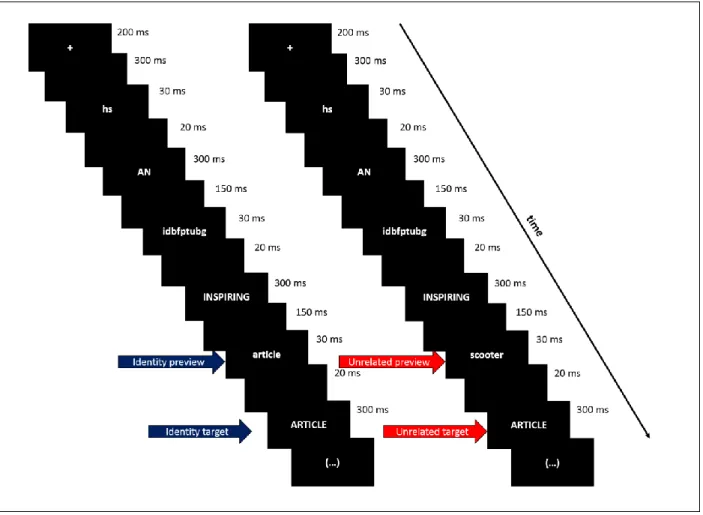
Figure 1: Experiment 1 Excerpt from a Sentence Reading trial…….………….……..…..……..12
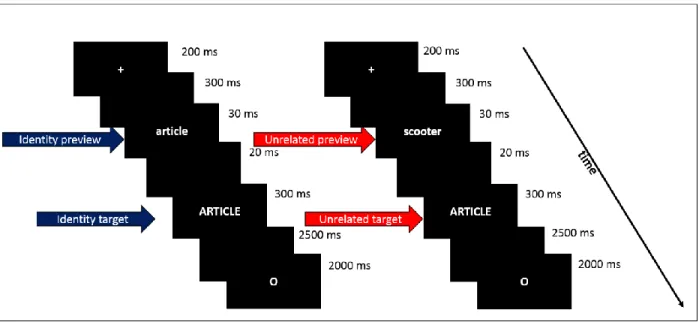
Figure 2: Experiment 1 Excerpt from an Isolated word with lexical decision trial…..….………13
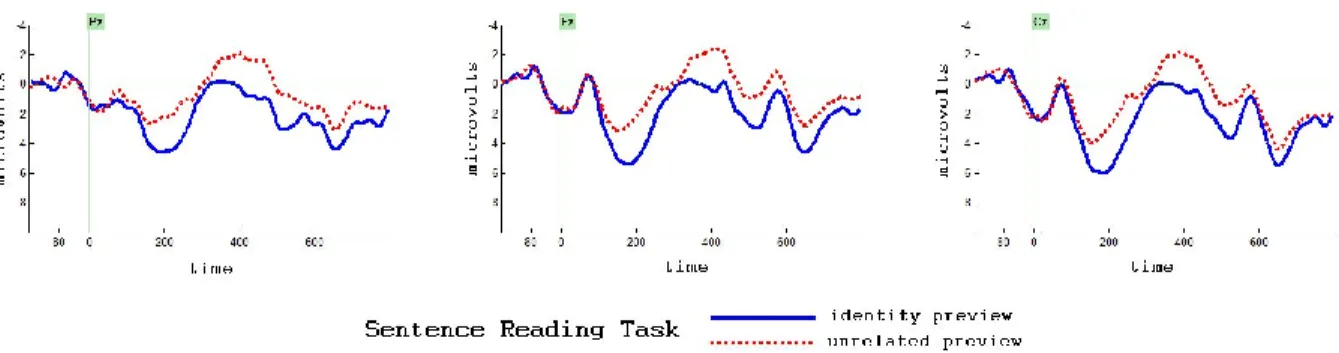
Figure 3: Experiment 1 Select electrodes in the sentence reading task………..…….….……….15
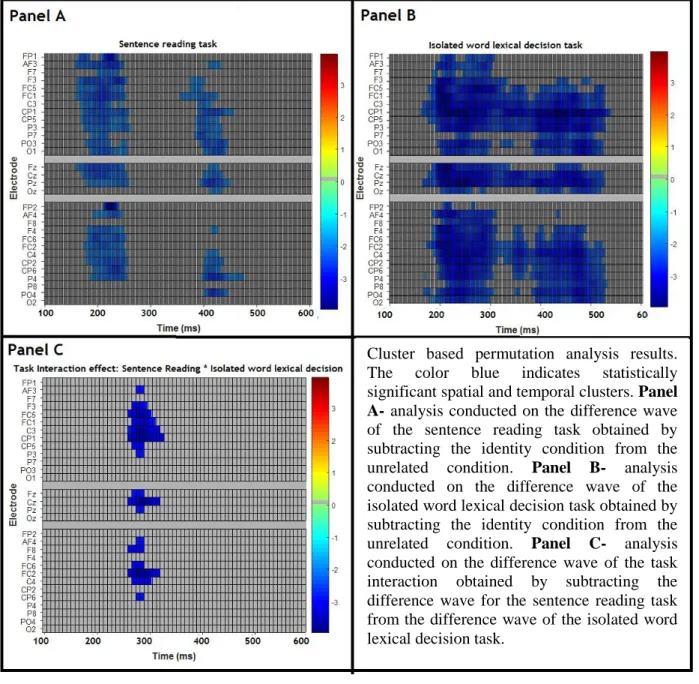
Figure 4: Experiment 1 Cluster-based permutation analyses results……….……….……...16
Figure 5: Experiment 1 Select electrodes in the isolated word lexical decision task………...….17
Figure 6: Experiment 1 Comparison of task differences……….………….……….18
Figure 7: Experiment 1 Task Interaction Effect……….………….………..19
Figure 8: Experiment 2 Sample Trial…..………….…………..…………..………..22
Figure 9: Experiment 2 Behavioral Parafoveal Preview Effect ….………….………..24
Figure 10: Experiment 3 mean EM measures for target words..……...…..………..28
Figure 11: Experiment 3 Select electrodes for the Sentence Reading with Contingent Display Task …...……….………….……...…..……….………..29
Figure 12: Experiment 3 Cluster Based Permutation Analysis of the Effect of Visual Change on the FRP.….………….……...…..……..………..31
Figure 13: Experiment 4 Eye Movement Data by Preview Condition..……….…...…………..38
Figure 14: Experiment 4 Vincentile Plots ………….………….……...…..………..39
Figure 15: Experiment 4 Select Electrodes of FRPs to Target Words...…..………...40
Figure 17: Experiment 4 Spatio-Temporal factors corresponding to the
P300 (a) and the N400 (b) ... …...…………...43
Introduction
Over the past forty years, eye-movement (EM) research has shaped theories of reading by
providing on-line measures of the processes that lead to comprehension. More recently,
Event-Related Potentials (ERPs) have been used extensively to measure neural correlates of these same
comprehension mechanisms and to gain a deeper understanding of how they unfold over time.
However, findings from these two literatures do not always converge, and establishing a
common ground has proven challenging due to differences in methodology. While participants in
EM experiments typically read connected text and are free to move their eyes at their own
reading rate, participants in ERP experiments are usually presented with one word at a time at a
fixed presentation rate and asked not to move their eyes from a central fixation location. A
consequence of these differences is that parafoveal preview, the ability to process words that are
not currently being fixated, is available in EM studies but not in most ERP studies.
To this day, theories of reading and sentence processing fail to account for the
discrepancies between these two sets of measures. The current work aims to provide some of the
common ground necessary to reconcile EM and ERP. In doing so, it relates established EM and
ERP measures obtained through canonical experimental paradigms to measures obtained by
The Time-course of Lexical Processing in Behavioral and Neural Measures
The divergence between EM and ERP findings is best documented for the time course of
lexical access and processing. The EM literature has estimated that lexical access occurs within
100 and 150 ms after the onset of a fixation on a word (Rayner, 1998; Sereno, Rayner, & Posner,
1998). This estimation is based on the fact that fixations last on average 250 ms and that at least
60 ms are needed for the visual signal to travel from the retina to the higher cortices when the
eyes first land on a word. In addition, before the eyes leave the word, approximately 150 ms are
needed to program and launch a saccade. Lexical access is therefore bound to occur early even if
one allows for the possibility that saccade programming begins while word recognition is still
ongoing (Rayner, 1998; Sereno et al., 1998). In contrast, the ERP literature does not provide
consistent evidence for lexical processing within this early timeframe and places lexical
processing around 400 ms (Bornkessel & Schlesewsky, 2006; Kutas & Federmeier, 2000). While
some ERP studies point to earlier effects, there is no consensus on their latency or their
interpretation (Hauk, Davis, Ford, Pulvermüller, & Marslen-Wilson, 2006; Pulvermüller,
Assadollahi, & Elbert, 2001; Rugg, 1983). Such discrepancies are particularly evident when both
EMs and ERPs are recorded in separate experiments using the same language stimuli. In one
such study (Ledoux, Gordon, Camblin, & Swaab, 2007a), supraliminally presented words were
repeated within the context of a sentence (i.e. At the office Daniel and Amanda moved the cabinet because Daniel needed room for the desk) and EMs and ERPs were recorded in separate blocks. While EMs showed a repetition-priming facilitation on both early and later measures of
processing, ERPs only showed facilitation on a later measure. More specifically, repetition
two measures can be attributed to the mode of stimulus presentation; for the eye-tracking
experiment sentences were presented normally with parafoveal preview available while in the
ERP experiment sentences were presented one word at a time with a fixed presentation rate using
RSVP. This is a standard method that is adopted to reduce electrical noise due to ocular artifacts
in the EEG, but one that eliminates parafoveal preview.
Masked Priming studies can show early neural facilitation in the absence of parafoveal
preview: here the repetition prime is masked and immediately precedes the target (Dufau,
Grainger, & Holcomb, 2008; Grainger & Holcomb, 2009; Holcomb & Grainger, 2006;
Kiyonaga, Grainger, Midgley, & Holcomb, 2007). The earliest effects of masked repetition
priming in such experiments have been found to begin around 90 ms after stimulus presentation
and to affect the N/P150, a component which is thought to reflect the prelexical mapping of
visual features onto orthographic representations (Grainger & Holcomb, 2009). Shortly thereafter
these foveal previews can attenuate the N250, a widely distributed component with a peak that
occurs between 175 and 300 ms in frontal electrodes (Grainger, Kiyonaga, & Holcomb, 2006).
The N250 is sensitive to both absolute and partial orthographic previews and has been
interpreted as an index of processing at the interface between sublexical and lexical units,
specifically reflecting a mismatch between the representations activated by the prime and those
activated by the target. When the prime is a transposed-letter version of the target, the partial
orthographic overlap results in greater N250 facilitation than when it is a letter substitution (i.e.
‘barin–brain’ vs ‘bosin–brain’) (Duñabeitia, Molinaro, Laka, Estévez, & Carreiras, 2009).
However, if the transposed-letter preview is itself a word (i.e. ‘causal–casual’), processing
facilitation is no longer evident on the N250, suggesting that this component may reflect
depend on overlap on the retina between target and prime, effects on the N250 as well as the
later N400 are resistant to small horizontal location shifts (Davis & Forster, 1994; Dufau et al.,
2008) a finding that implies the integration of higher level previewed information in a way that is
similar to parafoveal processing.
As mentioned above, this early facilitation surfaces in the isolated word recognition task
where participants’ attention is focused on the specific characteristics of the target word. It is
unknown whether the N250 is affected by repetition during sentence reading, a task which
requires attention to the semantic content of words and their relations to the sentential context.
The presence of such early effects of repetition in sentence reading would narrow the temporal
gap between neural and behavioral measures. It would further show that readers who are not in
control of their reading rate can still extract and integrate preview information that is masked and
presented foveally.
Preview and Priming
Proficient readers are able to move quickly through text and extract information
efficiently by coordinating attentional, oculomotor and lexicosemantic processes. In order to
begin lexical processing of a word within a sentence, a reader must first attend to it and begin
processing its visual features. Most visual information is obtained from the fovea, the area of the
retina with highest visual acuity which covers approximately 2° of the visual field, but some
additional information is obtained from the parafovea, the surrounding area which has reduced
retinal acuity (Rayner, 1998). In most cases, information that is extracted parafoveally from
words to the right of fixation is integrated with foveal information once the words are fixated
parafoveal preview is shown by the increase in reading times when parafoveal information is
masked, invalid or partial (Henderson & Ferreira, 1993; Inhoff, 1989; Schroyens, Vitu,
Brysbaert, & d'Ydewalle, 1999). Foveal previews as those discussed above in masked repetition
priming experiments offer analogous benefits. In this case, processing of a word is facilitated by
a masked prime which is presented so briefly that it is not detected by the participant. The
subsequent target word is facilitated when it is identical to the prime, suggesting that previewed
information can be extracted within tens of milliseconds and used to “jump-start” processing of
the next word (Forster & Davis, 1984; Grainger et al., 2006). While the first type of preview
occurs during natural reading, the second is the principle method for studying neural processes,
particularly ERPs (Grainger & Holcomb, 2009; Rugg & Nagy, 1989) but also functional
Magnetic Resonance Imaging (fMRI) (Dehaene et al., 2001; Kouider & Dehaene, 2007;
Naccache & Dehaene, 2001).
Parafoveal preview and masked repetition priming are functionally similar processes in
that they rely on some type of briefly available preview to provide information about the
upcoming text. Regardless of whether they tap into the same cognitive mechanisms,
understanding how they relate is crucial to the interpretation of divergent findings in the EM and
ERP literature.
Both types of preview can facilitate word recognition and lexical processing through the
activation of representations of varying complexity, from orthographic to semantic. This
information is then quickly processed despite sub-optimal circumstances of presentation:
decreased retinal acuity in the parafovea results in perceptually impoverished parafoveal
For both types of preview, facilitation does not depend fully on physical similarity
between preview and target: previews facilitate targets that differ in size, case or font (Chauncey,
Holcomb, & Grainger, 2008; Holcomb & Grainger, 2006; Rayner, McConkie, & Zola, 1980) and
different levels of processing can be facilitated depending on the characteristics of the previewed
information.
Though parafoveal processing occurs naturally during normal sentence reading, isolating
its effects requires the use of the boundary technique (Rayner, 1975). This is a
contingent-display paradigm in which sentences are presented on a screen and an invisible boundary is
defined between a word (n) and the following (n+1). When the participants' eyes cross the
invisible boundary they cause a display change that typically goes unnoticed due to a
phenomenon known as saccadic suppression which prevents visual information from being
recoded while the eyes are moving (A. Inhoff, Eiter, Radach, & Juhasz, 2003; Matin, 1974).
Wordn+1 is masked or replaced by a different word until it is revealed by the display change, eliminating the possibility of true parafoveal processing. Reading times are shorter when full
parafoveal preview is present compared to situations in which it is partial, invalid, degraded or
absent (Gagl, Hawelka, Richlan, Schuster, & Hutzler, 2014; Henderson & Ferreira, 1993; A. W.
Inhoff, 1989; Schroyens, Vitu, Brysbaert, & d'Ydewalle, 1999).
Masked repetition priming, on the other hand, occurs only in experimental tasks where
stimuli are presented one at a time at the center of the screen and the prime is presented as a brief
foveal preview preceding the target and is then immediately masked. The typical masked
repetition priming task, isolated word recognition, requires participants to read words in isolation
the form of faster reaction times (RTs) in lexical-decision (Forster & Davis, 1984) and
word-naming tasks (Ferrand, Grainger, & Segui, 1994) as well as reduced ERP components associated
with the difficulty of recognizing a target in isolated word recognition (Dehaene et al., 2001;
Grainger & Holcomb, 2009; Holcomb & Grainger, 2006) and shorter gaze durations on target
words during sentence reading (Nakayama, Sears, & Lupker, 2010; Sereno & Rayner, 1992).
These effects tend to be smaller and shorter-lived than their supraliminal counterparts (Forster &
Davis, 1984; Holcomb, Reder, Misra, 2005) which have been found to occur even days after the
initial presentation of a word (Scarborough, Cortese, & Scarborough, 1977; Jacoby, 1983).
The lack of preview awareness in both parafoveal processing and masked repetition
priming does not imply that these processes occur without attention. On the contrary, findings
that the foveal load mediates the parafoveal preview benefit (Henderson & Ferreira, 1990;
White, Rayner, & Liversedge, 2005a) and that the size of the perceptual span is variable
(Henderson, Pollatsek, & Rayner, 1989; A. W. Inhoff, 1989; Miellet, O'Donnell, & Sereno,
2009) indicate that parafoveal processing depends on covert attention being allocated to the right
of fixation, though the mechanisms by which this occurs are the subject of debate (Engbert,
Nuthmann, Richter, & Kliegl, 2005; Morrison, 1984; Reichle, Pollatsek, Fisher, & Rayner,
1998). In supraliminal priming, attention operates in two distinct ways depending on the stimulus
onset asynchrony (SOA) between prime and target: with longer SOAs subjects can use
information from the prime to actively predict the nature of the target whereas with shorter SOAs
such top-down strategies are not employed (Posner & Snyder, 2004). Attention appears to play a
similar role during masked priming though the topic has not been explored as extensively. When
temporal attention is manipulated by varying the stimulus onset asynchrony (SOA) of the
priming is reduced or eliminated in number comparison and lexical decision tasks. This suggests
that masked stimuli require some amplification by attention in order to be processed (Naccache,
Blandin, & Dehaene, 2002; Smith, Besner, & Miyoshi, 1994). Accordingly, endogenous
attention is a driver of parafoveal preview benefit and it is at least a component of the masked
priming benefit. Because these two mechanisms operate in different domains of reading, further
comparisons between them pose a challenge that demands a closer study of their effects under
similar conditions. A deeper understanding of the similarities between parafoveal preview and
masked priming can aid in the interpretation of discordant findings on the time-course of lexical
processing from the behavioral and neural literature. The main goal of the current study is to
reduce the differences between the methods used in the two literatures to obtain effects that can
be related more easily. Four experiments are presented. In Experiment 1 we assess whether the
neural effects of masked repetition priming extend from isolated word-recognition tasks to
sentence reading during RSVP by comparing the two tasks with the same set of participants and
stimuli. Experiment 2 replicates the parafoveal preview benefit effect in EMs using the
contingent display paradigm and the same stimuli as Experiment 1. Experiment 3 explores the
neural correlates of the parafoveal preview benefit employing a novel technique in which EMs
and EEGs are synchronously recorded as participants read sentences with the contingent display
paradigm. Finally, Experiment 4 identifies the neural equivalent of the parafoveal preview
Experiment 1: Masked Repetition Priming in Words and Sentences
The first step in assessing whether previewed information is extracted and integrated
similarly during parafoveal preview and masked repetition priming is to determine whether the
effects of priming found in isolated word-recognition tasks can be replicated in a task that
typically relies on parafoveal preview processing. This task is sentence reading. In Experiment 1
we do so by extending the masked priming technique used in isolated word recognition tasks to
the RSVP mode that is traditionally used in ERP studies of sentence reading. We then compare
its effects on targets embedded in word lists and in sentences. Previous studies have shown both
early (N250) and later (N400) neural effects of masked repetition priming on isolated words
presented in lists but only later (N400) effects when repetition occurred supraliminally within the
context of a sentence despite early behavioral evidence that foveal previews were impacting
processing at the earliest stages (Huang, Hopfinger, & Gordon, 2014; Ledoux et al., 2007a). The
facilitation of featural word properties reflected by the N250 might be too short-lived or not
survive the processing of intervening words, while lexical and semantic facilitation reflected in
the N400 persists across the longer lags between words in sentences (Misra & Holcomb, 2003;
Nagy & Rugg, 1989; Rugg & Nagy, 1989). Alternatively, participants may establish different
perceptual sets to meet diverse task demands: this may result in reduced analysis of lower-level
features during sentence reading, where the task focus is on a higher-level understanding of the
sentence, compared to isolated word recognition for lexical decision, where the focus is on each
word’s lexicality.
Method
participated in both the sentence-reading and isolated word-recognition phases of this
experiment. All participants reported having normal or corrected to normal vision and no history
of neurological impairment. They were compensated $25 for their participation and signed
informed consent before beginning the experiment.
Stimuli.
Sentence Reading (RSVP) Task. The critical stimuli were five-to-eight letter words which were preceded by either the same word (Identity Preview, e.g., ARTICLE-article) or a different word
(Unrelated Preview, e.g., MOSQUITO-magician) and were embedded in sentences (Appendix
A). Each sentence contained two target words, one per preview type, for a total of 80 target
words in 40 sentences. Two lists were created in which the preview type was counterbalanced
and participants were randomly assigned one version of each sentence with the first target
appearing as the third, fourth or fifth word in the sentence and the second target as the seventh,
eighth or ninth word. Non-target words in each sentence served as fillers and were preceded by
preview stimuli consisting of random letter strings which matched them in length. Each trial
ended with a true/false comprehension question.
Isolated Word Lexical Decision Task. The critical stimuli were 80 words matched in length, mean frequency and frequency range1 to the stimuli from the sentence reading task. They were preceded by identity or unrelated previews as in the previous task. Twenty non-word fillers were
preceded by different previews and randomly distributed in each experimental list. The
preview-target /filler pairs were presented in isolation and followed by a lexical decision task. A list of all
experimental stimuli can be found in Appendix B.
Procedure. Participants sat in a dimly lit sound-attenuated booth, looking at a display that was
placed at approximately 55 cm from their eyes. Half of the participants performed the Sentence
Reading Task first and half performed the Isolated Word Lexical Decision Task first. A
gamepad was used for manual responses for comprehension questions and lexical decisions. At
the beginning of each task participants completed a 10 trial practice block to become familiar
with the task and were given feedback on their performance by the experimenter.
All stimuli were displayed on a 17 inch CTR monitor with a refresh rate of 100 Hz in white Arial
font over a black background. Previews were presented in lower-case and targets and fillers in
uppercase.
For the Sentence Reading Task each trial (Figure 1) began with a 300 ms fixation cross
followed by a 200 ms blank screen. The sentence was presented one word at a time in RSVP
with an SOA of 500 ms between words that made up the sentence. Words were presented for
300 ms and were followed by a 150 ms blank screen. Each word was preceded by a 30 ms
preview (random letter strings for filler words and related or unrelated previews for target words)
Figure 1- Experiment 1 Excerpt from a Sentence Reading trial.
At the end of the sentence a comprehension question appeared, with the participant’s
response triggering the onset of the next trial. Participants were encouraged to blink during the
time that the question was on screen to reduce ocular artifacts during the trial.
The Isolated Word Lexical Decision Task followed the same time course as the Sentence
Reading Task except that only a single preview-target pair was presented (Figure 2). The blank
screen following the word cued the participant to press a button for non-word fillers and make no
overt response for target words. A two second blink cue appeared on screen two and a half
between trials. In both tasks participants were instructed to maintain central fixation at all times
during the experiment.
Figure 2: Experiment 1 Excerpt from an Isolated word with lexical decision trial.
EEG Recording and processing. The EEG was recorded through the Active-Two Biosemi system from 32 Ag/AgCl active electrodes positioned according to International 10/20 system at
a sample rate of 512 Hz. Four additional electrodes positioned at the outer canthi and under the
eyes were used to monitor eye-movements and blinks while two supplementary electrodes were
placed on the mastoid bones and used for offline referencing.
Continuous EEGs were then processed offline in the Matlab plugins EEGlab (Delorme &
Makeig, 2004) and ERPlab (Lopez-Calderon & Luck, 2014). EEGs were first bandpass filtered
offline from .1 Hz to 30 Hz and then time-locked to target words in both conditions for epoching
with a 100 ms pre-prime baseline. Epochs from both conditions were then submitted to a moving
window peak-to-peak artifact rejection algorithm which rejected epochs containing voltages
muscle artifacts undetected by the algorithm. This resulted in an average rejection rate of 4.89%
for the Sentence Reading Task and 2.94% for the Isolated Word Lexical Decision. Separate
waveforms were obtained by averaging the remaining epochs in the identity preview and the
unrelated preview condition and a grand average wave was obtained by averaging the ERPs of
all subjects.
Statistical analysis
Difference waves were computed from the grand-averaged data by subtracting the
identity preview condition from the unrelated preview condition separately for both tasks. The
difference waves were submitted to a repeated-measures, two-tailed, cluster-based permutation
test based on the cluster mass statistic (Bullmore et al., 1999) in the Mass Univariate ERP
Toolbox (Groppe, Urbach, & Kutas, 2011). A family-wise alpha of .05 was adopted for both
experiments and included in the analysis of all 30 scalp electrodes as well as all time points
between 100 and 600 ms, resulting in a total of 7710 comparisons. Repeated measures t-tests
were performed for each comparison in the original data and on 5000 random within-participant
permutations of the data (Manly, 1997). For each permutation, t-scores equal or smaller than an
uncorrected p-value of .01 (the cluster inclusion threshold) were entered into clusters with
neighboring t-scores that met the same criterion. Spatial neighbors were defined as electrodes
within a radius of 5.44 cm and temporal neighbors as adjacent time points. Cluster masses were
obtained by summing the t-scores within each cluster and the most extreme masses were recoded
to estimate the null hypothesis distribution. Finally clusters masses in the original data were
ranked against those in the permutations to derive their unique p value which was assigned to
The cluster-based permutation test analysis was used because it does not require an
a-priori definition of electrodes or timeframes of interest as does the more conventional ANOVA
approach to ERP analysis. Furthermore the cluster based permutation test maintains control of
the family-wise alpha level affording the possibility of a thorough exploration of the entire epoch
while controlling for multiple comparisons. In our analysis time points after 600 ms were
excluded to avoid component summation between ERPs elicited by the targets and ERPs elicited
500 ms later by the presentation of previews in the Sentence Reading Task.
Results
Sentence Reading Task.
Figure 3 shows average ERP waves in select central electrodes in the identity and the unrelated
preview conditions in the sentence reading task. Each electrode shows an increased negativity
peaking around 200 ms for the unrelated compared to the identity preview condition and a
Figure 3- Experiment 1 Select electrodes in the sentence reading task
Similarly the cluster based permutation analysis (Panel A, Figure 4) established two main
clusters of significance. The first one (p<.001), which begins approximately 156 ms post
stimulus presentation and ends by 260 ms, includes all electrodes in the left hemisphere and all
frontal, central and centro-parietal electrodes in the midline and in the right hemisphere as well
as Pz and P4. The second cluster (p<.05) is comprised of almost all electrodes in the left
hemisphere and midline and central, centro-parietal and parietal electrodes in the right
hemisphere. It begins at approximately 353 ms post-stimulus presentation in the left hemisphere
and 394 ms in the right hemisphere and ends by 455 ms in the left hemisphere and 472 ms in the
Figure 4: Experiment 1 Cluster based permutation analyses results.
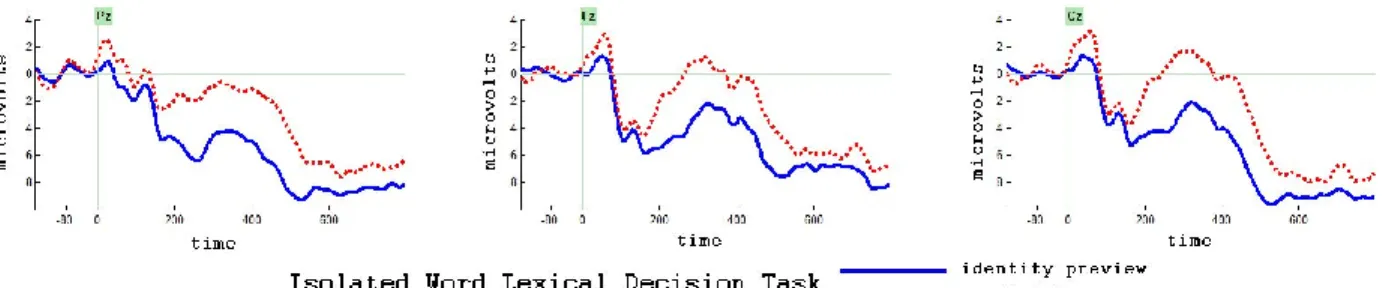
Isolated Word Lexical Decision Task. The average ERPs depicted in Figure 5 show a long lived negativity with two peaks indicating that the unrelated preview condition is more negative than
the identity preview condition throughout the epoch but more so in two peaks around 200 and
450 ms.
Figure 5: Experiment 1 Select electrodes in the isolated word lexical decision task
The cluster-based permutation analysis (Panel B, Error! Reference source not found.4)
paints a similar picture in that it identifies only one large cluster of significance (p<.001) which
extends from 162 ms to 537 ms and includes most electrodes around the time points
corresponding to the difference wave peaks (~200 ms and ~450 ms) and mostly frontal and
central electrodes around 300 ms post stimulus offset.
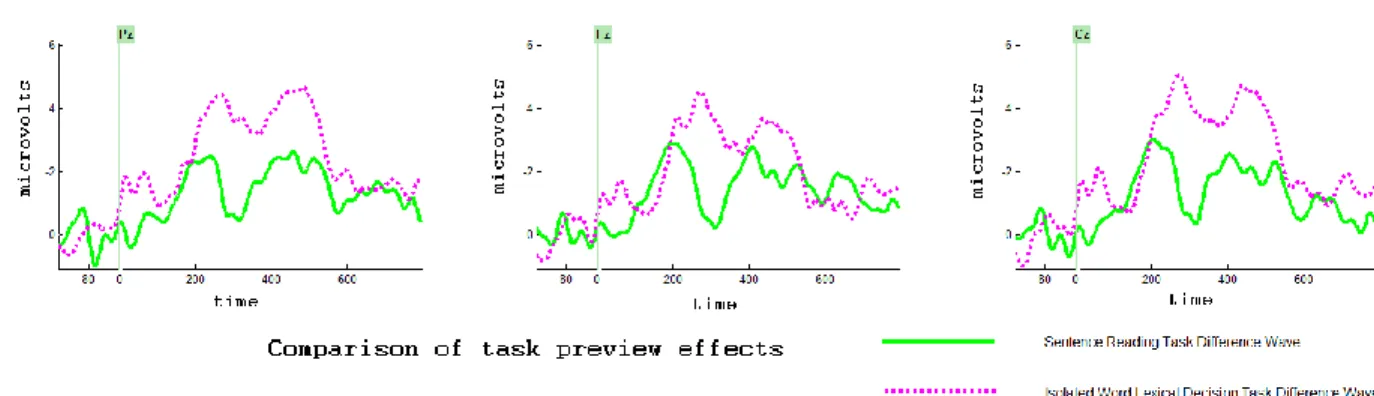
Task interaction. Both tasks revealed a significant masked priming effect for identity previews. The ERP for this condition peaked twice within the epoch of interest: first around 200 ms and
then again around 450 ms. The isolated word lexical decision task however showed that the
significant attenuation associated with identity preview persisted between the two main peaks,
unrelated preview condition for each task are presented on the same plot to illustrate the
difference in the magnitude of the effect for Sentence Reading and Isolated Word Lexical
Decision.
Figure 6: Experiment 1 Comparison of task differences. Each line is the difference wave of
the grand average for a task, calculated subtracting the identity preview condition from the
unrelated preview condition.
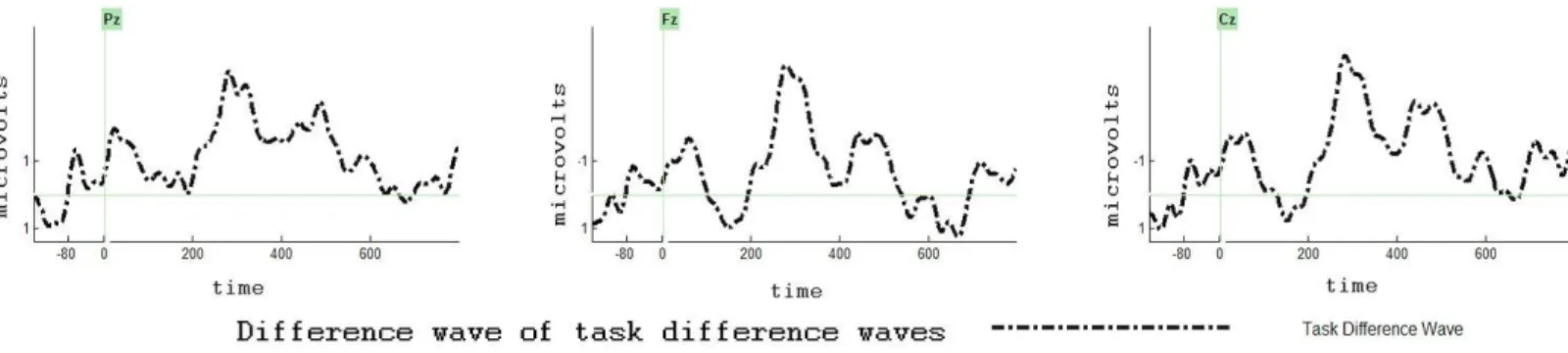
This difference indicates that the effect of identity preview is modulated by the reading
task being performed. This possibility was examined with the calculation of a task difference
wave by subtracting the grand averaged difference wave for the sentence reading task from that
for the isolated word lexical decision task which revealed a protracted negativity for the isolated
Figure 7- Expriment 1 Task Interaction Effect. The dashed line represents is the difference
wave of the two task difference waves and was obtained by subtracting the sentence
reading repetition effect from the isolated word during lexical decision repetition effect.
A final cluster-based permutation analysis on the task difference wave (Panel C,
Bullmore et al., 1999Error! Reference source not found.) confirmed a significant task by
repetition interaction (p< .05) between 261 ms and 335 ms which included mostly frontal and
central electrodes. The interaction points to a larger and longer lasting effect of repetition on the
N250 for isolated word recognition than word recognition during sentence reading and no
significant difference between the tasks on the N400.
Discussion
The current findings provide the first report of both early (N250) and later (N400) effects
of masked priming on word recognition during a sentence-reading task. Early effects were
previously only found in isolated word-recognition tasks. Our results show integration of prime
and target representations beginning around 160 ms for both the isolated word task and the
previous findings from both the word in isolation and sentence reading literature (Grainger et al.,
2006; Ledoux, Gordon, Camblin, & Swaab, 2007b; Nagy & Rugg, 1989; Rugg & Nagy, 1989).
Earlier, several properties of sentence reading were identified as possible causes for the absence
of an early neural marker of preview feature integration. Among these were the presence of
intervening items, the long lags between prime and target and the reduced attentional focus to
form level features were all identified of preview features in sentence reading. Here, we showed
that removing lags and intervening items does indeed restore integration of lower level preview
information early during target processing in sentence reading but that this effect is still reduced
compared to the isolated word task. No difference between tasks was found for the later effect on
the N400 component. The task difference on the early measure may reflect enhanced featural
processing in the isolated word with lexical decision task. This task implicitly requires
participants to examine the word form closely in order to correctly reject pseudoword foils. On
the other hand, feature processing in the sentence reading task is only necessary to the extent that
it will lead to recognition of the current word and may require fewer attentional resources from
the reader.
In sum, the current experiment showed that masked repetition priming extends to
sentence reading, the domain of parafoveal preview processing, and it suggests the demands of
sentence processing determine how attentional resources are allocated as is the case for
parafoveal preview processing.
Experiment 2: Behavioral Parafoveal Preview Benefit
The next step in assessing whether previewed information is extracted and integrated
behavioral parafoveal preview benefit with the stimuli from the sentence reading portion of
Experiment 1 where early and late neural effects of masked priming were found. In Experiment 2
we do so by measuring participants’ EMs as these stimuli are presented with the
contingent-display paradigm (Rayner, 1975).
Method
Participants. Twenty-eight English speakers (18 female) enrolled in an Introduction to
Psychology course at the University of North Carolina at Chapel Hill participated in the study.
All participants reported having normal or corrected to normal vision and no history of
neurological impairment. They received course credit for their participation and signed informed
consent before beginning the experiment.
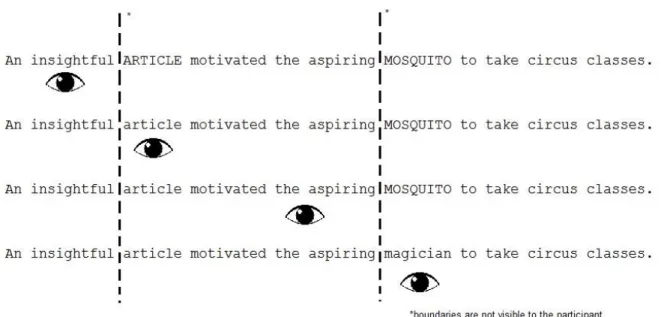
Stimuli. Participants read the same set of sentences presented in Experiment 1’s Sentence
Reading Task but sentences were presented with the contingent display paradigm (Rayner, 1975)
in which saccades crossing a pre-defined invisible boundary between words trigger a display
change (Figure 8). Parafoveal availability of two critical target stimulus words per sentence was
controlled by masking each word with either an identity uppercase mask (Identity Preview , e.g.,
ARTICLE-article) or an unrelated uppercase mask (Unrelated Preview, e.g.,
MOSQUITO-magician) until the invisible boundary in the blank space preceding the word was crossed and the
critical word was presented in lower case. The case change between mask and target ensured that
some type of display change would occur in both conditions. This way any difference between
fixation durations on the unrelated and the identity preview conditions could be attributed to
the Sentence Reading Task of Experiment 1, each sentence was followed by a simple True/False
comprehension question.
Figure 8- Experiment 2 Sample trial – The eye icon represents the participant’s fixation
location and dashed lines represent invisible boundaries between words.
Procedure. Participants sat in a dimly lit sound-attenuated booth with their head stabilized by a
desk-mounted head-rest and looked at a display that was placed 55 cm from their eyes. Sentences
were presented with Experiment Builder (SR Research). Participants were instructed to read the
sentences naturally to themselves, to ignore any “flicker” they might notice on the screen and to
respond to comprehension questions with a button press on a gamepad. At the beginning of each
experiment participants completed a five-trial practice block to become familiar with the task
and were given feedback on their performance by the experimenter. All stimuli were displayed
on a 24” LCD monitor with a refresh rate of 120 Hz in a black monospaced font over a white
background. Previews were presented in lower-case and targets in uppercase. Eye movements
was calibrated using a 9-point procedure at the beginning of each session and again during the
experiment if the between-trial calibration-check revealed excessive drift. Participants read
sentences at their own pace and pressed a button on the gamepad to advance to the
comprehension question. At the end of the experiment participants were asked to report whether
they had noticed anything unusual about the visual display of the text and were encouraged with
increasingly specific questions to reveal the degree to which they had become aware of the
manipulation.
Statistical analysis
Trials in which the display change occurred more than 10 ms after the first crossing of the
invisible boundary were excluded from the analysis as were trials where the participant blinked
on the pre-target or target word. The remaining 76.5% of trials were included in the final
analysis. Reading-time measures were then calculated for all participants and submitted to a
paired sample t-test with Preview as the independent variable. Single-fixation duration was
defined as the average of the duration of the initial, first-pass fixation on a word given that the
word received only one first-pass fixation. First-fixation duration was calculated as the average
duration of the initial fixation on a word regardless of whether the word was subsequently
re-fixated. Gaze duration was the average of the sum of all first-pass fixation durations on a word.
Results
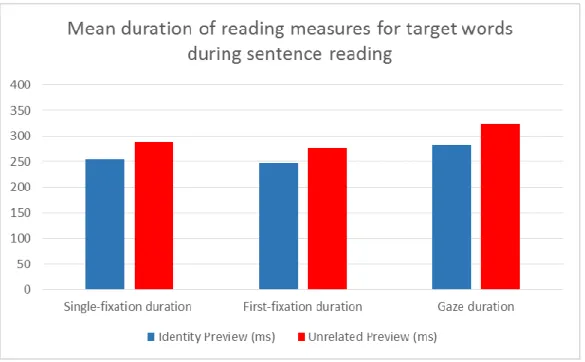
Figure 9 indicates that, on average, words in the identity preview condition
were fixated for shorter durations than words in the unrelated preview condition across a number
of measures. This effect was significant for all measures: Single-fixation duration [t(27)=6.12,
Figure 9: Experiment 2 Behavioral Parafoveal Preview Effect
Discussion
Participants showed faster reading times when an identity preview was available in the
parafovea, thereby showing that the stimuli that produced masked priming benefit in Experiment
1 also produce the classic parafoveal preview benefit as measured by eye movements (Rayner,
McConkie, & Zola, 1980; Rayner, 1975). 0
50 100 150 200 250 300 350 400
Single-fixation duration First-fixation duration Gaze duration
Mean duration of reading measures for target
words during sentence reading
Experiment 3: Parafoveal Preview Processing with Coregistration of Behavioral and Neural Measures.
In an effort to further relate parafoveal processing and masked repetition priming the
neural correlates of the parafoveal preview benefit are investigated by synchronously recording
participants’ EMs and EEGs as they read sentences with the contingent display paradigm. This
fairly novel experimental technique, which is also known as coregistration, faces the challenge of
producing a useful EEG recording in spite of the electrical noise introduced into the signal by
the saccadic EMs that occur during natural reading. Here we attempt to overcome this challenge
by decomposing the EEG signal into independent source components (ICA), and rejecting
components that are primarily driven by ocular artifacts (Winkler, Haufe, & Tangermann, 2011).
Previous research from a task in which participants read a series of horizontally displayed
words pointed to the attenuation of a posterior negativity between 200 and 280 ms as the index
of processing facilitation due to parafoveal preview (Dimigen, Kliegl, & Sommer, 2012). The
same study found an attenuation of the N400 that failed to reach significance. It is however
unclear whether either of these findings would extend to skilled sentence reading because
reading array of words likely requires a distinct strategy. Here we investigate this question with
the same set of stimuli employed in Experiments 1 and 2.
Method
Participants. Twenty native English speakers (9 female, average age 22 years) from the
University of North Carolina at Chapel Hill and surrounding community participated in the
history of neurological impairment. They received approximately $20 for their participation and
signed informed consent before beginning the experiment.
Stimuli. Participants were presented with the same set of stimuli as in Experiment 2.
Procedure. The experimental procedure was identical to that of Experiment 2 but participants’
EEG was recorded concurrently to their eye-movements. Sentences were presented with
Experiment Builder (SR Research) and TTL pulses were sent to the EEG recording computer at
the beginning of each trial and every time an invisible boundary was crossed triggering a display
change. Continuous EEGs were recorded as in Experiment 1.
EEG processing. The continuous EEG was processed offline in the Matlab plugins EEGlab (Delorme & Makeig, 2004) and ERPlab (Lopez-Calderon & Luck, 2014). EEGs were first
high-pass filtered offline at .1 Hz and independent components were extracted with the RUNICA
function in EEGlab. Components arising from ocular artifacts were classified with the Multiple
Artifact Rejection Algorithm (Winkler et al., 2011) and visual inspection was used to identify
and then correct components arising from ocular artifacts. The signal was then low-pass filtered
at 30 Hz and merged with the eye-track by synchronizing the TTL signals in the EEGlab plugin
EYE-EEG (Dimigen et al., 2011). Epochs were time-locked to the first target fixation after the
display change and averaged across conditions to obtain Fixation Related Potentials (FRPs) for
each participant in every condition. Follow-up analyses were conducted to assess whether the
visual change from uppercase preview to lowercase target word itself elicited any changes in the
brainwave. In order to do so, comparison FRPs were calculated for non-boundary content words
Statistical Analysis
Eye Movements. EM analysis was performed with a procedure identical to that described in
Experiment 2.
Fixation Related Potentials. Cluster-based permutation analyses as described in Experiment 1
were conducted to examine the effects of preview condition and any possible effects due to
detecting a salient visual change during sentence reading. An additional repeated-measures
ANOVA with preview condition and electrodes as factors was computed to further explore
parafoveal preview effects in select electrodes and time intervals.
Results
Eye Movements. The current experiment replicated the findings from Experiment 2 on all EM
measures. Figure 10 indicates that, on average, words in the identity preview condition were
fixated for shorter durations than words in the unrelated preview for Single-fixation duration
[t(18)=4.72, p<.001], First-fixation duration [t(18)=4.14, p<.01] and Gaze-duration [t(18)=5.47,
Figure 10- Experiment 3 mean EM measures for target words.
Fixation Related Potentials. Figure 11 shows a comparison between grand average FRPs in the
identity preview and unrelated preview conditions. FRPs to the identity preview condition and
the unrelated condition appear to diverge around 100 ms on frontal and central electrodes (See
Appendix II for a topographical representation of all scalp electrodes) but this difference did not
reach significance in a cluster-based permutation analysis contrasting the two conditions. This
type of analysis is necessary to control for the increased false discovery rate that results from
making multiple comparisons across time intervals and electrodes in the FRP and is particularly
appropriate to test effects that are not hypothesis driven such as the one discussed above (Groppe
Figure 11- Experiment 3 Select electrodes for the Sentence Reading with Contingent
Display Task.
Nevertheless, a traditional and less conservative factorial ANOVA approach was
employed to compare main effects of preview condition and electrode as well as their
interaction. The average amplitude in the 50-150 ms timeframe and sixteen frontal and central
electrodes2 were selected for the analysis upon visual inspection of the topographical array of FRPs (Appendix II). This analysis revealed a significant main effect of parafoveal preview
[F(1,19)=5.47; p<.05] and a main effect of electrode [F(15, 19)= 8.52; p<.01]3. There was no significant interaction of preview and electrode. This finding is reported cautiously as the
time-frame and electrode selection were chosen a-posteriori and based on visual inspection.
Furthermore, the timing and direction of the effect are not compatible with the neural parafoveal
preview benefit reported by Dimigen et al. (2012) on word series. We performed follow-up
analyses to assess whether our findings may have been affected by the experimental
manipulation, specifically whether the visual change that occurred in all experimental trials
disrupted normal reading.
Follow-up analyses on effects of visual change. We compared mean EM measures for words
following a visual change (target words in both conditions which always changed from
uppercase to lowercase) and words where no visual change occurred (filler words). Results
showed delays in reading for words that followed a display change as measured by first fixation
duration [t(18)=-8.37, p<.001]4 . The effect of display change added an average 31 ms to participants’ first-fixations. When the same analysis was repeated on data from Experiment 2,
results were equivalent [t(28)=-8.85, p<.0001]. We then performed a similar analysis on
Experiment 3’s neural data. The cluster-based permutation analysis contrasting FRPs to words
following a visual change and words following no visual change is represented in Figure 12.
Results show a large, positive effect of display change on all scalp electrodes. This effect is
significant beginning at 201 ms after fixation until the end of the analysis window 700 ms after
fixation. These results show that the visual change occurring in both conditions affected reading
in an unexpected way.
Figure 12- Experiment 3: Cluster based permutation analysis of the effect of visual changes
on the FRP.
Discussion
Access to valid information in the parafovea lead to faster reading in the identity preview
condition compared to the unrelated condition. The only effect of preview on neural measures
was a brief and unexpected increased negativity associated with the identity condition which
lowercase when a display change was triggered and were read slower overall compared to words
that didn’t follow a display change. This finding, coupled with the large FRP positivity
associated with words following a display change, points to a temporary hindrance of reading
which may be due to the visual salience of the display change. Further research is needed to
determine the nature of this effect. As mentioned above, Dimigen et al. (2012) manipulated
parafoveal preview of word series. Their manipulation conflated display change and parafoveal
availability as no display change occurred in the identity condition while a lexical change
occurred in the unrelated condition. The authors argue that a visually evoked potential tied to a
display change would appear before 200 ms in components associated with purely visual
processing such as the N1-P1 and that the absence of effects on these early components implies
no impact of the display change itself on the FRP. Our findings in this experiment suggest that
at least a salient display change can impact the FRP well after these early visual components. In
Experiment 4 we manipulate the saliency of the display change in order to separate display
change and parafoveal preview effects.
Experiment 4: Parafoveal Processing of physically and lexically deviant previews
Experiment 4 aims to disentangle the effects of parafoveal preview processing and visual
change. It does so by manipulating preview availability in a less visually salient way and by
employing Principal Component Analysis (PCA) on the FRP wave to isolate distinct sources of
variance.
The results of Experiment 3 showed that normal reading was disrupted when display
target word. While saccadic suppression should limit display change awareness as the eye is
moving to the target (Matin, 1974) some participants can detect changes and their reading
patterns are qualitatively different from those of participants who are not aware of anything
unusual happening to the text (White, Rayner, & Liversedge, 2005b). Signal detection analyses
on trial by trial reports of visual change detection show that participants are less sensitive to a
case change for alternating case words (i.e. ExAmPle/eXaMpLe) compared to an identity change
(i.e. LaMdPeX/eXamPle) (Slattery, Angele, & Rayner, 2011) whereas our results from
Experiment 3 suggest that a standard case change (i.e. EXAMPLE/example) might be too
visually salient to remain unnoticed. In Experiment 4, the visual salience of the display change
between preview and target is decreased by presenting both in lowercase across conditions. In
the unrelated preview condition, the lexical identity of the previewed word changes as the eyes
cross the boundary (e.g., mosquito/magician). In the degraded preview condition, partial overlap
is obtained between preview and target by removing 10% of the black pixels that constitute the
target word (e.g., /magician) for preview creation. Visual degradation of the stimulus
in the parafovea has been shown to make parafoveal information less accessible as suggested by
longer fixation durations on the target for both children (Marx, Hawelka, Schuster, & Hutzler,
2015) and adults (Gagl et al., 2014) and, unlike parafoveal masks, it does not appear to disrupt
foveal processing nor lead to visual change awareness. The identity preview condition, in which
no change occurs between preview and target (e.g., magician/magician), is used as a baseline
measure of processing with valid parafoveal preview for both behavioral and neural measures.
The effects of parafoveal processing and visual change are further analyzed by submitting the
FRP to a PCA in order to assess whether distinct sources of variance are associated with the
Method
Participants. Thirty-six right-handed native English speakers (22 female, mean age 21.77 years)
from the University of North Carolina at Chapel Hill and the surrounding community
participated in the experiment. Participants received either one course credit or $10 per hour in
exchange for their participation. Four participants’ data were excluded from the analysis due to
an insufficient number of trials meeting analysis selection criteria.
Stimuli. Stimuli consisted of three hundred target words embedded in the same number of
sentences. Of these, forty are comprised of the sentence stimuli from Experiments 1 - 3, though
only one of the two original target words was manipulated in the current experiment. Target
words never occurred in first, second or last position in the sentence and, in order to maximize
the likelihood of parafoveal processing of the target, were never preceded by a closed-class
word. As in Experiments 2 and 3 sentences were presented with the contingent display paradigm
(Rayner, 1975). Degraded stimuli were obtained by randomly exchanging 10% of the black
pixels from the bitmap of the preview with white pixels with an R script adapted from Marx and
colleagues (2015). Sentence frames were equally assigned to conditions and fully
counterbalanced across participants. One third of the trials were followed by a True/False
comprehension question and two thirds by an invitation to press a button to advance to the next
trial.
Procedure. The experimental procedure was identical to that of Experiment 3 with the only
difference that participants were offered additional breaks because of the increased number of
trials.
the 100ms preceding the onset of the first progressive fixation on a target word and the 800 ms
that followed fixation onset. Fixations that were shorter than 120 ms or longer than 600ms, as
well as those that were followed by a regressive saccade were not included in the analysis. These
criteria were necessary to exclude fixations resulting from participants quickly scanning the
sentence before reading it more carefully on a second pass as well as extremely long fixations
that they signal an interruption in normal reading. Though these concerns apply to Experiment 3
as well, the smaller number of trials in that experiment did not permit such stringent exclusion
criteria. Additionally, only fixations that occurred immediately after the boundary change were
included. FRPs were obtained by averaging data epochs for each participant within condition
with a pre-stimulus baseline of 100 ms. Grand-average waves for data visualization purposes
were obtained by averaging each condition across participants.
Statistical Analysis
Eye Movements. Trials in which the display change occurred more than 10 ms after the eyes
crossed the invisible boundary for the first time were excluded from the analysis as well as trials
in which the target word was skipped. Reading-time measures described in Experiment 2 were
calculated and submitted to a repeated measure ANOVA with Preview as a single factor.
Vincentile plots (Hoedemaker & Gordon, 2014; Ratcliff, 1979; Vincent, 1912) were constructed
to provide a visual representation of the distribution of the parafoveal preview effect in the
unrelated and the degraded preview conditions. Plots were obtained by dividing trials for each
participant and condition into ten vincentiles based on first-fixation duration. The fastest 10% of
trials in each condition were assigned to the first vincentile, the next 10% to the second
subtracted from the corresponding value in the unrelated and degraded preview conditions,
thereby obtaining two sets of difference scores per participant. These were further averaged
within condition across participants and displayed as connected points in the vincentile plots,
with the average value of each vincentile in the identity condition as the x axis and the size of the
effect on the y axis. Standard errors associated with each vincentile are depicted as bars
connected to each point in the graph.
Fixation Related Potentials. Three cluster-based permutation analyses were performed on the
FRPs: the contrast between the identity preview condition and the degraded preview condition
tests the EEG-equivalent of the parafoveal preview benefit. Contrasting the identity preview
condition and the unrelated preview condition tests whether the effect described by Dimigen
(2012) for single words can be replicated in sentence reading. Finally, the contrast between
degraded previews and unrelated previews assesses whether the display change in the latter
condition is responsible for FRP differences above and beyond those due to lack of a valid
parafoveal preview. Once the spatial and temporal loci of these effects are identified via the
cluster-based permutation analyses, a repeated-measures ANOVA is performed with preview
type and electrodes as factors.
Principal Component Analysis. In order to observe the contribution of overlapping
components in the FRP, spatial-temporal Principal Component Analysis (PCA) was applied to
the FRP data epochs (Spencer, Dien, & Donchin, 2001; Arbel, Spencer, & Donchin, 2011a).
This type of approach reduces the dimensionality of the original dataset, which consisted of 36
electrodes, 502 time points and 3 conditions for each of the 32 participants, to a new set of
orthogonal dimensions, thereby separating components that overlap in time or space. First a
consisting of the average for each of the 36 electrodes in each condition for every participant.
This type of analysis reduces the dimensionality of the dataset to a set of spatial factors, or
virtual FRPs. Each factor is a linear combination of electrodes that attempts to capture variance
in the data uniquely associated with scalp distribution. Next, a temporal PCA using Varimax
rotation, is applied to each of the spatial factors. Here, the covariance between the time points in
each spatial factor, condition and participant is analyzed and the temporal dimensionality of the
data is reduced to a smaller number of temporal factors representing orthogonal patterns of
temporal activity.
Results.
Eye Movements. Figure 13: Experiment 4 Eye Movement data by Preview Condition Repeated
measures ANOVAs were performed for all EM measures and the omnibus test revealed a
significant effect of preview type: First-fixation duration [F(2,31)=28.74; p<.0001],
Figure 13: Experiment 4 Eye Movement data by Preview Condition
Table 1: Bonferroni corrected pairwise comparisons for EM
Follow-up pairwise comparisons were performed using the Bonferroni correction and the 0
50 100 150 200 250 300 350
First-Fixation duration Single-fixation duration Gaze duration
Mean duration of reading measures for target words during
sentence reading
Identity Preview (ms) Unrelated Preview (ms) Degraded Preview (ms)
EM measure Contrast Std. Error p
Identity vs Unrelated 3.63 <.001 Identity vs Degraded 2.63 <.001 Unrelated vs Degraded 3.75 0.99 Identity vs Unrelated 4.74 <.001 Identity vs Degraded 2.79 <.001 Unrelated vs Degraded 4.81 0.46 Identity vs Unrelated 4.34 <.001 Identity vs Degraded 3.31 <.001 Unrelated vs Degraded 5.02 0.056 First-fixation duration
Single-fixation duration
durations, Single-fixation durations and Gaze Durations that were significantly shorter than those
for words in the unrelated and degraded preview conditions. This pattern replicates the
parafoveal preview benefit and shows that unrelated or degraded information in the parafovea
results in slower reading. The next set of pairwise comparisons assess whether unrelated and
degraded previews result in different patterns of eye movements. The two types of invalid
preview did not significantly differ from one another in terms of average First-fixation duration
or Single-fixation duration. However, the difference between degraded previews and unrelated
previews on the gaze duration measure was found to be marginally significant. These findings
tentatively suggest that the later stages of processing, as captured by Gaze Duration, are
disrupted more by the presence of an unrelated word in the parafovea than they are by the
presence of a degraded word. Most interestingly, these two types of preview differ in the
distribution of their effect on first-fixation durations as illustrated in the vincentile plots below
(Figure 14)Error! Reference source not found..
The red line in panel a of Figure 14 shows that the effect of unrelated preview is
negligible on the fastest fixations but increases linearly as fixations become longer, reaching its
maximum of approximately 55 ms in the slowest 10% of trials. On the other hand, the effect of
degraded preview (Panel b, Figure 14 ) is close to constant and remains between 20 and 30 ms
across the distribution.
Fixation Related Potentials. FRPs corresponding to the three preview conditions are presented
in Figure 15. An early negativity is followed by a positive deflection around 200 ms in all
conditions, after which the identity and the unrelated conditions present a negative deflection
which is most prominent in centro-parietal locations. This negativity is compatible with both the
topography and the latency, roughly between 250 and 500 ms, of the N400. No N400 is present
for the degraded condition, instead FRPs to words in this condition shows a positivity that
continues until the end of the epoch. This positive deflection resembles the positivity that was
associated with words following a display change in Experiment 3.
Figure 15: select electrodes of FRPs to target words
The cluster based permutation analysis comparing the identity and the unrelated condition (Panel
A, Figure 16) identified a significant (p<.01) negative cluster between 336 and 502 ms on all
unrelated word. Panel B, Figure 16, reveals a large significant positivity between 193 and 479ms
which encompasses all electrodes indicating that FRPs to words in the degraded preview
condition are significantly more positive than those to words in the identity preview condition.
Similarly, the degraded condition is significantly more positive than the unrelated as evidenced
While the negative deflection associated with the unrelated preview condition can be identified
as an accentuated N400, the positive deflection associated with the degraded condition does not
conform to N400 topology, nor is it restricted to the N400 time-frame. Instead, this positivity
most resembles a P300, a positive component that has been associated with the resolution of
uncertainty, context updating and attentional allocation (Sutton, 1968; Donchin 1971; Polich
1981) Given the similarity between this positivity and that observed in response to words
following a display change in Experiment 4, it is possible that the distinct visual properties of the
degraded previews are triggering the same type of response that was observed in Experiment 3.
Despite being specifically designed to create a less visually salient display change compared to
their unrelated counterparts, degraded previews are physically deviant from their context of
presentation and may require additional visual analysis or attentional allocation. In order to
examine the possibility that two distinct components are modulating the FRP in the unrelated and
degraded preview condition, Principle Component Analysis is performed.
Principal Component Analysis. The spatial PCA retained 7 factors which together were able to
account for 95% of the variance in the dataset while reducing its dimensionality by 80%5. Each factor, or “virtual FRP”, represents a different pattern of spatial activity: the first one has a
frontal distribution, the second an occipital distribution and the third one a centro-parietal
distribution. Given the typical centro-parietal distribution of both the P300 and the N400, the
third spatial factor (SF3) was identified as the virtual FRP of interest. The remaining factors do
not appear to distinguish between the different preview conditions and are therefore of little
interest to this analysis. Next, a temporal PCA was performed on each virtual FRP as described
in the methods section. Sixteen temporal factors were retained for Varimax rotation. Of these,
the second factor is compatible with the timeframe of the N400 and the third with that of the
P300.
Figure 17- Experiment 4 spatio-temporal factors corresponding to the P300 (a) and the
N400 (b)
Figure 17 depicts the spatio-temporal factors of interest. The P300 was identified as the third
temporal factor of the third spatial factor (SF3-TF3, centro-patietal distribution with peak at
235ms) and the N400 as the second temporal factor of the third spatial factor (SF3-TF2,
centro-parietal distribution with peak at 422ms). The factor scores were averaged within condition
between 200 and 500 ms for the P300 and 250 and 500 ms for the N400 and were analyzed with
a repeated-measures ANOVAs with preview as a sole factor. The ANOVA for the P300 revealed
a main effect of preview [F(2,30)=8.81, p<.001] and Bonferroni corrected pairwise comparisons
showed that the degraded preview condition was significantly more positive than both the
identity preview (p<.001) and the unrelated preview (p<.05) conditions which did not differ from
one another. A main effect of preview was also found for the N400 [F(2,30)=7.90, p<.01] where
Bonferroni corrected pairwise comparisons revealed that unrelated condition was significantly
more negative than either the identity condition (p<.05) or the degraded condition (p<.05). The
identity and degraded preview conditions did not significantly differ from one another. In sum,
degraded previews affect the P300 component whereas unrelated previews affect the N400.
Relation of Eye-movement measures and Fixation Related Potentials
The EM effect distributions were superimposed on the PCA plots in order to visually
compare the time course of the effects across measures.
Figure 18: Experiment 4 Distribution of EM effects superimposed on FRP PCA results
Panel A of Figure 18 shows that the degraded preview effect in EMs unfolds within the
timeframe of its neural equivalent, the P300, meaning that it is possible, though not certain, that
the two measures arise from the same underlying process that occurs relatively early during word
recognition. On the other hand, Panel B of Figure 18 shows that the EM effect in response to
unrelated previews begins before the N400 response and reaches its maximum on the slowest
fixations, which on average occur before the N400 peak and well before its return to baseline.
This pattern replicates the temporal gap that commonly occurs between neural and behavioral