Integrative transcriptomic analysis reveals key
drivers of acute peanut allergic reactions
C.T. Watson
1,2, A.T. Cohain
1,3, R.S. Grif
fi
n
4, Y. Chun
1, A. Grishin
5, H. Hacyznska
1, G.E. Hoffman
1,3,
N.D. Beckmann
1,3, H. Shah
1, P. Dawson
6, A. Henning
6, R. Wood
7, A.W. Burks
8, S.M. Jones
9, D.Y.M. Leung
10,
S. Sicherer
5, H.A. Sampson
5, A.J. Sharp
1, E.E. Schadt
1,3& S. Bunyavanich
1,3,5Mechanisms driving acute food allergic reactions have not been fully characterized. We
profile the dynamic transcriptome of acute peanut allergic reactions using serial peripheral
blood samples obtained from 19 children before, during, and after randomized, double-blind, placebo-controlled oral challenges to peanut. We identify genes with changes in expression triggered by peanut, but not placebo, during acute peanut allergic reactions. Network analysis reveals that these genes comprise coexpression networks for acute-phase response and
pro-inflammatory processes. Key driver analysis identifies six genes (LTB4R, PADI4, IL1R2,
PPP1R3D,KLHL2, and ECHDC3) predicted to causally modulate the state of coregulated
net-works in response to peanut. Leukocyte deconvolution analysis identifies changes in
neu-trophil, naive CD4+T cell, and macrophage populations during peanut challenge. Analyses in
21 additional peanut allergic subjects replicate major findings. These results highlight key
genes, biological processes, and cell types that can be targeted for mechanistic study and therapeutic targeting of peanut allergy.
DOI: 10.1038/s41467-017-02188-7 OPEN
1Department of Genetics and Genomic Sciences, Icahn School of Medicine at Mount Sinai, New York, NY 10029, USA.2Department of Biochemistry and
Molecular Genetics, University of Louisville School of Medicine, Louisville, KY 40202, USA.3Icahn Institute for Genomics and Multiscale Biology, Icahn School of Medicine at Mount Sinai, New York, NY 10029, USA.4Department of Anesthesia, Hospital for Special Surgery, New York, NY 10021, USA.
5Department of Pediatrics, Icahn School of Medicine at Mount Sinai, New York, NY 10029, USA.6eEmmes Corporation, Rockville, MD 20850, USA. 7Department of Pediatrics, Johns Hopkins University, Baltimore, MD 21287, USA.8Department of Pediatrics, University of North Carolina, Chapel Hill, NC
27599, USA.9Department of Pediatrics, University of Arkansas for Medical Sciences and Arkansas Children’s Hospital, Little Rock, AS 72202, USA. 10Department of Pediatrics, National Jewish Health, Denver, CO 80206, USA. C.T. Watson and A.T. Cohain contributed equally to this work. E.E. Schadt and
S. Bunyavanich jointly supervised this work. Correspondence and requests for materials should be addressed to S.B. (email:[email protected])
123456789
P
eanut allergy is a clinical and public health problem that affects 2–5% of US school-age children, with evidence of increasing prevalence1. Peanut allergy is defined as an adverse health effect arising from a specific immune response that occurs reproducibly upon exposure to peanut, leading to acute symptoms such as hives, swelling, respiratory difficulty, cardio-vascular compromise, gastrointestinal disturbance, and/or ana-phylaxis that can be life-threatening2. The development of peanut allergy involves deviation from mucosal and cutaneous immune tolerance, such that dietary antigens presented by antigen pre-senting cells lead to an adverse Th2-cell skewed response, priming of innate immune effector cells, and alteration of cytokine milieu such that subsequent food allergen-specific antigen exposure leads to IgE-mediated acute reactions3. In addition to immediate symptoms of the allergic response, peanut allergy has broader long-term effects, impacting nutrition, emotional health, and lifestyle2. There is presently no cure for peanut allergy, and our understanding of its causation and pathobiology remain limited. Gene expression studies in food allergic individuals have pro-vided some insight into the potential molecular processes underlying peanut allergy. Differentially expressed genes identi-fied in food allergic individuals indicate that underlying pertur-bations in immune system processes contribute to the development of food allergy4,5. For example, transcriptome-wide gene expression profiles in stimulated CD4+T cells collected from allergic individuals at infancy prior to disease onset, and matched non-allergic controls, revealed significant expression differences for >2000 genes, which together represented a signature of reduced capacity for T cell proliferation in allergic individuals4. Comparisons of gene expression levels in circulating peripheral blood mononuclear cells between 17 fruit and/or latex allergic adults and four controls revealed global differences in the resting state, including the differential expression of genes involved in helper T cell cytokine signaling5. Dysregulation of genes involved in various immune processes has also been reported in other allergic diseases6,7.Although studies conducted to date have illuminated factors and genes associated with food allergy susceptibility, little emphasis has been placed on characterizing genes that mediate acute food allergic reactions. Furthermore, studies attempting to address such questions have not done so in human cohorts using in vivo oral food challenges. Thus, limited actionable information exists that can be used to inform targeted development of novel therapeutics for prevention of acute reactions. In this study, we take an in vivo approach (Fig. 1) to comprehensively profile changes in the transcriptome that occur during the course of acute peanut allergic reactions. We apply RNA-sequencing (RNA-seq) to serial peripheral blood samples from a cohort of peanut allergic children before, during, and after randomized, double-blind, placebo-controlled oral peanut challenges. Using these data, we integrate results from linear mixed-effects (lme) models, leukocyte deconvolution, weighted gene coexpression network analysis (WGCNA), and probabilistic causal gene net-work modeling to identify causal key driver genes, biological processes, and cell types involved in acute peanut allergic reac-tions. Support for our majorfindings is then gained from repli-cation in an additional 21 peanut allergic subjects.
Results
Clinical characteristics of the peanut allergic cohort.
Twenty-one children with suspected peanut allergy completed rando-mized, double-blind, placebo-controlled oral food challenges to peanut, performed according to a modified AAAAI/EAACI PRACTALL protocol8,9. Under close medical supervision with blinding of subjects and staff, subjects ingested incremental
Placebo Peanut
Baseline Baseline
2 h 2 h
4 h 4 h
RNA-seq
Peanut genes
Peanut response
module
Peanut response cell types
Leukocyte deconvolution discovery/replication Weighted gene
coexpression network
Linear mixed-effects models discovery/replication
Key driver analysis discovery/replication
Gene ontology enrichment Projection onto
Bayesian network discovery/replication
amounts of peanut at 20 min intervals until an allergic reaction occurred or until the cumulative dose of 1.044 grams protein was ingested. In a similar fashion and on a different day, the same subjects ingested incremental doses of placebo oat powder. The order of peanut and placebo challenges was randomized, and all subjects completed both peanut and placebo challenges. Periph-eral blood samples were drawn before, during, and at the end of each challenge.
Nineteen of the 21 children reacted to peanut, and none of the subjects reported symptoms during the placebo challenge; clinical characteristics are shown in Table1. The two children who met inclusion criteria and completed the challenges, but had no reaction to peanut, were considered not peanut allergic and were excluded from further study. Among the 19 peanut allergic children, peanut sIgE ranged from 1.21 to >100 kUA/L, and
peanut skin prick test wheal ranged from 4.5 to 39.5 mm. All children reacted within thefirst 2 h of the peanut challenge. Five children with peanut allergy reacted to the first dose of peanut, with symptoms of an allergic reaction following just 1 mg of peanut protein. The median cumulative dose atfirst objective symptom among the peanut allergic children was the third dose (10 mg dose for a cumulative intake of 14 mg peanut protein). The most common symptom elicited by peanut was distress, followed by throat tightness, urticaria, angioedema, vomiting, and rhinorrhea. All children received antihistamines and 58% were administered epinephrine.
Identifying genes associated with peanut allergic reactions. The
primary aims of this study were to characterize gene expression signatures, functional processes, and causal key drivers of acute
peanut allergic reactions. To do this, during each peanut and placebo challenge, we collected peripheral blood from each sub-ject at zero hours (baseline, pre-challenge), 2 h (during challenge) and 4 h (end of challenge) from challenge start, totaling 6 samples per subject for RNA-seq (Fig.1). This design enabled us to exe-cute analyses such that each subject served as their own control over time and exposure (peanut vs. placebo). Six samples were collected from each of the 19 subjects, except for two participants for whom samples were obtained during peanut challenge only, resulting in a total of 108 samples collected.
Following data processing, normalization, and quality control, one outlier sample was removed (Supplementary Figure 1), resulting in RNA-seq data (n=17,337 genes) for 107 blood samples (placebo n=51; peanut n=56) across the 19 peanut allergic subjects. To identify genes associated with acute peanut allergic reactions, we used lme modeling10, which allowed us to collectively and statistically assess, across all individuals in this peanut allergic cohort, within-individual changes in gene expression across all time points in response to peanut and not placebo (see Methods). The top 30 genes identified by this analysis (Bonferroni-corrected P<0.01) are shown in Table 2; functional information for each gene is summarized in Supple-mentary Table1. Because effect size estimates from lme models can be less intuitive, changes in gene expression between the means at baseline and four-hour time points for the peanut challenge are displayed in Table2as a more intuitive measure of effect size. As Bonferroni correction is often considered overly conservative, an extended set of genes significant atP<0.005 was used for many of the downstream analyses that follow (Supplementary Data 1). For ease, we refer to this extended set of peanut allergen response genes henceforth as“peanut genes.”
Gene expression levels for six selected peanut genes are plotted in Fig.2as examples of patterns observed for genes identified by lme modeling; these genes are also the six key drivers identified by causal network analyses conducted below. For context, plots for the top 30 peanut genes are provided in Supplementary Fig. 2. Consistent with the activation of pro-inflammatory processes, the majority of peanut genes were upregulated with peanut exposure, with 65% (1411/2168) exhibiting increased gene expression at four hours after initial exposure to peanut. Across all peanut genes, we observed a greater magnitude of gene expression change between baseline and four hours (mean differences of 0.24 log2-counts per million (c.p.m.)) compared to baseline and two
hours (mean difference 0.04 log2-c.p.m.).
Leukocyte compositional changes in peanut allergic reactions.
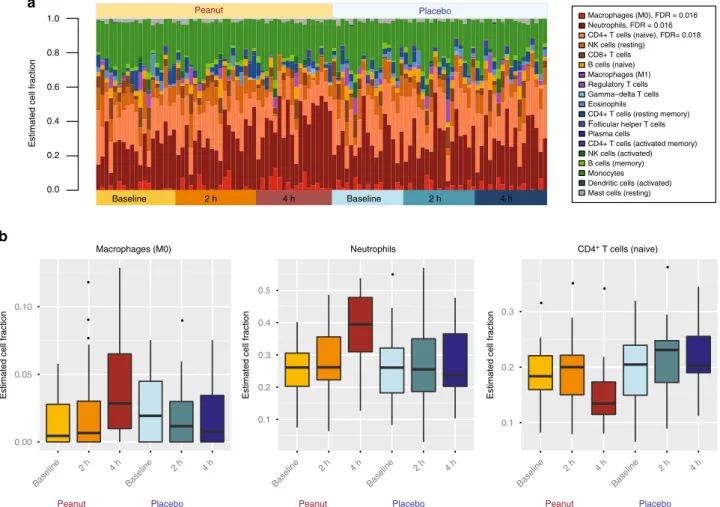
Given that the allergic response involves the activation, differ-entiation, and recruitment of various immune cell types, we tested for changes in the distribution of leukocyte cell fractions during acute peanut allergic reactions. Employing a leukocyte cell-type deconvolution algorithm11, we inferred the proportions of 19 leukocyte populations from RNA-seq expression profiles of each sample and time point (Fig.3a). Neutrophils, naive CD4+T cells, and monocytes were the predominant cell types observed, col-lectively representing 70% of cells on average across samples. In contrast, the remaining cell types each had individual mean fractions <10%.
Analogous to our gene expression analysis, we used lme models to identify leukocyte cell fractions with significant changes over time in response to peanut but not placebo. We observed significant differences in three specific cell types after correction for multiple testing (Fig. 3b): M0 macrophages (FDR=0.016), neutrophils (FDR=0.016), and naive CD4+T cells (FDR=0.018). Whereas the fraction of both macrophages and neutrophils continuously increased over time during the peanut challenge, Table 1 Characteristics of the peanut allergic discovery
cohort (n=19) and replication cohort (n=21)
Discovery Cohort (n=19)
Replication Cohort (n=21)
Sex: Female 7 (36.8%) 7 (33.3%)
Age: years 12.0 (4.0) 11.0 (5.0)
Parental allergy 16 (84.2%) 21 (100.0%)
Peanut sIgE: kUa/L 68.0 (82.8) 87.4 (140.5) Peanut skin prick test: mm 12.0 (6.0) 13.0 (11.0) Cumulative dose atfirst
objective symptom: g peanut protein
0.014 (0.44) 0.044 (0.14)
Cumulative successfully consumed dose: g peanut protein
0.144 (0.48) 0.144 (0.40)
Symptoms experienced during peanut challenge
Distress 13 (68.4%) 14 (66.7%)
Throat tightness 9 (47.4%) 6 (28.6%)
Rhinorrhea 3 (15.8%) 2 (9.5%)
Rash 1 (5.3%) 4 (19.0%)
Rubbing of eyes, nose, or scratching
2 (10.5%) 3 (14.3%)
Urticaria: 1–2 lesions 3 (15.8%) 6 (28.6%) Urticaria:>3 lesions 2 (10.5%) 5 (23.8%)
Angioedema 4 (21.1%) 9 (42.9%)
Vomit: single 2 (10.5%) 2 (9.5%)
Vomit: multiple times 1 (5.3%) 0 (0.0%)
Abdominal pain: severe 2 (10.5%) 5 (23.8%)
Diarrhea 0 (0.0%) 1 (4.8%)
Wheeze 0 (0%) 1 (4.8%)
Stridor 1 (5.3%) 0 (0.0%)
Hypotension 0 (0%) 0 (0.0%)
but not placebo, there was a reduction in naive CD4+T cells at four hours compared to baseline (Fig.3b). Raw and correctedP -values from this analysis are provided in Supplementary Table2. To treat severe reactions, some subjects in our study (n=11) were given epinephrine during peanut challenge. Because epinephrine can impact cell numbers in peripheral blood12, 13, we stratified our data to assess whether the same trends were observed in subjects who did and did not receive epinephrine (Supplementary Fig.3). Consistent with the combined results, we observed increased fractions of macrophages and neutrophils, and a decreased fraction of naive CD4+T cells, after peanut challenge in both the epinephrine treated and untreated strata. However, particularly for neutrophils and CD4+ T cells, the effects were more pronounced in subjects who received epinephrine, which could be attributable to the fact that these individuals had more severe allergic reactions. To directly test whether this difference was due to reaction severity vs. epinephrine treatment, an experimental design barring epinephrine treatment in subjects with severe reactions would be needed; however, this is not ethically possible in human subjects given the risk of anaphylaxis and death with untreated severe allergic reactions.
Replication of gene expression and leukocyte signatures. To
assess the robustness of the changes in gene expression and leu-kocyte fractions observed, we sought to replicate ourfindings in an independent replication cohort of 21 peanut allergic children, with clinical characteristics similar to those of the discovery cohort (Table1). Each of the 21 individuals underwent analogous
double-blind, placebo-controlled peanut challenges using the same sample collection protocol as the discovery cohort. We used RNA-seq data generated from whole blood collected at baseline, two hours, and four hours of the peanut challenge to test for gene expression changes that occurred in response to peanut. Of the top 30 genes identified in the discovery cohort, 28 exhibited statistically sig-nificant (P<0.05) changes in expression during peanut challenge in the replication cohort (Table 2), representing a significant enrichment (OR=27.9, Fisher’s exact test P=9.5 × 10⁻¹²) over that expected by chance. Boxplots depicting expression data in this replication cohort for each of the top 30 genes presented in Table2are shown in Supplementary Fig.4, showing concordant directions of gene expression change for all genes during peanut challenge relative to the discovery cohort.
We next used transcriptome profiles from the replication cohort to perform peripheral blood leukocyte deconvolution (Supplementary Fig.5a) and lme modeling to identify changes in the proportions of cell subsets during peanut challenge. The same three cell types identified in the discovery cohort were again significant in the replication cohort (Supplementary Fig.5b; M0 macrophages (FDR=0.0053); neutrophils (FDR=0.0013); naive CD4+T cells (FDR=0.0038)).
Peanut genes enriched in an acute-phase response module. To
investigate the biological context and relationships of peanut genes identified by our analyses, we constructed transcriptome-wide gene networks in the discovery cohort using WGCNA14. WGCNA identifies modules of co-expressed genes (i.e., groups of
Table 2 Top 30 peanut allergen response genes (peanut genes) identified by linear mixed-effects models (Bonferroni-corrected
P<0.01) in the discovery cohort and their corresponding results in the replication cohort
Discovery Cohort (n=19) Replication Cohort (n=21) Gene
P-value BonferroniP-value Peanut T4 vs. T0Δlog2-cpma P-value Peanut T4 vs. T0Δlog2-cpma
PLP2 1.24 × 10−08 2.00 × 10−04 0.55 3.81 × 10−03 0.38
LY9 1.43 × 10−08 2.00 × 10−04 −0.48 4.34 × 10−02 −0.22
APLP2 1.57 × 10−08 2.00 × 10−04 0.62 1.68 × 10−04 0.40
AGPAT9 3.21 × 10−08 5.004 × 10−04 1.18 9.95 × 10−06 0.78
NOV 3.56 × 10−08 6.00 × 10−04 0.97 9.86 × 10−03 0.45
DGKG 5.94 × 10−08 0.001 0.73 8.85 × 10−04 0.48
BST1 9.64 × 10−08 0.0016 1.11 6.86 × 10−04 0.68
CRK 1.05 × 10−07 0.0018 0.54 4.01 × 10−04 0.31
CD22 1.09 × 10−07 0.0018 −0.55 3.89 × 10−01 −0.16
MOSC1 1.75 × 10−07 0.003 1.37 7.29 × 10−05 0.92
PLXDC1 1.76 × 10−07 0.003 −0.31 2.85 × 10−01 −0.15
PADI4 1.93 × 10−07 0.0033 1.51 4.21 × 10−04 0.86
FCAR 1.95 × 10−07 0.0033 1.49 5.68 × 10−04 1.05
DDX55 2.22 × 10−07 0.0038 −0.22 2.83 × 10−02 −0.17
PLCG2 2.66 × 10−07 0.0046 0.55 1.99 × 10−03 0.28
SULF2 2.75 × 10−07 0.0047 0.73 1.95 × 10−06 0.61
LTB4R 2.83 × 10−07 0.0049 1.21 2.03 × 10−03 0.51
RBP7 2.86 × 10−07 0.0049 0.97 1.81 × 10−03 0.68
OSCAR 2.92 × 10−07 0.005 0.77 1.69 × 10−03 0.50
MMP9 3.29 × 10−07 0.0057 2.24 2.79 × 10−04 1.36
JDP2 3.42 × 10−07 0.0059 1.26 5.88 × 10−04 0.75
ACSS2 3.49 × 10−07 0.006 0.52 7.17 × 10−04 0.26
CCDC164 3.50 × 10−07 0.006 1.67 3.07 × 10−04 1.22
EPHB4 3.70 × 10−07 0.0064 1.31 1.86 × 10−05 0.81
C5orf39 3.89 × 10−07 0.0067 −0.21 1.11 × 10−02 −0.18
SLC26A8 4.14 × 10−07 0.0071 1.27 2.3 × 10−05 0.92
DIRC2 4.18 × 10−07 0.0072 0.76 3.73 × 10−04 0.53
BMX 4.58 × 10−07 0.0079 2.05 6.58 × 10−05 1.28
LILRA3 4.66 × 10−07 0.008 1.26 1.69 × 10−03 0.63
FCRL3 5.27 × 10−07 0.009 −0.43 3.67 × 10−03 −0.45
aBecause effect size estimates from lme models are less intuitive, changes in gene expression between the means at baseline and four-hour time points for the peanut challenge are displayed as a more
genes with similar expression profiles and interconnectivity across experimental samples), that can serve as broader con-structs of gene expression beyond the single gene level15. Using WGCNA, we identified 13 coexpression modules (Supplementary Table 3). To identify modules associated with acute peanut allergic reaction, we tested for enrichment of peanut genes in each module. Only the blue coexpression module was significantly enriched for peanut genes. 1223 (51%) of the 2381 genes in that module were peanut genes, equivalent to a 4.1-fold enrichment over that expected by chance (Fisher’s exact testP=1.2 × 10−304) (Fig.4a; Supplementary Table3). We will henceforth refer to the blue module as the “peanut response module,”given it was the only module enriched for peanut genes.
To gain insight into the collective putative function of genes within the peanut response module, we next performed gene ontology (GO) analysis16. This revealed significant enrichments of the peanut response module for inflammatory processes, including acute-phase response (fold enrichment=3.5; FDR= 6.5 × 10⁻³), acute inflammatory response (fold enrichment=2.8, FDR=2.9 × 10⁻³), positive regulation of I-kappa-B kinase/NF-kappa-B signaling (fold enrichment=1.9; FDR=1.8 × 10⁻³), and lymphocyte activation (fold enrichment=1.7; FDR=3.0 × 10⁻³). The GO biological process terms associated with the peanut response module at FDR<0.01, sorted by fold enrichment, are shown in Fig. 4b. A complete list of these GO terms and associated genes are provided in Supplementary Data2. Although no other coexpression module identified by WGCNA was enriched for peanut genes after correction, we show the top biological processes associated with these other modules for comparison (Fig. 4a). To further enhance our understanding of the peanut response module, we examined GO biologic process terms for the upregulated and downregulated peanut genes in this module separately (Fig.4c, d). Whereas the upregulated genes are involved in inflammation, the downregulated genes regulate
macromolecule metabolism; P-values and enrichment statistics from this analysis are provided in Supplementary Data3.
Identifying causal key drivers of the peanut response module.
Although integration of our peanut gene analysis with WGCNA provided strong evidence for a link between acute peanut allergic reactions and the peanut response module, this type of analysis is associative and thus cannot on its own reveal causal relationships among genes in the implicated module. Elucidating the con-nectivity structure within these modules can lead to the identi-fication of key driver genes that are predicted to modulate the regulatory state of the module, and be of high interest to prioritize as causal to acute peanut allergic reactions. We have previously integrated genetic, transcriptome and other high-throughput data into probabilistic causal gene networks as one approach to uncover key driver genes in disease associated networks/mod-ules17, 18. This type of data-driven, directed approach provides systems-wide context for understanding known and novel reg-ulators and processes for a disease. We sought to apply such approaches here to identify key driver genes of the peanut response module.
Given the lack of large-scale gene expression data sets generated from individuals with peanut or other food allergies, which would be needed to construct accurate probabilistic causal gene networks19, we explored the availability of alternative data sets that could be used to model gene networks associated with inflammation (consistent with processes identified by WGCNA analyses above). We constructed a directed probabilistic causal gene network using peripheral blood gene expression data and expression quantitative trait loci (eQTL) from 526 patients with inflammatory bowel disease (IBD)20. Although IBD is distinct from food allergy, both conditions are due to maladaptive immune reactions to antigens presented to the gastrointestinal tract in genetically susceptible individuals, and there is an 9
LTB4R P=1.8 × 10⁻⁷
P=1.9 × 10⁻⁷
ECHDC3 IL1R2
P=3.2 × 10⁻⁵ P=7.3 × 10⁻⁵
PPP13RD KLHL2
P=1.5 × 10⁻⁵ P=6.59 × 10⁻⁵
8
8
8 6
6 10
4
4
7
6
5
4
3 2
0
Normalized log2 (cpm) Normalized log2 (cpm) Normalized log2 (cpm)
Normalized log2 (cpm)
7
6
5
9
6.5
6.0
5.5
5.0
4.5 8
Normalized log2 (cpm) Normalized log2 (cpm) 7
6
5
Peanut Placebo
Baseline Baseline 2 h 4 h 2 h 4 h
Peanut Placebo
Baseline Baseline 2 h 4 h 2 h 4 h
Peanut Placebo
Baseline Baseline 2 h 4 h 2 h 4 h PADI4
association between IBD and atopic diseases, including food allergy21,22. We reasoned that there is some overlap between the two conditions with regard to chronic immune dysregulation and pro-inflammatory processes such that the topology and major edges of the underlying disease network architecture in IBD could inform gene coregulation relevant to the inflammatory response to peanut.
To narrow in on the component of the constructed probabilistic causal gene network most relevant to acute peanut allergic reactions, we projected peanut genes belonging to the WGCNA peanut response module onto this network. The projection consisted of overlapping genes from the intersection of these genes and all genes in the network, identifying all genes in the network that are within a path length of one node in this overlap, and then identifying the largest connected graph (subnetwork) from this set of nodes and all associated edges. The subnetwork identified from this projection was composed of 1029 genes, including 500 genes belonging to both the peanut response module and peanut gene set, representing a 4.7-fold enrichment over that expected by chance (Fisher’s exact testP= 3.81 × 10−272). This indicated that the peanut response module constructed from our study was highly conserved in the probabilistic causal network constructed from the IBD cohort.
To predict genes that modulate the regulatory state of the peanut response module, we employed key driver analysis (KDA), an algorithm that mathematically identifies causal modulators of the regulatory state of functionally relevant gene groups17. Key drivers have been found to be reproducible and successfully validated in different contexts23. KDA identified 26 key drivers (FDR<0.05) of the peanut response module in the IBD network, and these key drivers were significantly enriched for genes in the identified subnetwork (OR=82.6, Fisher’s exact testP=9.65 × 10 −20) (Supplementary Table 4). The relationship between key
drivers with the peanut genes, and genes belonging to the peanut response module are depicted in Fig.5. This hierarchical structure of the network, reflects an ordering of the key driver genes in which key drivers at the highest level have the most upstream effects on modulating the state of genes at the lowest level, which specifically comprise peanut genes and genes belonging to the peanut response module. As the distance from the bottom increases, so too does the enrichment at each level for being a key driver. The higher up in the response cascade, the higher the odds ratio (OR 274.1, Fisher’s exact test P=6.0 × 10⁻¹⁶ for the top level). Resolving the structure of these networks allows for the identification of those driver genes that are causally associated with the expression of peanut genes at the most upstream points in the response cascade.
Estimated cell fraction
0.0 0.2 0.4 0.6 0.8
1.0 Macrophages (M0), FDR = 0.016
Neutrophils, FDR = 0.016 CD4+ T cells (naive), FDR= 0.018 NK cells (resting)
CD8+ T cells B cells (naive) Macrophages (M1) Regulatory T cells Gamma−delta T cells Eosinophils
CD4+ T cells (resting memory)
Follicular helper T cells Plasma cells
CD4+ T cells (activated memory) NK cells (activated) B cells (memory) Monocytes Dendritic cells (activated) Mast cells (resting)
Baseline 2 h 4 h Baseline 2 h 4 h
a Peanut
Placebo
0.00 0.05 0.10
Baseline
2 h 4 h
Baseline
2 h 4 h
Estimated cell fraction
Macrophages (M0)
b
0.1 0.2 0.3 0.4 0.5
Baseline
2 h 4 h
Baseline
2 h 4 h
Estimated cell fraction
Neutrophils
0.1 0.2 0.3
Baseline
2 h 4 h
Baseline
2 h 4 h
Estimated cell fraction
CD4+ T cells (naive)
Peanut Placebo Peanut Placebo Peanut Placebo
To ensure that the IBD network was capturing biology relevant to peanut allergy, we constructed a validation causal gene network using the peanut allergic discovery and replication cohorts (Table1). As context, we used the IBD network as our discovery causal network because it could be built on a much larger data set (n=526) with genetic prior information (expression quantitative trait loci (eQTL)), thus enabling construction of a robust and informative causal network19,24,25. The peanut causal network we built is not as robust as the IBD network given the limited sample size for its construction and lack of eQTLs available as input, and was therefore used to validatefindings from the IBD network. Indeed, when we performed the same subnetwork analysis as above but in the peanut network, the overlap between the IBD and peanut subnetworks was 3-fold enriched over that expected by chance (Fisher’s exact testP=3.3 × 10−224). Further, KDA of the peanut allergy-specific causal network identified key drivers significantly overlapping those from the IBD network (OR 16.8, Fisher’s exact testP=2.4 × 10⁻⁷), lending confidence to our causal networkfindings.
Six key driver genes (LTB4R, PADI4, IL1R2, PPP1R3D, KLHL2, and ECHDC3) in particular were highlighted by the combined interpretation of the lme models, WGCNA, and KDA, as these were the only genes that met all three criteria of being: (1) peanut genes with a significant change in expression with peanut but not placebo exposure; (2) members of the WGCNA peanut response module; and (3) top level key driver genes in the hierarchical visualization of the network, predicted to causally modulate the
state of peanut genes and peanut response module members at the most proximal level (Fig. 5). To illustrate the relationship between these six key drivers of highest interest, Fig.6shows their relationship within the probabilistic causal gene network, as well as their cellular context based on prior knowledge. Two of these top layer key drivers, LTB4Rand PADI4, were peanut genes by the strictest significance criteria (Bonferroni-correctedP<0.01) (Table2; Fig.2). In addition,LTB4RandPADI4have previously demonstrated roles in inflammatory and immune-related diseases26,27, as doesIL1R2, another top layer key driver28,29.
Discussion
In this study, we collected and analyzed serial peripheral blood transcriptomic profiles from a cohort of peanut allergic children undergoing double-blind, placebo-controlled oral food challenges to identify six causal key driver genes (LTB4R, PADI4, IL1R2, PPP1R3D,KLHL2, andECHDC3) of high interest in acute peanut allergic reactions. Analysis of a second peanut allergic cohort of 21 children replicated our major findings. The results of this study provide a data-driven, circumscribed set of high-yield gene targets for directed mechanistic studies of peanut allergy, the most common cause of food-related anaphylaxis and death in the United States.
Currently, allergen avoidance and prompt care of allergic reactions remain the standard treatment strategy for food allergic individuals. Although immunotherapy for desensitization and/or 0 2 4 4 3 2 1 0 5 6
Fold enrichment of peanut
genes per module
FDR = 1.5× 10
–303
Acute-phase responsePositive regulation ofNK cell chemotaxis
N-terminal peptidyl-lysine acetylation Response to type i interferon
SRP-dependent cotranslationalprotein targeting to membraneNucleic acid metabolic process Appendage development
Positive regulation of leukocyte adhesion to vascular endothelial cellGlucosylceramide metabolic process
Platelet degranulation Histone H3-K27 demethylation
Antigen processing and presentationof exogenous peptide antigen viaMHC class I, TAP-independent NA
b
Fold enrichment of GO term in peanut response module a
Acute-phase response Actue inflammatory response
Response to bacterium Positive regulation of I-kappaBkinase/NH-kappaB signaling
Inflammatory response Regulatation of I-kappaB Kinase/NF-kappaB signaling
Regulation of inflammatory response Leukocyte differentiation
Defense response to other organism Innate immune responseLymphocyte activation
Response to other organism Defense response Response to biotic stimulus
Positive regulation of cytokine production Response to external biotic stimulusRegualtion of cytokine production
Cell activation
Immune system process Response to external stimulus
Regulation of response to external stimulus Regulation of defense response
Locomotion Regulation to stress
Cell surface receptor signaling pathway Response to organic substance Defense response to bacterium
Immune response Chemotaxis Leukocyte activation
d c
Positive regulation of cell−substrate adhesion
Regulation of anatomical structure size
Regulation of phosphorylation
Cell morphogenesis Phosphorylation Positive regulation of
macromolecule metabolism Single organism cellular process I−kappaB kinase/ NF-kappaB signaling Acute−phase response
Autophag- osome assembly
Cellular
response to
biotic
signaling
Cellular resp. to external stimulus Immune response Inflammatory response Leukocyte chemo--taxis Myeloid leukocyte activation
Reg of i-kappaB
kinase/nf-kappaB signaling
Reg. of response
to stimulus Response to bacterium Response to biotic stimulus Response to external stimulus Resp. to fungus Response to molecule of bacterial origin Response to stress Response to wounding Signal transduction Cell communi-cation Cytokine production Defense response Immune system process
Response to stimulus
Signaling
Single organism
process
Fig. 4Identification and characteristics of the peanut response coexpression module.aFold enrichment of peanut genes (P<0.005) in the 13 coexpression modules identified by WGCNA, ranked from highest enrichment to lowest. The FDR (Fisher’s exact test) for the most highly enriched module is shown (peanut response module). Gene ontology (GO) enrichment analysis17was conducted on each module; the top 30 most significant GO terms for each module were ranked by fold enrichment, and the highest-fold term for each module is shown on thexaxis. No significant terms were found for genes in the black module.bThe top thirty GO terms associated with the peanut response module, ranked by fold enrichment. Horizontal dotted lines in bothaandb
sustained unresponsiveness have demonstrated progress, immu-notherapy is not effective for all individuals30–32, carries sig-nificant adverse side effects, may not have long-term efficacy, and is not ready for generalized clinical implementation33. In addi-tion, the fact that unexpected acute reactions are responsible for the majority of mortalities associated with food allergy, stresses the need for better understanding the molecular processes med-iating such reactions.
A major strength of this study is that the design (Fig. 1) allowed for rigorous characterization of changes in gene expres-sion signatures that occurred during allergic reactions to peanut by profiling the transcriptomes of peanut allergic subjects at multiple time points throughout the course of randomized, double-blind, placebo-controlled challenges. Although such challenges are considered the gold standard for characterizing food allergy, they are not routinely performed because they are resource-intensive. Rather than analyzing differences between
allergic and non-allergic individuals (i.e., case-control design used in most studies of food allergy to date), our design allowed us to leverage data collected at multiple time points and between in vivo exposures (peanut and placebo) within the same indivi-dual, increasing precision and power by minimizing bias due to inter-individual variability, and optimizing relevance of findings to actual human systems. Further, we were able to replicate our majorfindings in a second cohort of 21 peanut allergic children. We identified peanut genes (Table2, Supplementary Table2) that exhibited significant changes in expression in response to challenge with peanut but not placebo. Asserting the robustness of our results, an overwhelming majority (93%) of the top peanut genes identified in our discovery cohort were replicated in a second independent cohort. We interpret the observed expression signatures dominated by upregulation to be consistent with activation of the acute-phase response to peanut allergen. Indeed, the most significant peanut genes, including key drivers, are ALOX5
BMX
SLC9A8 PHC2
HDGFRP3 MAR1 CEBPD
PFKFB4 FLOT2 GNB2
HAL
EXOC6
ACSL1 TMCC3 MAPK14 KLHL2
LTB4R PADI4 IL1R2
ATP11A ECHDC3 PPP1R3D
PTENP1
LOC100507006 RAB36
MAP2K6 CAMKK2
Peanut Gene
Peanut Respon se
Gene Key
Driver
IL18R1
OR 1.3 P = 0.4
OR 2.9 P = 0.17
Overall causality flow
OR 21.4 P = 2.0×10⁻⁶
OR 72.4 P = 1.9 × 10⁻¹¹
OR 274.1 P =6.0×10⁻¹⁶
OR 0.0 P = 1.0
expressed by inflammatory cells with roles in immune activation, immune effector functions, chemokine and cytokine signaling, and cell migration and proliferation26–29,34–37. These expression trends and functional categories are similar to those recently shown in a gene expression study of six subjects admitted to the emergency room with anaphylaxis (including two individuals for whom peanut exposure was the cause)38. Investigation in cohorts with other food allergies will be required to determine the extent to which expression of peanut genes are specific to the allergic response to peanut.
As genes do not function in isolation, we constructed weighted coexpression and probabilistic causal gene networks to model molecular interactions and causal gene relationships, and applied
mathematical approaches (KDA) to identify and prioritize key drivers of acute peanut allergic reactions. Indeed, effects of peanut exposure on gene expression extended beyond single genes, influencing networks of co-regulated loci involved in acute-phase response and inflammatory processes. Specifically, peanut genes were significantly over-represented in a single coexpression module identified using WGCNA (Fig.4). This peanut response module of 2381 genes was highly enriched for pro-inflammatory processes, including regulation of the Rel/nuclear factor-κB (NF-κB) transcription factor family. NF-κB signaling has been investigated extensively in asthma and allergy, and shown to regulate key cytokines, chemokines, and cell adhesion molecules in immune cells infiltrating sites of inflammation39,40. A recent KD target
ECHDC3 ECHDC3 and IL1R2
ECHDC3 and IL1R2 and LTB4R and PADI4 ECHDC3 and KLHL2
KLHL2
KLHL2 and PPP1R3D LTB4R
LTB4R and PADI4 PPP1R3D
PADI4 ECHDC3
LTB4R IL1R2
PPP1R3D
KLHL2
Based on Probablistic causal gene network interactions IL-4
ARG
PADl4
LTB4
CIT
Leukocyte migration allergic inflammation
PPP1R3D ECHDC3
KLHL2
LTB4R
Fatty acid
3-ketoacyl-CoA
(S)-3-hydroxyaycl-CoA
PHA
Acyl-CoA
Enoyl-CoA
3-cullin-3
Proteasome
IL1
IL1R2
study employing WGCNA on transcriptomes of dust mite-stimulated CD4+T cells from asthmatic subjects foundNFKBIA (a member of the NF-κB family) to be one of nine hub genes within the primary coexpression module identified41. This gene and several others related to NF-κB regulation have also been associated with genetic risk of asthma and related phenotypes42. In contrast to other allergic diseases, NF-κB signaling in food allergy has been less studied; however, its activation was recently observed in a mouse model of intestinal anaphylaxis following ovalbumin challenge43. Expression profiling in neonatal CD4+ T cells of food allergic individuals also revealed the dysregulation of several genes involved in NF-κB signaling4.
Our probabilistic causal network and KDA identified and prioritized six key drivers that most strongly and causally modulated the peanut response module in the network (Fig. 5). While little is known about KLHL2,ECHDC3, andPPP1R3Din the immune response,LTB4R,PADI4, andIL1R2have established roles in inflammation.LTB4Rencodes a receptor for leukotriene B4 (LTB4) (Fig.6), a lipid pro-inflammatory mediator involved in the recruitment of leukocytes to sites of inflammation, including neutrophils and macrophages26,37,44. Linked to biological pro-cesses implicated by GO analyses, LTB4R and its ligand influence the activation of NF-κB signaling44, 45. In addition, LTB4 and LTB4R have previously been implicated in the pathogenesis of atopic diseases, including asthma, atopic dermatitis, and allergic rhinitis26, 46. PADI4, although not explicitly implicated in pro-cesses associated with the allergic response, is a primary genetic risk factor for rheumatoid arthritis (RA)27, a disease characterized by systemic inflammation. The expression ofPADI4 by various inflammatory cells, namely neutrophils27, 47, 48, is elevated in inflamed synovial RA tissue, and associated with increased levels of RA-associated autoantibodies in humans and animal mod-els49–51. IL1R2is expressed by various immune cells, and gen-erally considered to be a negative regulator of pro-inflammatory IL-1 cytokine signaling, with roles in the production of inter-leukins, as well the activation of NF-κB signaling52. Upregulation ofIL1R2has been observed in peripheral blood mononuclear cells of adult food allergic individuals5. In addition, variants inIL1R2 have previously been implicated in atopic disease28,42, as well as other inflammatory disorders52. Our probabilistic causal gene network analysis additionally provided support for a directed relationship betweenECHDC3andIL1R2(Fig.6).
Our study was intentionally designed to not focus on any one peripheral blood cell-type, as multiple cell types have been implicated in acute food allergic reactions, and discovery thus far has been biased toward cell types sufficiently abundant for iso-lation. Our leukocyte deconvolution approach was unbiased so as to inclusively capture cellular expression signatures across per-ipheral blood. Given limitations on the volume of blood that can be collected from children, especially when sampling serially,flow cytometry-based assays to target multiple cell populations at each time point was not feasible. Our study provides data on 19 inferred leukocyte cell fractions (Fig. 3), highlighting three cell subsets that could be directly profiled in future studies. Impor-tantly, each of the significant cell subset changes were replicated in our second peanut allergic cohort, bolstering the likelihood that these changes represent genuine signatures associated with acute allergic response to peanut. Among these, we observed that naive CD4+ T cells decreased during peanut challenge. This is perhaps not surprising, given that food allergy is classically considered to be an IgE-mediated response orchestrated by Th2 T cells, which involves the activation of naive CD4+ T cells and their transition to effector T cell types3. Decreases in naive CD4+ T cells could also reflect their migration from the periphery to sites of inflammation. In contrast to the decrease of naive T cells, the proportions of neutrophils and M0 macrophages both
increased in response to peanut, with neutrophils representing ~40% of cells on average in subjects four hours following expo-sure. Both neutrophils and macrophages hold primary roles in inflammation and allergic disease53,54. For example, depletion of macrophages and neutrophils in several mouse models influences symptoms of peanut-induced anaphylaxis55–57. In humans, markers of neutrophil activation, such as plasma myeloperoxidase concentration, are significantly elevated in individuals experien-cing acute anaphylaxis58. Interestingly, connecting cell-type analyses to results from KDA, it is notable that the expression ofLTB4R,PADI4, andIL1R2are linked to the function of mac-rophages and neutrophils in the context of the inflammatory response26,49, 59–61. For example, inhibition of LTBR4 reduces macrophage chemotaxis and inflammation59. Likewise, the infi l-tration of neutrophils and recruitment of effector T cells to allergen-challenged sites is dependent on the expression ofLTB4/ LTB4Rby neutrophils26. In contrast, the expression ofIL1R2by neutrophils has been shown to mediate pro-inflammatory effects of IL-160. These results support the targeting of these cell types for profiling of cell type-specific gene expression signatures in acute peanut allergy.
Because the key drivers, molecular processes, and cell types highlighted here were characterized in the context of changes occurring directly during allergic reactions, they have potential to inform the design and application of therapeutic strategies for mitigating symptoms of peanut allergic reactions. Notably, a subset of genes and biological processes highlighted by our integrative analyses already serve as therapeutic targets for other atopic and inflammatory diseases. For example, the key driver, LTB4R, is modulated by 5-lipoxygenase inhibitors, which are in clinical use for asthma; several LTB4R antagonists have also been developed62. A biological process identified by our integrated analysis, NF-κB signaling, is mediated by glucocorticoids63, which are frequently administered for food allergic reactions. Also, allergen-specific subcutaneous immunotherapy for environ-mental allergies has been shown to suppress NF-κB signaling in neutrophils of allergic individuals64. Several other inhibitors and modulators of NF-κB signaling are in various stages of investi-gation and development63,65. It would be interesting to investi-gate whether current treatment strategies can modulate peanut genes and biological networks identified here, and generalize to other food allergies as well.
In summary, we comprehensively profiled peripheral blood transcriptomic changes in peanut allergic individuals during acute allergic reactions. By adopting an integrative, data-driven approach, we have identified key driver genes, biological pro-cesses, and cell types associated with acute peanut allergic reac-tions. Furthermore, we were able to replicate our majorfindings in a second cohort. Our identification of six key driver genes includes three previously associated with other allergic and atopic diseases, as well as genes that remain less explored to date. This combination of findings serves as a useful sanity check of our results and indicates promise in targeting these genes and bio-logical processes to further our mechanistic understanding of peanut allergy, with the potential to inform development of new treatment strategies.
Methods
Recruitment and sample collection. Subjects age 4–25 years with physician-diagnosed peanut allergy or convincing history of peanut allergy with skin prick
test positive to peanut (wheal diameter≥3 mm greater than saline control) or
detectable peanut specific IgE (ImmunoCAP>0.35 kUA/L) were eligible to
parti-cipate. Nineteen subjects were recruited from those undergoing screening oral food
challenges to determine eligibility for the CoFAR6 study9, a trial of epicutaneous
immunotherapy for peanut allergy atfive study centers across the United States
University School of Medicine, Baltimore, Maryland; National Jewish Health,
Denver, Colorado; and Arkansas Children’s Hospital, Little Rock, Arkansas. These
nineteen subjects were thefirst CoFAR6 subjects undergoing screening oral food
challenges who consented to having additional blood drawn for transcriptomic study. An additional two subjects were recruited from patients undergoing oral food challenges as part of their clinical care of peanut allergy at the Icahn School of Medicine at Mount Sinai, New York, NY during the same time period. The institutional review boards of the participating institutions approved this study. Written informed consent was obtained from all participants.
All subjects underwent randomized, double-blind, placebo-controlled oral food
challenges performed according to a modified AAAAI/EAACI PRACTALL
protocol8,9. Following randomization by coinflip and under close medical
supervision with blinding of subjects and staff, each subject ingested incremental
amounts of peanut at 20 min intervals until allergic reaction or untilfinal
cumulative dose of 1.044 grams protein ingested on one day, and ingestion of equivalent incremental doses of placebo oat powder in similar fashion on another day shortly before or after. The standardized doses ranged from 1 mg to 600 mg protein. The order of peanut and placebo challenges was randomized between subjects, with subjects completing both peanut and placebo challenges. Intravenous catheters allowed for 2.5 ml peripheral blood samples to be drawn right before challenge (baseline), during the challenge (2 h from challenge start), and at the end (4 h from challenge start) of the peanut and placebo challenges respectively into Tempus tubes. Fixed collection time points were chosen to ensure uniformity in collection strategy across peanut and placebo challenges performed by varying blinded study personnel at different sites. The rationale for sampling at 2 h is that experience at our study sites supports that most children who react during a peanut
challenge exhibit symptoms within thefirst 2 h. We additionally sampled at 4 h
because we hypothesized that adaptive immune responses could take longer to manifest as gene expression changes, and 4 h is a typical length of time for a food challenge visit to conclude.
Once a subject reacted with dose-limiting symptoms, the challenge was
terminated with detailed documentation of the cumulative dose atfirst objective
symptom, cumulative successfully consumed dose, and symptoms experienced by
the subject. Medications including antihistamines, epinephrine, IVfluids, IV
steroids, and beta-agonists were administered to the subject as needed according to the study protocol, and the subject was closely monitored until all symptoms resolved.
For the replication cohort, 30 additional children who also underwent double-blind, placebo-controlled peanut challenges as part of the CoFAR6 trial were eligible. Written informed consent was also obtained from these subjects with IRB approval from the same institutions as the discovery cohort. Serial whole blood collections were obtained following the same protocols used for the discovery
cohort. Subjects who did not react to peanut (n=5) or did not have samples
collected during peanut challenge (n=4) were then excluded, yielding a replication
cohort of 21 peanut allergic subjects.
Sample library preparation, sequencing, and data processing. RNA was iso-lated from peripheral blood samples using Tempus Spin RNA Isolation kits (Applied Biosystems). For the discovery cohort, all available samples from peanut allergic children underwent RNA-seq library preparation and sequencing. For the replication cohort, only samples from the peanut challenge of peanut allergic children were processed and sequenced based on results from the discovery cohort demonstrating that the placebo-related samples exhibited unremarkable gene
expression profiles (Supplementary Figure2). Sequencing libraries for samples
from the discovery and replication cohorts were processed and sequenced separately.
Following depletion of mitochondrial and cytoplasmic rRNA using Ribo-Zero Gold rRNA Removal (Illumina), mRNA libraries were sequenced on the Illumina
HiSeq 2500 System with a per-sample target of 40–50 million 100 bp paired-end
reads, according to the manufacturer’s protocol. Read data were subjected to
quality control with FastQC and RNA-SeQC. The data in fastq format were
mapped to GRCh37 using the STAR v2.4.0g1 aligner (https://github.com/
alexdobin/STAR), and gene-level counts were estimated using HTSeq (https://pypi.
python.org/pypi/HTSeq).
Prior to statistical analyses, raw gene read counts were converted to cpm using
the edgeR66package within R (www.R-project.org). Genes with systematically low
expression levels were removed, keeping only genes with c.p.m.>0.1 in at least
10% of the samples analyzed (n=17,337). Library sizes and normalization factors
were estimated, and counts were then normalized using edgeR and voom in the
limma R package67,68, resulting in log2-cpms and weights for each gene.
Multidimensional scaling analysis was used to identify outlier RNA-seq samples,
resulting in removal of one sample (Supplementary Fig.1) from the discovery
cohort. In addition, we used variancePartition69, to assess the contribution of
technical and biological factors to variation in gene expression across the samples.
This revealed minimal influence of age and gender (Supplementary Fig.6), and
thus we did include these variables as covariates in the lme models next described.
Identifying genes associated with acute peanut reactions. For the 19 subjects in the discovery cohort who reacted to peanut during their double-blind, placebo-controlled food challenges, null and test lme models were constructed for each
gene, using the lme4 R package10. Each model included factor variables,“Time”
(baseline, two hours, and four hours),“Challenge”(peanut or placebo),“Order”
(which challenge camefirst), and“Weights”(voom output) asfixed effects, and per
subject variation and collection date as random effects. Differentiating the two models was an interaction between the Time and Challenge variables (Time×-Challenge) that was only present in the test model.
Null model:gene expression ~ Time + challenge + order + weights + individual
+ collection date +ε
Test model:gene expression ~ Time × challenge + order + weights + individual
+ collection date +ε
To identify genes with expression changes that occurred specifically during
peanut but not placebo challenge, we used a likelihood ratio test (LRT) to test for a
significant additional contribution of the interaction between time and peanut vs.
placebo exposure on gene expression in the test model when compared to the null
model. The LRT was implemented in R using the lmtest package (www.R-project.
org).
A similar approach was applied to RNA-seq data generated from the replication cohort. However, because this cohort only included data from peanut challenges,
the LRT was used to test for an effect of“Time”.
Leukocyte deconvolution analyses. Raw RNA-seq read counts for genes used in
lme model analysis (n=17,337) from 107 samples werefirst normalized using
DESeq270. We used CIBERSORT11to estimate the proportions of leukocyte
sub-populations in each RNA-seq sample from DESeq2-normalized gene counts, using
the“L22”validated gene signature matrix;11estimates and associatedP-values were
based on 1000 permutations of the data, as implemented in the CIBERSORT
pipeline. To be inclusive of all individual samples in our data set, no significance
filter was applied to the estimated cell fractions. Following the same framework
used for gene expression analysis, for each of the cell types estimated, an LRT was used to assess differences between null and test lme models, in which the test model again included an interaction effect.
Null model:cell fraction ~ Time + challenge + order + individual + collection
date +ε
Test model:cell fraction ~ Time × challenge + order + individual + collection
date +ε
P-values produced by the LRT were FDR corrected using the
Benjamini-Hochberg method.
In the replication cohort, following the same methods for the inference of leukocyte fractions from RNA-seq data using CIBERSORT, the LRT was used to
test for effects of“Time”on cell fraction, using equivalent models to those outlined
above for the gene expression analysis.
Coexpression network and gene ontology analyses. WGCNA was conducted
using the WGCNA and coexpp R packages (https://bitbucket.org/multiscale/
coexpp). To construct a weighted gene coexpression network for food allergy, 139
RNA-seq samples from food allergic children were used, including the 107 samples from peanut allergic discovery cohort plus 32 samples from seven individuals with non-peanut food allergies who were recruited from the Mount Sinai Allergy/ Immunology practice during the same study period and analogously sampled during oral food challenges to their suspected food allergen (Supplementary
Table5). The rationale for including samples from food allergic children more
broadly and not just those from peanut allergic subjects was that our goal was to build a coexpression network for food allergy upon which we could then project our peanut genes. Prior to WGCNA, the same expression level thresholds used previously for the lme model analysis were applied to the data set, resulting in 17,328 genes. Gene counts were again normalized using edgeR/voom, and the effects of collection date were removed. The resulting residuals were used for weighted gene coexpression network construction. An adjacency matrix was
gen-erated by applying a power function (beta=6; Supplementary Fig.7) to a pair-wise
gene correlation (Pearson’s) matrix, initially estimated using per gene residual
values. This was then transformed into a topological overlap matrix, from which module assignments were made using a dynamic tree cutting method.
We tested for enrichment of peanut genes in each module using the Fisher’s
exact test. Enrichments of coexpression modules for GO“Biological Process”terms
were assessed using GOrilla;16the full set of genes input into WGCNA was used as
background.
Probabilistic causal gene network construction. We constructed a directed probabilistic causal gene network by integrating peripheral blood gene expression
data from 526 patients with IBD20and eQTL using RIMBAnet19,24,25, a software
package we developed for constructing integrative molecular Bayesian networks. As these networks do not scale linearly with increasing nodes, we took the top 25% of
varying genes to build this network19,25. Continuous data was used for calculating
partial priors, which are then used as priors in the network construction.
Addi-tional priors included genes that areciseQTLs. For the eQTL priors, if a gene also
has a strong eQTL associated with it incis, such a gene can be considered as a
parent node, given the genotype cannot be the effect of a gene expression change. The data was discretized into three states for each gene: high expression levels, low
each gene to ensure a normal distribution. Then, k-means clustering (k=3) is used
with the option of dropping groups should there not be enough members tofill it
to assign the values for each sample. In a case for which there are only two clusters
they would be classified as high and low19,24,25.
To support our use of the IBD network, a peanut allergy-specific replication
causal network was constructed using data from the peanut allergic discovery and
replication cohorts. Specifically, the same genes that were used as input for the IBD
network that were also expressed in the peanut allergic cohorts (n=7055) were
used. The data were discretized in the same fashion as the IBD data with analogous
use of RIMBAnet19,24,25to construct a probabilistic causal network.
Key driver analysis. Key driver analysis was conducted using the KDA package in
R17. The packagefirst defines a background subnetwork by looking for a
neigh-borhood K-steps away from each node in the target gene list in the network. Then, stemming from each node in this subnetwork, it assesses the enrichment in its k-step (k varies from 1 to K) downstream neighborhood for the target gene list. In
this analysis, we usedK=7. KDA was run on both the IBD network as well as the
peanut allergy-specific causal network.
Data availability. Data for this study (doi:10.7303/syn10212437) is available via Synapse, a software platform for open, reproducible data-driven science. The direct
link to the data is:https://www.synapse.org/#!Synapse:syn10212437/files/.
Received: 5 May 2017 Accepted: 9 November 2017
References
1. Bunyavanich, S. et al. Peanut allergy prevalence among school-age children in a
US cohort not selected for any disease.J. Allergy Clin. Immunol.134,
2011–2013 (2014).
2. Boyce, J. A. et al. Guidelines for the diagnosis and management of food allergy
in the United States: summary of the NIAID-sponsored expert panel report.J.
Allergy Clin. Immunol.126, 1105–1118 (2010).
3. Abbas, A. K., Lichtman, A. H. & Pillai S.Basic Immunology: Functions and
Disorders of the Immune System. (Elsevier, 2016).
4. Martino, D. J. et al. T-cell activation genes differentially expressed at birth in
CD4+ T-cells from children who develop IgE food allergy.Allergy Eur. J. Allergy
Clin. Immunol.67, 191–200 (2012).
5. Saulnier, N. et al. Gene expression profiling of patients with latex and/or
vegetable food allergy.Eur. Rev. Med. Pharmacol. Sci.16, 1197–1210 (2012).
6. Quaranta, M. et al. Intraindividual genome expression analysis reveals a specific
molecular signature of psoriasis and eczema.Sci. Transl. Med.6, 244ra290
(2014).
7. Baines, K. J., Simpson, J. L., Wood, L. G., Scott, R. J. & Gibson, P. G.
Transcriptional phenotypes of asthma defined by gene expression profiling of
induced sputum samples.J. Allergy Clin. Immunol.127, 153–160.e9 (2011).
8. Sampson, H. A. et al. Standardizing double-blind, placebo-controlled oral food challenges: American academy of allergy, asthma & immunology-european
academy of allergy and clinical immunology PRACTALL consensus report.J.
Allergy Clin. Immunol.130, 1260–1274 (2012).
9. Jones, S. M. et al. Epicutaneous immunotherapy for the treatment of peanut
allergy in children and young adults.J. Allergy Clin. Immunol.139, 1242–1252.
e1249 (2017).
10. Bates, D., Mächler, M., Bolker, B. M. & Walker, S. C. Fitting linear
mixed-effects models using lme4.J. Stat. Softw.67, 1–48 (2015).
11. Newman, A. M. et al. Robust enumeration of cell subsets from tissue expression profiles.Nat. Methods12, 453–457 (2015).
12. Crary, B. et al. Epinephrine-induced changes in the distribution of lymphocyte
subsets in peripheral blood of humans.J. Immunol.131, 1178–1181 (1983).
13. Yu, D. T. & Clements, P. J. Human lymphocyte subpopulations effect of
epinephrine.Clin. Exp. Immunol.25, 472–479 (1976).
14. Zhang, B. & Horvath, S. A general framework for weighted gene co-expression
network analysis.Stat. Appl. Genet. Mol. Biol.4, Article17 (2005).
15. Bunyavanich, S. et al. Integrated genome-wide association, coexpression
network, and expression single nucleotide polymorphism analysis identifies
novel pathway in allergic rhinitis.BMC Med. Genome7, 48 (2014).
16. Eden, E., Navon, R., Steinfeld, I., Lipson, D. & Yakhini, Z. GOrilla: a tool for
discovery and visualization of enriched GO terms in ranked gene lists.BMC
Bioinformatics10, 48 (2009).
17. Zhang, B. & Zhu, J. Identification of key causal regulators in gene networks.
Proc. World Congr. Eng.II, 5–8 (2013).
18. Zhu, J. et al. Stitching together multiple data dimensions reveals interacting
metabolomic and transcriptomic networks that modulate cell regulation.PLoS
Biol.10, e1001301 (2012).
19. Zhu, J. et al. Integrating large-scale functional genomic data to dissect the
complexity of yeast regulatory networks.Nat. Genet.40, 854–861 (2008).
20. Sandborn, W. J. et al. Ustekinumab induction and maintenance therapy in
refractory Crohn’s disease.N. Engl. J. Med.367, 1519–1528 (2012).
21. Virta, L. J., Ashorn, M. & Kolho, K. L. Cow’s milk allergy, asthma, and pediatric
IBD.J. Pediatr. Gastroenterol. Nutr.56, 649–651 (2013).
22. Glassman, M. S., Newman, L. J., Berezin, S. & Gryboski, J. D. Cow’s milk
protein sensitivity during infancy in patients with inflammatory bowel disease.
Am. J. Gastroenterol.85, 838–840 (1990).
23. Cohain, A. et al. Exploring the reproducibility of probabilistic causal molecular
network models.Pac. Symp. Biocomput.22, 120–131 (2016).
24. Zhu, J. et al. An integrative genomics approach to the reconstruction of gene
networks in segregating populations.Cytogenet. Genome Res.105, 363–374
(2004).
25. Zhu, J. et al. Increasing the power to detect causal associations by combining
genotypic and expression data in segregating populations.PLoS Comput. Biol.
3, e69 (2007).
26. Oyoshi, M. K. et al. Leukotriene B4-driven neutrophil recruitment to the skin is
essential for allergic skin inflammation.Immunity37, 747–758 (2012).
27. Suzuki, A. et al. Functional haplotypes of PADI4, encoding citrullinating enzyme peptidylarginine deiminase 4, are associated with rheumatoid arthritis.
Nat. Genet.34, 395–402 (2003).
28. Hirota, T. et al. letters Genome-wide association study identifies eight new
susceptibility loci for atopic dermatitis in the Japanese population.Nat. Genet.
44, 1222–1226 (2012).
29. Moffatt, M. et al. Cookson WOCM, and the GABRIEL consortium. A
GABRIEL consortium large-scale genome-wide association study of asthma.N.
Engl. J. Med.363, 1211–1221 (2010).
30. Fleischer, D. M. et al. Sublingual immunotherapy for peanut allergy: a
randomized, double-blind, placebo-controlled multicenter trial.J. Allergy Clin.
Immunol.131, 119–27 (2013).
31. Vickery, B. P. et al. Sustained unresponsiveness to peanut in subjects who have
completed peanut oral immunotherapy.J. Allergy Clin. Immunol.133, 468–475.
e466 (2014).
32. Burks, A. W. et al. Oral immunotherapy for treatment of egg allergy in children.
N. Eng. J. Med.367, 233–243 (2012).
33. Sampson, H. A. Peanut oral immunotherapy: Is it ready for clinical practice?J.
Allergy Clin. Immunol. Pract.1, 15–21 (2013).
34. Vandooren, J., Van den Steen, P. E. & Opdenakker, G. Biochemistry and molecular biology of gelatinase B or matrix metalloproteinase-9 (MMP-9): The
next decade.Crit. Rev. Biochem. Mol. Biol.48, 222–272 (2013).
35. Cenni, B., Gutmann, S. & Gottar-Guillier, M. BMX and its role in
inflammation, cardiovascular disease, and cancer.Int. Rev. Immunol.31,
166–173 (2012).
36. Anzilotti, C., Pratesi, F., Tommasi, C. & Migliorini, P. Peptidylarginine
deiminase 4 and citrullination in health and disease.Autoimmun. Rev.9,
158–160 (2010).
37. Tager, A. M. & Luster, A. D. BLT1 and BLT2: the leukotriene B4 receptors.
Prostaglandins Leukot. Essent. Fat. Acids69, 123–134 (2003).
38. Stone, S. F. et al. Genomic responses during acute human anaphylaxis are
characterized by upregulation of innate inflammatory gene networks.PLoS
ONE9, e101409 (2014).
39. Gagliardo, R. et al. Persistent activation of nuclear factor-κB signaling pathway
in severe uncontrolled asthma.Am. J. Respir. Crit. Care Med.168, 1190–1198
(2003).
40. Sheller, J. R. et al. Nuclear factor kappa B induction in airway epithelium
increases lung inflammation in allergen-challenged mice.Exp. Lung Res.35,
883–895 (2009).
41. Troy, N. M., Hollams, E. M., Holt, P. G. & Bosco, A. Differential gene network
analysis for the identification of asthma-associated therapeutic targets in
allergen-specific T-helper memory responses.BMC Med. Genome9, 9
(2016).
42. Daley, D., Park, J. E., He, J-q, Yan, J. & Akhabir, L. Asthma and lower airway disease Associations and interactions of genetic polymorphisms in innate immunity genes with early viral infections and susceptibility to asthma
and asthma-related phenotypes.J. Allergy Clin. Immunol.,130, 1284–1293
(2012).
43. Kinney, S. R. M. et al. Curcumin ingestion inhibits mastocytosis and suppresses
intestinal anaphylaxis in a murine model of food allergy.PLoS ONE10,
e0132467 (2015).
44. Serezani, C. H., Lewis, C., Jancar, S. & Peters-Golden, M. Leukotriene B4
amplifies NF-kappaB activation in mouse macrophages by reducing SOCS1
inhibition of MyD88 expression.J. Clin. Invest.121, 671–682 (2011).
45. Sanchez-Galan, E. et al. Leukotriene B4 enhances the activity of nuclear
factor-kB pathway through BLT1 and BLT2 receptors in atherosclerosis.Cardiovasc.
Res.81, 216–225 (2009).
46. Liu, M. & Yokomizo, T. The role of leukotrienes in allergic diseases.Allergol.