LATINASIAN NATION: RE-IMAGINING UNITED STATES HISTORY THROUGH CONTEMPORARY ASIAN AMERICAN AND LATINA/O LITERATURE
Susan Bramley Thananopavarn
A dissertation submitted to the faculty at the University of North Carolina at Chapel Hill in partial fulfillment of the requirements for the degree of Doctor of Philosophy in the Department
of English and Comparative Literature in the College of Arts and Sciences.
Chapel Hill 2015
ii © 2015
iii ABSTRACT
Susan Thananopavarn: LatinAsian Nation: Re-imagining United States History through Contemporary Asian American and Latina/o Literature
(Under the direction of Jennifer Ho and María DeGuzmán)
Asian American and Latina/o populations in the United States are often considered marginal to discourses of United States history and nationhood. From laws like the 1882
Chinese Exclusion Act to the extensive, racially targeted immigration rhetoric of the twenty-first century, dominant discourses in the United States have legally and rhetorically defined Asian and Latina/o Americans as alien to the imagined nation. However, these groups have histories within the United States that stretch back more than four hundred years and complicate foundational narratives like the immigrant “melting pot,” the black/white binary, and American
exceptionalism. This project examines how Asian American and Latina/o literary narratives can rewrite official histories and situate American history within a global context. The literary texts that I examine – including works by Carlos Bulosan, Américo Paredes, Luis Valdez, Mitsuye Yamada, Susan Choi, Achy Obejas, Karen Tei Yamashita, Cristina García, and Siu Kam Wen – create a “LatinAsian” view of the Americas that highlights and challenges suppressed aspects of
iv
TABLE OF CONTENTS
LIST OF FIGURES ……….. vi
INTRODUCTION: ASIAN AMERICAN AND LATINA/O VOICES WRITING HISTORY, RE-WRITING NATION……….………... 1
Immigrants and Aliens: Historical and Legal Constructions of Otherness ……….. 6
National Amnesia: Race and the Erasure of Historical Memory ………. 24
Re-Imagining the Past: Latina/o and Asian American Comparative Work ………. 34
CHAPTER 1. REMEMBERING U.S. IMPERIALISM ……….……….. 45
Embodying the Colonial Past: Carlos Bulosan’s America Is in the Heart …... 50
From Gringo School Days to Military Espionage: Américo Paredes’s George Washington Gómez …... 63
Education, History, and National Ideologies ……….…….. 78
CHAPTER 2. WORLD WAR II AND PATRIOTIC RACISM ……….. 82
Battle on the Homefront: Luis Valdez’s Zoot Suit and Wartime Propaganda ………. 91
“Looking Out” from Mitsuye Yamada’s Camp Notes ………...…….. 105
Remembering the “Good War”: Memory, History, and Art………...…….…. 118
CHAPTER 3. INTERROGATING COLD WAR EPISTEMOLOGIES ………. … 121
“Translation’s Unnatural Byproduct”: Susan Choi’s The Foreign Student ………... 128
“What Really Happened”: Achy Obejas’s Memory Mambo ………... 140
National Memories, National Amnesia ………..………... 154
CHAPTER 4. LATINASIAN CONTACT ZONES ……… 158
v
Adoption and Military Violence: Cristina García’s The Lady Matador’s Hotel …... 185
CONCLUSION. LATINASIAN LITERATURE BEYOND NATIONAL BORDERS ……. 197
In the “No-Man’s Land” of Siu Kam Wen’s El tramo final ………... 201
Ripping Aside the Veil: Asian Contract Labor in the Americas ……….. 204
Multiple Migrations and Mestizo Chinese: Imagining Asian Latin America ……….. 209
Towards a LatinAsian Approach to American Studies ………..….…. 216
ENDNOTES ………... 219
vi
LIST OF FIGURES
1
INTRODUCTION: ASIAN AMERICAN AND LATINA/O VOICES WRITING HISTORY, RE-WRITING NATION
It must be odd to be a minority he was saying. I looked around and didn’t see any. So I said
Yeah it must be.
Mitsuye Yamada, “Looking Out,” Camp Notes and Other Writings
In the confusion, Pedro ran, terrified of being caught. He couldn’t speak English, couldn’t tell them he was fifth generation American. Sin papeles – he did not carry his birth certificate to work in the fields. La migra took him away while we watched.
Gloria Anzaldúa, Borderlands/La Frontera
In her poem “Looking Out,” Japanese American writer Mitsuye Yamada critically
examines the idea of a racial “minority,” as an unnamed speaker remarks, “It must be odd/ to be a minority,” and the narrator agrees, not considering herself a minority within her own
community (39). “Looking Out” is part of an autobiographical collection of poetry about
Yamada’s experiences as a Japanese American during World War II. Along with her family and
approximately 120,000 other Japanese Americans, Yamada was incarcerated as an enemy alien during the war; when she was still a teenager, her family was sent to the Minidoka War
2
housed Japanese Americans during the war. The girl does not identify with the label “minority,” since inside the camp she is in the majority, nor is her status as a Japanese American “odd.” Displacing the oddity of minority status onto a hypothetical other, she concurs with the male figure in the poem: “Yeah/ it must be” (39). In another situation, this deferral might indicate a
benign and even amusing difference in perspective. Within the context of the incarceration camps, however, the fact that the girl is “looking out” means that she is being observed from a position of power. The “he” in the poem has the freedom of movement conferred by his status as
a white male looking in, and the category of “minority” is one in which the narrator is imprisoned. The very fact that she is not technically in the minority in her immediate environment proves that the term is less about numbers and more about power: who has the power to fix the captive other with his gaze. And the use of the word “odd” confirms this power, for the white male names the Japanese American girl “odd” in a way that places her outside the racial (and gendered) norm. The poem’s perspective shift challenges this norm, even as it draws
attention to the real, barbed-wire consequences of the power of the majority/minority
construction, a construction that defines who is an American by default, and who must be subject to definition by others.
Chicana writer Gloria Anzaldúa also disrupts dominant assumptions of who is American as she tells the story of Pedro, a fifth generation U.S. citizen who is caught “sin papeles” –
3
are “terrified of being caught” and run from la migra – the immigration officials – despite their
status as native-born U.S. citizens (26). The passage relies on the reader’s knowledge of Pedro’s constitutional rights: the Fourth Amendment to the United States Constitution prohibits
unwarranted search and seizure. Unless driving a car or travelling by air (ostensibly voluntary activities), United States citizens are not required to carry identification with them. Pedro does not “carry his birth certificate to work in the fields,” but no American is required to carry a birth
certificate to go to work; the statement both explains his arrest and highlights the injustice of such a requirement. Likewise, Anzaldúa leaves the phrases “sin papeles” and “la migra”
untranslated to show their importance and common usage for Pedro and his community. Pedro’s terror “of being caught” is a terror that has nothing to do with his legal rights. As a fifth
generation American, he is by rights an American citizen. Instead, his terror is a result of the dominant construction of the non-English speaking Latina/o as alien to the nation. This construction is more powerful than the presence of witnesses who are also presumably U.S. citizens – “La migra took him away while we watched” – and results in the tragic deportation of a man to a country that is not his own (26).
Both “Looking Out” and Pedro’s story critique dominant constructions of America that
4
Latino field worker, nor were generations of Asian Americans in the U.S. enough to halt the imprisonment of Japanese Americans during World War II. Asian American and Latina/o histories are missing from mainstream histories of the United States, an absence that has deeply impacted civil rights for over a century. Along with other Asian American and Latina/o writers in the twentieth and twenty-first centuries, Yamada and Anzaldúa ask important questions of their readers: what is an American? What does it mean to be a racial minority in the United States, particularly one defined as alien to the nation? And what can Asian American or Latina/o perspectives show us about dominant constructions of “America” and its historical and
contemporary power structures?
LatinAsian Nation addresses these questions by placing Latina/o and Asian American literary texts in dialogue with foundational narratives of the United States, including narratives of American exceptionalism, war-time patriotism, Cold War anti-communism, and global free trade. It contends that the Asian American and Latina/o presence in the United States, often considered marginal in discourses of U.S. history and nationhood, is in fact crucial to
understanding how U.S. national identity has been constructed historically and continues to be constructed in the present day. Although Asian Americans and Latina/os tend to be defined legally and socially as outsiders to the U.S. – as illustrated by Yamada’s imprisoned Japanese American girl and Anzaldúa’s deported field worker – this project seeks to turn this model inside
5
This examination of Asian American and Latina/o narratives is both comparative – illustrating similarities in Asian American and Latina/o experiences of U.S. imperialism, nativistic racism, Cold War divisions, and globalization – and overlapping, as migration and colonization have created trans-Pacific zones of Asian-Latina/o interaction. Latina/o Studies scholar María DeGuzmán has employed the term “Latinasia” to describe the transnational convergence of Asians and Latin Americans or Latina/os over the course of the last three centuries: “that is, the enormous influx of Asian immigrants and the movement of Latina/o peoples across the Americas, south to north and west to east” (301). Extending the idea of Latinasia to “LatinAsian” literary productions, I focus on authors who write from within this
historic movement of peoples eastward across the Pacific and north to the United States from Latin America. Taken together, the literary texts that I examine create a LatinAsian view of the Americas that highlights previously suppressed aspects of U.S. national history. These authors have constructed narratives that self-consciously resist official national narratives. They tell the stories omitted in dominant historical discourse, drawing attention to the ways in which U.S. foreign and domestic policies have had far-reaching implications both in the past and for the present.
6
Modern America (2003), on the common experiences of Asian Americans and Mexican Americans as a result of twentieth-century U.S. immigration policies.1 More recently, Crystal Parikh’s An Ethics of Betrayal: The Politics of Otherness in Emergent U.S. Literatures and
Culture (2009) explores themes of betrayal in Asian American and Latina/o literature and cultural narratives. Specifically, Parikh focuses on how Asian American and Latina/o authors and subjects position themselves in terms of national belonging, treason, betrayal, and espionage. LatinAsian Nation builds on Ngai’s and Parikh’s theories of the importance of legal and social exclusion in understanding Asian American and Latina/o histories, focusing on literary historical narratives and national memory rather than the thematic element of betrayal. In challenging nativism by claiming that the U.S. is in fact a “LatinAsian nation” – that Asian American and
Latina/o literary narratives are important because they have the power to disrupt dominant histories of the U.S. – this work forges new connections between the distinct fields of Asian American and Latina/o Studies.
Immigrants and Aliens: Historical and Legal Constructions of Otherness
According to the United States Census Bureau, the growth of Asian American and Latina/o populations is one of the most important demographic changes of the twenty-first century. Summarizing the latest population estimates for nation, states, and counties, a widely publicized 2013 Census Bureau report highlighted the following four points:
Asian is fastest growing group
Hispanic population surpasses 53 million 11% of counties are now majority-minority
The nation ages, but some areas become younger (Jones-Puthoff)
Such reports emphasize the importance of Latina/o and Asian American studies for
7
In the case of this report, Asian Americans and Latina/os are not only perceived as external to the United States majority; they are considered a threat to the majority status of the non-Hispanic white population as the fastest-growing part of a spreading “majority-minority.” Even the statement “the nation ages” is less about aging than it is about race, as the report reveals that the
non-Hispanic white population, on average, is more than ten years older than any other group; the “areas” that are becoming younger are geographically defined, but importantly, they are also
demarcated by race and ethnicity. These demographic reports are more than just statements of facts. To borrow a phrase from theorist Hayden White, demography, like historiography, is both a social science and also a “species of the genus narrative” (112). The same data could have told
that more than 63% of the U.S. population identifies as non-Hispanic white, forming by far the most numerous racial group (Jones-Puthoff). It could have addressed the question of wealth distribution to show that the median wealth of non-Hispanic white residents of the U.S. is more than 20 times that of black residents and 18 times that of Hispanic residents (Kochhar, Fry, and Taylor), or it could have shown that white residents are over-represented in Congress, with 96% of senators and 81% of representatives identifying as white in 2012 (Manning). However, the narrative that is increasingly pulled from demographic reports in the twenty-first century is one of racial encroachment phrased as a growing “majority-minority,” a term that the census defines as “meaning that more than 50% of [an area’s] population is other than non-Hispanic white alone” (“U.S. Census Bureau Statistics”).2
And the minorities that are tagged as fastest-growing, most likely to tip the scales that determine whether an area is predominantly white or other, are Asian and Hispanic.
8
welcoming the world’s “huddled masses yearning to breathe free,” dominant society in the U.S. has never been enthusiastic about demographically significant numbers of immigrants, especially poor immigrants and refugees.3 Concerns about lower-class immigrants have often intersected with racial and ethnic anxieties, and nineteenth and early twentieth century immigrants from Eastern and Southern Europe and Ireland were frequently met with hostility and legal attempts to limit their participation in society. For European immigrants, however, a paradigm of ethnicity defined race as a social category that could be overcome through cultural assimilation (Omi and Winant 15). From the eighteenth century, authors like J. Hector St. John de Crevecoeur
answered the question “What is an American?” in theoretically flexible terms for these immigrants:
He is an American, who, leaving behind him all his ancient prejudices and manners, receives new ones from the new mode of life he has embraced, the new government he obeys, and the new rank he holds. He becomes an American by being received in the broad lap of our great alma mater. Here individuals of all nations are melted into a new race of men, whose labours and posterity will one day cause great changes in the world. (27)
In this view, race is a matter of cultural prejudice and conventions that can be discarded at will, and indeed, must be discarded to enter into the new, wholly American “race of men.” St. John de Crevecoeur likened human beings to plants, theorizing that they would take on the
characteristics of their new soil; a stunted plant transplanted to good soil would inevitably thrive. It was St. John de Crevecoeur’s image of melting, however, that became a crucial part of the American imaginary, re-appearing most significantly in Israel Zangwill’s 1908 play The Melting-Pot, which promulgated the famous statement that “America is God’s Crucible, the great
Melting-Pot where all the races of Europe are melting and re-forming” (qtd. in Sollors 66). Zangwill’s four-act elaboration of this idea resonated across America, and his images and terms
9
stated, whether critics agree with Zangwill or not, the debate on ethnicity and race has largely been shaped by the image of the melting pot and phrases and ideas from this “rarely read, yet universally invoked, play” (66).
Yet key to both St. John de Crevecoeur’s and Zangwill’s definition of an American was an origin in Europe. The former “endeavored to shew you how Europeans became Americans” (29); for the latter, the races that God placed in his crucible were “all the races of Europe.” The ethnicity paradigm of race relied on the ideas of cultural pluralism and assimilation and “lay outside the experience of those identified … as racial minorities: Afro-Americans, Latin
Americans, Native Americans, and Asian Americans (blacks, browns, reds, and yellows)” (Omi and Winant 16). Even the blunt description of these groups in terms of color indicates the ways in which the white race, while ethnically diverse, could talk of assimilation in terms that did not include those of other races. For this reason, although the U.S. Census Bureau makes a
distinction between race and ethnicity (i.e., white is a “race,” but Hispanic is an “ethnicity”), it is more politically and sociologically consistent to discuss both Latina/os and Asian Americans according to Omi’s and Winant’s concept of racial formation, which they define as “the sociohistorical process by which racial categories are created, inhabited, transformed, and destroyed,” and in terms of historically situated racial projects through which “human bodies
and social structures are represented and organized” (55-56).4 Through these concepts, we can trace a historical continuity in which neither Asians nor Latina/os have been historically admitted as potential Americans to the crucible, and through which they are frequently represented and organized today as existing outside the constructed “majority” of non-Hispanic whites alone.
10
a black/white binary. The black/white binary was written into law early in United States history; the Nationality Act of 1790 restricted the right to naturalized citizenship to “free white persons”
of good moral character, a deliberate exclusion of African American slaves and indigenous American peoples. This right was extended after the Civil War to include “persons of African nativity or descent” (Ngai 37-38), thus defining citizenship in the U.S. starkly in terms of white
or black. As Latina/o Studies scholar Suzanne Oboler and critic Crystal Parikh have observed, the 1896 Plessy v. Ferguson case further codified the black/white binary, as it signaled the partial political incorporation of African Americans to the state, even while it legalized racial
discrimination; the court’s “separate but equal” decision paradoxically acknowledged the rights of African Americans as citizens at the same time as it established the national community as one that “could be invoked primarily in white-only terms” (Oboler 31, see also Parikh, An Ethics 17).
Outside of this black/white binary, however, Asians and Latina/os were considered permanently foreign to the United States imaginary. From nineteenth century exclusion laws to the racially targeted immigration politics of the twenty-first century, dominant discourses in the United States have legally and rhetorically defined Asian and Latina/o Americans as alien to the imagined nation. This construction has prevented many Latina/o and Asian residents of the United States from becoming citizens, creating “illegal aliens” who were and are prohibited by
11
asserting that both Latina/os and Asian Americans “have been plagued by images of alienness, treason, and duplicity” (An Ethics, 16). Parikh traces these images to the social and legal
structures of racism within the U.S., imperialism abroad, and exclusionary immigration policies that together form a “history that haunts the nation and structures present-day Asian American and Latina/o alienation” (An Ethics, 16). If the nation is an imagined community, as
anthropologist Benedict Anderson and others have claimed, then Asian Americans and Latinos have historically been excluded from the national imaginary of the United States.
The exclusion of Asian Americans – which as cultural critic Kandice Chuh has argued renders the very category “Asian American” contradictory, as it both claims subjectivity and refers to the impossibility of the Asian American as citizen-subject (8) – can be traced to the nineteenth century, when Asians became the only people in United States history to be prohibited from immigration and naturalization solely on the basis of their race. Until 1924, immigration to the United States was numerically unrestricted and even encouraged as part of the free global movement of labor (Ngai 17). Asian exclusion, which was legislated in a series of laws in the late nineteenth and early twentieth centuries, was the exception to this rule. These laws were in part a response to anti-Chinese sentiment that had developed with the first mass immigration of Chinese laborers to California during the 1849 gold rush, a time in which cries of “California for Americans!” spurred white mob violence against Chinese immigrants, as well as
against Latin American participants in the gold rush (Pfaelzer 8). The perception that Chinese labor threatened “free white labor” led to the formation of anti-Chinese leagues, vigilante
12
and city laws included the Foreign Miners’ Tax, which penalized Asian and Latin American miners; the San Francisco Cubic Air Ordinance, which criminalized Chinese tenement housing; the Sidewalk Ordinance, which banned Chinese merchants from carrying laundry or vegetables in baskets hanging from shoulder poles; various laundry ordinances that penalized Chinese businesses by outlawing wooden buildings and taxing hand-delivered laundry; a Queue Ordinance targeting Chinese hairstyles; and even a Cemetery Ordinance that disallowed traditional Chinese burial practices (Pfaelzer 74-75). Moreover, in the nineteenth century
California amended anti-miscegenation laws to prohibit “Mongolians” from marrying whites and passed a school law barring “Mongolians and Negroes” from public schools (Pfaelzer 75). Although all of these laws were eventually found unconstitutional, in the years they were
enforced they imposed a significant hardship on Asian American residents of the U.S. They also both reflected and created a national perception that the Chinese, along with other Asian peoples, were outsiders, unassimilable to American ways of life. This perception was reinforced by the passage of federal laws preventing Chinese immigration, including the Page Law of 1875 that prohibited the immigration of Chinese women by classifying them as prostitutes and the 1882 Chinese Exclusion Act that excluded the entry of Chinese laborers for a period of ten years (Ancheta 25). The Chinese Exclusion Act was renewed by a series of laws, including the Geary Act of 1892 that allowed the deportation of Chinese residents who failed to register with the government, and it was not repealed until 1943 (Ancheta 25-26).
13
Geary Act and the right of the United States government to deport unregistered Chinese residents:
After some years’ experience, … the government of the United States was brought to the opinion that the presence within our territory of large numbers of Chinese laborers, of a distinct race and religion, remaining strangers in the land, residing apart by themselves, tenaciously adhering to the customs and usages of their own country, unfamiliar with our institutions, and apparently incapable of assimilating with our people, might endanger good order, and be injurious to the public interests. (qtd. in Ancheta 66, emphasis added)
In other words, people of Chinese ancestry, forced by discriminatory laws and vigilante violence to live in segregated areas, and prohibited from marrying or going to school with white
Americans, were deemed unfit for American inclusion because of their incapacity to assimilate into white American life.
These discriminatory laws, initially aimed at the Chinese, were eventually extended to include all immigrants from Asia. Despite the opposition of the Japanese government, the United States Immigration Act of 1917 established a “barred Asiatic zone” that stretched from Afghanistan eastward to the Pacific Ocean (Ngai 18). Laws were enacted that retroactively defined all Asians as racially ineligible for naturalized citizenship on the basis of the Nationality Act of 1790, which reserved naturalization for free white persons and persons of African descent. Because Asians were aliens ineligible for citizenship, the courts reasoned, they could have no vested interest in promoting the welfare of the United States and should not be allowed to immigrate at all. In two Supreme court cases, Takao Ozawa v. U.S. (1922) and U.S. v. Baghat Singh Thind (1923), Asian residents of the United States challenged the prohibition to
naturalization on the basis of their contributions to U.S. society (including military service), but their racial ineligibility for citizenship was upheld. Indeed, Ngai argues that in grouping
14
constitute the racial category “Asian” (38). In a series of legal cases, the courts established that
Chinese, Japanese, Indians, Filipinos, and other Asians were neither white nor black and were thus aliens permanently ineligible for citizenship; these laws eventually paved the way for alien land laws that prohibited Asian immigrants from owning land, thus further disenfranchising Japanese American and other Asian American farmers on the West Coast (Ngai 47). In a striking instance of both racial and gendered state power, the Cable Act of 1922 even ruled that women who were United States citizens could have their citizenship stripped by marrying Asian immigrants, as “any woman citizen who marries an alien ineligible to citizenship shall cease to be a citizen of the United States” (qtd. in Ancheta 24). As Ngai observes, these exclusion laws “made Asians into permanent foreigners and guaranteed they would be but a small, marginalized population in America for nearly one hundred years” (18).
The national quota system set into place by the Johnson-Reed Act of 1924 also drew on the definition of Asians as “aliens ineligible for citizenship” to exclude them and their
descendants from being counted as a percentage of the American population. Thus, not only were Asians legally barred from immigration and naturalization, but even Asian Americans born in the United States were not considered a formal part of the American nation. Instead, the national quotas that were established by this act accorded the minimum of 100 persons each from China, Japan, India, and Siam – with the stipulation that all people from these countries must be racially eligible for naturalization. The act thus created the paradoxical phenomenon of
15
citizens regardless of whether their parents were eligible for citizenship. However, with laws that heavily restricted and criminalized immigration from Asia, it is not surprising that the number of Asian Americans in the United States was very low until laws beginning in the 1940s began gradually chipping away at legal barriers to immigration. The Chinese exclusion laws were repealed in 1943, and the racial bar to naturalization was repealed entirely with the 1952 McCarran-Walter Act. But it was not until the Immigration Act of 1965 abolished the national origins quota system that Asian immigrants were finally accorded many of the same rights as immigrants from Europe. With this act, every country not in the Western hemisphere was granted an equal allocation of visas, and a preference system was established that prioritized family reunification and professional and labor skills (Ancheta 34).
Immigration law was not the only area in which Asian Americans were excluded from the United States imaginary. As is the case with other racial minorities, the protection of United States citizenship has not always guaranteed Asian Americans the same legal rights as other U.S. citizens. During World War II, approximately 120,000 Japanese Americans in California, Washington, and Oregon – including the adolescent Yamada – were removed without trial to concentration camps in remote areas of the United States; more than half of these were U.S. citizens (Takaki, Democracy 93). Despite private and military investigations that found no particular cause for concern or “disloyalty” among Japanese American residents of the West
Coast, and the objections of the attorney general, widespread racist sentiments against Japanese Americans prevailed. General John L. DeWitt, the army officer in charge of military security on the West Coast, wrote:
16
that along the vital Pacific Coast over 112,000 potential enemies, of Japanese extraction, are at large today. (qtd. in Takaki, Democracy 88)
Legal challenges to the incarceration of Japanese Americans resulted in decisions that
emphasized the importance of military necessity over the constitutional right of citizens. In one case, Korematsu v. United States, the U.S. Supreme Court ruled that “the identification and exclusion of a single racial group was allowable through the war powers of Congress and the president” (Maki, Kitano, and Berthold 37). Forty-six years later, the efforts of Japanese
American citizens and civil rights activists to obtain redress for this violation of their rights resulted in the passage of the Civil Liberties Act of 1988, which extended a federal apology and authorization of reparation payments to survivors of the camps. It also came with a formal acknowledgement that the forcible removal of Japanese Americans from their homes during the war was a decision based solely on their race (Maki, Kitano, and Berthold 195).
Legal scholar Angelo Ancheta categorizes the anti-Asian legislation of the nineteenth and twentieth centuries into three main forms: naturalization laws that banned Asian immigrants from United States citizenship; laws limiting migration from Asia; and federal, state, and local laws that discriminated against Asians (22). Altogether, as Ngai has argued, the racial
formations produced by these laws had cultural consequences that cast Asians as “permanently foreign and unassimilable to the nation”; they wore a “badge of foreignness that could not be shed” (8). The consequence of permanent foreignness is evident in the particular tenor of
17
the world, but rather as part of a trend towards a so-called majority-minority, whose main consequence is decreasing the relative percentage of the white population.
If Asian Americans have been considered foreigners from the East, Latina/o populations in the United States have been the foreigners from the South, also historically excluded from the imagined community of “Americans.” In the case of Latina/os, this exclusion both justified and erased the facts of U.S. occupation of former Mexican and Spanish land and dependence on Latina/o labor. In her book Ethnic Labels, Latino Lives: Identity and the Politics of
(Re)Presentation in the United States, Oboler notes that the category “Hispanic” is inextricably linked to United States imperialism in Latin America and the Caribbean. She asserts that “internal social and racial group differentiations notwithstanding, people of Latin American descent in the United States have long been perceived homogeneously as ‘foreign’ to the image of ‘being American’ since the nineteenth century, regardless of the time and mode of their incorporation into the United States or their subsequent status as citizens of this nation” (18). Like the emergence of the category “Asian” in the United States, the homogenization of people of diverse origins into the category “Hispanic” has had less to do with social status, race, or
nationality than with the construction of the United States polity as an entity based on the exclusion of certain “others.” As DeGuzmán notes, this exclusion was a key part of United States exceptionalism: the need to understand the U.S.as a liberal antithesis of imperial Spain. DeGuzmán has traced the ways in which Anglo-American cultural productions since the eighteenth century have Orientalized and primitivized Spain in an attempt to frame “Anglo-American empire as an antiempire, innocent of the barbarities of the Spanish Empire” (xxv).
18
expanded in the Western hemisphere, so did the distinction between the two Americas, English America and Spanish America, “our” America and the “other” America.
Historically, the construction of Latina/os outside the United States imaginary has depended on at least three ideologies: the idea of manifest destiny that drove U.S. expansion in the Southwest; the Monroe Doctrine and its justification of United States imperialism within the Western hemisphere; and the twentieth and twenty-first century construction of the “illegal alien” as a central trope of immigration politics. Each of these overlapping ideologies has
contributed to the idea of a hemisphere divided into two Americas: a northern Anglo America and a southern Latin America, with Latina/os in the U.S. considered a foreign presence in dominant society. Journalist John O’Sullivan coined the phrase “manifest destiny” in 1845 during the United States’ annexation of Texas, when he famously warned European nations against any interference that would limit or check “the fulfillment of our manifest destiny to
overspread the continent allotted by Providence for the free development of our yearly
multiplying millions” (qtd. in Hietala 255). As historian Thomas R. Hietala has observed, this
reconciliation of democracy with empire provided Americans with a legitimizing myth of Christian, democratic development at the same time that it “implicitly sanctioned the
dispossession of all non-Anglo peoples on the continent” (255). Over the next decade, the U.S. occupation of the Southwest was justified in Congress by repeated comparisons between Indians and Mexicans, whose conquest was held to be in their own best interests. In the words of one New York congressman in 1847, the Mexicans of the borderlands were “a perfidious and mixed
race – a community of pirates and robbers,” and it was the duty of the United States to “civilize, Christianize, and moralize” them and “teach them what they so much stand in need of – a
19
of all nations that have any intercourse of correspondence with them” (qtd. in Hietala 156).
Another senator noted in a Senate speech in 1847 that “Mexico and the United States are peopled by two distinct and utterly unhomogenous races;” the Mexicans resembled “our own savage tribes” and were therefore “utterly unfit for the blessings and the restraints of rational liberty”
(qtd. in Hietala 156-157). The idea of manifest destiny went hand in hand with the notion of the inferiority of the Indian and Mexican inhabitants of the Southwest and justified the annexation of Texas and the eventual occupation of a third of formerly Mexican lands.
The Treaty of Guadalupe Hidalgo, which ended the Mexican-American war in 1848, provided legal protection for Mexicans living in newly acquired territories of the United States, granting them the right to citizenship and the right to maintain ownership of their lands.
However, although this treaty theoretically provided Latina/os in the U.S. with legal rights, in practice these protections were often challenged or violated. Corrupt lawyers, biased judges, pressure exerted on Mexicans to give up their land, and confusion about titles and land rights ultimately led to widespread dispossession of Mexican Americans from their land. Small village farmers’ communally owned grazing lands were systematically expropriated, and by the turn of
the twentieth century, many poor Mexicans had become seasonal migrant workers (Oboler 23-24). Not all Mexicans were equally dispossessed. Pre-war Spanish colonial society in the Southwest was highly socially stratified, and many of the landed elite families forged alliances with Anglos, claiming a racial superiority based on a shared European “pure” ancestry.
However, these “Spanish Americans,” or “Hispanos,” also came up against the nation’s belief in
20
Americans, demonstrating how the terms of the Treaty of Guadalupe Hidalgo were consistently violated by Anglo squatters and a hostile U.S. Congress. As Oboler has stated,
“notwithstanding Mexicans’ adherence to the social and racial dynamics that once differentiated
their status and power in Spanish colonial and postcolonial societies, they, like other Latin American populations, came to be perceived homogeneously, and as culturally and racially inferior in the U.S. context” (26).
An 1897 legal case, In re Rodriguez, demonstrates the ways in which Latina/os and Asian Americans were subject to similar racial challenges in the nineteenth century, despite the legal protections afforded to Latina/os by the Treaty of Guadalupe-Hidalgo. In this case, a Mexican man who had lived in Texas for ten years petitioned to become a citizen of the United States; his application was contested because, as two attorneys of the court noted, “he is not a white person, nor an African, nor of African descent” (qtd. in Ngai 53). In other words, Rodriguez’s right to
naturalize was called into question on the same grounds that Asians in the U.S. were defined as “aliens ineligible for citizenship.” In Rodriguez’s case, the court upheld his right to naturalize
because of the Treaty of Guadalupe Hidalgo and other U.S.-Mexican treaties. Ngai observes, “Mexicans were thus deemed to be white for purposes of naturalization, an unintended
consequence of conquest” (54). However, this definition was unstable and highly contingent on circumstances. As Oboler asserts, the very fact that Rodriguez’s right to naturalize was initially denied on racial grounds, and he had to use racial terms to argue his case, “shows that the definition of the domestic boundaries of the national community in black/white terms had also become a legitimate justification for reinforcing nationality to render Mexican Americans invisible both as citizens and as native-born members of the nation” (33, emphasis in original).
21
binary was being actively used to justify discrimination against them. Ironically, because legally Mexican Americans were deemed “white,” they had no legal basis to claim the violation of their
Fourteenth Amendment rights when they were barred from white schools or restaurants, or when they were tried in a court of law by an all-Anglo jury; as whites, they could not technically experience racial discrimination. It was not until the landmark 1954 case Hernandez v. Texas successfully established that Mexican Americans were subject to discrimination as a “class apart” that they were granted the legal protection of the Fourteenth Amendment (A Class Apart).
As a conquered people, Mexican Americans were accorded the legal right to citizenship and naturalization, but in practice this right was contested and unstable, subject to the shifting definition of “white” and the many legal loopholes afforded by an ill-defined place in the
black/white binary.
The further expansion of the United States into Latin America after the Spanish
American war solidified the idea of peoples of Latin American descent as “other” Americans. DeGuzmán observes that after the Monroe Doctrine of 1823, “the United States
22
similarities between Filipino/as and Puerto Ricans in their relationship to the United States were not lost on congressmen at the time, one of whom stated baldly: “I am opposed to increasing the
opportunities for the millions of negroes in Puerto Rico and the 10,000,000 Asiatics in the Philippines of becoming American citizens and swarming into this country and coming in competition with our farmer and mechanics and laborers” (qtd. in Oboler 37). At the same time
as anti-Chinese leagues throughout the American West sought to protect the interests of “free white labor” through the exclusion of Asians, Puerto Ricans were being typed as another labor
threat, one that racially classified them as “negroes” along with African American former slaves. Like Mexican Americans, Puerto Ricans’ racial category was unstable; what was certain was that they were outside the white imaginary of the United States.
The construction of the “illegal alien” in the twentieth century added to the perceived
division between legitimate (Anglo) Americans and illegitimate (Latina/o) Americans in the U.S. Ironically, the numerical restriction of immigration that came with the Johnson-Reed
Immigration Act of 1924 did not apply to residents of the Western hemisphere, who were deemed necessary for the free movement of labor, but it nevertheless created a class of illegal aliens from Mexico due to its bureaucratization of the immigration process. Mexicans in the 1920s crossing the U.S.-Mexico border faced a formal admissions process and inspection that was often both humiliating and expensive. Bathing, de-lousing, line inspections, and
23
entry to the United States, making illegal immigrants subject to deportation and criminal
prosecution (Ngai 60). In addition to deportation policies, “repatriation” movements throughout the twentieth century, most notoriously the repatriation of over 400,000 Mexican Americans during the Great Depression (60% of whom were United States citizens), ensured that Mexican Americans were seen by the public as undesirable, a burden on society (Ngai 72). While illegal immigrants from Europe were often legalized as “deserving” through administrative reforms, these reforms were rarely applied to Mexicans, whose method of crossing the border on foot cast them as criminal and “undeserving” of relief; Ngai argues that this idea, combined with the association of Mexicans as migratory agricultural laborers, “gave powerful sway to the notion that Mexicans had no rightful presence on United States territory, no rightful claim of belonging”
(89). In the twenty-first century this perception has been extended to Central Americans, with an increasing militarization of the U.S.-Mexico border in an attempt to keep out migrants from Honduras, Guatemala, and El Salvador, even when these migrants are children, as in the 2014 influx of tens of thousands of unaccompanied children fleeing violence in Central America.
24
National Amnesia: Race and the Erasure of Historical Memory
The construction of Asian Americans and Latina/os as alien to the United States has meant that Latina/o and Asian American histories have also been marginalized within discourses of United States nationalism. In his seminal work Imagined Communities: Reflections on the Origin and Spread of Nationalism, Benedict Anderson explores the reliance of modern
nationalism on history, narrative, and selective amnesia. The secular nations that sprung from eighteenth-century revolutions, Anderson explains, relied on the idea of creating something new and breaking from the old ways of Europe, but they also relied on the careful construction of national genealogies. Embedded for the first time in secular and serial historical time, these nations required imaginings of fraternity and origins that preceded the foundation of the nation itself, even when the society was “fractured by the most violent racial, class and regional antagonisms,” as in the nineteenth century United States (203). Thus, nineteenth century novels like James Fenimore Cooper’s The Pathfinder constructed an unlikely historical friendship
between the white Natty Bumppo and the Delaware chieftain Chingachgook, while Mark Twain’s The Adventures of Huckleberry Finn imagined an antebellum past in which the African
25
render the means into a meaningful and coherent narrative that extends backwards into history and forward in time according to the desired trajectory of the nation.
In the United States, the narrative myth of “a nation of immigrants,” expressed most eloquently by President John F. Kennedy as justification for the immigration reforms of 1965, establishes the United States as a nation defined by democracy, openness, and freedom of choice. As Ngai has observed, it is an idea legally grounded in a relatively open process of naturalization (with major historical exceptions) and the principle that confers automatic citizenship to all children born in the U.S.; however, its rhetorical power is derived in large part from the ways in which it establishes the U.S. as exceptional and desirable, a place to which others come by choice to start a new life (5). The power of this narrative obscures the historical origins of many Americans in circumstances of coercion and exclusion, not to mention the presence of Native Americans on the continent before the arrival of the first European immigrants. Ngai contends that the idea of a “nation of immigrants” was framed in terms of a Euro-American pluralism; Kennedy’s published work, A Nation of Immigrants, included just two paragraphs on Asian and
Latino immigration to the United States (Ngai 246). The implied European origin of the nation’s immigrants had significant consequences for immigration policy, especially for Mexican (and later Central American) migrants, who began to appear symbolically as a racialized illegal foil for the “putatively legal, desirable, and freedom-loving European seeking entrance through the main gate” (Ngai 247). It also tended to erase narratives of coercion, exclusion, and United
States imperialism from dominant national histories.
26
the missing pieces of American history and remind us that the nation’s pluralist origins have never been exclusively Euro-American or even exclusively drawn along the black/white binary. Rather, the long history of Latina/os and Asian Americans in the United States has been erased because it does not fit dominant nationalist narratives, much as the famous photograph of the “Golden Spike Ceremony,” taken to mark the completion of the transcontinental railroad in
1869, deliberately excluded more than 12,000 Chinese workers despite the fact that they made up the majority of the Central Pacific Railroad’s workforce (Wang).6 Correcting dominant histories to include the Asian Americans and Latina/os who have resided in the United States for
centuries, to establish that founding ancestors included Latina/o and Asian men and women, is an important step to countering current narratives of encroachment and nativism.
These missing histories include foundational narratives of Asian American and Latina/o achievement in the face of legal and social oppression, but they also include challenges that have shaped American society as a whole. Asian American Studies scholar Gary Okihiro contends that while that minority “contributions” to American history are significant, the deeper
significance of suppressed histories lies in the ways in which civil rights movements have changed dominant society; in the case of Asian Americans, he writes of their “opposition to the dominant paradigm, their fight against ‘the power,’ their efforts to transform, and not simply reform, American society and its structures” (Margins 155). Okihiro states that indeed, all “marginal” groups in the United States – he includes African Americans, Latinos, Native
Americans, Asian Americans, women, and gay and lesbian groups in this definition – are the source of the “core ideals and values of the nation,” their struggles a key part of the preservation
27
histories are important not only to recognize the existence of minority groups, but because in fighting their legal and social exclusion, these groups have actively shaped mainstream American culture.
Asian American and Latina/o cultural productions in the United States, including literary narratives, memoirs, plays, and poetry, are thus engaged in an important project of historical recovery: the project of how to “rip that veil drawn over ‘proceedings too terrible to relate,’” to use Toni Morrison’s exhortation to writers of color (“The Site” 70) or, conversely, of
documenting resistance, achievement, and the furthering of democratic principles through civil rights movements. Latina/o and Asian American cultural productions also decolonize history from inaccurate and damaging misrepresentations in dominant historical narratives. Here, I take the word “decolonize” from historian Emma Pérez’s discussion of the “decolonial imaginary as a rupturing space, the alternative to that which is written in history” (6). For Pérez, writing about Chicana history in the U.S. Southwest, “the historian’s political project, then, is to write a history that decolonizes otherness” (6).7
Historic images of the “yellow peril” or the “illegal alien” have been written into dominant histories in ways that misrepresent Asian Americans and Latina/os, casting them in the historic trope of outsiders to the legitimate nation. Latina/o and Asian American histories and literature decolonize otherness by contesting these historical
representations. Literary critic Patricia Chu states that Asian American literary narratives both claim America for Asian Americans and engage in “scrutinizing or rewriting accounts of Asian ethnicities” that may be inaccurate or stereotypical (7). For both Pérez and Chu, re-writing is an
28
As part of the decolonization process, Asian American and Latina/o cultural productions often engage in interrogating the nation-state itself. Cultural critic Lisa Lowe marks Asian American culture as an “alternative formation,” a site “where the palimpsest of lost memories is
reinvented, histories are fractured and retraced, and the unlike varieties of silence emerge into articulacy” (Immigrant 6). According to Lowe, because of its forced distance from dominant U.S. culture, Asian American literature forms a dialectical critique of U.S. national culture, challenging hegemonic views about nativism and assimilation, as well as silences about state violence and oppression. Latina/o Studies theorists have proposed Latina/o cultural production, too, as a site of resistance and new possibilities for American Studies. This critique emerges most strongly among Latina/o border theorists; in Gloria Anzaldúa’s famous theorization of the U.S.-Mexico border, the space is both a “1,950 mile-long open wound” and a place for the uprooting of “dualistic thinking” (24, 102), a site of militarism and injustice, but also a site for
healing the split between the white race and peoples of color. Following Anzaldúa and others, Latina/o Studies scholar José David Saldívar has posited that cultural productions from the U.S.-Mexico border engage in a critique of “linear narratives of immigration, assimilation, and
nationhood” in American Studies (Border 1). Indeed, Saldívar theorizes the border as a space of
mixing, crossing, and resistance that calls into question the dominant trope of nationhood itself as a primary cultural organizer (Border 13).
29
national identity in the U.S. as a contested domain. In addition to disrupting official historical narratives, they disrupt popular expressions of national collective identity. In Remaking
America: Public Memory, Commemoration, and Patriotism in the Twentieth Century, historian John Bodnar emphasizes the importance of “ordinary people” in countering official expressions of national identity in the United States. While official commemorations tend to emphasize order, growth, and civic duty, he argues that vernacular expressions of nationalism tend to celebrate pioneer ancestors and fallen soldiers. For members of ethnic communities, he claims that the most important symbols of the past have been “the homeland and the pioneer” (76); “these interests represented a threat to the dominant ideology of patriotism and Americanization,
since they emphasized ordinary people and a vernacular culture rather than founding fathers and loyalty to national institutions” (76). Yet even the image of the pioneer immigrant ancestor
building a nation through hardship and struggle is challenged by Latina/o and Asian American narratives, in which non-white immigrants struggle not only against natural forces, but also against hostile laws and violence perpetrated by the very pioneers and frontiersmen so important to Bodnar’s discussion of an American vernacular.8
Asian American and Latino histories have the potential to correct this bias in American Studies and prompt a reconsideration of both official and vernacular tropes of national memory.
It is important to emphasize that this history is not only a matter of the past. As William Faulkner famously wrote, “The past is never dead. It’s not even past” (92).9 The strategic exclusion of Asian Americans and Latina/os from national belonging in the legal realm and in mainstream representations as perpetual foreigners is an integral aspect of current border politics, foreign policy, and domestic power structures. Building on the work of philosopher Paul
30
envisioning the present and the future of a group: “history is memory cultivated in the interest of producing a ‘collective’ past on the basis of which a collective identity can be forged” (320).
Latina/o and Asian American histories and culture challenge and complicate ideas of an American collective identity, in all senses of the term. In fact, many Asian American and Latina/o theorists observe that the very categories “Asian American” and “Latina/o” encompass such tremendous diversity of experience that the terms themselves operate mainly from within the framework of opposition to mainstream America. Lowe borrows from Gayatri Chakravorty Spivak’s idea of a “stragetic essentialism” to observe that the concept “Asian American” is a “socially constructed unity, a situationally specific position, assumed for political reasons”
(Immigrant 82). Given the heterogeneity of Asian American experiences in terms of national origin, generation, gender, class, sexuality, and a host of other differences, Lowe posits that the category itself must be understood in terms of a positioning “for the purpose of contesting and disrupting the discourses that exclude Asian Americans” (Immigrant 82). R. Radhakrishnan
takes this idea one step further by making a distinction between “Asian-America” as a
demographic category and “Asian-America” as an epistemological, political category. While members of the former could well be “mainstream assimilationists,” Radhakrishnan defines the latter as “an ideologist perspective that will have to be critical of mainstream America, of
capitalist individualism, of Orientalism and Eurocentrism, and in deep solidarity with gay, lesbian, feminist, minority activist movements, and with the third world even though that world is not here” (254). In this view, the hyphen (or rather, the relationship between Asia and
America that constitutes the category of Asian-America) demands a different historiography, one that does not view immigration as an added “Asian flavor” to an established American identity,
31
nationalist bounds of “American history” or “Asian history” (Radhakrishnan 255). Radhakrishnan’s theorization of Asian-America places it not only in contrast to American
nationalist histories, but allows it to encompass transnational histories that are not bound to one defined territory.10
Latina/o Studies, too, often defines itself in opposition to mainstream national ideologies. Both Oboler and Marta Caminero-Santangelo emphasize that the categories “Latino” and
“Hispanic” (and even the earlier “Spanish”) are often applied by outside entities, while the
people they name frequently reject such a blanket term in favor of more nationally based
identities (Oboler 155, Caminero-Santangelo 1-2). Like “Asian American,” the term “Latina/o” encompasses such a diversity of cultural markers and experiences that its viability has been called into question by Latina/o Studies scholars. Differences in class, race, gender, sexuality, generation, and national origin make the demographic category highly suspect when compiling national statistics on Latina/os. As writers such as Ana Castillo have stated:
Among Latina/os in the United States today there is a universe of differences. There is a universe of difference, for example, between the experience of the Cuban man who arrived in the United States as a child with his parents after fleeing Castro’s revolution and the Puerto Rican woman who is a third generation single mother on the Lower East Side … There is a universe of difference
between [a] South American fashion designer and socialite, and a Guatemalan refugee who has hardly learned to speak Spanish but must already adapt to English in order to work as a domestic in the United States. (29)
Caminero-Santangelo observes that even the Spanish language, an important cultural identifier for many Latina/os, cannot be assumed to be the first language or “mother tongue” of all U.S. Latina/os (14-15). Moreover, the idea of a single Latina/o identity can be dangerous, covering over considerable differences in gender and race and leading, for example, to the absence of women’s voices and Afro-Latina/o and indigenous voices from Latina/o cultural theory and
32
“ethnoracial ontology” that includes “Latino” or “Hispanic” as one of five sides of the
ethnoracial pentagon (comprised of white, black, Latino or Hispanic, Native American, and Asian American) already “lies firmly at the core of the construction of Americanness,” and such a category is necessary for the implementation of “programs of compensatory justice” (125). In
this view, the adoption of a pan-Latino category is not only oppositional to white hegemony, it can work against intra-Latino racism and class divisions.
Juan Flores also argues that the idea of a politically-based “Latino imaginary” can be creatively fashioned in a way that is distinct from the “official, demographic version” (Flores
198). This imaginary recalls Cuban philosopher and revolutionary José Martí’s discussion of “nuestra América” (“our America”), that part of the Western hemisphere joined in its opposition to the “other America” of the United States. For Flores, the Latino imaginary is shaped by this opposition; as he observes, “colonial relations of hemispheric inequality underlie not only the
historic logic of Latino migration but also the position and conditions of Latinos here in this society” (199). By this token, the Latino imaginary is one that necessarily critiques United States nationalist history by demonstrating its transnational scope, its construction with and against the Latina/o “nuestra América.” José David Saldívar has argued that Latina/o literature can thus combat a tendency towards parochialism in U.S. literature and serve “as a more adequate and chastening form of self-knowledge,” a cultural critique that runs “against the (North) American grain” (The Dialectics 4).
Both Asian American and Latina/o literatures, although theoretically challenged by the heterogeneity of the groups they represent, may be understood not as blanket terms that
33
keep oppositional histories alive: to create debate and combat the national amnesia that
adherence to official national myths requires. In Memory, History, Forgetting, philosopher Paul Ricoeur demonstrates the importance of creating debate by distinguishing between historical narratives and judicial narratives, especially with respect to the great crimes against humanity of the twentieth century. While a judge must establish a verdict, the work of the historian (or historical narrative) is to produce a healthy dissensus and thereby educate the public; in the words of White, “the task of the historian is to keep memory of [events] alive, rather than to try to wrap them up, classify them, and return them to the archive” (326). Ricoeur observes that
forging a unified national history requires strategic forgetting, but the defect in this “imaginary unity” is that it “erases from the official memory the examples of crimes likely to protect the
future from the past and, by depriving public opinion of the benefits of dissensus … condemn[s] competing memories to an unhealthy underground existence” (455).12
By this token, the cultural productions of Asian Americans and Latina/os in the United States are an important part of producing a dissensus about American history. Some of the most vocal opponents of the racial profiling of Muslim Americans after the attacks of September 11, 2001, and the resulting “War on Terror” were Japanese American citizens recalling their racially motivated incarceration during World War II. Latina/o and Asian American voices can help the public recall past injustices, providing alternative views of the past that speak to the present and future directions of the nation.
34
“when one moves beyond [the] notion of our history and their history and sees instead
interconnected histories that interact and mutually shape one another, subordinated histories and dissident traditions become a pathway, not to separatism and fundamentalism, but to a renewed vision of national histories” (634). This renewed vision may even stretch beyond the nation
itself, in favor of a transnational, hemispheric, or global understanding of migration and conquest. By emphasizing the ways in which national histories have been contingent on
forgetting key aspects of the American past, and by connecting “America” to both Asia and Latin America, this renewed vision provides an alternative and a critique of hegemonic ideas of who we are and what we are to become.
Re-Imagining the Past: Latina/o and Asian American Comparative Work
Each chapter in LatinAsian Nation focuses on aspects of American history and structures of knowledge that have been uncovered and/or reinterpreted by Asian American and Latina/o authors. Chapter 1 examines U.S. imperialism in Asia and Latin America through the works of Carlos Bulosan and Américo Paredes. Generations of scholars have insisted on the importance of imperialism in Asia and Latin America to U.S. history, yet dominant discourse in the U.S. continues to minimize or deny that it ever occurred. The controversial 2010 decision by the Texas Board of Education to eliminate the word “imperialism” from its U.S. history curriculum
35
aftermath of imperial conquest. Anthropologist and physician Paul Farmer calls this suffering “structural violence,” a violence that manifests itself in disease, poverty, and widespread
inequality and depends on legitimizing structures of forgetting. I contend that literary texts can participate in what Farmer calls the “enterprise of … fighting amnesia” (317) and therefore
delegitimizing structural violence. The literary texts that I examine, Carlos Bulosan’s America Is in the Heart (1946) and Américo Paredes’s George Washington Gómez (published in 1990, but written fifty years earlier), document the structural violence of U.S. imperialism in the
Philippines and in the American Southwest, respectively, as well as the ways that it has been rationalized by those in power. They illustrate how Asian American and Latina/o literary texts have important roles to play in countering the erasure of this history from textbooks, political discourse, and public policies that deeply affect people today.
In the next chapter, I turn to expressions of patriotism in times of war. Chapter 2 focuses particularly on critiques of nativistic racism against Chicanos and Japanese Americans during World War II in the works of civil rights-era authors Luis Valdez and Mitsuye Yamada. The years around the turn of the millennium saw a tremendous surge of interest in the so-called “greatest generation” of Americans, those who fought to protect the world against fascism in
World War II. Within the heroic narrative of the greatest generation, the experiences of
36
combatants. Patriotic racism is linked with national identity, as it is an attempt by the dominant society to express national loyalty through racial hostility towards domestic groups perceived as foreign regardless of their actual citizenship status. Mexican Americans and Japanese
Americans became targets for patriotic racism during World War II in the “zoot suit riots” and the war-time incarceration camps. In his play Zoot Suit (1978), playwright Luis Valdez
considers the historical moment of the riots to be of key importance to the Chicano movement. Poet Mitsuye Yamada and other Japanese American writers also take the experience of the Japanese American incarceration to be pivotal to understanding the material, psychological, and social conditions of Japanese Americans in the U.S. Chapter 2 compares works by Valdez and Yamada to demonstrate how the experiences of Latina/os and Asian Americans are often subject to intense pressures around questions of insider/outsider and loyalty/disloyalty, particularly in times of war or other external threat. These works also serve to question the relationship between patriotism and injustice and between national ideas of belonging and exclusion.
Chapter 3 explores structures of knowledge produced by Cold War military actions in Korea and Cuba through the critical novels of Susan Choi and Achy Obejas. Perhaps nowhere is national amnesia more evident than in the history of the Cold War, when the U.S. fought “secret wars” in Asia while militarily supporting so-called counterinsurgencies in Latin America.
37
on the task of deconstructing the Cold War as an ideological project, one that was (and is) complicit with internal racism, earlier imperial practices, and gendered violence. Partially based on real-life histories – the story of Choi’s father in Korea and the U.S. South, and the story of Obejas’s own immigration from Cuba to Chicago – these narratives question the bilateral
framework of the Cold War. They tell the stories of individuals caught in the violent turmoil of war and its aftermath, emphasizing the disconnect between Asian/American and Latin/American experiences and the ideological justifications that have been put forth for U.S. intervention in these wars. Ultimately, this chapter argues that Asian American and Latina/o cultural
productions since the last decades of the twentieth century act as important counternarratives to the Cold War rhetoric of containment, insurgency, and dualism that shaped twentieth century politics, served as justification for domestic racism and gender oppression, and continues to inform U.S. policy in the age of “wars on terror.”
To re-imagine national identity is to pay close attention to borders; in Latina/o Studies, border theory has sought to place the U.S.-Mexico border at the center of a new American Studies paradigm. Chapter 4 examines how Latina/o and Asian American literature of the past few decades reconceptualizes U.S. geography in the age of globalization. In this chapter, I borrow Mary Louise Pratt’s concept of the “contact zone,” a space in which people with distinct histories and identities “come into contact with each other and establish ongoing relations,
38
to critique the U.S.’s role in globalization policies. Karen Tei Yamashita’s Tropic of Orange
(1997) reconfigures the U.S. around the geography of the Pacific Rim, a LatinAsian
configuration that incorporates North and South America as well as Asia. In her novel, people and commodities move across both East/West and North/South borders; a sinister infant organ smuggling ring symbolizes the cannibalistic tendencies of U.S.-originated policies like NAFTA (the North American Free Trade Agreement). With “traffic” a key trope of this novel, Tropic of Orange demonstrates how a focus on the porous borders of the U.S. can place domestic power inequities in a critical global context. Cristina García’s novel The Lady Matador’s Hotel (2010)
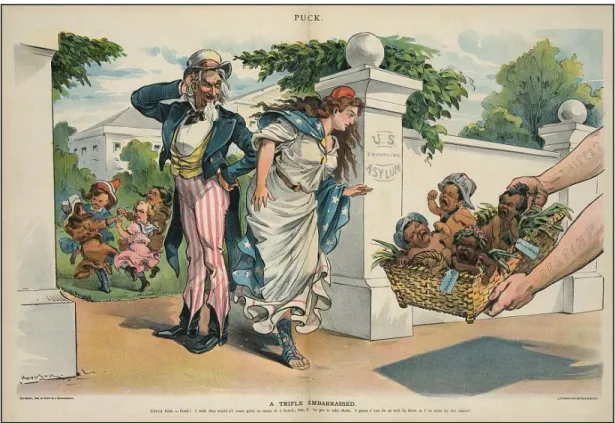
also focuses on the movement of people and children across borders; set in a fictionalized Guatemala, the novel connects U.S. involvement in military atrocities in Latin America to the availability of Guatemalan children for international adoption. Chapter 4 argues that the cannibalistic themes of these two novels are not a coincidence. Rather, the literary depiction of the U.S. consumption of Third World children symbolizes the racial politics of the U.S. as a global presence. Thus, Asian American and Latina/o authors like Yamashita and García can simultaneously critique U.S. foreign policies that promote violence and a domestic tendency to absorb Asian American and Latina/o children in a way that divorces them from the history of that violence. Expanding border theory to look at both East/West and North/South borders can further link the domestic and the international, placing U.S. history in a global context.
The conclusion of this project further expands the scope of American histories by
examining the work of Chinese-Peruvian-American author Siu Kam Wen. Born in China, raised in Peru, and living in the U.S. for more than thirty years, Siu describes himself as