Three Essays on Intellectual Property Rights
in Developing Countries
by
Kristie N. Briggs
A dissertation submitted to the faculty of the University of North Carolina at Chapel Hill in partial fulfillment of the requirements for the degree of Doctor of Philosophy in the Department of Economics.
Chapel Hill 2008
Approved by:
Alfred J. Field, Jr., Advisor
Scott A. Baker, Reader
Patrick J. Conway, Reader
Neville R. Francis, Reader
c
2008
ABSTRACT
KRISTIE N. BRIGGS: Three Essays on Intellectual Property Rights in Developing Countries
(Under the direction of Alfred J. Field, Jr.)
Developing countries today face different international policies and pressures than did
the currently industrialized countries when they were in the midst of the development
pro-cess. Recent external pressures on developing countries to implement intellectual property
rights (IPRs) are just one example. In practice many developing countries have chosen to
implement strong patent policies, despite the fact that these countries have limited capacity
for innovation. Developing countries are instead better characterized as “imitators” that
learn from technology transferred from innovating (industrialized) countries. Therefore,
im-plementing IPRs would seem counterintuitive for developing countries as it restricts their
ability to imitate. Despite the possible costs, many international organizations argue that
developing countries do, in fact, benefit from implementing IPRs via increased trade and
foreign direct investment. However, the true impact of IPR policy in developing countries
remains largely unclear. This dissertation untangles some of the links between IPRs, trade,
and development by focusing on a particular aspect of this issue in each of three essays. The first essay considers how a country’s choice in IPRs relates to their stage in
devel-opment. The essay is novel in that it brings to light evidence that a country’s choice in
IPRs as it develops (the longitudinal relationship) has a distinctly different IPR-per capita
GDP relationship than it has when considering the IPR choice for a variety of countries in
different stages of development, but at one point in time (the cross-sectional relationship).
The second essay looks at whether IPRs in developing countries stimulate high technology
exports from industrialized countries. By analyzing an array of different high technology
ex-ports to developing countries, it was determined which types of high technology goods were
strengthened domestic IPRs. The third essay explores whether stronger IPRs in developing
countries will stimulate their export activity. The acquisition of IPRs in developing countries
is found to have a significantly positive impact on developing country exports, suggesting a
ACKNOWLEDGEMENTS
I would like to express my appreciation for my advisor, Alfred Field, Jr. He has provided me with time, guidance, and encouragement throughout the course of my research. I also
wish to thank my committee members: Scott Baker, Patrick Conway, Neville Francis, and
David Guilkey for their insight and advice. I thank Walter Park for providing data. I also
thank my fellow graduate students, especially Charlie, Tia, and Mike for helping me along
the way. I would like to thank my sister, Jennifer, for her unending support, and both Jen
and Art for never making me pay for a single meal throughout all of graduate school!
Lastly, I would like to thank my parents for all the encouragement and sacrifices they
made that helped me reach where I am today. They have truly shown me value of hard
TABLE OF CONTENTS
LIST OF TABLES . . . x
LIST OF FIGURES . . . xii
1 Introduction . . . 1
2 Intellectual Property Rights and Development: A Longitudinal vs. Cross Sectional Study . . . 4
2.1 Introduction . . . 4
2.2 Review of Literature . . . 5
2.3 Theoretical Model . . . 8
2.3.1 Chen and Puttitanun’s Model . . . 8
2.3.2 A Revised Longitudinal Theory . . . 14
2.4 Linking Theory and Empirical Analysis . . . 19
2.4.1 The Ginarte-Park IPR Index . . . 19
2.5 Exploring the Longitudinal Data . . . 21
2.5.1 Pooled Data Analysis of the IPR-per capita GDP relationship . . . 25
2.6 The Fully Specified Model . . . 27
2.6.1 Estimating IPRs . . . 29
2.6.2 Endogeneity of IPRs and per capita GDP . . . 32
2.6.3 Estimating per capita GDP . . . 32
2.6.4 Specification of the System of Equations . . . 34
2.6.5 Empirical Results . . . 36
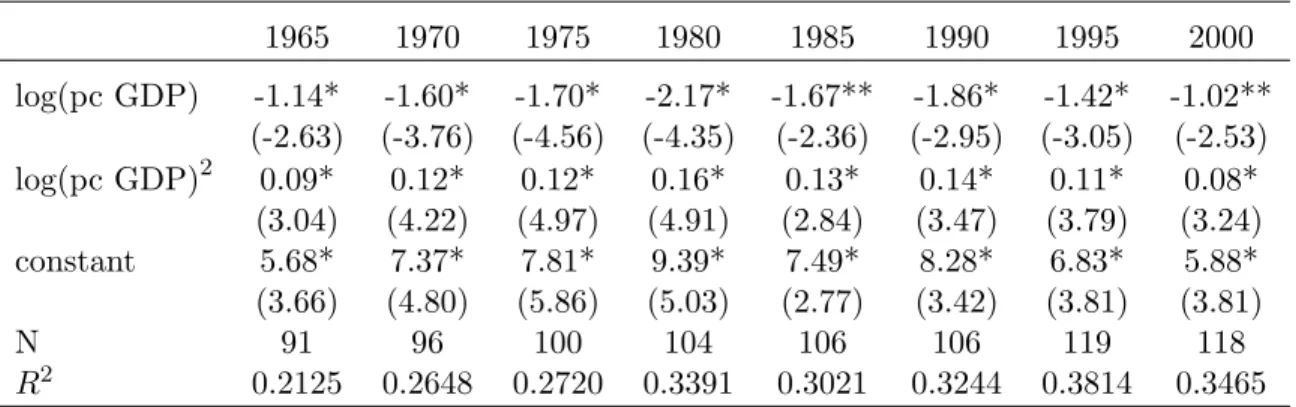
2.7 A Cross-Sectional Explanation for the U-shape . . . 38
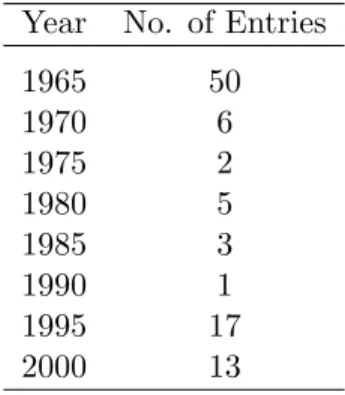
2.7.1 The Role of International Pressure in IPR Choice . . . 39
2.8 Conclusion . . . 53
3.1 Introduction . . . 56
3.2 Review of Literature . . . 58
3.2.1 Literature on IPRs and Trade in the North-South Context . . . 58
3.2.2 Empirical Research on IPRs and Bilateral Trade Flows . . . 59
3.2.3 Review of Literature on Gravity Models . . . 61
3.3 Theoretical Model . . . 62
3.3.1 The Story . . . 62
3.3.2 The Model . . . 63
3.3.3 What Impacts the Optimal Quantity to Produce and Export? . . . 70
3.3.4 Predictions about the Empirical Results . . . 71
3.4 Empirical Estimation . . . 73
3.4.1 The Gravity Model . . . 74
3.4.2 Country and High Technology Good Specifications . . . 79
3.4.3 Results . . . 80
3.5 Conclusion . . . 85
4 Do Intellectual Property Rights Increase Export Activity in Developing Countries? . . . 94
4.1 Introduction . . . 94
4.2 Relevant Literature . . . 95
4.3 Theoretical Model . . . 97
4.3.1 Exports of Newly Innovated Goods . . . 97
4.3.2 Exports of Existing Goods . . . 99
4.3.3 Total Export Activity . . . 103
4.4 Empirical Estimation . . . .104
4.4.1 Estimating Equation for Exports . . . 104
4.4.2 Problems with Endogeneity . . . 106
4.4.3 Data Description . . . 110
4.4.4 Empirical Results . . . 113
A Appendix for Essay One . . . 121
A.1 Summary of Empirical Results from Past Literature . . . 121
A.2 Ginarte-Park Index of Patent Rights . . . 123
A.3 Identifying the “Critical” Cross-Sectional Year . . . 124
A.4 Stage One Results for the Fully Specified Model . . . 127
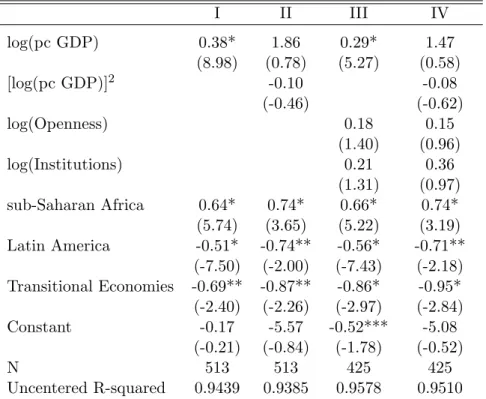
A.5 Cross-Sectional Results Accounting for Regional Effects . . . 128
B Appendix for Essay Two . . . 129
B.1 Explanations Proposed by Primo Braga and Fink . . . 129
B.2 Determining “Value Added” Categories . . . 130
B.3 Analysis of Low & Lower-Middle Income Countries . . . 131
C Appendix for Essay Three . . . 142
C.1 USPTO Patent Count Data . . . 142
C.2 First Stage Results for Essay 3 . . . 144
LIST OF TABLES
2.1 Group Classification used in Pooled Regression Analysis . . . 26
2.2 Pooled Regression Using Panel Data . . . 28
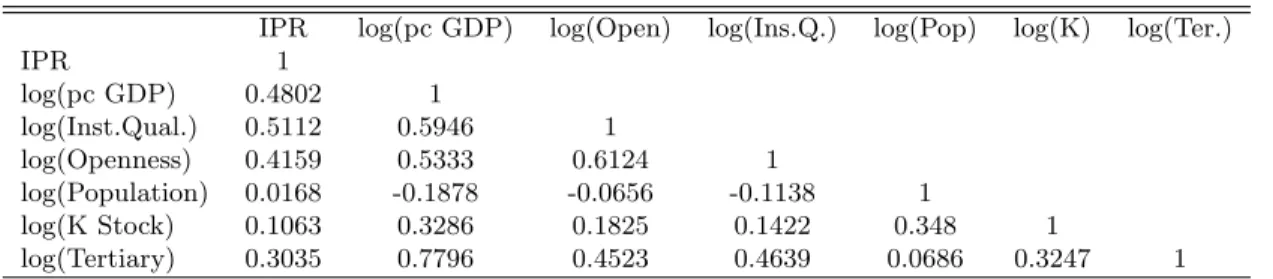
2.3 Descriptive Statistics . . . 36
2.4 Correlation Matrix . . . 36
2.5 Choice of IPRs: The Fully Specified Model . . . 37
2.6 Cross Section of IPRs for Each Available Year . . . 38
2.7 Composition of the Critical Cross-Section of Years . . . 45
2.8 Critical Cross Sectional IPR Decision . . . 48
2.9 Composition of Critical Cross-Section: Omitting 1885-1960 . . . 52
2.10 Critical Cross Sectional IPR Decision: Omitting 1885-1960 . . . 54
3.1 Composition of Aggregate High Technology Goods . . . 81
3.2 Value Added Categories . . . 82
3.3 Developed Country High Tech Exports to Low Income Countries . . . 86
4.1 Descriptive Statistics: Low & Lower-Middle Income Countries . . . 113
4.2 Bilateral Exports with Inward FDI in Current Period . . . 115
4.3 Bilateral Exports with Lagged Inward FDI . . . 116
4.4 Descriptive Statistics: High Income Countries Only . . . 118
4.5 Bilateral Exports (High Income Countries) . . . 119
A.1 IPR Regression Results from Past Literature . . . 121
A.2 Preliminary Results for IPR Choice . . . 122
A.3 Ginarte-Park Index of Patent Rights: Categories and Calculations . . . 123
A.4 Specification for the ‘Critical” Cross-Sectional Year . . . 124
A.5 Stage One Results: log(Per Capita GDP) . . . 127
B.1 Developed Country Exports to Low & Lower-Middle Income Countries . . . . 134
LIST OF FIGURES
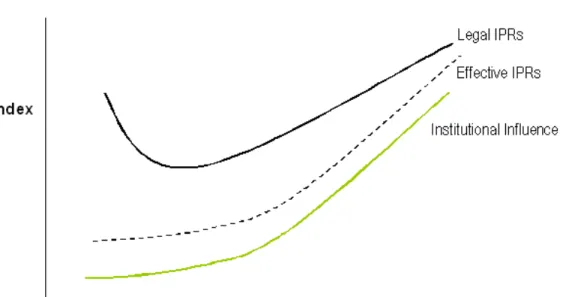
2.1 Legal vs. Effective IPRs . . . 15
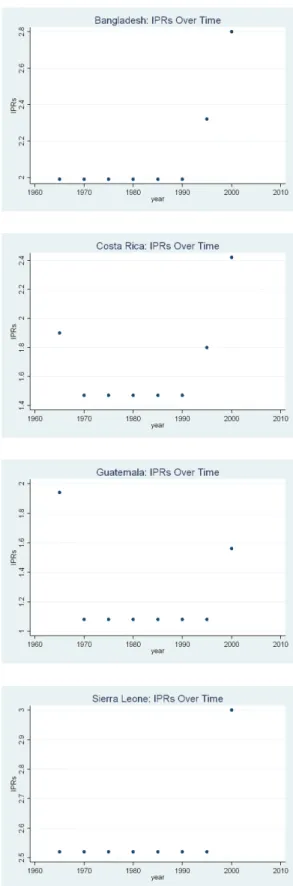
2.2 Selected Country Specific IPR Graphs . . . 24
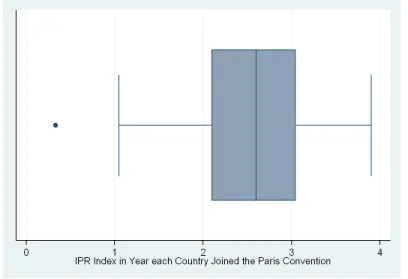
2.3 Box Plot of IPRs showing Indonesia as an Outlier . . . 49
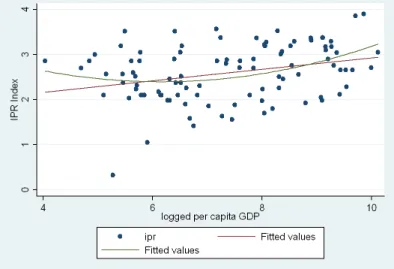
2.4 Scatter Plot of Critical Cross-Section when Indonesia is Included . . . 50
2.5 Scatter Plot of Critical Cross-Section when Indonesia is Omitted . . . 50
Chapter 1
Introduction
Developing countries today face different international policies and pressures than did
the currently industrialized countries when they were in the midst of the development
pro-cess. Recent external pressures on developing countries to implement intellectual property
rights (IPRs) are just one example. In practice many developing countries have chosen to
implement strong patent policies, despite the fact that these countries have limited capacity
for innovation. Developing countries are instead better characterized as “imitators” that
learn from technology transferred from innovating (industrialized) countries. Therefore,
im-plementing IPRs would seem counterintuitive for developing countries as it restricts their
ability to imitate. Despite the possible costs, many international organizations argue that
developing countries do, in fact, benefit from implementing IPRs via increased trade and
foreign direct investment. However, the true impact of IPR policy in developing countries remains largely unclear. This dissertation untangles some of the links between IPRs, trade,
and development by focusing on a particular aspect of this issue in each of three essays.
The first essay examines the role that a country’s stage of development plays in its choice
of IPRs. The essay is novel in that it brings to light evidence that a country’s choice in IPRs
as it develops (the longitudinal relationship) has a distinctly different IPR-per capita GDP
relationship than it has when considering the IPR choice for a variety of countries in different
stages of development, but at one point in time (the cross-sectional relationship). Past
empirical observations on a panel of countries over time have found a U-shape relationship
countries. A longitudinal U-shape, however, does not correspond to historical observation;
countries generally maintain or increase IPRs over time and demonstrate a similar trend as
they progress through stages of development. This paper argues that the well known U-shape
relationship between IPRs and per capita GDP is instead a result of cross country differences
originating in the year that each country first chooses to implement IPRs. Distinguishing
between the longitudinal and cross-sectional relationship between IPRs and per capita GDP
will enable researchers to accurately estimate and interpret the effects of IPRs when using
panel data.
The second essay examines how developed-country exports of high technology goods to developing countries are stimulated by IPRs in developing countries. One argument for
im-plementing strong IPRs in developing countries is that they attract greater high technology
exports from industrialized countries, which should consequently lead to economic growth.
Past empirical observation using an aggregate of high technology goods, however, has
sug-gested that bilateral exports of high technology goods is not impacted by the level of IPRs in
the importing country. A disaggregated analysis of high technology goods provides a more
precise insight into which high technology goods developed countries export in the presence
of stronger developing country IPRs. The impact of developing country IPRs on high
tech-nology exports from developed countries is contingent on a combination of variables such as
production and adaptation costs and whether innovations in the high technology group can
readily be used in domestic production processes. Innovations in high technology groups
such as potassic fertilizers, synthetic yarn, and artificial fibers are arguably very pertinent
to production in developing countries that specialize in agricultural and textile production.
Therefore, the markup in price for these high technology innovations is relatively high. In addition, marginal production and adaptation costs of innovated goods in these categories
are expectedly low. The combination of high markups and low marginal costs result in
a dominant market power effect when developing countries increase IPRs, indicating that
an increase in IPRs does not increase developed country exports of these goods. On the
other hand, industrialized high technology exports that have relatively higher production
mar-ket expansion effect. In this latter case, stronger IPRs in developing countries lead to an
increased receipt of high technology goods from industrialized countries.
The third essay examines the impact that patent policies have on export activity in
developing countries. Outward looking development policies centered on export promotion
have become increasingly popular strategies for stimulating economic growth in developing
countries. At the same time, many developing countries have adopted IPRs in recent years,
often upon the suggestion of industrialized countries and international organizations. This
paper explores the possible link between export promotion and IPR policies by examining
Chapter 2
Intellectual Property Rights and
Development: A Longitudinal vs. Cross
Sectional Study
2.1
Introduction
This paper examines the role that a country’s stage of development plays in its choice
of intellectual property rights (IPRs). Past empirical observations on a panel of countries
over time have found a U-shape relationship between IPRs and per capita GDP and taken it to imply a longitudinal U-relationship within countries. A longitudinal U-shape, however,
is counterfactual. Countries generally maintain or increase IPRs over time and, therefore,
expectedly demonstrate a similar trend as they progress through stages of development.
This paper argues that the well known U-shape is a result of cross country differences
originating in the year that each country first chooses to implement IPRs, rather than a
result of a longitudinal trend. To summarize, the conjecture of this paper is two-fold. First,
the longitudinal relationship between IPRs and per capita GDP is monotonically increasing
(rather than U-shaped). Second, a U-shape relationship between IPRs and per capita GDP
exists cross-sectionally, when a variety of countries in different stages of development are
examined at one point in time.
IPRs initially decrease and later increase as per capita GDP increases in a given country.
The downward portion of a longitudinal U relationship is generally not obtained as countries
generally do not actively weaken IPRs, barring a regime change or other alteration in their
political economy. The longitudinal U conclusion was largely drawn from the results of panel
data. Although longitudinal extrapolations of panel data are common, they are not always
valid. The significant non-monotonic link empirically discovered using panel data is a result
of cross sectional influences, not longitudinal influences. Interpretation of a cross-sectional
U-shape relationship between IPRs and per capita GDP would mean that, in a given year,
least developed countries exhibit stronger IPRs than middle-income developing countries, while high-income countries again exhibit strong IPRs.
The cross-sectional U-shape between IPRs and per capita GDP can be attributed to
cross country differences in IPRs in the year IPRs were first implemented. In the year that
countries first implemented IPRs, the least developed countries implement stronger patent
rights, partially because these countries are the most vulnerable to international pressures to
do so. Middle-income developing countries exercise more autonomy, however, and implement
weaker patent rights that enable them to greater utilize imitation as a pathway for growth.
Finally, when high-income countries first implement IPRs they implement relatively strong
IPRs as they have innovation related incentives to do so.
This paper contributes to the IPR literature by making a distinction between the
longi-tudinal and cross-sectional relationship between IPRs and per capita GDP, and by
demon-strating that the U-shape relationship observed in panel data is a result of cross sectional
differences in countries at different stages of development. Establishing this will enable
researchers to accurately estimate and interpret the effects of IPRs when using panel data.
2.2
Review of Literature
Three key contributions to the literature on the U-shape relationship between IPRs
Braga, Fink, and Sepulveda (2000).1 In addition, Ginarte and Park (1997) made ancillary contributions.
Ginarte and Park introduced their IPR index in 1997. In the same article, they
ex-amined the characteristics that influenced a country’s choice in IPRs. Ginarte and Park
concluded that a country’s level of per capita income, research and development (R&D),
political freedom, openness to trade, and secondary school enrollment rates together
deter-mine a country’s choice in IPRs. While Ginarte and Park concluded a country’s stage in
development significantly impacts its choice of IPRs, they did not consider the possibility
of a U-shape relationship.2 Efforts to pinpoint the exact relationship between these two variables has since emerged.
Maskus (2000) empirically observed a U-shape link between per capita income and IPRs.
He came to this conclusion in two separate analysis. He found this U-shape link in an
expansion of his work with Penubarti (1995) using a 1984 cross-section of countries and
the Rapp and Rozek IPR Index, as well as in analysis using the Ginarte and Park IPR
Index for a panel of countries in 1985 and 1990. The U-shape link remained significant
even when Maskus expanded the IPR regression equation to include independent variables
such as R&D expenditures as a proportion of GDP, secondary school enrollment, political
freedom, openness to trade, and market freedom. (These results can be found in Appendix
A.1.) While Maskus empirically observed the U-shape, and interpreted it longitudinally to
explain a country’s choice in IPRs as it develops, he did not provide a theoretical explanation
for the U-shape.
Chen and Puttitanun (2005) provided the first theoretical explanation for the U-shape
relationship between IPRs and per capita GDP by using a game theoretic approach to model a country’s choice of optimal IPRs. (This model will be outlined in detail in the
next section.) They then tested their theory using a panel of 62 developing countries for
the years 1985, 1990, 1995, and 2000. Chen and Puttitanun concluded that countries in 1
Most analysis of the U-shape has been explored using panel data for many countries over a series of years, while some has been strictly cross sectional analysis.
2The data used by Ginarte and Park include a panel of 48 developed and developing countries for the
the earliest stages of development implement higher IPRs to attract foreign technologies so
that they can imitate and grow. As a country gains access to foreign technologies, however,
stronger IPRs actually hinder its ability to imitate. As a result, Chen and Puttitanun argue
that these countries decrease the strength of IPRs so they can utilize imitation to foster
technological advancement. Once a certain level of development is reached,3 countries are capable of obtaining benefits from domestic innovation and therefore begin to strengthen
their IPRs.4 Chen and Puttitanun’s theoretical argument for the U-shape is examined thoroughly in the next section, as this paper suggests a revised longitudinal model for the
IPR-per capita GDP relationship.
In Chen and Puttitanun’s empirical estimation, they incorporate a two-stage regression
in their evaluation of the U relationship where they estimate IPRs in the first stage and then
estimate innovation as a function of IPRs in the second stage.5 (This paper alternatively argues that per capita GDP directly influences IPRs.) Chen and Puttitanun ultimately
found that there is a significant U-shape link between IPRs and per capita GDP.
Primo Braga, Fink, and Sepulveda (2000) consider the relationship between IPRs and
per capita GDP for a cross section of countries in the year 1975. Although the U-shape is
not a primary focus, the Primo Braga, Fink, and Sepulveda paper is important for a couple
of reasons. First, it finds a statistically significant relationship between IPRs and per capita
GDP using a strictly cross-sectional analysis for the year 1975. This is an important result
as it provides preliminary evidence that the U-shape configuration captured by panel data
could actually be driven by the cross-sectional variation. Secondly, in discussion unrelated
to the U-shape, Primo Braga, Fink, and Sepulveda claim that one determinant of IPRs
in developing countries is the international pressures they feel from more industrialized 3Chen and Puttitanun use development and technological advancement interchangeably in their model.
4
Chen and Puttitanun argue that even developing countries benefit from domestic innovation, pointing out that the number of domestic patent application in 1985-1995 were particularly high in Brazil, India, South Africa, and South Korea.
5
countries. In a similar line of thinking, this paper postulates that developing countries’
vulnerability to international pressures are directly related to the cross-sectional U-shape
between IPRs and per capita GDP.
Empirical results for papers discussed in this literature review found in AppendixA.1.
Primo Braga, Fink, and Sepulveda did not provide specific results, but rather a scatter plot
and the associated best-fit monotonic line.
2.3
Theoretical Model
The theoretical model explaining the U-shape link between IPRs and per capita GDP
found in Chen and Puttitanun (2005) is the only theory I could locate addressing the
possible relationship to date. In their model Chen and Puttitanun (CP) find support for
a longitudinal U-shape link between IPRs and per capita GDP. Their model, however,
considers a country’s IPRs written into law and does not explicitly address how enforcement
of these laws may impact perceived IPRs. The Ginarte-Park IPR index, which is most often
used in empirical analysis of IPRs, includes a measure for enforcement. The suggested
revised model for the longitudinal relationship between IPRs and per capita GDP explicitly
considers enforcement of IPRs.
2.3.1 Chen and Puttitanun’s Model
The CP theoretical model takes a game theoretic approach to finding how economic
growth affects optimal IPRs. In their model, the developing (domestic) country chooses its
level of IPR protection, β ∈[0; 1], where β= 0 indicates no protection and β = 1 indicates perfect protection. In addition, the parameter θ∈(0; 1] is a measure of the country’s level of development such that higher levels of θindicate greater development.
The domestic economy has two sectors, A and B. Sector A is comprised of two firms, a
foreign (developed country) firm, F, and a domestic (developing country) firm, D. Sector B
is comprised of two domestic firms, L and M. Each sector produces a different good and has
one imitating firm. Firms F and L are innovators in Sectors A and B, respectively, while
firms D and M are imitators, respectively. Sectors A and B are linked through the shared
IPRs.
In Sector A, the foreign firm sells a product of exogenous quality µF, which is under
a patented technology. Domestic firm D may produce the good in Sector A, but with a
quality level µD(β, θ) = µ0 +µFφ(θ)[1−α(β)] such that µD < µF by assumption. The
quality of the domestically produced good is dependent on the exogenous quality of the
foreign produced good, as well as firm D’s imitative abilities, represented by the parameter
φ(θ), and the limitation to imitation that results from stronger IPRs, α(β). In addition, for everyθ, 0≤φ(θ)≤1,φ0(θ)>0,α0(β)>0, α(1) = 1, and 0≤µ0 ≤µF(1−φ(1)). Countries
that are more developed (as identified by higher levels of θ) have greater imitative ability.
Perfect IPR protection (as identified by β = 1) results in no imitative capabilities for firm
D. Finally, all firms in Sector A have a constant unit cost ofcA∈[0, µ0].
In Sector B, firm L produces a good of quality v(z;θ), where z(β;θ) ≥ 0 represents firm L’s investment in quality improvement through innovative activities. CP argue that
the function z can also be interpreted as a measure of domestic innovation. For every
θ, vz(z, θ) > 0, vz(∞, θ) = 0, vzz(z, θ) < 0, vθ(z, θ) > 0, and vzθ(z;θ) > 0. Firm M produces a good in Sector B of quality vM(β;θ) = v(z;θ)−γ(β)(v(z;θ)−v0) such that
vM(β;θ) < v(z;θ) by assumption. Although firm M does not have innovative capabilities,
they can increase the quality of their good by imitating the variety produced by firm L.
For every θ, 0 ≤ v0, γ(0) > (1/vz(0, θ)), γ0(β) > 0, and γ(1) = 1. These assumptions also ensure that 0 < γ(β) ≤ 1, which results in a non-negative valuation of vM. CP also assume v0 ≡ 0, arguing that they do so without loss of generality. This assumption
leaves the quality of firm M’s good equal to imitation-dependent fraction of firm L’s variety
vM(β;θ) = v(z;θ)(1−γ(β)). Finally, all firms in Sector B have a constant unit cost of
cB ≡0.
Each sector has its own individual set of consumers. In Sector A, there is a continuum
of consumers of measure 1. Each consumer in A assigns a value to one unit of the good in
the good, additional units receive a valuation of zero. In Sector B, there is a continuum of
consumers of measure N >0. Each consumer in B assigns a value to one unit of the good
that is equal to the quality of that good. Again, since each consumer values only one unit
of the good, additional units receive a valuation of zero.
All consumers have identical preferences, such that a consumer’s utility from consuming
a good equals the quality of the good minus its price, or
U =µ−p
whereµis the value the consumer assigns to the good (which is equivalent to the quality of
that good) and p is its price. This functional form for consumer utility ultimately ensures the result that consumers will always purchase the high quality good in equilibrium. (This
fact will be discussed in more detail below.)
In CP’s model, the game is as follows: In the first stage, the domestic government
chooses the level of IPRs, β. In the second stage, firm L chooses research and development
expenditures, z, which is a proxy for the level of domestic innovation. After β and z are
chosen, the product qualities are simultaneously determined. In the third stage of the game,
firms F and D simultaneously choose prices for their good in market A. Similarly, firms L and
M simultaneously choose prices for their good in market B. In the final stage, production by
firms and purchases by consumers are carried out. Backward induction allows the subgame
perfect equilibria to be solved.
Given β and z > 0, each firm chooses its price by maximizing profits subject to the
constraint that consumers’ utility from consumption of their good exceeds consumers’ utility
from consumption of the competing firm’s good in that sector. Since both the low and high
quality firms in each sector face identical unit costs to production, the low quality firms will drive prices as low as possible to try and achieve a differential between quality and price
that exceeds that of the high quality firm, and therefore “win” the consumer. Thus, the low
quality firm will push prices down so that the price of its good exactly equals its marginal
cost. Given that firm D is the low quality firm in Sector A and firm M is the low quality
pD =cA;
pM =cB.
The profit maximizing prices of firms F and L are similarly determined by each firm
maximizing its profits subject to the constraint that consumers’ utility from consuming
their good exceeds that of consuming their competitor’s good. Equilibrium prices for firms
F and L are as follows:
pF =µF −µD +pD
=µF −µ0−µFφ(θ)[1−α(β)] +cA;
pL=v(z;θ)−vM(β;θ) +cB
=v(z;θ)−v(z;θ)(1−γ(β)) +cB
=v(z;θ)γ(β) +cB
CP assume that if consumers are indifferent between purchasing from firm F or D in Sector
A and firm L or M in Sector B, they will choose to buy the respective goods from firms F
and L. Even though equilibrium prices are higher in firms F and firm L, purchasing from
these higher quality firms yields greater (or equal) utility for consumers. It follows that all
consumers purchase from firm F in Sector A and firm L in Sector B.
such that profits are maximized. Profits for firm L are defined as follows:
πL=N[pL−cB]−z
=N[v(z;θ)γ(β) +cB−cB]−z.
Accounting for the possible corner solution of z = 0,6 the profit maximization equation implies that the optimal level of z satisfies N γ(β)vz −1 ≤ 0. However, when z > 0,
N γ(β)vz −1 = 0. Recall the assumption that γ(0) > (1/vz(0, θ)), which implies that
γ(0)vz(0, θ) > 1. This implication violates the Kuhn-Tucker first order condition in which
the optimalz(β;θ) satisfiesN γ(β)vz−1≤0. Therefore, it can be concluded thatz>0 and
N γ(β)vz−1 = 0.
Applying the implicit function theorem (IF T) on the first order conditionN γ(β)vz−1 = 0 shows how the optimal level of innovation, z, will respond to changes in IPRs, β, and the level of development, θ. If H is defined by the first order condition for z such that
H =N γ(β)vz−1, then
zβ(β;θ) =− ∂H
∂β ∂H ∂z
=−N γ
0(β)v
z
N γ(β)vzz
>0;
zθ(β;θ) =− ∂H
∂θ ∂H ∂z
=−N γ(β)vzθ
N γ(β)vzz
>0.
While the above application of the IFT is not related to the IPR-per capita GDP relationship
of primary concern for this paper, it does provide an important ancillary result; that the
optimal level of domestic innovation increases both as the level of IPRs increase and as the
country develops.
In the last stage of the game in CP’s theoretical model, the domestic government chooses
consists of consumer surplus in Sectors A and B, as well as producer surplus in Sector B.
(Producer surplus in Sector A is not included in domestic welfare since the foreign firm
produces the good in Sector A.)
Domestic Social Welfare (CP’s Model)=CSF +CSL+P SL
=(µF −pF) +N(µL−pL) +N(pL−cB)−z
=µF −pF +N µL−z
=µ0+µFφ(θ)[1−α(β)] +N v(z;θ)−z
(2.1)
wherez(β;θ).
Maximizing domestic social welfare in CP’s theoretical model with respect toβ yields a
unique, interior solution for the optimalβ (such that 0< β <1) characterized by the below first order condition:
µFφ(θ)α0(β(θ)) = [N vz(z(β(θ);θ);θ)−1]zβ(β(θ);θ). (2.2)
The left and right hand sides of equation (2.2) are the marginal cost and marginal benefit
to increasing β, respectively. (According to CP, the marginal cost of increasing β is the
cost associated with a country’s decreased ability to imitate the competing firm’s good.
The marginal benefit of increasing β refers to the benefits to the domestic economy from
increased innovation.) Notice that marginal benefits of increasingβ are always non-negative.
This can be shown by combining two facts: (1) 0< γ(β)≤1 and (2) the optimalz satisfies
N γ(β)vz −1 = 0. This means that N vz = γ(1β), which implies that N vz >1. When this fact along withzβ >0 (as previously determined) is applied to the marginal benefit term in
equation (2.2), we can conclude that [N vzz−1]zβ >0.
By this stage in the model, all the tools are available to evaluate the key relationship
to determine how the optimal β will respond to changes in θ. Given that the partial
derivative of equation (2.2) with respect to β is always negative (since β in the above
equation is the maximum β by definition), CP conclude that the sign of β0(θ) will take the
same sign as the partial derivative of equation (2.2) with respect to θ. In other words, CP
find that
β0(θ)
>0 ifµFφ0(θ)α0(β(θ))<[N vz(z(β(θ);θ);θ)−1]zβθ(β(θ);θ);
<0 if µFφ0(θ)α0(β(θ))>[N vz(z(β(θ);θ);θ)−1]zβθ(β(θ);θ).
(2.3)
whereµFφ0(θ)α0(β(θ)) represents the effect of a marginal increase inθon the marginal cost
of increasing β and [N vz(z(β(θ);θ);θ)−1]zβθ(β(θ);θ) represents the effect of a marginal increase in θ on the marginal benefit of increasing β. More generally, the results in (2.3)
imply that there exists a time when increases in per capita GDP, as embodied by θ, will
cause a country’s choice in optimal IPRs, as embodied by β, to fall. CP conclude that this
result provides theoretical justification for the downward portion of the U-shape relationship
empirically observed between IPRs and per capita GDP.
Now that CP’s theoretical model of the relationship between IPRs and per capita GDP has been presented, a revised longitudinal theory will be proposed.
2.3.2 A Revised Longitudinal Theory
While CP present an interesting explanation for a U-shape link between IPRs and per
capita GDP, the β that they optimize in their model represents a country’s optimal choice
in IPRs as it should be written into law. They assume that these “legal IPRs” are enforced.
The effectiveness of these “legal IPRs,” however, is dependent on the institutional environ-ment. If institutions are relatively weak, IP protection likely will not be maintained and
corresponding IP laws not effectively enforced.7 Although the optimal level of legal IPRs
7
may decrease for the least developed countries, as suggested by CP, the level of effectively
enforced IPRs, or “effective IPRs,” is monotonically increasing. The positive relationship
between institutional quality and per capita GDP has been presented by individuals such
as North (1990), Hall and Jones (1999), and Acemoglu, Johnson, and Robinson (2001).
Institutional quality is therefore assumed to be positively related to a country’s level
of economic development. In addition, the effectiveness of IPRs depends on the quality
of institutions in a country. More specifically, “effective IPRs” in a country are a linear
combination of institutional quality and “legal IPRs.” This is demonstrated in Figure 2.1.
So long as the positive influence of institutional improvement on IPRs exceeds any net imitative marginal benefit from decreasing IPRs as a country develops, the optimal level of
effective IPRs will always increase as a country develops.
Figure 2.1: Legal vs. Effective IPRs
Letβ ∈[0,1] represent legal IPRs in Figure 2.1 and embody the characteristics previously outlined by CP. In addition, consider a measure of institutional influenceψ∈[0,1] such that stronger institutions correspond to larger values of ψ. In other words ψ = 0 means that a
ψ= 1 means there is perfect institutional quality and all laws on the books are completely
effective. As previously stated, institutional quality will increase as a country develops. This
suggests thatψ0(θ)>0. It is also assumed that|β0(θ)|<|ψ0(θ)|, indicating that an increase in per capita GDP will have a greater marginal impact on improving institutional influence
in a country than it will have on changing the optimal level of legal IPRs.8 The functional form for the linear combination demonstrated in Figure 2.1 is represented by β+2ψ such that 0≤ β+2ψ ≤1 captures effective IPRs.
Distinguishing between legal IPRs and effective IPRs, as outlined above, lends to a
theoretical model that is similar in structure to that of CP. Structural differences arise in the quality of the domestically produced goods, as quality is now dependent not only on
the legal IPRs but also on the institutional influences that impact the effectiveness of these
IPRs. More specifically, in Sector A, firm F continues to supply a good of quality µF while
the quality of firm D’s good is µD(β+2ψ, θ) = µ0+µFφ(θ)[1−α(β+2ψ)]. The limitation to
imitation that results from stronger IPRs is now captured by α(β−ψ) such that αβ >0,
αψ >0,α0(β+2ψ)>0, 0≤α(β+2ψ)≤0,α(1) = 1, and 0≤µ0 ≤µF(1−φ(1)). A combination
of perfect IPR protection and perfectly effective IP laws (as identified byβ = 1 andψ= 1)
results in no imitative capabilities for firm D. Finally, as in CP, all firms in Sector A have
a constant unit cost of cA∈[0, µ0].
In Sector B, firm L now produces a good of quality v(z;θ), where z(β −ψ;θ) ≥ 0 represents firm L’s quality improvement through innovation. Firm M produces a good in
Sector B of qualityvM(β+2ψ;θ) =v(z;θ)−γ(β+2ψ)(v(z;θ)−v0) such that for everyθ, 0≤v0,
γ(0)>(1/vz(0, θ)), γβ >0, γψ >0,γ0(β+2ψ) >0 and γ(1) = 1. These assumptions ensure that 0< γ(β+2ψ)≤1, which results in a non-negative valuation ofvM. As in the CP model,
8
it is again assumed that v0≡0 and constant unit costscB≡0.
The four stages of the game remain the same as those in CP’s model: (1) the domestic
government chooses legal IPRs, (2) firm L chooses domesticR&Dexpenditures, (3) all firms
set prices, and (4) production and consumption is carried out in both sectors. Consider the
first stage for a moment, in which the domestic government chooses legal IPRs as embodied
by β. The government chooses legal IPRs given a set of ideologies regarding the decision.
These ideologies may or may not be borne out in practice. Laws are not always written to
correspond to what will necessarily happen, but rather because of what the government’s
ideologies are for making the law. This line of reasoning supports the idea that countries respond to international pressures to implementing IPRs, which will be discussed later in
the paper. For the purposes of the current theoretical model, however, it is assumed that
the government’s choice in legal IPRs reflects their ideologies for implementing the law and
does not necessarily depend on whether the law can and/or will be enforced. Therefore,
the government still chooses legal IPRs that ideally maximize social welfare (rather than
choosing effective IPRs).
Given these alterations, the prices set by firms in Stage 3 mirror those found by CP in
their functional form based on product qualities. Specifically,
SectorA
pD = cA
pF = µF −µ
0−µFφ(θ)[1−α(β+2ψ)] +cA
SectorB
pM = cB;
pL= v(z;θ)γ(β+2ψ) +cB.
The same is true for firm L’s choice inR&Dexpenditures in Stage 2. In the revised model,
the optimal level ofR&Dexpenditures satisfies the first order conditionN γ(β+2ψ)vz−1 = 0. DefiningH=N γ(β+2ψ)vz−1, and applying the IFT lends to the following:
zβ(β, ψ, θ) =− ∂H ∂β ∂H ∂z
=−N γβ( β+ψ
2 )vz
N γ(β+2ψ)vzz
zθ(β, ψ, θ) =− ∂H
∂θ ∂H
∂z
=−N γ( β+ψ
2 )vzθ
N γ(β+2ψ)vzz
>0;
zψ(β, ψ, θ) =− ∂H ∂ψ ∂H ∂z
=−N γψ( β+ψ
2 )vz
N γ(β+2ψ)vzz
>0.
Only the result zψ(β, ψ, θ) > 0 is new. It indicates that, as expected, innovation will be
lower the weaker a country’s institutional quality.
Domestic social welfare now accounts for the institutional influence on legal IPRs.
Domestic Social Welfare (Revised Model)=µ0+µFφ(θ)[1−α(
β+ψ
2 )] +N v(z;θ)−z (2.4)
wherez(β+2ψ;θ). The domestic government chooses legal IPRs to maximize domestic social welfare as represented in (2.4). The optimal level of IPRs satisfies
−µFφ(θ)αβ(
β+ψ
2 ) + [N vz(z(
β+ψ
2 ;θ);θ)−1]zβ(
β+ψ
2 ;θ) = 0. (2.5)
whereβ(θ) andψ(θ). In (2.5),µFφ(θ)αβ(β+2ψ) represents the marginal cost to social welfare of increasingβand [N vz(z(β+2ψ;θ);θ)−1]zβ(β+2ψ;θ) represents the marginal benefit to social welfare of increasing β.
The relationship of primary interest is how the optimal level of effective IPRs (or β+2ψ) changes as a country develops (or θincreases). Equation (2.6) embodies this effect. Notice
that the effect of an increase in per capita GDP on effective IPRs can be broken into two
components: (1) the effect of an increase in per capita GDP on legal IPRs and (2) the effect
d(β+2ψ)
dθ =
∂(β+2ψ)
∂β ·
dβ dθ +
∂(β+2ψ)
∂ψ ·
dψ
dθ (2.6)
=1 2·
dβ dθ +
1 2·
dψ dθ
Since |β0(θ)|< |ψ0(θ)| the effective level of IPRs is monotonically increasing as a country develops even when the optimal legal level of IPRs is decreasing.
2.4
Linking Theory and Empirical Analysis
The revised theory provides a theoretical rationale for a monotonically increasing
rela-tionship between effective IPRs and per capita GDP. The next step is to focus on empirical
analysis of the longitudinal relationship between IPRs and per capita GDP. Before doing
so, a few comments should be made about the empirical analysis in this paper compared
to that of CP. Both this paper and CP’s paper use the Ginarte and Park IPR Index to
approximate a country’s level of IPRs. Given the opposing theories captured in Figure 2.1,
it is natural to ask whether the Ginarte and Park IPR Index best captures legal IPRs or effective IPRs. In order to answer this question, let’s first examine the Ginarte and Park
IPR Index in more detail.
2.4.1 The Ginarte-Park IPR Index
When empirically analyzing intellectual property rights, two indices for the strength of
patent systems have commonly been used. In 1990, Rapp and Rozek developed an IPR
index based on how closely a country’s patent policies mirror those embodied by US patent laws. In 1997, Ginarte and Park introduced a broader index of patent strength. Specifically,
the Ginarte-Park (GP) Index accounts for; (1) coverage, (2) membership in international
treaties, (3) loss of protection, (4) enforcement, and (5) duration of protection. Since its
IPR analysis.9 This is because the GP Index embodies a greater number of countries and years, and considers a greater scope of categories in its construction (which lends to a more
precise estimate).
This paper utilizes an updated version of the GP Index that contains data for 121
countries at five-year intervals between 1960 and 2000.10 A detailed description of the construction of the index, as outlined in Ginarte and Park (1997), can be found in Appendix
A.2. However, further analysis of the enforcement component of the GP Index provides
insight as to whether the measure is best approximating legal IPRs or effective IPRs in the
above theories.
The enforcement component of the GP index generates a dummy variable based on
whether the country (1) implements preliminary injunctions to protect the patentee until
a final decision about infringement is made by the courts, (2) protects against third party
induced infringement, and (3) implements burden-of-proof reversals to place the burden
of proving “innocence” on the individual doing the alleged infringement rather than the
patentee. It is important to justify whether or not this enforcement component is sufficient
in capturing the effective level of enforcement of IPRs in these countries. If it does, then
the GP Index measures effective IPRs in a country.
In fact, there is recent evidence to suggest that the GP Index does capture countries’
effectively enforced level of IPRs. This support is provided in a recent comparison between
the GP Index and a newly developed IPR rating created by the World Economic Forum. The
World Economic Forum released an IPR rating in their 2000 Annual Global Competitiveness
Report (GCR) that was based on surveys of opinions and experiences of firms and individuals
in an array of countries.11 Thus, the GCR Index provides information aboutperceived IPRs, 9For example, this is true in Maskus (2000), Schneider (2004), and Chen and Puttitanun (2005).
10
I would like to thank Professor Walter Park for providing me with the updated index. Note that IPR data is available for 1960, 1965, 1970, 1975, 1980, 1985, 1990, 1995, and 2000.
11The IPR index found in the Global Competitiveness Report does not provide historical data, given that
which implicitly includes their effective enforcement.12 Comparison of the two indices in the one year (2000) for which overlapping data is available reveals that the GCR rating
and the GP Index are strikingly similar. In fact, the indices have a positive correlation
of approximately 0.8.13 This comparison suggests that there is little difference between perceived IPRs in these countries and the level of IPRs reported by GP, thereby providing
support that the GP Index approximates effective IPRs.
If the GP Index best captures effective IPRs, then why did CP find a statistically
sig-nificant U-shape link between the GP IPR Index and per capita GDP in their empirical
analysis? The first answer to this question lies in the fact that the GP Index is an approxi-mation of effective IPRs, meaning that some errors likely exist in the index’s representation
of effective IPRs. Secondly, regional influences on the longitudinal relationship between IPRs
and per capita GDP are carefully examined in this paper and prove to play an important
role in IPR choice. These regional influences were not included in CP’s analysis.
The next section explores the longitudinal relationship, first by focusing on time series
data and then by applying what has been observed in the time series data so to better
analyze the longitudinal relationship between IPRs and per capital GDP using the entire
panel data set.
2.5
Exploring the Longitudinal Data
In general, IPRs for a given country remain the same or increase over time barring any
regime shift or other change in a country’s political economy. Only 14 out of 121 countries
show any decrease in the GP Index over time.14 In addition, only India exhibited a decrease in IPRs at a point in time when their per capita GDP was at or below the critical US$785
level, which was found to be the level of per capita GDP that corresponds with the minimum 12
The GCR Index includes patents as well as other varieties of IPRs such as copyrights and trademarks.
13
Economic Freedom of the World: 2001 Annual Report; Chapter 4.
14Bolivia, Brazil, Colombia, Costa Rica, Ecuador, Germany, Guatemala, Honduras, India, Malaysia,
level of IPRs in a preliminary quadratic regression. (See Table A.2 in AppendixA.1.) The
majority of countries that demonstrate a decrease in their IPR index are middle-income
developing or already developed countries. This is an important point given that previous
theories postulate that it is the least developed countries that decrease IPRs as they grow.
Finally, ten of the fourteen countries with a decrease in IPRs over time are located in Latin
America. This fact suggests that there may be a regional effect coming into play between
IPRs and per capita GDP that may impact Latin American countries differently than the
rest of the world.15
Given the fact that only 14 out of 121 countries ever show a decrease in IPRs over time, it can be concluded that, in general, IPRs within countries remain the same or increase
over time. Since economic development is embodied by increases in per capita income
over time, the strength of IPRs for a given country would expectedly remain the same or
increase as a country develops. Time series regressions on each country largely reject the
longitudinal U-shape proposed in past literature. Time series analysis is conducted even
though a complete set of time series data contains only eight data points, which is small and
lends to questionable asymptotic properties in estimation. In order to address the problems
brought about by the small sample size in time-series analysis, a longitudinal relationship
between IPRs and per capita GDP is later examined using the entire panel data set.
When time series regressions are run on the 102 countries that have a complete set of time
series data,16 only 24 countries17 report a significant quadratic relationship between IPRs 15Such regional influences may implicitly appear in the theoretical model via the institutional quality
variable. Institutional quality and institutional structure may vary between regions, resulting an a regional impact in empirical analysis. It is also possible that there are region-wide changes in the political economy for which a decrease in IPRs may result. Political economy “shocks” are not introduced into the theoretical model, but they do provide an intuitive caveat for stable or increasing IPRs as a country develops. This caveat will be emphasized throughout the paper. Nonetheless, there is not an explicit account of regional influences in the theoretical model. Therefore, the significance of regional effects found in the empirical longitudinal exploration explain more than what is presented in the theoretical model.
16A complete set of time series data would be data for 1965, 1970, 1975, 1980, 1985, 1990, 1995 and 2000
as a result of limitations in the GP Index and per capita GDP data. Countries with less than the maximum number of time series data points (eight data points) are omitted.
17
and logged per capita GDP at the 90 percent level. Only four countries–Bangladesh, Costa
Rica, Guatemala, and Sierra Leone–indicate a quadratic relationship that is significant at
the 99 percent level. The distinction in levels of significance is important as the quadratic
relationship for the entire panel data set has been consistently found at the 99 percent level
in past research.
The graphical representation of these four countries indicates that only Costa Rica and
Guatemala truly represent any downward swing in the strength of IPRs over time.
Coinci-dentally, the decrease in IPRs in 1970 corresponds with the collapse of the Central American
Common Market (CACM) of which both Costa Rica and Guatemala were members. This link is significant as the CACM established IPR guidelines for member countries. In
ad-dition, the IPR index increases in both Costa Rica and Guatemala after that CACM was
reinstated in 1991. (Costa Rica shows an increase in 1995 and Guatemala in 2000.) This
suggests that the downward longitudinal swing of IPRs in these countries is a consequence
of a shift in the political economy rather than a consequence of development.
The graphs for Sierra Leone illustrate a curious relationship. While the strength of IPRs
in Sierra Leone remains constant or increases over time, IPRs decrease with respect to per
capita GDP. This suggests that per capita GDP in Sierra Leone is decreasing over time.
When considering the complete data set, thirteen African countries exhibit the anomaly that
per capita GDP is decreasing over time.18 Each of these thirteen countries, however, either maintain or increase IPRs over time, but never decrease IPRs over time. This suggests that,
in these countries the choice in IPRs is not necessarily driven by their stage in development.
Accounting for sub-Saharan African countries in longitudinal analysis therefore becomes
very important.
While time series analysis supports the claim that individual countries generally maintain
or increase their IPRs as they develop, the small sample size is less than ideal. A maximum
of only eight data points is available for each country to analyze the time series regression
between IPRs and logged per capita GDP. As a result, methods to isolate the time-series 18
effect in the panel data provide improved asymptotic qualities of the estimators and are,
therefore, worth exploring. This will be done first by looking at the IPR-per capita GDP
relationship while pooling together countries with similar time series characteristics. Then,
using the full panel of data, the choice in IPRs will be examined in the context of a fully
specified model, where independent variables other than per capita GDP are included in the
regression equation.
2.5.1 Pooled Data Analysis of the IPR-per capita GDP relationship
Most methods to isolate time effects in panel data impose a common per capita GDP
slope coefficient for all countries. There are regional specific characteristics, which were
discussed in the previous section, that suggest slope coefficients likely vary between certain
regions. Therefore, in this study countries in regions with similar characteristics are pooled
together, and slope coefficients vary between each pooled group.
To be more specific, the entire panel data set is divided into four pooled groups. The first
group includes countries in the region of Latin America and the Caribbean. As previously
stated, ten of the fourteen countries showing a decrease in the IPR Index over time were from this region. Therefore, the pooled group of Latin America and the Caribbean will
capture the similarities in this geographical region. Countries in this region were specified
using the regional classifications of the United Nations.19
The second pooled group includes sub-Saharan African countries. Over a third of the
countries in this region exhibit a dominant downward trend in per capita GDP over time.20 Many of these countries continue to increase IPRs despite the decrease in per capita GDP.
This effect was exhibited in the graph of Sierra Leone presented in the previous section. As
with the regional classification of Latin America and the Caribbean, and the United Nations’
classification was used to identify countries to the sub-Saharan region. In this classification,
sub-Saharan Africa is designated as all of Africa except northern Africa, with the Sudan 19http://unstats.un.org/unsd/methods/m49/m49regin.htm.
20Angola, Central African Republic, Chad, Democratic Republic of the Congo, Cote d’Ivoire, Ghana,
included in sub-Saharan Africa.
The third pooled group consists of those countries for which there exist only two data
points: 1995 and 2000. These are mostly transitional, Eastern European economies, but also
include China and Vietnam. Specifically, only two data points are available for Bulgaria,
China, Czech Republic, Hungary, Lithuania, Poland, Romania, Russian Federation, Slovak
Republic, Ukraine, and Vietnam. It is possible that the limited time series in these countries,
as well as their sudden inclusion in 1995, at a time when IPRs were internationally on the
rise, may be skewing the panel results. The fourth and final group in the pooled analysis
includes all other countries not otherwise specified in one of the three previously mentioned groups.
Table 2.1: Group Classification used in Pooled Regression Analysis Group 1 Latin America & the Carribean
Group 2 Sub-Saharan Africa
Group 3 Transitional Economies, China, & Vietnam Group 4 All Other Countries
Note: Transitional Economies, China, & Vietnam, are countries that have a limited sample size for IPRs.
For each pooled group, an interaction term is created between per capita GDP and a
dummy variable, P OOLi, that equals 1 for each Group j = i, and zero otherwise. This
allows each pooled group to have a different slope coefficient. Countries within groups
do not necessarily have similar intercepts, however. To account for country differences
within groups, each country is given its own intercept. In addition, year fixed effects are
included to capture difference between years. (Given that the estimation finds country
specific intercepts, intercepts for each pooled group are omitted.)
IP Rkt=αk+αt+
4
X
i=1
(βilog(per capita GDPit)∗P OOLi)+
4
X
i=1
(θi[log(per capita GDPit)]2∗P OOLi) +εkt;
where,
P OOLi
= 1 if Groupj =i;
= 0 if Groupj6=i
(2.7)
whereαk is the country specific intercept term andαt is the year specific intercept term.
Results for the pooled regression are found in Table 2.2. As shown in column I, none of
the groups exhibit a significant U-shape. In fact, the coefficients on the rest of the world
(Group 4) instead tell a story more along the lines of a diminishing marginal choice in the
strength of IPRs as a country develops. This is particularly encouraging as Group 4 contains
382 of the 840 total observations in the pooled regression.
Overall, accounting for variation in slope coefficients for the four specified groups enables
the longitudinal effects in panel data to be better isolated. The results of the pooled regres-sions do not provide support for a longitudinal U-shape relationship. In the next section,
the longitudinal relationship between IPRs and per capita GDP will be examined in more
detail by considering a fully specified choice equation for IPRs.
2.6
The Fully Specified Model
The objective of the fully specified model is to account better for the variety of factors
that influence a country’s choice in IPRs. A fully specified model leads itself to a more
Table 2.2: Pooled Regression Using Panel Data
I II
Group 1 log(pc GDP) 0.32 0.27**
(0.24) (2.28)
Group 1 [log(pc GDP)]2 -0.01 (-0.07)
Group 2 log(pc GDP) 0.12 -0.02
(0.28) (-0.33)
Group 2 [log(pc GDP)]2 -0.01 (-0.34)
Group 3 log(pc GDP) -0.10 0.92***
(-0.02) (1.68)
Group 3 [log(pc GDP)]2 0.07
(0.25)
Group 4 log(pc GDP) 0.49* 0.42*
(11.50) (33.21)
Group 4 [log(pc GDP)]2 -0.01*** (-1.69)
1970 0.02 0.02
(0.60) (0.49)
1975 0.00 -0.01
(0.04) (-0.26)
1980 0.10* 0.09*
(2.61) (2.26)
1985 0.15* 0.13*
(3.62) (3.32)
1990 0.15* 0.13*
(3.62) (3.30)
1995 0.44* 0.41*
(8.32) (8.55)
2000 0.79* 0.75*
(13.33) (14.93)
Observations 840 840
R-squared 0.9920 0.9920
2.6.1 Estimating IPRs
Numerous variables impact a country’s choice in IPRs. A country’s choice in IPRs
may depend not only on their level of development (or per capita GDP), but also on their
level of openness and institutional quality. Proxies for each of these factors are included as regressors in the IPR equation and will be discussed further in a moment. In addition, a
country’s choice in IPRs may vary depending on their regional association. Latin American
and the Caribbean, sub-Saharan Africa, and Eastern European Transitional Economies
(including China and Vietnam) are the three regions with unique links that have already
been discussed.21 Dummy variables for these regions are therefore included in the fully specified model. Finally, time fixed effects are also included so to capture variation in the
IPR choice related to a certain year. To summarize, the full specification of the IPR equation
is as follows:
IP Rit=β1log(yit) +β2[log(yit)]2+β3log(opennessit) (2.8) +β4log(institutional qualityit) +β5Latini+β6Africai+β7Transitionali+εit.
Openness
The impact of openness to trade on a country’s level of IPRs is ambiguous. It is possible
that the more open a country is to trade, the stronger IPRs will be in order to entice high
technology goods. On the other hand, greater openness may occur in hopes of imitating
high technology goods, which would result in expectedly weak IPRs.
A country’s level of openness to trade depends on such things as tariffs, quotas, and
exchange controls. However, it is difficult to measure openness in a way that is not
endoge-nous with per capita GDP. The “Freedom to Trade Internationally” Index mitigates the
possibility of endogeneity. “Freedom to Trade Internationally” is a subindex included in the 21China and Vietnam are included in regional classification for Transitional Economies as all these countries
Fraser Institute’s Economic Freedom of the World Index (to be discussed in more detail in
the below section on institutional quality). “Freedom to Trade Internationally” is estimated
using equally weighted data on the following five areas: (1) taxes on international trade, (2)
regulatory trade barriers such as non-tariff barriers, (3) the actual size of the trade sector
compared to expected trade sector, (4) the difference between the official exchange rate and
the black market rate, and (5) international capital market controls. Thus, this measure of
openness captures many desirable aspects that are often difficult to quantify without using
per capita GDP.
Institutional Quality
Institutional quality is a term used to describe a country’s ability to sustain sound
economic practices given their economic and political environment. Institutional quality is
sometimes approximated using a broad measure for economic freedom. This has been the
case in past literature analyzing IPRs.
There are two widely used indices of economic freedom: (1) TheEconomic Freedom of
the World Index created by the Fraser Institute, and (2) The Index of Economic Freedom
created by the Heritage Foundation and the Wall Street Journal. Chen and Puttitanun (2005) used the former in their previous research into the U-shape. The Economic Freedom
of the World Index accounts for five different factors: (1) size of government as measured
by expenditures, taxes, and enterprizes, (2) legal structure and security of property rights,
(3) access to sound money, (4) freedom to trade internationally, and (5) regulation of credit,
labor, and business.22 The index ranges from zero to ten, with ten embodying complete economic freedom. Beginning in 1995 a measure for intellectual property right protection
was included in the calculations of group 2. Therefore, using the Economic Freedom of the
World Index as a regressor in my estimation equation would be erroneous.
In addition to having a limited data range (with data available only beginning in 1996),
the Heritage Foundation’s Index of Economic Freedom also perpetuates simultaneity with
ness, Trade, Fiscal, Freedom from Government, Monetary, Investment, Financial, Property
Rights, Freedom from Corruption, and Labor Freedom. While the Heritage Foundation is
not specific about what goes into their calculations for property rights, the sources they
use to comprise data in this category are similar to those used in the Economic Freedom
of the World Index. This fact is a red flag that using either of these two indices of
eco-nomic freedom would bias my estimates. Using an index that, in part, measures a country’s
IPRs to approximate that country’s IPRs violate the non-collinearity assumption among
independent variables.
It is now apparent that, due to the breadth of categories included in economic freedom, such a measure will likely be correlated with a country’s choice of IPRs. As a consequence,
it is better to narrow the focus of institutional quality from the wide-ranging concept of
economic freedom to those components of institutional quality that directly impact IPRs.
These include rule of law, physical property rights, and the existence of a sound business
environment.
Rule of law and physical property rights will have a clear consequence on a country’s
IPRs, but likely not the other way around. A country will only have incentive to implement
IPRs if they know such laws will be adequately enforced and not overpowered by corruption.
In addition, laws for physical property rights provide the precursor for laws for intellectual
property rights. Thus stronger physical property rights suggest the onset of stronger IPRs.
(Note, the direction of casualty is from physical property rights to IPRs.) Measures for rule
of law and physical property rights can be calculated by removing the IPR measure from
“legal structure and property rights” component of the Economic Freedom of the World
Index.
A sound business environment supports innovation and IPR related growth.23 Without
sound business environment, firms’ ability to innovate, as well as the benefits from
innova-tion, will be stunted. Component 5 of the Economic Freedom of the World Index, which
measures the “regulation of credit, labor, and business” effectively captures the sound busi-23
ness environment critical to institutional quality. Thus, the measure of institutional quality
used in the empirical estimations of this paper combine rule of law, physical property rights,
and business environment.
2.6.2 Endogeneity of IPRs and per capita GDP
Although the key relationship of interest is how IPRs are affected by levels of per capita
GDP, the causality also works in the other direction: per capita GDP is a function of
IPRs. Countries with stronger IPRs may generate more output and lead to more economic
growth. Ginarte and Park (1997) acknowledge problems pertaining to simultaneity, but they
did not account for it in their empirical analysis. Although Chen and Puttitanun (2005) do
incorporate a two-stage regression in their evaluation of the U relationship, they estimate
IPRs in the first stage and then estimate innovation as a function of IPRs in the second
stage.
Since CP model innovation to be dependent on income levels, their endogenous
rela-tionship is similar to the simultaneity of IPRs and income used in this paper. However,
the two-stage model CP used does not account for all the possible effects that IPRs could have on income. Intellectual property protection in a country not only impacts domestic
innovation, but also affects things such as the country’s attractiveness to foreign companies.
A direct endogenous relationship between income and IPRs is therefore considered in this
paper.
In the case of simultaneous equations, the IPR equation will be estimated using a
two-stage least squares, instrumental variables approach. The next step, then, is to identify the
estimating equation for the included endogenous variable, per capita GDP.
2.6.3 Estimating per capita GDP
Per capita GDP in a given period depends upon physical capital, population, human
capital, and the level of intellectual property rights. Greater levels of physical and human
capital would expectedly lead to higher levels of output. Similarly, countries with stronger
other hand, expectedly has a negative relationship with per capita GDP. This relationship
between per capita GDP and the mentioned explanatory variables can be captured in a
traditional Cobb-Douglas production function as demonstrated below.
Yit=AitKitα1P opitα2Hitα3eγIP Rit
or
yit=
Yit
P opit
= AitK α1
it P op α2
it H α3
it eγIP Rit
P opit
or
log(yit) = logAit+α1logKit+ (α2−1) logP opit+α3logHit+γIP Rit+εit (2.9) whereYit= output for country i at time t;
P opit = Population;
Kit = Physical capital stock;
yit= per capita GDP;
Hit= Human capital as approximated by tertiary school enrollment rates
IP Rit= Index of IPR strength.
In the two-stage estimation, human capital is approximated by tertiary school enrollment
rates. Data on tertiary school enrollment rates is available on the UNESCO web site.24 IPR strength is approximated by the GP IPR Index discussed previously. Data on per capita
GDP (in constant 2000 US dollars) and total population are obtained from the World Bank’s
World Development Indicators (WDI). 24
![Table 2.2: Pooled Regression Using Panel Data I II Group 1 log(pc GDP) 0.32 0.27** (0.24) (2.28) Group 1 [log(pc GDP)] 2 -0.01 (-0.07) Group 2 log(pc GDP) 0.12 -0.02 (0.28) (-0.33) Group 2 [log(pc GDP)] 2 -0.01 (-0.34) Group 3 log(pc GDP) -0.10 0.92*** (-0](https://thumb-us.123doks.com/thumbv2/123dok_us/8261369.2188669/40.918.233.715.187.871/table-pooled-regression-group-group-group-group-group.webp)
![Table 2.8: Critical Cross Sectional IPR Decision I II III IV V VI log(pc GDP) -0.84** -0.79** -0.72** -0.69** -1.15** -1.06** (-2.52) (-2.39) (-2.16) (-2.10) (-2.34) (-2.13) [log(pc GDP)] 2 0.06* 0.06* 0.05** 0.05** 0.08* 0.08** (2.79) (2.73) (2.33) (2.35)](https://thumb-us.123doks.com/thumbv2/123dok_us/8261369.2188669/60.918.191.762.254.830/table-critical-cross-sectional-ipr-decision-iii-gdp.webp)