A CULTURALLY AND LINGUISTICALLY RESPONSIVE VOCABULARY APPROACH FOR YOUNG LATINO DUAL LANGUAGE LEARNERS
Lucía I. Méndez
A dissertation submitted to the faculty of the University of North Carolina at Chapel Hill in partial fulfillment of the requirements for the degree of Doctor of Philosophy in the Department of Allied Health Sciences (Division of Speech and Hearing Sciences)
Chapel Hill 2012
Approved by:
Elizabeth R. Crais, Ph.D. Dina C. Castro, Ph.D. Linda R. Watson, Ed.D. Patsy L. Pierce, Ph.D.
ABSTRACT
LUCIA I. MENDEZ: A Culturally and Linguistically Responsive Vocabulary Approach for Latino Dual Language Learners
(Under the co-direction of Drs. Elizabeth R. Crais and Dina C. Castro)
This dissertation document includes three separate articles that share a single focus: the development, implementation and assessment of a Culturally and Linguistically
Responsive (CLR) English vocabulary approach for young Latino dual language learners (DLLs).
The first article reviews and integrates insights from different bodies of existing literature into a cohesive theoretical framework to inform the development of a CLR vocabulary approach for young DLLs; the second article reports results of a randomized study of the CLR approach that contributes to the research literature on theoretically and evidence based vocabulary approaches to support vocabulary development in Latino
preschool DLLs; and the third article is a translational research article that provides practical guidance to early childhood professionals wishing to incorporate CLR instructional strategies into vocabulary approaches for preschool DLLs.
ACKNOWLEDGEMENTS
I would like to express my deepest gratitude to the children, families, and
administrative/teaching staff of the Head Start sites where I conducted my research for their participation and support. Many thanks also to my research assistants: Meralis Bile, Lindsey Kaynes, Sarah Ladd, Elizabeth Martinez, Taylar Middleton, Andy Ni, Erin Richard, Wendy Oxendine and Camile Watson who assisted me in all aspects of implementation and data collection of the research study. Without your help, I would not have been able to bring this journey to its conclusion – thank you all.
I want to also express my deeply felt thanks to my dissertation co-mentors Drs. Betsy Crais and Dina Castro for their thoughtful guidance and for making the process of
completing a Ph. D a valuable and enjoyable experience. Thanks also to the members of my dissertation committee, Drs. Linda Watson, Patsy Pierce and Carol Scheffner Hammer, for all their support, mentoring and enthusiasm throughout this process. Many thanks also to Drs. Ziya Gizlice and Michael Willoughby for their advice in statistics.
To Reha for encouraging me to pursue this degree and for telling me that the journey is the reward. Thanks to Isabel and Ana Sofía, my “cool” support system who were with me every step of the way. You have taught me the importance of a parent’s role as their
children’s first teacher. Through you, I further understood the significance of supporting bilingual education, which has cemented my interest in researching young bilinguals. Without your constant and unwavering love, encouragement and understanding for those moments I could not fully share your world of wonders, I could not have completed this journey. You are my greatest source of strength and inspiration, and I feel so blessed and honored to be your Mamy. Your innate love for learning and your infectious enthusiasm fills my life with happiness, and re-energized me throughout this process when I was frustrated, discouraged or just plain tired. ¡Gracias princesas!
Thanks to my fellow doctoral students and to the Nuestros Niños research team at FPG for all the laughs, the get-togethers, and for your friendship and support that meant more than you realize.
vi
TABLE OF CONTENTS
LIST OF TABLES………...viii
LIST OF FIGURES………...…...ix
CHAPTER 1: Introduction…….………...1
References………...7
CHAPTER 2: A Conceptual Framework to Support the Development of Culturally and Linguistically Responsive Approaches to Vocabulary Development in Young Dual Language Learners………...9
Introduction………9
Theoretical Underpinnings and Conceptual Framework……….11
Putting it all Together: An Illustration of an Intervention for Preschoolers………28
Summary and Conclusions………..32
References………35
CHAPTER 3: A Culturally and Linguistically Responsive Vocabulary Approach for Young Latino Dual Language Learners.……….42
Introduction………..42
Effective Vocabulary Instructional Strategies for Monolinguals and DLLs………...43
Method……….49
Results………..58
Discussion……… ………..………...62
CHAPTER 4: Incorporating Culturally and Linguistically Responsive Instructional Strategies into a Vocabulary Approach for Young Dual Language
Learners: A Tutorial………75
Introduction………..75
Vocabulary Acquisition in DLLs……...78
Differences in Language Input and Output………...80
A Culturally and Linguistically Responsive Approach for Young Latino DLLs………83
Summary………...96
Implications for Supporting Vocabulary Acquisition in Preschool DLLs ………….……...97
Challenges………98
Appendix A: Summary Of Demographic Variables ……….101
Appendix B: List of Books and Target Vocabulary………..103
Appendix C: Detailed Statistical Tables……….……….104
Appendix D: Summary of Correlation Coefficients………..110
References………...111
viii
LIST OF TABLES
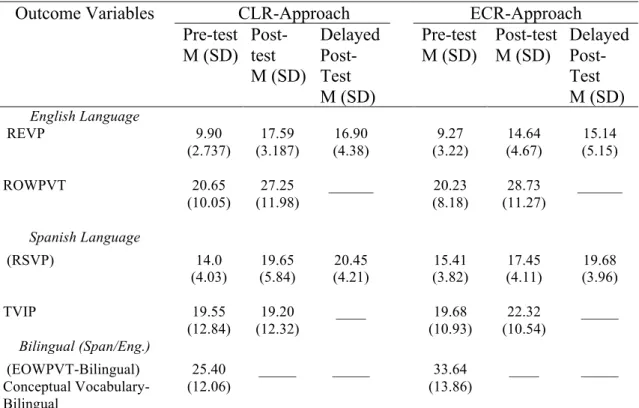
TABLE 3.1 Descriptive statistics for CLR and ECR groups for English and
Spanish outcome variables …………..………54 TABLE 3.2 One-way ANCOVA results for dependent variables with
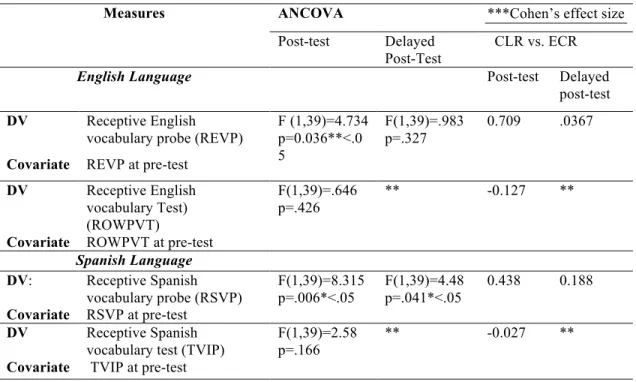
covariates at pre-test ………60 TABLE 3.3 Results of Pairwise Comparisons for Researcher-Developed Vocabulary
Probes.………...61
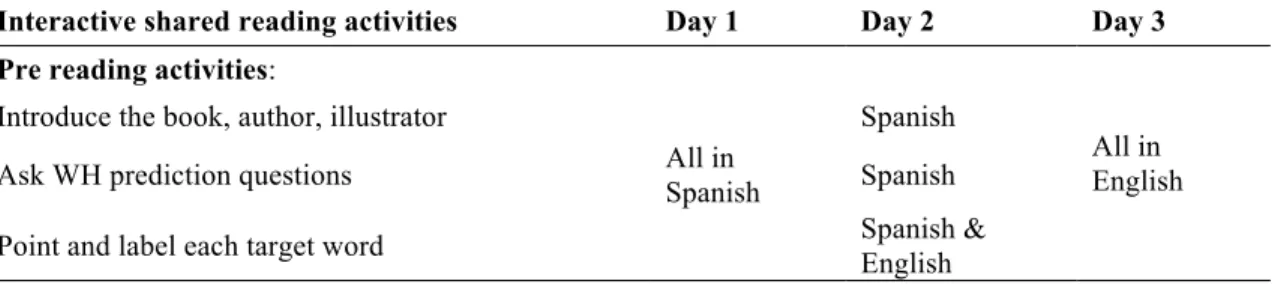
TABLE 4.1 Format of Interactive Shared Reading and Vocabulary
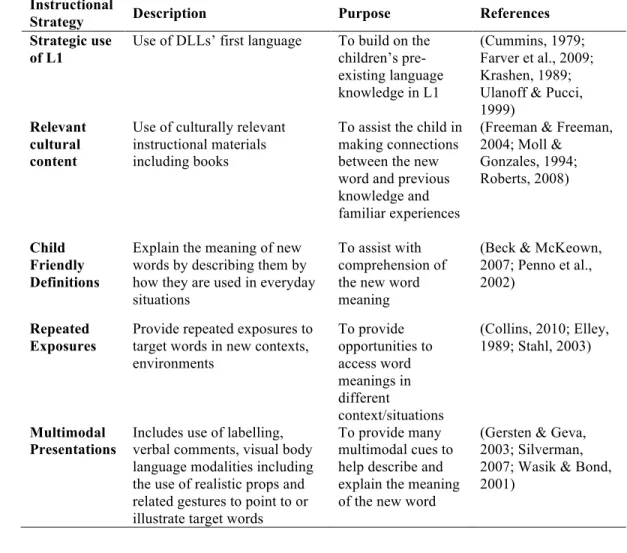
Instruction ………86 TABLE 4.2 Instructional Strategies of the CLR Approach………...88
TABLE 4.3 Examples of Culturally Relevant Content, Child-Friendly Definitions,
LIST OF FIGURES
FIGURE 1.1 Conceptual Underpinnings……….……….……….4
FIGURE 2.1 Word Association Model ………...13
FIGURE 2.2 Concept Mediation Model ……….14
FIGURE 2.3 Components of CLR Approach………...29 FIGURE 3.1 Mean Scores of Target Word Probes for CLR and ECR Groups………...61
CHAPTER 1 Introduction
The impact of vocabulary skills on early literacy skills and later reading outcomes is firmly established in the research literature (D. Dickinson & Tabors, 2002; D. K. Dickinson & Smith, 1994). Several research studies reviewed in the National Early Literacy Panel Report (2004) have identified oral language development in general, and vocabulary skills in particular, as significant predictors of later achievement in reading (Cunningham, 1997).
vocabulary development in both the first (L1) and second language (L2), reinforcing their at-risk status.
If the reported vocabulary gap between young DLLs and their monolingual peers is not addressed, it could become a precursor to low achievement, negatively impacting academic outcomes. Consequently, there is an urgent need for effective vocabulary approaches, especially at the preschool level, that fully meet the learning needs of DLLs. However, our understanding of evidence-based instructional approaches that can support the unique vocabulary learning needs of diverse children remains limited (Collins, 2005; Ulanoff & Pucci, 1999). In particular, there has been limited research on vocabulary instruction targeting diverse children, as the bulk of research has been on children in upper elementary grades and above (Neuman, 2009). Thus additional research is needed to develop tailored instructional strategies and delivery approaches for effective English vocabulary instruction for this population.
This dissertation responds to these gaps in the research literature through three
vocabulary development. To support this contention, the individual contributions of theoretical models and research findings in the areas of second language acquisition, the word learning dynamics of young DLLs and the cultural and cognitive resources (funds of knowledge) available to children and their families as learning tools are reviewed. This comprehensive, although not exhaustive, review of the literature indicates that due to differences in word learning between monolinguals and DLLs, the cross-linguistic transfer between L1 and L2 (Cummins, 1979; Kroll & Stewart, 1994), and the existence of children’s unique funds of knowledge, vocabulary approaches need to be designed to address the resulting differences in learning needs. A discussion of how these research findings can be translated into high quality instructional practices structured for this population is also given.
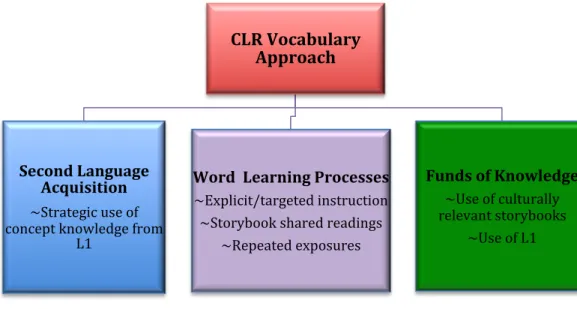
Three main sets of theoretical and empirical underpinnings that should be considered in designing efficient instructional approaches for children are identified, including: (a) theoretical perspectives on second language acquisition (SLA) that support the role of L1 in scaffolding L2 acquisition, especially due to shared cross-linguistic resources between L1 and L2 (Cummins, 1979; Kroll & Stewart, 1994); (b) differences in the word learning processes and quality of language input that children who are DLLs receive in the target language; and (c) the socio-cultural perspectives or funds of knowledge that view the linguistic and cultural assets of young DLLs, their families and their communities as instructional resources (Moll, 1992).
combining the instructional strategies derived from each of the conceptual underpinnings shown in Figure 1.1.
Figure 1.1 Conceptual Underpinnings
The manuscript concludes by describing practical strategies that could be utilized in creating culturally and linguistically responsive vocabulary approaches in preschool
classrooms for young Latino DLLs. It is suggested that provision of effective instructional services for this population requires a departure from the current “one size fits all” L2-only approach. Instructional approaches for this population, like the CLR approach, could be more effective if they were based on theoretical and empirical underpinnings, and were designed not only to meet the unique learning needs, but also to build on the unique strengths of DLLs.
The second manuscript in this dissertation, A Culturally and Linguistically Responsive Vocabulary Approach for Young Latino Dual Language Learners, reports the rationale, methods, results, and implications of a randomized research study that evaluates the
effectiveness of the CLR vocabulary approach. The study compares the gains and retention of CLR Vocabulary
Approach
Second Language Acquisition
~Strategic use of concept knowledge from
L1
Word Learning Processes ~Explicit/targeted instruction ~Storybook shared readings
~Repeated exposures
Funds of Knowledge
~Use of culturally relevant storybooks
receptive English vocabulary by Spanish-speaking preschoolers who are DLLs from low-income families after participating in either a Culturally and Linguistically Responsive (CLR) shared reading approach or a contrastive English-Culturally Responsive approach (ECR). The results of this study provide initial evidence of the potential benefits of shared reading using both the child’s first language and English in facilitating English vocabulary development in DLLs from low-income families. Future directions for applied clinical research are also discussed as well as interdisciplinary approaches to school-based vocabulary interventions for preschool DLLs.
linguistically responsive vocabulary approaches for low-income Latino DLLs in preschool settings.
In conclusion, the three manuscripts that constitute this dissertation address gaps in the research literature related to designing evidence-based vocabulary approaches for preschool children who are DLLs. The development of the CLR approach which lies at the core of this dissertation is a first step towards meeting the urgent need for alternate
REFERENCES
Carlisle, J. F., Beeman, M., Davis, L. D., & Spharim, G. . (1999). Relationship of
metalinguistic capabilities and reading achievement for children who are becoming bilingual. Applied Psycholinguistics, 20, 459-478.
Collins, M. (2005). ESL preschoolers' English vocabulary acquisition from storybook reading. Reading Research Quarterly, 40(4), 406-408.
Cummins, J. (1979). Linguistic interdependence and the educational development of bilingual children. Review of Educational Research, 49(2), 222-251. doi: 10.3102/00346543049002222
Cunningham, A., & Stanovich, K. (1997). Early reading acquisition and its relation to
reading experience and ability 10 years later. Development Psychology, 33, 934-945.
Dickinson, D, & Tabors, P. O. (2002). Fostering language and literacy in classrooms and homes. Young Children, 57(2), 10-18.
Dickinson, D. K, & Smith, M. (1994). Long-term effects of preschool teachers' book readings on low-income children's vocabulary and story comprehension. Reading Research Quarterly, 29(2), 104-122.
Farkas, G., Beron, K. (2004). The detailed age trajectory of oral vocabulary knowledge: Differences by class and race. Social Science Research, 33, 464–497.
Hart, B., & Risley, T. (1995). Meaningful differences in the everyday experience of young american children. Baltimore, MD: Brookes.
Hart, B., & Risley, T. (2003). The early catastrophe. American educator, 27, 4,6-9. American Educator, 27, 4,6-9., 27(4), 6-9.
Kroll, J. F., & Stewart, E. (1994). Category interference in translation and picture naming: Evidence for asymmetric connections between bilingual memory representations. Journal of Memory and Language, 33(2), 149-174. doi: 10.1006/jmla.1994.1008
Neuman, S., & Dwyer, J. (2009). Missing in action: Vocabulary instruction in pre-k. The Reading Teacher, 62(5), 384–392. doi: DOI:10.1598/RT.62.5.2
Proctor, C. P., Carlo, M., August, D., & Snow, C. (2006). The intriguing role of Spanish language vocabulary knowledge in predicting English reading comprehension. Journal of Educational Psychology, 98(1), 159-169.
Pruitt, S., & Oetting, J. (2009). Past tense marking by African American English-speaking children reared in poverty. Journal of Speech-Language-Hearing Research, 52, 2-15.
CHAPTER 2
A Conceptual Framework to Support the Development of Culturally and Linguistically Responsive Approaches to Vocabulary Development in Young Dual Language Learners
Introduction
Latinos are among the largest and fastest growing minority groups in the U.S.,
accounting for 15.1% of the total U.S. population. Spanish is thus the home language of over 79% of U. S. Dual Language Learners (DLLs), children sequentially learning a second language (L2) while still acquiring their first (L1) (U.S.Census.Bureau, 2008). Twenty-four percent of Latino immigrants live below the poverty level, and fewer than 40% have the equivalent of a high school diploma. The educational needs of these children have raised concerns due to the documented vocabulary gap between DLLs from families of low socio-economic status and their English monolingual peers (August & Hakuta, 1997; Dickinson & Tabors, 2002; Vernon Feagans, Hammer, Miccio, & Manlove, 2002).
A wide discrepancy remains between DLLs and their English-only peers in terms of both the number of words they know (breadth of word knowledge) and the different meanings of a given word they know (depth of word knowledge), impacting their reading and their academic performance (August et al., 2005).
Despite ongoing attempts to address the educational needs of these young DLLs (August & Hakuta, 1997; Jimenez, 1994), additional work is needed in order to close the vocabulary gap. This paper contends that in many instances the below-level educational performance of DLLs may result from limitations of “traditional English-only” incidental educational approaches. These approaches may not fully meet their learning needs, especially in L2 vocabulary development, and generally do not tap into their cultural and linguistic funds of knowledge (Hancock, 2002; Riojas-Cortez & Bustos Flores, 2009).
The paper also contends that these limitations can be mitigated by instructional approaches more closely tailored to meet their learning needs. This requires taking into account factors that impact vocabulary development in this population, such as the processes of second language acquisition, the word learning dynamics of young DLLs, and the cultural and linguistic resources (funds of knowledge) available to these children and their families as learning tools (Cummins, 2005; Moll & Gonzales, 1994; Nagy & Scott, 2000). Each of these areas has an extensive literature largely independent of the others, with only limited efforts to integrate them into effective instructional approaches for young DLLs.
The purpose of this article is to integrate the insights and perspectives of these different bodies of literature into a conceptual framework upon which instructional
research underpinning this conceptual framework are discussed including: a) processes of second language acquisition, b) the word learning process in DLLs, and, c) the socio-cultural or funds of knowledge perspective. The second section illustrates how these research
findings can provide a basis for selecting high quality instructional strategies. The final section illustrates how the resulting strategies are pulled together into a cohesive vocabulary instructional approach for preschool Latino DLLs
Theoretical and Empirical Underpinnings of the Conceptual Framework
In this section some of the theoretical and empirical bases of vocabulary development in young DLLs in the above-mentioned bodies of literature are discussed. A description of how these findings are integrated into a conceptual framework to support the development of instructional vocabulary approaches for this population follows.
Processes of second language acquisition. The processes by which a second language is acquired have been studied for several decades. This work has produced a number of perspectives on the processes underlying second language acquisition: the word association and the concept mediation models (Potter, So, von Eckhardt, & Feldman, 1984), the developmental hypothesis (Kroll & Stewart, 1994), the inter-developmental hypothesis (Cummins, 1979) and the Common Underlying Proficiency Model (Cummins, 1981). While some of these perspectives are based on research with older children and young adult L2 learners, there is evidence to support their relevance to sequential preschool DLLs.
suggest that in spite of age differences, L2 learners go through similar developmental stages of L2 acquisition. In particular, in the early stages of L2 acquisition both children and adult L2 learners use what is available to them from L1, suggesting that both groups use similar language mechanisms for L2 acquisition (Unsworth, 2004).
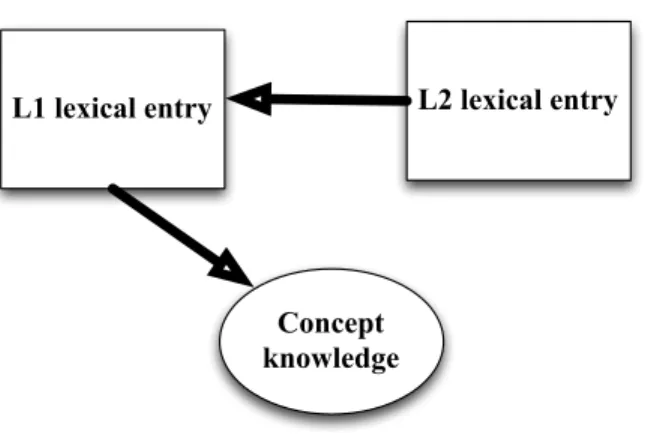
One source of differences in the word learning process between monolinguals and sequential DLLs is the prior existence of a lexical and conceptual system in L1 that interacts with L2 learning (Jiang, 2002). According to the word association and concept mediation models (Potter et al., 1984), words or lexical entries belonging to each language are stored in separate lexical memory systems, but the corresponding concepts or meanings are stored in an abstract memory system common to both languages. The word association model states that during the early stages of SLA, beginning second language learners rely on
interdependent conceptual links to L1. This implies that L2 words are mediated via direct connection to their translation equivalents in L1. Under this model, the mapping of L2 forms with existing conceptual entries in L1 relies on L1’s lexical level (mental representation of a whole word sound form) to gain access to the conceptual level (mental representation of the characteristics of the referent) as suggested in Figure 2.1. Thus, beginning L2 learners rely heavily on existing knowledge in L1 to gain initial access to the concept knowledge level of L2, highlighting the interconnection of L1 and L2 during the early stages of L2 learning.
Figure 2.1. Word Association Model
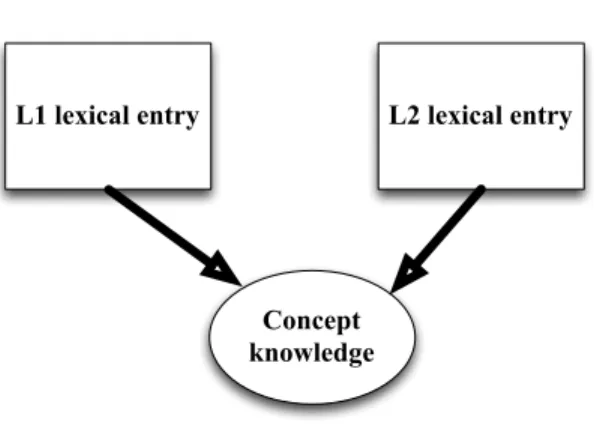
As the DLLs’ fluency in L2 increases, L2 words begin to be directly linked to their meanings (concepts) stored in an abstract memory system common to both languages without L1 mediation, arguing for a universal inter-language connection that mediates the two
languages as suggested in Figure 2.2. This developmental transition to direct lexical access of L2 due to increased fluency in L2, resulting in decreased reliance of L2 on L1, is captured by the Developmental Hypothesis of Kroll and Stewart (1994). This hypothesis integrates the word association and conceptual mediation models into a single model that describes the evolution of the degree of reliance of L2 on L1 over time as the second language learner increases fluency. In particular, this hypothesis proposes that once increased fluency in L2 is achieved, L2 learners will rely less on L1 and will begin to demonstrate independent links in each language, marking the transition from an interconnected lexical system to the
development of two independent systems.
L1 lexical entry L2 lexical entry
Figure 2.2 Concept mediation model
Another influential theory of SLA is Cummins’ (1979) developmental
interdependence hypothesis. This theory proposes that the level of L2 competence attained by a sequential bilingual child is related to the child’s level of competence in L1 at the time intensive exposure to L2 begins, as in the case of DLLs entering an English-only setting. The second language learner’s first language skills scaffold the learning of the second language unless there is adverse exposure and motivation. Thus, the learning of a new word in L2 for a concept already existing in the child’s L1 requires only learning of a new label (translation).
There is empirical support, although somewhat inconsistent, for a positive interdependence between L1 and L2 across a number of word learning areas, including phonological awareness (Dickinson, McCabe, Clark-Chiarelli, & Wolf, 2004; Durgunoglu, Nagy, & Hancin-Bhatt, 1993). Durgunoglu et al. (1993) studied 31 Spanish-speaking, first-grade beginning, non-fluent readers in a transitional bilingual educational program to determine whether the phonological awareness developed through home and school experiences in a child’s L1 (Spanish in this case) was related to word recognition in L2. Findings suggested that phonological awareness was a significant predictor of performance
L1 lexical entry L2 lexical entry
on word recognition tests both within and across languages. Both phonological awareness and word recognition skills in Spanish were found to contribute independently to English word and pseudo-word recognition tasks. Children who performed better on Spanish phonological awareness tests were more likely to be able to read English and English-like pseudo-words than those who performed poorly.
Other studies have supported L1-L2 interdependence of vocabulary related skills such as information on the words’ core meaning. Lugo-Neris et al. (2010) reported that providing comprehensible vocabulary extensions through the use of L1 appears to scaffold the sharing of conceptual knowledge from L1, benefiting expressive knowledge of L2 target vocabulary. This study examined twenty-two Spanish-speaking children learning English (ages 4–6) randomly assigned to two different types of instruction: word expansions in English or English readings with word expansions in Spanish. Standardized measures of vocabulary skills in both languages revealed that additional vocabulary instruction focused on conceptual knowledge in Spanish resulted in greater growth in the English target words.
Ordoñez et al. (2002) examined evidence of cross-linguistic influence in higher-level vocabulary skills with a group of eighty-eight fourth and fifth grade Spanish-English DLLs who were provided high quality formal definitions in L1 (Spanish in this case). Their
Spanish vocabularies, highlighting the contribution of breadth of L1 vocabulary in predicting L2 performance in these higher-order metalinguistic tasks.
Other research studies have documented a positive cross-linguistic relationship in receptive language and literacy development. Dunn Davison et al. (2011) examined English language and literacy development in 81 preschool-aged bilingual Head Start children in a longitudinal study. They also found a positive cross-linguistic relationship with reading outcomes in first grade as Spanish receptive language skills predicted letter and word identification as well as reading comprehension in English. Hancock (2002) also measured the pre-literacy English skills of seventy-seven Spanish-speaking kindergartners and found that those exposed to the Spanish version of the FRED books scored significantly higher than those receiving English-only readings.
Taken together, these findings suggest that skills underlying language skills in L1 promote growth in L2 (Dunn Davison et al., 2011) for DLLs in early childhood. However, other studies with children in this age range suggest that there are limits to the influence of L1 on L2 acquisition. Collins (2010), for example, examined the effects of rich explanation in L2 on sophisticated vocabulary learning from storybook reading to English language learning (ELL) preschoolers. Rich explanation in L2 and initial L2 vocabulary were found to contribute significantly to sophisticated word learning from storybook reading. However, initial L1 vocabulary knowledge did not influence L2 target vocabulary acquisition.
children in this study showed significant growth in oral vocabulary and letter–word identification measures in L1 after a year in a Transitional Bilingual Education classroom. This negative correlation in vocabulary measures led the authors to question the validity of their standardized measures, suggesting caution in interpreting the findings from this study.
Tabors et al. (2003) also found negative correlations between Spanish and English vocabulary using measures of productive vocabulary knowledge for 139 Spanish–English bilingual pre-K children. A confounding factor in this study, according to these authors, was the bilingual environment the children experienced. If the children are in a subtractive bilingual environment where only L2 is supported, as they learn more of the community language (L2) they may begin to lose their language skills in L1. The risk of decreased L1 development for DLLs attending L2–only instruction with no direct L1 instruction has also been reported by Restrepo et al. (2009)
These inconsistent research findings on the breadth of word knowledge suggest that not all aspects of oral language in the L1-L2 cross-linguistic relationship are equally
interdependent. In particular, some aspects like phonological awareness, literacy
development and higher cognitive vocabulary skills, including conceptual knowledge in L1, may be more influential in supporting the acquisition of L2 skills than others such as breadth of vocabulary knowledge (Durgunoglu et al., 1993; Ordoñez et al., 2002).
language positively impacts the learning of the other and also promotes the continuing development of a cross-linguistic reservoir of abilities available to both languages. This common underlying proficiency of oral language abilities is what supports the learning of L2 (Verhoeven, 2007), as well as skill development in both languages. Thus both languages can thrive given adequate motivation and exposure (additive bilingualism). By the same token, intensive exposure to L2 (without L1 exposure) in the initial grades is likely to hamper the continued development of L1 in children with less developed skills and limited support in L1 (subtractive bilingualism).
The potential existence of shared resources between L1 and L2 highlights the possible role of skills in L1, such as word learning mechanisms, in supporting vocabulary knowledge in L2, especially in the initial stages of L2 acquisition. These findings on the potential existence of shared cross-linguistic resources raise the possibility that word learning skills in L1 may transcend specific languages and facilitate the learning of vocabulary across different languages (semantic bootstrapping). These lexical proficiency skills may be an important component of the common underlying proficiency proposed by Cummins (1981).
In summary, these findings raise the possibility that the lexical proficiency that facilitates word learning skills in L1 may support the learning of vocabulary across different languages. Indeed, Goldenberg (2008) concluded that English vocabulary interventions that use L1 as an instructional vehicle may have long-term benefits and that teaching students emergent and literacy skills in L1 promotes higher levels of reading achievement in English. Therefore the cognitive processes driving the cross-linguistic influence of L1 and L2 need to be understood and considered in the design of optimal instructional approaches to L2
body of research of interest, examining word learning processes in young children, will now be discussed.
Word learning processes. The learning of new words is an intricate and time-consuming task. Words are learned gradually and the time required to learn them varies depending on their complexity (Nagy & Scott, 2000). Some words like simple nouns can be learned quickly while low–frequency words that we seldom hear often take much longer (Nagy & Scott, 2000). Thus the quality of the word representation young children acquire may vary by how often and in what contexts they are exposed to new words (Childers & Tomasello, 2002).
Research suggests that the initial stages of word learning, or fast-mapping, largely result in the initial learning of a phonetic shape and a word association with a very general meaning of the new word (Kan & Kohnert, 2008). After fast mapping has taken place,
vocabulary acquisition proceeds in small steps where many exposures to the word are needed to accumulate a more elaborate knowledge of the various aspects of the word. For DLLs this process may also be impacted by differences in the quality and quantity of input and
opportunities for output in their linguistic environments (Bohman, Bedore, Peña, Mendez-Perez, & Gillam, 2010).
repeated in a story that is re-read multiple times (Collins, 2010). Similarly for DLLs whose L2 exposure is mostly in the school setting, appropriate levels of L2 word exposure in
multiple contexts are needed to support their development of vocabulary skills in L2. Limited word exposure may lead to limited depth of word knowledge (Nash & Snowling, 2007) and incomplete lexical representations of L2 (Ordoñez et al., 2002).
The research literature pertaining to DLLs suggests that different levels of exposure to incidental word learning in different linguistic environments can result in differences in word learning outcomes for DLLs. Verhallen and Schoonen (1998) collected word definition data on 40 monolingual Dutch and 40 bilingual children aged 9 and 11 years from a low-income Turkish minority living in the Netherlands. As a group, the Turkish children
exhibited fewer words and less developed depth of word knowledge of the various meanings of the target words than the Dutch children. These differences in vocabulary size were
interpreted to be a result of substantial differences in the contexts and frequency of incidental exposure to vocabulary between the groups. Differences in the quality and quantity of incidental input that DLLs receive in different linguistic environments can impact both their depth and breadth of word knowledge and their rate of L2 acquisition (Nation, 2001; Schmitt, 2008; Verhallen & Schoonen, 1998). While these reported differences in word learning outcomes are related to older children, preschool DLLs may be also be impacted as both younger and older children use similar mechanisms for L2 acquisition (Unsworth, 2004).
are used in everyday situations (Beck, McKeown, & Kucan, 2002). Penno et al. (2002) studied 47 monolingual children aged 5-6 years in the beginning stages of learning to read to determine the effect on learning new words when teachers explained the words as they occurred in context. The researchers presented two stories to the children, one with pictorial cues only and the other with pictorial cues and verbal definitions. They found that both repeated exposure to a story and the additive effects of explanation of the meaning of target words contributed significantly to students’ oral vocabulary growth. Although gains in vocabulary due to listening to the story with pictorial cues were observed, the group receiving explanations of the target words in context attained greater vocabulary gains.
Research findings on the role of L1 in L2 acquisition also suggest that in early stages of L2 acquisition, the teaching of child friendly definitions scaffolded by L1 concept
knowledge could accelerate the process of form-meaning mapping in beginning DLLs, especially given the word knowledge infrastructure in L1 (Nation, 2001; Schmitt, 2008).
Dialogic reading in preschoolers has been associated with robust vocabulary development in monolinguals (Hargrave & Sénéchal, 2000; Penno et al., 2002). A limited number of research studies of dialogic reading with DLLs also report positive links with the development of word learning (Cohen , Kramer-Vida , & Frye, 2012; Collins, 2010; Roberts, 2008; Valdez-Menchaca & Whitehurst, 1992). Most of the studies with DLLs enlisted the assistance of L1-speaking parents or bilingual teachers to engage in dialogic reading, since the impact of dialogic reading may be decreased by a mismatch between the language of instruction and the child’s proficiency in the language of instruction (Cohen et al., 2012; Valdez-Menchaca & Whitehurst, 1992). Therefore the strategic use of the child’s first language during book reading can be utilized as an enhancing tool to support learning in DLLs (Gillanders & Castro, 2007; Zepeda, Castro, & Cronin, 2011).
In summary, the learning of new words in both monolingual and bilingual children is a gradual and time-consuming process. Words are learned in stages and the time required to learn words varies depending on the complexity of the word, the context, and the child’s initial vocabulary (Nagy & Scott, 2000). The incidental learning of new words during typical classroom activities such as storybook readings is usually facilitated by the context of the story, which becomes a scaffold that helps young children expand their vocabulary (Ulanoff & Pucci, 1999). Combining incidental learning from the story context with contextually relevant direct instruction might be more beneficial than either approach in isolation.
Repeated readings of children’s books could be further enhanced by the addition of toys and related props (Stahl, 1986; Wasik & Bond, 2001)
may not adequately meet their learning needs (August et al., 2005; Carlo et al., 2004; Ordoñez et al., 2002) as evidenced by the smaller size and limited depth of their L2 vocabulary. Based on the research discussed above, story reading combined with other instructional strategies such as repeated word exposure, explicit instruction and the use of child friendly definitions have shown potential for supporting vocabulary development in L2 and helping DLLs build background knowledge upon which they can draw to increase comprehension and depth of L2 vocabulary knowledge (Collins, 2010; Hickman, 2004; Lugo-Neris et al., 2010). The third body of research underpinning the conceptual framework discussed next is focused on the identification of culturally relevant instructional strategies for word learning in young DLLs.
Funds of knowledge: a socio-cultural perspective on learning. The research findings reviewed so far suggest that differences in levels of exposure to incidental word learning in different linguistic environments impact word learning outcomes in DLLs. Cummins (1981) also states that the common underlying proficiency across languages can advance L2 oral language development by drawing on this common reservoir of language knowledge. Hence providing children with linguistic contexts that offer rich input connected to their existing knowledge base could support the acquisition of vocabulary in young DLLs. However, current instructional strategies for DLLs are not aligned with these research findings
(Hancock, 2002; Ulanoff & Pucci, 1999).
1992). In contrast, the viewpoint of funds of knowledge, a socio-cultural perspective on learning, suggests that validating the children’s overall life experiences, prior knowledge and previous sociocultural experiences rooted in the lived practices of their households is
important for their learning (Gonzales, Moll, & Amanti, 2005). Therefore to reinforce new learning, educational experiences must be related to the students’ life experiences including activities and conversations in their immediate home and community surroundings (Gonzales et al., 2005; Maguire & Graves, 2001).
Unfortunately for many DLL preschoolers from low-income families, a disconnect between preschool and home begins the moment they enter the classroom. In the past, many well-intentioned early childhood professionals and related service providers discouraged the use of the children’s first language because they felt that this would delay their L2 learning (Ortiz & Ordoñez-Jasis, 2005). This unintended devaluation of the home language may send the message that the community language, English in this case, is the only language that counts in the school world. This, in turn, may result in the internalization that the home language (L1) and everything related to it, including prior knowledge and experiences, have no function or value, and may actually be undesirable, in their school life (Wong-Fillmore, 1991). This disconnect between home and school may impede the child’s mastery of new word knowledge rather than reinforcing new word knowledge in different linguistic
environments. From a social perspective the child may feel isolated and caught between two different worlds that do not seem to connect or be mutually reinforcing (Orellana &
The need to connect the children’s world at home to the school environment for better word learning outcomes has been clearly documented (Ortiz & Ordoñez-Jasis, 2005). In her review of the literature, Araujo (2009) proposes the use of funds of knowledge as a strategic approach to developing meaningful connections between home and school, thus supporting not only new word knowledge but overall language and school readiness in children who are linguistically diverse.
The concept of funds of knowledge is defined by its main proponent, Luis Moll, as “the essential cultural practices and bodies of knowledge and information that households use to survive, to get ahead, or to thrive” (Moll, 1992). Moll and colleagues studied the dynamics of diverse families and communities through ethnographic interviews (Moll & Gonzales, 1994). They identified a variety of cultural and linguistic resources in family members who could offer a wealth of language knowledge on a wide range of topics ranging from botany to culinary arts. Other community members capable of sharing their world and overall
knowledge of mathematics, finance, commerce and storytelling for example were also identified as valuable resources.
Moll’s findings reveal that the practical and intellectual knowledge manifested in diverse household and community activities by children, their families, and communities offer rich linguistic environments with ample resources for word learning. These social, cultural and linguistic resources can contribute valuable knowledge and resources for word learning and building strong partnerships between home and schools. Critical to the
classroom materials and intervention approaches (Gonzales et al., 2005; Moll, 1992; Moll & Gonzales, 1994).
Other research studies support the effectiveness of instructional approaches that build on the children’s funds of knowledge by using culturally related practices and content in L1 to support vocabulary and literacy development as well as socio-emotional growth (Riojas-Cortez, 2001; Riojas-Cortez & Bustos Flores, 2009). Storytelling, which is a rich cultural tradition and a central part of some children’s funds of knowledge, has been used to support children’s oral language and literacy development. Riojas-Cortez (2009) trained 73 parents of preschool DLLs to use storytelling to promote early language and literacy skills by
introducing story elements such as character description, setting, conflict and resolution using cultural content related to their own traditional stories. Parents were encouraged not only to use topics linked to their own cultures such as their own traditional folktales, but also to use their first language and to create their own stories relevant to their families or to provide their own cultural adaptation of classic fairy tales.
The teachers who observed this activity remarked on the children’s engagement and the natural manner in which salient story elements including word knowledge were
central elements of these children’s funds of knowledge can play in supporting DLLs’ acquisition of new word knowledge.
Although the type of language-related activities to which DLLs may be exposed at home may not fit the conventional model of vocabulary and literacy-related activities in which mainstream children participate, such as read-alouds in English, the development of vocabulary skills in DLLs can be adequately supported by the funds of knowledge that diverse families offer their children. Araujo (2009) observes that DLLs can be exposed to oral language and literacy in their first language through a variety of home and community related activities, such as being read letters from their relatives or by helping to write shopping, chores and appointment lists in L1. These interactions could promote new world learning opportunities as the household or community members repeat the word in different context (e.g., shopping, looking at family pictures).
The use of language exchanges in the home language related to familiar topics and contexts also facilitates the connection of new concepts to previous personal experiences and the acquisition of new words. The activation of prior knowledge through the connection to previous individual and familiar experiences has been linked to strong vocabulary gains (Dickinson & Smith, 1994; Senechal, 2002). The sociocultural and linguistic environment of these children’s funds of knowledge also provides opportunities to expand the breadth and depth of word meaning (Roberts, 2008).
language can promote oral language and early literacy skills in both L1 and L2 (Hancock, 2002; Ulanoff & Pucci, 1999).
In summary, the use of cultural and linguistic resources that link new word knowledge to the children’s personal experiences promotes strong vocabulary gains (Dickinson & Smith, 1994). These resources could be employed by early childhood professionals to create contextually rich lessons and vocabulary approaches to build new word skills. Furthermore, the use of cultural and linguistic links may also facilitate the home-school connection since home support may be more easily attainable if literacy activities can be incorporated into daily routines or home activities in the first language (Araujo, 2009) .
Putting it all Together: Illustration of an Intervention for Preschoolers
Taken together, the diverse bodies of literature discussed in the previous section inform the potential selection of the following instructional approaches that appear to be relevant in supporting vocabulary development in young DLLs. They include: the strategic use of the first language, inclusion of culturally relevant content, dialogic-like storybook reading, explicit teaching through the use of child-friendly definitions, and repeated exposures. Next the integration of these strategies into a coherent vocabulary instructional approach for young DLLs is discussed.
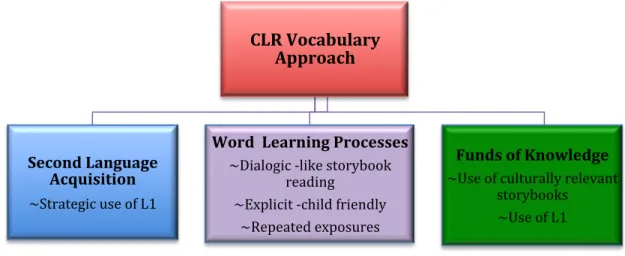
designed to be responsive to this population’s learning needs, combines the instructional strategies derived from each of the conceptual underpinnings as shown in Figure 2.3.
Figure 2.3 Components of CLR Approach
The purpose of the CLR approach is to support the development of English vocabulary skills in preschool DLLs from low SES backgrounds. It uses the context of shared readings to teach English vocabulary through explicit instruction in small groups three times a week for five weeks in a preschool setting. The instructional strategies selected for this approach include the following:
Strategic use of the first language. This strategy is implemented in the CLR approach by strategically including L1 as one of the languages of instruction during two of the three weekly shared book reading sessions. The strategy, derived from the research on second language acquisition and funds of knowledge, recognizes the potential cognitive differences in the DLLs’ L2 learning due to the prior existence of a lexical and conceptual system in L1. It builds L2 vocabulary by leveraging the common underlying proficiency between L1 and L2, while capitalizing on the linguistic dimension of the DLLs’ funds of knowledge to promote the learning of new words in meaningful environmental contexts. This
CLR Vocabulary Approach
Second Language Acquisition
~Strategic use of L1
Word Learning Processes ~Dialogic -‐like storybook
reading
~Explicit -‐child friendly ~Repeated exposures
Funds of Knowledge
strategy also facilitates the use of dialogic-like storybook reading with DLLs by providing DLLs with the means to participate in the dialogue in a familiar language.
Inclusion of culturally relevant content. This strategy is incorporated in the CLR approach through the use of storybooks with culturally relevant content and the use of L1. Familiar content could contribute to activate prior knowledge and facilitate connections to DLLs’ individual experiences (Hancock, 2002). Familiar elements help activate children’s background knowledge via making predictions and inferences about the story (Freeman & Freeman, 2004).
Dialogic-like storybook reading. The format selected to deliver the CLR approach is dialogic-like storybook reading which provides a naturalistic context for vocabulary
development where the child is an active participant. This context supports the delivery of both incidental and explicit target vocabulary words contained in the story, and facilitates vocabulary learning through labeling pictures of the target words in the storybook. Repeated readings of the storybook also provide multiple exposures to the target words.
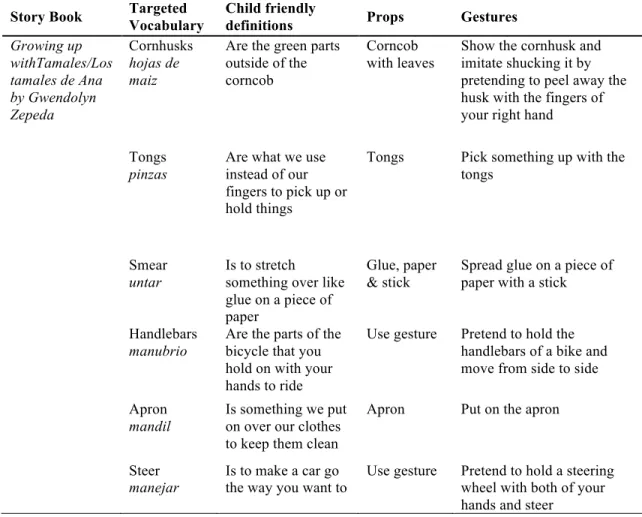
Child-friendly definitions. Explicit vocabulary instruction is incorporated in the CLR approach through the use of child-friendly definitions. This approach is aimed at teaching the meanings of new words by explaining their typical use through everyday language e.g., an illusion is something that looks like one thing but is really something else or is not there at all (Beck et al., 2002). Empirical studies provide evidence on the use of word explanations and definitions to promote vocabulary development with monolingual children and DLLs.
breadth and depth of L2 word knowledge (Brown, 2007; Buysse, Castro, West, & Skinner, 2005; Ordoñez et al., 2002; Penno et al., 2002). Repeated exposures are incorporated in the CLR approach through re-reading the same book 3x/week with related activities including labeling the pictures of the target words in the storybook and introducing each target word five times during different segments of the individual shared readings.
Assessment of the CLR Approach
Once these individual instructional strategies were combined into the CLR
vocabulary approach, the effectiveness of this approach in supporting English vocabulary development in DLL preschoolers was examined in a research study (Méndez, 2012). The study compared the gains and retention of receptive English vocabulary by Spanish-speaking preschoolers who are DLLs (from low-income families) after participating in either the CLR vocabulary approach or a contrastive English Culturally Responsive approach (ECR). The ECR approach used the same instructional strategies as the CLR approach except for the use of L1; in the ECR approach all shared reading activities were conducted in L2.
ECR-comparison group. These findings provide initial evidence of the potential benefits of a vocabulary approach like the CLR approach rooted in the conceptual framework described above in facilitating English vocabulary development in DLLs from low-income families (2012). For more details on the study, see Méndez (2012).
Summary and Conclusions
With the increased numbers of culturally and linguistically diverse students in the U.S., many educational and early childhood settings face the challenges of providing effective instructional approaches for children and families from linguistically diverse backgrounds. This paper suggests that provision of effective instructional services for this population requires not only a departure from the current one size fits all L2-only approach, but also a shift to more culturally and linguistically responsive approaches based on the needs and strengths of DLLs.
This extensive, although clearly not exhaustive, review of the literature suggests that due to differences in: word learning between monolinguals and DLLs, the cross-linguistic relationships between L1 and L2 (Cummins, 1979; Kroll & Stewart, 1994) and the existence of children’s unique funds of knowledge, vocabulary instructional approaches must be designed to address the resulting differences in learning needs by incorporating instructional strategies derived from these bodies of literature.
of this word input, but not all the multiple exposures or varied contexts of exposure to the new L2 words needed for the full development of breadth and depth of vocabulary
knowledge. Thus additional instructional components such as the use of L1 and culturally relevant content may increase the saliency and redundancy of the contextual information and effectively support the learning of additional aspects of word knowledge in L2. Similarly, repeated exposures to the target words in various situations could also enrich the contextual cues available for DLLs to infer word meanings and bridge comprehension in L2 in the context of incidental learning (Gersten & Geva, 2003).
Findings in the areas of second language acquisition highlight the benefits of building L2 vocabulary on the common underlying linguistic proficiency across languages. The potential benefits of combining the strategic use of L1 to scaffold the explicit instruction of L2 as part of an instructional strategy are well articulated (Farver, Lonigan, & Eppe, 2009; Lugo-Neris et al., 2010; Ulanoff & Pucci, 1999). Finally, English vocabulary instruction for preschool DLLs could also be enhanced by building on the cultural and linguistic skills that DLLs bring to the classroom (Moll, 1992).
REFERENCES
Araujo, Blanca E. (2009). Best practices in working with linguistically diverse families. Intervention in School and Clinic, 45(2), 116-123. doi: 10.1177/1053451209340221
August, D., Carlo, M., Dressler, C., & Snow, C. (2005). The critical role of vocabulary development for english language learners. Learning Disabilities Research, 20(1), 50-57. doi: 10.1111/j.1540-5826.2005.00120.x
August, D., & Hakuta, K. (1997). Improving schooling for language-minority students: A research agenda. Washington, DC: National Academy Press.
Beck, I. L, McKeown, M. G, & Kucan, L. (2002). Bringing words to life: Robust vocabulary instruction. New York: The Guilford Press.
Biemiller, A, & Slonim, N. (2001). Estimating rootword vocabulary growth in normative and advantaged populations: Evidence for a common sequence of vocabulary acquisition. Journal of Educational Psychology, 93(3), 498–520.
Bohman, T, Bedore, Lisa M., Peña, E, Mendez-Perez, A, & Gillam, Ronald B. . (2010). What you hear and what you say: Language performance in spanish english bilinguals. International Journal of Bilingual Education and Bilingualism, 13(3), 325-344. doi: doi:10.1080/13670050903342019.
Brown, Monica R. (2007). Educating all students: Creating culturally responsive teachers, classrooms, and schools. Intervention in School and Clinic, 43(1), 57-62.
Buysse, V., Castro, D. C., West, T., & Skinner, M. (2005). Addressing the needs of latino children: A national survey of state administrators of early childhood programs. Early Childhood Research Quarterly, 20, 146-163.
Carlo, Maria S., August, Diane, McLaughlin, Barry, Snow, Catherine E., Dressler, Cheryl, E, Lippman, David N., . . . White, Claire E. (2004). Closing the gap: Addressing the vocabulary needs of english-language learners in bilingual and mainstream classrooms Reading Research Quarterly, 39(2), 188-215.
Cohen , L, Kramer-Vida , L, & Frye, N. (2012). Using dialogic reading as professional development to improve students’ english and spanish vocabulary. NHSA Dialog: A Research-to-Practice Journal for the Early Childhood Field,, 15(1), 59-80.
Collins, M. (2010). Ell preschoolers' english vocabulary acquisition from storybook reading. Early Childhood Research Quarterly, 25, 84-97.
Cummins, J. (1979). Linguistic interdependence and the educational development of bilingual children. Review of Educational Research, 49(2), 222-251. doi: 10.3102/00346543049002222
Cummins, J. (1981). The role of primary language development in promoting educational success for language minority students. Schooling and language minorityvstudents: A theoretical framework. Los Angeles: California.
Cummins, J. (2005). Teaching for cross-language transfer in dual language education: Possibilities and pitfalls. TESOL Symposium on Dual Language Education: Teaching and Learning Two Languages in the EFL Setting. from
http://www.achievementseminars.com/seminar_series_2005_2006/readings/te sol.turkey.pdf
Dickinson, D, McCabe, A. , Clark-Chiarelli, N., & Wolf, A. (2004). Cross-language transfer of phonological awareness in low-income spanish and english bilingual preschool children. Applied Psycholinguistics, 25(3), 323–347.
Dickinson, D, & Smith, M. W. (1994). Long-term effects of preschool teachers' book readings on low-income children's vocabulary and story comprehension. Reading Research Quarterly, 29(2), 105-122.
Dickinson, D, & Tabors, P. O. (2002). Fostering language and literacy in classrooms and homes. Young Children, 57(2), 10-18.
Dunn Davison, M , Hammer, C. S. , & Lawrence, F. (2011). Associations between preschool language and first grade reading outcomes in bilingual children. Journal of
Communication Disorders, 44 444–458.
Durgunoglu, A., Nagy, W., & Hancin-Bhatt, B. . (1993). Cross-language transfer of phonological awareness. . Educational Psychology, 3, 453-465.
Farver, J, Lonigan, C., & Eppe, S. (2009). Effective early literacy skill development for young spanish-speaking english language learners: An experimental study of two methods. Child Development, 80(3), 703-719. doi:
10.1111/j.1467-8624.2009.01292.x
Freeman, Y, & Freeman, D. (2004). Connecting students to culturally relevant texts. Talking Points, 15(2), 7-11.
Gersten, R., & Geva, E. (2003). Teaching reading to early language learners. Educational Leadership, 60(7), 44-49.
Gillanders, C, & Castro, D. (2007). Reading aloud to english language learners. Children and Families, 21(13), 12-14.
Goldenberg, C. . (2008). Teaching english language learners what the research does—and does not—say. American Education, 8-44.
Gonzales, Norma, Moll, L.C, & Amanti, Cathy. (2005). Funds of knowledge: Theorizing practices in households, communities and classrooms. Mahwah, NJ: Lawrence Erlbaum Associates, Inc.
Hancock, D. (2002). The effects of native language books on the pre-literacy skill
development of language minority kindergartners. Journal of Research in Childhood Education, 17(1), 62-68.
Hargrave, A. C., & Sénéchal, M. . (2000). A book reading intervention with preschool children who have limited vocabularies: The benefits of regular reading and dialogic reading. Early Childhood Research Quarterly, 5(1), 75-90.
Hickman, P., Pollard-Durodola, S., & Vaugh, S. (2004). Storybook reading: Improving vocabulary and comprehension for english-language learners. The Reading Teacher, 57(8), 720-730.
Jiang, N. (2002). Form-meaning mapping in vocabulary acquisition in a second language. Studies in Second Language Acquisition, 24(04), 617-637. doi:
Jimenez, R. (1994). Understanding and promoting the reading comprehension of bilingual students. Bilingual Research Journal, 18(1-2), 99-119.
Kan, P. F., & Kohnert, K. (2008). Fast mapping by bilingual preschool children. Journal of Child Language, 35, 495-414. doi: 10.1017/S0305000907008604
Kohnert, K., Windsor, J., & Yim, D. (2006). Do language-based processing tasks separate children with language impairment from typical bilinguals? Learning Disabilities Research & Practice, 21(1), 19-29.
Kroll, J. F., & Stewart, E. (1994). Category interference in translation and picture naming: Evidence for asymmetric connections between bilingual memory representations. Journal of Memory and Language, 33(2), 149-174. doi: 10.1006/jmla.1994.1008
Lugo-Neris, M., Wood Jackson, C., & Goldstein, H. (2010). Facilitating vocabulary acquisition of young english language learners. Language, Speech and Hearing Services in Schools, 41, 314-327. doi: 10.1044/0161-1461(2009/07-0082)
Maguire, M. H., & Graves, B. . (2001). Speaking personalities in primary school children’s l2 writing. TESOL Quarterly, 35, 561–593.
Méndez, L. I. (2012). A culturally and linguistically responsive vocabulary approach for preschool latino dual language learners. (Ph.D. Doctoral Dissertation), University of North Carolina at Chapel Hill, Chapel Hill, NC.
Moll, L. C. (1992). Bilingual classroom studies and community analysis: Some recent trends. Educational Researcher, 21(2), 20-24.
Moll, L. C., & Gonzales, Norma. (1994). Lessons from research with language-minority children. Journal of Literacy Research, 26(4), 439-456. doi:
10.1080/10862969409547862
Nash, J., & Snowling, M. (2007). Teaching new words to children with poor existing vocabulary knowledge: A controlled evaluation of the definition and context methods. International Journal of Language and Communication Disorders, 3(335-354).
Nation, I. (2001). Learning vocabulary in another language. Cambridge, UK: Cambridge University Press.
Ordoñez, C., Carlo, M., Snow, C., & McLaughlin, B. (2002). Depth and breadth of vocabulary in two languages: Which vocabulary skills transfer? Journal of Educational Psychology, 94, 719-728. doi: 10.1037/0022-0663.94.4.719
Orellana, M, & Reynolds, J. (2008). Cultural modeling: Leveraging bilingual skills for school paraphrasing tasks. Reading Research Quarterly, 43(1), 48-65.
Ortiz, R, & Ordoñez-Jasis, R. (2005). Leyendo juntos (reading together): New directions for latino parents' early literacy involvement. The Reading Teacher, 59(2), 110-121.
National Reading Panel (2000). Teaching children to read: An evidence-based assessment of the scientific research literature on reading and its implications for reading
instruction.
Penno, J., Wilkinson, I. A., & Moore, D. W. (2002). Vocabulary acquisition from teacher explanation and repeated listening to stories: Do they overcome the mathew effect? Journal of Educational Psychology, 94, 23-33. doi: 10.1037/0022-0663.94.1.23
Potter, M, So, K-F, von Eckhardt, B, & Feldman, L. B. (1984). Lexical and conceptual representation in beginning and more proficient bilinguals. Journal of Verbal Learning and Verbal Behavior, 23, 23-38.
Riches, C., & Genesee, F. ( 2006). Educating english language learners: A synthesis of research evidence. In F. Genesee, K. Lindholm-Leary, W. Saunders & D. Christian (Eds.), In cross-linguistic and cross-modal aspects of literacy development (pp. 64– 108 ). NY: Cambridge University Press.
Riojas-Cortez, Mari. (2001). Preschoolers' funds of knowledge displayed through
Riojas-Cortez, Mari, & Bustos Flores, Belinda. (2009). Supporting preschoolers' social development in school through funds of knowledge. Journal of Early Childhood Research, 7(2), 185-199. doi: 10.1177/1476718x09102651
Roberts, T. (2008). Home storybook reading in primary or second language with preschool children: Evidence of equal effectiveness for second-language vocabulary acquisition. Reading Research Quarterly, 43, 103–130. doi: 0.1598/RRQ.43.2.1
Rodríguez, A. D. (2009). Culturally relevant books: Connecting hispanic students to the curriculum. GiST Colombian Journal of Bilingual Education 3(11-29).
Ryan, C, Casas, J. , Kelly-Vance, L., Ryalls, B., & Nero, C. (2010). Parent involvement and views of school success: The role of parents' latino and white american cultural orientations. Psychology in the Schools, 47(4), 391-405.
Schmitt, Norbert. (2008). Review article: Instructed second language vocabulary learning. Language Teaching Research, 329-363. doi: 10.1177/1362168808089921 12:
Sénéchal, M. (2006). A book reading intervention with preschool children who have limited vocabularies-the benefits of regular reading and dialogic reading. Early Childhood Research Quarterly,, 15(1), 75-90.
Senechal, M., & LeFevre, j. (2002). Parental involvement in the development of children's reading skill: A five-year longitudinal study. Child Development, 73, 445-460.
Stahl, S. (1986). Three principles of vocabulary instruction. Journal of Reading, 29, 662-668.
Tabors, P. O, Paéz, M, & Lopez, L. (2003). Dual language abilities of bilingual four year olds: Initial findings from the early childhood study of language and literacy
development of spanish-speaking children. NABE Journal of Research and Practice, 1(1), 70–91.
U.S.Census.Bureau. (2008). U.S. Population projections. from
http://www.census.gov/population/www/projections/summarytables.html
Unsworth, S. (2004). On the syntax-semantics interface in dutch: Adult and child l2 acquisition compared. International Review of Applied Linguistics, 42, 173-187.
Unsworth, S, & Blom, E. (2010). Comparing l1 children, l2 children and l2 adults. In E. Blom & S. Unsworth (Eds.), Experimental methods in language acquisition research. (pp. 483-492). Amsterdam: John Benjamins.
Valdez-Menchaca, M. C., & Whitehurst, G. J. . (1992). Accelerating language development through picture book reading: A systematic extension to mexican day care.
Developmental Psychology, 28, 1106-1114.
Verhallen, Marianne, & Schoonen, R. O. B. (1998). Lexical knowledge in l1 and l2 of third and fifth graders. Applied Linguistics, 19(4), 452-470. doi: 10.1093/applin/19.4.452
Verhoeven, Ludo T. (2007). Early bilingualism, language transfer, and phonological awareness. Applied Psycholinguistics, 28, 425–439.
Vernon Feagans, L., Hammer, C. S. , Miccio, A. W, & Manlove, E. (2002). Early language and literacy skills in low-income african american and hispanic children. New York: Guilford Press.
Wasik, B, & Bond, A. (2001). Beyond the pages of a book: Interactive book reading and language development in preschool classrooms. Journal of Educational Psychology, 93(2), 243-250. doi: 10.1037//0022-O663.93.2.243
Wasik, B, & Hindman, A. (2006). The effects of a language and literacy intervention on head start children and teachers. Journal of Educational Psychology, 98(1), 63–74.
Wong-Fillmore, L. (1991). When learning a second language means losing the first. Early Childhood Research Quarterly, 6(3), 323-346.
Chapter 3
A Culturally and Linguistically Responsive Vocabulary Approach for Young Latino Dual Language Learners
Introduction
The impact of vocabulary skills on early literacy skills and later reading outcomes is
firmly established in the research literature (August, Carlo, Dressler, & Snow, 2005;
Dickinson & Smith, 1994; Dickinson & Tabors, 2002; Storch & Whitehurst, 2002). Research
studies reviewed in the National Early Literacy Panel Report (2004) have identified oral
language development in general, and especially vocabulary skills, as strong predictors of
later achievement in reading. Expressive and receptive vocabulary, for example, have been
consistently and positively associated with reading outcomes through the fourth grade and
beyond (Storch & Whitehurst, 2002). Although this evidence highlights the importance of
vocabulary in promoting early literacy skills, many children from low-income families are at
higher risk for delays in vocabulary development, and hence reading difficulties, due to the
limited quantity and quality of their oral language input (Pruitt & Oetting, 2009).
The impact of these socio-economic disparities is also impacting low income dual
language learners (DLLs), who are children learning a second language while continuing to
develop their first. This is evidenced by the reported vocabulary gap between these DLLs and
their English monolingual peers (August et al., 2005; Carlo et al., 2004; Proctor, Carlo,
from low-income families may be vulnerable to limitations in vocabulary development in
both their first (L1) and second languages (L2), as indicated by their over-representation in
special education programs (Artiles, Rueda, Salazar, & Higareda, 2005; NCCREST, 2009).
In addition, many of these children currently receive largely incidental vocabulary instruction
in L2 that may not adequately address their unique learning needs, further contributing to the
vocabulary gap (August et al., 2005). There is thus an urgent need for effective vocabulary
instructional approaches, especially at the preschool level, that meet these children’s learning
needs (August & Hakuta, 1997; Jimenez, 1994).
Despite this urgent need, our understanding of evidence-based instructional
approaches that can support the vocabulary learning needs of diverse children remains
limited (Carlo et al., 2004; Collins, 2005; Ulanoff & Pucci, 1999). Additional research is
needed to develop specific instructional strategies and deliver related high-quality classroom
practices and materials. In response to this need, this research study examines the
effectiveness of a Culturally Linguistically Responsive (CLR) vocabulary approach in
supporting English vocabulary development in preschool Latino DLLs. This vocabulary
approach, which is specifically designed for this population, combines six theoretically and
empirically supported vocabulary instructional strategies. Prior to describing the research
study, the related research is reviewed.
Effective vocabulary instructional strategies for monolinguals and DLLs
Research on vocabulary acquisition has identified a number of vocabulary
instructional strategies that were initially selected to promote vocabulary development in
DLLs. In this section these instructional strategies and their empirical support are briefly
reviewed.
Storybook reading as an instructional context. Interactive storybook reading as an
instructional context has been identified in a number of studies as an effective vocabulary
building strategy for monolingual preschoolers (Beck & McKeown, 2007; Beck, McKeown,
& Kucan, 2002; Sénéchal & Cornell, 1993; Whitehurst et al., 1999). During interactive
reading children are encouraged to both listen to the story and become actively involved in the
reading process. The target vocabulary words are delivered in the context of the story as the
adult provides opportunities for the children to participate by repeating phrases, answering
questions and manipulating related props. Ultimately the children are engaged as partners in a
dialogue advanced by the storybook (Wasik & Hindman, 2006).
Although this approach has proven effective for monolingual children (Hargrave &
Sénéchal, 2000; Whitehurst et al., 1994), research findings on word learning in DLLs suggest
that reading in L2 only may provide insufficient comprehensible input for DLLs just
beginning to acquire L2 (Krashen, 1989). In other words, if a child does not understand most
of the content in L2, it will be difficult and time consuming to learn the targeted vocabulary
words in L2. Research suggests that interactive reading for young DLLs could be more
effective if it is combined with additional strategies such as using the child’s first language
(August et al., 2005; Hickman, 2004; Lugo-Neris, Wood Jackson, & Goldstein, 2010). Most
research studies examining dialogic reading and DLLs incorporate L1 by enlisting the
assistance of parents or bilingual teachers to engage in interactive shared reading (Cohen ,