A Recombinant Respiratory Syncytial Virus Vaccine Candidate
Attenuated by a Low-Fusion F Protein Is Immunogenic and Protective
against Challenge in Cotton Rats
Christina A. Rostad,a,bChristopher C. Stobart,a,bBrian E. Gilbert,cRay J. Pickles,dAnne L. Hotard,a,bJia Meng,a,bJorge C. G. Blanco,e Syed M. Moin,fBarney S. Graham,fPedro A. Piedra,c,gMartin L. Moorea,b
Department of Pediatrics, Emory University School of Medicine, Atlanta, Georgia, USAa; Children’s Healthcare of Atlanta, Atlanta, Georgia, USAb; Department of Molecular Virology and Microbiology, Baylor College of Medicine, Houston, Texas, USAc; Marsico Lung Institute and Department of Microbiology and Immunology, University of North Carolina at Chapel Hill, Chapel Hill, North Carolina, USAd; Sigmovir Biosystems Inc., Rockville, Maryland, USAe; Vaccine Research Center, National Institute of Allergy and Infectious Diseases, National Institutes of Health, Bethesda, Maryland, USAf; Department of Pediatrics, Baylor College of Medicine, Houston, Texas, USAg
ABSTRACT
Although respiratory syncytial virus (RSV) is the leading cause of lower respiratory tract infections in infants, a safe and effective
vaccine is not yet available. Live-attenuated vaccines (LAVs) are the most advanced vaccine candidates in RSV-naive infants.
However, designing an LAV with appropriate attenuation yet sufficient immunogenicity has proven challenging. In this study,
we implemented reverse genetics to address these obstacles with a multifaceted LAV design that combined the codon
deoptimi-zation of genes for nonstructural proteins NS1 and NS2 (dNS), deletion of the small hydrophobic protein (
⌬
SH) gene, and
re-placement of the wild-type fusion (F) protein gene with a low-fusion RSV subgroup B F consensus sequence of the Buenos Aires
clade (BAF). This vaccine candidate, RSV-A2-dNS-
⌬
SH-BAF (DB1), was attenuated in two models of primary human airway
epithelial cells and in the upper and lower airways of cotton rats. DB1 was also highly immunogenic in cotton rats and elicited
broadly neutralizing antibodies against a diverse panel of recombinant RSV strains. When vaccinated cotton rats were
chal-lenged with wild-type RSV A, DB1 reduced viral titers in the upper and lower airways by 3.8 log
10total PFU and 2.7 log
10PFU/g
of tissue, respectively, compared to those in unvaccinated animals (
P
<
0.0001). DB1 was thus attenuated, highly immunogenic,
and protective against RSV challenge in cotton rats. DB1 is the first RSV LAV to incorporate a low-fusion F protein as a strategy
to attenuate viral replication and preserve immunogenicity.
IMPORTANCE
RSV is a leading cause of infant hospitalizations and deaths. The development of an effective vaccine for this high-risk
popula-tion is therefore a public health priority. Although live-attenuated vaccines have been safely administered to RSV-naive infants,
strategies to balance vaccine attenuation with immunogenicity have been elusive. In this study, we introduced a novel strategy to
attenuate a recombinant RSV vaccine by incorporating a low-fusion, subgroup B F protein in the genetic background of
codon-deoptimized nonstructural protein genes and a deleted small hydrophobic protein gene. The resultant vaccine candidate, DB1,
was attenuated, highly immunogenic, and protective against RSV challenge in cotton rats.
R
espiratory syncytial virus (RSV) is the leading cause of lower
respiratory tract infections in infants (
1
). Globally, RSV causes
an estimated 3.4 million (
1
) hospitalizations and 234,000 deaths
per year in children under the age of 5 years (
2
). Almost all
chil-dren have been infected with RSV by the age of 2 years, with
clinical manifestations ranging from upper respiratory tract
infec-tions to pneumonia with respiratory failure. Despite the striking
burden of RSV disease in children worldwide, no RSV-specific
therapies or vaccines are commercially available. The
develop-ment of a safe and effective RSV vaccine is therefore a public
health priority.
The initial attempt to develop an RSV vaccine by formalin
inactivation (FI-RSV) not only failed to protect against infection
but also primed RSV-naive infants for enhanced respiratory
dis-ease upon natural infection (
3
). Subsequent animal studies also
demonstrated enhanced disease following vaccination with some
RSV protein-based vaccines (
4
,
5
). Although many protein-based
vaccines have not caused enhanced disease in animals, the risk of
this outcome has hindered their administration to seronegative
infants to date. In contrast, RSV live-attenuated vaccines (LAVs)
have never been associated with enhanced disease in animal
mod-els or in humans (
6
). Thus, LAVs are the only RSV vaccines which
have been safely administered to the target population of
RSV-naive infants. LAVs offer multiple advantages over nonreplicating
vaccines, including intranasal administration and the ability to
broadly stimulate cellular and humoral immune responses.
How-ever, one major limitation of LAVs is the relatively poor
immu-nogenicity and incomplete protection conferred by natural
RSV infection. A successful LAV must therefore maintain its
im-Received4 January 2016 Accepted1 June 2016
Accepted manuscript posted online8 June 2016
CitationRostad CA, Stobart CC, Gilbert BE, Pickles RJ, Hotard AL, Meng J, Blanco
JCG, Moin SM, Graham BS, Piedra PA, Moore ML. 2016. A recombinant respiratory syncytial virus vaccine candidate attenuated by a low-fusion F protein is immunogenic and protective against challenge in cotton rats. J Virol 90:7508 –7518.doi:10.1128/JVI.00012-16.
Editor:T. S. Dermody, University of Pittsburgh School of Medicine
Address correspondence to Martin L. Moore, [email protected].
munogenicity yet be sufficiently attenuated so as not to cause
symptoms in recipients.
RSV reverse genetics has enabled the rational design of LAVs
which incorporate genetic modifications designed to balance
at-tenuation and immunogenicity. One such genetic modification
we recently described is the codon deoptimization of RSV
non-structural proteins NS1 and NS2 (dNS), which are virulence
pro-teins that antagonize the host interferon responses (
7
). Codon
deoptimization (
8
,
9
) and codon pair deoptimization (
10
,
11
) are
strategies to decrease viral protein expression by incorporating the
least used codons or least used codon pairs in the human genome,
respectively. In previous studies, deletion of NS1 was
overattenu-ating in nonhuman primates (
12
), whereas deletion of NS2 was
underattenuating (
13
). However, we demonstrated that codon
deoptimization reduced expression of NS1 and NS2 by 70 to 90%,
which resulted in an LAV that was moderately attenuated
in vivo
,
with enhanced immunogenicity in mice compared to that of
wild-type virus (
7
). Similarly, the deletion of the small hydrophobic
(SH) protein has been introduced into multiple RSV LAV
candi-dates because of its potential to attenuate site-specific viral
repli-cation
in vivo
(
13
,
14
) without compromising immunogenicity
(
14
). Importantly, the codon deoptimization of nonstructural
proteins and the deletion of SH do not attenuate viral replication
in Vero cells, which could allow for LAV production in this cell
line (
7
,
14
,
15
).
In this study, our objective was to implement reverse genetics
to design an RSV LAV which was both attenuated and
immuno-genic. To accomplish this, we first identified an RSV subgroup B F
protein consensus sequence of the Buenos Aires clade (BAF) with
poor fusogenicity compared to that of wild-type F protein. We
then incorporated BAF into the genetic background of RSV-A2
with codon-deoptimized nonstructural protein genes and a
dele-tion of the small hydrophobic protein gene. The resultant vaccine
candidate, RSV-A2-dNS-⌬SH-BAF (DB1), was attenuated, highly
immunogenic, and protective against RSV A challenge in cotton
rats. Additionally, DB1 elicited broadly neutralizing antibodies
against a novel panel of recombinant reporter viruses representing
diverse RSV A and B subgroup isolates.
MATERIALS AND METHODS
Cell lines and primary cell cultures. HEp-2 (ATCC CCL-23), Vero
(ATCC CCL-81), and 293T (ATCC, CRL-3216) cells were maintained in minimal essential medium (MEM) with Earle’s salts andL-glutamine (Gibco) supplemented with 10% fetal bovine serum (FBS; HyClone) and 1g/ml of penicillin, streptomycin sulfate, and amphotericin B solution (PSA; Life Technologies, Grand Island, NY). BEAS-2B cells were main-tained in RPMI 1640 (Cellgro) with 10% FBS and 1g/ml of PSA as described previously (16). BSR T7/5 cells (a gift from Ursula Buchholz, National Institutes of Health, Bethesda, MD) were cultured in Glasgow’s minimal essential medium (GMEM) containing 10% FBS, 1g/ml of PSA, and, every other passage, Geneticin at 1 mg/ml as described previ-ously (17).
Normal human bronchial epithelial (NHBE) cells (Lonza, Allendale, NJ) were cultured at the air-liquid interface (ALI) according to the rec-ommended protocols as described previously (7). Human airway epithe-lial (HAE) cells were isolated from airway specimens of patients without underlying lung disease by the University of North Carolina (UNC) Mar-sico Lung Institute Tissue Culture Core, which obtained airway specimens with informed consent under UNC at Chapel Hill Institutional Review Board-approved protocols from the National Disease Research Inter-change (NDRI; Philadelphia, PA). Primary cells were expanded on plastic for one passage and plated at a density of 3⫻105per well on permeable
Transwell-Col supports. HAE cell cultures were grown at an ALI for 4 to 6 weeks to form differentiated, polarized cultures, as described previ-ously (18).
Cloning and rescue of recombinant viruses.To generate the BAF
consensus sequence, the full-length F gene nucleotide sequences from 5 BA isolates deposited under GenBank accession numbers JF714712, JN032115, JN032117, JN032119, and JN032120 were obtained (http: //www.ncbi.nlm.nih.gov/GenBank/index.html). These sequences were aligned using MegAlign within the DNASTAR, Inc., Lasergene Suite (Madison, WI), and the consensus BAF gene was synthesized by GeneArt (Thermo Fisher Scientific, Inc., Waltham, MA).
We next generated recombinant viruses kRSV-A2, kRSV-A2-line19F, kRSV-A2-BAF, kRSV-A2-dNS-⌬SH-BAF (kDB1), and RSV-A2-dNS-⌬SH-BAF (DB1) and a panel of viruses expressing mKate2 and the G and F surface glycoproteins of diverse RSV clinical isolates within an A2 back-bone using reverse genetics as previously described (17). To do this, we made modifications to the pSynkRSV-line19F bacterial artificial chromo-some (BAC), which contains the antigenome of kRSV-A2-line19F un-der the control of a T7 promoter with far-red fluorescent protein monomeric Katushka-2 (mKate2) in the first gene position to facilitate virus detection and quantification (17). We previously described mod-ifications of pSynkRSV-A2-line19F to yield pSynkRSV-A2 and pSyn-kRSV-A2-dNS, which produce kRSV-A2 and pSyn-kRSV-A2-dNS, respec-tively, where dNS represents complete codon deoptimization of NS1 and NS2 incorporating the least used codons in humans (7). To generate kRSV-A2-BAF, we cloned the BAF gene into pSynkRSV-A2 using SacII and SalI restriction sites.
To generate kDB1, we first removed the SH gene from pSynkRSV-A2-dNS using recombination-mediated mutagenesis (recombineering) with positive and negative selection of the galactokinase expression cassette (galK) as previously described (17,19). To generate thegalKcasette, the following oligonucleotides were synthesized (Integrated DNA Technolo-gies, Coralville, IA): dSH50f (5=-AGATCTAGTACTCAAATAAGTT AATAAAAAATATACACATGGACGTCCATCCTGTTGACAATTA ATCATCGGCA-3=) and dSH50r (5=-GTCTTAGCGGTGCGTT GGTCCTTGTTTTTGGACATGTTTGCATTTGCCCCTCAGCACT GTCCTGCTCCTT-3=). We then amplified the sequence using PCR to generate thegalKcassette flanked by RSV homology arms. Upon recom-bination, thegalKcassette replaced the SH sequence to be deleted. For the second recombination step, to replace thegalKcassette with the desired SH deletion, we used annealed oligonucleotide adapters with the follow-ing sequences: dSH100f (5=-AGATCTAGTACTCAAATAAGTTAATAAA AAATATACACATGGACGTCCATGGGGCAAATGCAAACATGTCCAA AAACAAGGACCAACGCACCGCTAAGAC-3=) and dSH100r (5=-GT CTTAGCGGTGCGTTGGTCCTTGTTTTTGGACATGTTTGCA TTTGCCCCATGGACGTCCATGTGTATATTTTTTATTAACTT ATTTGAGTACTAGATCT-3=). Following recombineering, the deletion of the SH gene from pSynkRSV-A2-dNS was confirmed by sequencing.
We then used SacII-SalI restriction sites to clone the synthetic BAF sequence in place of the A2F sequence to generate pSynkRSV-A2-dNS-⌬SH-BAF, which produced kDB1. A version of DB1 without the mKate2 gene was also generated from pSynkRSV-dNS-⌬SH-BAF by excising the coding region containing the mKate2 gene with KpnI and AvrII. The resultant fragment containing mKate2 flanked by identical BlpI sites was then excised using BlpI, and the flanking fragments were ligated to gen-erate pSynkRSV-dNS-⌬SH-BAF without mKate2.
To construct the panel of recombinant viruses expressing mKate2 and clinical G and F surface glycoproteins within an A2 backbone, we selected 6 distinct RSV clinical strains with published G and F nucle-otide sequences representing both A and B subgroups isolated from diverse temporal and geographic settings. The strains included (Gen-Bank numbers are in parentheses) RSV A strains RSVA/human/USA/ A1998-12-21 (JX069802), A/2001/2-20 (JF279545andJF279544), Riyadh 91/2009 (JF714706andJF714710), and RSV B strains NH1276 (JQ680988
JQ736679). We obtained the synthetic G and F nucleotide sequences of these clinical isolates, flanked by SacI-SacII and SacII-SalI restriction sites, respectively. We used these restriction sites to clone the corresponding G and F genes into pSynkRSV-A2-line19F. We also generated a recombi-nant RSV strain without G protein expression (kRSV-A2-220F-G-stop) as previously described (20,21).
We recovered all recombinant viruses by cotransfecting the RSV anti-genomic BACs with four human codon-optimized helper plasmids that expressed RSV N, P, M2-1, or L protein into BSR T7/5 cells (17). Master and working virus stocks of vaccine strains were subsequently propagated and harvested in Vero cells (7). The panel of viruses expressing clinical G and F surface glycoproteins was propagated and harvested in HEp2 cells. For cotton rat studies, RSVA/Tracy and RSVB/18537 stocks were generated in HEp-2 cells as previously described (22).
DSP fusion assay.A dual-split-protein (DSP) cell-to-cell fusion assay
was used to quantify fusion activity of expressed RSV F proteins as de-scribed previously (23–25). The consensus BAF gene was obtained in mammalian codon optimized form from GeneArt and cloned into pcDNA3.1. Subconfluent 293T cells in 12-well plates were transfected using Lipofectamine 2000 (Thermo Fisher Scientific, Waltham, MA). One population of cells was transfected with DSP1-7and a plasmid encoding the RSV F protein of interest (BAF, A2F, or line19F, all codon optimized), while another population of cells was transfected with DSP8-11. All plas-mids were transfected at a concentration of 1g per well in the presence of the fusion inhibitor BMS-433771 (provided by Jin Hong, Alios Biop-harma, San Francisco, CA) (26). Twenty-four hours posttransfection, cells were resuspended, mixed at a 1:1 ratio, and supplemented with EnduRen live-cell luciferase substrate (Promega, Madison, WI) at 34 g/ml in a 96-well opaque plate. Mixed cells were maintained at 37°C, and luciferase activity was quantified using a TopCount NXT microplate scin-tillation and luminescence counter (PerkinElmer, Waltham, MA) at the indicated time points.
In vitrogrowth analyses.Subconfluent BEAS-2B cells in 6-well plates
were infected in triplicate with either kRSV-A2 or kRSV-BAF at a multi-plicity of infection (MOI) of 0.01 fluorescent focus unit (FFU)/cell in a volume of 500l. After rocking at room temperature for 1 h, the inocu-lum was removed, the cells were washed with phosphate-buffered saline (PBS), 2 ml of complete growth medium was added to each well, and plates were incubated at 37°C in 5% CO2. Then, at specified time points postinfection (p.i.), cells were scraped into medium and aliquots were stored at⫺80°C until analysis.
Titrations were performed by FFU assay as previously described (7), with slight modifications. Briefly, HEp-2 cells at 70% confluence in 96-well plates were inoculated in duplicate with 50l of 10-fold serial dilu-tions of samples. Plates were spinoculated at 2,095⫻gfor 30 min at 4°C, and 0.75% methylcellulose (EMD, Gibbstown, NJ) dissolved in MEM supplemented with 10% FBS and 1% PSA was added. Cells were incu-bated for 48 h at 37°C in 5% CO2before counting of FFU per well. The limit of detection was defined as 2 FFU per well, corresponding to 40 FFU/ml.
Similarly, subconfluent Vero cells in 6-well plates were infected in triplicate with kRSV-A2-line19F or kDB1 at an MOI of 0.01 FFU/cell. Following the above-described protocol, cells were scraped into medium at specified time points p.i. and aliquots were stored at⫺80°C until titra-tion by FFU assay.
Differentiated NHBE cells from two donors were infected at an MOI of 2.6 FFU/cell. Virus inoculum (100l) was applied apically after PBS wash, and samples were incubated for 2 h at 37°C. The inoculum was then removed by three apical PBS washes. To collect virus for specified time points p.i., differentiated medium without an inducer (150l) was added to the apical chamber and incubated for 10 min at 37°C. This step was repeated twice for each well (300l total), and the apical supernatant was snap-frozen in liquid nitrogen and stored at⫺80°C until analysis (7).
HAE cells from two donors were infected with an MOI of 6.0 50% tissue culture infective doses (TCID50)/cell after washing the apical
sur-faces with PBS and supplying fresh medium to the basolateral compart-ments. Cells were incubated for 2 h at 37°C. The inoculum was then removed, and cells were washed three times for 5 min each with PBS and incubated at 37°C. Virus released into the apical compartment was har-vested by performing apical washes with 425l of medium for 30 min at 37°C. Samples were collected on days 1 to 7 p.i. and stored at⫺80°C until analysis (18).
Western blotting.BEAS-2B cells at 70% confluence were infected
with kRSV-A2line19F or kDB1 at an MOI of 1 FFU/cell or were mock infected. Cell lysates were harvested at 24 h p.i. in radioimmunoprecipi-tation assay (RIPA) buffer (Sigma-Aldrich, St. Louis, MO) and were cleared by centrifugation at 12,000⫻gfor 5 min. Proteins were separated by SDS-PAGE and were transferred to polyvinylidene fluoride (PVDF) membranes. Western blot analyses were performed by sequential probing with polyclonal rabbit antisera against NS1 and NS2 (gifts from Michael Teng, USF Health), motavizumab (anti-RSV F; provided by Nancy Ul-brandt, MedImmune), or D14 (anti-RSV N; a gift from Edward Walsh, University of Rochester) as a loading control, followed by the appropriate peroxidase-conjugated anti-rabbit, anti-human, or anti-mouse second-ary antibodies (Jackson ImmunoResearch, West Grove, PA). The chemi-luminescent signal was developed using Western Bright Quantum sub-strate (Advansta, Menlo Park, CA) and detected on a ChemiDoc XRS analyzer (Bio-Rad, Hercules, CA). Antibodies were stripped from mem-branes using Restore Western protein stripping buffer (Thermo Scientific Inc., Waltham, MA) and reprobed.
Animals.InbredSigmodon hispiduscotton rats were obtained from
colonies maintained at Sigmovir Biosystems, Inc. (Rockville, MD) for kA2-BAF and histopathology experiments or Baylor College of Medicine (Houston, TX) for DB1 experiments. Four- to 8-week-old animals were used for all experiments. Animals were housed in large polycarbonate cages and were fed a standard diet of rodent chow and waterad libitum. All studies were conducted under applicable laws and guidelines and after approval from the Sigmovir Biosystems, Inc., or Baylor College of Medi-cine Institutional Animal Care and Use Committee, respectively.
Viral attenuation in cotton rats.Cotton rats (5 per group) were
lightly anesthetized with isoflurane and inoculated intranasally (i.n.) with 105FFU of either kRSV-A2-line19F or kRSV-A2-BAF. Following CO
2 euthanasia on day 4 p.i., the left lobe of the lung was homogenized in 1 ml of Hanks balanced salt solution (HBSS) plus 10% sucrose-phosphate-glutamate plus 1% amphotericin B (Fungizone) plus 0.1% gentamicin for determination of lung viral titers as previously described (27).
To measure lung lavage and nasal wash titers of viruses kRSV-A2 and kDB1, groups of 3 cotton rats were similarly inoculated i.n. with 105PFU of virus. On day 4 p.i., animals were sacrificed and nasal washes and lung lavages were performed. For nasal washes, the jaws were disarticulated, the head was removed, and 1 ml of Iscove’s medium with 15% glycerin mixed with 2% FBS-MEM (1:1, vol/vol) was pushed through each naris (total of 2 ml). For lung lavages, the left lung and one of the large lobes of the right lung were removed and rinsed in sterile water to remove external blood contamination. The lung lobes were transpleurally lavaged using 3 ml of Iscove’s medium with 15% glycerin mixed with 2% FBS-MEM. Fluid was collected and stored on ice until analysis. Viral titration of these specimens was performed by standard plaque assays using 24-well tissue culture plates as described previously (22). The plaques in wells contain-ing between 20 and 100 plaques were enumerated, the average was ob-tained, and virus titers were calculated as the total log10number of PFU for nasal wash fluid or log10number of PFU/g of tissue for lungs. The lower limit of detection by this method is 0.7 log10total PFU or approxi-mately 1.4 log10PFU/g of lung tissue, respectively.
Evaluation for enhanced histopathology in cotton rats.To evaluate
42 p.i., we challenged all rats intranasally with 106FFU (100l) of kRSV-A2-line19F. Six days later, we harvested the lungs and scored them for histopathology as previously described (28). Briefly, we inflated the lungs intratracheally with 10% neutral buffered formalin, embedded specimens in paraffin, cut 4-m sections, and stained them with hematoxylin and eosin. We performed blinded histopathologic scoring for four parame-ters: peribronchiolitis (inflammatory cells, primarily lymphocytes, sur-rounding bronchioles), perivasculitis (inflammatory cells sursur-rounding blood vessels), interstitial pneumonitis (increased thickness of alveolar walls associated with inflammatory cells), and alveolitis (inflammatory cells within alveolar spaces). Each parameter was scored separately for each histopathologic section, with a maximum value of 4 and a minimum of 0 (28).
Viral immunogenicity and efficacy in cotton rats.For
immunogenic-ity and efficacy studies, groups of 6 cotton rats each were inoculated i.n. with 105PFU of RSVA/Tracy or DB1. Prior to infection on day 0, blood was obtained from the orbital plexus of one cotton rat in each group. On
days 28, 42, and 46 p.i., blood was obtained from all of the cotton rats. On day 42 p.i., cotton rats were challenged i.n. with 1.35⫻105PFU (100l) of RSVA/Tracy. Lung lavage and nasal wash specimens were obtained and titrated 4 days postchallenge as described above.
Tests for serum neutralizing antibody (nAb) responses to RSVA/Tracy and RSVB/18537 were performed in 96-well plates with HEp-2 cells. Se-rum samples were heat inactivated at 56°C for 30 min, and serial 2-fold dilutions in duplicates starting at 3 log2were performed. The nAb titer was defined as the serum dilution at whichⱖ50% reduction in viral cytopathic effect (CPE) was observed. CPE was defined as tissue destruction and was determined visually after the wells were fixed with 10% neutral buffered formalin and stained with crystal violet. Neutralizing antibody titers were categorical log numbers, and the lowest detectable nAb titer was 2.5 log2. Samples with nondetectable nAb titers were assigned a value of 2 log2.
Tests for serum nAb to the panel of RSV strains expressing mKate2 and G and F surface glycoproteins from clinical strains on days 0, 28, and 42 p.i. were performed by an FFU assay as previously described (7).
Hours post-mixing
C
oun
ts
per
se
co
n
d
4 6 8 4 6 8 4 6 8 4 6 8
0 20000 40000 60000 80000
BA F A2 F
Line19 F pcDNA ***
***
0 24 48 72 96 101
102 103 104 105 106 107
Hours post-infection
FFU
/m
L
kA2 kA2-BAF
LOD
* ****
**
kA 2-line1
9F
kA 2-BAF
2 3 4 5 6
L
u
ng
v
ir
a
l
ti
ter
(l
o
g10
PF
U
/gl
ung
) **
B
A
C
D
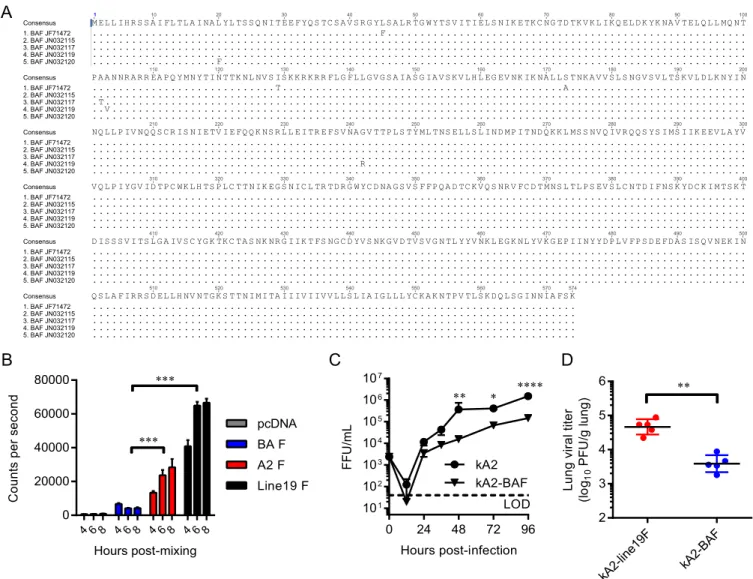
FIG 1Fusion activity of the Buenos Aires F protein (BAF) and its effect on attenuationin vitroand in cotton rats. (A) The consensus sequence of the BAF protein was obtained by alignment of 5 clinical isolates from the GenBank database. Disagreements from the consensus sequence are indicated. (B) BAF fusion activity was measured using a dual-split protein (DSP) cell-to-cell fusion assay. A representative graph from three experimental replicates shows means⫹SEMs of 4 replicate wells. ***,P⬍0.0005 using two-way ANOVA and Tukey multiple-comparison test. (C) BEAS-2B cells were infected at an MOI of 0.01 FFU/cell with either kRSV-A2 or kRSV-A2-BAF. Growth curve data are presented as means⫾SEMs from 3 experimental replicates titrated in triplicate. *,P⬍0.05; **,P⬍
Briefly, serum samples were heat inactivated at 56°C for 30 min. Serial 2-fold dilutions were performed in duplicate starting at 2 log2, and equal volumes were added to 50 to 100 FFU of each of the RSV strains on the panel. The virus and serum mixtures were incubated at 37°C for 1 h. Then, 50l of each mixture was transferred onto subconfluent HEp-2 cell monolayers in 96-well plates in duplicate. Plates were spinoculated at 2,095⫻gfor 30 min at 4°C, and FFU were counted after 48 h of incuba-tion at 37°C and 5% CO2. The 50% effective concentration (EC50) was calculated using nonlinear regression analysis with four-parameter fitting in GraphPad Prism version 6.0. Nondetectable nAb titers were assigned a value of 2 log2.
Serum anti-RSV IgG antibodies on day 46 p.i. were determined by enzyme immunoassay (EIA) against RSV A2 lysate or mock control lysate. First, 96-well plates were coated with lysate and incubated at room tem-perature overnight. After blocking in 5% bovine serum albumin (BSA) in PBS containing 0.05% Tween 20 (PBST) for 1 h at room temperature, 100-l volumes of 2-fold serial dilutions of serum samples (ranging from 1:512 to 1:65,536) in PBST were added to appropriate wells and incubated for 2 h at room temperature. Next, plates were washed 3 times with PBST and incubated for 1 h at 37°C with horseradish peroxidase (HRP)-conju-gated goat anti-mouse immunoglobulin antibody (diluted 1:1,000; Thermo Fisher Scientific, Waltham, MA). After washing 3 times with PBST, color was developed with an R&D Systems (Minneapolis, MN) substrate reagent pack (stabilized hydrogen peroxide and stabilized te-tramethylbenzidine) as indicated by the manufacturer. The enzyme-sub-strate reaction was terminated by the addition of a sulfuric acid solution, and absorbance was measured at a wavelength of 450 nm. The cutoff value to determine antibody titer was chosen as the mean optical density (OD)⫹1 standard deviation (SD) for the lowest dilution (1:512) of se-rum from mock-infected cotton rats. The highest sese-rum dilution with absorbance above the cutoff was defined as the antibody titer.
Anti-RSV IgA antibodies from cotton rat nasal washes obtained on
day 46 p.i. were similarly determined by EIA against RSV A2 or mock stock lysates. After coating plates overnight and blocking in 5% BSA, 100-l volumes of 2-fold serial dilutions of nasal wash samples (ranging from 1:1 to 1:128) in PBST were added to appropriate wells and incubated for 2 h at room temperature. Wells were then washed with PBST and incubated for 1 h at 37°C with HRP-conjugated goat anti-mouse IgA (Southern Biotech, Birmingham, AL). Plates were then washed and incu-bated with R&D Systems substrate reagents as described above. The en-zyme-substrate reaction was terminated with a sulfuric acid solution, and absorbance was measured at 450 nm. The cutoff to determine antibody titer was again chosen as the mean OD⫹1 SD of the lowest dilution (1:1) of nasal wash from mock-infected cotton rats. The highest nasal wash dilution with absorbance above the cutoff was defined as the antibody titer.
Statistical analyses. All statistical analyses were performed using
GraphPad Prism software version 6.0 (San Diego, CA). Data are presented as means with SDs or standard errors of the means (SEMs) as indicated below. Student’s ttest and one-way or two-way analyses of variance (ANOVA) were used as indicated below, with Tukey’spost hoc multiple-comparison test. For all analyses, aPvalue of 0.05 was considered signif-icant.
RESULTS
Identification and characterization of a low-fusion F protein.
We generated an RSV F protein consensus sequence of the Buenos
Aires (BA) clade by aligning the full-length F nucleotide sequences
from 5 BA clinical isolates in the GenBank database (
http://www
.ncbi.nlm.nih.gov/GenBank/index.html
) (
Fig. 1A
). Using a
dual-split protein (DSP) cell-to-cell fusion assay with 293T cells as
pre-viously described (
23–25
), we found that BAF, when expressed
alone, was poorly fusogenic compared to A2F and line19F
pro-BAF consensussequence
Leader
NS1 NS2
∆SH
N P M G F M2-2 L
Trailer A
B
RSV N
RSV F
RSV NS1
RSV NS2
Mock kA2-line19F kDB1
C
0 50 100 150
P
e
rcen
tag
e
o
f
k
A
2
-l
in
e19F
* **
N F NS1 NS2
teins (
Fig. 1B
). Based on these results, we hypothesized that BAF
may confer attenuation to a vaccine candidate based on its low
fusogenicity. To test this hypothesis, we cloned BAF in place of
A2F in a bacterial artificial chromosome (BAC) construct
con-taining the antigenome of strain kRSV-A2, where k represents the
red fluorescent protein mKate2 gene (
17
). We rescued this
recom-binant virus and then performed multistep growth curve analyses
with BEAS-2B cells to compare growth of kRSV-A2-BAF to that of
kRSV-A2
in vitro
. Although the two viruses replicated to similar
levels at earlier time points p.i., growth of kRSV-A2-BAF was
at-tenuated at 48, 72, and 96 h p.i. (
Fig. 1C
). We then measured the
effects of BAF on viral attenuation
in vivo
by infecting groups of 5
cotton rats intranasally with 10
5FFU of either kRSV-A2-line19F
or kRSV-A2-BAF and measuring the lung viral titer 4 days later.
kRSV-A2-BAF was attenuated by 1.1 log
10PFU/g of lung (
P
⫽
0.0054) compared to kRSV-A2-line19F in the lower respiratory
tracts of the cotton rats (
Fig. 1D
). Taken together, these results
demonstrated that BAF was poorly fusogenic and attenuating
in
vitro
and
in vivo
.
Design of RSV live-attenuated vaccine DB1 and expression
of viral proteins.
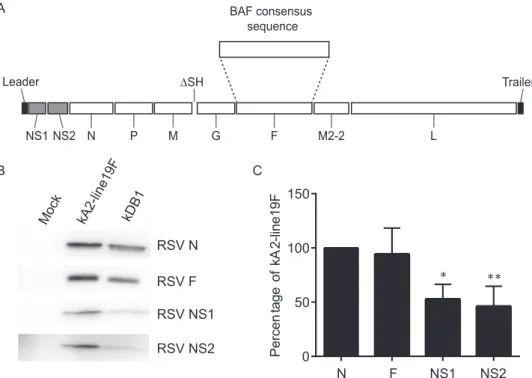
We next generated an RSV LAV candidate, DB1,
by replacing the A2F gene with BAF, codon deoptimizing the
genes for the nonstructural proteins NS1 and NS2 (dNS) (
7
), and
deleting the small hydrophobic protein gene (
⌬
SH) in an RSV-A2
backbone (
Fig. 2A
). Our rationale for this vaccine design was to
combine the novel low-fusion BAF protein with two attenuating
ge-netic modifications known to preserve immunogenicity, namely, the
codon deoptimization of NS1 and NS2 and the deletion of SH
pro-tein. We generated DB1 by cloning BAF in place of A2F in the
bacterial artificial chromosome (BAC) construct containing the
antigenome of RSV-A2-dNS-⌬SH. We similarly generated an
an-tigenomic version of DB1 containing mKate2 in the first gene
position (kDB1) and rescued these recombinant viruses (
17
). To
analyze viral protein levels, we performed Western blotting on
lysates from infected HEp-2 cells. The results demonstrated
that expression levels of NS1 and NS2 proteins in
kDB1-in-fected cells were less than in kRSV-A2-line19F-inkDB1-in-fected cells, as
expected, whereas F protein expression levels were equivalent
(
Fig. 2B
and
C
).
DB1 viral growth kinetics
in vitro
.
We next characterized
kDB1 growth kinetics
in vitro
by performing multistep growth
curve analyses with well-differentiated primary HAE (
18
) and
NHBE (
7
) cells grown at the air-liquid interface. We employed
these two models because well-differentiated human airway
epi-thelial cells more accurately predict RSV attenuation in
seronega-tive children than immortalized cell lines or nonhuman primates
(
29
). In both models of well-differentiated airway epithelial cells,
kDB1 was attenuated compared to kRSV-A2, with significant
dif-ferences observed in NHBE cells on days 6 and 7 p.i. (
Fig. 3A
to
C
).
In contrast, kDB1 had growth kinetics similar to those of
kRSV-A2-line19F in Vero cells, an interferon-deficient cell line approved
for vaccine production (
Fig. 3D
). The lack of kDB1 attenuation in
Vero cells may be in part explained by the diminished impact of
codon-deoptimized nonstructural proteins on this
interferon-de-ficient cell line. In summary, these data demonstrated that kDB1
was attenuated in primary cells
in vitro
but grew to sufficient levels
for rescue and production in Vero cells.
DB1 attenuation and histopathology in cotton rats.
To
deter-mine the level of DB1 attenuation
in vivo
in cotton rats, we
in-fected groups of 3 animals with either DB1 or RSV A2 (
Fig. 4A
and
0.0208) and 1.2 log
10PFU/g lung (
P
⫽
0.0022) lower than those of
RSV A2 in the lung lavage and nasal wash, respectively. These
results demonstrated that DB1 was attenuated in cotton rats
com-pared to RSV A2.
To evaluate for enhanced disease attributable to vaccination
following challenge, we next vaccinated groups of 5 cotton rats
intranasally with kDB1 or a control, or intramuscularly with
FI-RSV (lot 100; 1:125). On day 21 p.i., we boosted FI-
FI-RSV-vacci-nated rats with a second identical vaccination. On day 42 p.i., we
challenged all rats intranasally with 10
6FFU of kRSV-A2-line19F.
Six days later, we harvested the lungs for histopathology and
per-formed scoring for peribronchiolitis, perivasculitis, interstitial
pneumonitis, and alveolitis (
Fig. 4C
to
F
). The average
histopa-thology scores for kDB1-vaccinated rats were statistically
equivalent to those obtained with mock treatment for all four
parameters. kDB1-vaccinated rats also had significantly lower
histopathology scores than FI-RSV-vaccinated rats for
peribron-chiolitis (
P
⫽
0.0155) and alveolitis (
P
⬍
0.0001). These results
demonstrated that kDB1 does not cause enhanced disease
follow-ing challenge in the standard cotton rat model.
DB1 immunogenicity in cotton rats.
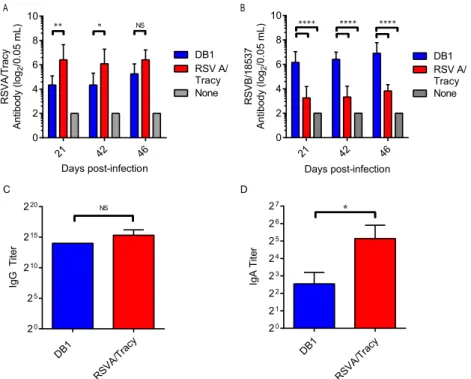
To analyze DB1
immu-nogenicity in cotton rats, we mock infected rats or infected groups
of 6 cotton rats with 10
5PFU of DB1 or RSVA/Tracy (GA1
geno-type) and measured serum titers of nAb against RSVA/Tracy and
RSVB/18537 by microneutralization assays on days 21, 42, and 46
p.i. (
Fig. 5A
and
B
). DB1 generated nAb to both RSVA/Tracy and
RSVB/18537, and DB1 generated significantly higher serum titers
of nAb to RSVB/18537 than did RSVA/Tracy.
We then pooled cotton rat serum samples from day 46 p.i. and
measured anti-RSV IgG binding antibodies via enzyme
immuno-assay (EIA) against kRSV-A2 (
Fig. 5C
). DB1 generated anti-RSV
IgG titers of
⬎2
13, which were statistically equivalent to titers
gen-erated by RSVA/Tracy (
P
⫽
0.4169). DB1 also generated
detect-able virus-specific IgA antibodies in cotton rat nasal washes
ob-tained on day 46 p.i. (
Fig. 5D
).
Breadth of neutralizing antibody responses elicited by DB1.
To further characterize the spectrum of nAb generated by DB1, we
designed a panel of chimeric RSV reporter strains expressing the
attachment (G) and F glycoproteins of a broad range of clinical
isolates in an RSV-A2 background with mKate2 in the first gene
position. The panel of viruses included glycoproteins from RSV B
strains TX11-56, NH1276, and 9320 and RSV A strains
1998/12-21, Riyadh 91/2009, and 2-20. These strains were chosen to
repre-sent phylogenetically distant RSV strains from both subgroups
and multiple clades. We additionally generated a recombinant
virus, kRSV-A2-2-20F/G-stop, which contained a premature stop
codon in the G glycoprotein as previously described, in order to
measure the relative effects of anti-G antibodies on neutralization
(
21
). We also included kRSV-A2 in the panel and rescued the
recombinant viruses.
We subsequently pooled the cotton rat serum samples
col-lected on days 0, 21, and 42 p.i. and measured nAb titers at each
time point against the panel of viruses by an FFU reduction assay
(
Fig. 6
) (
7
). DB1 generated broadly neutralizing Ab responses
against both RSV A and B representative viruses that were similar
in titer to those induced by RSVA/Tracy. Antibody titers against
the chimeric clinical strains ranged from EC
50s of 2
8to 2
10per 0.05
ml and were highest against RSV B strain NH1276, followed by B
strains 9320 and TX11-56. Antibody titers were lowest against the
laboratory-adapted wild-type strain RSV-A2, which may be less
representative of currently circulating RSV clinical strains.
Nota-bly, nAb titers were higher against kRSV-A2-2-20F/G-stop than
kRSV-A2-2-20, demonstrating that the neutralization generated
by DB1 was not dependent on antibodies directed against G.
Taken together, these data demonstrated that DB1 was highly
immunogenic and generated broadly neutralizing Ab responses
against both RSV A and B strains, with the highest titers observed
against RSV B strains.
DB1 efficacy in cotton rats.
To analyze vaccine efficacy (
Fig.
7
), we next challenged the cotton rats described above with 1.35
⫻
10
5PFU of RSVA/Tracy on day 42 postvaccination and measured
RSVA/Tracy viral titers in lung lavage and nasal wash fluids by
standard plaque assay 4 days later. In lung lavage samples (
Fig.
7A
), vaccination with DB1 reduced viral titers after challenge by
2.7 log
10PFU/g tissue compared to titers in untreated cotton rats
(
P
⬍
0.0001). In the nasal washes, DB1 reduced titers by 3.8 log
10total PFU compared to those in untreated cotton rats (
P
⬍
0.0001), which were statistically equivalent to those of RSVA/
Tracy (
P
⫽
0.3710) (
Fig. 7B
). DB1 was thus effective in reducing
viral titers after RSV challenge by
⬎99% in both the upper and
lower airways of cotton rats.
DISCUSSION
We generated an RSV live-attenuated vaccine, DB1, which was
both attenuated and highly immunogenic in cotton rats. This
vac-cine incorporated a low-fusion F protein as a novel strategy to
attenuate viral replication without compromising
immunogenic-ity. DB1 additionally incorporated two genetic modifications
DB 1
RSV A/T
racy 20
25
210
215
220
Ig
G
T
it
e
r
NS
DB 1
RSV A/T
racy 20
21
22
23
24
25
26
27
Ig
A
T
it
e
r
*
21 42 46
0 2 4 6 8 10
Days post-infection
R
S
V
B
/18537
A
n
tibody
(l
o
g2
/0
.0
5
m
L)
None RSV A/ Tracy DB1
**** **** ****
21 42 46
0 2 4 6 8 10
Days post-infection
R
S
VA/Tr
a
c
y
A
n
ti
body
(l
o
g2
/0
.0
5
m
L
) ** * NS
DB1 RSV A/ Tracy None
A B
C D
known to balance attenuation and immunogenicity, the codon
deoptimization of nonstructural proteins (
7
) and the deletion of
SH (
13
). The resultant vaccine was
⬎
10-fold attenuated in cotton
rat upper and lower airways, yet it still elicited high titers of
broadly neutralizing Ab to a diverse panel of RSV A and B
recom-binant strains. DB1 also generated mucosal immunity in the form
of RSV-specific IgA antibodies in cotton rat nasal wash specimens.
When vaccinated animals were challenged with RSV, DB1
re-duced challenge strain titers by
⬎
99% in both the nasal wash and
lung lavage specimens. Thus, DB1 was attenuated, highly
immu-nogenic, and efficacious at protecting against RSV challenge in
cotton rats.
To characterize the breadth of neutralization generated by
DB1, we designed a novel panel of recombinant RSV viruses
ex-pressing mKate2 and the G and F surface glycoproteins of diverse
RSV A and B clinical isolates. We found that intranasal
inocula-tion with DB1 generated broadly neutralizing Ab against our
panel of recombinant viruses, with the highest titers observed
against the RSV B strains. We additionally observed
subgroup-specific immune responses to the lab strain RSVB/18537 when
analyzed by a standard plaque reduction neutralization test
(PRNT). Notably, DB1 generated significantly higher
neutraliza-tion of RSVB/18537 than did infecneutraliza-tion with wild-type RSVA/
Tracy. Conversely, RSVA/Tracy also generated significantly
higher neutralization of RSVA/Tracy (homologous) than did DB1
on days 28 and 42 postinfection. These subgroup-specific
re-sponses must have been attributable to differences within the
fu-sion protein, as these were the principal antigenic differences
be-0 10 20 30 402 4 6 8 10 12 TX11-56 (B) Days post-infection EC 50 (l o g2 /0 .0 5 m L )
0 10 20 30 40 2 4 6 8 10 12 NH1276 (B) Days post-infection EC 50 (l o g2 /0 .0 5 m L )
0 10 20 30 40 2 4 6 8 10 12
Riyadh 91/2009 (A)
Days post-infection EC 50 (l o g2 /0 .0 5 m L ) Mock Tracy DB1
0 10 20 30 40 2 4 6 8 10 12 9320 (B) Days post-infection EC 50 (l og 2 /0 .0 5 m L )
0 10 20 30 40 2 4 6 8 10 12 A2 (A) Days post-infection EC 50 (l og 2 /0 .0 5 mL ) Mock Tracy DB1
0 10 20 30 40 2 4 6 8 10 12 2-20F/G-stop (A) Days post-infection EC 50 (l og 2 /0 .0 5 m L )
0 10 20 30 40 2 4 6 8 10 12 2-20 (A) Days post-infection EC 50 (l o g2 /0 .0 5 m L ) DB1 Tracy Mock 0 10 20 30 40
2 4 6 8 10 12 1998/12-21 (A) Days post-infection EC 50 (l o g2 /0 .0 5 m L ) DB1 Tracy Mock A C E G B D F H
tween DB1 and RSVA/Tracy. Thus, our data implicate the fusion
protein as an important mediator of subgroup-specific immunity,
despite its highly conserved neutralizing epitopes (
30
). The data
also validate that RSV elicits cross-neutralizing Ab responses to
heterosubtypic viruses that are broad but variable in magnitude,
which may have implications for vaccine design (
31
).
The titers of nAb elicited by DB1 against our panel of
recom-binant viruses fell in the range of what is known to be protective
against lower respiratory tract infections in cotton rats. Previous
studies with cotton rats demonstrated that serum nAb titers of
1:100 conferred partial pulmonary protection, whereas titers of
1:380 completely protected against lower respiratory tract disease
(
32
). These results correlated with observations in human infants
⬍
2 months of age, which showed that maternally derived
anti-body titers of 1:400 offered protection against RSV bronchiolitis
and pneumonia (
33
). The serum nAb titers elicited by DB1 in
cotton rats to our panel of recombinant clinical viruses ranged
from 1:256 to 1:1,024 by FFU reduction assay. In comparison,
RSV LAV candidate RSV-⌬M2-2, which is under evaluation in
clinical trials, generated nAb titers of 1:32 to 1:64 by the plaque
reduction neutralization titer necessary to reduce the number of
plaques by 60% (PRNT
60) in cotton rats (
34
). With regard to
efficacy, DB1 was
⬎99% efficacious in reducing cotton rat nasal
wash and lung lavage titers postchallenge. DB1 efficacy was thus
comparable to that of palivizumab, which is dosed in humans
based on the serum trough concentration necessary to reduce the
cotton rat lung viral load by 99% (
35
).
With regard to attenuation, DB1 was highly attenuated in two
models of primary human airway epithelial cells, which more
ac-curately gauge levels of RSV LAV attenuation in humans than
immortalized cell lines (
29
). However, the vaccine was only
15-fold attenuated in cotton rat upper airways and 45-15-fold attenuated
in lung lavage specimens. We suspect that this discrepancy was
observed because the dNS and
⌬
SH mutations exerted minimal
effects in the cotton rat model. In fact, the BAF mutation alone
conferred a reduction in viral titer in cotton rat lower airways
(12-fold) nearly equivalent to those conferred by the combined
mutations in DB1. This is consistent with previous studies which
found that the
⌬SH mutation conferred attenuation in
chimpan-zee lower airways (
13
) but not in cotton rats (
15
). Additionally,
the dNS mutations have been characterized only in mice and
pri-mary cells (
7
), so their effects in cotton rats are unknown. Thus,
the applicability of the cotton rat model to approximate human
levels of attenuation with these specific mutations remains
un-clear.
In conclusion, we generated an RSV LAV DB1 that
incorpo-rated a low-fusion F protein as a novel strategy to attenuate viral
replication without compromising immunogenicity. We
com-bined this low-fusion F protein with codon-deoptimized
non-structural proteins and deleted the SH protein in an RSV-A2
back-bone to generate a multifaceted vaccine that balanced attenuation
and immunogenicity. DB1 also elicited broadly neutralizing
anti-bodies against a panel of RSV A and B strains and protected
against RSV challenge in cotton rats. DB1 is a promising RSV
vaccine candidate that merits further investigation.
ACKNOWLEDGMENTS
We thank Ursula Buchholz and Karl-Klaus Conzelmann for BSR-T7/5 cells, Michael Teng for polyclonal rabbit antisera against NS1 and NS2, Nancy Ulbrandt for motavizumab, Edward Walsh for D-14, Jin Hong for the fusion inhibitor BMS-433771, and the Emory⫹Children’s Pediatric Research Center Flow Cytometry Core.
We declare the following competing financial interests. J.C.G.B. is an employee of Sigmovir Biosystems, Inc., a contract research organization that uses the cotton rat model of infectious diseases. M.L.M. cofounded Meissa Vaccines, Inc., and serves as chief scientific officer for the com-pany. C.A.R., C.C.S., A.L.H., J.M., and M.L.M. are coinventors of the RSV vaccine evaluated in this study.
C.A.R., C.C.S., B.E.G., R.J.P., A.L.H., J.M., J.C.G.B., and P.A.P. per-formed the experiments. S.M.M. and B.S.G. contributed reagents and to concepts of the experimental design. C.A.R. and M.L.M. designed the studies and analyzed data. C.A.R. wrote the paper.
FUNDING INFORMATION
This work, including the efforts of Martin L. Moore, Christina Rostad, Christopher C. Stobart, Anne L. Hotard, and Jia Meng, was funded by HHS | NIH | National Institute of Allergy and Infectious Diseases (NIAID) (1R01AI087798 and 1U19AI095227). This work, including the efforts of Christopher C. Stobart, was funded by HHS | NIH | National Institute of Allergy and Infectious Diseases (NIAID) (T32AI074492). This work, in-cluding the efforts of Brian Edward Gilbert and Pedro A. Piedra, was funded by HHS | NIH | National Institute of Allergy and Infectious Dis-eases (NIAID) (HHSN272201000004I). This work, including the efforts of Christina Rostad, was funded by HHS | NIH | National Institute of Child Health and Human Development (NICHD) (5K12HD072245).
The funders had no role in study design, data collection and interpreta-tion, or the decision to submit the work for publication.
REFERENCES
1.Nair H, Nokes DJ, Gessner BD, Dherani M, Madhi SA, Singleton RJ,
O’Brien KL, Roca A, Wright PF, Bruce N, Chandran A, Theodoratou E, Sutanto A, Sedyaningsih ER, Ngama M, Munywoki PK, Kartasasmita
C, Simoes EA, Rudan I, Weber MW, Campbell H.2010. Global burden
of acute lower respiratory infections due to respiratory syncytial virus in young children: a systematic review and meta-analysis. Lancet375:1545– 1555.http://dx.doi.org/10.1016/S0140-6736(10)60206-1.
2.Lozano R, et al.2012. Global and regional mortality from 235 causes of death for 20 age groups in 1990 and 2010: a systematic analysis for the Global Burden of Disease Study 2010. Lancet380:2095–2128.http://dx .doi.org/10.1016/S0140-6736(12)61728-0.
3.Kim HW, Canchola JG, Brandt CD, Pyles G, Chanock RM, Jensen K,
Parrott RH.1969. Respiratory syncytial virus disease in infants despite prior administration of antigenic inactivated vaccine. Am J Epidemiol
89:422– 434.
A B No ne DB 1 RSV A/T racy 0 1 2 3 4 5 6 Na s a l w a s h ti te r R SVA/ T ra c y (l o g10 PFU) **** LOD NS No ne DB 1 RSVA /Tra cy 0 1 2 3 4 5 6 Lung lavag e ti te r R SVA/ T ra c y (l o g10 P F U /g lung ) **** LOD ***
FIG 7Vaccine efficacy of DB1 in cotton rats. Groups of 6 cotton rats were infected i.n. with DB1 or RSVA/Tracy or served as uninfected controls. Ani-mals were challenged with RSVA/Tracy on day 42 p.i., and viral loads were measured 4 days later by standard plaque assays of lung lavage (A) and nasal wash (B) fluids. Each symbol represents a single animal. Data represent means⫾SDs. Dotted lines indicate the limits of detection (LOD). ***,P⬍
4.Murphy BR, Sotnikov AV, Lawrence LA, Banks SM, Prince GA.
1990. Enhanced pulmonary histopathology is observed in cotton rats immunized with formalin-inactivated respiratory syncytial virus (RSV) or purified F glycoprotein and challenged with RSV 3-6 months after immunization. Vaccine 8:497–502. http://dx.doi.org/10.1016 /0264-410X(90)90253-I.
5.Connors M, Collins PL, Firestone CY, Sotnikov AV, Waitze A, Davis
AR, Hung PP, Chanock RM, Murphy BR.1992. Cotton rats previously
immunized with a chimeric RSV FG glycoprotein develop enhanced pul-monary pathology when infected with RSV, a phenomenon not encoun-tered following immunization with vaccinia-RSV recombinants or RSV. Vaccine10:475– 484.http://dx.doi.org/10.1016/0264-410X(92)90397-3. 6.Wright PF, Karron RA, Belshe RB, Shi JR, Randolph VB, Collins PL,
O’Shea AF, Gruber WC, Murphy BR.2007. The absence of enhanced
disease with wild type respiratory syncytial virus infection occurring after receipt of live, attenuated, respiratory syncytial virus vaccines. Vaccine
25:7372–7378.http://dx.doi.org/10.1016/j.vaccine.2007.08.014. 7.Meng J, Lee S, Hotard AL, Moore ML.2014. Refining the balance of
attenuation and immunogenicity of respiratory syncytial virus by targeted codon deoptimization of virulence genes. mBio5:e01704-14.http://dx .doi.org/10.1128/mBio.01704-14.
8.Mueller S, Papamichail D, Coleman JR, Skiena S, Wimmer E.2006.
Reduction of the rate of poliovirus protein synthesis through large-scale codon deoptimization causes attenuation of viral virulence by lowering specific infectivity. J Virol80:9687–9696.http://dx.doi.org/10.1128/JVI .00738-06.
9.Burns CC, Shaw J, Campagnoli R, Jorba J, Vincent A, Quay J, Kew O.
2006. Modulation of poliovirus replicative fitness in HeLa cells by deop-timization of synonymous codon usage in the capsid region. J Virol80:
3259 –3272.http://dx.doi.org/10.1128/JVI.80.7.3259-3272.2006. 10. Coleman JR, Papamichail D, Skiena S, Futcher B, Wimmer E, Mueller
S.2008. Virus attenuation by genome-scale changes in codon pair bias. Science320:1784 –1787.http://dx.doi.org/10.1126/science.1155761.
11. Le Nouën C, Brock LG, Luongo C, McCarty T, Yang L, Mehedi M,
Wimmer E, Mueller S, Collins PL, Buchholz UJ, DiNapoli JM.2014.
Attenuation of human respiratory syncytial virus by genome-scale codon-pair deoptimization. Proc Natl Acad Sci U S A111:13169 –13174.http://dx .doi.org/10.1073/pnas.1411290111.
12. Teng MN, Whitehead SS, Bermingham A, St Claire M, Elkins WR,
Murphy BR, Collins PL.2000. Recombinant respiratory syncytial virus that does not express the NS1 or M2-2 protein is highly attenuated and immunogenic in chimpanzees. J Virol74:9317–9321.http://dx.doi.org/10 .1128/JVI.74.19.9317-9321.2000.
13. Whitehead SS, Bukreyev A, Teng MN, Firestone CY, St Claire M, Elkins WR, Collins PL, Murphy BR.1999. Recombinant respiratory syncytial virus bearing a deletion of either the NS2 or SH gene is attenuated in chimpanzees. J Virol73:3438 –3442.
14. Bukreyev A, Whitehead SS, Murphy BR, Collins PL.1997. Recombinant respiratory syncytial virus from which the entire SH gene has been deleted grows efficiently in cell culture and exhibits site-specific attenuation in the respiratory tract of the mouse. J Virol71:8973– 8982.
15. Jin H, Zhou H, Cheng X, Tang R, Munoz M, Nguyen N. 2000.
Recombinant respiratory syncytial viruses with deletions in the NS1, NS2, SH, and M2-2 genes are attenuated in vitro and in vivo. Virology273:210 – 218.http://dx.doi.org/10.1006/viro.2000.0393.
16. Stokes KL, Chi MH, Sakamoto K, Newcomb DC, Currier MG,
Hucka-bee MM, Lee S, Goleniewska K, Pretto C, Williams JV, Hotard A, Sherrill TP, Peebles RS, Jr, Moore ML.2011. Differential pathogenesis of respiratory syncytial virus clinical isolates in BALB/c mice. J Virol85:
5782–5793.http://dx.doi.org/10.1128/JVI.01693-10.
17. Hotard AL, Shaikh FY, Lee S, Yan D, Teng MN, Plemper RK, Crowe JE, Jr, Moore ML.2012. A stabilized respiratory syncytial virus reverse genet-ics system amenable to recombination-mediated mutagenesis. Virology
434:129 –136.http://dx.doi.org/10.1016/j.virol.2012.09.022.
18. Pickles RJ, McCarty D, Matsui H, Hart PJ, Randell SH, Boucher RC.
1998. Limited entry of adenovirus vectors into well-differentiated airway epithelium is responsible for inefficient gene transfer. J Virol72:6014 – 6023.
19. Warming S, Costantino N, Court DL, Jenkins NA, Copeland NG.2005. Simple and highly efficient BAC recombineering using galK selection. Nu-cleic Acids Res33:e36.http://dx.doi.org/10.1093/nar/gni035.
20. Teng MN, Whitehead SS, Collins PL.2001. Contribution of the respi-ratory syncytial virus G glycoprotein and its secreted and membrane-bound forms to virus replication in vitro and in vivo. Virology289:283– 296.http://dx.doi.org/10.1006/viro.2001.1138.
21. Meng J, Hotard AL, Currier MG, Lee S, Stobart CC, Moore ML.14
October 2015. The respiratory syncytial virus attachment glycoprotein contribution to infection depends on the specific fusion protein. J Virol http://dx.doi.org/10.1128/JVI.02140-15.
22. Piedra PA, Wyde PR, Castleman WL, Ambrose MW, Jewell AM,
Speel-man DJ, Hildreth SW.1993. Enhanced pulmonary pathology associated with the use of formalin-inactivated respiratory syncytial virus vaccine in cotton rats is not a unique viral phenomenon. Vaccine11:1415–1423. http://dx.doi.org/10.1016/0264-410X(93)90170-3.
23. Stokes KL, Currier MG, Sakamoto K, Lee S, Collins PL, Plemper RK, Moore ML.2013. The respiratory syncytial virus fusion protein and neu-trophils mediate the airway mucin response to pathogenic respiratory syncytial virus infection. J Virol 87:10070 –10082.http://dx.doi.org/10 .1128/JVI.01347-13.
24. Hotard AL, Lee S, Currier MG, Crowe JE, Jr, Sakamoto K, Newcomb
DC, Peebles RS, Jr, Plemper RK, Moore ML. 2015. Identification of residues in the human respiratory syncytial virus fusion protein that mod-ulate fusion activity and pathogenesis. J Virol89:512–522.http://dx.doi .org/10.1128/JVI.02472-14.
25. Ishikawa H, Meng F, Kondo N, Iwamoto A, Matsuda Z.2012.
Gener-ation of a dual-functional split-reporter protein for monitoring mem-brane fusion using self-associating split GFP. Protein Eng Des Sel25:813– 820.http://dx.doi.org/10.1093/protein/gzs051.
26. Cianci C, Langley DR, Dischino DD, Sun Y, Yu KL, Stanley A, Roach J, Li Z, Dalterio R, Colonno R, Meanwell NA, Krystal M.2004. Target-ing a bindTarget-ing pocket within the trimer-of-hairpins: small-molecule inhi-bition of viral fusion. Proc Natl Acad Sci U S A101:15046 –15051.http: //dx.doi.org/10.1073/pnas.0406696101.
27. Prince GA, Jenson AB, Horswood RL, Camargo E, Chanock RM.1978.
The pathogenesis of respiratory syncytial virus infection in cotton rats. Am J Pathol93:771–791.
28. Prince GA, Curtis SJ, Yim KC, Porter DD. 2001. Vaccine-enhanced
respiratory syncytial virus disease in cotton rats following immunization with Lot 100 or a newly prepared reference vaccine. J Gen Virol82:2881– 2888.http://dx.doi.org/10.1099/0022-1317-82-12-2881.
29. Wright PF, Ikizler MR, Gonzales RA, Carroll KN, Johnson JE,
Werkhaven JA.2005. Growth of respiratory syncytial virus in primary epithelial cells from the human respiratory tract. J Virol79:8651– 8654. http://dx.doi.org/10.1128/JVI.79.13.8651-8654.2005.
30. McLellan JS, Chen M, Leung S, Graepel KW, Du X, Yang Y, Zhou T,
Baxa U, Yasuda E, Beaumont T, Kumar A, Modjarrad K, Zheng Z, Zhao
M, Xia N, Kwong PD, Graham BS. 2013. Structure of RSV fusion
glycoprotein trimer bound to a prefusion-specific neutralizing antibody. Science340:1113–1117.http://dx.doi.org/10.1126/science.1234914.
31. Sande CJ, Mutunga MN, Medley GF, Cane PA, Nokes DJ.2013.
Group-and genotype-specific neutralizing antibody responses against respiratory syncytial virus in infants and young children with severe pneumonia. J Infect Dis207:489 – 492.http://dx.doi.org/10.1093/infdis/jis700. 32. Prince GA, Horswood RL, Chanock RM.1985. Quantitative aspects of
passive immunity to respiratory syncytial virus infection in infant cotton rats. J Virol55:517–520.
33. Parrott RH, Kim HW, Arrobio JO, Hodes DS, Murphy BR, Brandt CD,
Camargo E, Chanock RM.1973. Epidemiology of respiratory syncytial virus infection in Washington, DC. II. Infection and disease with respect to age, immunologic status, race and sex. Am J Epidemiol98:289 –300. 34. Jin H, Cheng X, Zhou HZ, Li S, Seddiqui A.2000. Respiratory syncytial
virus that lacks open reading frame 2 of the M2 gene (M2-2) has altered growth characteristics and is attenuated in rodents. J Virol74:74 – 82.http: //dx.doi.org/10.1128/JVI.74.1.74-82.2000.