Disparities in Depressive Symptoms and
Antidepressant Treatment by Gender and
Race/Ethnicity among People Living with HIV
in the United States
Angela M. Bengtson1☯*, Brian W. Pence1☯, Heidi M. Crane2‡, Katerina Christopoulos3‡, Rob J. Fredericksen2‡, Bradley N. Gaynes4‡, Amy Heine5‡, W. Christopher Mathews6‡, Richard Moore7‡, Sonia Napravnik5‡, Steven Safren8‡, Michael J. Mugavero9‡
1Department of Epidemiology, University of North Carolina at Chapel Hill, Chapel Hill, North Carolina, United States of America,2Department of Medicine, School of Medicine, University of Washington, Seattle, Washington, United States of America,3HIV/AIDS Division, San Francisco General Hospital, University of California San Francisco, San Francisco, California, United States of America,4Department of Psychiatry, School of Medicine, University of North Carolina at Chapel Hill, Chapel Hill, North Carolina, United States of America,5Division of Infectious Diseases, Department of Medicine, School of Medicine, University of North Carolina at Chapel Hill, Chapel Hill, North Carolina, United States of America,6Department of Medicine, School of Medicine, University of California San Diego, San Diego, California, United States of America, 7Department of Medicine, School of Medicine, Johns Hopkins University, Baltimore, Maryland, United States of America,8Department of Psychology, University of Miami, Miami, Florida, United States of America,9Department of Medicine and UAB Center for AIDS Research, University of Alabama at Birmingham, Birmingham, Alabama, United States of America
☯These authors contributed equally to this work. ‡These authors also contributed equally to this work.
Abstract
Objective
To describe disparities along the depression treatment cascade, from indication for antide-pressant treatment to effective treatment, in HIV-infected individuals by gender and race/ ethnicity.
Methods
The Center for AIDS Research (CFAR) Network of Integrated Clinical Systems (CNICS) cohort includes 31,000 HIV-infected adults in routine clinical care at 8 sites. Individuals were included in the analysis if they had a depressive symptoms measure within one month of establishing HIV care at a CNICS site. Depressive symptoms were measured using the validated Patient Health Questionnaire-9 (PHQ-9). Indication for antidepressant treatment was defined as PHQ-910 or a current antidepressant prescription. Antidepressant treat-ment was defined as a current antidepressant prescription. Evidence-based antidepressant treatment was considered treatment changes based on a person’s most recent PHQ-9, in accordance with clinical guidelines. We calculated the cumulative probability of moving through the depression treatment cascade within 24 months of entering CNICS HIV care.
a11111
OPEN ACCESS
Citation:Bengtson AM, Pence BW, Crane HM, Christopoulos K, Fredericksen RJ, Gaynes BN, et al. (2016) Disparities in Depressive Symptoms and Antidepressant Treatment by Gender and Race/ Ethnicity among People Living with HIV in the United States. PLoS ONE 11(8): e0160738. doi:10.1371/ journal.pone.0160738
Editor:Viviane D. Lima, British Columbia Centre for Excellence in HIV/AIDS, CANADA
Received:May 12, 2016
Accepted:July 25, 2016
Published:August 11, 2016
Copyright:© 2016 Bengtson et al. This is an open access article distributed under the terms of the
Creative Commons Attribution License, which permits unrestricted use, distribution, and reproduction in any medium, provided the original author and source are credited.
Data Availability Statement:Data used in the present analysis were collected by the Center for AIDS Research (CFAR) Network of Integrated Clinical Systems (CNICS) and are not owned by any of the authors. CNICS data is available to researchers who meet the criteria for access to confidential data (For information on CNICS, please visit:https://www.uab.edu/cnics/).
We used multivariable Cox proportional hazards models to estimate associations between gender, race/ethnicity, and a range of depression outcomes.
Results
In our cohort of HIV-infected adults in routine care, 47% had an indication for antidepressant treatment. Significant drop-offs along the depression treatment cascade were seen for the entire study sample. However, important disparities existed. Women were more likely to have an indication for antidepressant treatment (HR 1.54; 95% CI 1.34, 1.78), receive anti-depressant treatment (HR 2.03; 95% CI 1.53, 2.69) and receive evidence-based antide-pressant treatment (HR 1.67; 95% CI 1.03, 2.74), even after accounting for race/ethnicity. Black non-Hispanics (HR 0.47, 95% CI 0.35, 0.65), Hispanics (HR 0.63, 95% CI 0.44, 0.89) and other race/ethnicities (HR 0.35, 95% CI 0.17, 0.73) were less likely to initiate antide-pressant treatment, compared to white non-Hispanics.
Conclusions
In our cohort of HIV-infected adults depressive symptoms were common. Important dispari-ties in the prevalence of depressive symptoms and receipt of antidepressant treatment existed by gender and race/ethnicity.
Introduction
Depression affects an estimated 30% of HIV-infected adults, making it the most commonly reported mental health condition among adults in HIV care.[1,2]. For people living with HIV (PLHIV), depression negatively affects quality of life,[3–5] and is consistently associated with reduced antiretroviral (ART) adherence, [6–11] viral suppression,[12–14] and higher mortality rates.[12,14] Despite the high prevalence of depression and its association with poor outcomes among HIV-infected adults, depression remains widely unrecognized, untreated, or under-treated in HIV clinical care.[15,16]
The“depression treatment cascade”, similar to the HIV treatment cascade, estimates the proportion of HIV-infected adults with depression whose condition is recognized clinically, treated, and remits. Estimates of the depression treatment cascade suggest that less than half of all cases of depression are recognized clinically. Of cases recognized clinically, only half receive any mental health treatment, and fewer than half of those treated receive guideline-concordant treatment.[17] Although these large gaps in depression identification and treatment among HIV-infected patients are well documented, little is known about gender and racial/ethnic dis-parities that may exist in this cascade.
In the general population, disparities in the prevalence, diagnosis, and treatment of depres-sion are complex. A higher lifetime prevalence of depresdepres-sion has been reported among white non-Hispanics (18%), compared to black non-Hispanics (11%) and Hispanics (14%).[18] However, black Americans are also more likely to be undiagnosed[19] and to experience more severe or persistent depression.[20,21] Hispanics and black Americans are also less likely to receive antidepressant medication,[22–24] including treatment that conforms to current clini-cal guidelines [21,25] or to be referred for counseling.[26,27] Disparities in depression care by gender also exist. Compared to men, women are significantly more likely be diagnosed with depression [28] and to utilize mental health services.[29,30] Differences in the assessment of and by the National Institute of Allergy and Infectious
Disease (https://www.niaid.nih.gov/Pages/default. aspx)-funded Center for AIDS Research Network of Integrated Clinical Systems (CNICS; (R24 AI067039; PI Mike Saag).
depression between studies, from a diagnosis of major depressive disorder using the Diagnostic and Statistical Manual of Mental Disorders [31] to validated scales which screen for depressive symptoms, such as the Patient Health Questionaire-9, [32] further complicates our under-standing of disparities in depression prevalence and treatment.
Less is known about disparities in depression care that may exist in HIV-infected popula-tions by gender or race/ethnicity. As HIV transipopula-tions from an acute to a chronic medical condi-tion, high-quality mental health services to ensure the long-term health of HIV-infected adults are increasingly important. In the United States, HIV disproportionately affects men who have sex with men (MSM) and women in the southern United States–two groups also at high risk of depression.[28,33–36] Given the high burden of depression among HIV-infected adults and disparities by gender and race/ethnicity in the general population, understanding disparities in depression care among HIV-infected adults is essential to optimize mental health and clinical outcomes.
The goal of the present analysis is to describe disparities along the depression treatment cas-cade by gender and race/ethnicity in a large cohort of HIV-infected adults in the United States. We report on differences by gender and race/ethnicity in the cumulative probability of success-fully moving through the depression treatment cascade, from indication for antidepressant treatment to effective treatment, and estimate the association between gender, race/ethnicity and a range of depression-related outcomes.
Materials and Methods
Data for the present analysis come from the Center for AIDS Research (CFAR) Network of Integrated Clinical Systems (CNICS) cohort. The CNICS cohort includes over 31,000 HIV-infected adults in routine HIV clinical care at 8 sites in the United States.[37] CNICS collects detailed information on demographic characteristics, ART, antidepressant medications, HIV/ AIDS clinical events, co‐morbid conditions, HIV‐related laboratory values and vital status on patients who consent to participate. Starting between 2005 and 2011, patients in CNICS also began completing self-administered socio‐behavioral questionnaires, or Patient‐Reported Out-comes (PROs), on touch-screen tablets as part of routine care visits. HIV-infected patients complete PROs approximately every 4–6 months, although this varies based on clinical care follow-up. Written informed consent was obtained from all study participants and docu-mented at each CNICS site. Ethical approval for the use of routinely collected clinical data was provided by the institutional review board at the University of North Carolina at Chapel Hill.
Study Population
Measures
Each PRO includes an assessment of depressive symptoms using the Patient Health Question-naire-9 (PHQ-9).[32] The PHQ-9 has been widely validated, including among HIV-infected populations.[38,39] PROs also include several other validated measures for mental health and substance use, including: panic disorder (Patient Health Questionnaire-5),[40] high risk alco-hol use (The Alcoalco-hol Use Disorders Identification Test (AUDIT), defined as4 for males and3 for females),[41] and use of illicit drugs including cocaine/crack, heroin/opiates, crys-tal/amphetamine use, but excluding marijuana (The Alcohol, Smoking and Substance Involve-ment Screening Test (ASSIST)).[42,43] Information on counseling-based depression
treatment is not available in CNICS.
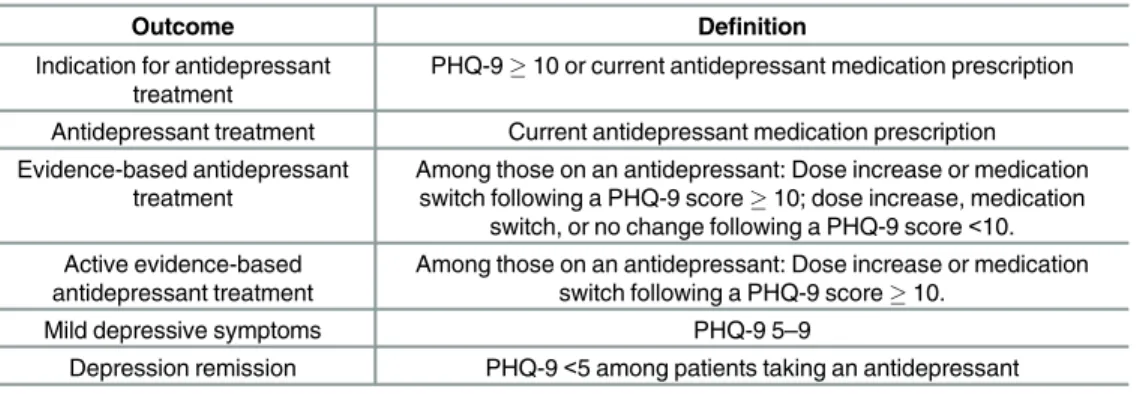
For the present analysis, we focused on disparities in indication, receipt and quality of anti-depressant treatment among HIV-infected adults (Fig 1;Table 1). We defined indication for antidepressant treatment as a PHQ-9 total score10 (88% sensitivity and specificity to indi-cate a major depressive episode)[32] or prescription of an antidepressant. Receipt of antide-pressant treatment was defined as prescription of an antideantide-pressant medication. Quality of antidepressant treatment was considered to be evidence-based or not evidence-based. Evi-dence-based antidepressant treatment was defined as adjusting the antidepressant prescription based on follow-up depressive severity measures in a manner consistent with evidence-based guidelines. [44,45] Specifically, for patients on antidepressant treatment, if a follow-up PHQ-9 score was10 (indicating persistent depressive symptoms) and either the antidepressant dose was increased or a switch or augmentation of the antidepressant regimen was prescribed, this was considered active evidence-based treatment. Whereas if no medication adjustment occurred, this was considered not to be evidence-based treatment. If the follow-up PHQ-9 score was<10, then both changes to and maintenance of the antidepressant regimen were con-sidered to be (passive) evidence-based. Secondary outcomes concon-sidered were mild depressive symptoms (PHQ-9 between 5 and 9), and depression remission (PHQ-9<5).[46] We exam-ined depression-related outcomes stratified by gender (female or male) and race/ethnicity (white, non-Hispanic; black, non-Hispanic, Hispanic, or other).
Fig 1. The depression treatment cascade for HIV-infected adults.
doi:10.1371/journal.pone.0160738.g001
Table 1. Depression-related outcomes and definitions.
Outcome Definition
Indication for antidepressant treatment
PHQ-910 or current antidepressant medication prescription
Antidepressant treatment Current antidepressant medication prescription Evidence-based antidepressant
treatment
Among those on an antidepressant: Dose increase or medication switch following a PHQ-9 score10; dose increase, medication
switch, or no change following a PHQ-9 score<10. Active evidence-based
antidepressant treatment
Among those on an antidepressant: Dose increase or medication switch following a PHQ-9 score10.
Mild depressive symptoms PHQ-9 5–9
Depression remission PHQ-9<5 among patients taking an antidepressant
Data Analysis
To understand disparities in depression treatment and response across the depression treat-ment cascade, we conducted three analyses–each examining a different aspect of the depression treatment experience. First, to understand the likelihood of a person sequentially moving through the depression treatment cascade, we looked at each individual’s antidepressant treat-ment experience over 24 months and calculated the cumulative probability of ever having an indication for antidepressant treatment, ever initiating antidepressant treatment, ever receiving evidence-based antidepressant treatment, and ever receiving active evidence-based antidepres-sant treatment. The cumulative probability of each event was defined as the probability of experiencing an event, multiplied by the probability of experiencing each previous event on the depression treatment cascade.
Second, to understand the depression treatment cascade at the clinic population level, we categorized the first 24 months of each individual’s person-time in CNICS HIV care by its depressive severity (not depressed, mild depressive symptoms, depressed) and antidepressant status (on or not on antidepressants) and stratified by gender and race/ethnicity. Antidepres-sant status was determined using patient medication records for each person-month under observation. PHQ-9 measurements were considered valid (i.e. carried forward) for up to 6 months. Person-time was excluded if it had been more than 6 months since the most recent PHQ-9 measure.
Finally, we used multivariable Cox proportional hazards models to estimate associations between gender, race/ethnicity, and the following depression treatment cascade outcomes over 24 months: first indication for antidepressant treatment, first receipt of antidepressant medica-tion, and first receipt of evidence-based antidepressant treatment. The origin was considered entry into care at the CNICS site for all multivariable analyses and all models included site and calendar time, modeled using restricted cubic splines. Additional covariates, such as CD4, viral load, substance use and other mental health disorders, were not included because they likely represent mediators, rather than confounders, of the relationship between race/ethnicity, gen-der and depression outcomes. We developed inverse probability of censoring weights to account for differential LTFU by baseline demographic (age) and clinical factors (depression, anxiety and viral load suppression) that were associated with LTFU.[47] The likelihood of receiving active evidence-based depression treatment and achieving depression remission were not evaluated in multivariable analyses due to limited sample size. All analyses were conducted using Stata 13 (StataCorp: College Station, TX).
Results
Table 2. Sociodemographic, clinical and mental health characteristics at entry into care of 1,390 HIV-infected adults in CNICS.
N (%) or Median (IQR)
Demographic and clinical characteristics1
Age 41 (32, 49)
Gender
Male 1,234 (88.8)
Female 156 (11.2)
Race/ethnicity
White, non-Hispanic 680 (49.1)
Black, non-Hispanic 290 (20.9)
Hispanic 328 (23.7)
Other 87 (6.3)
Risk group
IDU 146 (10.6)
MSM (no IDU) 942 (68.3)
Heterosexual (no MSM or IDU) 237 (17.2)
Other 55 (4.0)
Site
Site A 270 (19.4)
Site B 1,120 (80.6)
Viral load at enrollment
Undetectable,<50 copies/mL 497 (36.9)
Detectable,50 copies/mL 849 (63.1)
CD4 count, cells/mm3 427 (230, 639)
200 301 (21.9)
201–500 532 (38.7)
>500 543 (39.5)
ART use
Efavirenz containing 176 (12.7)
Non-efavirenz containing 345 (24.8)
Not on ART 869 (62.5)
Panic disorder
No panic 921 (67.1)
Some panic symptoms 246 (17.9)
Panic disorder 205 (14.9)
Drug use (excluding marijuana use)
No use 544 (45.3)
Current use 191 (15.9)
Past use 465 (38.8)
High risk alcohol use
Yes 444 (32.8)
No 910 (67.2)
Mental health characteristics over 24 months of follow-up
PHQ-9 indicating depressive symptoms (10) 543 (39.1)
Indication for antidepressant treatment (A) 659 (47.4)
Of A: Initiated antidepressant treatment (B) 290 (44.0)
Of B: Evidence-based antidepressant treatment (C) 116 (40.0)
Of C: Active evidence-based antidepressant treatment 21 (18.1)
Depression remission (at any time over 24 months) 109 (20.1)
1 Missing data: race/ethnicity 0.5%, risk group 0.7%, viral load 3.2%, CD4 count 1.0%, panic disorder 1.3%, drug use 13.7%, alcohol use 2.6%.
The prevalence of mental health issues in our cohort was high. At entry into CNICS care, one third of participants had some indication of panic disorder (either some panic symptoms or panic disorder). Panic disorder was more common among women than men (27% versus 14%). Over 24 months of follow-up, nearly 40% of participants ever had a PHQ-910 indicat-ing depressive symptoms and almost half (47%) had either a PHQ-9 indicatindicat-ing depressive symptoms or were on an antidepressant at some point (Table 2;S1 Table). Women were more likely than men to have a PHQ-9 indicating probable depression (54% versus 37%).
There was a substantial decline in the proportion of patients who progressed to each subse-quent category along the depression treatment cascade for all genders and race/ethnicities (Fig 2A). However, important disparities existed. Over 65% of women had an indication for antide-pressant treatment within 24 months of entering CNICS HIV care, while only 45% of men did. Women also had a higher cumulative probability of receiving antidepressant treatment within 24 months of entering care (39% versus 19% for men). Overall, 40% of individuals who initi-ated antidepressant treatment received evidence-based antidepressant treatment (Table 2). However, the vast majority of evidence-based antidepressant treatment was passive (the patient had a low PHQ-9 score and therefore no clinician action was indicated); only a small propor-tion was active evidence-based (dose increase or medicapropor-tion switch following a high PHQ-9). The cumulative probability of having an indication for antidepressant treatment, receiving antidepressant treatment and for that treatment to be evidence-based was low for both genders (15% for women and 8% for men). The cumulative probability of active evidence-based treat-ment was even lower (5% for women and 1% for men). Among persons who had a PHQ-910 (n = 543), 20% experienced depression remission at some point during follow-up, regardless of antidepressant treatment.
When the depression treatment cascade was stratified by race/ethnicity, 38–49% of persons in each group had an indication for antidepressant treatment (Fig 2B). However, the cumula-tive probability of receiving antidepressant treatment (e.g. the probability of having an indica-tion for antidepressant treatment and subsequently receiving treatment) was higher among white non-Hispanics (25%) and black non-Hispanics (23%), compared to Hispanics (14%) and
Fig 2. The cumulative probability of moving through the depression treatment cascade, by (A) gender and (B) race/ethnicity. The cumulative probability of experiencing each depression-related event is defined as the probability of experiencing an event, multiplied by the probability of experiencing each previous event on the depression treatment cascade.
persons of other race/ethnicity (10%). The cumulative probability of evidence-based antide-pressant treatment was also low across all racial/ethnic groups, but again was higher for white non-Hispanics (10%) and black non-Hispanics (12%), compared to Hispanics (5%) and per-sons of other race/ethnicity (1%). The cumulative probability of receiving active evidence-based antidepressant treatment was very low in all racial/ethnic groups (0–2%).
When person-time was stratified by depressive severity and antidepressant use, women spent considerably more time with depressive symptoms or on antidepressants than men (approximately 50% versus 30%;Fig 3). However, women also spent more time in remission while on antidepressants (approximately 15%), compared to men (approximately 5%). When the proportion of individuals who experienced depression remission (on antidepressant treat-ment with a PHQ-9 score<5) was considered, similar results were seen among men (12%) and women (13%).
When person-time stratified by depressive severity and antidepressant use was considered by race/ethnicity, the amount of person-time spent on antidepressants was similar between white non-Hispanics and black non-Hispanics (approximately 15% of person-time for both groups;Fig 3). Hispanics and those of other race/ethnicity experienced slightly lower propor-tions of person-time on antidepressants (approximately 10% and 7%, respectively). Across gen-der and racial/ethnic groups, a sizeable proportion of person-time (approximately 20%) was spent with depressive symptoms but not on antidepressant treatment.
In multivariable analyses accounting for both gender and race/ethnicity, the largest dispari-ties in having an indication for antidepressant treatment and receiving treatment persisted by gender. Compared to men, women were more likely to have an indication for depression treat-ment (HR 1.54, 95% CI 1.34, 1.78);Table 3). Black non-Hispanics (HR 0.47, 95% CI 0.35, 0.65), Hispanics (HR 0.63, 95% CI 0.44, 0.89) and persons of other race/ethnicity (HR 0.35, 95% CI 0.17, 0.73) were less likely to initiate antidepressant treatment, compared to white non-Hispanics. Women were also more likely to initiate antidepressant treatment (HR 2.03, 95% CI 1.53, 2.69), and to receive evidence-based depression treatment (HR 1.67, 95% CI 1.03, 2.74). Compared to white non-Hispanics, all other racial/ethnic groups were also less likely to receive evidence-based depression treatment, however estimates were imprecise due to limited sample size. Associations between gender and race/ethnicity with active evidence-based antidepressant treatment were not evaluated due to small sample size.
Discussion
In our cohort of HIV-infected adults in routine care, almost half of the population had an indi-cation for antidepressant treatment. There was a substantial decline in the proportion of patients who proceeded to each subsequent category of the depression treatment cascade: from having an indication for antidepressant treatment, to starting antidepressant treatment, to receiving evidence-based antidepressant treatment or active evidence-based antidepressant treatment. Among those with depressive symptoms, the cumulative probability of receiving evidence-based antidepressant treatment remained15% regardless of gender or race/ ethnicity.
drug with known psychiatric side effects, could account for some of the gender disparity in HIV-infected populations.[49] However, in our cohort only 13% of participants were on an efavirenz containing ART regimen at baseline and of those, only 5% were women. A higher proportion of depression among women has also been reported in the general US population.
Fig 3. Antidepressant (AD) use and depressive severity, stratified by person-time and (A) gender and (B) race/ethnicity.
[28] The increased likelihood of women receiving any antidepressant treatment or evidence-based antidepressant treatment may be related to the fact that women are more likely than men to seek mental health services.[50,51] Future analyses should explore possible reasons, such as domestic violence, economic vulnerability or social support, for gender disparities in depressive symptoms among PLWH.
Several large surveys of adults in the general US population have found a higher prevalence of depression among white non-Hispanics compared to black non-Hispanics or Hispanics.[18, 20,52] In unadjusted analyses, the probability of having an indication for antidepressant treat-ment was similar across all race/ethic groups (ranging from 38%-49%). However, after adjust-ing for gender in the multivariable analysis, white non-Hispanics were more likely to have an indication for antidepressant treatment compared to black non-Hispanics and Hispanics, although confidence intervals included the null value of 1.00. Women in our cohort were more likely to be black non-Hispanic (38% versus 19% for men) and depressed (65% versus 45% for men), which may explain why accounting for gender resulted in a higher burden of depression on white non-Hispanics relative to other racial/ethnic groups.
In addition to having a higher prevalence of depression, white non-Hispanics in the general population also disproportionately are prescribed antidepressants and receive treatment in accordance with clinical guidelines.[21,23,24,53–55] Our analysis demonstrated similar trends in a HIV-infected population, with white non-Hispanics being more likely to initiate antidepressant treatment and to receive evidence-based antidepressant treatment than all other race/ethnicities. The disparity in depression treatment for racial and ethnic minorities may be related to healthcare access and antidepressant prescribing patters of clinicians. Compared to white non-Hispanics, black non-Hispanics and Hispanics in the general population are more likely to be uninsured,[19,24,56] are less likely to receive an antidepressant prescription from a provider[55,57] and are also less likely to fill an antidepressant prescription.[54] Many HIV-infected adults have access to HIV medical care through federal Ryan White HIV/AIDS pro-gram, however coverage for mental health services varies widely by state which may contribute to the disparity in initiating antidepressant treatment.[58] Non-medication-based depression interventions, such as counseling, have effectively reduced depression for non-white racial groups.[59–61] However information on counseling and psychotherapy was not available in our data.
Our analysis included participants from two sites in the southeastern and western United States. As a result, our study population was largely male, MSM and had a higher proportion of black non-Hispanics and Hispanics than HIV-infected adults in the US overall.[62] Our study results, therefore, are generalizable to similar populations of HIV-infected adults, but may be less generalizable to HIV-infected adults in the US overall. Further, participants in our analysis
Table 3. Multivariable results for the associations between gender and race/ethnicity with depression-related events.1
Characteristic Indication for Antidepressant Treatment Initiate Antidepressant Treatment Evidence-based Antidepressant Treatment
HR (95% CI) HR (95% CI) HR (95% CI)
Male 1.00 1.00 1.00
Female 1.54 (1.34, 1.78) 2.03 (1.53, 2.69) 1.67 (1.03, 2.74)
White, non-Hispanic 1.00 1.00 1.00
Black, non-Hispanic 0.86 (0.72, 1.03) 0.47 (0.35, 0.65) 0.48 (0.30, 0.79)
Hispanic 0.84 (0.70, 0.99) 0.63 (0.44, 0.89) 0.67 (0.37, 1.19)
Other 0.77 (0.56, 1.04) 0.35 (0.17, 0.73) 0.15 (0.02, 1.09)
1 All models adjusted for variables in the table, site, calendar time and inverse probability of censoring weights for LTFU.
were receiving HIV care at large academic medical centers, which may have more resources to screen for and treat depression in HIV-infected populations. Additional work is needed to characterize the prevalence of depressive symptoms and disparities in depression treatment, with both antidepressant and counseling-based approaches, for HIV-infected adults receiving care at smaller, community-based clinics.
Our study has several important limitations. Depressive symptoms were defined in our cohort as a PHQ-9 score10, which is a validated threshold for identifying probable depres-sion but is not diagnostic. Further, some antidepressants have secondary indications, such as bupropion for smoking cessation or duloxetine for pain management and more severe mental illnesses, such as bipolar disorder, are sometimes misclassified as depressive symptoms. Thus there may be some measurement error in our estimate of the proportion of the study popula-tion having an indicapopula-tion for antidepressant treatment. Second, although the CNICS dataset contains a unique combination of repeated PHQ-9 measures and antidepressant medication changes, we did not have data on referral to counseling or to additional aspects of the clinical presentation that might legitimately prompt a clinician not to adjust antidepressant treatment even in the face of persistent depressive symptoms (for example, concern about side effects at a higher dose or evidence of patient non-adherence to the prescribed antidepressant dose). Therefore some of the clinical care classified as“not evidence-based”may have been clinically appropriate. Finally, our study draws on a large, geographically and racially diverse populations of HIV-infected adults. However, our analysis was limited to participants at sites where the PHQ-9 is routinely administered upon entry into CNICS care to ensure a valid measure of depressive symptoms. Information on whether patients entering CNICS care have a new HIV diagnosis or have been in care previously is not available in CNICS. Consequently, the high prevalence of depressive symptoms reported in our study may in part reflect participants deal-ing with a new diagnosis of HIV.
Conclusions
Our analysis is among the first to characterize disparities in indication, receipt and quality of antidepressant treatment among HIV-infected adults in routine care. The precipitous drop-offs we observed along the depression treatment cascade highlight the need to improve access to high-quality depression care for all HIV-infected adults. Our results also confirm that many of the disparities in receiving high-quality depression care that exist by gender and race/ethnic-ity in the general population, persist among HIV-infected adults. In particular, HIV-infected women appear to be experiencing more depressive symptoms compared to men, and racial/ ethnic minorities are less likely to initiate antidepressants and receive evidence-based treatment than white non-Hispanics. Given the high burden of depression among HIV-infected adults, these disparities are particularly concerning. Increasing awareness among mental health and HIV providers about disparities in depression treatment for HIV-infected adults may help to close the treatment gap. However, future research should also explore whether different types of depression treatment interventions (such as antidepressant treatment only or antidepressant treatment with counseling) are more efficacious for women or racial/ethnic minorities in order to reduce disparities along the depression treatment cascade.
Supporting Information
S1 Table. Medication type and dose information for 290 persons initiating antidepressant treatment over up to 2 years of follow-up.
Author Contributions
Conceived and designed the experiments:AMB BWP HMC BNG MJM.
Analyzed the data:AMB BWP.
Wrote the paper:AMB.
Assisted with the interpretation of the data analysis and critically revised the manuscript for important intellectual content: BWP HMC KC RJF BNG AH WCM RM SN SS MJM.
References
1. Bing EG, Burnam MA, Longshore D, Fleishman JA, Sherbourne CD, London AS, et al. Psychiatric dis-orders and drug use among human immunodeficiency virus-infected adults in the United States. Arch Gen Psychiatry. 2001; 58(8):721–8. Epub 2001/09/06. PMID:11483137.
2. Ciesla JA, Roberts JE. Meta-analysis of the relationship between HIV infection and risk for depressive disorders. Am J Psychiatry. 2001; 158(5):725–30. Epub 2001/05/01. PMID:11329393.
3. Bengtson AM, Pence BW, O'Donnell J, Thielman N, Heine A, Zinski A, et al. Improvements in depres-sion and changes in quality of life among HIV-infected adults. AIDS Care. 2015; 27(1):47–53. doi:10. 1080/09540121.2014.946386PMID:25105320; PubMed Central PMCID: PMCPMC4402235. 4. Reis RK, Haas VJ, Santos CB, Teles SA, Galvao MT, Gir E. Symptoms of depression and quality of life
of people living with HIV/AIDS. Revista latino-americana de enfermagem. 2011; 19(4):874–81. PMID: 21876938
5. Zimpel RR, Fleck MP. Depression as a major impact on the quality of life of HIV-positive Brazilians. Psychology, Health & Medicine. 2013. doi:10.1080/13548506.2013.772302
6. Gonzalez JS, Batchelder AW, Psaros C, Safren SA. Depression and HIV/AIDS treatment nonadher-ence: a review and meta-analysis. J Acquir Immune Defic Syndr. 2011; 58(2):181–7. Epub 2011/08/23. doi:10.1097/QAI.0b013e31822d490aPMID:21857529; PubMed Central PMCID: PMCPmc3858003. 7. Gordillo V, del Amo J, Soriano V, Gonzalez-Lahoz J. Sociodemographic and psychological variables
influencing adherence to antiretroviral therapy. Aids. 1999; 13(13):1763–9. Epub 1999/10/06. PMID: 10509579.
8. Horberg MA, Silverberg MJ, Hurley LB, Towner WJ, Klein DB, Bersoff-Matcha S, et al. Effects of depression and selective serotonin reuptake inhibitor use on adherence to highly active antiretroviral therapy and on clinical outcomes in HIV-infected patients. J Acquir Immune Defic Syndr. 2008; 47 (3):384–90. Epub 2007/12/20. doi:10.1097/QAI.0b013e318160d53ePMID:18091609.
9. Mugavero M, Ostermann J, Whetten K, Leserman J, Swartz M, Stangl D, et al. Barriers to antiretroviral adherence: the importance of depression, abuse, and other traumatic events. AIDS Patient Care STDS. 2006; 20(6):418–28. Epub 2006/06/23. doi:10.1089/apc.2006.20.418PMID:16789855. 10. Uthman OA, Magidson JF, Safren SA, Nachega JB. Depression and adherence to antiretroviral therapy
in low-, middle- and high-income countries: a systematic review and meta-analysis. Curr HIV/AIDS Rep. 2014; 11(3):291–307. Epub 2014/07/21. doi:10.1007/s11904-014-0220-1PMID:25038748; PubMed Central PMCID: PMCPMC4359613.
11. Springer SA, Dushaj A, Azar MM. The impact of DSM-IV mental disorders on adherence to combination antiretroviral therapy among adult persons living with HIV/AIDS: a systematic review. AIDS Behav. 2012; 16(8):2119–43. Epub 2012/05/31. doi:10.1007/s10461-012-0212-3PMID:22644066; PubMed Central PMCID: PMCPMC3481055.
12. Ickovics JR, Hamburger ME, Vlahov D, Schoenbaum EE, Schuman P, Boland RJ, et al. Mortality, CD4 cell count decline, and depressive symptoms among HIV-seropositive women: longitudinal analysis from the HIV Epidemiology Research Study. JAMA. 2001; 285(11):1466–74. PMID:11255423. 13. Ironson G, O'Cleirigh C, Fletcher MA, Laurenceau, Balbin E, Klimas N, et al. Psychosocial factors predict
CD4 and viral load change in men and women with human immunodeficiency virus in the era of highly active antiretroviral treatment. Psychosomatic medicine. 2005; 67(6):1013–21. Epub 2005/11/30. doi:10. 1097/01.psy.0000188569.58998.c8PMID:16314608; PubMed Central PMCID: PMCPmc2614887. 14. Leserman J, Jackson ED, Petitto JM, Golden RN, Silva SG, Perkins DO, et al. Progression to AIDS: the
effects of stress, depressive symptoms, and social support. Psychosomatic medicine. 1999; 61 (3):397–406. Epub 1999/06/15. PMID:10367622.
16. O'Cleirigh C, Magidson JF, Skeer MR, Mayer KH, Safren SA. Prevalence of Psychiatric and Substance Abuse Symptomatology Among HIV-Infected Gay and Bisexual Men in HIV Primary Care. PMID: Psy-chosomatics. 2015; 56(5):470–8. Epub 2015/02/07. doi:10.1016/j.psym.2014.08.004PMID: 25656425; PubMed Central PMCID: PMCPMC4339664.
17. Pence BW, O'Donnell JK, Gaynes BN. Falling through the cracks: the gaps between depression preva-lence, diagnosis, treatment, and response in HIV care. AIDS (London, England). 2012; 26(5):656–8. doi:10.1097/QAD.0b013e3283519aae; 10.1097/QAD.0b013e3283519aae.
18. Breslau J, Aguilar-Gaxiola S, Kendler KS, Su M, Williams D, Kessler RC. Specifying race-ethnic differ-ences in risk for psychiatric disorder in a USA national sample. Psychol Med. 2006; 36(1):57–68. Epub 2005/10/06. doi:10.1017/s0033291705006161PMID:16202191; PubMed Central PMCID:
PMCPmc1924605.
19. Bailey RK, Blackmon HL, Stevens FL. Major depressive disorder in the African American population: meeting the challenges of stigma, misdiagnosis, and treatment disparities. J Natl Med Assoc. 2009; 101(11):1084–9. Epub 2009/12/17. PMID:19998635.
20. Breslau J, Kendler KS, Su M, Gaxiola-Aguilar S, Kessler RC. Lifetime risk and persistence of psychiat-ric disorders across ethnic groups in the United States. Psychol Med. 2005; 35(3):317–27. Epub 2005/ 04/22. PMID:15841868; PubMed Central PMCID: PMCPmc2748985.
21. Gonzalez HM, Tarraf W, Whitfield KE, Vega WA. The epidemiology of major depression and ethnicity in the United States. Journal of psychiatric research. 2010; 44(15):1043–51. Epub 2010/06/12. doi:10. 1016/j.jpsychires.2010.03.017PMID:20537350; PubMed Central PMCID: PMCPmc2963677. 22. Williams DR, Gonzalez HM, Neighbors H, Nesse R, Abelson JM, Sweetman J, et al. Prevalence and
distribution of major depressive disorder in African Americans, Caribbean blacks, and non-Hispanic whites: results from the National Survey of American Life. Arch Gen Psychiatry. 2007; 64(3):305–15. Epub 2007/03/07. doi:10.1001/archpsyc.64.3.305PMID:17339519.
23. Gonzalez HM, Vega WA, Williams DR, Tarraf W, West BT, Neighbors HW. Depression care in the United States: too little for too few. Arch Gen Psychiatry. 2010; 67(1):37–46. Epub 2010/01/06. doi:10. 1001/archgenpsychiatry.2009.168PMID:20048221; PubMed Central PMCID: PMCPmc2887749. 24. Alegria M, Chatterji P, Wells K, Cao Z, Chen CN, Takeuchi D, et al. Disparity in depression treatment
among racial and ethnic minority populations in the United States. Psychiatr Serv. 2008; 59(11):1264– 72. Epub 2008/10/31. doi:10.1176/appi.ps.59.11.1264PMID:18971402; PubMed Central PMCID: PMCPmc2668139.
25. Quinones AR, Thielke SM, Beaver KA, Trivedi RB, Williams EC, Fan VS. Racial and ethnic differences in receipt of antidepressants and psychotherapy by veterans with chronic depression. Psychiatr Serv. 2014; 65(2):193–200. Epub 2013/11/02. doi:10.1176/appi.ps.201300057PMID:24178411. 26. Lagomasino IT, Stockdale SE, Miranda J. Racial-ethnic composition of provider practices and
dispari-ties in treatment of depression and anxiety, 2003–2007. Psychiatr Serv. 2011; 62(9):1019–25. Epub 2011/09/03. doi:10.1176/appi.ps.62.9.1019PMID:21885579; PubMed Central PMCID:
PMCPMC4805374.
27. Lewis-Fernandez R, Das AK, Alfonso C, Weissman MM, Olfson M. Depression in US Hispanics: diag-nostic and management considerations in family practice. The Journal of the American Board of Family Practice / American Board of Family Practice. 2005; 18(4):282–96. Epub 2005/07/05. PMID:
15994474.
28. Kessler RC, Chiu WT, Demler O, Merikangas KR, Walters EE. Prevalence, severity, and comorbidity of 12-month DSM-IV disorders in the National Comorbidity Survey Replication. Arch Gen Psychiatry. 2005; 62(6):617–27. Epub 2005/06/09. doi:10.1001/archpsyc.62.6.617PMID:15939839; PubMed Central PMCID: PMCPmc2847357.
29. Fleury MJ, Grenier G, Bamvita JM, Caron J. Determinants and patterns of service utilization and recourse to professionals for mental health reasons. BMC Health Serv Res. 2014; 14:161. Epub 2014/ 04/10. doi:10.1186/1472-6963-14-161PMID:24712834; PubMed Central PMCID: PMCPmc3996168. 30. Mack S, Jacobi F, Gerschler A, Strehle J, Hofler M, Busch MA, et al. Self-reported utilization of mental
health services in the adult German population—evidence for unmet needs? Results of the DEGS1-Mental Health Module (DEGS1-MH). Int J Methods Psychiatr Res. 2014; 23(3):289–303. Epub 2014/ 04/02. doi:10.1002/mpr.1438PMID:24687693.
31. Association AP. Diagnostic and statistical manual of mental disorders: DSM-5. 5th ed. Washington D. C: American Psychiatric Association; 2013.
32. Kroenke K, Spitzer RL, Williams JB. The PHQ-9: validity of a brief depression severity measure. J Gen Intern Med. 2001; 16(9):606–13. Epub 2001/09/15. PMID:11556941; PubMed Central PMCID: PMCPMC1495268.
34. Ahaneku H, Ross MW, Nyoni JE, Selwyn B, Troisi C, Mbwambo J, et al. Depression and HIV risk among men who have sex with men in Tanzania. AIDS Care. 2016; 28 Suppl 1:140–7. Epub 2016/03/ 24. doi:10.1080/09540121.2016.1146207PMID:27002772.
35. Dyer TP, Regan R, Pacek LR, Acheampong A, Khan MR. Psychosocial vulnerability and HIV-related sexual risk among men who have sex with men and women in the United States. Archives of sexual behavior. 2015; 44(2):429–41. Epub 2014/09/04. doi:10.1007/s10508-014-0346-7PMID:25183549; PubMed Central PMCID: PMCPMC4324087.
36. Secor AM, Wahome E, Micheni M, Rao D, Simoni JM, Sanders EJ, et al. Depression, substance abuse and stigma among men who have sex with men in coastal Kenya. Aids. 2015; 29 Suppl 3:S251–9. Epub 2015/11/13. doi:10.1097/qad.0000000000000846PMID:26562814; PubMed Central PMCID: PMCPMC4706380.
37. Kitahata MM, Rodriguez B, Haubrich R, Boswell S, Mathews WC, Lederman MM, et al. Cohort profile: the Centers for AIDS Research Network of Integrated Clinical Systems. Int J Epidemiol. 2008; 37 (5):948–55. Epub 2008/02/12. doi:10.1093/ije/dym231PMID:18263650; PubMed Central PMCID: PMCPmc2597168.
38. Cholera R, Gaynes BN, Pence BW, Bassett J, Qangule N, Macphail C, et al. Validity of the Patient Health Questionnaire-9 to screen for depression in a high-HIV burden primary healthcare clinic in Johannesburg, South Africa. J Affect Disord. 2014; 167:160–6. Epub 2014/06/28. doi:10.1016/j.jad. 2014.06.003PMID:24972364; PubMed Central PMCID: PMCPMC4264106.
39. Monahan PO, Shacham E, Reece M, Kroenke K, Ong'or WO, Omollo O, et al. Validity/reliability of PHQ-9 and PHQ-2 depression scales among adults living with HIV/AIDS in western Kenya. J Gen Intern Med. 2009; 24(2):189–97. Epub 2008/11/26. doi:10.1007/s11606-008-0846-zPMID:19031037; PubMed Central PMCID: PMCPMC2629000.
40. Spitzer RL, Kroenke K, Williams JB. Validation and utility of a self-report version of PRIME-MD: the PHQ primary care study. Primary Care Evaluation of Mental Disorders. Patient Health Questionnaire. JAMA. 1999; 282(18):1737–44. Epub 1999/11/24. PMID:10568646.
41. Babor TF, Higgins-Biddle JC, Saunders JB, Monteiro MG. AUDIT, The Alcohol Use Disorders Identifi-cation Test. Guidelines for Use in Primary Care. Geneva, Switzerland: World Health Organization, Dependence DoMHaS; 2001.
42. The Alcohol, Smoking and Substance Involvement Screening Test (ASSIST): development, reliability and feasibility. Addiction. 2002; 97(9):1183–94. Epub 2002/08/30. PMID:12199834.
43. Humeniuk R, Ali R, Babor TF, Farrell M, Formigoni ML, Jittiwutikarn J, et al. Validation of the Alcohol, Smoking And Substance Involvement Screening Test (ASSIST). Addiction. 2008; 103(6):1039–47. Epub 2008/04/01. doi:10.1111/j.1360-0443.2007.02114.xPMID:18373724.
44. American Psychiatric Association. Practice Guideline for the Treatment of Patients With Major Depres-sive Disorder, Third Ed. Washington, DC: American Psychiatric Association Press; 2010.
45. Agency for Health Care Policy and Research. Depression in Primary Care: Vol 2: Treatment of Major Depression. Rockville, MD: US Dept of Health and Human Services; 1993.
46. Lowe B, Unutzer J, Callahan CM, Perkins AJ, Kroenke K. Monitoring depression treatment outcomes with the patient health questionnaire-9. Medical care. 2004; 42(12):1194–201. PMID:15550799. 47. Howe CJ, Cole SR, Lau B, Napravnik S, Eron JJ Jr. Selection Bias Due to Loss to Follow Up in Cohort
Studies. Epidemiology. 2016; 27(1):91–7. Epub 2015/10/21. doi:10.1097/ede.0000000000000409 PMID:26484424.
48. Brown C, Bromberger JT, Schott LL, Crawford S, Matthews KA. Persistence of depression in African American and Caucasian women at midlife: findings from the Study of Women Across the Nation (SWAN). Arch Womens Ment Health. 2014; 17(6):549–57. Epub 2014/07/06. doi: 10.1007/s00737-014-0444-5PMID:24996377; PubMed Central PMCID: PMCPmc4443669.
49. Gazzard B, Balkin A, Hill A. Analysis of neuropsychiatric adverse events during clinical trials of efavir-enz in antiretroviral-naive patients: a systematic review. AIDS reviews. 2010; 12(2):67–75. Epub 2010/ 06/24. PMID:20571601.
50. Neighbors HW, Caldwell C, Williams DR, Nesse R, Taylor RJ, Bullard KM, et al. Race, ethnicity, and the use of services for mental disorders: results from the National Survey of American Life. Arch Gen Psychiatry. 2007; 64(4):485–94. Epub 2007/04/04. doi:10.1001/archpsyc.64.4.485PMID:17404125. 51. Vasiliadis HM, Gagne S, Jozwiak N, Preville M. Gender differences in health service use for mental
health reasons in community dwelling older adults with suicidal ideation. International psychogeriatrics / IPA. 2013; 25(3):374–81. Epub 2012/12/12. doi:10.1017/s1041610212001895PMID:23217245. 52. Riolo SA, Nguyen TA, Greden JF, King CA. Prevalence of depression by race/ethnicity: findings from
53. Ault-Brutus AA. Changes in racial-ethnic disparities in use and adequacy of mental health care in the United States, 1990–2003. Psychiatr Serv. 2012; 63(6):531–40. Epub 2012/03/17. doi:10.1176/appi. ps.201000397PMID:22422014.
54. Harman JS, Edlund MJ, Fortney JC. Disparities in the adequacy of depression treatment in the United States. Psychiatr Serv. 2004; 55(12):1379–85. Epub 2004/12/02. doi:10.1176/appi.ps.55.12.1379 PMID:15572565.
55. Meyer OL, Saw A, Cho YI, Fancher TL. Disparities in assessment, treatment, and recommendations for specialty mental health care: patient reports of medical provider behavior. Health services research. 2015; 50(3):750–67. Epub 2014/12/04. doi:10.1111/1475-6773.12261PMID:25470767; PubMed Central PMCID: PMCPmc4450928.
56. Vasiliadis HM, Lesage A, Adair C, Wang PS, Kessler RC. Do Canada and the United States differ in prevalence of depression and utilization of services? Psychiatr Serv. 2007; 58(1):63–71. Epub 2007/ 01/12. doi:10.1176/appi.ps.58.1.63-aPMID:17215414.
57. Sclar DA, Robison LM, Schmidt JM, Bowen KA, Castillo LV, Oganov AM. Diagnosis of depression and use of antidepressant pharmacotherapy among adults in the United States: does a disparity persist by ethnicity/race? Clinical drug investigation. 2012; 32(2):139–44. Epub 2012/01/10. doi:10.2165/ 11598950-000000000-00000PMID:22220929.
58. Health Resources and Services Administration. About the Ryan White HIV/AIDS Program 2016 [cited 2016 May 3]. Available:http://hab.hrsa.gov/abouthab/aboutprogram.html.
59. Alegria M, Ludman E, Kafali EN, Lapatin S, Vila D, Shrout PE, et al. Effectiveness of the Engagement and Counseling for Latinos (ECLA) intervention in low-income Latinos. Med Care. 2014; 52(11):989– 97. Epub 2014/10/14. doi:10.1097/mlr.0000000000000232PMID:25310525; PubMed Central PMCID: PMCPMC4201237.
60. Dorstyn DS, Saniotis A, Sobhanian F. A systematic review of telecounselling and its effectiveness in managing depression amongst minority ethnic communities. Journal of telemedicine and telecare. 2013; 19(6):338–46. Epub 2013/10/29. doi:10.1177/1357633x13501767PMID:24163298.
61. Gartlehner G, Gaynes BN, Amick HR, Asher GN, Morgan LC, Coker-Schwimmer E, et al. Comparative Benefits and Harms of Antidepressant, Psychological, Complementary, and Exercise Treatments for Major Depression: An Evidence Report for a Clinical Practice Guideline From the American College of Physicians. Ann Intern Med. 2016; 164(5):331–41. Epub 2016/02/10. doi:10.7326/m15-1813PMID: 26857743.