realisation of the youth guarantee, the budgetary impact of the proposals and the potential legislative amendments arising from them to the effect that the enforcement of the guarantee can be launched at the beginning of 2013.
In accordance with the Government Programme of 22 June 2011, the youth guarantee requires that each person under 25 years and each recent graduate under 30 years of age be offered work, a traineeship, or a study, workshop or labour market rehabilitation place, within three months of becoming unemployed.
Director-General Tuija Oivo from the Ministry of Employment and the Economy was appointed chair of the working group. The members of the working group were: Director Kirsi Kangaspunta and Director Georg Henrik Wrede from the Ministry of Education and Culture; Senior Adviser Janne Torvinen, Ministry of Defence; Director-General Kristina Stenman, Migration Department of the Ministry of the Interior; Director Kari Ilmonen, Ministry of Social Affairs and Health; Labour Market Counsellor Teija Felt, Ministry of Employment and the Economy; Counsellor Juha Majanen, Ministry of Finance; Economist Heikki Taulu, Confederation of Unions for Professional and Managerial Staff in Finland; Hanna-Mari Manninen, Chairman of the Finnish Youth Co-operation Association; Consultant Mikko Räsänen, Confederation of Finnish Industries; Development Director Saana Siekkinen, Central Organisation of Finnish Trade Unions; Special Adviser Ulla Hyvönen, Student and Youth Issues, Finnish Confederation of Professionals; Senior Consultant Maarit Kallio-Savela, Association of Finnish Local and Regional Authorities; Director Rauno Vanhanen, Federation of Finnish Enterprises; and Lawyer Heidi Giss from the Social Insurance Institute of Finland. Acting as the Secretary General for the working group were Senior Adviser Liisa Winqvist from the Ministry of Employment and the Economy, and Special Adviser Ville Heinonen and Special Adviser Jaana Walldén from the Ministry of Education and Culture.
Tuija Oivo
Kirsi Kangaspunta
Georg Henrik Wrede
Kristina Stenman Kari Ilmonen Teija Felt Juha Majanen Heikki Taulu Hanna-Mari Manninen Mikko Räsänen Saana Siekkinen Ulla Hyvönen
Rauno Vanhanen
Heidi Giss
Liisa Winqvist
Ville Heinonen
Contents ...Virhe. Kirjanmerkkiä ei ole määritetty.
Abstract ... 8
1. Prevention of social exclusion of young people a priority in the Government Programme ... 8
2. What are the numbers? ... 9
3. Educational quarantee for young people who do not get a place of study in general or vocational upper secondary education or do not complete a qualification ...10
4. Young people who register as unemployed jobseekers with TE Offices ...11
5. Young people not currently involved in any activities or otherwise in need of support ...13
6. Proposals for later discussion...14
Part I The situation of young people entering working life ...15
1. The situation of young people in light of statistics and research ...15
1.1 The first major transition phases of young people ...15
1.2 Young people in working life ...16
1.3 Youth unemployment ...17
1.4 Welfare problems underlying the social exclusion of young people ...19
1.5 Young people who are not employed or pursuing any form of education ...20
1.6 Costs arising from the social exclusion of young people ...21
2. Consulting young people and various actors ...22
2.1 The voice of young people...22
2.2 The voice of TE Office and Labour Force Service Centre advisers and counsellors ...27
2.3 The voice of stakeholders and researchers...27
2.4 The voice of employers ...28
Part II Services promoting the education and employment of young people ...30
1. Education ...30
1.1 Availability of education ...30
1.2 Operating models within the education system that support the objectives of the social guarantee ..32
2. Guidance within youth work cooperation networks ...37
3. TE Offices’ current operating model for the social guarantee ...40
4. Division of responsibilities and services in vocational rehabilitation ...45
5. Special measures ...50
5.1 Services for young immigrants ...50
5.2 Military and non-military service ...52
5.3 Sentenced young offenders ...52
Part III First phase proposals for the enforcement of the youth guarantee ...55
1. Definition and target group of the youth guarantee as of 2013...55
1.1 Target...55
1.2 Division of responsibility for enforcing the youth guarantee ...56
2. Educational guarantee ...57
2.1 Definition and target group ...57
2.2 Availability of education ...58
2.3 Student selection criteria...60
2.4 Development of apprenticeship training ...60
2.5 Improvement of young immigrants’ study skills and language training ...61
2.6 Skills programme for young adults ...61
3. Guidance within cooperation networks ...63
3.1 From basic to upper secondary education ...63
3.2 Ensuring the introduction of a youth guidance and service network within municipalities ...64
4. The employment and economic administration’s measures for promoting the employment of young people and supporting their transition to the labour market ...66
4.1 Enhancing the employment and economic administration’s career guidance services ...66
4.2 Supporting young people’s transition to working life ...68
4.3 Supporting young people’s entrepreneurship as an alternative to paid work ...70
4.4 Labour market subsidy for young people – rights and obligations ...71
4.5 Steering young people to working life through rehabilitation ...72
5. Evaluation and monitoring of the realisation of the social guarantee ...77
Part IV Proposals for later discussion ...79
References ...82
Appendices ...85
Appendix 1. The youth guarantee – the themes, consulted parties and materials of working group meetings ...86
Appendix 2. An analysis of the costs of social exclusion...89
Appendix 3. Flow of unemployed young people into unemployment that exceeds three months for those aged 24 and under and those aged 25 to 29 by ELY Centre in 2011 ...91
Appendix 4. The coverage of the Youth Act–compliant youth guidance and service network in 2011 ..92
Appendix 5. The scope of youth outreach work ...93
Appendix 6. Young people’s means of gaining access to workshop activities ...94
Appendix 7. The number of coaches and participants in youth workshops in 2004–2010 ...95
Appendix 8. Youth unemployment rate in 27 EU countries in 2008-2011 (second quarter) ...96
Preface
The realisation of the youth guarantee to promote the employment and prevent the social exclusion of young people forms part of the Government Programme of Prime Minister Jyrki Katainen’s cabinet. The youth guarantee is one the spearhead projects of the Government Programme and therefore falls within the scope of special government investments and monitoring.
The working group on the youth guarantee was appointed on 1 September 2011. The working group’s first assignment was to prepare proposals for the full-scale realisation of the youth guarantee, the budgetary impacts of the proposals and the potential legislative amendments arising from them. The working group’s assignment began on 26 September 2011 at the House of the Estates (Säätytalo) in Helsinki. The working group has held 13 meetings and organised a researchers’ evening comprising 54 expert presentations. The working group will continue its work throughout the government term.
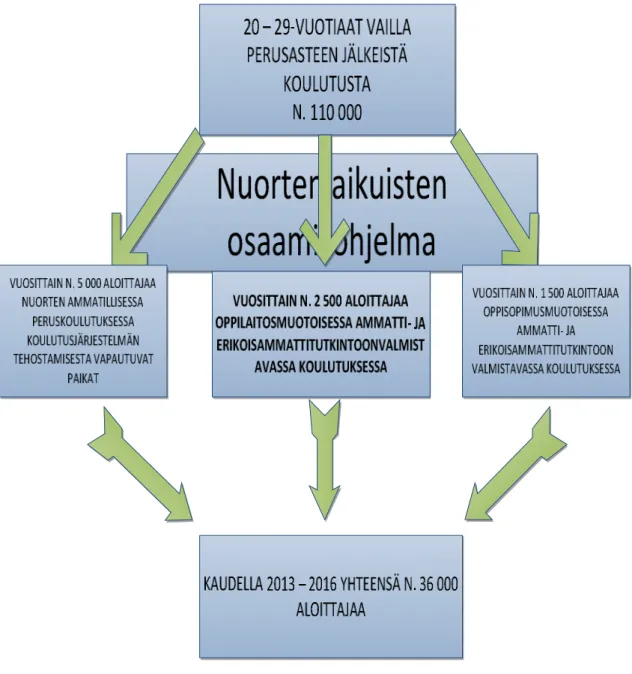
At present in Finland, there are approximately 110,000 young people aged 20–29 who do not have a post-basic qualification. The lack of a secondary education qualification is the single most significant factor behind exclusion from the labour market and society. The number of socially excluded young people without an upper secondary education qualification is approximately 40,000. Of these, the number of “lost ones” missing from the statistics is around 25,000. These young people form the so-called “hard core” of marginalised young people, because they do not participate in education or working life, and are not even registered as jobseekers.
Despite the effectiveness and quality of our country’s education system, not all young people’s welfare is at an adequate level. There is a number of health and mental problems that hinder the transition to further education and working life. The growth and development of young people is important to the national economy, but so is the prevention of social exclusion. The social exclusion of young people costs society hundreds of millions of euros per year.
Large-scale challenges, for which this report aims to offer solutions, include insufficient social and healthcare service provision; not enough study places; mismatch issues within the education system; insufficient support for student welfare, student guidance counselling and career planning services; and deficiencies in the determination of authorities' responsibilities. The main focus of the enforcement of the social guarantee must be on preventive measures. The full-scale realisation of the social guarantee stems from the idea of representing services in as clear and unified a form as possible in the eyes of young people. The Finnish Government has allocated 60 million euros in annual appropriations to the enforcement of the social guarantee. The first report of the working group will present solutions for targeting the appropriations as well as other proposals for realising the social guarantee. Using the proposed solutions, the enforcement of the youth guarantee can begin in 2013.
The 60 million euro appropriation allocated to the social guarantee is not adequate for solving all the challenges related to the education, employment and participation of young people. Therefore, the working group suggests in this report that the skills programme for young adults be included as part of the social guarantee. The programme would enable offering vocational education to young people aged 20 to 29 who have no training. In addition to the present investments, the situation calls for structural solutions and a willingness to invest in young people in the long run.
The working group has identified society’s large-scale problems related to the education, employment and participation of young people. As a result, the last part of the report presents preliminary outlines for the further efforts of the working group that the group will prepare in connection with its future efforts. They comprise the prerequisites for developing the social guarantee into a holistic, comprehensive and effective operating model for providing all young people with access to education and working life. This development work requires a shared intent and spirit of voluntary work from the whole society. The collective responsibility adopted by authorities, businesses, organisations and young people is integral to the fully successful enforcement of the social guarantee. Finland's youth guarantee will be founded on the
Public-Private-People Partnership approach based on which young people themselves are active participants and make decisions regarding their own future.
Abstract
1. Prevention of social exclusion of young people a priority in the Government Programme Changes to society and the labour market have affected the capacities and opportunities of young people to act as active citizens. Rapid economic fluctuations, structural change of the Finnish economy, high competence requirements in the labour market, and intensifying competition have increased unemployment amongst young people and affected their commitment to work. At the same time, it has become even more important that all young people are provided with access to upper secondary education and complete some form of vocational qualification. Recently, progress has not been favourable for all young people. Ultimately, a proportion of young people only complete basic education and some of those people end up in a situation where establishing a stable career is very difficult.
As the size of the working-age population diminishes, the permanent commitment of young people to working life becomes more important than ever. In order to ensure the availability of workforce and sustainability of public finances, the employment rate needs to reach 72% by 2015, and climb even higher by the end of this decade. This is not feasible if a significant proportion of the younger generation becomes excluded from the education system and working life.
The inability to commit to work and education also causes social and psychological problems. Homelessness, mental health problems and substance misuse among young people are already serious social issues with long-term consequences. Dealing with these issues is hampered even further due to a significant proportion of young people having drifted away from all activities.
The social exclusion of young people has a human as well as an economic dimension. The human impact of social exclusion is difficult to verify in numbers. If the social malaise of individuals multiplies, it may cause a tendency toward social segregation, which in turn results in unwanted phenomena, such as substance misuse and increased criminal activity. The impact on Finland’s national economy is linked to both direct and indirect costs arising from social exclusion. The cost of a single person excluded from working life is estimated at approximately 750,000 euros over a period of 40 years – not counting other possible social benefits and costs arising from social exclusion, as well as lost tax income and added value from work input. At the level of the national economy, social exclusion of young people also has an impact on the availability of workforce and length of careers. It is probable that once the current economic low has passed, certain sectors will experience a lack of skilled workforce. Unfortunately, the situation will be made worse by the trend of social exclusion among young people. Completing an upper secondary education qualification or higher would have a significant impact on employees’ length of career.
Prime Minister Katainen’s Cabinet has highlighted the prevention of social exclusion of young people as one of its spearhead projects. The objective is to provide all young people with realistic opportunities to pursue and complete a post-basic qualification and find employment while paying attention to not allowing young people to become stuck in a period of non-activity for too long.
The Government Programme addresses the trend of social exclusion among young people by means of a youth guarantee:
1. Each young person under 25 and recently graduated people under 30 will be offered a job, on-the-job training, a study place, or a period in a workshop or rehabilitation within three months of becoming unemployed.
The definition of youth guarantee is supplemented and specified in the Government’s development plan ‘Education and Research 2011-2016’. The plan’s introduction of an educational guarantee defines the concept as follows:
2. Every school-leaver will be guaranteed a place in upper secondary school, in vocational education and training, in apprenticeship training, in a youth workshop, in rehabilitation, or by other means.
2. What are the numbers?
Assessing the number of young people who have become or are at risk of becoming socially excluded can be based on a range of starting points. In the first phase of its work, the working group has examined the social exclusion of young people from three points of view:
– young people who do not get a place of study in general or vocational upper secondary education or do not complete a qualification,
– young people who register as an unemployed jobseeker with a TE Office, and
– young people not currently involved in any activities or are otherwise in need of support.
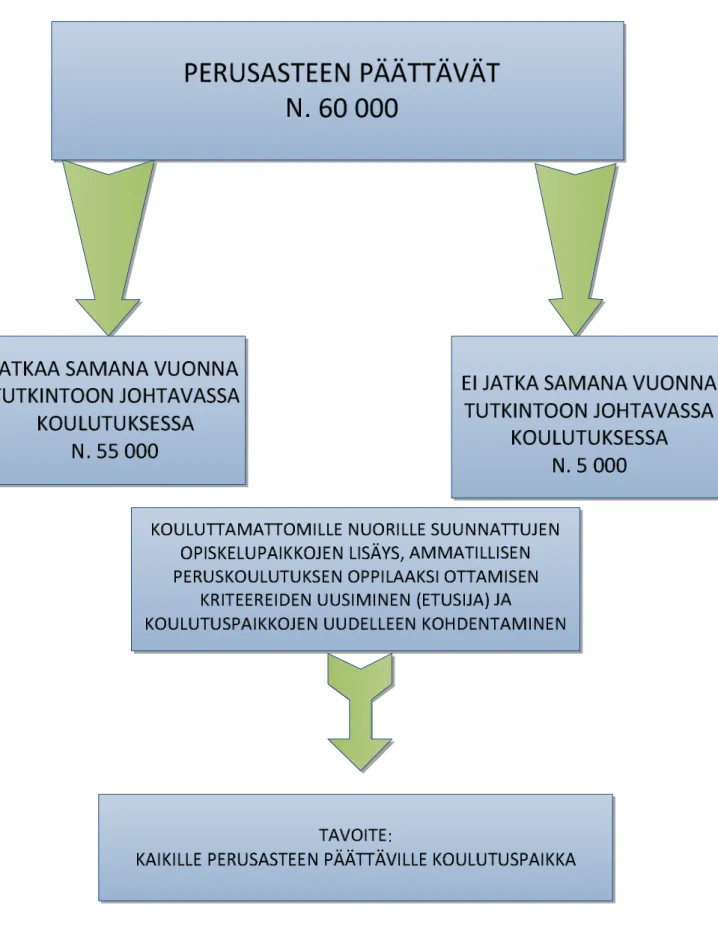
Every year, approximately 60,000 young people complete their basic education. Around 55,000 of them go straight on to pursue a qualification in upper secondary education. Some of the 5,000 comprehensive school graduates who do not apply for or are not admitted to education leading to a qualification choose to continue their studies, for example, in preparation courses for vocational education or in folk high schools. Every year, around 4-5,000 young people from each age group are left without a place in further education.
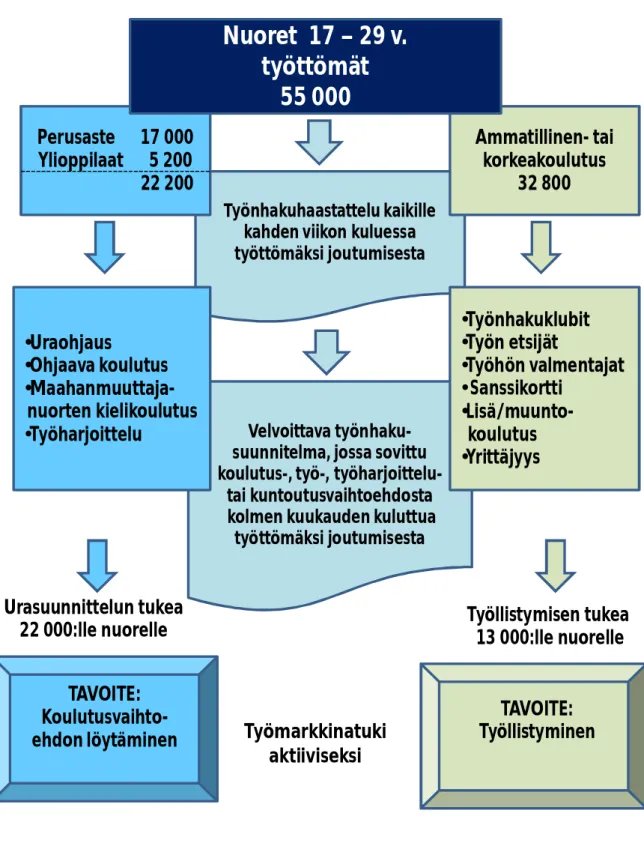
In December 2011, approximately 54,900 unemployed jobseekers under 30 were registered with TE Offices. An estimated 17,000 of them had completed only basic education, around 32,000 had a vocational qualification, and some 5,300 had completed the matriculation examination.
There are various estimates on the number of young people who lack further qualification after finishing comprehensive school and are not employed or pursuing any form of education. According to recent studies, the number of under 30-year-olds in this situation is approximately 40,000.
The target groups described above partially overlap. However, it was deemed appropriate to present the figures in such manner since they can be used as foundation in designing measures for various needs and purposes. The working group has made a breakdown of the sets of measures by target group. As a result, they are different for the unqualified, the unemployed, and the so-called lost ones. The division is technical; in reality, the supply chain is constructed in such a manner that modes of operation support one another. For instance, unqualified, unemployed young people are primarily signposted towards the sphere of the education system or other services that support their situation in life. In a similar fashion, the best possible solution to support the “lost” young people is sourced for each of them. The solution can be, for example, placement in a youth workshop. In this respect, the working group’s proposals form a robust whole.
However, the problem with the social exclusion of young people extends further than what is described above. A percentage of young people are left without a study place after completing their basic education, some 25% prematurely quit vocational education, and another 10% leave their general upper secondary education unfinished. As a result, 15% of each age group do not complete any form of upper secondary education qualification. Among young people aged 20-29, approximately 110,000 have completed only basic education; 70,000 of them are male.
The working group has divided its assignment into two phases: first priority is to ensure that the service network functions for new young people entering the sphere of the social guarantee. The aim is to create a system that provides all young people with realistic opportunities to find employment or a place of study, or
pursue other activities. These measures generate a situation where the number of young people who have become or are at risk of becoming socially excluded ceases to increase with new age groups.
The second priority involves looking after those 110,000 young people who have no upper secondary education qualification and are at risk of social exclusion. Supporting their route to a solid career is realised through increasing education so that by 2016 we have reached what might be termed a “normal state”, in which the service network for young people functions well, and any large-scale marginalisation of young adults has been prevented. However, this cannot be achieved with the 60 million euros reserved for the implementation of the youth guarantee.
The working group will carry out the proposals described in this report during the first phase of its work. After that, the working group will focus on other concerns related to the functionality of the service network for young people that touch on education, finding employment, and young people’s participation in society. This involves more than just the increase and reallocation of public resources; more wide-ranging commitment from society as a whole is required to improve the position of young people. In this context, the selection of methods is extended in cooperation with labour market organisations and actors in civil society. The objective is to start a positive spiral of mutually complementary public and private contributions. The working group will return to these themes at a later phase of its work. The first intermediate report will focus on the proposals drafted in view of the budget for 2013, and those legislative needs supporting them that require swift action.
3. Educational quarantee for young people who do not get a place of study in general or vocational upper secondary education or do not complete a qualification
The education system has certain deficits on account of which a proportion of young people do not complete a post-basic qualification. They include:
– not enough entry positions in vocational education in all regions so that each basic education graduate can go straight on to pursue an upper secondary education qualification
– on account of the student admission criteria for vocational education, a proportion of basic education graduates do not get selected
– apprenticeship training is not an adequate form of education for young people even though it has a positive impact on the employment rate in other respects.
The working group proposes the following:
Proposal 1. Provide more vocational education in regions with a sub-average ratio of vocational education in comparison with the number of young people. As of 2013, there will be 1,200 entrants, and the costs amount to 17 million euros to the state and 23.6 million euros to municipalities. Proposal 2. Amend the student admission criteria for initial vocational education to prioritise basic
education graduates without an upper secondary education qualification in the upper secondary education student selection process. The renewed criteria will be adopted in 2013. Proposal 3. Amend the criteria for determining the price of apprenticeship training directed at a partial
qualification for young people covered by the educational guarantee who have completed a basic education to the effect that the unit price is determined in line with the unit price of vocational education directed at a full qualification. The training compensation for employers of young people covered by the educational guarantee will be increased to 800 euros per month, while the student volume will be approximately 500. The total costs arising from higher training compensation are approximately 5 million euros.
Proposal 4. Support the improvement of young immigrants’ study and language skills by increasing related training in folk high schools and community colleges. Tuition fees will be compensated for through granting education vouchers. Costs: 2 million euros; the estimated number of students is 1,500.
In addition to proposals 1–4, the working group suggests that a separate appropriation is reserved for the enforcement of the social and educational guarantees, to be allocated to raising the competence level of undereducated young adults. The working group proposes the following:
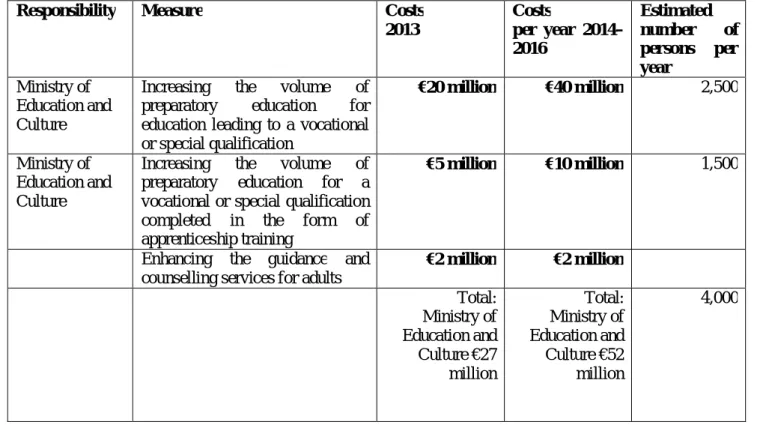
Proposal 5. Establish a skills programme for young adults for 2013–2016. Programme costs amount to 27 million euros in 2013, and 52 million euros per year in 2014–2016, distributed as follows: – Increasing the volume of preparatory training for education leading to a vocational or
special qualification by approximately 2,500 entrants: additional costs are 20 million euros in 2013 and 40 million euros per year in 2014–2016,
– Increasing the volume of preparatory training for a vocational or special qualification completed in the form of apprenticeship training by 1,500 entrants: additional costs are 5 million euros in 2013 and 10 million euros per year in 2014–2016,
– Enhancing the guidance and counselling services for adults: additional costs amount to 2 million euros per year.
The implementation of the programme cannot be covered by the 60 million euro appropriation reserved for the social guarantee. Therefore, additional sources of funding are required. Implemented in the form of further vocational education, the programme’s public costs would be completely covered by the state.
4. Young people who register as unemployed jobseekers with TE Offices
The working group has divided the client base formed by young unemployed jobseekers into two groups. The first group comprises young people without a vocational qualification. The objective for this group is to create a path that leads to vocational education.
The second group comprises young people who have completed a vocational qualification but require support in finding their place in working life. They are supported specifically through services and support that guide them and are aimed at finding employment in an employment relationship or by starting their own business.
The key issue for both groups is the efficiency and effectiveness of the service process of the TE Offices. The key service on which further measures are based is the employment plan drawn up by the jobseeker together with the TE Office staff. The plan must be drafted within two weeks of starting the job search. In compliance with current regulations, the jobseeker is obliged to participate in drawing up the plan as well as the employment services agreed upon and offered in the plan. The plan includes agreeing on the measures to be offered by TE Offices to young jobseekers, in line with the social guarantee, no later than within the first three months of uninterrupted unemployment.
Young people without a vocational qualification are supported in identifying their own career path and applying for education or training through the following measures proposed by the working group:
Proposal 10. Enhance the TE Offices’ vocational guidance and career planning services by increasing the personnel resources for the services by 60 person-years. Some of the additional resources are allocated to services for people with higher education degrees, immigrants and persons with reduced working capacity, as well as for online and telephone services. Costs: 4 million euros. Proposal 11. Centres for Economic Development, Transport and the Environment (ELY Centres) compile a
Proposal 12. Provide more guidance courses for young people who are pursuing their first career or who are considering a new career. Costs amount to 1 million euros, allocated to the organisation of 40 days of guidance courses for 780 young people.
Proposal 13. Provide more labour market training for young immigrants, including courses that help improve their study and language skills. Costs amount to 1 million euros, allocated to the organisation of six months of training for 260 young people.
Proposal 14. On-the-job training is to provide strong support for career planning. The maximum duration of an on-the-job training period at a workshop under one employer should be made more flexible. Recently graduated young people should not be primarily signposted to on-the-job training positions; instead, their entry into working life should be supported by means of pay-subsidies.
Proposal 20. Alleviate the obligation to apply for education or training as eligibility criteria for labour market subsidy. The alleviation should be conducted so that the obligation to apply for training in the spring remains unchanged, but the number of application changes is reduced from three to two. The obligation to apply for training in the autumn as eligibility criteria for labour market subsidy should be removed. The significance of the employment plan is to be emphasised. If the employment plan includes an agreement with the unemployed young jobseeker for the use of an alternative solution to training to promote his or her employment, neglecting to apply and/or participate in training must not result in the loss of his or her labour market subsidy.
As measures targeted at young people who have completed a vocational qualification, the working group proposes the following:
Proposal 15. Support in job seeking through short-term job search training. Costs amount to 2 million euros, allocated to the organisation of two-week job search training courses for 6,300 young people.
Proposal 16. Lower the threshold of employers to hire recently graduated young people with no previous work experience by making the Sanssi card permanent. Reduce the employers’ administrative burden arising from the use of pay subsidy. Costs amount to 9 million euros, allocated to providing a 6-month pay-subsidiced work period for 2,800 young people.
Proposal 17. Promote the entry into the labour market of young people through job coaching that supports both the young jobseeker and the employer. Job coaches advance the placement into working life of young people who have difficulties finding work on their own and need assistance in the workplace at the beginning of the employment relationship (for example, persons with disabilities or reduced working capacity). Costs: 2 million euros, allocated to providing job coaching services for 2,000 young people.
Proposal 18. More vocational labour market training for young people provided in the form of further and supplementary training, as well as licence training. Costs amount to 4 million euros, allocated for the organisation of three-month training periods for 1,460 young people.
Proposal 19. Support and develop new forms of advancing self-employment and entrepreneurship (cooperatives, teams, mentoring, etc.) through training, guidance and start-up grants. The amount of entrepreneurship training provided in place of labour market training is increased and the method for implementing entrepreneurship training is developed to meet the needs of young people. Costs amount to 5 million euros, allocated to provide six-month training periods or start-up grants for 1,300 young people.
5. Young people not currently involved in any activities or otherwise in need of support
The most challenging target group are young people who are not currently involved in any activities and are not registered as unemployed jobseekers at a TE Office. This group also comprises young people at risk of social exclusion due to illness or otherwise difficult situation in life. The position of these so-called lost ones is complicated by the unclear division of responsibilities in outreach work and in assisting young people to access services. Furthermore, the new law concerning the matter was adopted only recently. In addition, the current legislation in force does not enable the organisation of vocational rehabilitation for all young people who need it.
The working group proposes the following:
Proposal 6. Under new legislation, municipalities are made responsible for providing counselling for young people who complete their basic education. Further preparations will include specifying the content of the new legislation and estimating its cost impacts.
Proposal 7. Use of and access to information related to the transition phase following the completion of basic education is to be regulated by law. Legislative provisions determine in what role and through what means information related to applying for and starting further education is accessible to various authorities, the young person in question, and his or her parents/guardians.
Proposal 8. Youth services provided by the Centres for Economic Development, Transport and the Environment (ELY Centres) are responsible for the provision of regional training concerning the Youth Act amendment, as well as disseminating the best practices developed by guidance and service networks within their local area. Cohesion is necessary in providing informative guidance to municipalities and local authorities on young people’s participation in the guidance and service network.
Proposal 9. Outreach youth work is to be expanded to cover the whole country. The expansion of operations also takes account of the cooperation and integration of methods in line with the ‘Time Out!’ approach. The extent and quality of youth workshop activities is improved and cooperation with educational institutions is increased. Workshop services are enhanced through start-up training to facilitate the swift signposting towards services for young people who have been contacted via outreach youth work. Costs: 8 million euros
Proposal 21. Examine the possibility to specify the admission criteria for vocational rehabilitation provided by Kela, the Social Insurance Institution of Finland, so that vocational rehabilitation services can be granted on the basis of the young person’s life situation. This way, in addition to illness, account could be taken of other factors that impact on a young person’s life and their ability to work and study, such as a lack of social skills. The estimated additional costs, based on the current number of applicants, for young people aged 16–29 would be 0.4 million euros per year. Based on the current number of applicants, the change would cover approximately 360 young people.
6. Proposals for later discussion
This intermediate report includes proposals for the full-scale realisation of the youth guarantee, the budgetary impact of the proposals, and the legislative amendments required to implement them, effective from the beginning of 2013. In addition to the proposals discussed in the working group, the members have suggested several other proposals and initiatives for debate. However, their implementation is not covered by the 60 million euros reserved for the social guarantee or otherwise requires further examination. The working group will determine and present its position on them in connection with its further efforts. The additional proposals and initiatives are targeted at the following entities:
- Completion of education and transition phases
- Guidance and counselling services
- Guidance counselling, teaching support, and educational institutions’ student welfare services
- Increase in apprenticeship training and on-the-job learning
- Financial incentives for young people to pursue a qualification and participate in active measures
- Rehabilitation and employment services
Part I
The situation of young people entering working life
Part 1 of the report examines the transition phases along the path to further education and working life as well as the related challenges and objectives. It also presents calculations on the costs incurred by society due to the social exclusion of young people. In addition, the voices and ideas of young people themselves are heard. This part of the report serves as background information to the descriptions of the existing offering of services and the working group’s proposals for measures introduced in the latter parts of the report.
1. The situation of young people in light of statistics and research
1.1 The first major transition phases of young people
Finnish society includes many factors that support and protect young people’s growth and first steps towards independent living. The primary influence of home in supporting young people is undeniable. However, young people’s own role as a citizen, a member of a municipality and society, and as an independent actor becomes stronger with the increase of rights, obligations and responsibilities. As young people learn various skills, gain new capabilities and experience success at school, in leisure time activities, at work or while interacting with friends, it helps them cope with whatever situations they may face in life.
The majority of young people are capable of making decisions about work and education independently or through actively seeking assistance. However, some young people need more targeted support and services so that their chances of full participation in society do not diminish significantly. The possible reasons underlying young people’s need for support include, for example, the lack of cooperation between society’s service processes and services, the young people themselves, or deprivation across generations.
For most young people, the transition phase following basic education runs smoothly, and they continue their studies in upper secondary education to complete a qualification in an initial vocational education institute or upper secondary school. However, despite this, approximately 5,000 young people of those 64,000 who completed their basic education in 2010 were left without a place of study leading to a qualification in upper secondary education. Of those young people, some 3,500 will not get a place of study via the joint application system, and the remaining 1,500 will not apply for education or training at all. Furthermore, on estimate, 4,700 young people drop out of general upper secondary school and 12,000 leave their initial vocational education unfinished every year.
There were 32,700 new upper secondary school graduates in the spring of 2010. Of these, 18% went on to university and 17% to a university of applied sciences in the following autumn, while 4% of the graduates started in upper secondary vocational education. In total, 60% of upper secondary school graduates of 2010 did not continue their studies that same year, although 77% of new upper secondary school graduates applied for further education1.
The completion rate of education has improved in all vocationally-oriented education courses targeted at young people. In initial vocational education, the completion rate is 71.3%, in universities of applied science 67.8%, and in higher education institutes, the rate is 70.3%.
Not applying for education, exclusion from the joint application system and dropping out of school result in approximately 110,000 young adults aged 20–29 not having a post-basic qualification. Of these, 40,000 1 Source: Statistics Finland
are female and 70,000 are male. Furthermore, approximately 60,000 young people aged 20–24, and more than 50,000 25 to 29-year-olds are without an upper secondary education qualification.
The Finnish Government aims to have more than 90% of 20–24 year-olds complete a post-basic qualification by the end of this decade. At present, the most challenging target group is young men. Among women under 25, the share of those without a post-basic qualification is less than 14%, while the corresponding share of men is greater than 20%.
1.2 Young people in working life
The majority of young people are engaged in studies. Therefore, the employment rate of young people is low in comparison to the employment rate of adults. The employment rate of people aged 15–64 was 68.6% in 2011. That same year, the average employment rate of young people aged 15–24 was 39.1%. The employment rate of young women was 41.2%, and that of men, 37.2%.2
Young people in Finland enter working life relatively late. The median age of people graduating from universities of applied science (education of young people) is 25.1, and the median age of people who complete a higher education degree is 27.3. The Finnish Government aims to lower the median age of people graduating from studies targeted at young people at universities of applied science down to 24.1 years, and the median age of higher education graduates down to 26.33. The prerequisite for realising the Finnish Government’s target employment rate of 72% is that career extension also occurs in the early stages of one’s career.
All forms of initial vocational education at the upper secondary level and lower degree studies in higher education include a compulsory period of on-the-job learning or on-the-job training to improve one’s professional skills. Completing a university degree may involve participating in compulsory or voluntary training. In addition, 55% of students worked alongside their studies. Working alongside studying is most common amongst university students; 60% of university students are engaged in an employment relationship whilst completing their higher education degree. Working alongside studying increases with age: as many as 70% of over 25-year-olds worked alongside their studies4. Young people also gain work experience that supports their future career choices through summer jobs.
Approximately 16% of wage earners work in a fixed-term employment relationship. In 2010, the number of new employment contracts totalled 393,000, of which 56% were concluded for a fixed term. Fixed-term employment may be a desired solution or against the wishes of the wage earner. About one-fourth of wage earners working in a fixed-term employment relationship did not want a permanent position; mostly young people aged 15 to 24. Summer employees are a typical group of people who voluntarily conclude their employment contract for a fixed term.
Temporary agency work is on the rise. However, in 2011, the number of temporary agency workers only totalled 29,000, which is 1% of the entire workforce. Fewer than 5% of under 25-year-old wage earners were hired as temporary agency workers. Temporary agency work is most common in the wholesale and retail business, the accommodation and catering business, and in industry.
According to the Working Life Barometer, young people give higher marks to the quality of their working life than people in older age groups. In the opinion of young people, the most clear improvement can be seen in the equality of treatment and personal encouragement, as well as in the overall quality of working life. The marks given to these attributes have not changed from previous results amongst other age groups. According to the responses of young people, similar improvements did not occur with regard to job security and resources5.
2Source: Statistics Finland, Labour Force Survey
3 Education and Research 2011-2016. A development plan. 4 Source: Statistics Finland
Young people as entrepreneurs
The average age of entrepreneurs in Finland is relatively high; approximately 30% of Finnish entrepreneurs are 55 or older. The share of Finnish entrepreneurs aged 35 or under is relatively low, only 19% of all entrepreneurs. In 2008, the number of entrepreneurs aged 25 or under was 4,000, and there were fewer than 10,000 entrepreneurs aged 25 to 296.
The percentage of young entrepreneurs within their age group is low: the share of young people aged 25 and under varies between 0.1% and 1.8%, while the share of 25 to 29 year-olds varies between 2.1% and 3.7%. The share of entrepreneurs increases steadily by age group. It is the highest among 45–47 year-olds; the share of entrepreneurs within this age group is 9.1%.
1.3 Youth unemployment
The youth unemployment rate began to climb as the result of the recession in the autumn of 2008. In 2009, the number of unemployed jobseekers under 25 years of age grew by a massive 56% from the previous year. In June 2010, however, the trend took a downturn. In that year, the number of young unemployed people reduced slightly compared to the previous year. The number continued to decrease in 2011. At the end of December, unemployed jobseekers under 25 years of age numbered 31,600, representing a decrease of 1,900 from the previous December. However, the youth unemployment rate still remains at a clearly higher level than before the recession, when the number of unemployed young people averaged some 21,000 per month.
Table 1. New job seeking periods of under 25-year-olds; share of job seeking periods commenced during unemployment (excluding laid-off people); and the average number of young unemployed people per month in 2008–20117
Year New job seeking
periods/ all young people
Share of job seeking periods commenced during unemployment Average number of young unemployed people per month 2008 160,617 104,644 21,704 2009 187,912 125,263 33,753 2010 176,810 121,640 33,256 2011 173,463 122,901 29,235
Among the total number of new job seeking periods (of unemployed people), the share of under 25-year-olds was 16% in 2011.
In 2011, the youth unemployment rate was 19.8%. Compared to the rest of the EU for that year, Finland is close to the average unemployment rate of 21.1%. In the Labour Force Survey of Statistics Finland, the term ‘unemployed person’ refers to someone who has been actively looking for a job for the past four weeks and could start a new job within two weeks, but is not employed. For this reason, and especially in the spring, the unemployment statistics of the Labour Force Survey mainly comprise young people engaged in studies who are applying for a summer job. Approximately every one young person in ten is unemployed.
Approximately one-third of all young unemployed jobseekers have only completed basic education. In the long run, the competence requirements of working life have changed to the effect that whereas in 1987 nearly 40% of employed people lacked vocational training, in 2010, the amount of employed people without
6 Register of Enterprises and Establishments, Statistics Finland
training was just 17%8. As the structural change in business life progresses and the productivity of work increases, new job requirements include more and more competencies. At the same time, less productive jobs that do not require vocational training are disappearing. The share of basic education graduates from the total number of unemployed people is double the share of basic education graduates from the total number of employed people.
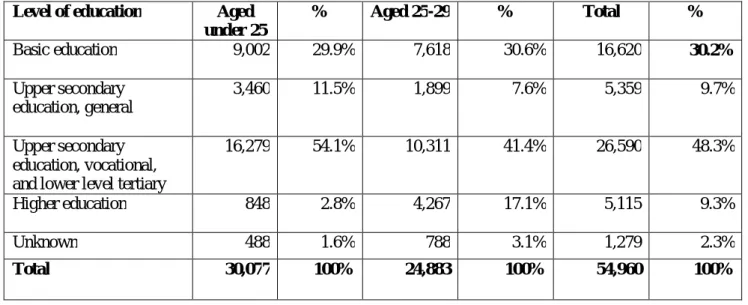
Table 2. Young unemployed people in December 2011 by base level of education Level of education Aged
under 25 % Aged 25-29 % Total % Basic education 9,002 29.9% 7,618 30.6% 16,620 30.2% Upper secondary education, general 3,460 11.5% 1,899 7.6% 5,359 9.7% Upper secondary education, vocational, and lower level tertiary
16,279 54.1% 10,311 41.4% 26,590 48.3%
Higher education 848 2.8% 4,267 17.1% 5,115 9.3%
Unknown 488 1.6% 788 3.1% 1,279 2.3%
Total 30,077 100% 24,883 100% 54,960 100%
In December 2011, young unemployed people aged 25 to 29 numbered 24,883, of whom 2,180 had graduated recently (within the last 12 months).
The third sector as an employer of young people
Important places for participating in activities of membership organisations are provided to young people by sports clubs, student associations, youth organisations, cultural organisations, organisations for providing leisure time activities, human rights organisations, environmental conservation organisations, trade unions, labour market organisations, multicultural associations, cultural heritage associations and political parties. Activities of membership organisations are provided at the local, regional and national level. One of the key actors is the nationwide Finnish Youth Co-operation Association, Allianssi ry.
A youth employment project for finding employment for young people in sports clubs, youth and cultural organisations and other organisations within those sectors was launched in 2010 and financed by National Lottery funds. The funds allocated for the project totalled 11.5 million euros. Roughly 2,100 young people and nearly 1,000 employers took part in the project. The length of employment relationships varied from one month to one year. In workplaces within the youth and sports sectors, 40% of young people worked for a longer period than what was originally agreed in their employment contract. In the cultural sector, more than 50% of employers continued to employ the young worker after the fixed-term employment contract ended. Within each of the sectors, some young people gained a permanent position. In the sports sector, for example, more than a quarter of all young people hired for a job continued in that job on a full-time basis after their fixed-term contract had ended9.
8 Pekka Myrskylä, Unempoyment during the recession period (2010)
9 ‘Sport provides work’ project report, and ‘Employing young people’ final report, Finnish Youth Co-operation Association
The church employs approximately 4,600 people in educational sector jobs or positions. Of these, 1,272 are youth workers. The educational sector offers roles such as child counsellor, child work coordinator and church youth work coordinator. In addition, this group includes those pastors and cantors who are mainly employed within the educational sector, for example, as youth pastors or church musicians working with young people10. According to the financial statement data of Finnish parishes, the Church’s child and youth work expenditure totalled 332 million euros in 2010.
1.4 Welfare problems underlying the social exclusion of young people
According to the Soterko research project description (Soterko is a research consortium of the administrative branch of the Ministry of Social Affairs and Health), problems in the early stages of one’s career arise from prolonged studies, challenges related to the transition to further education, taking a year off from studies or work, the low quality of employment relationships, the reconciliation of work and family life, and returning to work after family leave. Factors such as short-term employment relationships of low quality that do not correspond to one’s level of training or skills, periods of unemployment and insufficient familiarisation deteriorate young people's self-esteem and life management skills, as well as hinder their socialisation into working life. Young people feel they do not have enough information on working life on which to base their decisions (youth survey conducted in autumn 2011), and their view of working life may frighten them11. The 1987 Finnish Birth Cohort is a study commissioned by the National Institute of Health and Welfare (THL)12. It observed all 60,000 children born in Finland in 1987, starting from their prenatal period up to the end of 2008. Based on the outcome of the study, welfare problems have a tendency to accumulate, and parents’ problems are closely connected to the future well-being and mental health problems of children. Among those taking part in the study, 40% have mental health problems, and one in five received psychiatric specialised healthcare or medication for mental health problems before the age of 21. Approximately 18% of this age group has not completed any qualification or degree after completing comprehensive school. At some point, 23% of the children born in 1987 have had to resort to social assistance, while 26% have records of minor violations or convictions. In total, 3% of the children in this age group were taken into care or placed outside the home. Children in this age group grew up during the 1990s recession when a substantial share of Finnish families had to face unemployment and financial difficulties. Reductions were made to basic child and family services and preventive work. Municipalities’ preventive work and work that supports well-being have not yet been elevated back to their pre-recession level. As a result, the spending on corrective services keeps on growing.
Child welfare service clients, children of single-parent families and children of parents with mental health problems as well as immigrants are examples of the most vulnerable groups with regards to coping in adulthood (the Soterko strategy). Those who are in a particularly weak position are people without training, people with illnesses and disabilities, those who are difficult to employ and the long-term unemployed as well as adolescents and young adults with mental health problems.
Every day in Finland, five young people retire on a disability pension on account of mental health problems13. The key issue is the way in which pupil welfare services and youth health services can help to reduce the socioeconomic health gap that emerges at a young age and manifests later in life as early retirement, for example. Rehabilitation services are also an effective method of preventing young people with mental health problems from progressing to disability pension.
In 2011, the average number of TE Offices’ unemployed jobseekers under 25 years of age was 29,233 per month. Of those, 1,521 were young people with reduced working capacity. The share of young people with
10 2010 statistics of the Commission for Church Employers 11 2009 survey of the Economic Information Office
12 Reija Paananen, the National Institute of Health and Welfare (THL) 13 Kela 2011
reduced working capacity from unemployed young people under 25 was 5.1%. The most common diagnosis for reduced working capacity among young jobseekers was mental health disorders (58.4%).
1.5 Young people who are not employed or pursuing any form of education
According to a survey conducted by Myrskylä, there are approximately 40,000 under 29-year-olds who have only completed basic education amongst those not employed or pursuing any form of education14. Of these, some 15,000 are registered as a jobseeker with a TE Office – the rest are not.
Even today, parents’ low educational level and social deprivation is commonly passed down to their children. A survey of young people engaged in workshop activities15 showed that 70% of young people who participated in youth workshop activities had parents who had become unemployed within the past two years. The background of young people not involved in education, employment or training reveals an unemployed parent twice as often in comparison to the average amount, while the corresponding number for young people engaged in workshop activities is three to four times the average.
The risk of social exclusion for immigrants is four to six times higher than that of the original population. Nearly one in four socially excluded young people has an immigrant background. The risk of marginalisation is also increased by the housing arrangements of young people, because one in ten socially excluded young people are homeless.16
Poor educational attainment is the most important factor explaining youth unemployment and the social exclusion of young people. Various surveys indicate that the motivation to study declines rapidly with age. More than 80% of over 25-year-olds who end up marginalised or unemployed never complete a qualification higher than basic education. Studying is worthwhile, because amongst the young people observed in the survey, more than 60% of those who had completed their qualification were employed. Not having an education has far-reaching consequences on the quality and length of young people’s future careers. In 2010, the unemployment rate of people with a basic education only was 20%, while the rate for people with upper secondary education was 12% and approximately 5% for higher education graduates. For instance, completing an upper secondary education qualification increases the working life expectancy of men by six years, and by nine years for women17.
Jari-Erik Nurmi (2011) raises additional social and individual reasons behind marginalisation, such as parents’ low level of education, single parenthood, the young person’s weak school performance and various learning difficulties. According to Nurmi, one underlying factor of social exclusion may be a self-fulfilling vicious cycle generated by negative thinking, lack of motivation and poor school performance. As examples of possible preventive measures against social exclusion, Nurmi highlights boosting young people’s self-esteem and positive thinking as well as helping them learn social skills, draft study plans and make decisions about career goals.
Young men exempted from military and non-military service are also at risk of social exclusion. In comparison to young men assigned for military and non-military service, there are more occurrences of psychological and social problems, substance abuse, financial problems, unemployment and various psychological symptoms amongst those excluded18.
14 Pekka Myrskylä, Young people outside the labour market and studies 15 Ismo Pohjantammi, 2006
16 Myrskylä 2012, Lost – EVA analysis on the social exclusion of young people 17 Myrskylä 2012
18 Appelqvist-Schmidlechner, Kaija. Time Out! Getting life on track. A psychosocial programme targeted at young men exempted from compulsory military or civil service. Acta Universitatis Tamperensis 1653. Tampere. Tampere University Press, 2011.
Discrimination in recruitment, working life and education
Another underlying factor in the social exclusion of young people and youth unemployment may be discrimination. Especially immigrants, the Roma people and members of other minority groups as well as young people with disabilities are faced with prejudice, racism and discrimination. The Non-Discrimination Act (21/2004) prohibits discrimination in recruitment to work and admission to education, for example, based on a person’s age, ethnic or native origin, nationality, language, religion, conviction, opinions, state of health, disability, sexual orientation or any other comparable, personal reason.
Nevertheless, discrimination occurs. Approximately 5% of young women aged 16 to 24, and 1–2% of men that age have experienced discrimination in connection with recruitment19. There is an over-representation of young women in fixed-term employment relationships, which places them in a weaker position in the labour market. In total, 38% of women and 29% of men aged 15 to 24 are in a fixed-term employment relationship. 20
Part-time and temporary employees experience the most discrimination in working life21.
Finding employment is often especially difficult for members of minority groups such as immigrants, the Roma or others, as well as for young people with disabilities. According to various studies, approximately 35–65% of people with a foreign background believe that their ethnic origin has made finding employment more difficult for them22. Somalis, Sub-Saharan Africans and Arabs are particularly faced with discrimination in connection with the recruitment process as well as in working life in general23.
During the review period from 1996 to 2006, 15.4% of first generation immigrants who have come to Finland from outside the EU countries did not apply for, were left without a place of study in, or dropped out of upper secondary education at an early stage. The corresponding proportion from the original population was 3.5%. During the 11-year follow-up period, there has been no improvement in the percentage of people left outside of education24.
The most challenging group regarding education are young immigrants who come to live in Finland at a later stage of their basic education. Their situation requires special attention, because they are not able to reach the knowledge and skills level required in upper secondary education in such a short period of time. This especially applies to those young people who have attended school very little or not at all in their home country or country of departure.
The entry into working life of people with disabilities or long-term illnesses may be hindered by the negative attitudes and prejudices of employers. In 2008, 8% of women and 5% of men among people with disabilities or long-term illnesses have experienced discrimination during the recruitment process25. In the opinion of more than half of all employers, employing a person with a mental disability could have a negative impact on the company's image or the work community26.
1.6 Costs arising from the social exclusion of young people
The costs arising from the social exclusion of young people can be analysed using a timeline, where the starting point is the moment they drop out of school without continuing their studies elsewhere or moving on
19 Lehto & Sutela, 2008; Statistics Finland, 2008; Larja et al., forthcoming 20 Lehto & Sutela, 2008
21 Ylöstalo and Jukka, 2011
22 Jaakkola, 2000; Jasinskaja-Lahti et al., 2002; Pohjanpää et al., 2003
23 Jasinskaja-Lahti et al., 2002; Pohjanpää et al., 2003; Sutela, 2005; Vartia & Bergbom, 2007
24 Finnish National Board of Education, Immigrant students and education – study on learning results, education choices and employment, 2008
25 Statistics Finland, 2008; Sundbäck et al., 2012 26 Ala-Kauhaluoma & Härkäpää, 2006
to working life. From the viewpoint of society, this type of characterisation is justified on the basis of the costs of education being a form of society’s investment on the future.
If dropping out has a positive outcome; i.e. the person transitions to another form of education or into working life, no significant additional costs are necessarily incurred by society. In fact, in the case of transitioning into working life, society makes a profit. If the outcome of dropping out is that the young person’s livelihood consists of income transfers, society’s investment in the education of said young person turns into a non-productive investment.
The following calculation has been conducted to evaluate the costs of social exclusion incurred by society. The hypothesis is that the young person’s income consists of labour market subsidy and housing allowance. In 2010, the amount of labour market subsidy was 25.64 euros per day (paid for five days a week), and the average housing allowance was 258.90 euros per month.
Appendix 2 describes one way of evaluating the costs of social exclusion based on the above method while taking account of the amounts of labour market subsidy and housing allowance paid to the young person per month and per year. Multiplying the calculated costs by the number of young people without a post-basic qualification given in Myrskylä’s survey, for example, produces the following estimate:
The cost arising from 40,000 socially excluded young people is approximately 300 million euros per year.
According to a report by the National Audit Office of Finland27, the loss to national income arising from one socially excluded person is approximately 700,000 euros (at 2007 prices), if the social exclusion extends throughout the person’s expected working age, totalling some 40 years. The corresponding loss to public finances would amount to approximately 430,000 euros.
The costs arising from young people’s incapacity for work are accumulated from the loss of work input and payment of treatment expenses and benefits. When a 30-year-old retires due to incapacity for work, the value of lost work input is more than 1.5 million euros. The loss arising from the nearly 4,000 people aged 16 to 34 who retired due to incapacity for work in 2008 totalled 6.6 billion euros. The reference point for the calculations is a career that continues until the person reaches 65. On top of the loss of work input, treatment expenses totalled 2.5 billion euros.
The most common reason for early retirement in 2008 amongst people aged 16 to 35 was depression or some other mental health problem. The loss of work input due to a mental disorder accounted for 4.7 billion euros from the abovementioned 6.6 billion euros.28
2. Consulting young people and various actors
2.1 The voice of young people
Background support for the youth guarantee working group was provided by a group that was led by the Finnish Youth Co-operation Association and comprised a wide range of young active forces. The working group also organised a public consultation with young active forces and entrepreneurs. The online
27 National Audit Office of Finland, 146/2007
consultation “Giving young people a voice”, commissioned by the working group, prompted responses from 6,336 young people between 19 October and 7 November 2011.
Most specifically, the questions focused on the support received and required by young people in their transition from one form of education to the next or into working life. The responses indicate that young people feel they are left alone to make their decisions. Some support was available on the Internet and from close ones, but not a lot at school or the TE Office. In the future, young people hoped they would be supported more, especially by TE Office staff and employers. They would also like to have access to more guidance and counselling services in addition to “clear” yet truthful information on working life.
“Information on various professions; an opportunity to find out what work is like in practice; what are my employment options based on my educational attainment; what type of work would I be most suited to; the opportunity to do a work trial at a workplace; and, thinking about what type of work I actually want to do.”
Less than one-third of all young people excluded from the education system and working life felt there were obstacles hindering them from commencing education (such as securing a livelihood during studies, various health-related issues, difficulties related to the theoretical side of studies and the difficulty in gaining admission to study the subject of their choice). Instead of full-time studying in an educational institution, these young people wished they could acquire a professional qualification through more practical means, and for that, around half of them chose apprenticeship training.
“In general, get more apprenticeship training agreements and strengthen them significantly. You could establish a department or something for phoning employers and asking them if they would hire people to do work under an apprenticeship training agreement, because apprenticeship training is literally a golden opportunity. A job for gaining work experience during your studies. And, well, of course, for completing an education. Apprenticeship training is the best way to study I know of…. Of course being in school is more effective, but I should think that if you are given the opportunity, you should take a job you get paid for, and because it is your place of study, you work with a smile on your face. In a nutshell. Please, get lots of new apprenticeship training places, and advertise them on the apprenticeship training web pages. And create a direct link to those pages from the TE Office web site www.mol.fi. Apprenticeship training is an awesome thing that does not get enough attention. We need it…”
There seemed to be even more obstacles hindering the entry into working life or on-the-job training, the main ones being the lack of job opportunities, various health issues and uncertainty about coping.
“The employment situation is very poor, because there just aren’t any vacancies. I haven’t found employment in the past year, even though I have completed two vocational qualifications and the matriculation examination, and I also have some work experience. For reasons beyond my control (I mean, the poor employment situation), I have to work for free (under preparatory training for working life), which definitely does not boost my motivation but only makes the money tighter because nine euros per day just doesn’t cover the expenses of travelling 40 km to work and buying meals during the work day. Real jobs for young people with previous work experience instead of slave labour for a pittance!!
Young people registered as jobseekers felt they had been heard in connection with drafting their employment plan with the TE Office staff. However, they did not have much faith in the benefits of the plan in reaching their goals. In addition, they did not believe that the measures agreed in the plan would do much to improve their chances of finding employment. The general opinion was that independent job seeking improved the chances of finding employment a little, while on-the-job training and preparatory training for working life got the second-most favourable reviews in that respect.
“In my opinion, the TE Office could pay more attention to individuals, or consider people's employment problems on an individual basis instead of acting according to what was written down
on a piece of paper at one time. I think it would be very nice if I, for example, would be understood so that my benefits would not be removed from me if I don't use the joint application system to apply for education in schools that do not correspond to my career aspirations in any way. I feel frustrated, and the whole situation is distressing. I would like to see a more people-centric approach. If I do not apply for something, I assure you, I have a good reason for not doing so. These regulations could use some rethinking. I have strong plans for the future and I intend to stick to them no matter what. Lastly, I would like to say that the system for providing on-the-job training/pay-subsidised work functions well, and has saved me from becoming socially excluded. Thank you for that."
Nearly half of the respondents said they had considered entrepreneurship as an employment option. Young people’s strongest encouragement to pursue entrepreneurship came from their parents and teachers as well as the stories of famous young entrepreneurs. Young people estimated that the role of enterprise service providers and TE Offices in the promotion of entrepreneurship would increase in the future. The respondents felt they had not been supported in their efforts of starting their own business by the TE Office, and therefore were expecting the role of TE Offices to be strengthened in that respect in the future.
Young people were asked about their reasons for not considering entrepreneurship. The main reasons included not being interested in becoming an entrepreneur, not having a business idea, feeling that the risks were too high, and being scared of the responsibility. Other reasons that were mentioned included the lack of seed capital, too much hard work, the lack of professional skills and too much bureaucracy. Approximately 17% of the respondents said they had not received information about entrepreneurship.
“I hope to do versatile work, something that provides challenges too. The scariest thing about entrepreneurship is bearing all the responsibilities alone. I feel I want to keep work as work, and not make it a way of living, as I have seen happen to some entrepreneurs.”
At the end of the questionnaire, the respondents were asked to reveal any hopes or fears they had regarding their future career. The range of responses was wide, from a few words to long descriptions of the current situation and expectations for the future. The responses were tinged with positive and negative anticipation.
“I believe that an industrious person will find work. So far, I have acquired work experience from different types of jobs. If a vacancy doesn't present itself in my own field of expertise, I will find something in another line of work. Of course the current economic situation in Finland and around the world makes you wonder. I still trust that come what may, I can pull through. If I were to become unemployed, I would use my time doing something useful, such as voluntary work. I wouldn’t sit at home doing nothing. There is no work that I could imagine myself doing for the rest of my life. On the contrary, I want to gain work experience from many fields and do a bit of everything.”
Since the responses to the last question may have the same answer expressed in different ways (“I hope to get a permanent position/I don’t believe I will ever get a permanent position”), and only half of the respondents gave an answer, what is more important than the content analysis of the responses is the message that they convey – “the voice of the young people". Many responses describe a completely different world from the one that the adults making the decisions today were faced with in their youth: following a “normative life cycle” from education to work, independent living and possibly starting a family is not as self-evident anymore. These days, some young people feel they have to compete for their favoured place of study and, when on the verge of graduating, they need to consider what type of work their qualifications are leading them towards and whether they have acquired enough competence. They are also required to desperately obtain work experience and fiercely battle for jobs in their own field of expertise, while the outcome may be that they remain for years in a completely irrelevant fixed-term position. That is, if they succeed in getting a job in the first place. Far too many of the respondents did not trust that they would find work that is interesting and meaningful, and would provide them with a sufficient income. If such fundamental building blocks are missing, young people do not know how to proceed in constructing their own life. For many, the “golden years of youth” are spent in a battle to survive: