Idaho
School
Distracted
Driving
Program
Table
of
Contents
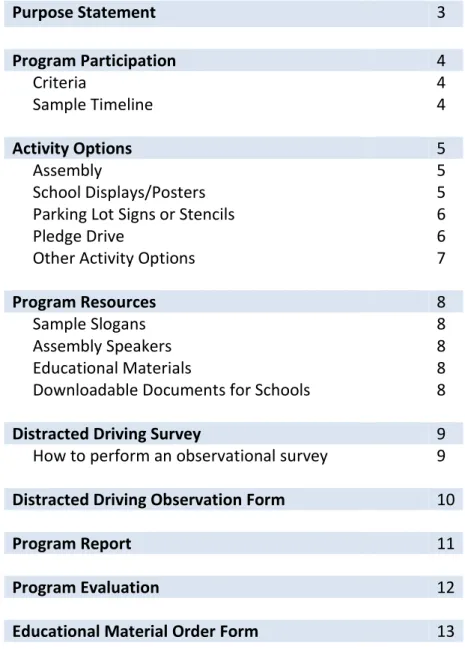
Purpose Statement 3 Program Participation 4 Criteria 4 Sample Timeline 4 Activity Options 5 Assembly 5 School Displays/Posters 5
Parking Lot Signs or Stencils 6
Pledge Drive 6
Other Activity Options 7
Program Resources 8
Sample Slogans 8
Assembly Speakers 8
Educational Materials 8
Downloadable Documents for Schools 8
Distracted Driving Survey 9
How to perform an observational survey 9
Distracted Driving Observation Form 10
Program Report 11
Program Evaluation 12
Educational Material Order Form 13
Idaho Transportation Department Office of Highway Safety Distracted Driving Program Coordinator – Lisa Losness
P.O. Box 7129, Boise ID 83707‐1129 Phone: (208) 334‐8103 ‐ ‐ Fax: (208) 334‐4430
Purpose
Statement
The Idaho Transportation Department, Office of Highway Safety (OHS) is committed to the
reduction of deaths and serious injuries on Idaho’s roads. To make progress toward the goal of
“Toward Zero Deaths” the Idaho School Distracted Driving Program was developed. The intention
is to raise awareness among Idaho’s teen population and to encourage all teens to “Put it Down”
while driving.
Traffic crashes are the number one cause of death and serious injury for youth in Idaho. In 2009,
youthful drivers (drivers ages 15‐19) were involved in 2.6 times as many crashes as you would
expect to be and were 2.9 times as likely as all other drivers to be involved in a crash. Many of the
youthful crashes were as a result of distracted driving.
• Distracted driving contributed to 1 out of every 5 crashes.
• Distracted driving contributed to 32% of the economic costs of crashes. • 82% of the fatal distracted driving crashes occurred in rural areas. • 62% of the fatal distracted driving crashes involved a single vehicle.
Distraction is defined by the National Highway Traffic Safety Administration (NHTSA) as a specific
type of inattention that occurs when drivers divert their attention away from the task of driving to
focus on another activity instead. These distractions can be electronic distractions, such as
navigation systems and cell phones, or more conventional distractions, such as interacting with
passengers and eating. These distracting tasks can affect drivers in different ways and are
categorized into the following three types: • Visual ‐ taking your eyes off the road;
• Manual ‐ taking your hands off the wheel; and • Cognitive ‐ taking your mind off the road.
Research conducted by the Virginia Tech Transportation
Institute (VTTI) in 2006 reported that, “Nearly 80% of
crashes and 65% of near‐crashes involved some form of
driver inattention within three seconds before the event.
The primary cause of driver inattention in this major study
included such distracting activities as cell phone use and
factors that significantly increase risk such as reaching
for a moving object (a 9 times greater risk) and drowsiness (4 times greater).” Distracted driving
caused by the use of a cell phone or any other electronic device to make a phone call, text a
message, read email messages, manipulate music files or search for direction information is an
ever growing concern.
The Idaho School Distracted Driving program will provide schools with the tools and resources to implement the program. It is designed to be used by the school administration, the student government, a club, a class, as a senior project or even a newly formed committee.
Program
Participation
Criteria
• Conduct a pre and post distracted driving survey.
• Conduct distracted driving activities in the school or community during National Distracted
Driving Month (April) or other timeline as established by the school officials.
• Complete and submit the Idaho School Distracted Driving Report within two weeks of
completing the program.
• Submit the program evaluation form within two weeks of completing the program.
Suggested Timeline
Week one – conduct a distracted driving pre‐survey prior to any activities
Week two – Conduct the distracted driving activities*
Assembly
School Displays/Posters Parking Lot Signs or Stencils
Pledge Drive
Other activities – School’s choice
Week three – Conduct distracted driving post‐survey after all activities are completed and compile the data
Week four – Submit the program report and evaluation back to the ITD Office of Highway Safety
within two weeks of completing the program.
*Note: Schools can also substitute these activities with other distracted driving educational activities of interest to the faculty and students.
Activity
Options
Assembly
Your school assembly speaker or activity needs to be dynamic to have an impact on students.
Follow‐up should always be done after an assembly to help students remember the information
shared during the event. Following are some steps to consider:
1. Decide on a speaker, activity or video. Get your assembly booked as soon as possible, with the speaker,
local partners, videos, and the school. You will have time to change some of the details with them later if
necessary. Suggestions for assembly speakers include law enforcement officers, emergency room
doctors or nurses, and traffic crash survivors or their parents.
2. Advertise for the assembly in advance. This will allow the students to see, over and over again, the
speaker’s name and become familiar with them.
3. A day before the assembly, make sure you are ready with all of the details. Have a student rehearse to
be prepared to introduce the speaker, activities, local partners or videos. Make sure all of the electronic
equipment is hooked up and working properly.
4. Double check that you have everything needed for the assembly (i.e. a chair, microphone, bottled water,
etc…)
5. Have a great time during the assembly. Encourage students to ask question and participate. Have
members of your group ready to greet other students as they enter and exit the assembly.
6. Do a follow‐up questionnaire with the students to get their thoughts on the assembly. Provide an online
questionnaire or place a questionnaire box in a central location at the school for students to return paper
questionnaires. You may want to have a random drawing and award some prizes to students who return
the questionnaire.
7. Send a personalized thank you note to your speaker or local partners. You may provide information on
the feedback received from students about the assembly.
School Displays/Posters
Your school, classroom, or hallway displays/posters should be designed to bring attention to
your message and make it the focal point at your school for the time in which it is displayed. You
may want to consider a distracted driving poster contest. Each homeroom, grade level, hallway,
club or school organization can compete against one another to create the best distracted
driving posters.
1. Decide on a theme for your distracted driving display/posters.
2. Choose a time when each group can help put the display or posters together. Teamwork is everything.
3. Have a voting box centrally located for students to vote on their favorite display.
4. Announce the winning poster with possible prizes available.
Another alternative may be to use the posters available through the Office of Highway Safety.
Display them throughout the school to bring awareness to distracted driving.
Parking Lot Posters or Stencils
Parking lot signs and stencils are amazing advertising tools –everyone sees them. If you are
driving a car, riding in a car or crossing the parking lot, everyone will see it. This event can be fun
for your group. You will need a few items to help accomplish this task. Be sure to get
permission from school administration before posting signs or stencils.
1. Have a contest between classrooms, school groups, clubs, grade levels, etc… for slogans to be used for
parking lot signs or stencils. This can be done through the bulletin, announcements, art classes or by
distributing fliers. Have a time and place for people to turn in their entries or you can use some of the
suggested slogans listed in the resources section of this manual for using on the parking lot signs.
2. Have students vote on the best slogans, maybe by using the school’s web page. Decide how many you
will use by the number of parking locations in which you can post signs.
3. See the art teacher(s) to see if they will give you the paint you will need for the signs and stencils. You
might need to purchase poster board for the signs unless the school can provide the materials.
4. Get groups to stay after school to paint or post the signs and stencils. Maybe you can do this on a Friday
afternoon or after school to allow sufficient time for the paint to dry. Students will see the messages
when they return to school on Monday morning.
5. Announce the winner of the slogan contest on Monday. If possible have some prizes for the winners (i.e.
coupons and gift cards from local businesses.)
Pledge Drive
Your school may choose to have an “I promise
to not text and drive” or “I choose to Put it
Down when driving” pledge drive. The
message is that when you make a pledge you
are more likely to keep your promise.
1. Create a giant poster to hang on the wall, then
after a presentation or assembly, each student
can choose to sign the pledge poster or create an on‐line
pledge form through the school’s web page.
2. An option to signing the poster may be to first
put the student’s thumbprint on the poster with
their signature next to the thumbprint.
3. For each student that signs the pledge a small prize such as the “Put it Down” thumb ring will be given to
the student. (The rings are available through OHS.)
4. Each student that signs the pledge will receive a chance at a drawing (i.e. coupons or gift card to local
merchants, donated items, etc…)
Other Activity Options
Listed below are some other activity ideas that your group may consider implementing during
the High School Distracted Driving Program. You may also consider using the Program Resources
section in the manual to come up with your own creative activities.
School Projects
• Post a message on the school’s reader board.
• Include a message to students and parents in the school newsletter. • Information booth at parent/teacher conferences.
• Window banners/posters. • School newspaper testimonials. • Tricycle while texting demonstrations.
• Announcements at school events reminding everyone to not text and drive or to just “put
it down” while driving.
• Distracted driving bumper sticker campaign.
• Create your own anti distracted driving public service announcement (PSA) video or text
for morning announcements.
Community Projects
• Distracted driving signs or banners at
local stores/businesses • Sponsorship of your program
activities by community partners • Encourage stores/businesses to put
distracted driving messages on their
reader boards
Classroom Projects
• Host an essay, poster or slogan contest.
• Write distracted driving jingles, songs and cheers. • Host debates.
• Contact local radio stations – write and submit Public Service Announcements (PSA’s.) • Design a distracted driving symbol and incorporate your school mascot.
• Design and sell t‐shirts.
• Design bumper or dashboard stickers. • Perform distracted driving skits.
• Design distracted driving comics for the newspaper or newsletter. • Design a distracted driving crossword puzzle.
Program
Resources
Sample Slogans
• Texting Kills
• Send Can End
• Put it Down • Arrive Alive
• Phone in one hand, ticket in the other • Was the last text worth it?
Assembly Speakers
If you need assistance with securing a speaker, contact your local law enforcement agency, the
local hospital or health department. Don’t forget to include the School Resource Officer they
may have contacts for speakers.
Educational Materials
Fliers, brochures, and posters can be downloaded and printed by visiting the www.distraction.gov
website.
Downloadable Documents for Schools
DOT/Consumer Reports brochure: Distracted Driving Shatters Lives Letter from School Officials to Parents Parent‐Teen Driving Contract Parent‐Teen Distracted Driving Flyer Sample Morning Announcements Distracted Driving Signs/Flyers Online Banner Ads
There are also videos, radio clips and more.
The Office of Highway Safety has brochures, window clings, and thumb rings (Put It Down) that
can be used as incentives for pledges etc… follow this link for the online order form .
For additional lists of resources visit the Distracted Driving webpage through the Idaho
Transportation Department Office of Highway Safety or www.idahoteendriving.org .
REMEMBER: Your best defense against
a distracted or impaired driver is your seat belt.
BUCKLE
UP
–
ARRIVE
ALIVE
Distracted
Driving
Survey
How
to
Perform
a
Distracted
Driving
Observation
Survey
Selection and Preparation
1. Select a site that has good traffic flow such as the main road entering or exiting your school parking lot. If you would like assistance is selecting sites, please call for input. You can survey more than one site. 2. After you arrive at the site, look for the best vantage point to make your observations. Choose your position so the sun does not interfere with seeing inside of the passing vehicles. Surveys are to be conducted during daylight hours only. 3. A survey is conducted by standing on the corner of the street. Be sure to wear high visibility clothing or a safety vest. Safety while conducting a survey is always a concern, therefore adults such as a parent, school resource officer or local law enforcement may accompany the student while completing the survey. 4. When conducting the pre and post program surveys, be sure to stand in the same locations and conduct at the same time of day. This will encourage consistency. The Survey 1. Do not leave the site during the observational period. 2. Collect data for a minimum of 100 observations, or one full hour if you do not reach 100 observations. 3. Observe the lane of traffic closest to you and traveling in one direction. If the traffic flow is a sufficient level, you will probably have time to observe one lane only. If traffic is slow, count the next lane too. 4. Count only the driver and include the observation if you are sure the driver was or was not, distracted. • Texting = a driver actively engaged in texting
• Cell Phone = a driver actively talking on their cell phone
• Other = a driver eating, drinking, loading a CD, getting dressed, putting on makeup, etc…
Recording the Data
1. Use one form per site. You can use hand held tally counters or paper to document the distracted drivers. 2. Upon completion of the survey count, on line A enter the number of distracted drivers observed texting. On line B enter the number of drivers that were on the cell phone. On line C enter the number of drivers that were distracted in other ways. On line D enter the number of drivers that were not distracted. Add lines A, B, C and D and enter the total on line E. Divide (A+B+C) by line E to determine the distracted driving rate percentage. To get the percent of texting drivers divide A by E and the percent of cell phone users divide B by E. If you perform more than one pre and post survey, add the percentage from all sites then divide by the total number of sights to get the average percentage of distracted drivers. 3. The Notes and Comments section is where you can enter any additional information or unusual observations you have made.
Distracted
Driving
Observation
Form
Observational Data
Mark your observations below by using tally marks then totaling the results below.
A. Texting B. Cell Phone C. Other D. None
Notes and Comments: Data Results: A. Total distracted drivers texting B. Total distracted drivers on cell phone C. Total distracted drivers other D. Total non‐distracted drivers E. Total number of person observed (A+B+C+D) F. Percent of distracted drivers (A+B+C) divided by E % G. Percent of distracted texting drivers A/E % H. Percent of distracted cell phone use drivers B/E % Observer: ______________________________________________ Date: ______________________ School / City: Observation location: ________________________________________________________________ (i.e. south entrance, east parking lot, etc…)
Program
Report
Please complete and return this form within two week of completing the program. The form can be e‐ mailed, faxed or mailed to: ITD Office of Highway Safety Phone: (208) 334‐8103 Attn: Lisa Losness Fax: (208) 334‐4430 P.O. Box 7129 Email: [email protected] Boise, ID 83707‐1129
At the end of the year a compilation of all reports will be developed and posted on the website
www.idahoteendriving.com . Be sure to visit the site to compare your results to other schools throughout Idaho. School Contact / Title: _____________________________________________________________________ Contact Phone: ____________________________ Contact Email: __________________________________ School Name: ___________________________________________________________________________ Address: ________________________________________________________________________________ City: _______________________________________ State: _____ Zip: ______________________________
Survey Results – Attach survey forms
Attach additional pages for the narrative including photos and media articles regarding the activities described below. 1. Describe the distracted driving activities conducted during your school’s program. 2. Describe any community partnership developed as part of your school’s program. Pre‐Survey
______ % Total distracted drivers
______ % Texting drivers ______ % Cell Phone
Post‐Survey
______ % Total distracted drivers
______ % Texting drivers ______ % Cell Phone
Change in distracted driver numbers (+/‐)
______ % Total distracted drivers
______ % Texting drivers ______ % Cell Phone
Program
Evaluation
The Idaho Office of Highway Safety would like to evaluate the effectiveness of the Idaho School Distracted Driving Program in order to improve the program for future years. Please take a moment to complete this brief survey.
Excellent Good Fair Poor
How would you rate the program manual? How would you rate the presentation of the program and its materials? How would you rate the timing of the program activities? How would you rate the ease of conducting the activities? How would you rate the faculty’s willingness to participate in the program? How would you rate the student body’s willingness to participate in the program? How would you rate the community partners’ willingness to provide local support for the program? Please return attention Lisa Losness via: Fax (208) 334‐4430, e‐mail [email protected], or mail ITD OHS, P.O. Box 7129, Boise, ID 83707 1. Are there any program materials that could be provided or program activities that could be added to make this program more useful? 2. Please include any comments or feedback your school has received that you feel will help us to improve the Idaho School Distracted Driving Program.
Educational
Material
Order
Form
To request materials please return this form via fax, e‐mail or mail to the contact listed at the
bottom of the order form. Highway Safety materials are available at no charge to Idaho schools.
Orders will be filled in the quantities requested while supplies are available. Please allow one
week to 10 days to receive your order.
DESCRIPTION of PURPOSE (i.e. pledge drive, assembly, etc): _________________________________________________
EVENT/DATE: _________________________________________________________________________________
SHIP ORDER TO: ______________________________ORGANIZATION: ___________________________________ STREET ADDRESS: _____________________________________CITY: ________________ ST: ____ ZIP: ________
E‐MAIL: _______________________________________ PHONE: ________________ DATE NEEDED: ___________
Idaho Transportation Department, Office of Highway Operations and Safety
PO Box 7129 Boise, ID 83707‐1129
Fax: (208) 334‐4430 ‐‐ Phone: (208) 334‐8103 ‐‐ Email: [email protected]
ITEM LIMIT QUANTITY
Distracted
Driving
Window Vinyl Cling – Driving? Phone Off 3”x5” 100 stickers Silicone Thumb Ring – “Put it Down” 250 rings Palm Cards – Driving needs your attention. “Put it Down” 250 Cards Poster – You may be young but you’re not stupid. Don’t call or text while
you drive.
25 posters Poster – Survive your teenage years. Don’t call or text while you drive. 25 posters
Poster – Put it Down! 25 posters
Poster – Ponlo Abajo (Put it down – Spanish) 25 posters
General
Automobile Air Freshener – Buckle Up for those who love you! 100 fresheners Vehicle Litter Bags – Smart Choices Save Lives 250 litter bags Bandage Dispenser – Smart Choices Save Lives 100 dispensers Pens – Smart Choices Save Lives (BIC click, black ink) 100 pens Notepads – Smart Choices Save Lives 4”x5.5” 50 sheet notepad 100 notepads Notepads – Toward Zero Deaths 3”x3” Sticky Notepad 100 notepads