https://openaccess.leidenuniv.nl
License: Article 25fa pilot End User Agreement
This publication is distributed under the terms of Article 25fa of the Dutch Copyright Act (Auteurswet)
with explicit consent by the author. Dutch law entitles the maker of a short scientific work funded either
wholly or partially by Dutch public funds to make that work publicly available for no consideration
following a reasonable period of time after the work was first published, provided that clear reference is
made to the source of the first publication of the work.
This publication is distributed under The Association of Universities in the Netherlands (VSNU) ‘Article
25fa implementation’ pilot project. In this pilot research outputs of researchers employed by Dutch
Universities that comply with the legal requirements of Article 25fa of the Dutch Copyright Act are
distributed online and free of cost or other barriers in institutional repositories. Research outputs are
distributed six months after their first online publication in the original published version and with proper
attribution to the source of the original publication.
You are permitted to download and use the publication for personal purposes. All rights remain with the
author(s) and/or copyrights owner(s) of this work. Any use of the publication other than authorised under
this licence or copyright law is prohibited.
If you believe that digital publication of certain material infringes any of your rights or (privacy) interests,
please let the Library know, stating your reasons. In case of a legitimate complaint, the Library will make
the material inaccessible and/or remove it from the website. Please contact the Library through email:
[email protected]
Article details
Arenas-Lago D., Abdolahpur Monikh F., Vijver M.G. & Peijnenburg W.J.G.M. (2019), Dissolution
and aggregation kinetics of zero valent copper nanoparticles in (simulated) natural surface waters:
Simultaneous effects of pH, NOM and ionic strength, Chemosphere 226: 841-850.
Dissolution and aggregation kinetics of zero valent copper
nanoparticles in (simulated) natural surface waters: Simultaneous
effects of pH, NOM and ionic strength
Daniel Arenas-Lago
a, Fazel Abdolahpur Monikh
a,*, Martina G. Vijver
a,
Willie J.G.M. Peijnenburg
a,baInstitute of Environmental Sciences (CML), Leiden University, P.O. Box 9518, 2300 RA, Leiden, the Netherlands
bNational Institute of Public Health and the Environment (RIVM), Center for Safety of Substances and Products, Bilthoven, the Netherlands
h i g h l i g h t s
g r a p h i c a l a b s t r a c t
DOC accelerate the dissolution of Cu0 ENPs.
10 mM Ca2þ/Mg2þ increase the dissolution of Cu0ENPs due to parti-cle stability.
5 mg/L DOC block the 10 mM Ca2þ/ Mg2þ induced dissolution to Cu0 ENPs.
Dissolution/aggregation behavior of Cu0ENPs is different at different pH's.
a r t i c l e i n f o
Article history:
Received 27 December 2018 Received in revised form 22 March 2019 Accepted 31 March 2019 Available online 1 April 2019
Handling Editor: Petra Petra Krystek
Keywords:
Copper nanoparticles Physico-chemical parameters Natural water
Dissolution Aggregation Environmental fate Complexation
a b s t r a c t
The combined effects of pH, dissolved organic carbon (DOC) and Ca2þ/Mg2þ on the dissolution and aggregation kinetics of zero valent copper engineered nanoparticles (Cu0ENPs) were investigated. The
dissolution and aggregation of the particles were studied in (a) synthetic aqueous media, similar in chemistry to natural surface waters, and (b) natural surface waters samples, for up to 32 or 24 h. The DOC stabilized the particles and prevented aggregation, and thus increased the available surface area. The higher available surface area in turn accelerated the dissolution of the particles. The presence of Ca2þ/ Mg2þ, however, changed the aggregation and the dissolution of the DOC-stabilized particles. The
in-fluence of Ca2þ/Mg2þon DOC-stabilized particles was different at different pH's. In the absence of DOC,
10 mM of Ca2þ/Mg2þinduced charge reversal on the particles and caused particle stability against ag-gregation. This subsequently increased particles dissolution. The results obtained with regard to disso-lution and aggregation of the particles in natural surface waters were compared with those determined for the synthetic waters. This comparison showed that the behavior of the particles in the natural surface waters was mostly similar to the behavior determined for media at pH 9. Overall, the current study provides some novel insights into the simultaneous effects of physicochemical parameters of water on particle stability against aggregation and dissolution, and provides data about how the processes of aggregation and dissolution of Cu0ENPs interact and jointly determine the overall particle fate.
©2019 Elsevier Ltd. All rights reserved.
*Corresponding author. Van Steenis Building, Einsteinweg 2, 2333 CC, Leiden, the Netherlands.
E-mail address:[email protected](F. Abdolahpur Monikh).
Contents lists available atScienceDirect
Chemosphere
j o u r n a l h o m e p a g e :w w w . e l s e v i e r . c o m / l o c a t e / c h e mo sp h e r e
https://doi.org/10.1016/j.chemosphere.2019.03.190
0045-6535/©2019 Elsevier Ltd. All rights reserved.
1. Introduction
Many products containing engineered nanoparticles (ENPs) are currently on the market (Vance et al., 2015). Copper (Cu) ENPs are among the most commonly used ENPs with a wide range of ap-plications, such as in electronics, textiles, ceramics, wood pre-servatives, inks, films and coatings, to name just a few of them (Vance et al., 2015). Upon production and application, Cu ENPs may enter the environment and end up in different environmental compartments such as natural surface water and sediment (Mudunkotuwa et al., 2012). Many studies nowadays focus on
determining the fate and behavior of ENPs (Abdolahpur Monikh
et al., 2018;Wagner et al., 2014), whereas only few data are avail-able regarding the fate of Cu ENPs in the environment. In aquatic systems, the fate of Cu ENPs depends upon whether (a) the particles remain in dispersion, (b) processes that affect particle aggregation remove them from the water, or (c) dissolution changes their speciation (Johnson et al., 2011). Often these studies are limited to laboratory test conditions, although it is known that the natural
conditions dramatically influence ENPs' environmental
trans-formation and behavior (Conway et al., 2015). Understanding par-ticle aggregation and dissolution kinetics under natural conditions is critical, since these processes have a decisive impact on the mobility and bioavailability of ENPs and, ultimately, on their toxicity in the aquatic environment (Li et al., 2012; Keller et al., 2010). Thus, dissolution/aggregation tests might be useful analyt-ical tools for the regulatory assessment of not only Cu ENPs, but of dissolvable ENPs in general.
Literature showed that the dissolution kinetics of ENPs are influenced by particles aggregation and by physicochemical pa-rameters of the system, such as ionic strength, pH and natural organic matter (NOM) (Keller et al., 2010;Flemming and Trevors, 1989). Aggregation of ENPs decreases the volume specific surface area of particles and subsequently reduces the dissolution of the particles (Zhang et al., 2010;Axson et al., 2015). For instance, it is reported that a decrease in the particle size of aggregates increases the dissolution rate of Cu ENPs (Adeleye et al., 2014) and silver (Ag) ENPs (Li et al., 2010a). Moreover, depending on their composition and the chemistry of the medium, NOM can stabilize (steric sta-bilization against aggregation) particles in suspension and through these mechanisms alter the dissolution rate and aggregation of ENPs (Conway et al., 2015;Wang et al., 2011). A decrease in the pH of an aquatic system may accelerate the dissolution of ENPs (Zhang et al., 2010). A study showed that at low pH, an elevated concen-tration of Ca2þincreases the stability of titanium dioxide (TiO2)
ENPs against aggregation due to charge reversal of the particles (Von Der Kammer et al., 2010). Although many studies are available that investigated the effect of NOM, pH and ionic strength on ag-gregation and stability behavior of ENPs (Kanel et al., 2015;
Chowdhury et al., 2013;Louie et al., 2015), the simultaneous
in-fluence of these parameters on the dissolution of ENPs is still not well known. The underlying mechanisms are not straightforward, particularly when it comes to the behavior of these particles under natural field conditions. For example, previous studies reported inconsistent results when investigating the effect of NOM on two types of zero valent ENPs, including Ag0ENPs (Gunsolus et al., 2015;
Linlin and Tanaka, 2014; Linlin and Tanaka, 2014,2014) and Cu0 ENPs (Wang et al., 2015).Gunsolus et al. (2015)reported that NOM decreases the dissolution rate of Ag0ENPs, whileWang et al. (2015)
reported that NOM increases the dissolution of Cu0 ENPs. These contrasting reports created the motivation for this study to un-derstand in greater detail the chemistry of NOM interactions with Cu0ENPs in simulated natural surface waters containing different pH and ionic strength, and to assess the dissolution rates and ag-gregation in dependence of the composition of the aqueous
medium.
This study thereforefirst provides a large set of experimental data on dissolution and aggregation of Cu0ENPs in a model system mimicking natural surface waters (reported as synthetic media in this study) to systematically gain insight into how NOM, pH and ionic strength in conjunction influence aggregation and the disso-lution of the particles in natural conditions. Second, the dissodisso-lution kinetics of Cu0ENPs are evaluated in samples from different natural surface waters by comparing the results obtained in these waters with the experimental data obtained from the synthetic media.
2. Material and methods
2.1. Chemicals and test materials
All chemicals were reagent grade and used without further purification unless noted. The water used was deionized by reverse osmosis and purified by a Millipore MilliQ (milliQ) system, making so-called milliQ water. Spherical bare Cu0ENPs with a nominal size of 25 nm, a purity of 99.5% and a specific surface area of 30e50 m2/g (according to the product information) were supplied from IoLiTec-Ionic Liquids Technologies GmbH. Optima grade hydrochloric acid (HCl, 30%) and nitric acid (HNO3, 65%) were purchased from Merck
(Suprapure®, USA). Sodium hydroxide (NaOH) was purchased from Sigma-Aldrich (Sigma-Aldrich Corp., St. Louis, MO, USA). Suwannee River NOM was supplied by the International Humic Substances Society (1R101 N).
2.2. Sampling areas and preparation of natural samples
The natural surface waters were collected from three different ditches, a lake (Valkenburgse Meer) and a river (Rijn) in the Netherlands (Fig. 1). Since the Ditches were shallow, to keep the sampling depth equal between all sampling area, the samples were
collected from the first centimeters of the water column and
brought to the laboratory of Leiden University on the same day. The physicochemical parameters of the samples (pH, concentration of NOM, concentration of Ca2þ and concentration of Mg2þ) were measured and the samples were kept in a climate chamber under controlled conditions at 18C. After 24 h, the samples werefiltered using a 0.45
m
m Whatmanfilter paper and used for the experiment.2.3. Characterization of the Cu0ENPs
The hydrodynamic size (Dh) and the zeta potential of the Cu
particles in milliQ water and the natural samples were measured using a Zetasizer Nano device (Malvern Panalytical, Netherlands
and UK). The morphology and size of the Cu0 ENPs were also
characterized by Transmission Electron Microscopy (JEOL 1010 TEM).
2.4. Preparation of synthetic water samples
The preparation of synthetic water samples containing NOM is described in Section1of theSupporting Information. The NOM was
filtered (0.45
m
m) and thefiltered fraction, reported as dissolved organic carbon (DOC) in this study, was used. The stock DOC was used at four different concentrations, including 0, 5, 25, and 50 mg/ L in milliQ water. Three concentrations of CaCl2and MgSO4werea natural buffer to maintain a constant pH. The measured concen-trations of DOC in the media with different conditions are reported inTables 1e3in theSupporting Information.
2.5. Developing the testing matrices
A stock suspension of Cu0 ENPs (250 mg/L) was prepared in milliQ water and tip sonicated using a SONOPULS ultrasonicator (BANDELIN electronic. Berlin, Germany) at 100% amplitude for 10 min. To investigate the influence of pH, ionic strength and DOC content on the aggregation and dissolution behavior of Cu0ENPs, synthetic water samples were prepared using milliQ water. The different pH's, Ca2þ/Mg2þconcentrations and DOC contents were selected according to the most common features of the waters re-ported by the Geochemical Atlas of Europe (“The Geochemical Atlas of Europe) and a previous study (Abdolahpur Monikh et al., 2018) to cover the variance of natural surface water conditions that is typical for European waters. From the sonicated stock dispersion, the required volume was added to reach afinal concentration of 1 mg/L of Cu0ENPs in each testing medium. The dispersions were stored in a climate chamber under controlled conditions (20±1C). All tests were performed in triplicate.
2.6. Aggregation kinetics
Aggregation kinetics were measured using dynamic light scat-tering (DLS). For measurement of Dh, dispersions (relevant for each
testing medium) of 10 mg/L Cu0 ENPs were sonicated at 100%
amplitude for 10 min and immediately measured using DLS for 30 min. It was selected 10 mg/L only for Dhmeasurement and not
for exposure because measuring Dhof 1 mg/L of ENPs using DLS is
problematic due to size detection limit of the DLS. The measure-ments using DLS were carried out every 1 min; 30 data points in total for each samples.
2.7. Dissolution testing
Aliquots of the samples were taken immediately after prepara-tion to measure the total copper concentraprepara-tion ([Cu]total). To
sepa-rate dissolved and particulate Cu, aliquots of each dispersion were
Fig. 1.Location of the sampling stations. D1: Ditch 1, D2: Ditch 2, D3: Ditch 3. The circle indicate the area where the sampling has been done.
Table 1
Average dissolution rates (kdiss) of Cu0ENPs in the synthetic water samples up to 32 h.
Concentration of
Ca2þ/Mg2þ- DOC added pH 6 pH 7.5 pH 9
(ng cm2h1)jR2 (ng cm2h1)jR2 (ng cm2h1)jR2
0 mMe5 mg/L 17.1j0.99 25.3j0,92
0 mMe25 mg/L 28.7j0.95 42.3j0.99
0 mMe50 mg/L 27.5j0.82 28.3j0.97
2.5 mMe5 mg/L 13.0j0.58 23.0j0.87 24.0j0.97
2.5 mMe25 mg/L 20.1j0.60 31.2j0.96 32.6j0.95
2.5 mMe50 mg/L 21.0j0.68 22.0j0.76 40.7j0.96
10 mMe5 mg/L 13.1j0.55 22.2j0.92
10 mMe25 mg/L 17.4j0.62 18.0j0.85
10 mMe50 mg/L 11.0j0,66 25.9j0.83
Table 2
Physicochemical parameters of the samples collected from the natural surface water in the Netherlands.
Sample Cu (mg/L) DOC (mg/L) pH Ca (mM) Mg (mM)
Ditch 1 <dl 18.5±1.3 9.0±0.2 2.1±0.7 1.2±0.2
Ditch 2 <dl 16.2±1.6 8.9±0.02 “ “
Ditch 3 <dl 16.9±1.3 9.2±0.4 “ “
Lake <dl 13.3±1.8 8.6±0.01 1.4±0.4 0.76±0.2
River <dl 9.2±1.3 7.67±0.01 1.75±0.1 9.0±0.07
<dl: not detected, the concentration of Cu was lower than the detection limit of the instrument.“¼same.
Table 3
Average dissolution rates (kdiss) of Cu0ENPs in the natural
surface water samples up to 24 h.
Sample (ng cm2h1)jR2
Ditch 1 26.1j0.99
Ditch 2 23.6j0.99
Ditch 3 24.2j0.98
Lake 21.2j0.98
River 16.0j0.98
taken at each time point (0, 4, 8, 24 and 32 h) and centrifuged at 4000 rpm for 30 min at 4C (Sorvall RC5Bplus centrifuge, Fiberlite F21-8). Samples were taken from the supernatant (top 5 cm), digested by HNO3and analysed for dissolved Cu ([Cu]dissolved) using
a flame atomic absorption spectrometer (FAAS; Perkin Elmer
AAnalist 100). Changes in the [Cu]dissolvedconcentrations in the
samples allow to examine the dissolution kinetics within 32 h of exposure.
2.8. Dissolution rate and its rate constant
The measured mass of [Cu]dissolvedversus time was examined to
obtain the dissolution rate constant following the approach re-ported byLevard et al. (2013). In this study, the rate constants were calculated for all conditions where the initial [Cu]dissolved/[Cu]totalat
thefirst sampling time was less than 0.5. The samples with initial [Cu]dissolved/[Cu]total higher than 0.5 were considered as being
reflective of very fast dissolution conditions that could not be reliably assessed by means of the methods employed in this study. The data showed that, as expected, the dissolution rate was not constant across all water samples tested. The calculation of the dissolution rate constants was carried out assuming pseudofi rst-order kinetics.
2.9. Statistics and data analysis
Data were analysed statistically with the statistical program SPSS v. 19. Data are expressed as the average±standard deviation (SD) of three replicates. Kolmogorov-Smirnov and Levene tests were applied to check the normality and homogeneity of variances, respectively, in order to test their homoscedasticity. ANOVA and Duncan's multiple range tests were used to compare the differences between groups (p<0.05). An initial linear regression analysis was performed byfitting data on [Cu]dissolvedversus time. The graphs
were created by the software OriginLab 9.1.
3. Results and discussion
3.1. Characterization of Cu0ENPs
The Cu0ENPs were characterized in milliQ water immediately after sonication. The DLS data showed that the Cu0ENPs were well dispersed immediately after sonication. Rapid aggregation of the particles was however observed over time. After 1 h, the particle Dh
was between 278 nm and 425 nm (Table 4, Supporting
Information). TEM microscopy confirmed the intense aggregation of the particles in milliQ water immediately after sonication (Fig. 1,
Supporting information). An averaged zeta potential value of
about 3.4±0.4 mV was measured by electrophoretic mobility.
The point of zero charge (PZC) for Cu0 ENPs from alkalimetric titration was at pH of 8.5e9 and close to previously reported values for similar particles (Collins et al., 2012;Kosmulski, 2009).
3.2. Particle aggregation behavior in synthetic water
The aggregation kinetics of Cu0 ENPs nanoparticles were
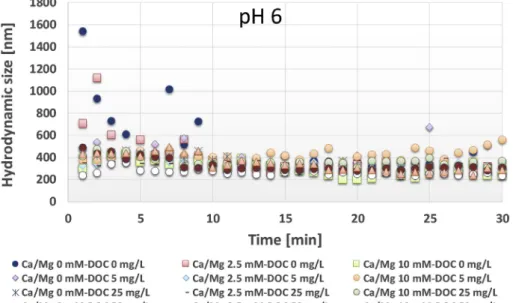
investigated over DOC, Ca2þ/Mg2þ and pH ranges of 0e10 mM, 0e50 mg/L, and 6e9 respectively. The Polydispersity Index (PDI) was in the range of 0.02e0.48 for all the measurements. At pH 6, the trends in the patterns of aggregation over time were similar in almost all conditions (Fig. 2). Immediate aggregation in thefirst few minutes (up to 10 min) in the media without DOC and 0e2.5 mM Ca2þ/Mg2þwas typically observed. A downward trend in aggregate size from 0 to 30 min was observed in some media. This trend was likely due to sedimentation of the largest aggregates (Conway et al.,
2015) and due to fast dissolution of the particles. At pH 7.5, the particles showed a typical increase in sizes over time in the media without DOC and Ca2þ/Mg2þ. At pH 9, substantial aggregation was observed for media without DOC and at Ca2þ/Mg2þconcentrations of 0 and 2.5 mM.
3.3. Particle dissolution behavior in synthetic waters
The concentrations of Cu ions (
m
g/l) were measured in the su-pernatant (top 5 cm) during 32 h of incubation in the synthetic media. The ratio of [Cu]dissolved/[Cu]totalwas calculated and plottedas a function of exposure time for the different media at pH 6, 7.5 and 9. The data show a good reproducibility, with generally low variations between the replicates.
As shown inFig. 3, in almost all media thefinal amount (at 32 h) of [Cu]dissolvedin the supernatant increased as compared to the
initial concentration, except for the media contain 0 or 2.5 mM Ca2þ/Mg2and 0 mg/L DOC at pH 9 (Fig. 3C). When introduced into the water, Cu0ENPs were immediately oxidized, as previously re-ported (Collins et al., 2012;Conway et al., 2015). This resulted in an immediate increase in the concentration of [Cu]dissolvedin the
sus-pension at thefirst sampling time (measurement at exactly 0 h was not possible given the time needed for sample preparation, including sonication, centrifugation, etc.) and continued to increase up to 32 h. The dissolution over time was different across the different media. The initial concentrations of [Cu]dissolved in the
media without DOC and without addition of Ca2þ/Mg2were higher at pH 6 than at pH 7.5 and 9, whereas the concentration of [Cu]dissolvedincreased slightly at pH 6 during 32 h. As described by
Wang et al. (2016), the dissolution of Cu0 ENPs in water is an oxidative process following the stoichiometry below (eq.(1)):
Cu0(s)þ1/4 O2(aq)þHþ(aq)4Cuþ(aq)þ1/2 H2O (1)
According to this stoichiometry, oxygen and Cuþare the factors controlling the dissolution of the particles in the system. When Cu0 ENPs are dispersed in a solution containing dissolved oxygen, release of Cu ions is observed (Zou et al., 2017). Dissolution may continue for a long time, but eventually the [Cu]dissolved
concen-tration typically reaches a plateau. Once the system has reached a state of equilibrium, the particles may persist dissolution even in the presence of free oxygen (Molleman and Hiemstra, 2017). This stability could be attributed to the formation of a layer of Cu oxide (CuO and Cu2O) on the surface of the particles (Mudunkotuwa et al.,
2012). However, Cu oxide is highly soluble and will generally not be stable for a long time under different physicochemical conditions. At neutral and acidic pH, the solubility of Cu oxide is some orders of magnitudes higher than at pH>8, which limits the persistence of a Cu oxide layer on the surface of the particles (Mudunkotuwa et al., 2012). This could explain the higher stability observed at pH 9 in comparison to the stability at pH7.5. Similar results were re-ported byJones and Su (2012) for dissolution of Cu0ENPs as a function of pH, andMolleman and Hiemstra (2017)for dissolution of Ag oxide formed on the surface of Ag ENPs. In the latter study the authors reported that formation and persistence of Ag is highly unlikely, unless the pH is very high.
In the absence of DOC, the concentration of dissolved Cu decreased after 4 h of exposure at all pH values, except for media containing 10 mM Ca2þ/Mg2at pH 6 and 7.5 (Figs. 3a and 1b). This decrease can be attributed to re-precipitation of Cu2þon the surface of the Cu0ENPs (Jones and Su, 2012) as reported for Ag ENPs by
Levard et al. (2013). Thefinal concentrations of [Cu]dissolvedin the
Fig. 2.Aggregation kinetics of Cu0ENPs as a function of DOC concentration, ionic strength and pH over 30 min of measurement using DLS.
particles were introduced in the media without DOC. This results in a lower available surface area and, subsequently, lower dissolution kinetics as reported byLi et al. (2010a,b). The aggregation results confirmed these observations (Fig. 2). Similar results were previ-ously reported for Cu ENPs as aggregation was found to decrease
the ion release from the particles (Adeleye et al., 2014).
ENPs. However, in the media containing 10 mM Ca2þ/Mg2þand pH
lower that 8, the particles were stable against aggregation and the rate of dissolution was high, in some cases even higher than in case of DOC-induced dissolution (Fig. 3). This finding also was in
agreement with the zeta potential of the particles (Table 5,
Supporting Information). At pH<7.5 and without DOC, the parti-cles are positively charged (Table 5, Supporting Information). An increase in the concentration of Ca2þ/Mg2þincreases the positive charge of the particles due to specific interactions of Ca2þions with the particles (Abdolahpur Monikh et al., 2018). This results in a high positive zeta potential. This thick double layer reduces the suc-cessful collision between particles, which in turn will decrease the aggregation rate. Consequently the particles remain stable against aggregation for a longer period of time and dissolution increases.
In agreement with previous studies (Wang et al., 2011,2015), the presence of DOC increases the amount of dissolved Cu (Fig. 3). In the presence of DOC and absence of Ca2þ/Mg2þ, the particles
remain stabilized in the suspension and do not aggregate. This leads to a high dissolution rate of the particles. NOM can act as a ligand that effectively interacts with Cu ENPs (Wang et al., 2015). NOM induces both a negative surface charge and steric stabilization on the surface of Cu0ENPs due to the interaction of carboxylic and phenolic functional groups with the particle surface. This could stabilize the particles electrostatically and sterically against ag-gregation (Jones and Su, 2012). In the presence of high concentra-tions of DOC, a higher amount of functional groups are available to
form strong complexes with the Cu0 ENPs. The complexation of
DOC with Cu ENPs (with CuO and Cu2O present on the surface of
the particles) weakens the surface CueCu and CueO bonds
(Korshin et al., 1998;Aiken et al., 2011;Wang et al., 2015), which leads to enhanced dissolution through ligand promoted processes (Misra et al., 2012). Dissolved Cu ions, independent of their release being induced by DOC, protons and/or hydroxide ions, have a
greater affinity towards organic ligands to form insoluble
complexes with DOC (Mudunkotuwa et al., 2012). Thus, after
release, Cu ions can form strong complexes with the functional groups of DOC via intra- or intermolecular bidentate chelation (Wang et al., 2015). If the concentration of DOC in the system is high, the Cu concentration gradient between the particle surface and the functional groups acts as the driving force of particle dissolution, resulting also in a decrease of the mineral saturation index (the driving force for precipitation) (Aiken et al., 2011).
At pH 6 (Figure 3a) and 0 mM Ca2þ/Mg2þ, there was no signif-icant difference in the dissolution patterns of Cu0ENPs between media containing 5, 25 and 50 mg/L DOC. The same results were observed in the media with 2.5 mM Ca2þ/Mg2þ. However, in the presence of 10 mM Ca2þ/Mg2þ, the highest and the lowest extent of dissolution were observed in the media containing 50 and 5 mg/L DOC, respectively. These results indicate that at a high concentra-tion of Ca2þ/Mg2þ, 5 mg/L DOC blocks the enhancement in the positive charge on the surface of the particles due to specific interaction of Ca2þwith particles, but also was not able to stabilize the particles against aggregation. Thus, the particles underwent aggregation, which led to a decrease in the dissolution rate.
At pH 7.5 (Fig. 3b) and pH 9 (Fig. 3c), the influence of DOC on the dissolution of the Cu0ENPs decreases as the concentration of Ca2þ/ Mg2þincreases in the media. The differences between media con-taining different DOC concentrations are also more pronounced in comparison to those at pH 6. At pH ~ 9, the zeta potential is close to zero and the particles are unstable and may aggregate relatively easy to form large particles. The larger aggregates influence the rate of release of ions in the media and the final [Cu]dissolvedat 32 h.
Previous studies also reported that dissolution of Cu ENPs (Adeleye et al., 2014) and Zn ENPs (Odzak et al., 2014) decreases as the pH of the system increases.Griffitt et al. (2007)reported that less than 0.1% of Cu ENPs dissolved in media at pH 8.2 after 48 h. However, the dissolution increased to 98% Cu ENPs at pH 6 after one week. Overall, the observation of higher rates of dissolution of the
Fig. 3.(continued).
particles in the presence of DOC compared to the rates of dissolu-tion in the absence of DOC shows that even (a) the presence of high levels of Ca2þ/Mg2þin the media, which can increase the aggre-gation and reduce the available surface area, and (b) the formation of Cu oxides on the surface of Cu0ENPs at high pH values cannot overcome the DOC promoted dissolution of the particles. The interaction Cu-DOC-carboxylic groups is predominantly covalent, outweighing the electrostatic effect of Ca2þ/Mg2þ, and at higher pH the polyionic DOC colloid is highly negatively charged, thus facili-tating covalent bonding with Cu2þ.
3.4. Dissolution rate in synthetic water
The dissolution rates (kdiss) of the Cu0ENPs, determined from
the slopes of the [Cu]dissolvedversus time, for synthetic waters are
reported inTable 1. Very fast dissolution and high values of kdiss
were observed in some samples at rates that were too high to be assessed by means of the methods used in this study. No numerical values for the rate constants are included in Table 1 for these samples. As reported in Table 1, the kdiss differed between the
media tested. At pH 6 and Ca2þ/Mg2þ concentration of 2.5 mM, increases in the concentration of DOC increased the kdissof Cu0
ENPs dissolution. A similar trend was observed at pH 9 for sample containing 2.5 mM Ca2þ/Mg2þ. Furthermore, the apparent kdissof
the particles increased as the pH value increased from 6 to 9 (Table 1). This is contradictory to what one would expect on the basis of eq(1)which could be due to the combined effects of pH, Ca2þ/Mg2þ and DOC. The kdiss of the Cu0 ENPs in the samples
containing no Ca2þ/Mg2þwere higher compared to those in media containing 2.5 and 10 mM. The differences in the release behavior were discussed in the previous section. These results suggest that the rate of dissolution of ENPs is strongly dependent on the con-centration of DOC and the pH of the media as reported in previous studies (Mitrano et al., 2014; Molleman and Hiemstra, 2017). It must be also mentioned that aggregation affects the kdiss, especially
for the high ionic strength suspensions. This explains the lower kdiss
observed in high ionic strength media.
3.5. Particle dissolution behavior in natural surface waters
The physicochemical parameters of the samples collected from
five different natural surface waters in the Netherlands were
measured and reported inTable 2. The background concentration of Cu in the samples was lower than the detection limit of the in-strument (<1 ppb). The concentration of DOC was between 9.2 and 18.5 mg/L with the highest concentration measured in Ditch 1 followed by Ditch 3Ditch 2>Lake>River. The highest pH value was recorded for Ditch 1 and the lowest was recorded in the River. The pH of all samples was in the neutraleslightly basic range and exceeded 7.6. According to the data reported in the Geochemical Atlas of Europe the highest concentration of Ca2þand Mg2þare 4,12 and 1,06 mM respectively. From these results is may be deduced that the conditions in the natural waters sampled are mostly
mimicked by the synthetic media contain 5e20 mg/L DOC,
2.5e10 mM of Ca2þ/Mg2þand 7.5e9 pH.
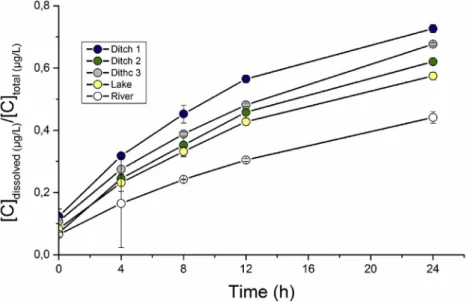
The [Cu]dissolved of Cu0 ENPs was determined in the natural
surface waters (Fig. 4). After 24 h, the [Cu]dissolvedin water followed
this order; Ditch 1>Ditch 2>Ditch 3Lake>River. The concen-tration of DOC in the Ditches and Lake is higher than that in the River. The results, thus, also imply that a higher extent of dissolu-tion of Cu0ENPs in the Ditches and in the Lake than in the River is likely to occur. According to these results, it is likely that DOC-enhanced dissolution of Cu0ENPs is occurring in the natural wa-ters, as observed in the synthetic waters. One should also consider that the physicochemical parameters of natural surface waters are changing dramatically from place to place and season to season. Thus, these variations will modify the dissolution and aggregation behavior of the particles dramatically. The reported data herein are therefore to be considered a snapshot of what occurs under dy-namic natural conditions. The rate constants measured in the natural samples provide a general overview of the range of disso-lution/aggregation of Cu0ENPs in natural conditions and show that the rate constants obtained in synthetic waters are indeed com-parable to the rate constants in natural waters of similar compo-sitions. Natural systems are inherently complex, which makes it difficult to directly compare the data with other published studies. Mitrano et al. (2014) reported that for most circumstances, the kdiss
of Ag ENPs was higher in water originating from a creek as compared to the kdissin distilled water and in tap water. It must be
mentioned that chloride, Cl, which is a common ligand in natural surface waters, may form a complex with Cu ENPs or with Cu ions released during particle oxidation, and thus may influence the
dissolution rate of the particles (Levard et al., 2011;Mitrano et al., 2014). In this research, the influence of Cl was not investigate and this could be a motivation for future studies in which the impact of Clon particle dissolution is explicitly considered.
Measuring Dhusing DLS to determine the aggregation kinetics
of ENPs in natural water is challenging due to the limitation of the technique to deal with samples containing different natural parti-cles (von der Kammer et al., 2012). In addition, it was noticed that there were natural particles settlements in the cuvettes which led to particle sedimentation as a consequence of heteroaggregation. Thus, reliably measuring the Dhusing DLS to obtain the aggregation
kinetics of Cu0ENPs in natural samples was not possible in this study. The measured zeta potential values are reported inTable 6 in the Supporting information.
As can be seen inFig. 4, a slightly higher extent of dissolution than in any of the other waters was observed for Ditch 1. The sec-ond highest [Cu]dissolvedwas observed in Ditch 3, followed by Ditch
2Lake>River. The concentration of [Cu]dissolved in the River
sample was significantly lower than in the other natural waters samples. The initial level of [Cu]dissolvedin all the natural waters,
after addition of Cu0ENPs, was around 0.1
m
g/L, which is similar to what was recorded for the synthetic media with 2.5 mM Ca2þ/Mg2þ at pH 7.5 and 9.The values of kdissas calculated for the natural samples are
re-ported inTable 3. The kdissin the investigated natural waters was
similar to that calculated for the synthetic media. The kdissin Ditch
1, 2 and 3 was higher that the lake and the river. The rate constant in the river was similar to the rate constant obtained for the synthetic medium containing 10 mM Ca2þ/Mg2þ, 5, 25 and 50 m/L DOC and pH 7.5. Considering the physicochemical parameters of the river (Table 2), this constant rate is expected for the river.
4. Conclusions
The keyfinding of this study is that dissolution and aggregation of Cu0ENPs are highly dependent on the DOC, ionic strength and pH of the aqueous media. DOC can induce dissolution of Cu0ENPs by controlling the aggregation, thus the available surface area, of the particles and by weakening the CueCu and CueO bonds formed as a result of oxidation on the surface of the particles. Moreover, DOC can sorb the released Cu ions from the particles and, subse-quently, accelerate the dissolution. Changes in the pH induced dissolution of the particles by causing instability of the copper oxide shell formed on the surface of the particles, as particularly observed in pH 6. The presence of Ca2þ/Mg2þalso modified the dissolution behavior of Cu0 ENPs by controlling the aggregation state of the particles and by interacting with functional groups available within the DOC. The impact of DOC on dissolution was stronger than the impacts of either Ca2þ/Mg2þ(ionic strength) or pH.
In the case of the natural surface waters investigated in this study, similar trends of dissolution over time were determined with the highest and lowest concentrations of dissolved Cu in Ditch 1 and in the River water respectively. The dissolution behavior of the particles in the natural samples was most similar to the behavior determined for synthetic media containing 5e25 mg/L DOC, 2.5 and 10 mM Ca2þ/Mg2þ, and pH 9. Thesefindings imply that DOC also controls the dissolution behavior of Cu0ENPs in natural waters given the similarity of the results obtained for synthetic media and those determined for natural samples. Ourfindings show that DOC-, pH- and ionic strength-driven dissolution/aggregation are important processes affecting the fate of Cu0ENPs in natural wa-ters. This implies that the impact of these water properties on the fate of soluble ENPs needs to be investigated simultaneously rather than by means of separate tests in which each property is modified
univariately. Bearing the results of this study in mind, it is to be concluded that it is required to investigate the dissolution/aggre-gation of other soluble metallic ENPs within a matrix of water properties mimicking natural conditions.
Acknowledgements
The research described in this work was performed within the framework of the“NANOFASE”project supported by the European Union's Horizon 2020 research and innovation programme under grant agreement number 642007. M.G. Vijver was funded by the Dutch Organisation of Scientific Research (NWO) by the NWO-VIDI grant 864.13.010. D. Arenas-Lago would like to thank the Xunta de Galicia and the University of Vigo for the Postdoctoral grant (Ref. ED48 1B 2016/152-0).
Appendix A. Supplementary data
Supplementary data to this article can be found online at
https://doi.org/10.1016/j.chemosphere.2019.03.190.
References
Abdolahpur Monikh, F., Praetorius, A., Schmid, A., Kozin, P., Meisterjahn, B., Makarova, E., Hofmann, T., von der Kammer, F., 2018. Scientific rationale for the development of an OECD test guideline on engineered nanomaterial stability. NanoImpact 11, 42e50.https://doi.org/10.1016/j.impact.2018.01.003. Adeleye, A.S., Conway, J.R., Perez, T., Rutten, P., Keller, A.A., 2014. Influence of
extracellular polymeric substances on the long-term fate, dissolution, and speciation of copper-based nanoparticles. Environ. Sci. Technol. 48, 12561e12568.https://doi.org/10.1021/es5033426.
Aiken, G.R., Hsu-Kim, H., Ryan, J.N., 2011. Influence of dissolved organic matter on the environmental fate of metals, nanoparticles, and colloids. Environ. Sci. Technol. 45, 3196e3201.https://doi.org/10.1021/es103992s.
Axson, J.L., Stark, D.I., Bondy, A.L., Capracotta, S.S., Maynard, A.D., Philbert, M.A., Bergin, I.L., Ault, A.P., 2015. Rapid kinetics of size and pH-dependent dissolution and aggregation of silver nanoparticles in simulated gastricfluid. J. Phys. Chem. C 119, 20632e20641.https://doi.org/10.1021/acs.jpcc.5b03634.
Chowdhury, I., Walker, S.L., Mylon, S.E., 2013. Aggregate morphology of nano-TiO2: role of primary particle size, solution chemistry, and organic matter. Environ. Sci. Process. Impacts 15, 275e282.https://doi.org/10.1039/c2em30680h. Collins, D., Luxton, T., Kumar, N., Shah, S., Walker, V.K., Shah, V., 2012. Assessing the
impact of copper and zinc oxide nanoparticles on soil: afield study. PLoS One 7.
https://doi.org/10.1371/journal.pone.0042663.
Conway, J.R., Adeleye, A.S., Gardea-Torresdey, J., Keller, A.A., 2015. Aggregation, dissolution, and transformation of copper nanoparticles in natural waters. En-viron. Sci. Technol. 49, 2749e2756.https://doi.org/10.1021/es504918q. Flemming, C.A., Trevors, J.T., 1989. Copper toxicity and chemistry in the
environ-ment: a review. Water Air Soil Pollut. 44, 143e158.https://doi.org/10.1007/ BF00228784.
Griffitt, R.J., Weil, R., Hyndman, K.A., Denslow, N.D., Powers, K., Taylor, D., Barber, D.S., 2007. Exposure to copper nanoparticles causes gill injury and acute lethality in zebrafish (Danio rerio). Environ. Sci. Technol. 41, 8178e8186.https:// doi.org/10.1021/es071235e.
Gunsolus, I.L., Mousavi, M.P.S., Hussein, K., B?hlmann, P., Haynes, C.L., 2015. Effects of humic and fulvic acids on silver nanoparticle stability, dissolution, and toxicity. Environ. Sci. Technol. 49, 8078e8086.https://doi.org/10.1021/acs.est. 5b01496.
Johnson, A.C., Bowes, M.J., Crossley, A., Jarvie, H.P., Jurkschat, K., Jürgens, M.D., Lawlor, A.J., Park, B., Rowland, P., Spurgeon, D., Svendsen, C., Thompson, I.P., Barnes, R.J., Williams, R.J., Xu, N., 2011. An assessment of the fate, behaviour and environmental risk associated with sunscreen TiO2nanoparticles in UKfield scenarios. Sci. Total Environ. 409, 2503e2510. https://doi.org/10.1016/j. scitotenv.2011.03.040.
Jones, E.H., Su, C., 2012. Fate and transport of elemental copper (Cu0) nanoparticles through saturated porous media in the presence of organic materials. Water Res. 46, 2445e2456.https://doi.org/10.1016/j.watres.2012.02.022.
Kanel, S.R., Flory, J., Meyerhoefer, A., Fraley, J.L., Sizemore, I.E., Goltz, M.N., 2015. Influence of natural organic matter on fate and transport of silver nanoparticles in saturated porous media: laboratory experiments and modeling. J. Nanoparticle Res. 17.https://doi.org/10.1007/s11051-015-2956-y.
Keller, A.A., Wang, H., Zhou, D., Lenihan, H.S., Cherr, G., Cardinale, B.J., Miller, R., Zhaoxia, J.I., 2010. Stability and aggregation of metal oxide nanoparticles in natural aqueous matrices. Environ. Sci. Technol. 44, 1962e1967.https://doi.org/ 10.1021/es902987d.
Korshin, G.V., Frenkel, A.I., Stern, E.A., 1998. EXAFS study of the inner shell structure in copper(II) complexes with humic substances. Environ. Sci. Technol. 32, 2699e2705.https://doi.org/10.1021/es980016d.
Kosmulski, M., 2009. Compilation of PZC and IEP of sparingly soluble metal oxides and hydroxides from literature. Adv. Colloid Interface Sci.https://doi.org/10. 1016/j.cis.2009.08.003.
Levard, C., Mitra, S., Yang, T., Jew, A.D., Badireddy, A.R., Lowry, G.V., Brown, G.E., 2013. Effect of chloride on the dissolution rate of silver nanoparticles and toxicity to E. coli. Environ. Sci. Technol. 47, 5738e5745.https://doi.org/10.1021/ es400396f.
Levard, C., Reinsch, B.C., Michel, F.M., Oumahi, C., Lowry, G.V., Brown, G.E., 2011. Sulfidation processes of PVP-coated silver nanoparticles in aqueous solution: impact on dissolution rate. Environ. Sci. Technol. 45, 5260e5266.https://doi. org/10.1021/es2007758.
Li, X., Lenhart, J.J., Walker, H.W., 2012. Aggregation kinetics and dissolution of coated silver nanoparticles. Langmuir 28, 1095e1104.https://doi.org/10.1021/ la202328n.
Li, X., Lenhart, J.J., Walker, H.W., 2010a. Dissolution-accompanied aggregation ki-netics of silver nanoparticles. Langmuir 26, 16690e16698.https://doi.org/10. 1021/la101768n.
Li, X., Lenhart, J.J., Walker, H.W., 2010b. Dissolution-accompanied aggregation ki-netics of silver nanoparticles. Langmuir 26, 16690e16698.https://doi.org/10. 1021/la101768n.
Linlin, Z., Tanaka, K., 2014. Dissolution of silver nanoparticles in presence of natural organic matter. Adv. Mater. Lett. 5, 6e8.https://doi.org/10.5185/amlett.2013. 7520.
Louie, S.M., Spielman-Sun, E.R., Small, M.J., Tilton, R.D., Lowry, G.V., 2015. Correla-tion of the physicochemical properties of natural organic matter samples from different sources to their effects on gold nanoparticle aggregation in mono-valent electrolyte. Environ. Sci. Technol. 49, 2188e2198.https://doi.org/10.1021/ es505003d.
Misra, S.K., Dybowska, A., Berhanu, D., Luoma, S.N., Valsami-Jones, E., 2012. The complexity of nanoparticle dissolution and its importance in nanotoxicological studies. Sci. Total Environ. 438, 225e232. https://doi.org/10.1016/j.scitotenv. 2012.08.066.
Mitrano, D.M., Ranville, J.F., Bednar, A., Kazor, K., Hering, A.S., Higgins, C.P., 2014. Tracking dissolution of silver nanoparticles at environmentally relevant con-centrations in laboratory, natural, and processed waters using single particle ICP-MS (spICP-MS). Environ. Sci. Nano 1, 248e259. https://doi.org/10.1039/ C3EN00108C.
Molleman, B., Hiemstra, T., 2017. Time, pH, and size dependency of silver nano-particle dissolution: the road to equilibrium. Environ. Sci. Nano 4, 1314e1327.
https://doi.org/10.1039/c6en00564k.
Mudunkotuwa, I.A., Pettibone, J.M., Grassian, V.H., 2012. Environmental
implications of nanoparticle aging in the processing and fate of copper-based nanomaterials. Environ. Sci. Technol. 46, 7001e7010.https://doi.org/10.1021/ es203851d.
Odzak, N., Kistler, D., Behra, R., Sigg, L., 2014. Dissolution of metal and metal oxide nanoparticles in aqueous media. Environ. Pollut. 191, 132e138.https://doi.org/ 10.1016/j.envpol.2014.04.010.
The Geochemical Atlas of Europe [WWW Document], n.D. URLhttp://weppi.gtk.fi/ publ/foregsatlas/-ForegsData.php.
Vance, M.E., Kuiken, T., Vejerano, E.P., McGinnis, S.P., Hochella, M.F., Hull, D.R., 2015. Nanotechnology in the real world: redeveloping the nanomaterial consumer products inventory. Beilstein J. Nanotechnol. 6, 1769e1780.https://doi.org/10. 3762/bjnano.6.181.
von der Kammer, F., Ferguson, P.L., Holden, P.A., Masion, A., Rogers, K.R., Klaine, S.J., Koelmans, A.A., Horne, N., Unrine, J.M., 2012. Analysis of engineered nano-materials in complex matrices (environment and biota): general considerations and conceptual case studies. Environ. Toxicol. Chem.https://doi.org/10.1002/ etc.723.
Von Der Kammer, F., Ottofuelling, S., Hofmann, T., 2010. Assessment of the physico-chemical behavior of titanium dioxide nanoparticles in aquatic environments using multi-dimensional parameter testing. Environ. Pollut. 158, 3472e3481.
https://doi.org/10.1016/j.envpol.2010.05.007.
Wagner, S., Gondikas, A., Neubauer, E., Hofmann, T., Von Der Kammer, F., 2014. Spot the difference: engineered and natural nanoparticles in the environment-release, behavior, and fate. Angew. Chem. Int. Ed.https://doi.org/10.1002/anie. 201405050.
Wang, L.F., Habibul, N., He, D.Q., Li, W.W., Zhang, X., Jiang, H., Yu, H.Q., 2015. Copper release from copper nanoparticles in the presence of natural organic matter. Water Res. 68, 12e23.https://doi.org/10.1016/j.watres.2014.09.031.
Wang, Z., Li, J., Zhao, J., Xing, B., 2011. Toxicity and internalization of CuO nano-particles to prokaryotic alga microcystis aeruginosa as affected by dissolved organic matter. Environ. Sci. Technol. 45, 6032e6040.https://doi.org/10.1021/ es2010573.
Wang, Z., Zhang, L., Zhao, J., Xing, B., 2016. Environmental processes and toxicity of metallic nanoparticles in aquatic systems as affected by natural organic matter. Environ. Sci. Nano.https://doi.org/10.1039/c5en00230c.
Zhang, H., Chen, B., Banfield, J.F., 2010. Particle size and pH effects on nanoparticle dissolution. J. Phys. Chem. C 114, 14876e14884. https://doi.org/10.1021/ jp1060842.