ASSOCIATIONS BETWEEN INFANT BEHAVIOR DURING THE FACE-TO-FACE STILL FACE PARADIGM AND OPPOSITIONAL DEFIANT AND CALLOUS-UNEMOTIONAL
BEHAVIORS IN EARLY CHILDHOOD
Nicholas James Wagner
A thesis submitted to the faculty at the University of North Carolina at Chapel Hill in partial fulfillment of the requirements for the degree of Master of Arts in the Department of Psychology.
Chapel Hill 2014
Approved by:
Martha J. Cox
W. Roger Mills-Koonce
© 2014
ABSTRACT
Nicholas James Wagner: Associations between Infant Behavior during the Face-to-Face Still Face Paradigm and Oppositional Defiant and Callous-Unemotional Behaviors in Early
Childhood
(Under the direction of Martha J. Cox)
Extant research with child and adolescent samples investigating the behavioral correlates
of oppositional defiant (ODD) and callous-unemotional (CU) traits have identified deficits in
social orienting during dyadic interactions and hyporeactivity to stressful stimuli. The goal of the
current study was to investigate infants’ mother-directed gaze and affective behavior during the
face-to-face and still-face episodes of the face-to-face still face paradigm performed at 6 months
in the prediction of oppositional defiant and callous-unemotional behaviors in early childhood.
Hierarchical regression analyses revealed that infants’ expressed negative affect and
mother-directed gaze predicted fewer ODD behaviors in early childhood. Similarly, infants’ expressed
negative affect during the still face episode predicted fewer ODD and CU behaviors in early
childhood. Further, mother-directed gaze during the free play episode attenuated the negative
relationship between negative affect during the still face episode and ODD and, at least
TABLE OF CONTENTS
LIST OF TABLES ... v
LIST OF FIGURES ... vi
LIST OF ABBREVIATIONS ... vii
ASSOCIATIONS BETWEEN INFANT BEHAVIOR DURING THE FACE-TO-FACE STILL FACE PARADIGM AND OPPOSITIONAL DEFIANT AND CALLOUS-UNEMOTIONAL BEHAVIORS IN EARLY CHILDHOOD ... 1
Mother-Directed Gaze and Social Orienting ... 2
Negative Affect and Reactivity ... 4
Infant Reactivity and Social Orienting in the Face-to-Face Still Face Paradigm ... 5
Current Study ... 7
METHODS ... 8
Participants ... 8
Procedure ... 9
Measures... 9
Face-to-Face Still-Face Paradigm ... 9
Coding Infants’ and Mothers’ Behavior during FFSFP ... 10
Achenbach System of Empirically Based Assessment... 11
Observed Parent-Infant Interactions ... 11
Additional Covariates ... 12
Analytic Strategy ... 13
Hierarchical OLS Regression Models ... 14
Covariates and parent contributions ... 14
Infant behavior during the FF and SF episodes ... 15
DISCUSSION ... 16
Speculative Considerations and Implications for Future Research ... 19
Strengths and Limitations... 20
Conclusions and Next Steps ... 22
LIST OF TABLES
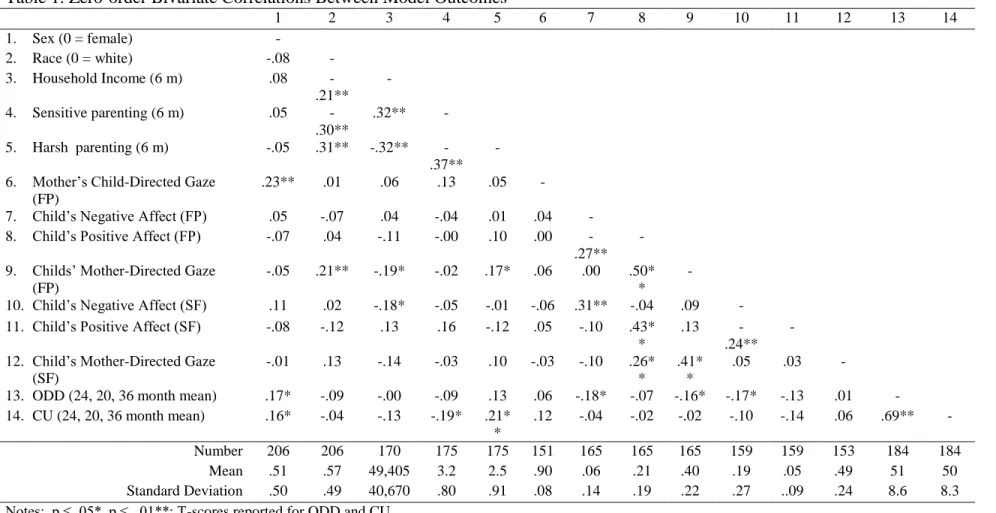
Table 1. Zero-order Bivariate Correlations Between Model Outcomes ... 24
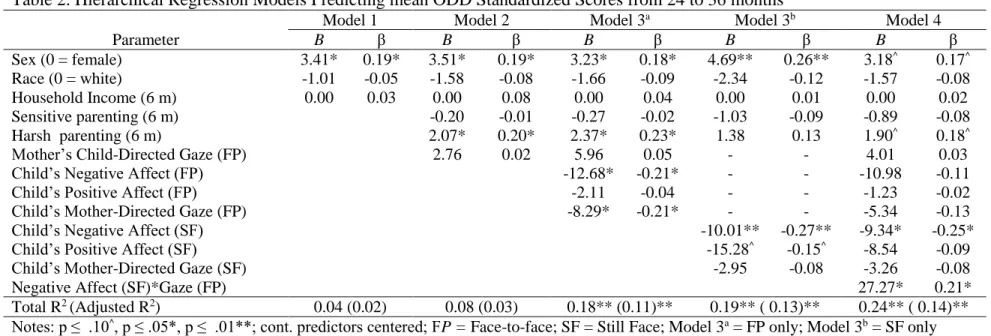
Table 2. Hierarchical Regression Models Predicting mean ODD Standardized Scores ... 25
LIST OF FIGURES
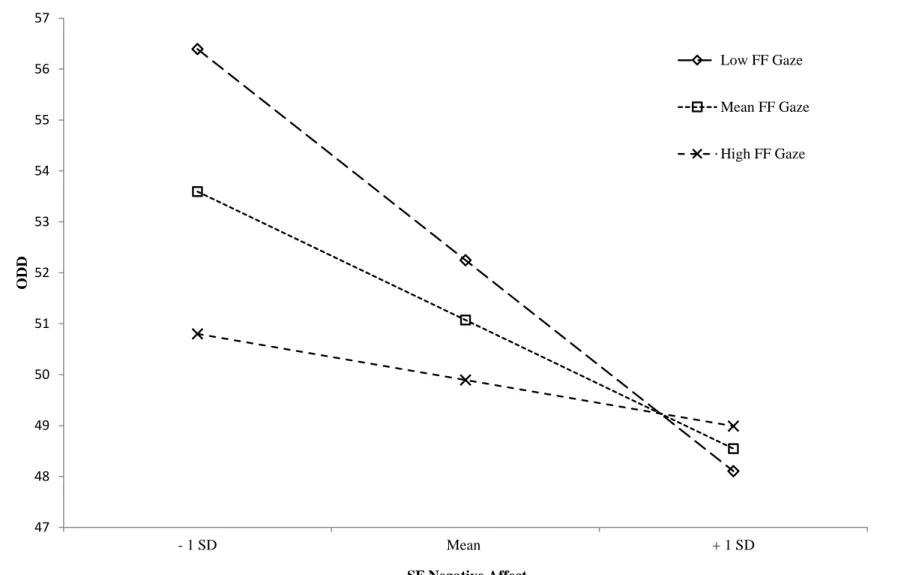
Figure 1. Interaction predicting ODD. ... 27
LIST OF ABBREVIATIONS
ADHD Attention Deficit Hyperactive Disorder
ASEBA Achenbach System of Empirically Based Assessment
CU Callous-unemotional
DCHDS Durham Child Health and Development Study
FFSFP Face-to-face Still-Face Paradigm
FF Face-to-face
ODD Oppositional Defiant
RE Reunion
SD Standard Deviation
SE Standard Error
Associations between Infant Behavior during the Face-to-Face Still Face Paradigm and Oppositional Defiant and Callous-Unemotional Behaviors in Early Childhood
Both developmental and clinical fields of research have invested substantial resources in
understanding the course, causes, and consequences of antisocial behaviors and psychopathic
traits. The monetary and societal costs incurred by individuals exhibiting disruptive behavior
problems has prompted an increase of research on the unique etiological pathways to these
outcomes, including potential origins in early oppositional defiant disorder (ODD) and elevated
callous-unemotional (CU) behaviors (Frick et al., 2003; Frick & Viding, 2009; Hawes, Brennan,
& Dadds, 2009). There is great variability in the behavioral, emotional, cognitive, and biological
functioning of children who demonstrate disruptive behavior problems and this variability has
implications for later functioning and response to treatment. Although the corpus of literature
highlighting environmental (see Waller, Gardner, & Hyde, 2013), biological, and behavioral
correlates of ODD and CU behaviors in childhood and adolescence is growing (see Frick, Ray,
Thornton, & Kahn, 2014 for review), there is a dearth of prospective longitudinal research that
has investigated if specific behavioral phenotypes associated with these outcomes precede the
manifestation of these disruptive outcomes in infancy.
ODD is typically characterized by defiant, disobedient, and uncooperative behaviors and
is often accompanied by anger and irritability (Stringaris & Goodman, 2009), whereas CU traits
describe non-normative emotional, affective, and cognitive deficits such as a lack of guilt,
empathy, and fear as well as an over-focus on reward and insensitivity to punishment (Blair,
that CU traits are distinct from symptoms of Attentional Deficit Hyperactive Disorder (ADHD),
ODD, and Conduct Disorder (Dadds et al., 2005; Frick, Bodin, & Barry, 2000; Pardini,
Obradović, & Loeber, 2006) and are distinguishable as early as 3 years of age (Willoughby,
Mills-Koonce, Gottfredson, & Wagner, 2013; Willoughby, Waschbusch, Moore, & Propper,
2011). Furthermore, individuals exhibiting elevated ODD and CU behaviors are at greater risk
for later antisocial behavior and psychopathy (Lynam, Caspi, Moffitt, Loeber, &
Stouthamer-Loeber, 2007; Rowe et al., 2010). Of particular interest to the current study are previous findings
relating elevated ODD and CU traits to deficits in orienting towards caregivers (i.e., less eye
contact and mutual orienting) during dyadic interactions and hyporeactivity in response to
arousing stimuli later in childhood and adolescence (Blair 1999; Colder, Mott, & Berman, 2002;
Dadds, Jambrak, Pasalich, Hawes, & Brennan, 2011; Frick, Cornell, Bodin, Dane, Barry, &
Loney, 2003; Loney, Lima, & Butler, 2006; Frick & White, 2008; Willoughby et al., 2011).
Researchers have suggested that a failure to orient towards a caregiver and attend to the
caregiver’s eyes may contribute to errors in the development of appropriate emotional responses
to arousing stimuli (Dadds et al., 2011, 2012, 2013). What remains unclear is the extent to which
deficits in social orientation and reactivity are present in infancy and precede the emergence of
later ODD and CU behaviors.
Mother-Directed Gaze and Social Orienting
There is a rather large research literature examining associations between early familial
experiences and the development and persistence of ODD (Deater-Deckard & Dodge, 1997;
Loeber & Hay, 1997; Shaffer, Lindhiem, Kolko, & Trentacosta, 2013), and a growing literature
on early experiences and the development of CU behaviors (see Waller et al., 2013 for review).
Lochman, & Powell, 2007) parenting have been shown to be predictive of ODD and CU
behaviors. In addition to the influence of harsh and insenstive parenting influences on the child,
emerging research suggests that children exhibiting concurrent behavioral problems and CU
traits make less eye contact with caregivers during emotionally charged discussions (Dadds et
al., 2012) and during normative free play (Dadds et al., 2011). In a sample of 92 males (mean
age = 8.9 years), youth high on both conduct problems and CU traits showed a consistent lack of
eye contact towards their parents during a free play task and an “emotion talk” scenario (Dadds
et al., 2011). Similarly, Dadds and colleagues (2012) found similar phenotypic behavior in
caregiver-directed eye contact for youth high on ODD and CU traits during an emotionally
charged discussion using a mixed-sex sample of youth (mean age = 5.9 years) (Dadds et al.,
2012). A number of studies support the finding that youth high on ODD and CU traits show
impaired attention to the eye region when interacting with parenting figures (Dadds et al., 2011;
Dadds et al., 2012) and when freely viewing emotional faces (Dadds et al., 2006; Dadds, El
Masry, Wimalaweera, & Guastella, 2008). Together with work by Kochanska and others, these
findings suggest that lack of attention to caregivers during social interactions, may contribute to
cascading errors in the development of empathy and conscience (Kochanska, 1997; Kochanska,
Forman, Aksan, & Dunbar, 2005; Kochanska & Murray, 2000).
When integrated, this research suggests that dyadic relations between children and their
caregivers which are characterized by less positive and more negative interactions, often
resulting in less social orienting and mother-directed gaze, may be at risk for later
psychopathology. How early youth exhibit deficits in orienting toward their caregivers and the
extent to which this behavior precedes later ODD and CU behaviors is an open question. As
normative interaction in infancy predicts later ODD and CU behaviors above and beyond the
influences of harsh and sensitive caregiving experiences. To our knowledge, the current study is
the first to extend down the examination of the associations between mother-directed gaze and
later ODD and CU behaviors into infancy.
Negative Affect and Reactivity
The extant research on affective and relational correlates of CU traits consistently
identifies negative correlations between behavioral reactivity and ODD and CU symptomatology
(c.f., Blair, J., Mitchell, & Blair, K., 2005; Newman & Lorenz, 2003; Patterson & Newman,
1993) just as hyporeactivity to stress-inducing stimuli has been linked with adult antisocial
behavior and psychopathy (Hare, Hart, & Harpur, 1991; Lykken, 1995). For example, CU traits
have been associated with low basal cortisol levels in a community sample of 12 to 18 year old
youths (Loney et al, 2006) and blunted cortisol reactivity in a sample of 8 to 14 year old boys
with ADHD and disruptive behavior symptoms (Stadler et al., 2011). Lower baseline levels and
blunted reactivity of other physiological systems including heart rate, skin conductance, and
parasympathetic nervous system functioning have been shown to be associated with ODD and
CU behaviors (Raine, 2002; Dietrich et al., 2006; Anastassiou-Hadjicharalambous & Warden,
2008) suggesting that children and adolescents high on ODD and CU traits may exhibit distinct
physiological and behavioral phenotypes characterized by underreactivity. Importantly, research
on developmental precursors of adult antisocial behavior and psychopathy linking hyporeactivity
to ODD and CU traits has largely focused on later childhood (Colder et al., 2002; Frick et al.,
2003; Loney, Frick, Clements, Ellis, & Kerlin, 2003) and adolescence (Loney et al., 2006), very
few have extended this model downward into the infancy and toddlerhood years (Willoughby et
Developmental scientists have stressed the importance of infants’ behavioral signaling
(e.g. negative affect, orienting) as a means of communicating emotional needs to the parent
which, when responded to appropriately, support adaptive social development (Kochanska,
1997; Kochanska & Murray, 2000; Maccoby, 1992; Tronick, 1989). The Mutual Regulation
Model (MRM; Tronick, 1989) describes early mother-infant dyadic interactions as being jointly
regulated toward reciprocity through a system of infant-directed behavioral and affective
feedback. When the behaviors of each member of the dyad are reciprocated, these
socio-emotional processes help to generate adaptive mutual states of regulation that support healthy
development (Tronick et al., 1998). Potential errors in this dyadic system, possibly fueled by
infant underreactivity and low-signaling during stressful parent-child interactions, may also
contribute to errors in healthy social development and be particularly informative for the etiology
of ODD and CU traits. As such, a goal of the current study was to investigate the extent to which
behavioral underreactivity during a stressful mother-child interaction in infancy predicts later
ODD and CU behaviors above and beyond the influences of harsh and sensitive caregiving
experiences.
Infant Reactivity and Social Orienting in the Face-to-Face Still Face Paradigm (FFSFP)
Tronick and colleagues (1978) developed the FFSFP (Tronick et al., 1978) to measure
and highlight 1) what happens when social connectedness and mutual regulation are disrupted
and 2) the importance of mother-infant connectedness and mutual regulation (Tronick et al.,
1978; Tronick et al., 1998). The FFSFP consists of three episodes during which the parent first is
asked to engage in typical face-to-face play (FF episode), then to stop responding to the infant
and maintain a neutral facial expression (SF episode) and, finally, to resume playing with the
The FFSFP is an ideal task for assessing infants’ reactivity to aversive interactions with
the caregiver and social orientation towards the caregiver (Weinberg & Tronick, 1996), and
individual differences in infant behaviors during the FFSFP have been associated with both
relational development (Braungart-Rieker, Garwood, Powers, & Wang, 2001; Cohn, Campbell,
& Ross, 1991; Ekas et al., 2013; Mesman, van IJzendoorn, & Bakermans-Kranenburg, 2009) and
behavior problems in children (Ekas et al., 2013; Moore, Cohn, & Campbell, 2001). In a
clinically informed (ODD 90th percentile and CU 96th percentile) subsample (N = 37) taken
from a largely urban community sample of lower- and higher-income African American and
European American families, Willoughby and colleagues (2011) found that infants high on both
ODD and CU behaviors at 36 months demonstrated significantly less negative reactivity during
the SF episode in infancy, providing support for extending downward investigations of the role
of hyporeactivity in the etiology of early ODD and CU (Frick & Morris, 2004; Willoughby et al.,
2011). Researchers have demonstrated that when the mother-infant dyad is engaged, such as
they are during the interactive episodes of the FFSFP, mutual orientation between mothers and
infants is related to the development of conscience and internalization of rules and expectations
(Kochanska, 1997; Kochanska et al., 2005; Kochanska & Murray, 2000). Furthermore, Moore
and colleagues (2001) demonstrated that infants who fail to signal mothers in an attempt to
reengage them during the FFSFP are more likely to exhibit externalizing behaviors later in
development.
Beyond the main effects of observed infant reactivity and social orienting, the current
study poses the question of whether the qualities of the mother-child interaction may
interactively predict later ODD and CU behaviors. This question is motivated by recent research
(i.e., Dadds and colleagues, 2011), as well as research with adults suggesting that associations
between psychopathic behaviors and diminished reactivity to emotion-related cues is moderated
by higher-order cognitive attentional deficits (Newman, Curtin, Bertsch, & Baskin-Sommers,
2010). As such, the current study considered the extent to which mother-directed gaze during
the FFSFP buffers any relationship between infant reactivity and later ODD and CU behaviors.
Such a prediction is also consistent with work by Ekas and colleagues (2013) linking infant
mother-directed gaze during the FFSFP to later attachment security (see also Cohn et al., 1991),
and evidence suggesting that early secure relationships with caregivers may buffer against
coercive pathways to antisocial conduct (Kochanska, Barry, Stellern, & O’Bleness, 2009).
These findings suggest that reactivity and social orienting may represent both independent and
interactive pathways to later ODD and CU behaviors and investigating the extent to which these
relational behaviors precede ODD and CU behaviors in infancy may offer new developmental
insight into the heterotypic continuity of the elevated ODD and CU phenotype over time.
Current Study
Data from a prospective longitudinal study was used to examine the correlation between
child behavior in the FFSFP at 6 months and later ODD and CU behaviors. Specifically, the
following questions were addressed: 1) Does expressed negative affect during the still face
episode of the FFSFP predict later ODD and CU behaviors above and beyond the influence of
harsh and sensitive parenting? 2) Does mother directed gaze during the face-to-face episode of
the FFSFP predict later ODD and CU behaviors above and beyond the influence of harsh and
sensitive parenting? 3) Is any association between infant negative affect during the still face
episode attenuated by mother-directed gaze during the face-to-face episode in the prediction of
demographic variables as well as mother’s behavior during the FFSFP in an attempt to isolate the
relationship between infants’ behavioral and affective responses to the FFSFP and later ODD
and CU behaviors, as well as observed sensitive parenting and harsh-intrusive parenting during a
separate free play task to control for the broader relationship quality between child and mother.
Methods
Participants
The current study used participants from the Durham Child Health and Development
Study (DCHDS), a prospective longitudinal study of 206 full-term infants and their families who
were recruited when their children were 3 months old. Approximately equal numbers of African
American and European American families from lower- and higher-income groups were
recruited. The study included only infants who were healthy, full-term, and born without
significant complications. Family’s race and income status were determined from mother
self-report.
Of the 206 children recruited into the DCHDS, 185 (89.8%) had data for ODD and CU
behaviors at one of the three time points of interest (24, 30, or 36 months). There was no
evidence that children with (N = 185) and without (N = 21) outcome data varied as a function of
sex (51% male vs. 57% male; p = .58), race (56% African American vs. 62% African American;
p = .62), or total family income at 6 months (p = .79). Furthermore, there was no evidence that
missingness was related to positive parenting at 6 months (p = .12), negative parenting at 6
months (p = .26), or mother (infant directed gaze during face-to-face, p = .27) and infant
(mother directed gaze during the face-to-face, p = .38; mother directed gaze during the still face,
p = .08; affect during face-to-face, p = .43; affect during still face, p = .53) behaviors during the
Procedure
The current study used observational and questionnaire data that were collected at visits
completed when the children were 6, 24, 30, and 36 months old. Information on children’s sex
and race was collected upon entry into the study. All ratings and observations occurred in a
laboratory setting except for the observation of parent-child interactions during free play (coded
for maternal sensitivity and harsh-intrusiveness), which were conducted at the participants’
homes. At each visit, infants and their mothers participated in a number of joint and individual
activities and mothers completed a standardized interview and demographic questionnaires.
Transportation was provided to families who required assistance getting to and from the
laboratory. Families were compensated $50 for their participation at each time point.
Measures
Face-to-Face Still-Face Paradigm (FFSFP; Adamson and Frick 2003; Tronick et al. 1978.)
The infants’ were observed in the FFSFP during the 6 month lab visit to assess infants’
behaviors, specifically mother-directed gaze, positive affect, and negative affect. Mothers placed
infants in an infant chair on a table and situated themselves in a chair that was placed directly in
front of the infants’ chair. Mothers were given a set of standardized instructions for each episode
of the FFSFP (i.e., FF, SF, RE). As the behaviors we are most interested in, mother-directed gaze
and negative affect, are demonstrated most often during the FF and SF episodes (Ekas et al.,
2013; Mesman et al., 2009), the RE phase of the FFSFP is of less interest to the current study and
will not be included in subsequent analyses. During the FF episode, mothers were instructed to
play with their babies as they normally would for 2-minutes. Then mothers were told to turn
away from their infant for 15 seconds and then to turn back toward their infants for the SF
response to the infant (i.e., maintaining a still face). The research assistant made it known that
they would stop the still-face episode if the infant became too distressed. The FFSFP was
stopped if the infant was unable to be soothed at any point during the procedure. The episodes
were video recorded using a split-screen procedure to ensure that the behaviors of both mothers
and infants could be observed during the entire interaction.
Coding Infants’ and Mothers’ Behavior during FFSFP
As previously described by Moore and colleagues (2009), infants’ and mothers’ affect
and gaze during the FFSFP episodes were coded by trained coders. In separate viewings of the
videotapes, different research assistants coded infants’ and mothers’ facial affect and direction of
gaze in 1-s intervals. Affect was coded as positive, neutral, or negative, and gaze was coded as
toward or away from the partner. Infants’ behavior was coded during all three episodes of the
FFSPF (FF, SF, and RE) and mothers’ behaviors were coded only during the FF and RE as their
behavior was constrained by the directions of the SF episode.
Coders were initially trained to reliability using a pre-existing video recorded FFSFP
interactions. Inter-observer agreement was determined by randomly selecting 15% of the
interactions to be coded by a second coder. The coders were considered in agreement if they
coded the same behavior within one second of each other. Reliability was calculated using kappa
to correct for chance agreement. Overall, coders reliably identified mother affect (K = .83),
infant affect (K = .89), infants’ direction of gaze (K = .90), and mothers’ direction of gaze (K =
.85). Mother affect is not used in the current analyses because observed measures of maternal
parenting and mothers’ direction of gaze were included as covariates. Affect and gaze scores
Achenbach System of Empirically Based Assessment, Preschool Forms (ASEBA; Achenbach and Rescorla, 2000)
Primary caregivers completed the ASEBA at the 24, 30, and 36 month visits. This
standardized assessment indexes children’s behavioral and emotional problems using caregivers’
ratings of their child’s behavior currently or within the last two months (Achenbach & Rescorla,
2000). The ASEBA includes a scoring profile drawn from DSM-referenced scales for ODD and
ADHD, both comprised of six items. Further, drawing from the sample used in the current study,
Willoughby and colleagues (2011) demonstrated that five items drawn from the ASEBA could
be used to measure individual differences in CU behaviors at these early ages. Taken together,
they demonstrated that items indicating CU behaviors (e.g., “punishment doesn’t change
behavior”, “shows too little fear of getting hurt”), ODD (e.g., “defiant”, “uncooperative”), and
ADHD (e.g., “can’t sit still, “quickly shifts from one activity to another”), although highly
correlated, were best conceptualized as distinct latent factors. In addition to demonstrating that
mothers can reliably distinguish between CU behaviors, ODD and ADHD in early childhood,
Willoughby and colleagues showed that the individual stability of CU in early childhood was
comparable to that of ODD, and ADHD (Willoughby et al., 2011). Measures of ODD behaviors
at 24, 30, and 36 months were significantly correlated between 0.48 to 0.62. Further, measures of
CU behaviors at 24, 30, and 36 months were significantly correlated between 0.41 to 0.51. Given
the strong intra-correlation between time points for ODD and for CU, respectively, a mean of
standardized scores (M = 50; STD = 10) from the ASEBA at 24, 30, and 36 months was used to
represent the two outcomes of interest. Standardized scores of ODD and CU behaviors in early
childhood were used to support interpretability of regression coefficients and interaction plots.
Mothers and their infant were observed during a free play task as part of the home visit
completed when the infants were 6 months of age. A set of standard toys were arranged on a
blanket and the mothers were asked to play with their infants as they normally would on a typical
day. The mother-child free play task was structured to last 10 minutes. All interactions were
videotaped and later viewed by trained and reliable coders who rated the interactions using
5-point subscales to measure parental sensitivity, intrusiveness, detachment, stimulation of
development, positive regard, negative regard, and animation (measures adapted from the
NICHD Early Child Care Research Network, 1999). Previous factor analysis supported the
creation of two composite measures of maternal parenting at 6 months. The first composite was
harsh and intrusive parenting, what we refer to as harsh parenting, and included measures of
intrusiveness and negative regard. The second composite was sensitive parenting and included
measures of sensitivity, detachment (reverse scored), stimulation of development, positive
regard, and animation. Each coding team consisted of four to five coders and included one or two
master coders. Each coder was trained to be reliable with the master coder(s). Reliability was
calculated using the intraclass correlation for the independent ratings made for the overlapping
coding assignments. Reliability across subscales and composites was high (intraclass correlations
>.80 for all subscales).
Additional Covariates
Child’s sex and race were collected at the time of recruitment. Family income was
collected at the 6 month home visit. Sex, race, and income were included in the first covariate
Analytic Strategy
The primary analytic approach involved estimating a series of ordinary least squares
multiple regression models in which CU and ODD behaviors were separately regressed on
indices of parenting behaviors, infant behaviors during the face-to-face and still face episodes of
the FFSFP. Child gender, race, and total family income at 6 months were included as covariates
in all OLS regression models. Measures of observed sensitive and harsh parenting at 6 months
and mothers’ infant-directed gaze during the FF episode of the FFSFP were included as
covariates in the second regression model and all subsequent models.
In order to examine the extent to which mother-directed gaze during FF predicted ODD
and CU behaviors in early childhood, the third model regressed ODD and CU behaviors on
covariates, infants’ positive affect, negative affect, and infants’ mother-directed gaze during the
FF episode. In order to examine the extent to which expressed negative affect in response to a
relational stressor predicted ODD and CU behaviors in early childhood, the fourth model
regressed ODD and CU behaviors on covariates, infants’ positive affect, negative affect, and
infants’ directed gaze during the SF episode. In order to test the hypothesis that
mother-directed gaze attenuates the risk associated with the absence of negative reactivity, the final
model tested the interaction between infant gaze during the FF episode and infant negative affect
during the SF in the prediction of ODD and CU behaviors in early childhood. Each set of OLS
regression models was completed for ODD and CU behaviors separately. Significant interactions
were probed using the online utility and computational tools for probing 2-way interaction
Results Descriptive Analyses
Table 1 presents the bivariate correlations, means, and standard deviations for the model
covariates and variables of interest. Observed measures of sensitive and harsh parenting were
significantly correlated with race and income. ODD and CU behaviors were both positively
correlated with sex indicating higher scores for boys. CU behaviors in early childhood were
associated with more harsh and less positive parenting at 6 months. ODD in early childhood was
associated with less expressed infant negative affect and infants’ mother-directed gaze during the
FF episode and less negative affect during the SF episode. ODD and CU behaviors in early
childhood were strongly positively correlated with each other which is consistent with previous
work (Willoughby et al., 2011, 2013).
Hierarchical OLS Regression Models
To test the associations between demographic variables, infancy measures (mothers’
parenting and FFSFP behaviors, and infant behaviors during the FFSFP) and ODD and CU
behaviors in early childhood, we completed a set of OLS regressions where means of ODD and
CU behavior standardized scores from 24, 30, and 36 months were separately regressed on (a)
sex, race, and income, (b) sensitive parenting, harsh parenting, and mothers’ child-directed gaze
during FF, and (c) infant expressed affect and infants’ mother-directed gaze during the FF
episode and then during the SF episode. Lastly, (d) an interaction term was added to test the
extent to which infants’ mother-directed gaze during the FF moderated the association of
underreactivity during the SF with ODD and CU behaviors in early childhood. Unstandardized
coefficients, standardized coefficients, and R2 statistics for each set of OLS regression models
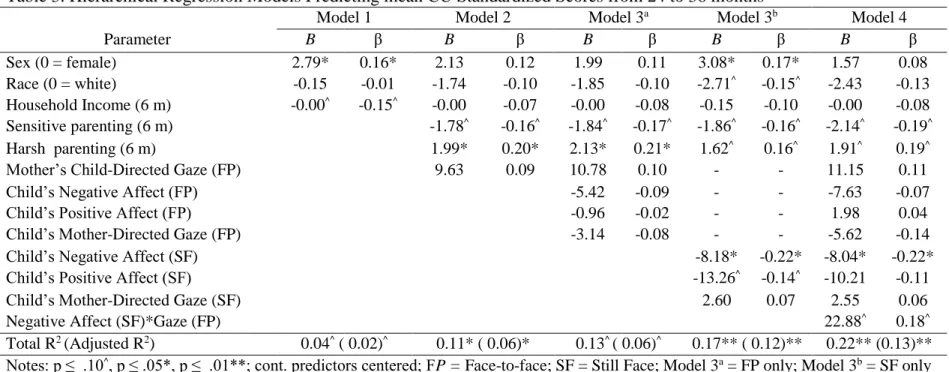
can be found in Table 2 and Table 3 for ODD and CU behaviors, respectively.
Contributions of sex, race, and household income approached significance in the
prediction of both ODD (R2 = .04, F(3, 155) = 2.56, p = .057) and CU behaviors (R2 = .04, F(3,
155) = 2.57, p = .056). Results from model 2 indicate that greater harsh parenting at 6 months
predicted higher ODD (B = 2.07, β = .20, p < .05) and higher CU (B = 1.99, β = .20, p < .05)
behaviors in early childhood. The association between positive parenting and CU behaviors
approached significance (B = -1.78, β = -.16, p =.10). Mothers’ child-directed gaze was not
predictive of ODD (B = 2.76, β = .02, n.s) or CU (B = 9.63, β = .09, n.s).
Infant behavior during the FF and SF episodes
Results from models 3a and 3b indicate that CU behaviors and ODD in early childhood
are predicted by infant behaviors during the FFSFP at 6 months. Specifically, infant behaviors
during the FF episode explained a significant amount of variance in ODD (R2 = .18, F(9, 113) =
2.82, p < .01). Infants’ expressed negative affect (B = -12.68, β = -.21, p < .05) and
mother-directed gaze (B = -8.29, β = -.21, p = .05) during the FF episode predicted fewer ODD
behaviors in early childhood. Additionally, infant behaviors during the SF episode explained a
significant amount of variance in ODD (R2 = .18, F(8, 118) = 3.45, p < .01) and CU (R2 = .17,
F(8, 118) = 3.10, p < .01) behaviors. Infants’ expressed negative affect predicted fewer ODD (B
= -10.01, β = -.27, p < .01) and CU (B = -8.18, β = -.22, p < .05) behaviors in early childhood.
Model 4 tested the extent to which the association between infants’ expressed negative
reactivity to a stressor and ODD and CU behaviors in early childhood is moderated by a
propensity to socially orient during free play. Results suggest that infants’ mother-directed gaze
during the FF episode interacted with expressed negative affect during the SF episode to predict
a mean of ODD from 24 to 36 months (B = 27.27, β = .21, p < .05). This interaction was probed
FF episode (Figure 1). Examination of simple slopes indicated that, although the association
between expressed negative affect during the SF episode and ODD in early childhood is negative
for children who were at or below the mean for amount of mother-directed gaze during the FF
episode (-1 SD simple slope = -15.3774(SE = 4.9837), t=-3.0856, p=0.0026; mean simple slope
= -9.3497(SE = 3.669), t=-2.5483, p=0.0123) (i.e., children who expressed less negative affect
during the SF episode demonstrated higher ODD scores), this association was attenuated (i.e.,
not significantly different from zero) for those children who consistently oriented or gazed
towards their mother during the FF episode (+1 SD simple slope = -3.3219(SE = 4.0754),
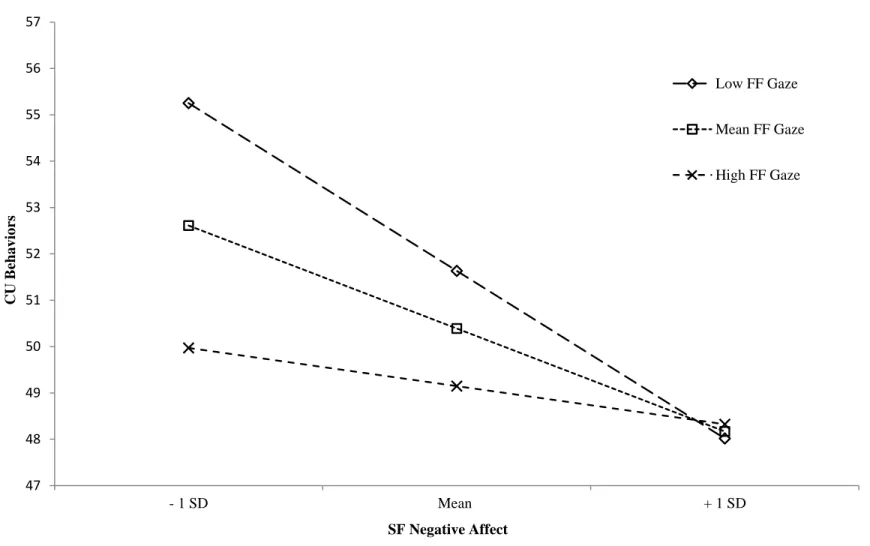
t=-0.8151, p=0.4169). Furthermore, regression results and examination of graphed estimated values
of CU behaviors (Figure 2) suggest a similar moderating relationship between expressed
negative affect during the SF episode and infants’ mother-directed gaze during the FF episode in
the prediction of CU behaviors (-1 SD simple slope = -13.0986(SE = 4.9033), t=-2.6714,
p=0.0088; mean simple slope = -8.0417(SE = 3.6098), t=-2.2277, p=0.0281; +1 SD simple slope
= -2.9847(SE = 4.0096), t=-0.7444, p=0.4584, although, this association only approached
significance (B = 22.88, β = .18, p = .059).
Discussion
Empirical investigations of the etiology of disruptive behavior problems in early
childhood have been the focus of substantial developmental and clinical research given the
evidence for their relative stability (Campbell, Pierce, Moore, & Marakovitz, 1996; Hawes &
Dadds, 2007; Heller, Baker, Henker, & Hinshaw, 1996), their associations with disruptions in
other domains of functioning like social competence (Campbell, 2002; Moffitt, 1993), and their
predictive relationship with other, more serious, antisocial and psychopathic behavior later in
of all children who meet diagnostic criteria for behavior disorder also exhibit
callous-unemotional traits (Frick & Viding, 2009) and the clear clinical and public health implications of
understanding the etiology of these behaviors, there is a paucity of prospective longitudinal
research that has extended downward the study of the early correlates of these behavioral
phenotypes from adolescence and adulthood into infancy. The current study examined the links
between 1) infants’ negative affect during the SF episode of the FFSFP and ODD and CU
behaviors in early childhood, 2) infants’ mother-directed gaze during the FF episode of the
FFSFP and ODD and CU behaviors in early childhood, and 3) explored the extent to which
infants’ mother-directed gaze attenuates the hypothesized relationship between a lack of negative
affect during the SF episode and CP and CU behaviors in early childhood. Hierarchical
regression analyses revealed that infants’ expressed negative affect and mother-directed gaze
during the FF episode predicted fewer ODD behaviors in early childhood. Similarly, infants’
expressed negative affect during the SF episode predicted fewer ODD and CU behaviors in early
childhood. Further, examination of interaction effects suggested that mother-directed gaze during
the FF episode attenuated the negative relationship between negative affect during the SF
episode and ODD and, at least marginally, CU behaviors in early childhood.
The SF episode of the FFSFP (Tronick et al., 1978), during which mothers are instructed
to become verbally and emotionally unresponsive, has been shown to elicit negative affect from
the infant. Our findings indicate that, in the context of this relational stressor, less expressed
negative affect relative to other infants (i.e., less reactivity) at 6 months was associated with
higher levels of ODD and CU behaviors in early childhood controlling for observed parenting
outside of the FFSFP and mother behavior during the FFSFP. This is consistent with clinical
aberrant relational functioning (Frick, Barry, & Bodin, 2000; Loney et al., 2003) and
under-arousal to presumed stressful or aversive stimuli (Frick & Morris, 2004; Marsh et al., 2008;
Stadler et al., 2011). The current study provides confirmation and extension of work done by
Barker and colleagues (2011) in which they found that maternal-rated child lack of inhibition,
what could be conceptualized as underreactivity when reactivity is expected, at age 2 predicts
both conduct problems and CU traits in early adolescence, controlling for other familial and
contextual risks (Barker, Oliver, Viding, Salekin, & Maughan, 2011). Similarly, Baker and
colleagues (2012) found that infants’ responses to a laboratory based paradigm intended to be
stressful predicted blunted behavioral and physiological responses to stress-inducing stimuli in
toddlerhood, suggesting some level of stability of this early behavioral phenotype (Baker,
Baibazarova, Ktistaki, Shelton, & Van Goozen, 2012).
Our findings also indicate that less mother-directed gaze during the FF episode of the
FFSFP at 6 months is associated with more ODD symptoms later, but interestingly we did not
find this association with CU behaviors. However, moderation analyses indicated that high
amounts of mother-directed gaze diminished the observed relationship between less negative
reactivity to mothers’ unresponsiveness during the SF episode and later ODD behaviors, and did
so marginally for later CU behaviors as well. This is partially consistent with extant findings
that older children and adolescents high on ODD and CU traits exhibit deficits in the extent to
which they make eye contact with caregivers during dyadic interactions (see Frick et al., 2014
for review) and that these deficits contribute to maladaptive social functioning (Dadds et al.,
2011).
A possible explanation of the current findings comes from classic attachment theory
orientation as primary mechanisms of communication with caregivers. When viewed through
this lens, infants’ positive affect and mother-directed gaze during the FF episode of the FFSFP
promote affiliation and continued reciprocity which, when responded to appropriately, promote
sensitive parenting and the formation of secure attachment relationships (Ainsworth, Blehar,
Waters, & Wall, 1978; Bowlby, 1969/1982). Interestingly, children and adolescents high on
ODD and CU traits have been shown to have low levels of eye contact with attachment figures
(Dadds et al., 2013; Dadds et al., 2011; Dadds et al., 2012) and are more likely to form insecure
attachments than youth with normative levels of ODD and CU behaviors (Fearon,
Bakermans-Kranenburg, van IJzendoorn, Lapsley, & Roisman, 2010; Pasalich, Dadds, Hawes, & Brennan,
2012). Work by Kochanska and her colleagues has shown that early attachment security may
enhance the positive outcomes associated with adaptive parenting (Kochanska, Aksan, Knaack,
& Rhines, 2004) and buffer against maladaptive trajectories of antisocial behaviors (Kochanska
et al., 2009). Thus, the current findings may suggest that high amounts of infants’
mother-directed gaze may indicate the foundations of a secure attachment relationship that buffers the
child from affective and emotional risks for ODD and CU behaviors.
Speculative Considerations and Implications for Future Research
The notion of heterotypic continuity as it applies to etiological processes associated with
ODD and CU traits in early life suggests that common underlying mechanisms influence
multiple phenotypic behaviors and that dynamic relations between these underlying mechanisms
may result in one influencing the developmental progression of another. Consistent with the
concept of heterotypic continuity, damage to the amygdala, a neural system implicated in
emotional dysfunction and fearlessness in children and adults with CU traits (Blair, 2008), has
2007). Furthermore, there is research to suggest that older samples who exhibit CU traits show
low levels of attention to affective cues (Newman et al., 2010) and that these attentional deficits,
especially when referring to orienting and attending to the eye region of others, may contribute to
dysfunctional recognition and interpretation of emotionally salient stimuli (Richell et al., 2003).
For example, Newman and colleagues (2010) showed that the startle response to fear stimuli
could be normalized for psychopathic adults if they were told to redirect their attention to key
features. Our findings might suggest that very early deficits in relational attention (as
demonstrated by orienting towards another during a dyadic interaction) and under-reactivity to
arousing stimuli may be independent precursors of later ODD and CU behaviors, and their
co-occurrence may multiplicatively affect the likelihood of developing elevated ODD and CU
behaviors. More specifically, given the associations between attentional processes and successful
interpretation of emotionally salient stimuli, an early ability to socially attend to one’s caregiver
in infancy may attenuate the risk of developing ODD and CU traits regardless of affective
reactivity to a mild relational stressor. It is important to note that the extent to which these infant
behaviors are phenotypic behavioral expressions of underlying neurological functioning cannot
be inferred from this study. The current findings also cannot speak to the nature or direction of
the relationship between attentional behavior and recognition of emotionally salient stimuli. That
being said, the presence of these behaviors in infancy and their relation to ODD and CU
behaviors in early childhood should provide support for future studies to more thoroughly
investigate such questions.
Strengths and Limitations
To our knowledge, this is one of the first studies to downwardly extend the investigation
FFSFP, a paradigm that elicits infants’ behavioral responses to normative and aberrant
interactions with a caregiver, to measure infant behavior rather than maternal report is a unique
contribution to this literature. The use of the FFSFP supports increased specificity with regard to
the etiological processes of interest in a way that more broad measures of temperamental
negativity might not by isolating specific affective and social behaviors that are the basis of
emotional and social processes underlying the development of ODD and CU traits, and perhaps
later antisocial behavior over time. Further, our findings are strengthened by the longitudinal
prospective design of the DCHDS and its demographic diversity, which allows for greater
generalizability than is possible with convenience or clinically-based samples.
There are limitations of this study that are important to note. First, although the current
study included well-designed and validated measures of parenting, infant behaviors, and ODD
and CU behaviors, the age at which we collected the outcomes of interest restricted the extent
which we could include truly diagnostic measures of antisocial behaviors. Therefore, we refer
throughout to behaviors rather than symptoms, although individual differences in these behaviors
are predictive of clinical outcomes. Second, there is emerging evidence that ODD might be
more accurately captured using three distinct dimensions (i.e., irritable, headstrong, hurtful),
which have distinct external correlates (Stringaris & Goodman, 2009). Use of these three
dimensions in future research may provide a more nuanced understanding of atypical
development. Third, the use of a community sample in this study, rather than a clinical sample,
restricted the extent to which our graphed estimates of the moderating relationship between gaze
and negative affect (Figure 1 and 2) were able to predict ODD and CU behaviors at clinically
significantly elevated ODD and CU behaviors in early childhood but the use of an older,
clinically informed, sample might yield stronger results.
Conclusions and Next Steps
This study has several implications for future research in this domain. First, it is possible
that infants’ mother-directed gaze and negative affectivity is representative of underlying
individual differences in psychophysiological and neurobiological functioning. Psychobiological
models of under-arousal and emotion processing and their etiological significance for behavior
problems and CU traits now include physiological (e.g. Gao, Glenn, Schug, Yang, & Raine,
2009; Hawes et al., 2009; Loney et al., 2006; Stadler et al., 2011; Willoughby et al., 2011) and
neurological (e.g. Jones, Laurens, Herba, Barker, & Viding, 2009; Marsh et al., 2008; Kiehl et
al., 2001) systems that influence these responses. Future studies should investigate infants’
concurrent biological and behavioral functioning in response to a stressor and the extent to which
individual differences in dual-system functioning predict ODD and CU traits later in childhood.
Second, an outstanding empirical question is whether the relationship between under-arousal to
stimuli and the development of ODD and CU traits differs as a function of relational (i.e.,
interacting with a caregiver) versus static (i.e., laboratory fear paradigm) stressors. Third, extant
literature suggests that the developmental pathways from low eye contact to behavioral problems
and CU traits may be different for mother-child and father-child dyads (Dadds et al., 2011;
Dadds et al., 2012). Replication of the current study using the FFSFP with both mothers and
fathers would significantly advance the literature. Fourth, given the emerging evidence linking
ODD and CU traits to insecure attachment relationships in older samples (e.g., Fearon et al.,
2010; Pasalich et al., 2012), a highly relevant line of research would attempt to replicate and
extension of the study of behavioral precursors in infancy to ODD and CU behaviors in
childhood and adolescence will aid in the development of early and targeted preventive
Table 1. Zero-order Bivariate Correlations Between Model Outcomes
1 2 3 4 5 6 7 8 9 10 11 12 13 14
1. Sex (0 = female) -
2. Race (0 = white) -.08 -
3. Household Income (6 m) .08 -.21**
-
4. Sensitive parenting (6 m) .05 -.30**
.32** -
5. Harsh parenting (6 m) -.05 .31** -.32** -.37**
-
6. Mother’s Child-Directed Gaze (FP)
.23** .01 .06 .13 .05 -
7. Child’s Negative Affect (FP) .05 -.07 .04 -.04 .01 .04 - 8. Child’s Positive Affect (FP) -.07 .04 -.11 -.00 .10 .00
-.27** -
9. Childs’ Mother-Directed Gaze (FP)
-.05 .21** -.19* -.02 .17* .06 .00 .50* *
-
10. Child’s Negative Affect (SF) .11 .02 -.18* -.05 -.01 -.06 .31** -.04 .09 - 11. Child’s Positive Affect (SF) -.08 -.12 .13 .16 -.12 .05 -.10 .43*
*
.13 -.24**
-
12. Child’s Mother-Directed Gaze (SF)
-.01 .13 -.14 -.03 .10 -.03 -.10 .26* *
.41* *
.05 .03 -
13. ODD (24, 20, 36 month mean) .17* -.09 -.00 -.09 .13 .06 -.18* -.07 -.16* -.17* -.13 .01 - 14. CU (24, 20, 36 month mean) .16* -.04 -.13 -.19* .21*
*
.12 -.04 -.02 -.02 -.10 -.14 .06 .69** -
Number 206 206 170 175 175 151 165 165 165 159 159 153 184 184 Mean .51 .57 49,405 3.2 2.5 .90 .06 .21 .40 .19 .05 .49 51 50 Standard Deviation .50 .49 40,670 .80 .91 .08 .14 .19 .22 .27 ..09 .24 8.6 8.3 Notes: p ≤ .05*, p ≤ .01**; T-scores reported for ODD and CU
2
Table 2. Hierarchical Regression Models Predicting mean ODD Standardized Scores from 24 to 36 months
Model 1 Model 2 Model 3a Model 3b Model 4
Parameter B β B β B β B β B β
Sex (0 = female) 3.41* 0.19* 3.51* 0.19* 3.23* 0.18* 4.69** 0.26** 3.18^ 0.17^
Race (0 = white) -1.01 -0.05 -1.58 -0.08 -1.66 -0.09 -2.34 -0.12 -1.57 -0.08
Household Income (6 m) 0.00 0.03 0.00 0.08 0.00 0.04 0.00 0.01 0.00 0.02
Sensitive parenting (6 m) -0.20 -0.01 -0.27 -0.02 -1.03 -0.09 -0.89 -0.08
Harsh parenting (6 m) 2.07* 0.20* 2.37* 0.23* 1.38 0.13 1.90^ 0.18^
Mother’s Child-Directed Gaze (FP) 2.76 0.02 5.96 0.05 - - 4.01 0.03
Child’s Negative Affect (FP) -12.68* -0.21* - - -10.98 -0.11
Child’s Positive Affect (FP) -2.11 -0.04 - - -1.23 -0.02
Child’s Mother-Directed Gaze (FP) -8.29* -0.21* - - -5.34 -0.13
Child’s Negative Affect (SF) -10.01** -0.27** -9.34* -0.25*
Child’s Positive Affect (SF) -15.28^ -0.15^ -8.54 -0.09
Child’s Mother-Directed Gaze (SF) -2.95 -0.08 -3.26 -0.08
Negative Affect (SF)*Gaze (FP) 27.27* 0.21*
Total R2 (Adjusted R2) 0.04 (0.02) 0.08 (0.03) 0.18** (0.11)** 0.19** ( 0.13)** 0.24** ( 0.14)**
Notes: p ≤ .10^, p ≤ .05*, p ≤ .01**; cont. predictors centered; FP = Face-to-face; SF = Still Face; Model 3a = FP only; Model 3b = SF only
2
Table 3. Hierarchical Regression Models Predicting mean CU Standardized Scores from 24 to 36 months
Model 1 Model 2 Model 3a Model 3b Model 4
Parameter B β B β B β B β B β
Sex (0 = female) 2.79* 0.16* 2.13 0.12 1.99 0.11 3.08* 0.17* 1.57 0.08
Race (0 = white) -0.15 -0.01 -1.74 -0.10 -1.85 -0.10 -2.71^ -0.15^ -2.43 -0.13
Household Income (6 m) -0.00^ -0.15^ -0.00 -0.07 -0.00 -0.08 -0.15 -0.10 -0.00 -0.08
Sensitive parenting (6 m) -1.78^ -0.16^ -1.84^ -0.17^ -1.86^ -0.16^ -2.14^ -0.19^
Harsh parenting (6 m) 1.99* 0.20* 2.13* 0.21* 1.62^ 0.16^ 1.91^ 0.19^
Mother’s Child-Directed Gaze (FP) 9.63 0.09 10.78 0.10 - - 11.15 0.11
Child’s Negative Affect (FP) -5.42 -0.09 - - -7.63 -0.07
Child’s Positive Affect (FP) -0.96 -0.02 - - 1.98 0.04
Child’s Mother-Directed Gaze (FP) -3.14 -0.08 - - -5.62 -0.14
Child’s Negative Affect (SF) -8.18* -0.22* -8.04* -0.22*
Child’s Positive Affect (SF) -13.26^ -0.14^ -10.21 -0.11
Child’s Mother-Directed Gaze (SF) 2.60 0.07 2.55 0.06
Negative Affect (SF)*Gaze (FP) 22.88^ 0.18^
Total R2 (Adjusted R2) 0.04^ ( 0.02)^ 0.11* ( 0.06)* 0.13^ ( 0.06)^ 0.17** ( 0.12)** 0.22** (0.13)**
Notes: p ≤ .10^, p ≤ .05*, p ≤ .01**; cont. predictors centered; FP = Face-to-face; SF = Still Face; Model 3a = FP only; Model 3b = SF only
2
47 48 49 50 51 52 53 54 55 56 57
- 1 SD Mean + 1 SD
O
DD
SF Negative Affect
Low FF Gaze
Mean FF Gaze
High FF Gaze
Figure 1. The relationship between negative affect and ODD as a function of mother-directed gaze.
2
47 48 49 50 51 52 53 54 55 56 57
- 1 SD Mean + 1 SD
CU
B
eha
v
io
rs
SF Negative Affect
Low FF Gaze
Mean FF Gaze
High FF Gaze
Figure 2. The relationship between negative affect and CU behaviors as a function of mother-directed gaze.
2
REFERENCES
Achenbach, Thomas M., and Leslie Rescorla. ASEBA Preschool Forms & Profiles: An Integrated System of Multi-informant Assessment. Aseba, 2000.
Adamson, L. B., & Frick, J. E. (2003). The Still Face: A History of a Shared Experimental Paradigm. Infancy, 4(4), 451-473. doi:10.1207/S15327078IN0404_01
Ainsworth, M., Blehar, M. C., Waters, E., & Wall, S. (1978). Patterns of attachment: A psychological study of the strange situation. Oxford England: Lawrence Erlbaum.
Anastassiou-Hadjicharalambous, X., & Warden, D. (2008). Physiologically-indexed and self-perceived affective empathy in conduct-disordered children high and low on callous-unemotional traits. Child Psychiatry and Human Development, 39, 503-517.
Baker, E., Baibazarova, E., Ktistaki, G., Shelton, K. H., & van Goozen, S. M. (2012).
Development of fear and guilt in young children: Stability over time and relations with psychology. Development And Psychopathology, 24(3), 833-845.
doi:10.1017/S0954579412000399
Barker, E. D., Oliver, B. R., Viding, E., Salekin, R. T., & Maughan, B. (2011). The impact of prenatal maternal risk, fearless temperament and early parenting on adolescent callous unemotional traits: A 14‐year longitudinal investigation. Journal Of Child Psychology And Psychiatry, 52(8), 878-888. doi:10.1111/j.1469-7610.2011.02397.x
Blair, R. R. (1999). Responsiveness to distress cues in the child with psychopathic
tendencies. Personality And Individual Differences, 27(1), 135-145. doi:10.1016/S0191 8869(98)00231-1
Blair, R.J.R. (2008). Fine cuts of empathy and the amygdala: Dissociable deficits in psychopathy and autism. Quarterly Journal of Experimental Psychology, 61, 157– 170.
Blair, R. R., Peschardt, K. S., Budhani, S. S., Mitchell, D. V., & Pine, D. S. (2006). The
development of psychopathy. Journal Of Child Psychology And Psychiatry, 47(3-4), 262 275. doi:10.1111/j.1469-7610.2006.01596.x
Blair, J., Mitchell, D., & Blair, K. (2005). The psychopath: Emotion and the brain. Malden: Blackwell Publishing.
Bowlby, J. (1969). Attachment and loss v. 3 (Vol. 1). Random House.
Braungart-Rieker, J. M., Garwood, M. M., Powers, B. P., & Wang, X. (2001). Parental sensitivity, infant affect, and affect regulation: Predictors of later attachment. Child Development, 72(1), 252-270. doi:10.1111/1467-8624.00277
Campbell, S. B. (2002). Behavior problems in preschool children: Clinical and developmental issues (2nd ed.). New York, NY US: Guilford Press.
Campbell, S. B., Pierce, E. W., Moore, G., & Marakovitz, S. (1996). Boys' externalizing problems at elementary school age: Pathways from early behavior problems, maternal control, and family stress. Development And Psychopathology, 8(4), 701-719.
doi:10.1017/S0954579400007379
Cohn, J. F., Campbell, S. B., & Ross, S. (1991). Infant response in the still-face paradigm at 6 months predicts avoidant and secure attachment at 12 months. Development And
Psychopathology, 3(4), 367-376. doi:10.1017/S0954579400007574
Colder, C. R., Mott, J. A., & Berman, A. S. (2002). The interactive effects of infant activity level and fear on growth trajectories of early childhood behavior problems. Development And
Psychopathology, 14(1), 1-23. doi:10.1017/S0954579402001013
Dadds, M. R., Allen, J. L., McGregor, K., Woolgar, M., Viding, E., & Scott, S. (2013). Callous unemotional traits in children and mechanisms of impaired eye contact during
expressions of love: a treatment target?. Journal of Child Psychology and Psychiatry.
Dadds, M. R., Allen, J. L., Oliver, B. R., Faulkner, N., Legge, K., Moul, C., Woolgar, M., & Scott, S. (2012). Love, eye contact and the developmental origins of empathy v. psychopathy. The British Journal Of Psychiatry, 200(3), 191-196.
doi:10.1192/bjp.bp.110.085720
Dadds, M. R., El Masry, Y., Wimalaweera, S., & Guastella, A. J. (2008). Reduced eye gaze explains 'fear blindness' in childhood psychopathic traits. Journal Of The American Academy Of Child & Adolescent Psychiatry, 47(4), 455-463.
doi:10.1097/CHI.0b013e31816407f1
Dadds, M. R., Fraser, J., Frost, A., & Hawes, D. J. (2005). Disentangling the Underlying Dimensions of Psychopathy and Conduct Problems in Childhood: A Community Study. Journal Of Consulting And Clinical Psychology, 73(3), 400-410.
doi:10.1037/0022-006X.73.3.400
Dadds, M. R., Jambrak, J., Pasalich, D., Hawes, D. J., & Brennan, J. (2011). Impaired attention to the eyes of attachment figures and the developmental origins of psychopathy. Journal Of Child Psychology And Psychiatry, 52(3), 238-245.
doi:10.1111/j.1469-7610.2010.02323.x
child psychopathy. The British Journal Of Psychiatry, 189(3), 280-281. doi:10.1192/bjp.bp.105.018150
Deater-Deckard, K., & Dodge, K. A. (1997). Externalizing behavior problems and discipline revisited: Nonlinear effects and variation by culture, context, and gender. Psychological Inquiry, 8(3), 161-175.
Ekas, N. V., Haltigan, J. D., & Messinger, D. S. (2013). The dynamic still-face effect: Do infants decrease bidding over time when parents are not responsive?. Developmental
Psychology, 49(6), 1027-1035. doi:10.1037/a0029330
Fearon, R., Bakermans-Kranenburg, M. J., van IJzendoorn, M. H., Lapsley, A., & Roisman, G. I. (2010). The significance of insecure attachment and disorganization in the development of children s externalizing behavior: A meta-analytic study. Child Development, 81(2), 435-456. doi:10.1111/j.1467-8624.2009.01405.x
Frick, P. J., Barry, C. T., & Bodin, S. (2000). Applying the concept of psychopathy to children: Implications for the assessment of antisocial youth. In C. B. Gacono (Ed.) , The clinical and forensic assessment of psychopathy: A practitioner's guide (pp. 3-24). Mahwah, NJ US: Lawrence Erlbaum Associates Publishers.
Frick, P. J., Bodin, S., & Barry, C. T. (2000). Psychopathic traits and conduct problems in community and clinic-referred samples of children: Further development of the Psychopathy Screening Device. Psychological Assessment, 12(4), 382-393. doi:10.1037/1040-3590.12.4.382
Frick, P. J., Cornell, A. H., Bodin, S., Dane, H. E., Barry, C. T., & Loney, B. R. (2003). Callous unemotional traits and developmental pathways to severe conduct
problems. Developmental Psychology, 39(2), 246-260. doi:10.1037/0012-1649.39.2.246
Frick, P. J., & Morris, A. (2004). Temperament and Developmental Pathways to Conduct Problems. Journal Of Clinical Child And Adolescent Psychology, 33(1), 54-68. doi:10.1207/S15374424JCCP3301_6
Frick, P. J., & Viding, E. (2009). Antisocial behavior from a developmental psychopathology perspective. Development and Psychopathology, 21(4), 1111-1131.
doi:10.1017/S0954579409990071
Frick, P. J., & White, S. F. (2008). Research review: The importance of callous-unemotional traits for developmental models of aggressive and antisocial behavior. Journal Of Child Psychology And Psychiatry, 49(4), 359-375. doi:10.1111/j.1469-7610.2007.01862.x
Gao, Y., Glenn, A. L., Schug, R. A., Yang, Y., & Raine, A. (2009). The neurobiology of
psychopathy: A neurodevelopmental perspective. The Canadian Psychiatric Association Journal / La Revue De L'association Des Psychiatres Du Canada, 54(12), 813-823.
Hare, R. D., Hart, S. D., & Harpur, T. J. (1991). Psychopathy and the DSM-IV criteria for antisocial personality disorder. Journal Of Abnormal Psychology, 100(3), 391-398. doi:10.1037/0021-843X.100.3.391
Hawes, D. J., Brennan, J., & Dadds, M. R. (2009). Cortisol, callous-unemotional traits, and pathways to antisocial behavior. Current Opinion In Psychiatry, 22(4), 357-362. doi:10.1097/YCO.0b013e32832bfa6d
Hawes, D. J., & Dadds, M. R. (2007). Stability and malleability of callous-unemotional traits during treatment for childhood conduct problems. Journal Of Clinical Child And
Adolescent Psychology, 36(3), 347-355. doi:10.1080/15374410701444298
Heller, T. L., Baker, B. L., Henker, B., & Hinshaw, S. P. (1996). Externalizing behavior and cognitive functioning from preschool to first grade: Stability and predictors. Journal Of Clinical Child Psychology, 25(4), 376-387. doi:10.1207/s15374424jccp2504_3
Jones, A. P., Laurens, K. R., Herba, C. M., Barker, G. J., & Viding, E. (2009). Amygdala hypoactivity to fearful faces in boys with conduct problems and callous-unemotional traits. The American Journal Of Psychiatry, 166(1), 95-102.
doi:10.1176/appi.ajp.2008.07071050
Kiehl, K. A., Smith, A. M., Hare, R. D., Mendrek, A., Forster, B. B., Brink, J., & Liddle, P. F. (2001). Limbic abnormalities in affective processing by criminal psychopaths as revealed by functional magnetic resonance imaging. Biological Psychiatry, 50(9), 677-684.
doi:10.1016/S0006-3223(01)01222-7
Kochanska, G. (1997). Mutually responsive orientation between mothers and their young children: Implications for early socialization. Child Development, 68(1), 94-112. doi:10.2307/1131928
Kochanska, G., Aksan, N., Knaack, A., & Rhines, H. M. (2004). Maternal Parenting and Children's Conscience: Early Security as Moderator. Child Development, 75(4), 1229 1242. doi:10.1111/j.1467-8624.2004.00735.x
Kochanska, G., Barry, R. A., Stellern, S. A., & O'Bleness, J. J. (2009). Early attachment organization moderates the parent–child mutually coercive pathway to children's antisocial conduct. Child Development, 80(4), 1288-1300. doi:10.1111/j.1467 8624.2009.01332.x
conduct, and cognition. Journal Of Child Psychology And Psychiatry, 46(1), 19-34. doi:10.1111/j.1469-7610.2004.00348.x
Kochanska, G., & Murray, K. T. (2000). Mother–child mutually responsive orientation and conscience development: From toddler to early school age. Child Development, 71(2), 417-431. doi:10.1111/1467-8624.00154
Kotler, J. S., & McMahon, R. J. (2005). Child psychopathy: Theories, measurement, and
relations with the development and persistence of conduct problems. Clinical Child And Family Psychology Review, 8(4), 291-325. doi:10.1007/s10567-005-8810-5
Loeber, R., & Hay, D. (1997). Key issues in the development of aggression and violence from childhood to early adulthood. Annual Review Of Psychology, 48371-410.
doi:10.1146/annurev.psych.48.1.371
Loney, B. R, Butler, M. A, Lima, E. N, et al. (2006). The relation between salivary cortisol, callous-unemotional traits, and conduct problems, in an adolescent nonreferred sample. Journal of Child Psychology and Psychiatry, 47, 30–36.
Loney, B. R., Frick, P. J., Clements, C. B., Ellis, M. L., & Kerlin, K. (2003). Callous
unemotional traits, impulsivity, and emotional processing in adolescents with antisocial behavior problems. Journal Of Clinical Child And Adolescent Psychology, 32(1), 66-80. doi:10.1207/15374420360533077
Loney, B. R., Lima, E. N., & Butler, M. A. (2006). Trait Affectivity and Nonreferred Adolescent Conduct Problems. Journal Of Clinical Child And Adolescent Psychology, 35(2), 329-336. doi:10.1207/s15374424jccp3502_17
Lynam, D. R., Caspi, A., Moffitt, T. E., Loeber, R., & Stouthamer-Loeber, M. (2007). Longitudinal evidence that psychopathy scores in early adolescence predict adult psychopathy. Journal Of Abnormal Psychology, 116(1), 155-165. doi:10.1037/0021 843X.116.1.155
Lykken, D. T. (1995). The antisocial personalities. Hillsdale, NJ England: Lawrence Erlbaum Associates, Inc.
Maccoby, E. E. (1992). The role of parents in the socialization of children: An historical overview. Developmental Psychology, 28(6), 1006-1017. doi:10.1037/0012-1649.28.6.1006
Mesman, J., van IJzendoorn, M. H., & Bakermans-Kranenburg, M. J. (2009). The many faces of the Still-Face Paradigm: A review and meta-analysis. Developmental Review, 29(2), 120-162. doi:10.1016/j.dr.2009.02.001
Moffitt, T. E. (1993). Adolescence-limited and life-course-persistent antisocial behavior: A developmental taxonomy.Psychological Review, 100(4), 674-701. doi:10.1037/0033 295X.100.4.674
Moore, G. A., Cohn, J. F., & Campbell, S. B. (2001). Infant affective responses to mother's still face at 6 months differentially predict externalizing and internalizing behaviors at 18 months. Developmental Psychology, 37(5), 706-714. doi:10.1037/0012-1649.37.5.706
Moore, G. A., Hill-Soderlund, A. L., Propper, C. B., Calkins, S. D., Mills-Koonce, W., & Cox, M. J. (2009). Mother—infant vagal regulation in the face-to-face still-face paradigm is moderated by maternal sensitivity. Child Development, 80(1), 209-223.
doi:10.1111/j.1467-8624.2008.01255.x
Newman, J. P., & Lorenz, A. R. (2003). Response modulation and emotion processing: Implications for psychopathy and other dysregulatory psychopathology. In R. J.
Davidson, K. R. Scherer, H. Goldsmith (Eds.) , Handbook of affective sciences (pp. 904-929). New York, NY US: Oxford University Press.
Newman, J. P., Curtin, J. J., Bertsch, J. D., & Baskin-Sommers, A. R. (2010). Attention moderates the fearlessness of psychopathic offenders. Biological Psychiatry, 67(1), 66-70. doi:10.1016/j.biopsych.2009.07.035
NICHD ECCRN (1999) Child care and mother-child interaction in the first three years of life. Developmental Psychology, 35(6), 1399-1413. Doi:10.1037/0012-1649.35.6.1399
Pardini, D., Lochman, J., & Powell, N. (2007). The development of callous–unemotional traits and antisocial behavior in children: Are there shared and/or unique predictors? Journal of Clinical Child and Adolescent Psychology, 36, 319–333.
Pardini, D., Obradović, J., & Loeber, R. (2006). Interpersonal Callousness,
Hyperactivity/Impulsivity, Inattention, and Conduct Problems as Precursors to
Delinquency Persistence in Boys: A Comparison of Three Grade-Based Cohorts.Journal Of Clinical Child And Adolescent Psychology, 35(1), 46-59.
doi:10.1207/s15374424jccp3501_5
Pasalich, D. S., Dadds, M. R., Hawes, D. J., & Brennan, J. (2012). Attachment and callous unemotional traits in children with early‐onset conduct problems. Journal Of Child Psychology And Psychiatry, 53(8), 838-845. doi:10.1111/j.1469-7610.2012.02544.x