8G Chapter 5
5.2.1 - Monomials and
Binomials
• Key Skill: WWBAT use a geometric
Key Vocabulary
• Term is a component of amathematical expression – Examples: x, 5, 3x, xy, x2
• Remember, combining like terms
refers to adding (or subtracting) a bunch of terms
– Example: 3x2 + 2x + 7 - x2 - 3x -2 contains
Key Vocabulary
• Like terms meet both of two tests
1) They must have the same variable, AND
2) The variable must be raised to the same exponent
• 4x3 and 2x3 are like terms
• 3x and 3x2 are not like terms
Combining Like Terms
• Simplify the following expression bycombining like terms:
Combining Like Terms
• Simplify the following expression bycombining like terms:
k + 4k2 + 13 - 2k3 + 2k - 6 + 6k3 + 3k2
Distributive Property
Example
• How about this one:
Distributive Property
Example
• How about this one:
x(2x+4) + y(y-2) + 3x + 2x2 + 5y
Remember…..
• Multiply what’s on the outside of the
parenthesis by EVERYTHING on the inside:
Remember…..
• Multiply what’s on the outside of the
parenthesis by EVERYTHING on the inside:
How about Division?
• How would we divide (6x2 + 4x) by 2?• The distributive property applies here
as well. We must divide EVERYTHING by 2 just as we would multiply
EVERYTHING by 1/2.
More Examples
(8x3 + 16x2 + 4x + 24) ÷
4
More Examples
(8x3 + 16x2 + 4x + 24)
÷ 4
2x3 + 4x2 + x + 6
(4x3 + 8x2 + 6x) ÷ 2x
Factoring
5x + 25
Factoring
5x + 25
5 is the common factor Divide each term by 5
Answer: 5(x+5) 4x3 + 3x2 + x
x is the common factor Divide each term by x
What is the area?
x
What is the area?
• One way to see the area is as x(x+1)
x
What is the area?
• Another way: Area of square = x2 and area
of small rectangle is 1x, so total is x2 + x
x
How about this one?
p p
p
How about this one?
3p(2p+4) = 6p2 + 12p
p p
p
p p 1 1 1 1 p2 p2 p2 p2 p2 p2 p p
p p p p p
p p p p
5.2.2 - Multiplying Binomials
• Key Skill: WWBAT use a geometric
Key Vocabulary
• Monomial is a variable expression with
a single term: x, 7x, x3, 8x5, or 4xy
• Binomial is a variable expression with 2
terms: x+1, 3x-5y, 4x2-7, 9xyz+4
• Trinomial is a variable expression with 3
Geometric Model
• What is the area of the large rectangle?
x
x
2
Geometric Model
• We can look at it as length times width
or (x+3)(x+2)
x
x
2
Geometric Model
• Or we can look at it in pieces that add
up to x2 + 5x + 6
Geometric Model
• Thus, a way to think about multiplying
(x+3)(x+2) is by using an “area” model and assigning one binomial to the
“length” and the other to the “width”.
• Note that multiplying two binomials
Another Example
• What is the area of the large rectangle?
x
x
3
Another Example
x2 + 8x + 15
x
x
3
5
x2 5x
5.2.5 - Multiplying Binomials
• Key Skill: WWBAT to use the
Geometric Model
• To multiply (x+3)(x+2) we can use the
area model.
x
x
2
Geometric Model
• We can look at it in pieces that add up
to x2+5x+6
Using a Table to Multiply
• Another way to multiply (x+3)(x+2) isto use a table to display the Distributive Property.
x 3
x
Using a Table to Multiply
• Another way to multiply (x+3)(x+2) isto use a table to display the Distributive Property.
x 3
x x2 3x
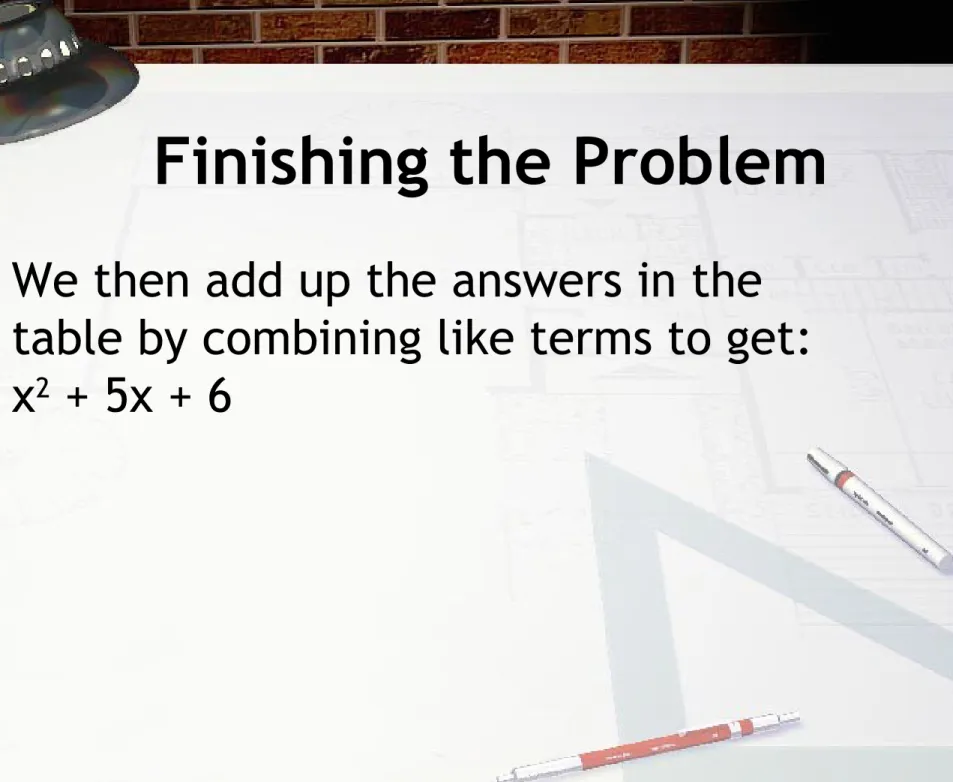
Finishing the Problem
• We then add up the answers in theAnother Example
• Multiply: (2x+4)(3x-2)2x 4
3x
Another Example
• Multiply: (2x+4)(3x-2)
• Add up the answers to get: 6x2 + 8x - 8
2x 4
3x 6x2 12x
Now You Try
Expand the following expression: (x + 6)(x + 8) =
(3x + 2)(5x + 9) =
Now You Try
Expand the following expression: (x + 6)(x + 8) = x2 + 14x +48
(3x + 2)(5x + 9) = 15x2 + 37x + 18
FOIL Method
• The quickest way of multiplying binomials is
to use the Distributive Property directly:
• (2x+3)(x+1)=
– Multiply the First term in each (2x · x)=2x2
– then the Outside terms (2x · 1)=2x – then the Inside terms (3 · x)=3x
– and finally the Last terms (3 · 1)=3
FOIL Method
• Warning: FOIL works ONLY whenmultiplying a binomial by another binomial.
– For problems like: (x + 4)(x2 + 2x - 8)
Example
• Problems involving subtraction are
treated the same way, we must just be careful with signs.
• Find the product of the following:
Example
• (x + 5)(x - 4) can be treated like
(x + 5)(x + (-4))
• First: x times x = x2
• Outside: x times -4 = -4x • Inside: 5 times x = 5x
More Examples
More Examples
(x + 9)(x + 1) First: x2
Outside: 1x Inside: 9x Last: 9
Total x2 + 10x + 9
(4x - 4)(5x - 2) First: 20x2
Outside: -8x Inside: -20x Last: 8
Factoring
• Look at the trinomial: x2 + 7x + 6
• What were the two binomials that
were multiplied to get the trinomial?
Factoring
• Look at the trinomial: x2 + 7x + 6
• What were the two binomials that
were multiplied to get the trinomial?
Classwork
• Page 230, #1-4• Page 232, #1-8
• No need to draw rectangle diagrams,
5.3.1 - Special Products:
Perfect Squares
• Key Skill: WWBAT expand squared
Example
• How would we solve: (7+3)2Example
• How would we solve: (7+3)2• Is it the same as 72 + 32 ? No!!!
• We know 102 = 100 and we know that
(7+3)2 = 100
• Is 72 + 32 the same thing? No!!!
Example
• How would we solve: (x+2)2• First we rewrite as (x+2)(x+2)
• Then we can use the FOIL method to
More Examples
More Examples
(x+5)2
(x+5)(x+5) First: x2
Outside: 5x Inside: 5x Last: 25
Total: x2 + 10x + 25
(x+6)2
(x+6)(x+6) First: x2
Outside: 6x Inside: 6x Last: 36
Patterns?
• Do we see a pattern when we square a
Patterns?
• Do we see a pattern when we square a
binomial?
What about Subtraction?
What about Subtraction?
How do we solve: (x-5)2
Rewrite as: (x-5)(x-5) First: x2
Outside: -5x Inside: -5x Last: 25
Factoring
• Look at the trinomial: x2 + 16x + 64
• What was the binomial that we
squared to get the trinomial?
Factoring
• Look at the trinomial: x2 + 16x + 64
• What was the binomial that we
squared to get the trinomial?
5.3.2 - Special Products:
Difference of Squares
• Key Skill: WWBAT identify patterns in
Differences of Squares
• Here’s another special situation:Differences of Squares
• Here’s another special situation:(x+2)(x-2) =
First: x2
Outside: -2x Inside: 2x Last: -4
More Examples
More Examples
(x+4)(x-4) First: x2
Outside: -4x Inside: 4x
Last: -16
Total: x2 - 16
(3x+1)(3x-1) First: 9x2
Outside: -3x Inside: 3x
Last: -1
Patterns
• Do we see any patterns from this kind
Patterns
• Do we see any patterns from this kind
of problem?
Mental Math
• How could we use this pattern to
Mental Math
• How could we use this pattern to
quickly multiply 54 by 46?
• (50+4)(50-4) = 502 - 42
• 2500 - 16 = 2484
• Note: this only works when the EXACT
Factoring
• Look at the expression: x2 - 81• What were the two binomials
multiplied together?
Factoring
• Look at the expression: x2 - 81• What were the two binomials
multiplied together?
Classwork
• Page 247 #1, 5, 6Multiplying Trinomials
• Key Skill: WWBAT use the distributive
More Than Two Terms
• Distributive Property states that wemultiply EVERYTHING inside one set of parenthesis by EVERYTHING inside
another set of parenthesis.
• How would we find the product for the
Example
• (x+1)(2x+y+3)=
• Add it up to get 2x2+5x+xy+y+3
x 1
2x 2x2 2x
y xy y
Examples
(3x - 1)(4x2 - 7x + 3) (4x2 + 5x - 9)(6x2 - x +
Examples
(3x - 1)(4x2 - 7x + 3)
12x3-21x2+9x
-4x2+7x-3
12x3-25x2+16x-3
(4x2 + 5x - 9)(6x2 - x +
7)
24x4 - 4x3 + 28x2
30x3 - 5x2 + 35x
-54x2 + 9x - 63
24x4 +26x3 -31x2 +44x
Classwork
1) (x+2)(x2+4x-5) =
2) (x-2)(2x2-8x-4) =
3) (x2+3x-1)(3x2-3x+1) =
Classwork
1) (x+2)(x2+4x-5) = x3 + 6x2 + 3x - 10
2) (x-2)(2x2-8x-4) = 2x3 – 12x2 + 12x + 8
3) (x2+3x-1)(3x2-3x+1) = 3x4 + 6x3 – 11x2 + 6x - 1
5.1.4 - Finding Angle Measures
• Key Skill: WWBAT write equations
Find the Missing Angle
• Write an equation for the missing angleand solve the equation:
Find the Missing Angle
• Write an equation for the missing angleand solve the equation:
• 135 + x = 180, therefore x = 45º
Find the Missing Angles
• Write an equation for the missing angleand solve the equation:
58º
Find the Missing Angles
• Write an equation for the missing angleand solve the equation:
• 90 + 58 + x = 180, therefore x = 32º
58º
Find the Missing Angles
• Write an equation for the missing angleand solve the equation:
Find the Missing Angles
(4x-35) + (4x+35) = 360 8x = 360
x = 45
4x - 35 = 145º
4x + 35 = 215º 4x-35
Regular Polygon Angles
Regular Polygon Angles
Total Degrees Each Angle 180° 60°
360° 90°
540° 108°
Formulas
• Total Degrees of the angles in a
Polygon = 180(n-2)
‘n’ is the number of sides in the polygon
• Degrees of one angle in a regular
polygon =
180(n - 2)