J
Ö N K Ö P I N GI
N T E R N A T I O N A LB
U S I N E S SS
C H O O L JÖNKÖPING UNIVERSITYQ u a l i t y O n l i n e B a n k i n g S e r v i c e s
Bachelor Thesis within Business Administration Author: Vasya Kenova
Bachelor’s Thesis in Business Administration
Title: Quality Online Banking Services Author: Vasya Kenova and Patrik Jonasson Tutor: Börje Boers
Date: May, 2006
Subject terms: Service quality, SERVQUAL, Online banking services, E-SQ Instrument
Abstract
Table of Contents
1
Introduction ... 1
1.1 Background ...1
1.2 Problem Discussion...3
1.3 Purpose ...4
1.4 Research Questions ...4
1.5 Delimitations ...4
1.6 Definitions...5
1.7 Disposition of the Thesis ...6
2
Theoretical Framework... 7
2.1 Traditional Services ...7
2.1.1 Definition and Characteristics of Services...7
2.1.2 Traditional Services Quality...7
2.1.3 SERVQUAL...9
2.1.4 Studies on Traditional Banking Services Quality...10
2.2 E-Services ...11
2.2.1 Definition and Characteristics of E-services...11
2.2.2 E-services Quality...11
2.3 Online Systems Quality ...13
2.3.1 Definition and Importance in Relation to the Study of E-service Quality....13
2.3.2 Studies on Online Systems Quality...13
2.4 E-Banking Services ...14
2.4.1 Definition and Types of E-Banking Services...14
2.4.2 Studies on E-banking Service Quality...15
2.5 E-SQ (E-S-QUAL and E-RecS-QUAL) Instrument for Measuring Online Services Quality...16
2.6 Summary of the Theoretical Framework...18
3
Methodology... 21
3.1 Research Approach...21
3.1.1 Quantitative and Qualitative Research Methods...21
3.2 Sample Selection...22
3.3 Data Collection ...22
3.4 Data Analysis ...24
3.4.1 Cronbach’s Alpha Test of Reliability...24
3.4.2 Principal Component Analysis...24
3.5 Reliability and Validity...25
3.5.1 Reliability...25
3.5.2 Validity...25
4
Empirical Data and Analysis ... 26
4.1 Missing Data...26
4.2 Descriptive Statistics ...26
4.3 Cronbach’s Alpha Test of Reliability ...28
4.4 Principal Component Analysis ...29
4.5 Cronbach’s Alpha Test of Reliability on the Modified Theoretical Model ... .…33
4.7 Descriptive Statistics Analysis (based on the modified theoretical
model)………… ...35
4.7.1 Analysis by Quality Dimension...35
4.7.2 Ranking Satisfaction and Dissatisfaction Levels of Customers on Different Quality Dimensions...40
4.7.3 The Special Case of Föreningssparbanken (FSB)...44
5
Conclusion and Discussions ... 46
5.1 Conclusions ...46
5.2 Discussions ...47
5.3 Managerial Recommendations ...48
5.4 Further Research...49
References………...51
Appendices
Appendix I Users of Internet Banking in Percentage during the first quarter of 2005 (Statistical Central Bureau, Sweden (SCB))
Appendix II Online Systems Quality Studies
Appendix III Description of the questions pertaining to each quality dimension and their number in the questionnaire
Appendix IV Questionnaire on the Quality of Online Banking Services Appendix V Descriptive Statistics of the Empirical Data
Appendix VI Theory and Tables supporting the statistical analysis of the thesis (Principal Component Analysis results)
Appendix VII Tables and Graphs on Frequency of Survey Responses in Percentage
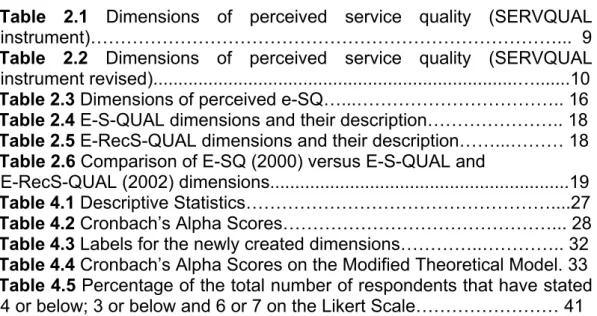
Tables
Table 2.1 Dimensions of perceived service quality (SERVQUAL instrument)………... 9
Table 2.2 Dimensions of perceived service quality (SERVQUAL instrument revised)...…...10
Table 2.3 Dimensions of perceived e-SQ…...……….. 16 Table 2.4 E-S-QUAL dimensions and their description……….. 18 Table 2.5 E-RecS-QUAL dimensions and their description……...……… 18 Table 2.6 Comparison of E-SQ (2000) versus E-S-QUAL and
E-RecS-QUAL (2002) dimensions...19 Table 4.1 Descriptive Statistics………....27 Table 4.2 Cronbach’s Alpha Scores………... 28 Table 4.3 Labels for the newly created dimensions…………..………….. 32 Table 4.4 Cronbach’s Alpha Scores on the Modified Theoretical Model. 33 Table 4.5 Percentage of the total number of respondents that have stated
4 or below; 3 or below and 6 or 7 on the Likert Scale……… 41
Figures
1
Introduction
This chapter has the aim to inform the reader about the increasing importance of
Online Banking Services and their quality. In this chapter the authors discuss the problem,
define their purpose and research questions and mention the delimitations of the presented
study
1.1 Background
Globalization and deregulations have increased competition in the marketplace, as nowadays it has become much easier for companies to cross borders and compete internationally. The increased competition, on its behalf, has made organizations to constantly try to increase their productivity and decrease their costs. One way for them to achieve that is by investing in information technology (Fredriksson, 2003).
The recent development of information technology has led to major changes in the way services are delivered to the customers. Nowadays, customers are using more and more self-service options, which are more convenient and fast. In addition, the advent and use of the Internet has changed considerably the daily activities of most people, such as shopping and banking. The popularity of banking services delivered over the Internet (online banking services) is increasing in recent years (Fredriksson, 2003). According to the figures presented by the Statistical Central Bureau (SCB) in Sweden (Appendix I), during the first quarter of 2005, 51% of the population aged between 16 and 74 has used online banking services.
Online services, including online banking services, are becoming an attractive alternative to visiting service outlets or phoning call centers for increasing number of customers (HR-Focus 2000; Tracking 2001). Some of the reasons for customers to prefer online services (as online banking services) are: convenience (Meuter, Ostrom, Roundtree & Bitner, 2000; Szymanski & Hise, 2000), feeling more in control of the service process (Bateson, 2000; Dabholkar, 1996) and avoiding human contact and saving time (Dabholkar 1996; Meuter et Al., 2000). As far as online services are concerned, it is quite easier for customers to evaluate and compare the benefits of competing services (Santos, 2003). In addition, the switching costs are very low, that is why retaining the customer in the Internet space is of vital importance (Reichheld & Schefter, 2000). In order for service providers to retain their e-customers, they should have better understanding of how customers perceive and evaluate the quality of the electronically offered services. Businesses that have been experienced and successful in offering e-services are starting to apprehend that besides website presence and low price, the important success or failure factors also include the electronic service quality (Yang, 2001; Zeithaml, 2002). Although the literature on service quality is abundant (Parasuraman, Berry & Zeithaml, 1991; Cronin & Taylor, 1992; Zeithaml, Berry & Parasuraman, 1996; Carman, 1990), very little research has been conducted on the evaluation of the quality of services delivered over the Internet (Cox & Dale, 2001).
turning into the crucial factors for success in online banking meaning that the generation of
positive customer value on the Internet requires the establishment of long-term customer relationships (Bauer, Hammerschmidt & Falk, 2005). In today’s oversupplied world, where
customers have very high demands, the financial services organizations are trying to become more customer-focused (Gonzales, Quesada, Picado & Eckelman, 2004). In order for the E-banking to be profitable, banks should focus not only on acquiring new customers but also on the retention of existing customers (Reichheld & Schefter, 2000). According to Mols (2000) the introduction of E-banking services may change crucially the way banks build and maintain their customer relationships. The increased use of the Internet in the future will heighten the expectations and perceptions of customers, thus making e-service quality an increasingly important issue. Thus, understanding service quality issues within the new delivery channel becomes crucial.
In addition, delivering high quality services is a way companies manage to improve their customer relationships. Delivering high quality services is a prerequisite for achieving customer satisfaction and only through customer satisfaction can the company gain loyal customers (Grönroos, 2000). Because of the highly undifferentiated products and services that financial organizations, and specifically banks, offer, service quality becomes main tool for competing in this marketplace (Stafford, 1996; Kim, Han, Choi & Kim, 1998). In general, because of the higher profits and higher customer retention to which they lead, high-quality services are believed to provide banks with competitive edge in the marketplace (Bennett & Higgins, 1988).
From the mentioned above, it becomes obvious that high service quality is essential for surviving in the highly competitive banking environment (Wang, Lo & Hui, 2003). This leads to the fact, that a good understanding of the attributes that customers use to judge service quality is necessary in order for the company to be able to monitor and enhance its service performance and improve its overall service quality.
A lot of research has been conducted about key service quality dimensions and customer requirements in the traditional banking environment, where personal interaction between the customers and the bank employees takes place (Cowling & Newman, 1995; Johnston, 1995; Bahia & Nantel, 2000; Oppewal & Vriens, 2000). However, the service quality attributes and customer requirements involved in Internet banking, where the interaction between the customers and the bank is impersonal, have not been studied enough, which can be implied by the fact that there has not been available a precise measurement instrument for online services quality (Cox & Dale, 2001). Thus, it is really important for Internet banking providers to learn more about their customers’ perceptions of the online banking services quality and the attributes, the customers find essential for a quality financial service delivery on the Internet. Customers have some expectations and criteria when they judge whether the provided E-banking service is satisfactory or not. This is what banks, which provide E-banking services should try to find out, so that they can improve their online services and gain competitive advantage in the banking industry.
1.2 Problem Discussion
When judging the quality of the provided E-banking services, customers consider a lot of factors which influence their judgment. For some customers the response and efficiency of the service providers would be of greatest importance, for others the security and privacy issues might be more important, and still for others what matters most may be the website design and ease of use. In reality, customers have different expectations and requirements. They deem different aspects of the service delivery process for essential in order for them to be satisfied with the service. Nevertheless, there should be some common requirements among users of online banking services, some overall valid expectations, which are of interest in this study.
As the service delivery process on the Internet differs significantly from that in the traditional brick-and-mortar banks’ environment mainly because of the lack of direct contact between the employees and the customers, the attributes for defining a high-quality service delivery are expected to differ in the two contexts. According to Li, Tan and Xie (2002), because of the existing difference between online and traditional services, there exists real challenges in measuring the quality of online services. Although there is a lot of research, made on evaluation of traditional banking services quality (Cowling & Newman, 1995; Johnston, 1995; Bahia & Nantel, 2000; Oppewal & Vriens, 2000), the research on online services quality, in this respect also online banking services quality, is in its infancy (Santos, 2003). As the use of online banking steadily increases over the years (Fredriksson, 2003), knowledge about defining high-quality service delivery over the Internet becomes crucial for banks, which want to stay competitive on the marketplace. If banks have knowledge about the quality attributes they can use to measure the quality of their online services and the overall satisfaction of their customers with each of these attributes, it would be much easier for them to take necessary measures and steps to improve the overall service quality.
For example, if the efficiency of the service provider is deemed very important for the quality of the delivered online services and customers turn out to be unsatisfied with this aspect of the service delivery, it means that banks and their managers should consider that issue carefully and try to improve it. Additionally, this knowledge will also help banks allocate their resources in a way that maximum service quality improvement is achieved. This will eventually lead to gaining competitive advantage, which will help them retain their customers and increase their profitability (Bennett & Higgins, 1988).
Finally, looking at the Swedish context in particular, the issue mentioned above seems to be very important and relevant as according to a report of the Swedish Bankers’ Association, by the end of 2004, more than 5.3 million banks’ customers of a total population of 9 million in the country have been using online banking services. Some surveys have also shown that between 40 and 45 percent of the total population of Sweden communicate with their banks through the Internet (Swedish Bankers’ Association, 2005). Furthermore, according to the Statistical Central Bureau (SCB) in Sweden (Appendix I), during the first quarter of 2005 48% of the people aged between 16 and 24 and 74% of those aged between 24 and 34 have used online banking services. Taking these facts into consideration, looking at the problem of how to measure the quality of online banking
the ones who are going to use the banks’ services for longer time in the future and they should be attracted to stay customers of the bank they use and not switch to another one.
1.3 Purpose
The purpose of this study is:
to provide insight into how customers perceive the quality of online banking services and to develop an instrument consisting of different service quality
dimensions that can be used to measure the quality of such services
1.4 Research Questions
To be able to accomplish the purpose stated above, the research questions of this study are defined as follows:
1. Which service quality dimensions should banks consider when evaluating the quality of their online banking services?
2. How these service quality dimensions of online banking services can be used to measure the quality of online banking services?
3. How do customers perceive the quality of different aspects of the online banking services they use?
1.5 Delimitations
This study is delimitated to gathering empirical data through a questionnaire from a sample of the population in the University area and other random areas in Jönköping, aged below 34, who are using online banking services. In addition, choosing only 200 people aged below 34 may to some extent delimit the generalization of the results and bias the results towards the experiences of only people pertaining to the above-mentioned age range. Despite that the authors believe that the selected age range is a good representative sample of the users of online banking services as according to the Statistical Central Bureau (SCB) in Sweden (Appendix I), during the first quarter of 2005 48% of the people aged between 16 and 24 and 74% of those aged between 24 and 34 have used online banking services. Furthermore, the authors of the thesis decided to focus the study on people aged below 34, but banks may not be interested that much in people from this age range, but more on older people who are probably more expected to take higher loans, trade stocks etc. Despite that the authors assume, that banks should not disregard their younger clients aged below 34. Actually they should consider very carefully the satisfaction level of these customers as they are the ones who are going to use the banks’ services for longer time in the future. That is why they should be attracted to stay customers of the bank they use and not switch to another one.
Finally, the authors of the thesis decided to exclude the questionnaires including non-Swedish banks as the underlying study is applied to the Swedish context, which means that only the responses from people using Swedish banks were included into the analysis.
1.6 Definitions
The authors will present a short description of the following terms which appear a lot throughout the thesis so that the reader has clear understanding of their meaning and can follow more easily the contents of the thesis.
• Online Banking Services (E-banking Services)
Banking services delivered over the Internet. These include opening/closing of account, domestic/foreign money transfer, standing orders, direct debit, debit card application, loan application, credit card application, insurance investment, mutual funds investment, foreign/domestic equity investment, deposit account opening, life insurance contract, traffic insurance contract and etc (Centeno, 2003).
• E-Service Quality
“Consumers’ overall evaluation and judgment of the excellence and quality of e-service offerings in the virtual marketplace” (Santos, 2003, p. 235)
• SERVQUAL
A 22-item instrument for measuring customers’ expectations and perceptions from a service along five quality dimensions: tangibles, reliability, responsiveness, assurance and empathy. (Parasuraman et. Al., 1991)
• E-SQ (E-S-Qual and E-RecS-Qual) Instrument
An instrument similar to the SERVQUAL scale, developed specifically for measuring online services (e-services) quality. It includes two scales: the E-S-QUAL scale consists of 4 dimensions with 22 attributes, including efficiency, fulfillment, system availability and privacy and the E-RecS-QUAL scale which consists of 3 dimensions with 11 attributes, including responsiveness, compensation and contact (Parasuraman, Zeithaml & Malhotra, 2005).
Furthermore, the following terms will be used interchangeably along the thesis as they are used to represent the same things:
E-services and Online services
E-services quality and Online services quality
Model and Instrument
Items and Questions and Variables
1.7 Disposition of the Thesis
Introduction
Theoretical Framework
Methodology
Empirical Data
And Analysis
Conclusion and Discussions
Figure 1.1 Outline of the Thesis (Disposition Model according to JIBS writer, 2006).
• Background
• Problem Discussion
• Purpose
• Research Questions
• Delimitations
• Definitions
• Disposition of the Thesis
• Traditional Services
• E-Services
• Online Systems Quality
• E-Banking Services
• E-SQ (E-S-QUAL and
E- RecS-QUAL) Instrument
• Research Approach
• Sample Selection
• Data Collection
• Data Analysis
• Reliability and Validity
• Missing Data
• Descriptive Statistics
• Cronbach’s Alpha Test of
Reliability
• Principal Component
Analysis
• Cronbach’s Alpha Test of
Reliability on the Modi-fied Theoretical Model
• Modified Theoretical
Model
• Descriptive Statistics
Analysis (based on the modified model)
• Conclusions
• Discussions
• Managerial
Recommendations
2
Theoretical Framework
The second chapter includes the Theoretical Framework of the study, including basic
knowledge in services, service quality, e-services, e-service quality, E-Banking services and
online systems quality. Furthermore, the authors present to the reader two models, namely
the
SERVQUAL
and
E-SQ (E-S-QUAL and E-RecS-QUAL)
models, on the
basis of which the study will be further developed.
2.1 Traditional Services
2.1.1 Definition and Characteristics of Services
The importance of the service sector in recent years is reflected in the increased part of services of the national economies. There is a dramatic shift toward services in the world economy and the number and diversity of service providers increases constantly. In this competitive environment, the service companies have to be faster, leaner, work more efficiently and provide better service quality in order to stay competitive.
In the 1960s, 70s and 80s a range of definitions of services was suggested. In 1990 the following definition was proposed:
“A service is a process consisting of a series of more or less intangible activities that normally, but not necessarily always, take place in interactions between the customer and service employees and/or physical resources or goods and/or systems of the service provider, which are provided as solutions to customer problems”
(Grönroos, 2000, p. 46)
Services have many characteristics that distinguish them from physical goods. As stated by Grönroos (2000, p. 47) some of the main differences between services and physical goods are that services are processes; they are intangible and heterogeneous; they cannot be kept in stock and there is no transfer of ownership; production, distribution and consumption are simultaneous processes in the service context; the core value is produced in buyer-seller interactions and most importantly in service contexts customers participate in the production process. This last characteristic of services that customers participate in the production process is of utmost importance when the issue of service quality is discussed. The reason is that because of the participation of customers in the production of the service, the quality of the service is directly perceived by the customer in the time of production. That is why service quality can be defined as the quality as it is perceived by customers (Grönroos, 2000, p. 63) and therefore the measurement of service quality has been a real challenge for service providers.
2.1.2 Traditional Services Quality
introduced the notion of “Total Perceived Service Quality” which defines how a customer perceives the difference between the expected service and the experienced service.
Figure 2.1 Total Perceived Quality.
Source: Adapted from Grönroos C. (2000), “Service Management and Marketing: A customer Relationship Management Approach”, p. 67.
According to all these early findings, service quality was accepted as a measure of how well the customer expectations were met by the delivered service. Parasuraman, Zeithaml and Berry (1988, p. 15) defined service quality as “the overall evaluation of a service firm that results from comparing that firm’s performance with the customer’s general expectations of how firms in that industry should perform”.
Many researchers have tried to define the dimensions of service quality. There are two main used methods to define the dimensions of service quality (Santos, 2003). According to the first method, service quality is defined in terms of functional quality (“how” the service is delivered = process) and technical quality (“what” service is delivered = outcome) (Grönroos, 2000). The second method tries to define service quality with the help of specific characteristics of a given service. For example, Parasuraman et Al. (1988) describe service quality in five to ten dimensions (responsiveness, reliability, assurance, tangibles and empathy). These five dimensions for defining service quality constitute the SERVQUAL instrument developed by Parasuraman et Al. This instrument has been developed to measure service quality based on the difference of customers’ expectations and perceptions for a given service (the so called disconfirmation method). It has been very popular and widely used in the field of Service Marketing and Management.
The idea of measuring service quality by comparing customers’ expectations and perceptions of a given service has been criticized in recent years. Opponents of this approach argue that measuring only customers’ perceptions is more reliable. Some of the opponents are Cronin and Taylor, who developed the SERVPERF instrument in 1992. This instrument is similar to the SERVQUAL instrument, but it measures service quality only on the basis of customers’ perceptions of a given service. Other opponents to the disconfirmation method are Dabholkar, Shepherd and Thorpe (2000) who have found that measuring only the perception of customers can better evaluate their intention and evaluation. Furthermore, Dabholkar et Al. (2000) state that in this way, detailed service quality studies can be performed with the use of more efficient, simpler and cross-sectional designs. All the above findings have led to defining service quality as an overall evaluation of service performance.
Looking at both ways of defining service quality, based on expectation and perceptions, it becomes obvious that service quality is a multi-dimensional concept, which means different things to different people (Brady & Cronin, 2001).
Total Perceived Quality Expected
Quality
2.1.3 SERVQUAL
SERVQUAL is an instrument for measuring how customers perceive the quality of a service (Grönroos, 2000). In the mid-1980s Berry and his colleagues Parasuraman and Zeithaml began to investigate what determines service quality and how it is evaluated by customers (Grönroos, 2000). As a result of their study they developed the SERVQUAL instrument for measuring service quality, which initially included 10 service quality dimensions, which were later reduced to the following five: tangibles, reliability, responsiveness, assurance and empathy. The following Table 2.1 describes the initial 10
elements of the SERVQUAL instrument.
Table 2.1Dimensions of perceived service quality (SERVQUAL instrument) Service Quality Dimension Definition
Reliability Involves consistency of performance and dependability
Responsiveness Willingness or readiness of employees to provide service
(timeliness of service, giving prompt service)
Competence Possession of the required skills and knowledge to perform
the service
Access ApproacÖhability and ease of contact
Courtesy Politeness, respect, consideration and friendliness of contact
personnel
Communication Keeping customers informed in language they can
understand and listening to them
Credibility Trustworthiness, believability, honesty, and having the
customers’ best interests at heart
Security Freedom from danger, risk and doubt
Understanding/Knowing the customer
Making the effort to understand the customer’s needs
Tangibles Physical evidence of the service
Source: Grönroos, “Service Management and Marketing: A customer Relationship Management Approach”, 2000, p.75
Table 2.2 Dimensions of perceived service quality (SERVQUAL instrument revised)
Service Quality Dimension Definition
Tangibles The appeal of facilities, equipment, material and employees which the service firm uses to deliver its services to the
customer
Reliability Consistency of performance and dependability
Responsiveness Willingness or readiness of employees to provide service
Assurance The knowledge and courtesy of employees and their ability to
convey trust and confidence
Empathy The providing of caring, individualized attention to
customers
Source: Grönroos, “Service Management and Marketing: A customer Relationship Management Approach”, 2000, p.74
The instrument is based on the idea of the disconfirmation model, in other words on the comparison of customers’ expectations with their experiences from the service. Usually, the five dimensions of the instrument are described through the use of 22 attributes and “respondents are asked to state (on a seven-point scale from “Strongly disagree” to “Strongly agree”) what they expected from the service and how they perceived the service” (Grönroos, 2000, p.76).
Furthermore, the reasoning of the SERVQUAL instrument is based on the concept “Zone of Tolerance”, suggested by Berry and his colleagues. This concept assumes that customers do not have expectations for a service attribute on one given level, but rather can accept a range in the real experience and still regard the service as satisfactory. The borders of the customer’s “Zone of tolerance” are formed by a Desired Level – the level on which the customers believe the service should be, and an Adequate Level – the minimum level of service that customers are willing to accept. Customers consider the service performance which falls within the borders of this “Zone of Tolerance” to be good (Grönroos, 2000).
This instrument has been widely used by researchers, but still, there are some controversies in its applicability across different service industries. In some studies the five dimensions of the instrument (determinants) have been found to be unstable across different types of services. Therefore, the SERVQUAL tool should be applied very carefully and the set of determinants and attributes used should be adapted to the specific situation (Grönroos, 2000).
2.1.4 Studies on Traditional Banking Services Quality
Researchers have used the SERVQUAL scale to measure the quality of various services, including bank services (Cowling & Newman, 1995). According to the study conducted by Cowling and Newman in 1995 concerning the SERVQUAL scale, one bank found out that the highest disparity between the expectations and perceptions of customers was found to exist for reliability, responsiveness, and empathy, and the lowest for tangibles. Also, concerning the banking industry, by using the critical incident technique, Johnston (1995) examined the service quality perceptions of the customers. He found out 18 service quality attributes: access, aesthetics, attentiveness/helpfulness, availability, care, cleanliness/
Very satisfied
Desired Level
Zone of Tolerance
Adequate Level
tidiness, comfort, commitment, communication, competence, courtesy, flexibility, friendli-ness, functionality, integrity, reliability, responsiveness and security.
Furthermore, an alternative measure of service quality in retail banking that comprises 31 items with six underlying key dimensions was proposed by Bahia and Nantel (2000). These six dimensions are: effectiveness and assurance, access, price, tangibles, service portfolio and reliability.
In addition, by using conjoint experiments to measure the service quality of retail banks, Oppewal and Vriens (2000) proposed the use of 28 attributes including four service quality
dimensions to evaluate service quality. These four dimensions are: accessibility, competence, accuracy and friendliness, and tangibles. Of those four dimensions, the most
important in determining banking preference turned out to be the accuracy and friendliness, followed by competence, tangibles and accessibility.
2.2 E-Services
2.2.1 Definition and Characteristics of E-services
E-services are services delivered over the Internet. The fact that the services are delivered over the Internet pose some challenges to the service providers. First of all, the direct contact between service employees and customers is missing and secondly the service delivery setting is completely changed. In the case of e-services, websites become the “moment of truth” between customers and the company (Iwwarden, Wiele, Ball & Millen, 2003). As a result the websites (user-interface) determine to high extent how the service is delivered to the customers. Customers evaluate both what the company offers and how it offers it. Because of the lack of face-to-face interaction with service representatives, the user interface (site design) is what customers of e-services interact with, and as such it can be expected to influence their evaluation of the overall service quality. That is why it is advisable that companies consider very well the design and function of their websites as well, because customers might get frustrated and eventually be discouraged of visiting the website if it cannot be accessed easily or the work with it is very slow. Additionally, the information content of the website is considered to be important for online evaluations (Grönroos, 2000).
2.2.2 E-services Quality
E-service quality is defined as overall customer assessment and judgment of e-service delivery in the virtual marketplace (Santos, 2003). Businesses that have been experienced and successful in offering e-services are starting to apprehend that besides website presence and low price, the important success or failure factors also include the electronic
service quality (Yang, 2001; Zeithaml, 2002). One of the reasons for the increase importance of e-services quality is that over the Internet, it is much easier for customers to
compare different service offerings than through traditional channels (Santos, 2003). Thus, customers of online services expect equal or higher levels of service quality than the customers of traditional services (Santos, 2003).
much research made on the quality of services delivered over the Internet (Cox & Dale, 2001). Recently, there have been two approaches to studying e-services that can be distinguished. The first approach suggests the study of e-service quality on the basis of already existing service quality theory (Grönroos, 2000; Zeithaml et Al., 2000). The other approach suggests the study of e-service quality through empirical research and the development of new categories of e-services (Szymanski & Hise, 2000).
For example, according to Van Riel, Liljander and Jurriens (2001) some researchers have tested the SERVQUAL instrument on different e-services as web-based service, internet retail and electronic banking. Despite that, there are still some doubts among researchers whether the SERVQUAL instrument can be applied for measuring the quality of online services. Parasuraman and Grewal (2000, p. 171) propose that research is needed on whether “the definitions and relative importance of the five service quality dimensions change when customers interact with technology rather than with service personnel”. Because the SERVQUAL tool dimensions and attributes were developed for traditional services where direct contact between the employees and the customers occur, many researchers believe that the items of the instrument and their content would need to be refined before they can be meaningfully applied in the online service context. According to Zeithaml et Al. (2000) additional dimensions may also be needed in order for the full construct of e-service quality to be captured.
Yang (2001) proposed in his research the use of seven online service quality dimensions which align with those of the SERVQUAL scale. These dimensions include reliability, responsiveness, access, ease of use, attentiveness, credibility and security. Besides the application of already existing models on the e-service quality measurement, some researchers have recently proposed new quality dimensions, specific for the online services. For example, in a recent study on the quality of online services of 23 travel agencies, Kaynama and Black (2000) have used seven quality dimensions derived from SERVQUAL: responsiveness, content and purpose (derived from reliability), accessibility, navigation, design and presentation (all derived from tangibles), background (assurance), and personalization and customization (derived from empathy).
Furthermore, Ziethaml et Al. (2000) made research with focus groups consisting of people with experience in online shopping. As a result of the study they defined eleven e-quality dimensions (the so-called E-SQ instrument): reliability, responsiveness, access, and flexibility, ease of navigation, efficiency, assurance/trust, security/privacy, price knowledge, site aesthetics and customization/personalization. Later in 2002, Zeithaml et Al. revised the E-SQ model and decreased the online service quality dimensions to seven. These dimensions are as follows: efficiency, fulfillment, system availability, privacy, responsiveness, compensation and contact (Parasuraman et Al., 2005).
2.3 Online Systems Quality
2.3.1 Definition and Importance in Relation to the Study of E-service Quality
Discussing online services, we cannot measure their quality, simply from researching the online service quality dimensions. The reason for that is that online services are quite different from the traditional services, where an interpersonal service encounter takes place. In an interpersonal service encounter, where customers have direct contact with service personnel, the way service personnel behaves, talks, smiles and etc. will influence to a high extent the satisfaction of the customers with the service delivered. In the virtual space customers communicate with the company through an information system. By using the Internet as a service delivery channel, companies should be aware of the fact that some aspects of the human interaction of traditional service settings cannot be replaced by technology (Cox & Dale, 2001). Such aspects, according to Cox and Dale (2001) are for example courtesy, friendliness, helpfulness, care, commitment, flexibility and cleanliness. The absence of these aspects of human interaction through which quality can be delivered to customers will have to be compensated by other quality factors, for example different features of the company’s website, through which the online services are delivered. That is why a literature review on the online systems quality is necessary for the purpose of this study.
2.3.2 Studies on Online Systems Quality
There is much research done on the quality of online information systems and websites in particular. Doll and Torkzadeh (1988) suggested five quality dimensions that influence customer satisfaction with the Website of a given company. These dimensions are: content, accuracy, format, ease of use and timeliness. In recent years, many studies have been conducted on the success features of websites. According to a study done by D’Angelo and Little in 1998, when designing a website the following factors should be considered: navigational characteristics, visual characteristics, and practical consideration including images, background, color, sound, video, media and content. Other researchers, Liu and Arnett (2000) propose that major determinants of a website success are the following factors: system use, system design quality, information quality and playfulness.
Studying websites’ quality, Cox and Dale (2001) have found out and proved four quality factors of a website: ease of use (the design of the Web site), customer confidence (how the website generates customer trust), online resources (capabilities of the website to offer products/services) and relationship services (how the website bonds with the customer and inspires loyalty) (from Yang, Jun & Peterson, 2004). According to Abels, White and Hahn (1999) user criteria for a good website design include use, content, structure, linkage, search and appearance. Later, using the finding from Abels et Al. (1999), Santos (2003) has discovered five dimensions of online systems quality: ease of use, appearance, linkage, structure and layout, and content.
banks’ websites: transaction technicalities, decision making convenience, interactive interrogation, specialty information, search efficiency, physical back-up and technology thrill.
For summary of conducted research on online systems quality please refer to Appendix II.
2.4 E-Banking Services
2.4.1 Definition and Types of E-Banking Services
E-Banking services are banking services delivered over the Internet. The services provided by banks over the Internet which once included only checking of accounts, have recently evolved to include a full range of banking services. It is not rare the case nowadays, when nearly all services accessible at the branch or by phone can be accessed on the Internet as well. The development of technology allows banks to offer not only “branch-based” services over the Internet, but also new added-value services which are available only online such as electronic commerce, real-time brokerage, financial information menus, e-mail alerts and third party services (tax payment, portals or management of electricity bills) (Centeno, 2003). Figure 2.2 below shows a possible classification of Internet banking services (Centeno, 2003).
Figure 2.2 Classification of Internet Banking Services.
Source: Centeno, C., “Adoption of Internet Services in the Enlarged European Union: Lessons from the Internet Banking case”, European Commission Joint Research Centre, Report EUR 20822 EN, June 2003.
Figure 2.3 below, presented in a report of the Swedish Bankers’ Association from September, 2005 clearly shows the steady increase in E-banking services users from 1996 to 2004.
Figure 2.3 Number of people (in thousands) in Sweden who have used Internet banking in each given year (Swedish Bankers’ Association, 2005).
This is an evidence of the evolution of E-banking services in Sweden. The increased use of
online banking services has many advantages for both customers and banks. For customers, E-banking services allow them to have better overview of their banking business and help them to manage their banking transactions more conveniently and fast. Additionally, customers who use Internet banking prove to be involved in more banking transactions, which is beneficial for the banks themselves. Moreover, through the Internet, the bank productivity increases as well, as the distribution and production of their services become more efficient (Swedish Bankers’ Association, 2005).
As a whole, customers’ motivation to use E-banking services comes from a number of factors: freedom of time and space, speed, convenience, 24 hours a day availability and price incentives (Mattila, Karjaluoto & Pento, 2002).Despite all the advantages the Internet offers to both banks and their customers in terms of increased productivity and reduced costs, it also hides a lot of disadvantages and challenges for the service providers. On the Internet, the comparison between different service offerings is much easier and switching costs are lower, which makes it easier for customers to change service providers (Santos, 2003). This, on its behalf, posts a challenge for the banks to not only acquire new customers, but retain their existing ones as well. To retain its customers, banks should try to make them satisfied with their services and offerings and this can be achieved through
delivering high quality services. Delivering high quality online services requires understanding of the online service quality dimensions considered crucial and trying to
improve the quality of the services provided over the Internet, so that a competitive advantage is gained.
2.4.2 Studies on E-banking Service Quality
For example, Jun and Cai (2001), by using the critical incidents method in online banking, distinguish three central quality categories, namely the customer service quality, online systems quality and banking service products quality. Other researchers, Broderick and Vachrapompuk (2002) tracked the usage pattern of members of an internet banking community. They found out that what influenced the service evaluation most were cues in the service setting, key events in the service encounters and the level and nature of customer participation. Unfortunately, they were not able to deduct from their research a precise and testable measurement of E-banking service quality.
Jayawardhena (2004) did a research on the service quality in E-banking by using an adopted version of the SERVQUAL instrument for the Internet context. The study resulted in 21 items which were reduced to five quality dimensions: access, website interface, trust, attention and credibility. Conclusively, it should be said that some research has been done to identify service quality dimensions in E-banking, but so far no model has been developed, that can be universally used and applied as far as E-banking services quality is concerned. More research in the field is necessary, in order for this to be done.
2.5 E-SQ (E-S-QUAL and E-RecS-QUAL) Instrument for
Measuring Online Services Quality
E-SQ Instrument is an instrument similar to the SERVQUAL scale, developed specifically for measuring online services (e-services) quality. The model has been developed in 2000 and tested and revised in 2002 by Parasuraman, Zeithaml and Malhotra who made an exploratory study on quality perceptions of customers as far as online shopping is concerned. The development of this instrument went through three stages. During the first stage the researchers used qualitative study with six focus groups with six to seven participants in each group (Zeithaml et Al., 2000). Furthermore, they claim that
“the responses of focus-group participants to e-service quality (e-SQ) dimensions were remarkably consistent across the groups, experience levels, and e-service businesses discussed. The focus groups revealed that consumers use basically similar dimensions in evaluating e-SQ regardless of the type of product or service being evaluated on the Internet” (Zeithaml et Al., 2000, p.15).
The dimensions for measuring e-service quality, found out at that stage were eleven: reliability, responsiveness, access, flexibility, ease of navigation, efficiency, assurance/trust, security/privacy, price knowledge, site aesthetics and customization /personalization. Table 2.3 below contains description of each of the
above-mentioned dimensions of e-service quality. Table 2.3 Dimensions of perceived e-SQ
E-Service Quality Dimension Description
Reliability Involves the correct technical functioning of the site and the accuracy of service promises (delivering when
promised) and product information
Responsiveness Quick response and the ability to get help if there is a
problem or question
Access The ability to get on the site quickly and to reach the
company when needed
Ease of Navigation
The site contains functions that help customers find what they need without difficulty, possesses a good search engine, and allows the customer to maneuver easily and quickly back and forth through the pages
Efficiency The site is simple to use, structured properly, requires
minimum of information to be input by the customer
Assurance/Trust
The confidence the customer feels in dealing with the site and is due to the reputation of the site and the products or services it sells as well as clear and truthful information presented
Security/Privacy The degree to which the customer believes the site is safe
from intrusion and personal information is protected
Price Knowledge The extent to which the customer can determine shipping price, total price and comparative prices during the
shopping process
Site Aesthetics The appearance of the site
Customization/Personalization How much and how easily the site can be tailored to individual customers’ preferences, histories and ways of
shopping
Source: V. Zeithaml, A. Parasuraman and A. Malhotra, “A conceptual framework for understanding e-service quality: implications for future research and managerial practice”, Marketing Science Institution, report No. 00-115, 2000, p. 16.
The above described model resembles a lot the SERVQUAL instrument (Parasuraman, Berry & Zeithaml, 1991), but it also includes few new dimensions specific for the online space.
First of all, the quality dimensions of reliability, responsiveness, access, assurance and customization/personalization are also key quality dimensions of the SERVQUAL instrument for traditional service settings. These five dimensions have the same perceptual attributes as those in traditional service quality evaluations, besides the access and reliability dimensions. These two dimensions have some attributes which deal with online-specific issues as well (Zeithaml et Al., 2000)
Secondly, several of the quality dimensions of perceived e-SQ are new and most of them are related to technology: ease of navigation, flexibility, efficiency, site aesthetics and price knowledge (Zeithaml et Al., 2000). The dimensions ease of navigation, efficiency and site aesthetics have been proved to be important for evaluating online systems quality (website quality in particular) by many researchers as shown by the authors of the thesis in the part
dealing with online services quality (Doll & Torkzadeh, 1988; Abels et Al., 1999; Jayawardhena & Foley, 2000; Liu & Arnett, 2000; Santos, 2003). One of the new dimensions that do not involve technology is price knowledge, which is probably specific for
the case of online shopping, investigated in this study (Zeithaml et Al., 2000).
collection of the survey data, the data was subject to scale-reduction and refinement analyses. As a result of this procedure the initial 11 dimensions from 2000 were reduced to total of 7 dimensions (Parasuraman et Al., 2005).
During the research Parasuraman et Al. observed that there was missing data on some items. After an analysis of these items they concluded that they were all related to service recovery. That is why they separated those items to develop a separate e-service recovery scale (E-RecS-QUAL). The rest of the items formed an e-core service quality scale (E-S-QUAL). The E-S-QUAL scale consists of 4 dimensions with 22 attributes and the E-RecS-QUAL consists of 3 dimensions with 11 attributes. After the development of these scales, they were empirically tested by using questionnaires distributed to sample of users of the most visited at that time web sites in the USA – amazon.com and walmart.com (Parasuraman et Al., 2005).
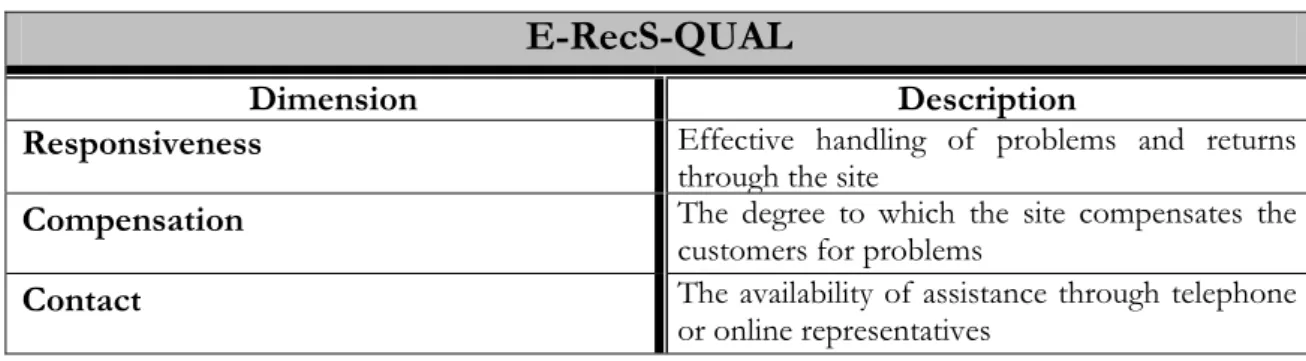
The E-S-QUAL and E-Recs-QUAL’ dimensions and their description are presented in Table 2.4 and Table 2.5below.
Table 2.4 E-S-QUAL dimensions and their description
E-S-QUAL scale
Dimension Description
Efficiency The ease and speed of accessing and using the website
Fulfillment The extent to which the site’s promises about
order delivery and item availability are fulfilled
System Availability The correct technical functioning of the site
Privacy The degree to which the site is safe and protects
customer information
Source: Parasuraman, A., Zeithaml, V. and Malhotra A. (2005), “E-S-QUAL: A Multiple-Item Scale for Assessing Electronic Service Quality”, p. 220.
Table 2.5 E-RecS-QUAL dimensions and their description
E-RecS-QUAL
Dimension Description
Responsiveness Effective handling of problems and returns through the site
Compensation The degree to which the site compensates the
customers for problems
Contact The availability of assistance through telephone
or online representatives
Source: Parasuraman, A., Zeithaml, V. and Malhotra A. (2005), “E-S-QUAL: A Multiple-Item Scale for Assessing Electronic Service Quality”, p. 220.
2.6 Summary of the Theoretical Framework
subject of the underlying study. Presenting theoretical background on both E-services and traditional services has been done with the intention for the reader to understand the importance of measuring service quality, how it has developed in time and how it is changing because of the increased use of online services, where the conditions and characteristics of the service itself change. Finally, the authors have presented to the reader the E-SQ instrument for measuring online services, based on which the rest of the thesis will be developed.
In order to develop an instrument for measuring the quality of online banking services, the
authors of the thesis would like to use as a basis the E-SQ (E-S-QUAL and E-Recs-QUAL) instrument created by Zeithaml, Parasuraman and Malhotra in 2002 for
measuring quality of online services.
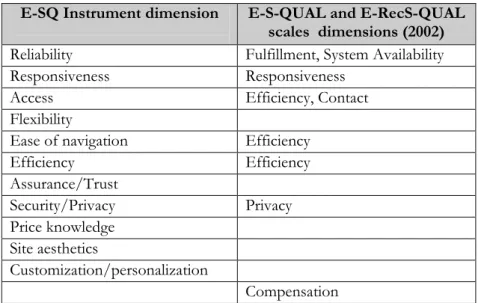
However, the authors of the thesis find the modified E-S-QUAL and E-Recs-QUAL scales not completely covering all the issues for measuring quality of online banking services. That is why a modified version of these scales will be used in the underlying study. In Table 2.6 below, the authors make comparison (according to the presented above definitions of the different quality dimensions) between the dimensions of the scale from 2000 and those from 2002. The aim of this is to show which dimensions from the research in 2000 are covered in the final version of the scales from 2002 and which are not. Through support from other studies, the authors of the thesis would like to show the importance of some of the dimensions from the research in 2000 which are not present in the scales from 2002. The authors have decided to add some of these dimensions to the dimensions of the E-S-QUAL scale in order for a better picture of the service delivery process to be captured.
Table 2.6 Comparison of E-SQ (2000) versus E-S-QUAL and E-RecS-QUAL (2002) dimensions
E-SQ Instrument dimension E-S-QUAL and E-RecS-QUAL
scales dimensions (2002)
Reliability Fulfillment, System Availability
Responsiveness Responsiveness
Access Efficiency, Contact
Flexibility
Ease of navigation Efficiency
Efficiency Efficiency
Assurance/Trust
Security/Privacy Privacy
Price knowledge Site aesthetics
Customization/personalization
Compensation
From Table 2.6 above it can be seen that more than half of the dimensions from 2000 are covered in the modified version of the instrument from 2002. Still, there are some dimensions which have not been included and which the authors of the thesis deem important for the evaluation of the quality of online banking services.
e-services quality (Madu & Madu, 2002; Jun, Yang & Kim, 2004; Cox & Dale, 2001; Jayawardhena, 2004; Jun & Cai, 2001).
In addition, the studies on online systems quality (Appendix II) and those on online service quality show that site aesthetics (appearance) is considered important for evaluating the quality of a website and the service delivered through that website (Doll & Torkzadeh, 1988; D’Angelo & Little, 1998; Liu & Arnett, 2000; Jayarwardhena & Foley, 2000; Jun & Cai, 2001; Yang, 2001; Abels et Al., 1999; and Santos, 2003). For that reason, the authors
of the thesis will include the site aesthetics dimension into their study. Both, the assurance/trust and site aesthetics dimensions have been added to the E-S-QUAL scale’s
dimensions.
Finally, as measurement on the compensation dimension of online services quality requires the customers’ experiences of problems with the given service and complaining about that. As this implies difficulty in evaluating this dimension because of the lack of enough people encountering problems (Parasuraman et Al., 2005), the compensation dimension of the E-RecS-QUAL scale has been dropped from this study.
Conclusively, the authors of this thesis have used adapted and slightly modified versions of the E-S-QUAL and E-RecS-QUAL scales developed by Parasuraman et Al. in 2002 in order to help them develop an instrument for measuring the quality of online banking services. The authors have added the assurance/trust and site aesthetics dimensions from the e-SQ instrument from 2000 to the E-S-QUAL scale and they have dropped the compensation dimension from the E-RecS-QUAL scale. All the dimensions included in the underlying study have been described and used based on the researches of Parasuraman, Zeithaml and Malhotra from both, 2000 and 2002. As a result of the slight changes made, the authors constructed the following model for measuring the quality of online banking services.
Figure 2.4 Model for measuring the quality of online banking services (adapted from Parasuraman et Al., 2000 and 2002.
System Availability
Fulfillment
Privacy
Assurance/Trust
Site Aesthetics
Contact Responsiveness
E-S-QUAL Scale
E-RecS-QUAL Scale
Perceived E-Service
3
Methodology
The following chapter on Methodology describes different research methods and gives
explanation of the chosen method of this study and the reasons for this choice. Furthermore,
this chapter describes the chosen sampling technique, the way the data for the study has been
collected and the statistical techniques used to analyze the data. In addition, the issue of the
reliability and validity of the presented study is discussed.
Figure 3.1 Schematic Presentation of the Methodology. Source: Foster (1998, p. 81), adapted
3.1 Research Approach
For the underlying study the authors of the thesis have chosen quantitative approach for achieving the purpose of the study.
3.1.1 Quantitative and Qualitative Research Methods
The research strategy should be chosen according to the research questions in the particular situation (Yin, 1994). Each strategy has its own advantages and disadvantages, because of its specific approach to collect and analyze empirical data. According to Yin (1994) the type of question posed; the degree of focus on historical or contemporary events and the control over actual behavioral elements should be the main grounds on which the appropriate research method is chosen.
Qualitative research requires strong contact with real situation, which is usually reflecting the everyday life of individuals, societies, groups or organizations (Miles & Huberman, 1994). According to Amaratunga, Baldry, Sarshar & Newton (2002), this type of research has few favourable features: this type of studies allows revealing of what the “real life” is by studying events occurring in natural settings; the information gathered through qualitative research is complete and rich and has potential to reveal complexity and finally this type of studies are quite flexible in nature. Furthermore, qualitative approach is found appropriate for discovery, exploring a new area, developing hypotheses and qualitative data are useful when “one needs to supplement, validate, explain, illuminate or reinterpret quantitative data gathered from the same setting” (Amaratunga et Al., 2002, p.22).
Research Approach
Sample Selection
Data Collection
Data Analysis
Quantitative research approach is based on the development of testable hypotheses and theory which can be generalized across settings. Quantitative investigations tend to measure “how often” or “how much”. This approach allows generalization of conclusions and flexibility in the treatment of data, in terms of comparative analysis, statistical analyses and repeatability of data collection in order to verify reliability (Amaratunga et Al., 2002). Taking into consideration the description of the quantitative research approach stated above, which is used to measure “how much” across settings and allows for statistical analysis on the collected data, the authors of the thesis have chosen this method for the purpose of this thesis. First of all, through the use of quantitative research method, the authors would like to measure “how much” customers of online banking services are satisfied with the provided online services. Furthermore, this method will allow statistical analysis of the collected data, on the basis of which an instrument for measuring quality of online banking services will be developed. To collect the quantitative data the survey method has been used and eventually the data has been analyzed by using statistical techniques. The combination of the quantitative method with the survey method is found appropriate from the authors, as a large population has been studied and general conclusions have been drawn for the entire population.
3.2 Sample Selection
According to the figures presented by the Statistical Central Bureau (SCB) in Sweden (Appendix I), during the first quarter of 2005 48% of the people aged between 16 and 24 and 74% of the people aged between 25 and 34 have used Internet Banking. Because of the relatively high proportion of the population in the age ranges mentioned above that use Internet Banking services, the authors of the thesis decided to focus the investigation on this section of the population.
As the authors of the thesis have focused the investigation on people aged between 16 and 34, people attending the University area and other random areas in Jönköping were selected as the sampling populations of this study. The University area in Jönköping was selected as there were expected to be found mainly people in the age between 19 and 25. In order for the sample concentration around 21 and 22 to be avoided, the authors of the thesis decided to distribute part of the questionnaires in other random areas in Jönköping where people aged between 25 and 34 were expected to be found. The sample technique used by the authors is random sampling, which means that “every member of the target population has an equal chance of being selected” (Oakshott, 1998, p.41). This sampling method was also chosen in order to avoid the occurrence of bias in the chosen sample population.
3.3 Data Collection
For the purpose of the thesis, the authors have decided to collect primary and secondary data. Primary data include data through a survey with customers of online banking services aged below 34. For that purpose a questionnaire has been designed. Secondary data include data from academic literature, books, journals, reports and Internet sources.
through the comparison between expectations and perceptions of customers for a given service over a number of quality attributes.
Although perceptions-only measures have been shown to demonstrate better predictive validity than expectation measures (Cronin & Taylor, 1992), the perception-expectation measures do seem to yield data about the quality of given service which is richer and more informative (Schneider & White, 2004). Despite its benefits, survey including the measurement of expectations and perceptions individually is too complicated, time-consuming and tedious. Taking into consideration the time- and resource- limits of
this study, the authors have decided to measure directly the divergence between customers’ expectations and perceptions using only one scale. Using this approach makes the questionnaire much easier to construct, administrate and analyze. In addition, it is thought to be easier for the customers to respond to such questionnaire including only one scale. When constructing the questionnaire, the authors of the thesis have used a slightly modified version of the E-SQ instrument (E-S-QUAL and E-RecS-QUAL) for measuring e-service quality (E-SQ), developed by Parasuraman et Al. in 2002. The authors have added the assurance/trust and site aesthetics dimensions from the e-SQ instrument from 2000 to the E-S-QUAL scale and they have dropped the compensation dimension from the E-RecS-QUAL scale. All the dimensions and their attributes included in the questionnaire have been described and used based on the researches of Parasuraman, Zeithaml and Malhotra from both, 2000 and 2002.
As mentioned above the questionnaire is designed to measure the divergence between the expectations and perceptions (perceived quality) of customers of the online banking services they use along the quality dimensions found in the E-SQ instrument developed by Parasuraman et Al. in 2002. This is expected to help the authors evaluate the overall satisfaction of customers with the online banking services they use and to give an insight into the important quality dimensions that can be used to measure quality of online banking services in general. For this purpose, the authors have used the seven-point Likert Scale, ranging from “1=”Very dissatisfied” to “7=Very satisfied”.
Before the questionnaire was distributed, it went through a thorough pre-testing. The pre-test included two steps. During the first step, the preliminary version of the questionnaire was tested on five students at Jönköping International Business School, who have been using online banking services for a long time and have experience as users of such services. During this first step, the questionnaire was modified, including the use of only one scale and some paraphrasing of words. In the second step, the modified questionnaire was given for inspection to the authors’ supervisor and few more slightly changes have been made, including paraphrasing of two of the questions. Finally, the questions included in the questionnaire do not follow the same order as the underlying model, but have been grouped differently so that the different quality dimensions and their attributes are measured throughout the whole questionnaire. For full description of the questions pertaining to each quality dimension and their number in the questionnaire please refer to Appendix III